Probability
Basic Probability Concepts
• Probability – the chance that an uncertain event will occur
(always between 0 and 1)
• A numerical value expressing the degree of uncertainty regarding
the occurrence of an event. A measure of uncertainty.
• CLASSICAL INTERPRETATION
If a random experiment is repeated an infinite number of times, the
relative frequency for any given outcome is the probability of this
outcome.
Probability of an event: Relative frequency of the occurrence of
the event in the long run.
• Example: Probability of observing a head in a fair coin toss is 0.5 (if coin is
tossed long enough).
3
PROBABILITY
• SUBJECTIVE INTERPRETATION
The assignment of probabilities to event of interest is subjective
• Example: I am guessing there is 50% chance of rain today.
• Random experiment
• a random experiment is a process or course of action, whose outcome is
uncertain.
• Examples
Experiment Outcomes
• Flip a coin Heads and Tails
• Record a statistics test marks Numbers between 0 and 100
• Impossible Event – an event that has no chance of occurring (probability = 0)
• Certain Event – an event that is sure to occur (probability = 1)
Types of Events
Simple Event: An event that consists of a single outcome (e.g., getting a 3 when rolling a die).
Compound Event: An event consisting of two or more simple events (e.g., getting an even
number when rolling a die).
Mutually Exclusive Events: Two events that cannot occur at the same time (e.g., rolling a 3
and rolling a 4).
Independent Events: Two events where the occurrence of one does not affect the occurrence
of the other (e.g., flipping a coin and rolling a die).
Dependent Events: Two events where the occurrence of one affects the occurrence of the
other (e.g., drawing cards without replacement).
Types of Events
• Joint event
• An event described by two or more characteristics
• e.g. A day in January that is also a Wednesday from all days in 2015
• Complement of an event A (denoted A’)
• All events that are not part of event A
• e.g., All days from 2015 that are not in January
• Disjoint Event
• Two events that cannot both occur at the same time
• E.g. getting both head and tail on the same toss of a coin
6
• Performing the same random experiment repeatedly, may
result in different outcomes, therefore, the best we can do is
consider the probability of occurrence of a certain outcome.
• To determine the probabilities, first we need to define and
list the possible outcomes
PROBABILITY
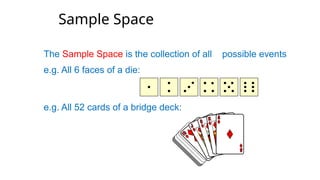
The Sample Space is the collection of all possible events
e.g. All 6 faces of a die:
e.g. All 52 cards of a bridge deck:
Sample Space
Sample Space
•Multiple sample spaces for the same
experiment are possible
•E.g. with 5 coin tosses we can take:
S={HHHHH, HHHHT, …} or if we are only
interested in the number of heads we can
take
S*={0,1,2,3,4,5}
8
9
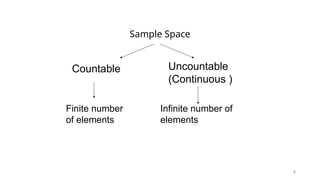
Sample Space
Countable Uncountable
(Continuous )
Finite number
of elements
Infinite number of
elements
10
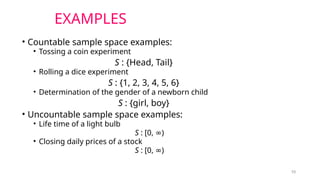
EXAMPLES
• Countable sample space examples:
• Tossing a coin experiment
S : {Head, Tail}
• Rolling a dice experiment
S : {1, 2, 3, 4, 5, 6}
• Determination of the gender of a newborn child
S : {girl, boy}
• Uncountable sample space examples:
• Life time of a light bulb
S : [0, )
∞
• Closing daily prices of a stock
S : [0, )
∞
11
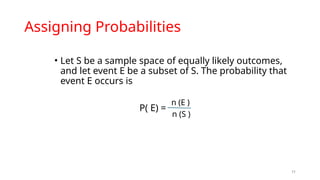
Assigning Probabilities
• Let S be a sample space of equally likely outcomes,
and let event E be a subset of S. The probability that
event E occurs is
P( E) =
n (E )
n (S )
12
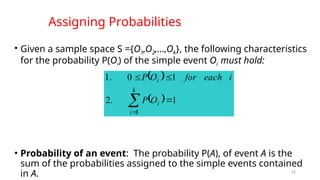
• Given a sample space S ={O1,O2,…,Ok}, the following characteristics
for the probability P(Oi) of the simple event Oi must hold:
• Probability of an event: The probability P(A), of event A is the
sum of the probabilities assigned to the simple events contained
in A.
 
 





k
i
i
i
O
P
i
each
for
O
P
1
1
.
2
1
0
.
1
Assigning Probabilities
Example
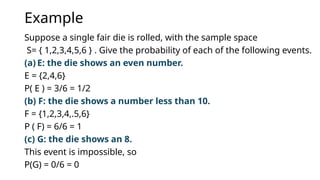
Suppose a single fair die is rolled, with the sample space
S= { 1,2,3,4,5,6 } . Give the probability of each of the following events.
(a) E: the die shows an even number.
E = {2,4,6}
P( E ) = 3/6 = 1/2
(b) F: the die shows a number less than 10.
F = {1,2,3,4,.5,6}
P ( F) = 6/6 = 1
(c) G: the die shows an 8.
This event is impossible, so
P(G) = 0/6 = 0
Example
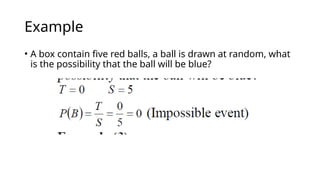
• A box contain five red balls, a ball is drawn at random, what
is the possibility that the ball will be blue?
Example
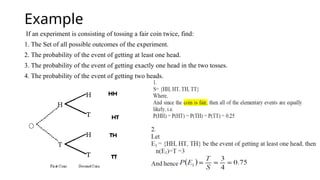
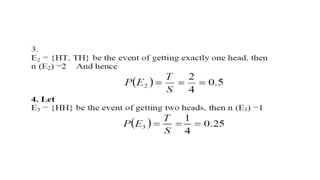
If an experiment is consisting of tossing a fair coin twice, find:
1. The Set of all possible outcomes of the experiment.
2. The probability of the event of getting at least one head.
3. The probability of the event of getting exactly one head in the two tosses.
4. The probability of the event of getting two heads.
Examples
• If the experiment is consisting of rolling a fair die once, find:
1. Set of all possible outcomes of the experiment.
2. The probability of the event of getting an even number.
3. The probability of the event of getting an odd number.
4. The probability of the event of getting a four or five.
5. The probability of the event of getting a number less than 5.
Algebraic laws
• Commutative: A B = B A
∪ ∪
A B = B A
∩ ∩
• Associative: (A B) C = A (B C)
∪ ∪ ∪ ∪
A (B C) = (A B) C
∩ ∩ ∩ ∩
• Distributive: A (B C) = (A B) (A C)
∪ ∩ ∪ ∩ ∪
A (B C) = (A B) (A C)
∩ ∪ ∩ ∪ ∩
• De Morgan’s: (A B)' = A' B' (' is complement)
∪ ∩
(A B)' = A' B'
∩ ∪
18
19
Intersection
•The intersection of event A and B is the event
that occurs when both A and B occur.
•The intersection of events A and B is denoted by
(A and B) or AB.
•The joint probability of A and B is the probability
of the intersection of A and B, which is denoted
by P(A and B) or P(AB).
20
Union
•The union event of A and B is the event that
occurs when either A or B or both occur.
•At least one of the events occur.
•It is denoted “A or B” OR AB
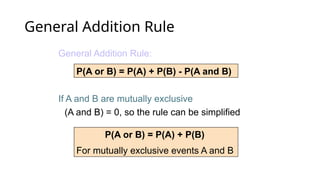
General Addition Rule
P(A or B) = P(A) + P(B) - P(A and B)
General Addition Rule:
If A and B are mutually exclusive, then
P(A and B) = 0, so the rule can be simplified:
P(A or B) = P(A) + P(B)
For mutually exclusive events A and B
22
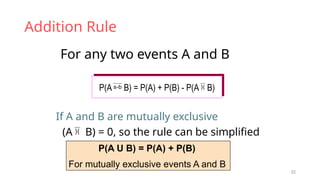
For any two events A and B
P(A  B) = P(A) + P(B) - P(A  B)
Addition Rule
If A and B are mutually exclusive, then
P(A  B) = 0, so the rule can be simplified:
P(A U B) = P(A) + P(B)
For mutually exclusive events A and B
Example
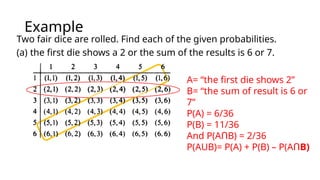
Two fair dice are rolled. Find each of the given probabilities.
(a) the first die shows a 2 or the sum of the results is 6 or 7.
A= “the first die shows 2”
B= “the sum of result is 6 or
7”
P(A) = 6/36
P(B) = 11/36
And P(A B) = 2/36
Ո
P(AUB)= P(A) + P(B) – P(AՈB)
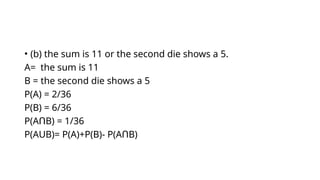
• (b) the sum is 11 or the second die shows a 5.
A= the sum is 11
B = the second die shows a 5
P(A) = 2/36
P(B) = 6/36
P(A B) = 1/36
Ո
P(AUB)= P(A)+P(B)- P(A B)
Ո
• The probabilities of the events A and B are 0.20 and 0.25, respectively.
The probability that both A and B occur is 0.10.What is the probability
of either A or B occurring.
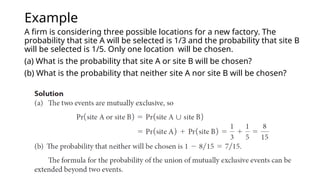
Example
A firm is considering three possible locations for a new factory. The
probability that site A will be selected is 1/3 and the probability that site B
will be selected is 1/5. Only one location will be chosen.
(a) What is the probability that site A or site B will be chosen?
(b) What is the probability that neither site A nor site B will be chosen?
27
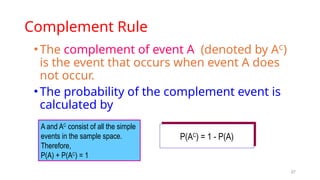
Complement Rule
•The complement of event A (denoted by AC
)
is the event that occurs when event A does
not occur.
•The probability of the complement event is
calculated by
P(AC
) = 1 - P(A)
A and AC
consist of all the simple
events in the sample space.
Therefore,
P(A) + P(AC
) = 1
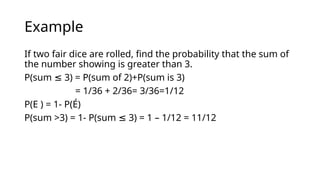
Example
If two fair dice are rolled, find the probability that the sum of
the number showing is greater than 3.
P(sum 3) = P(sum of 2)+P(sum is 3)
≤
= 1/36 + 2/36= 3/36=1/12
P(E ) = 1- P(É)
P(sum >3) = 1- P(sum 3) = 1 – 1/12 = 11/12
≤
29
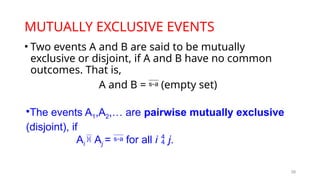
MUTUALLY EXCLUSIVE EVENTS
• Two events A and B are said to be mutually
exclusive or disjoint, if A and B have no common
outcomes. That is,
A and B =  (empty set)
•The events A1,A2,… are pairwise mutually exclusive
(disjoint), if
Ai  Aj =  for all i  j.
30
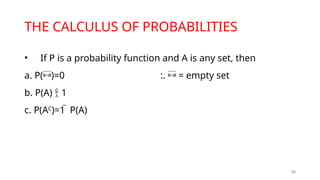
THE CALCULUS OF PROBABILITIES
• If P is a probability function and A is any set, then
a. P()=0 :.  = empty set
b. P(A)  1
c. P(AC
)=1  P(A)
31
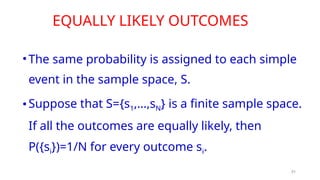
EQUALLY LIKELY OUTCOMES
•The same probability is assigned to each simple
event in the sample space, S.
•Suppose that S={s1,…,sN} is a finite sample space.
If all the outcomes are equally likely, then
P({si})=1/N for every outcome si.
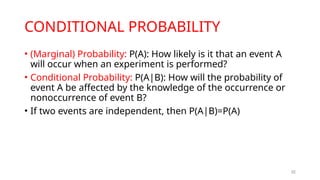
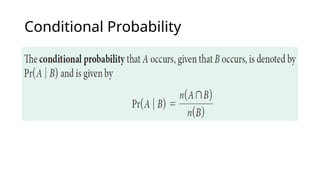
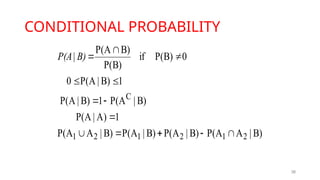
CONDITIONAL PROBABILITY
• (Marginal) Probability: P(A): How likely is it that an event A
will occur when an experiment is performed?
• Conditional Probability: P(A|B): How will the probability of
event A be affected by the knowledge of the occurrence or
nonoccurrence of event B?
• If two events are independent, then P(A|B)=P(A)
32
Conditional Probability
Example
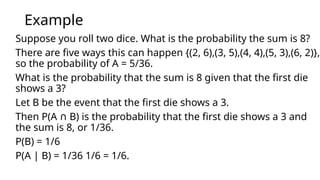
Suppose you roll two dice. What is the probability the sum is 8?
There are five ways this can happen {(2, 6),(3, 5),(4, 4),(5, 3),(6, 2)},
so the probability of A = 5/36.
What is the probability that the sum is 8 given that the first die
shows a 3?
Let B be the event that the first die shows a 3.
Then P(A B) is the probability that the first die shows a 3 and
∩
the sum is 8, or 1/36.
P(B) = 1/6
P(A | B) = 1/36 1/6 = 1/6.
Replacement vs. Without
Replacement
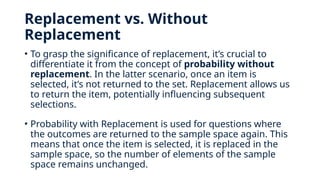
• To grasp the significance of replacement, it’s crucial to
differentiate it from the concept of probability without
replacement. In the latter scenario, once an item is
selected, it’s not returned to the set. Replacement allows us
to return the item, potentially influencing subsequent
selections.
• Probability with Replacement is used for questions where
the outcomes are returned to the sample space again. This
means that once the item is selected, it is replaced in the
sample space, so the number of elements of the sample
space remains unchanged.
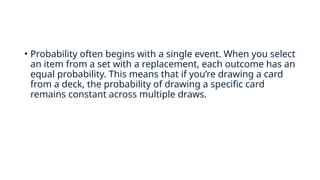
• Probability often begins with a single event. When you select
an item from a set with a replacement, each outcome has an
equal probability. This means that if you’re drawing a card
from a deck, the probability of drawing a specific card
remains constant across multiple draws.
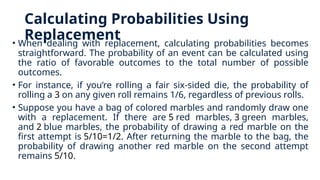
Calculating Probabilities Using
Replacement
• When dealing with replacement, calculating probabilities becomes
straightforward. The probability of an event can be calculated using
the ratio of favorable outcomes to the total number of possible
outcomes.
• For instance, if you’re rolling a fair six-sided die, the probability of
rolling a 3 on any given roll remains 1/6, regardless of previous rolls.
• Suppose you have a bag of colored marbles and randomly draw one
with a replacement. If there are 5 red marbles, 3 green marbles,
and 2 blue marbles, the probability of drawing a red marble on the
first attempt is 5/10=1/2. After returning the marble to the bag, the
probability of drawing another red marble on the second attempt
remains 5/10.
CONDITIONAL PROBABILITY
38
)
B
|
A
A
(
P
)
B
|
A
(
P
)
B
|
A
(
P
)
B
|
A
A
(
P
1
)
A
|
A
(
P
)
B
|
A
(
P
1
)
B
|
A
(
P
1
)
B
|
A
(
P
0
0
)
B
(
P
if
)
B
(
P
)
B
A
(
P
2
1
2
1
2
1
C













B)
|
P(A
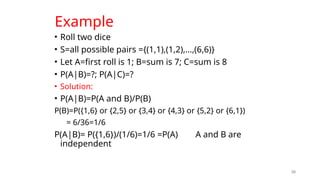
Example
• Roll two dice
• S=all possible pairs ={(1,1),(1,2),…,(6,6)}
• Let A=first roll is 1; B=sum is 7; C=sum is 8
• P(A|B)=?; P(A|C)=?
• Solution:
• P(A|B)=P(A and B)/P(B)
P(B)=P({1,6} or {2,5} or {3,4} or {4,3} or {5,2} or {6,1})
= 6/36=1/6
P(A|B)= P({1,6})/(1/6)=1/6 =P(A) A and B are
independent
39
Probability and statistics undergraduate .pptx

Probability and statistics undergraduate .pptx

  • 1.
  • 2.
    Basic Probability Concepts •Probability – the chance that an uncertain event will occur (always between 0 and 1) • A numerical value expressing the degree of uncertainty regarding the occurrence of an event. A measure of uncertainty. • CLASSICAL INTERPRETATION If a random experiment is repeated an infinite number of times, the relative frequency for any given outcome is the probability of this outcome. Probability of an event: Relative frequency of the occurrence of the event in the long run. • Example: Probability of observing a head in a fair coin toss is 0.5 (if coin is tossed long enough).
  • 3.
    3 PROBABILITY • SUBJECTIVE INTERPRETATION Theassignment of probabilities to event of interest is subjective • Example: I am guessing there is 50% chance of rain today. • Random experiment • a random experiment is a process or course of action, whose outcome is uncertain. • Examples Experiment Outcomes • Flip a coin Heads and Tails • Record a statistics test marks Numbers between 0 and 100 • Impossible Event – an event that has no chance of occurring (probability = 0) • Certain Event – an event that is sure to occur (probability = 1)
  • 4.
    Types of Events SimpleEvent: An event that consists of a single outcome (e.g., getting a 3 when rolling a die). Compound Event: An event consisting of two or more simple events (e.g., getting an even number when rolling a die). Mutually Exclusive Events: Two events that cannot occur at the same time (e.g., rolling a 3 and rolling a 4). Independent Events: Two events where the occurrence of one does not affect the occurrence of the other (e.g., flipping a coin and rolling a die). Dependent Events: Two events where the occurrence of one affects the occurrence of the other (e.g., drawing cards without replacement).
  • 5.
    Types of Events •Joint event • An event described by two or more characteristics • e.g. A day in January that is also a Wednesday from all days in 2015 • Complement of an event A (denoted A’) • All events that are not part of event A • e.g., All days from 2015 that are not in January • Disjoint Event • Two events that cannot both occur at the same time • E.g. getting both head and tail on the same toss of a coin
  • 6.
    6 • Performing thesame random experiment repeatedly, may result in different outcomes, therefore, the best we can do is consider the probability of occurrence of a certain outcome. • To determine the probabilities, first we need to define and list the possible outcomes PROBABILITY
  • 7.
    The Sample Spaceis the collection of all possible events e.g. All 6 faces of a die: e.g. All 52 cards of a bridge deck: Sample Space
  • 8.
    Sample Space •Multiple samplespaces for the same experiment are possible •E.g. with 5 coin tosses we can take: S={HHHHH, HHHHT, …} or if we are only interested in the number of heads we can take S*={0,1,2,3,4,5} 8
  • 9.
    9 Sample Space Countable Uncountable (Continuous) Finite number of elements Infinite number of elements
  • 10.
    10 EXAMPLES • Countable samplespace examples: • Tossing a coin experiment S : {Head, Tail} • Rolling a dice experiment S : {1, 2, 3, 4, 5, 6} • Determination of the gender of a newborn child S : {girl, boy} • Uncountable sample space examples: • Life time of a light bulb S : [0, ) ∞ • Closing daily prices of a stock S : [0, ) ∞
  • 11.
    11 Assigning Probabilities • LetS be a sample space of equally likely outcomes, and let event E be a subset of S. The probability that event E occurs is P( E) = n (E ) n (S )
  • 12.
    12 • Given asample space S ={O1,O2,…,Ok}, the following characteristics for the probability P(Oi) of the simple event Oi must hold: • Probability of an event: The probability P(A), of event A is the sum of the probabilities assigned to the simple events contained in A.          k i i i O P i each for O P 1 1 . 2 1 0 . 1 Assigning Probabilities
  • 13.
    Example Suppose a singlefair die is rolled, with the sample space S= { 1,2,3,4,5,6 } . Give the probability of each of the following events. (a) E: the die shows an even number. E = {2,4,6} P( E ) = 3/6 = 1/2 (b) F: the die shows a number less than 10. F = {1,2,3,4,.5,6} P ( F) = 6/6 = 1 (c) G: the die shows an 8. This event is impossible, so P(G) = 0/6 = 0
  • 14.
    Example • A boxcontain five red balls, a ball is drawn at random, what is the possibility that the ball will be blue?
  • 15.
    Example If an experimentis consisting of tossing a fair coin twice, find: 1. The Set of all possible outcomes of the experiment. 2. The probability of the event of getting at least one head. 3. The probability of the event of getting exactly one head in the two tosses. 4. The probability of the event of getting two heads.
  • 17.
    Examples • If theexperiment is consisting of rolling a fair die once, find: 1. Set of all possible outcomes of the experiment. 2. The probability of the event of getting an even number. 3. The probability of the event of getting an odd number. 4. The probability of the event of getting a four or five. 5. The probability of the event of getting a number less than 5.
  • 18.
    Algebraic laws • Commutative:A B = B A ∪ ∪ A B = B A ∩ ∩ • Associative: (A B) C = A (B C) ∪ ∪ ∪ ∪ A (B C) = (A B) C ∩ ∩ ∩ ∩ • Distributive: A (B C) = (A B) (A C) ∪ ∩ ∪ ∩ ∪ A (B C) = (A B) (A C) ∩ ∪ ∩ ∪ ∩ • De Morgan’s: (A B)' = A' B' (' is complement) ∪ ∩ (A B)' = A' B' ∩ ∪ 18
  • 19.
    19 Intersection •The intersection ofevent A and B is the event that occurs when both A and B occur. •The intersection of events A and B is denoted by (A and B) or AB. •The joint probability of A and B is the probability of the intersection of A and B, which is denoted by P(A and B) or P(AB).
  • 20.
    20 Union •The union eventof A and B is the event that occurs when either A or B or both occur. •At least one of the events occur. •It is denoted “A or B” OR AB
  • 21.
    General Addition Rule P(Aor B) = P(A) + P(B) - P(A and B) General Addition Rule: If A and B are mutually exclusive, then P(A and B) = 0, so the rule can be simplified: P(A or B) = P(A) + P(B) For mutually exclusive events A and B
  • 22.
    22 For any twoevents A and B P(A  B) = P(A) + P(B) - P(A  B) Addition Rule If A and B are mutually exclusive, then P(A  B) = 0, so the rule can be simplified: P(A U B) = P(A) + P(B) For mutually exclusive events A and B
  • 23.
    Example Two fair diceare rolled. Find each of the given probabilities. (a) the first die shows a 2 or the sum of the results is 6 or 7. A= “the first die shows 2” B= “the sum of result is 6 or 7” P(A) = 6/36 P(B) = 11/36 And P(A B) = 2/36 Ո P(AUB)= P(A) + P(B) – P(AՈB)
  • 24.
    • (b) thesum is 11 or the second die shows a 5. A= the sum is 11 B = the second die shows a 5 P(A) = 2/36 P(B) = 6/36 P(A B) = 1/36 Ո P(AUB)= P(A)+P(B)- P(A B) Ո
  • 25.
    • The probabilitiesof the events A and B are 0.20 and 0.25, respectively. The probability that both A and B occur is 0.10.What is the probability of either A or B occurring.
  • 26.
    Example A firm isconsidering three possible locations for a new factory. The probability that site A will be selected is 1/3 and the probability that site B will be selected is 1/5. Only one location will be chosen. (a) What is the probability that site A or site B will be chosen? (b) What is the probability that neither site A nor site B will be chosen?
  • 27.
    27 Complement Rule •The complementof event A (denoted by AC ) is the event that occurs when event A does not occur. •The probability of the complement event is calculated by P(AC ) = 1 - P(A) A and AC consist of all the simple events in the sample space. Therefore, P(A) + P(AC ) = 1
  • 28.
    Example If two fairdice are rolled, find the probability that the sum of the number showing is greater than 3. P(sum 3) = P(sum of 2)+P(sum is 3) ≤ = 1/36 + 2/36= 3/36=1/12 P(E ) = 1- P(É) P(sum >3) = 1- P(sum 3) = 1 – 1/12 = 11/12 ≤
  • 29.
    29 MUTUALLY EXCLUSIVE EVENTS •Two events A and B are said to be mutually exclusive or disjoint, if A and B have no common outcomes. That is, A and B =  (empty set) •The events A1,A2,… are pairwise mutually exclusive (disjoint), if Ai  Aj =  for all i  j.
  • 30.
    30 THE CALCULUS OFPROBABILITIES • If P is a probability function and A is any set, then a. P()=0 :.  = empty set b. P(A)  1 c. P(AC )=1  P(A)
  • 31.
    31 EQUALLY LIKELY OUTCOMES •Thesame probability is assigned to each simple event in the sample space, S. •Suppose that S={s1,…,sN} is a finite sample space. If all the outcomes are equally likely, then P({si})=1/N for every outcome si.
  • 32.
    CONDITIONAL PROBABILITY • (Marginal)Probability: P(A): How likely is it that an event A will occur when an experiment is performed? • Conditional Probability: P(A|B): How will the probability of event A be affected by the knowledge of the occurrence or nonoccurrence of event B? • If two events are independent, then P(A|B)=P(A) 32
  • 33.
  • 34.
    Example Suppose you rolltwo dice. What is the probability the sum is 8? There are five ways this can happen {(2, 6),(3, 5),(4, 4),(5, 3),(6, 2)}, so the probability of A = 5/36. What is the probability that the sum is 8 given that the first die shows a 3? Let B be the event that the first die shows a 3. Then P(A B) is the probability that the first die shows a 3 and ∩ the sum is 8, or 1/36. P(B) = 1/6 P(A | B) = 1/36 1/6 = 1/6.
  • 35.
    Replacement vs. Without Replacement •To grasp the significance of replacement, it’s crucial to differentiate it from the concept of probability without replacement. In the latter scenario, once an item is selected, it’s not returned to the set. Replacement allows us to return the item, potentially influencing subsequent selections. • Probability with Replacement is used for questions where the outcomes are returned to the sample space again. This means that once the item is selected, it is replaced in the sample space, so the number of elements of the sample space remains unchanged.
  • 36.
    • Probability oftenbegins with a single event. When you select an item from a set with a replacement, each outcome has an equal probability. This means that if you’re drawing a card from a deck, the probability of drawing a specific card remains constant across multiple draws.
  • 37.
    Calculating Probabilities Using Replacement •When dealing with replacement, calculating probabilities becomes straightforward. The probability of an event can be calculated using the ratio of favorable outcomes to the total number of possible outcomes. • For instance, if you’re rolling a fair six-sided die, the probability of rolling a 3 on any given roll remains 1/6, regardless of previous rolls. • Suppose you have a bag of colored marbles and randomly draw one with a replacement. If there are 5 red marbles, 3 green marbles, and 2 blue marbles, the probability of drawing a red marble on the first attempt is 5/10=1/2. After returning the marble to the bag, the probability of drawing another red marble on the second attempt remains 5/10.
  • 38.
  • 39.
    Example • Roll twodice • S=all possible pairs ={(1,1),(1,2),…,(6,6)} • Let A=first roll is 1; B=sum is 7; C=sum is 8 • P(A|B)=?; P(A|C)=? • Solution: • P(A|B)=P(A and B)/P(B) P(B)=P({1,6} or {2,5} or {3,4} or {4,3} or {5,2} or {6,1}) = 6/36=1/6 P(A|B)= P({1,6})/(1/6)=1/6 =P(A) A and B are independent 39