by: Sudheer pai 
Page 1 of 11 
PROBABILITY 
INTRODUCTION 
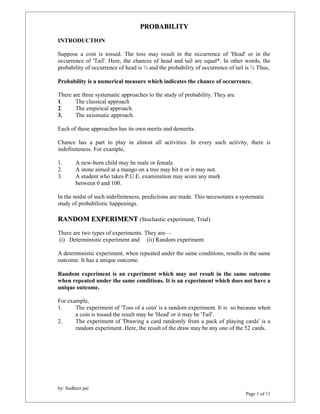
Suppose a coin is tossed. The toss may result in the occurrence of 'Head' or in the 
occurrence of 'Tail'. Here, the chances of head and tail are equal*. In other words, the 
probability of occurrence of head is ½ and the probability of occurrence of tail is ½ Thus, 
Probability is a numerical measure which indicates the chance of occurrence. 
There are three systematic approaches to the study of probability. They are 
1. The classical approach 
2. The empirical approach. 
3. The axiomatic approach. 
Each of these approaches has its own merits and demerits. 
Chance has a part to play in almost all activities. In every such activity, there is 
indefiniteness. For example, 
1. A new-born child may be male or female. 
2. A stone aimed at a mango on a tree may hit it or it may not. 
3. A student who takes P.U.E. examination may score any mark 
between 0 and 100. 
In the midst of such indefiniteness, predictions are made. This necessitates a systematic 
study of probabilistic happenings. 
RANDOM EXPERIMENT (Stochastic experiment, Trial) 
There are two types of experiments. They are— 
(i) Deterministic experiment and (ii) Random experiment. 
A deterministic experiment, when repeated under the same conditions, results in the same 
outcome. It has a unique outcome. 
Random experiment is an experiment which may not result in the same outcome 
when repeated under the same conditions. It is an experiment which does not have a 
unique outcome. 
For example, 
1. The experiment of 'Toss of a coin' is a random experiment. It is so because when 
a coin is tossed the result may be 'Head' or it may be 'Tail'. 
2. The experiment of 'Drawing a card randomly from a pack of playing cards' is a 
random experiment. Here, the result of the draw may be any one of the 52 cards.
SAMPLE SPACE 
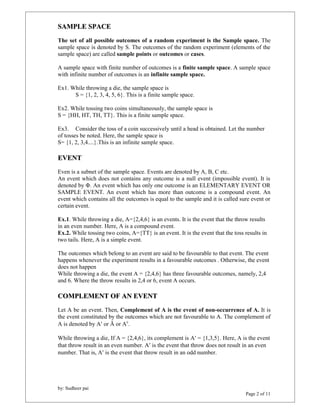
The set of all possible outcomes of a random experiment is the Sample space. The 
sample space is denoted by S. The outcomes of the random experiment (elements of the 
sample space) are called sample points or outcomes or cases. 
A sample space with finite number of outcomes is a finite sample space. A sample space 
with infinite number of outcomes is an infinite sample space. 
by: Sudheer pai 
Page 2 of 11 
Ex1. While throwing a die, the sample space is 
S = {1, 2, 3, 4, 5, 6}. This is a finite sample space. 
Ex2. While tossing two coins simultaneously, the sample space is 
S = {HH, HT, TH, TT}. This is a finite sample space. 
Ex3. Consider the toss of a coin successively until a head is obtained. Let the number 
of tosses be noted. Here, the sample space is 
S= {1, 2, 3,4....}.This is an infinite sample space. 
EVENT 
Even is a subnet of the sample space. Events are denoted by A, B, C etc. 
An event which does not contains any outcome is a null event (impossible event). It is 
denoted by Φ. An event which has only one outcome is an ELEMENTARY EVENT OR 
SAMPLE EVENT. An event which has more than outcome is a compound event. An 
event which contains all the outcomes is equal to the sample and it is called sure event or 
certain event. 
Ex.1. While throwing a die, A={2,4,6} is an events. It is the event that the throw results 
in an even number. Here, A is a compound event. 
Ex.2. While tossing two coins, A={TT} is an event. It is the event that the toss results in 
two tails. Here, A is a simple event. 
The outcomes which belong to an event are said to be favourable to that event. The event 
happens whenever the experiment results in a favourable outcomes . Otherwise, the event 
does not happen 
While throwing a die, the event A = {2,4,6} has three favourable outcomes, namely, 2,4 
and 6. Where the throw results in 2,4 or 6, event A occurs. 
COMPLEMENT OF AN EVENT 
Let A be an event. Then, Complement of A is the event of non-occurrence of A. It is 
the event constituted by the outcomes which are not favourable to A. The complement of 
A is denoted by A or Ā or Ac. 
While throwing a die, If A = {2,4,6}, its complement is A = {1,3,5}. Here, A is the event 
that throw result in an even number. A is the event that throw does not result in an even 
number. That is, A is the event that throw result in an odd number.
SUB-EVENT. 
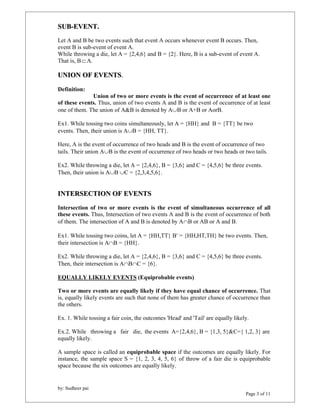
Let A and B be two events such that event A occurs whenever event B occurs. Then, 
event B is sub-event of event A. 
While throwing a die, let A = {2,4,6} and B = {2}. Here, B is a sub-event of event A. 
That is, B  A. 
UNION OF EVENTS. 
Definition: 
of these events. Thus, union of two events A and B is the event of occurrence of at least 
one of them. The union of A&B is denoted by AB or A+B or AorB. 
Ex1. While tossing two coins simultaneously, let A = {HH} and B = {TT} be two 
events. Then, their union is AB = {HH, TT}. 
Here, A is the event of occurrence of two heads and B is the event of occurrence of two 
tails. Their union AB is the event of occurrence of two heads or two heads or two tails. 
Ex2. While throwing a die, let A = {2,4,6}, B = {3,6} and C = {4,5,6} be three events. 
Then, their union is AB C = {2,3,4,5,6}. 
INTERSECTION OF EVENTS 
Intersection of two or more events is the event of simultaneous occurrence of all 
these events. Thus, Intersection of two events A and B is the event of occurrence of both 
of them. The intersection of A and B is denoted by AB or AB or A and B. 
Ex1. While tossing two coins, let A = {HH,TT} B = {HH,HT,TH} be two events. Then, 
their intersection is AB = {HH}. 
Ex2. While throwing a die, let A = {2,4,6}, B = {3,6} and C = {4,5,6} be three events. 
Then, their intersection is ABC = {6}. 
EQUALLY LIKELY EVENTS (Equiprobable events) 
Two or more events are equally likely if they have equal chance of occurrence. That 
is, equally likely events are such that none of them has greater chance of occurrence than 
the others. 
Ex. 1. While tossing a fair coin, the outcomes 'Head' and 'Tail' are equally likely. 
Ex.2. While throwing a fair die, the events A={2,4,6}, B = {1,3, 5}&C={ 1,2, 3} are 
equally likely. 
A sample space is called an equiprobable space if the outcomes are equally likely. For 
instance, the sample space S = {1, 2, 3, 4, 5, 6} of throw of a fair die is equiprobable 
space because the six outcomes are equally likely. 
by: Sudheer pai 
Union of two or more events is the event of occurrence of at least one 
Page 3 of 11
MUTUALLY EXCLUSIVE EVENTS (Disjoint events) 
Two or more events are mutually exclusive if only one of them can occur at a time. 
That is, the occurrence of any of these events totally excludes the occurrence of the other 
events. Mutually exclusive events cannot occur together. 
Ex. 1. While tossing a coin, the outcomes 'Head1 and 'Tail' are mutually exclusive 
because when the coin is tossed once, the result cannot be Head as well as Tail. 
Ex.2. While throwing a die, the events A = {2, 4, 6}, B= {3,5} and C = {1} are mutually 
exclusive. 
If A is an event, A and A' are mutually exclusive. It should be noted that intersection 
of mutually exclusive events is a null event. 
EXHAUSTIVE EVENTS (Exhaustive set of events) 
A set of events is exhaustive if one" or the other of the events in the set occurs 
whenever the experiment is conducted. 
That is, the set of events exhausts all the outcomes of the experiment 
The union of exhaustive events is equal to the sample space. 
Ex.1. While throwing a die, the six outcomes together are exhaustive. But here, if any one 
of these outcomes is leftout, the remaining five outcomes are not exhaustive. 
Ex.2. While throwing a die, events A = {2,4, 6},B = {3, 6} and C = {1,5,6} together are 
exhaustive. 
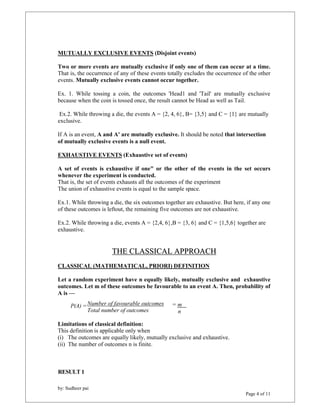
P(A) = = m 
by: Sudheer pai 
Page 4 of 11 
THE CLASSICAL APPROACH 
CLASSICAL (MATHEMATICAL, PRIORI) DEFINITION 
Let a random experiment have n equally likely, mutually exclusive and exhaustive 
outcomes. Let m of these outcomes be favourable to an event A. Then, probability of 
A is — 
Number of favourable outcomes 
Total number of outcomes 
Limitations of classical definition: 
This definition is applicable only when 
(i) The outcomes are equally likely, mutually exclusive and exhaustive. 
(ii) The number of outcomes n is finite. 
RESULT 1 
n
m 
  
n 
n 
by: Sudheer pai 
Page 5 of 11 
P(A) is a value between 0 and 1. That is, 0 < P(A) < 1. 
Proof: 
Let a random experiment have n equally likely, mutually exclusive and exhaustive 
outcomes. Let m of these outcomes be favourable to event A. 
Then,P(A) 
= m 
n 
Here, the least possible value of m is 0. Also, the highest possible value of m is n. 
And so, 0  m  n. 
0 ( ) 1 
0 
  p A 
 
n 
n 
Thus, P(A) is a value between 0 and 1. 
RESULT 2 
P(A') = 1 - P(A). That is, P(A) = 1 - P(A'). 
Proof: 
In a random experiment with n equally likely, mutually exclusive and exhaustive 
outcomes, if m outcomes are favourable to event A, the remaining (n-m) outcomes are 
favourable to the complementary event A'. Therefore, 
Thus, P(A') = 1 - P(A). That is, P(A) = 1 - P(A'). 
Exercise 1: 
a. Find the probability of head in the toss of a fair coin. 
Solution: 
The sample space is 5 = {H,T}. There are n- 2 equally likely, mutually exclusive and 
exhaustive outcomes. One outcome, namely H is favourable to the event 'A : toss results 
in head'. 
Thus, m = 1. 
 P[head] = P(A) = m/n = ½ 
b. Find the probability that a throw of an unbiased die results in 
(i) an ace (number 1) (ii) an even number (iii) a multiple of 3. 
Solution: 
The sample space is S = {1,2,3,4,5,6]. There are n = 6 equally likely, mutually exclusive 
and exhaustive outcomes. Let events A, Band C be— 
A : throw results in an ace (number 1)
B : throw results in an even number 
C: throw results in a multiple of 3 
(i) Event A has one favourable outcome. 
 P[ace] = P(A)= m/n = 1/6 
(ii) Event B has 3 favourable outcomes, namely, 2, 4 and 6. 
 P [even number] = P(B) = m/n = 3/6= ½ 
(iii) Event C has 2 favourable outcomes, namely, 3 and 6 
P [multiple of 3] = P(C)= m/n = 2/6 = 1/3 
c. A bag contains 3 white, 4 red and 2 green balls. One ball is selected at random from the 
bag. Find the probability that the selected ball is 
(i) white (ii) non-white (iii) white or green. 
Solution: 
The bag totally has 9 balls. Since the ball drawn can be any one of them, there are 9 
equally likely, mutually exclusive and exhaustive outcomes. Let events A, B and C be 
A: selected ball is white 
B: selected ball is non-white 
C: selected ball is white or green 
(i) There are 3 white balls in the bag. Therefore, out of the 9 outcomes, 3 are favourable 
to event A. 
P [white ball] = P(A) = 3/9 = 1/3 
(ii) Event B is the complement of event A. Therefore, 
 P(non-white ball] = P(B) = 1 - P(A) = 1 – 1/3 = 2/3 
(iii) There are 3 white and 2 green balls in the bag. Therefore, out of 9 outcomes, 5 are 
either white or green. 
 P[white or green ball] = P(C) = 5/9 
d. One card is drawn from a well-shuffled pack of playing cards. Find the probability 
that the card drawn (i) is a Heart (ii) is a King (iii) belongs to red suit (iv) is a King or a 
Queen (v) is a King or a Heart. 
by: Sudheer pai 
Page 6 of 11 
Solution: 
A pack of playing cards has 52 cards. There are four suits, namely, Spade, Club, Heart 
and Diamond (Dice). In each suit, there are thirteen denominations - Ace (1), 2, 3, 10, 
Jack (Knave), Queen and King. 
A card selected at random may be any one of the 52 cards. Therefore, there are 52 equally 
likely, mutually exclusive and exhaustive outcomes. Let events A, B, C, D and E be — 
A: selected card is a Heart 
B: selected card is a King 
C: selected card belongs to a red suit. 
D: selected card is a King or a Queen 
E: selected card is a King or a Heart 
(i) There are 13 Hearts in a pack. Therefore, 13 outcomes are favourable to event A. 
 P [Heart] = P(A) =13/52 = ¼
(ii) There are 4 Kings in a pack. Therefore, 4 outcomes are favourable to event B. 
 P[King] = P(B)=4/52 =1/13 
(iii)There are 13 Hearts and 13 Diamonds in a pack. Therefore, 26 outcomes are 
favourable to event C. 
 P [Red card] = P(C) =26/52 = ½ 
(iv) There are 4 Kings and 4 Queens in a pack. Therefore, 8 outcomes are favourable to 
event D. 
 P[King or Queen] = P(D) = 8/52 = 2/13 
(v) There are 4 Kings and 13 Hearts in a pack. Among these, one card is Heart-King. 
Therefore, (4+13-1) = 16 outcomes are favourable to event E. 
 P[King or Heart] = P(E) =16/52 = 4/13 
e. The selection can be any one of the eight numbers. Therefore, there are 8 equally 
Hkely, mutually exclusive and exhaustive outcomes. Let events A and B be— 
Solution: 
A bag contains 8 tickets which are marked with the numbers 1,2,3,.. 8. Find the 
probability that a ticket drawn at random from the bag is marked with (i) an even number 
(ii) a multiple of 3. 
by: Sudheer pai 
Page 7 of 11 
A: selected number is even. 
B: selected number is a multiple of 3. 
(i) Four of the selections, namely, 2, 4, 6 and 8 are favourable to event A. 
 P [even number] = P(A) = 4/8 = ½ 
(ii) Two of the selections, namely, 3 and 6 are favourable to event B. 
 P[multiple of 3] = P(B) = 2/8 = ¼ . 
Exercise 2: 
a. A fair coin is tossed twice. Find the probability that the tosses result in (i) two heads 
(ii) at least one head. 
b. Two fair dice are rolled. Find the probability that (i) both the dice show 
number 6 (ii) the sum of numbers obtained is 7 or 10 (iii) the sum of 
the numbers obtained is less than 11 (iv) the sum is divisible by 3.
c. A box has 5 white, 4 red and 3 green balls. Two balls are drawn at random from the 
box. Find the probability that they are (i) of the same colour (ii) of different colours. 
d. Two cards are drawn at random from a pack of cards. Find the probability that (i) 
both are Spades (ii) both are Kings (iii) one is Spade and the other is a Heart (v) the 
cards belong to the same suit (v) the cards belong to different suits. 
e. A bag has 9 tickets marked with numbers 1, 2, 3,……9. Two tickets are drawn at 
random from the bag. Find the probability that both the numbers drawn are (i) even 
(ii) odd. 
Solution: 
a. The sample space is 5 = (HH, HT, TH, TT}, There are four equally likely, mutually 
exclusive and exhaustive outcomes.-Let events A and B be— 
A : the tosses result in 2 heads 
B : the tosses result in at least one head. 
by: Sudheer pai 
Page 8 of 11 
(i) One outcome, HH is favourable to event A. 
P[two heads] = P(A) = ¼ 
(ii) 3 outcomes HH, HT and TH are favourable to event B. 
 P[at least one head] = P(B) = ¾ 
b. The sample space is S= {(1,1), (1, 2), (1,3)…… (1,6) 
(2,1), (2, 2), (2,3) ....(2,6) 
………………………………………….. 
(6,1), {6, 2), (6, 3)….(6,6)} 
There are 6x6 = 36 equally likely, mutually exclusive and exhaustive outcomes. Let 
events A, B, C and D be — 
A : both the dice show number 6 
B : sum of the numbers obtained is 7 or 10 
C: sum of the numbers obtained is less than 11. 
D : sum of the numbers obtained is divisible by 3. 
(i) One outcome, namely, (6, 6) is favourable to event A. 
 P[6 on both the dice] = P(A) = 1/36 
(ii) Nine outcomes, namely, (6,1), (5,2), (4, 3), (3,4), (2,5), (1,6), (6, 4), (5, 5) and (4,6) 
are favourable to event B. 
P[sum is 7 or 10] = 9/36 = ¼ 
(iii) The complement of event C is— 
C': sum is 11 or 12. 
Event C' has three favourable outcomes, namely, (6,5), (5, 6) and (6, 6). 
P[sum is less than 11] = 1 – P[sum is 11 or 12] 
= 1-3/36
by: Sudheer pai 
Page 9 of 11 
= 1-1/12 = 11/12 
(iv) The sum is divisible by 3 if it is 3, 6, 9 or 12. Therefore, the outcomes favourable to 
event D are (2, 1), (1,- 2), (5,1), (4,2), (3,3), (2, 4), (1,5), (6, 3), (5, 4), (4, 5), (3, 6) and 
(6, 6). Thus, 12 outcomes are favourable. 
P[sum is divisible by 3] = 12/36 = 1/3. 
c. The box totally has 12 balls. A random draw of two balls has 12C2 equally likely, 
mutually exclusive and exhaustive outcomes. Let events A and B be— 
A : the balls drawn are of the same colour 
B : the balls drawn are of different colours. 
(i)Events happens when the drawn balls are both white or both red or both green. Out of 
12C2 selections, 5C2 selections are both white,4C2 selections are both red and 3C2 
selections are both green. Thus, 5C2+4C2 + 3C2 outcomes are favourable to event A. 
P[balls of same colour] = 
C  C  C 
2 
12 
2 
3 
2 
4 
2 
5 
C 
= 
10  6  3 
66 
0.2879 
19  
66 
(ii) Event B is the complement of event A. Therefore, 
P [balls of different colours] = 1 - P[same colour] 
= 1- P(A) 
= 1 - 19/66 = 47/66 
d. A random draw of 2 cards from a pack of 52 cards has 52C2 equally likely, mutually 
exclusive and exhaustive outcomes. Let events A, B, C, D and E be— 
A: both the cards drawn are Spades 
B: both the cards drawn are Kings. 
C: the cards drawn are one Spade and one Heart. 
D: the cards belong to the same suit. 
E: the cards belong to different suits. 
(i) Since there are 13 Spades in a pack, event A has 13C2 favourable outcomes. Therefore, 
1 
P[both spades]= 
17 
 
13 6 
26 51 
2 
52 
2 
13 
 
 
 
C 
C 
(ii) Since there are 4 Kings in a pack, event B has 4C2 favourable outcomes. Therefore, 
P[both Kings] = 
1 
221 
 
2 6 
26 51 
2 
C 
52 
2 
4 
 
 
 
C 
(iii) Here, one card should be a Spade and the other should be a Heart.
From 13 Spades, one Spade can be had in 13C1 ways. From 13 Hearts, one Heart can be 
had in 13C1ways. Thus, 13C1X 13C1 outcomes are favorable to event C. Therefore, 
by: Sudheer pai 
Page 10 of 11 
P [a Spade and a Heart] = 
C  C 
2 
52 
1 
13 
1 
13 
C 
13 
102 
 
13 13  
26  
51 
 
(iv) Here, the cards should be 2 Spades or 2 Clubs or 2 Hearts or 2 Diamonds. There are 
13 cards of each suit. In each case, a selection of two cards can be made in 13C2 ways. 
Thus, totally the number of favourable cases is 13C2 + 13C2 + 13C2 + 13C2 
P[cards of same suit] = 
C  C  C  C 
2 
52 
2 
13 
2 
13 
2 
13 
2 
13 
C 
4 
17 
 
4 78  
 
26 51 
 
(v) Events E is the complement of event D. Therefore, 
P[cards of different suits] = 1 – P[cards of same suit] 
= 1 – 4/17 = 13/17 
(e) There are 9C2 equally likely, mutually exclusive and exhaustive outcomes. Let events 
A and B be 
A : both the selected numbers are even. 
B : both the selected numbers are odd. 
(i) Out of 9 numbers, 4 numbers, namely, 2,4,6 and 8 are even. Therefore, 4C2 selections 
will have two even numbers. Therefore, 
C 
P[both even] = P(A) = 6 / 36 1/ 6 
2 
9 
2 
4 
  
C 
(ii) Out of 9 numbers, 5 numbers, namely, 1,3,5,7 and 9 are odd. Therefore, 5C2 selections 
will have two odd numbers. Therefore, 
P[both odd] = P(B) = 10 / 36 5/18 
2 
9 
2 
5 
  
C 
C 
Exercise 3: A bag contains 3 red, 4 green and 3 yellow marbles. Three marbles are 
randomly drawn from the bag. What is the probability that they are of (i) the same colour 
(ii) different colours (one of each colour)? 
Solution : 
There are 10C3 equally likely, mutually exclusive and exhaustive outcomes. Let events A 
and B be 
A: Selected marble are of the same colour. 
B: Selected marbles are of different colours
by: Sudheer pai 
Page 11 of 11 
(i)The marbles drawn should be 3 red or 4 green or 3 yellow. 
Therefore, 3C3 + 4C3 + 3C3 outcomes are favourable to events A, Therefore, 
P [marbles of the same colour] = 
C  C  C 
3 
10 
3 
3 
3 
4 
3 
3 
C 
1 
20 
  
1 4 1  
120 
 
(ii) The marbles should be one of each colour. Therefore, 3C1 x3C1 x 3C1 outcomes are 
favourable. Therefore, 
P [marbles of different colours] = 
C  C  C 
3 
10 
1 
3 
1 
4 
1 
3 
C 
3  
10

S1 sp

  • 1.
    by: Sudheer pai Page 1 of 11 PROBABILITY INTRODUCTION Suppose a coin is tossed. The toss may result in the occurrence of 'Head' or in the occurrence of 'Tail'. Here, the chances of head and tail are equal*. In other words, the probability of occurrence of head is ½ and the probability of occurrence of tail is ½ Thus, Probability is a numerical measure which indicates the chance of occurrence. There are three systematic approaches to the study of probability. They are 1. The classical approach 2. The empirical approach. 3. The axiomatic approach. Each of these approaches has its own merits and demerits. Chance has a part to play in almost all activities. In every such activity, there is indefiniteness. For example, 1. A new-born child may be male or female. 2. A stone aimed at a mango on a tree may hit it or it may not. 3. A student who takes P.U.E. examination may score any mark between 0 and 100. In the midst of such indefiniteness, predictions are made. This necessitates a systematic study of probabilistic happenings. RANDOM EXPERIMENT (Stochastic experiment, Trial) There are two types of experiments. They are— (i) Deterministic experiment and (ii) Random experiment. A deterministic experiment, when repeated under the same conditions, results in the same outcome. It has a unique outcome. Random experiment is an experiment which may not result in the same outcome when repeated under the same conditions. It is an experiment which does not have a unique outcome. For example, 1. The experiment of 'Toss of a coin' is a random experiment. It is so because when a coin is tossed the result may be 'Head' or it may be 'Tail'. 2. The experiment of 'Drawing a card randomly from a pack of playing cards' is a random experiment. Here, the result of the draw may be any one of the 52 cards.
  • 2.
    SAMPLE SPACE Theset of all possible outcomes of a random experiment is the Sample space. The sample space is denoted by S. The outcomes of the random experiment (elements of the sample space) are called sample points or outcomes or cases. A sample space with finite number of outcomes is a finite sample space. A sample space with infinite number of outcomes is an infinite sample space. by: Sudheer pai Page 2 of 11 Ex1. While throwing a die, the sample space is S = {1, 2, 3, 4, 5, 6}. This is a finite sample space. Ex2. While tossing two coins simultaneously, the sample space is S = {HH, HT, TH, TT}. This is a finite sample space. Ex3. Consider the toss of a coin successively until a head is obtained. Let the number of tosses be noted. Here, the sample space is S= {1, 2, 3,4....}.This is an infinite sample space. EVENT Even is a subnet of the sample space. Events are denoted by A, B, C etc. An event which does not contains any outcome is a null event (impossible event). It is denoted by Φ. An event which has only one outcome is an ELEMENTARY EVENT OR SAMPLE EVENT. An event which has more than outcome is a compound event. An event which contains all the outcomes is equal to the sample and it is called sure event or certain event. Ex.1. While throwing a die, A={2,4,6} is an events. It is the event that the throw results in an even number. Here, A is a compound event. Ex.2. While tossing two coins, A={TT} is an event. It is the event that the toss results in two tails. Here, A is a simple event. The outcomes which belong to an event are said to be favourable to that event. The event happens whenever the experiment results in a favourable outcomes . Otherwise, the event does not happen While throwing a die, the event A = {2,4,6} has three favourable outcomes, namely, 2,4 and 6. Where the throw results in 2,4 or 6, event A occurs. COMPLEMENT OF AN EVENT Let A be an event. Then, Complement of A is the event of non-occurrence of A. It is the event constituted by the outcomes which are not favourable to A. The complement of A is denoted by A or Ā or Ac. While throwing a die, If A = {2,4,6}, its complement is A = {1,3,5}. Here, A is the event that throw result in an even number. A is the event that throw does not result in an even number. That is, A is the event that throw result in an odd number.
  • 3.
    SUB-EVENT. Let Aand B be two events such that event A occurs whenever event B occurs. Then, event B is sub-event of event A. While throwing a die, let A = {2,4,6} and B = {2}. Here, B is a sub-event of event A. That is, B  A. UNION OF EVENTS. Definition: of these events. Thus, union of two events A and B is the event of occurrence of at least one of them. The union of A&B is denoted by AB or A+B or AorB. Ex1. While tossing two coins simultaneously, let A = {HH} and B = {TT} be two events. Then, their union is AB = {HH, TT}. Here, A is the event of occurrence of two heads and B is the event of occurrence of two tails. Their union AB is the event of occurrence of two heads or two heads or two tails. Ex2. While throwing a die, let A = {2,4,6}, B = {3,6} and C = {4,5,6} be three events. Then, their union is AB C = {2,3,4,5,6}. INTERSECTION OF EVENTS Intersection of two or more events is the event of simultaneous occurrence of all these events. Thus, Intersection of two events A and B is the event of occurrence of both of them. The intersection of A and B is denoted by AB or AB or A and B. Ex1. While tossing two coins, let A = {HH,TT} B = {HH,HT,TH} be two events. Then, their intersection is AB = {HH}. Ex2. While throwing a die, let A = {2,4,6}, B = {3,6} and C = {4,5,6} be three events. Then, their intersection is ABC = {6}. EQUALLY LIKELY EVENTS (Equiprobable events) Two or more events are equally likely if they have equal chance of occurrence. That is, equally likely events are such that none of them has greater chance of occurrence than the others. Ex. 1. While tossing a fair coin, the outcomes 'Head' and 'Tail' are equally likely. Ex.2. While throwing a fair die, the events A={2,4,6}, B = {1,3, 5}&C={ 1,2, 3} are equally likely. A sample space is called an equiprobable space if the outcomes are equally likely. For instance, the sample space S = {1, 2, 3, 4, 5, 6} of throw of a fair die is equiprobable space because the six outcomes are equally likely. by: Sudheer pai Union of two or more events is the event of occurrence of at least one Page 3 of 11
  • 4.
    MUTUALLY EXCLUSIVE EVENTS(Disjoint events) Two or more events are mutually exclusive if only one of them can occur at a time. That is, the occurrence of any of these events totally excludes the occurrence of the other events. Mutually exclusive events cannot occur together. Ex. 1. While tossing a coin, the outcomes 'Head1 and 'Tail' are mutually exclusive because when the coin is tossed once, the result cannot be Head as well as Tail. Ex.2. While throwing a die, the events A = {2, 4, 6}, B= {3,5} and C = {1} are mutually exclusive. If A is an event, A and A' are mutually exclusive. It should be noted that intersection of mutually exclusive events is a null event. EXHAUSTIVE EVENTS (Exhaustive set of events) A set of events is exhaustive if one" or the other of the events in the set occurs whenever the experiment is conducted. That is, the set of events exhausts all the outcomes of the experiment The union of exhaustive events is equal to the sample space. Ex.1. While throwing a die, the six outcomes together are exhaustive. But here, if any one of these outcomes is leftout, the remaining five outcomes are not exhaustive. Ex.2. While throwing a die, events A = {2,4, 6},B = {3, 6} and C = {1,5,6} together are exhaustive. P(A) = = m by: Sudheer pai Page 4 of 11 THE CLASSICAL APPROACH CLASSICAL (MATHEMATICAL, PRIORI) DEFINITION Let a random experiment have n equally likely, mutually exclusive and exhaustive outcomes. Let m of these outcomes be favourable to an event A. Then, probability of A is — Number of favourable outcomes Total number of outcomes Limitations of classical definition: This definition is applicable only when (i) The outcomes are equally likely, mutually exclusive and exhaustive. (ii) The number of outcomes n is finite. RESULT 1 n
  • 5.
    m   n n by: Sudheer pai Page 5 of 11 P(A) is a value between 0 and 1. That is, 0 < P(A) < 1. Proof: Let a random experiment have n equally likely, mutually exclusive and exhaustive outcomes. Let m of these outcomes be favourable to event A. Then,P(A) = m n Here, the least possible value of m is 0. Also, the highest possible value of m is n. And so, 0  m  n. 0 ( ) 1 0   p A  n n Thus, P(A) is a value between 0 and 1. RESULT 2 P(A') = 1 - P(A). That is, P(A) = 1 - P(A'). Proof: In a random experiment with n equally likely, mutually exclusive and exhaustive outcomes, if m outcomes are favourable to event A, the remaining (n-m) outcomes are favourable to the complementary event A'. Therefore, Thus, P(A') = 1 - P(A). That is, P(A) = 1 - P(A'). Exercise 1: a. Find the probability of head in the toss of a fair coin. Solution: The sample space is 5 = {H,T}. There are n- 2 equally likely, mutually exclusive and exhaustive outcomes. One outcome, namely H is favourable to the event 'A : toss results in head'. Thus, m = 1.  P[head] = P(A) = m/n = ½ b. Find the probability that a throw of an unbiased die results in (i) an ace (number 1) (ii) an even number (iii) a multiple of 3. Solution: The sample space is S = {1,2,3,4,5,6]. There are n = 6 equally likely, mutually exclusive and exhaustive outcomes. Let events A, Band C be— A : throw results in an ace (number 1)
  • 6.
    B : throwresults in an even number C: throw results in a multiple of 3 (i) Event A has one favourable outcome.  P[ace] = P(A)= m/n = 1/6 (ii) Event B has 3 favourable outcomes, namely, 2, 4 and 6.  P [even number] = P(B) = m/n = 3/6= ½ (iii) Event C has 2 favourable outcomes, namely, 3 and 6 P [multiple of 3] = P(C)= m/n = 2/6 = 1/3 c. A bag contains 3 white, 4 red and 2 green balls. One ball is selected at random from the bag. Find the probability that the selected ball is (i) white (ii) non-white (iii) white or green. Solution: The bag totally has 9 balls. Since the ball drawn can be any one of them, there are 9 equally likely, mutually exclusive and exhaustive outcomes. Let events A, B and C be A: selected ball is white B: selected ball is non-white C: selected ball is white or green (i) There are 3 white balls in the bag. Therefore, out of the 9 outcomes, 3 are favourable to event A. P [white ball] = P(A) = 3/9 = 1/3 (ii) Event B is the complement of event A. Therefore,  P(non-white ball] = P(B) = 1 - P(A) = 1 – 1/3 = 2/3 (iii) There are 3 white and 2 green balls in the bag. Therefore, out of 9 outcomes, 5 are either white or green.  P[white or green ball] = P(C) = 5/9 d. One card is drawn from a well-shuffled pack of playing cards. Find the probability that the card drawn (i) is a Heart (ii) is a King (iii) belongs to red suit (iv) is a King or a Queen (v) is a King or a Heart. by: Sudheer pai Page 6 of 11 Solution: A pack of playing cards has 52 cards. There are four suits, namely, Spade, Club, Heart and Diamond (Dice). In each suit, there are thirteen denominations - Ace (1), 2, 3, 10, Jack (Knave), Queen and King. A card selected at random may be any one of the 52 cards. Therefore, there are 52 equally likely, mutually exclusive and exhaustive outcomes. Let events A, B, C, D and E be — A: selected card is a Heart B: selected card is a King C: selected card belongs to a red suit. D: selected card is a King or a Queen E: selected card is a King or a Heart (i) There are 13 Hearts in a pack. Therefore, 13 outcomes are favourable to event A.  P [Heart] = P(A) =13/52 = ¼
  • 7.
    (ii) There are4 Kings in a pack. Therefore, 4 outcomes are favourable to event B.  P[King] = P(B)=4/52 =1/13 (iii)There are 13 Hearts and 13 Diamonds in a pack. Therefore, 26 outcomes are favourable to event C.  P [Red card] = P(C) =26/52 = ½ (iv) There are 4 Kings and 4 Queens in a pack. Therefore, 8 outcomes are favourable to event D.  P[King or Queen] = P(D) = 8/52 = 2/13 (v) There are 4 Kings and 13 Hearts in a pack. Among these, one card is Heart-King. Therefore, (4+13-1) = 16 outcomes are favourable to event E.  P[King or Heart] = P(E) =16/52 = 4/13 e. The selection can be any one of the eight numbers. Therefore, there are 8 equally Hkely, mutually exclusive and exhaustive outcomes. Let events A and B be— Solution: A bag contains 8 tickets which are marked with the numbers 1,2,3,.. 8. Find the probability that a ticket drawn at random from the bag is marked with (i) an even number (ii) a multiple of 3. by: Sudheer pai Page 7 of 11 A: selected number is even. B: selected number is a multiple of 3. (i) Four of the selections, namely, 2, 4, 6 and 8 are favourable to event A.  P [even number] = P(A) = 4/8 = ½ (ii) Two of the selections, namely, 3 and 6 are favourable to event B.  P[multiple of 3] = P(B) = 2/8 = ¼ . Exercise 2: a. A fair coin is tossed twice. Find the probability that the tosses result in (i) two heads (ii) at least one head. b. Two fair dice are rolled. Find the probability that (i) both the dice show number 6 (ii) the sum of numbers obtained is 7 or 10 (iii) the sum of the numbers obtained is less than 11 (iv) the sum is divisible by 3.
  • 8.
    c. A boxhas 5 white, 4 red and 3 green balls. Two balls are drawn at random from the box. Find the probability that they are (i) of the same colour (ii) of different colours. d. Two cards are drawn at random from a pack of cards. Find the probability that (i) both are Spades (ii) both are Kings (iii) one is Spade and the other is a Heart (v) the cards belong to the same suit (v) the cards belong to different suits. e. A bag has 9 tickets marked with numbers 1, 2, 3,……9. Two tickets are drawn at random from the bag. Find the probability that both the numbers drawn are (i) even (ii) odd. Solution: a. The sample space is 5 = (HH, HT, TH, TT}, There are four equally likely, mutually exclusive and exhaustive outcomes.-Let events A and B be— A : the tosses result in 2 heads B : the tosses result in at least one head. by: Sudheer pai Page 8 of 11 (i) One outcome, HH is favourable to event A. P[two heads] = P(A) = ¼ (ii) 3 outcomes HH, HT and TH are favourable to event B.  P[at least one head] = P(B) = ¾ b. The sample space is S= {(1,1), (1, 2), (1,3)…… (1,6) (2,1), (2, 2), (2,3) ....(2,6) ………………………………………….. (6,1), {6, 2), (6, 3)….(6,6)} There are 6x6 = 36 equally likely, mutually exclusive and exhaustive outcomes. Let events A, B, C and D be — A : both the dice show number 6 B : sum of the numbers obtained is 7 or 10 C: sum of the numbers obtained is less than 11. D : sum of the numbers obtained is divisible by 3. (i) One outcome, namely, (6, 6) is favourable to event A.  P[6 on both the dice] = P(A) = 1/36 (ii) Nine outcomes, namely, (6,1), (5,2), (4, 3), (3,4), (2,5), (1,6), (6, 4), (5, 5) and (4,6) are favourable to event B. P[sum is 7 or 10] = 9/36 = ¼ (iii) The complement of event C is— C': sum is 11 or 12. Event C' has three favourable outcomes, namely, (6,5), (5, 6) and (6, 6). P[sum is less than 11] = 1 – P[sum is 11 or 12] = 1-3/36
  • 9.
    by: Sudheer pai Page 9 of 11 = 1-1/12 = 11/12 (iv) The sum is divisible by 3 if it is 3, 6, 9 or 12. Therefore, the outcomes favourable to event D are (2, 1), (1,- 2), (5,1), (4,2), (3,3), (2, 4), (1,5), (6, 3), (5, 4), (4, 5), (3, 6) and (6, 6). Thus, 12 outcomes are favourable. P[sum is divisible by 3] = 12/36 = 1/3. c. The box totally has 12 balls. A random draw of two balls has 12C2 equally likely, mutually exclusive and exhaustive outcomes. Let events A and B be— A : the balls drawn are of the same colour B : the balls drawn are of different colours. (i)Events happens when the drawn balls are both white or both red or both green. Out of 12C2 selections, 5C2 selections are both white,4C2 selections are both red and 3C2 selections are both green. Thus, 5C2+4C2 + 3C2 outcomes are favourable to event A. P[balls of same colour] = C  C  C 2 12 2 3 2 4 2 5 C = 10  6  3 66 0.2879 19  66 (ii) Event B is the complement of event A. Therefore, P [balls of different colours] = 1 - P[same colour] = 1- P(A) = 1 - 19/66 = 47/66 d. A random draw of 2 cards from a pack of 52 cards has 52C2 equally likely, mutually exclusive and exhaustive outcomes. Let events A, B, C, D and E be— A: both the cards drawn are Spades B: both the cards drawn are Kings. C: the cards drawn are one Spade and one Heart. D: the cards belong to the same suit. E: the cards belong to different suits. (i) Since there are 13 Spades in a pack, event A has 13C2 favourable outcomes. Therefore, 1 P[both spades]= 17  13 6 26 51 2 52 2 13    C C (ii) Since there are 4 Kings in a pack, event B has 4C2 favourable outcomes. Therefore, P[both Kings] = 1 221  2 6 26 51 2 C 52 2 4    C (iii) Here, one card should be a Spade and the other should be a Heart.
  • 10.
    From 13 Spades,one Spade can be had in 13C1 ways. From 13 Hearts, one Heart can be had in 13C1ways. Thus, 13C1X 13C1 outcomes are favorable to event C. Therefore, by: Sudheer pai Page 10 of 11 P [a Spade and a Heart] = C  C 2 52 1 13 1 13 C 13 102  13 13  26  51  (iv) Here, the cards should be 2 Spades or 2 Clubs or 2 Hearts or 2 Diamonds. There are 13 cards of each suit. In each case, a selection of two cards can be made in 13C2 ways. Thus, totally the number of favourable cases is 13C2 + 13C2 + 13C2 + 13C2 P[cards of same suit] = C  C  C  C 2 52 2 13 2 13 2 13 2 13 C 4 17  4 78   26 51  (v) Events E is the complement of event D. Therefore, P[cards of different suits] = 1 – P[cards of same suit] = 1 – 4/17 = 13/17 (e) There are 9C2 equally likely, mutually exclusive and exhaustive outcomes. Let events A and B be A : both the selected numbers are even. B : both the selected numbers are odd. (i) Out of 9 numbers, 4 numbers, namely, 2,4,6 and 8 are even. Therefore, 4C2 selections will have two even numbers. Therefore, C P[both even] = P(A) = 6 / 36 1/ 6 2 9 2 4   C (ii) Out of 9 numbers, 5 numbers, namely, 1,3,5,7 and 9 are odd. Therefore, 5C2 selections will have two odd numbers. Therefore, P[both odd] = P(B) = 10 / 36 5/18 2 9 2 5   C C Exercise 3: A bag contains 3 red, 4 green and 3 yellow marbles. Three marbles are randomly drawn from the bag. What is the probability that they are of (i) the same colour (ii) different colours (one of each colour)? Solution : There are 10C3 equally likely, mutually exclusive and exhaustive outcomes. Let events A and B be A: Selected marble are of the same colour. B: Selected marbles are of different colours
  • 11.
    by: Sudheer pai Page 11 of 11 (i)The marbles drawn should be 3 red or 4 green or 3 yellow. Therefore, 3C3 + 4C3 + 3C3 outcomes are favourable to events A, Therefore, P [marbles of the same colour] = C  C  C 3 10 3 3 3 4 3 3 C 1 20   1 4 1  120  (ii) The marbles should be one of each colour. Therefore, 3C1 x3C1 x 3C1 outcomes are favourable. Therefore, P [marbles of different colours] = C  C  C 3 10 1 3 1 4 1 3 C 3  10