Module
1 Statistics – Definition and Scope
OUTLINE ( Teaching Hours - 5)
1
1. Introduction
2. Sample and Population
3. Data Analysis : Classifications and Tabulations
4. Graphical representation and its interpretations
By Tushar Bhatt, Assistant Professor in Mathematics, Atmiya University, Rajkot.4/12/201
9
Classification of Data
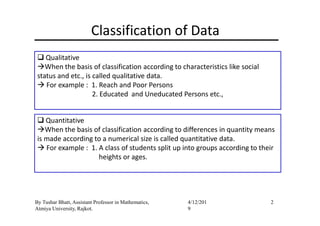
Qualitative
When the basis of classification according to characteristics like social
status and etc., is called qualitative data.
For example : 1. Reach and Poor Persons
2. Educated and Uneducated Persons etc.,
2
Quantitative
When the basis of classification according to differences in quantity means
is made according to a numerical size is called quantitative data.
For example : 1. A class of students split up into groups according to their
heights or ages.
By Tushar Bhatt, Assistant Professor in Mathematics,
Atmiya University, Rajkot.
4/12/201
9
Classification of Data
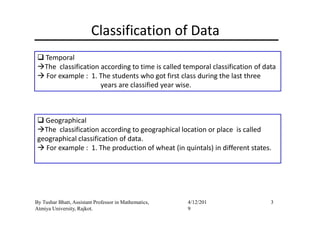
Temporal
The classification according to time is called temporal classification of data
For example : 1. The students who got first class during the last three
years are classified year wise.
3
Geographical
The classification according to geographical location or place is called
geographical classification of data.
For example : 1. The production of wheat (in quintals) in different states.
By Tushar Bhatt, Assistant Professor in Mathematics,
Atmiya University, Rajkot.
4/12/201
9
Tabulation of Data
The last stage in compilation of data is tabulation.
After the data have been collected and classified , it is essential to put
them in the form of tables with rows and columns.
4
Tabulation is a scientific process used in setting out the collected data in an
understandable form.
By Tushar Bhatt, Assistant Professor in Mathematics,
Atmiya University, Rajkot.
4/12/201
9
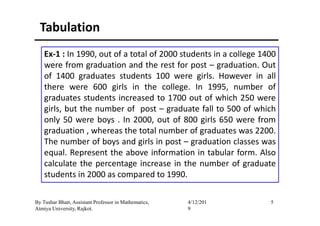
Ex-1 : In 1990, out of a total of 2000 students in a college 1400
were from graduation and the rest for post – graduation. Out
of 1400 graduates students 100 were girls. However in all
there were 600 girls in the college. In 1995, number of
graduates students increased to 1700 out of which 250 were
girls, but the number of post – graduate fall to 500 of which
Tabulation
girls, but the number of post – graduate fall to 500 of which
only 50 were boys . In 2000, out of 800 girls 650 were from
graduation , whereas the total number of graduates was 2200.
The number of boys and girls in post – graduation classes was
equal. Represent the above information in tabular form. Also
calculate the percentage increase in the number of graduate
students in 2000 as compared to 1990.
5By Tushar Bhatt, Assistant Professor in Mathematics,
Atmiya University, Rajkot.
4/12/201
9
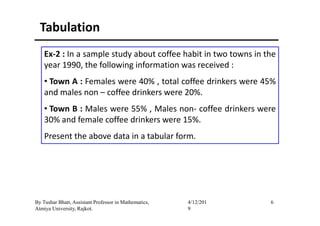
Ex-2 : In a sample study about coffee habit in two towns in the
year 1990, the following information was received :
• Town A : Females were 40% , total coffee drinkers were 45%
and males non – coffee drinkers were 20%.
• Town B : Males were 55% , Males non- coffee drinkers were
Tabulation
• Town B : Males were 55% , Males non- coffee drinkers were
30% and female coffee drinkers were 15%.
Present the above data in a tabular form.
6By Tushar Bhatt, Assistant Professor in Mathematics,
Atmiya University, Rajkot.
4/12/201
9
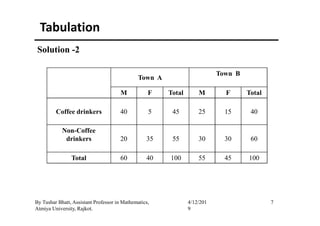
Tabulation
Town A
Town B
M F Total M F Total
Coffee drinkers 40 5 45 25 15 40
Solution -2
7By Tushar Bhatt, Assistant Professor in Mathematics,
Atmiya University, Rajkot.
4/12/201
9
Coffee drinkers 40 5 45 25 15 40
Non-Coffee
drinkers 20 35 55 30 30 60
Total 60 40 100 55 45 100
There are 3 – methods to represent the Ungrouped data in
graphical way :
a) Pictograms
b) Bar Charts
c) Pie Diagrams
Graphical Representations of Ungrouped data
c) Pie Diagrams
8By Tushar Bhatt, Assistant Professor in Mathematics,
Atmiya University, Rajkot.
4/12/201
9
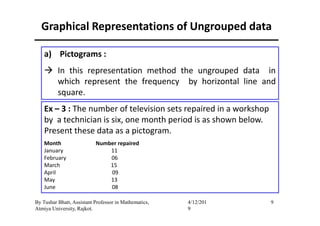
a) Pictograms :
In this representation method the ungrouped data in
which represent the frequency by horizontal line and
square.
Graphical Representations of Ungrouped data
Ex – 3 : The number of television sets repaired in a workshop
9
Ex – 3 : The number of television sets repaired in a workshop
by a technician is six, one month period is as shown below.
Present these data as a pictogram.
Month Number repaired
January 11
February 06
March 15
April 09
May 13
June 08
By Tushar Bhatt, Assistant Professor in Mathematics,
Atmiya University, Rajkot.
4/12/201
9
Graphical Representations of Ungrouped data
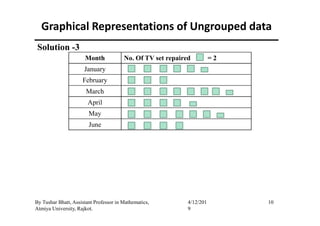
Month No. Of TV set repaired = 2
January
February
March
April
May
Solution -3
10By Tushar Bhatt, Assistant Professor in Mathematics,
Atmiya University, Rajkot.
4/12/201
9
May
June
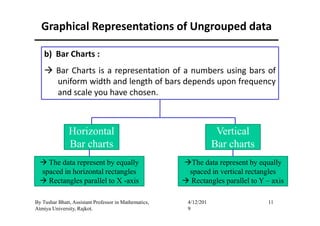
b) Bar Charts :
Bar Charts is a representation of a numbers using bars of
uniform width and length of bars depends upon frequency
and scale you have chosen.
Graphical Representations of Ungrouped data
11
Horizontal
Bar charts
Vertical
Bar charts
The data represent by equally
spaced in horizontal rectangles
Rectangles parallel to X -axis
The data represent by equally
spaced in vertical rectangles
Rectangles parallel to Y – axis
By Tushar Bhatt, Assistant Professor in Mathematics,
Atmiya University, Rajkot.
4/12/201
9
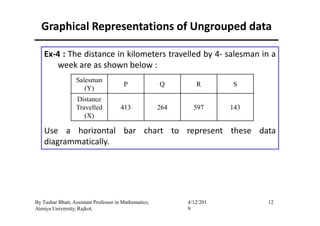
Ex-4 : The distance in kilometers travelled by 4- salesman in a
week are as shown below :
Graphical Representations of Ungrouped data
Salesman
(Y)
P Q R S
Distance
Travelled
(X)
413 264 597 143
Use a horizontal bar chart to represent these data
diagrammatically.
12By Tushar Bhatt, Assistant Professor in Mathematics,
Atmiya University, Rajkot.
4/12/201
9
(X)
Graphical Representations of Ungrouped data
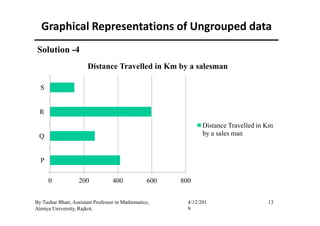
R
S
Distance Travelled in Km by a salesman
Solution -4
13By Tushar Bhatt, Assistant Professor in Mathematics,
Atmiya University, Rajkot.
4/12/201
9
0 200 400 600 800
P
Q
R
Distance Travelled in Km
by a sales man
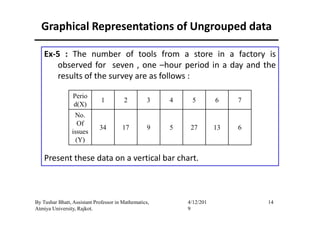
Ex-5 : The number of tools from a store in a factory is
observed for seven , one –hour period in a day and the
results of the survey are as follows :
Graphical Representations of Ungrouped data
Perio
d(X)
1 2 3 4 5 6 7
No.
Present these data on a vertical bar chart.
14By Tushar Bhatt, Assistant Professor in Mathematics,
Atmiya University, Rajkot.
4/12/201
9
No.
Of
issues
(Y)
34 17 9 5 27 13 6
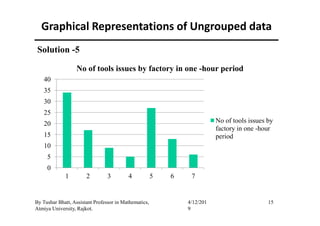
Graphical Representations of Ungrouped data
25
30
35
40
No of tools issues by factory in one -hour period
Solution -5
15By Tushar Bhatt, Assistant Professor in Mathematics,
Atmiya University, Rajkot.
4/12/201
9
0
5
10
15
20
25
1 2 3 4 5 6 7
No of tools issues by
factory in one -hour
period
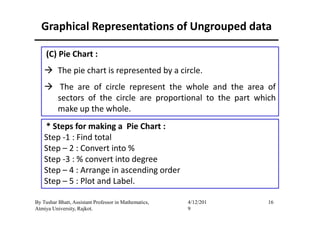
(C) Pie Chart :
The pie chart is represented by a circle.
The are of circle represent the whole and the area of
sectors of the circle are proportional to the part which
make up the whole.
Graphical Representations of Ungrouped data
make up the whole.
16By Tushar Bhatt, Assistant Professor in Mathematics,
Atmiya University, Rajkot.
4/12/201
9
* Steps for making a Pie Chart :
Step -1 : Find total
Step – 2 : Convert into %
Step -3 : % convert into degree
Step – 4 : Arrange in ascending order
Step – 5 : Plot and Label.
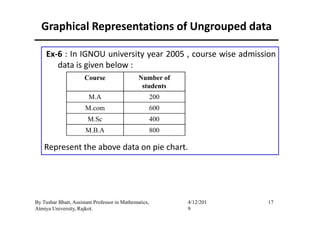
Ex-6 : In IGNOU university year 2005 , course wise admission
data is given below :
Graphical Representations of Ungrouped data
Course Number of
students
M.A 200
M.com 600
Represent the above data on pie chart.
17By Tushar Bhatt, Assistant Professor in Mathematics,
Atmiya University, Rajkot.
4/12/201
9
M.Sc 400
M.B.A 800
Graphical Representations of Ungrouped data
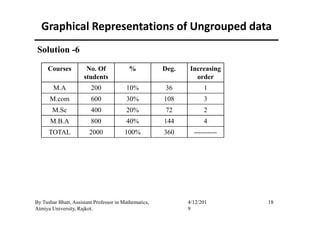
Solution -6
Courses No. Of
students
% Deg. Increasing
order
M.A 200 10% 36 1
M.com 600 30% 108 3
M.Sc 400 20% 72 2
18By Tushar Bhatt, Assistant Professor in Mathematics,
Atmiya University, Rajkot.
4/12/201
9
M.Sc 400 20% 72 2
M.B.A 800 40% 144 4
TOTAL 2000 100% 360 ----------
Graphical Representations of Ungrouped data
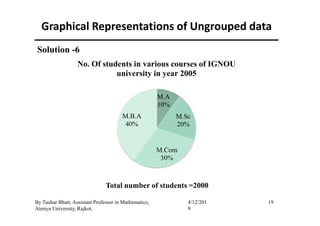
M.A
10%
M.ScM.B.A
No. Of students in various courses of IGNOU
university in year 2005
Solution -6
19By Tushar Bhatt, Assistant Professor in Mathematics,
Atmiya University, Rajkot.
4/12/201
9
M.Sc
20%
M.Com
30%
M.B.A
40%
Total number of students =2000
Graphical Representations of Grouped data
o The Graphical representation of grouped data is classified into
3-categarioes :
(a) Histogram
(b) Frequency Polygon
(c) Ogive
20By Tushar Bhatt, Assistant Professor in Mathematics,
Atmiya University, Rajkot.
4/12/201
9
(c) Ogive
Graphical Representations of Grouped data
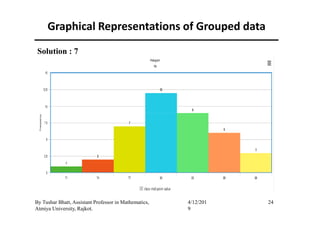
(a) Histogram :
The histogram is mainly used for presentation of grouped data in
which the respective frequency of the classes are plot on a graph as
a vertical adjacent rectangles.
If class intervals are of equal length then the heights of rectangles
of a histograms are equal to frequencies.
If class intervals are of not equal length then the heights of
21By Tushar Bhatt, Assistant Professor in Mathematics,
Atmiya University, Rajkot.
4/12/201
9
If class intervals are of not equal length then the heights of
rectangles of a histograms are obtain by using following manner:
1. Upper class boundary+5
2. Lower class boundary -5
3. Class range = [(Upper class boundary+5) - (Lower class
boundary -5)]
4. Heights of rectangles are = Frequency of the class / class range.
Graphical Representations of Grouped data
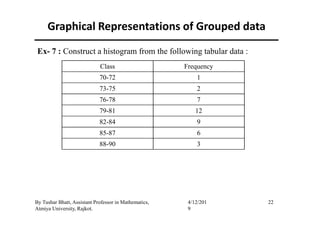
Ex- 7 : Construct a histogram from the following tabular data :
Class Frequency
70-72 1
73-75 2
76-78 7
79-81 12
22By Tushar Bhatt, Assistant Professor in Mathematics,
Atmiya University, Rajkot.
4/12/201
9
79-81 12
82-84 9
85-87 6
88-90 3
Graphical Representations of Grouped data
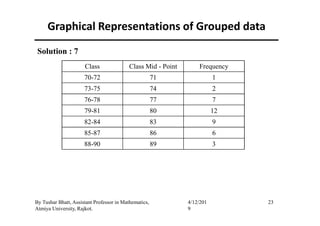
Solution : 7
Class Class Mid - Point Frequency
70-72 71 1
73-75 74 2
76-78 77 7
79-81 80 12
23By Tushar Bhatt, Assistant Professor in Mathematics,
Atmiya University, Rajkot.
4/12/201
9
79-81 80 12
82-84 83 9
85-87 86 6
88-90 89 3
Graphical Representations of Grouped data
Solution : 7
24By Tushar Bhatt, Assistant Professor in Mathematics,
Atmiya University, Rajkot.
4/12/201
9
Graphical Representations of Grouped data
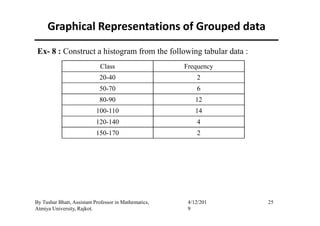
Ex- 8 : Construct a histogram from the following tabular data :
Class Frequency
20-40 2
50-70 6
80-90 12
100-110 14
25By Tushar Bhatt, Assistant Professor in Mathematics,
Atmiya University, Rajkot.
4/12/201
9
100-110 14
120-140 4
150-170 2
Graphical Representations of Grouped data
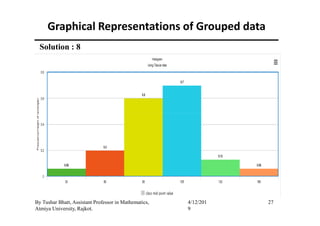
Solution : 8
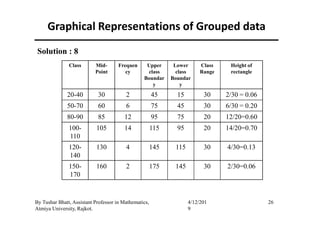
Class Mid-
Point
Frequen
cy
Upper
class
Boundar
y
Lower
class
Boundar
y
Class
Range
Height of
rectangle
20-40 30 2 45 15 30 2/30 = 0.06
50-70 60 6 75 45 30 6/30 = 0.20
80-90 85 12 95 75 20 12/20=0.60
26By Tushar Bhatt, Assistant Professor in Mathematics,
Atmiya University, Rajkot.
4/12/201
9
80-90 85 12 95 75 20 12/20=0.60
100-
110
105 14 115 95 20 14/20=0.70
120-
140
130 4 145 115 30 4/30=0.13
150-
170
160 2 175 145 30 2/30=0.06
Graphical Representations of Grouped data
Solution : 8
27By Tushar Bhatt, Assistant Professor in Mathematics,
Atmiya University, Rajkot.
4/12/201
9
Graphical Representations of Grouped data
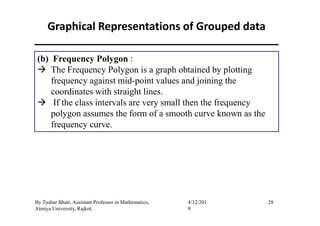
(b) Frequency Polygon :
The Frequency Polygon is a graph obtained by plotting
frequency against mid-point values and joining the
coordinates with straight lines.
If the class intervals are very small then the frequency
polygon assumes the form of a smooth curve known as the
28By Tushar Bhatt, Assistant Professor in Mathematics,
Atmiya University, Rajkot.
4/12/201
9
polygon assumes the form of a smooth curve known as the
frequency curve.
Graphical Representations of Grouped data
Ex-9 : Draw the frequency polygon for the data given in
following table :
Class Mid-Point Frequency
7.1-7.3 7.2 3
7.4-7.6 7.5 5
29By Tushar Bhatt, Assistant Professor in Mathematics,
Atmiya University, Rajkot.
4/12/201
9
7.5-7.9 7.8 9
8.0-8.2 8.1 14
8.1-8.5 8.4 11
8.2-8.8 8.7 6
8.9-9.1 9.0 2
Graphical Representations of Grouped data
Solution : 9
12
14
16
Frequency
Frequency Polygon
30By Tushar Bhatt, Assistant Professor in Mathematics,
Atmiya University, Rajkot.
4/12/201
9
0
2
4
6
8
10
7.2 7.5 7.8 8.1 8.4 8.7 9
Frequency
Class Mid-Point
Graphical Representations of Grouped data
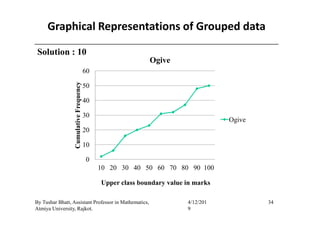
(C) Ogive or Cumulative Frequency Distribution curve :
The curve is obtained by joining the coordinates of
cumulative frequency (vertically ) against upper class
boundary ( horizontally) is called an Ogive or Cumulative
Frequency Distribution curve .
31By Tushar Bhatt, Assistant Professor in Mathematics,
Atmiya University, Rajkot.
4/12/201
9
Graphical Representations of Grouped data
Ex-10 : The frequency distribution for marks of 50 students is
given in the following table. Form cumulative frequency
distribution for these data and draw the corresponding Ogive.
Class Frequency
0-10 2
10-20 4
32By Tushar Bhatt, Assistant Professor in Mathematics,
Atmiya University, Rajkot.
4/12/201
9
20-30 10
30-40 4
40-50 3
50-60 8
60-70 1
70-80 5
80-90 11
90-100 2
Graphical Representations of Grouped data
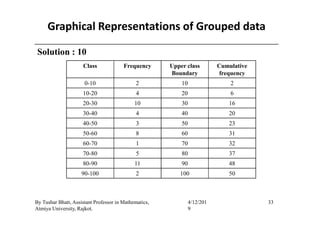
Solution : 10
Class Frequency Upper class
Boundary
Cumulative
frequency
0-10 2 10 2
10-20 4 20 6
20-30 10 30 16
30-40 4 40 20
33By Tushar Bhatt, Assistant Professor in Mathematics,
Atmiya University, Rajkot.
4/12/201
9
30-40 4 40 20
40-50 3 50 23
50-60 8 60 31
60-70 1 70 32
70-80 5 80 37
80-90 11 90 48
90-100 2 100 50
Graphical Representations of Grouped data
Solution : 10
30
40
50
60
CumulativeFrequency
Ogive
34By Tushar Bhatt, Assistant Professor in Mathematics,
Atmiya University, Rajkot.
4/12/201
9
0
10
20
30
10 20 30 40 50 60 70 80 90 100
CumulativeFrequency
Ogive
Upper class boundary value in marks
Thank
You
35By Tushar Bhatt, Assistant Professor in Mathematics,
Atmiya University, Rajkot.
4/12/2019
You
Module
2 Measures of Central Tendency
OUTLINE ( Teaching Hours - 5)
1. Introduction
1
1. Introduction
2. Mean
3. Median
4. Mode
By Tushar Bhatt, Assistant Professor in Mathematics, Atmiya University, Rajkot. 4/12/2019
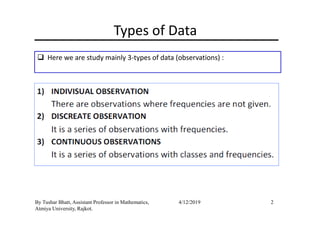
Types of Data
Here we are study mainly 3-types of data (observations) :
2By Tushar Bhatt, Assistant Professor in Mathematics,
Atmiya University, Rajkot.
4/12/2019
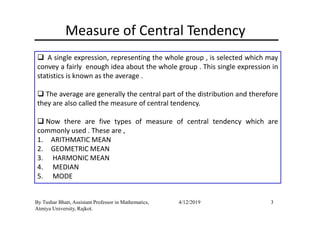
Measure of Central Tendency
A single expression, representing the whole group , is selected which may
convey a fairly enough idea about the whole group . This single expression in
statistics is known as the average .
The average are generally the central part of the distribution and therefore
they are also called the measure of central tendency.
3
Now there are five types of measure of central tendency which are
commonly used . These are ,
1. ARITHMATIC MEAN
2. GEOMETRIC MEAN
3. HARMONIC MEAN
4. MEDIAN
5. MODE
By Tushar Bhatt, Assistant Professor in Mathematics,
Atmiya University, Rajkot.
4/12/2019
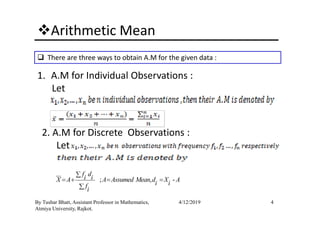
Arithmetic Mean
There are three ways to obtain A.M for the given data :
1. A.M for Individual Observations :
Let
4By Tushar Bhatt, Assistant Professor in Mathematics,
Atmiya University, Rajkot.
4/12/2019
2. A.M for Discrete Observations :
Let
; , -
f di iX A A Assumed Mean d X Ai ifi
∑
= + = =
∑
Arithmetic Mean
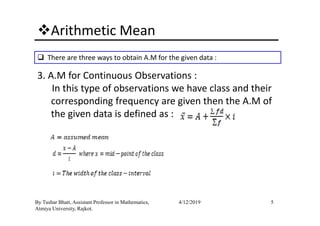
There are three ways to obtain A.M for the given data :
3. A.M for Continuous Observations :
In this type of observations we have class and their
corresponding frequency are given then the A.M of
the given data is defined as :
5By Tushar Bhatt, Assistant Professor in Mathematics,
Atmiya University, Rajkot.
4/12/2019
the given data is defined as :
Arithmetic Mean
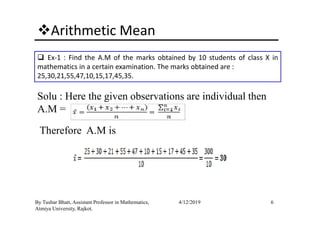
Ex-1 : Find the A.M of the marks obtained by 10 students of class X in
mathematics in a certain examination. The marks obtained are :
25,30,21,55,47,10,15,17,45,35.
Solu : Here the given observations are individual then
A.M =
6By Tushar Bhatt, Assistant Professor in Mathematics,
Atmiya University, Rajkot.
4/12/2019
A.M =
Therefore A.M is
Arithmetic Mean
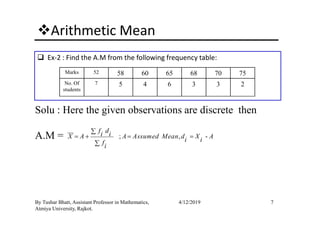
Ex-2 : Find the A.M from the following frequency table:
Solu : Here the given observations are discrete then
Marks 52 58 60 65 68 70 75
No. Of
students
7 5 4 6 3 3 2
7By Tushar Bhatt, Assistant Professor in Mathematics,
Atmiya University, Rajkot.
4/12/2019
Solu : Here the given observations are discrete then
A.M = ; , -
f di iX A A Assumed Mean d X Ai ifi
∑
= + = =
∑
Arithmetic Mean
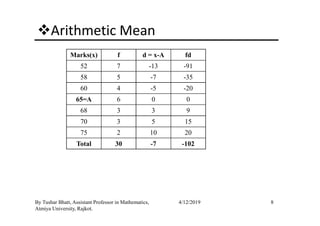
Marks(x) f d = x-A fd
52 7 -13 -91
58 5 -7 -35
60 4 -5 -20
65=A 6 0 0
68 3 3 9
8By Tushar Bhatt, Assistant Professor in Mathematics,
Atmiya University, Rajkot.
4/12/2019
68 3 3 9
70 3 5 15
75 2 10 20
Total 30 -7 -102
Arithmetic Mean
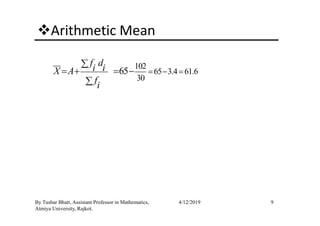
102
65 3.4 61.6
30
65
f d
i iX A
f
i
= − =
∑
= + = −
∑
9By Tushar Bhatt, Assistant Professor in Mathematics,
Atmiya University, Rajkot.
4/12/2019
Arithmetic Mean
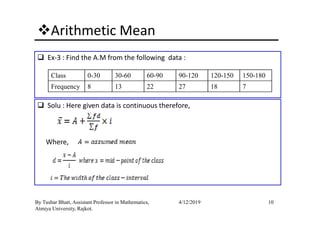
Ex-3 : Find the A.M from the following data :
Class 0-30 30-60 60-90 90-120 120-150 150-180
Frequency 8 13 22 27 18 7
Solu : Here given data is continuous therefore,
10By Tushar Bhatt, Assistant Professor in Mathematics,
Atmiya University, Rajkot.
4/12/2019
Where,
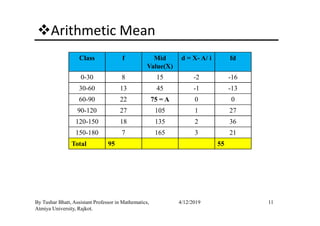
Arithmetic Mean
Class f Mid
Value(X)
d = X- A/ i fd
0-30 8 15 -2 -16
30-60 13 45 -1 -13
60-90 22 75 = A 0 0
90-120 27 105 1 27
11By Tushar Bhatt, Assistant Professor in Mathematics,
Atmiya University, Rajkot.
4/12/2019
90-120 27 105 1 27
120-150 18 135 2 36
150-180 7 165 3 21
Total 95 55
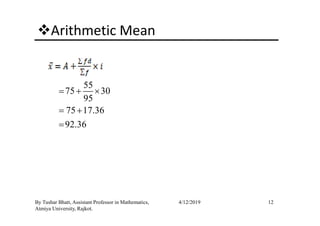
Arithmetic Mean
55
75 30
95
75 17.36
= + ×
= +
12By Tushar Bhatt, Assistant Professor in Mathematics,
Atmiya University, Rajkot.
4/12/2019
75 17.36
92.36
= +
=
Arithmetic Mean
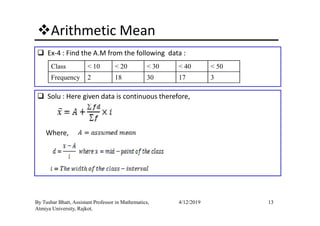
Ex-4 : Find the A.M from the following data :
Class < 10 < 20 < 30 < 40 < 50
Frequency 2 18 30 17 3
Solu : Here given data is continuous therefore,
13By Tushar Bhatt, Assistant Professor in Mathematics,
Atmiya University, Rajkot.
4/12/2019
Where,
Arithmetic Mean
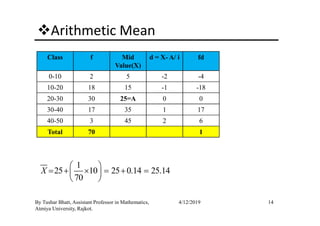
Class f Mid
Value(X)
d = X- A/ i fd
0-10 2 5 -2 -4
10-20 18 15 -1 -18
20-30 30 25=A 0 0
30-40 17 35 1 17
14By Tushar Bhatt, Assistant Professor in Mathematics,
Atmiya University, Rajkot.
4/12/2019
30-40 17 35 1 17
40-50 3 45 2 6
Total 70 1
1
25 10 25 0.14 25.14
70
X
 
= + × = + = 
 
Geometric Mean
15By Tushar Bhatt, Assistant Professor in Mathematics,
Atmiya University, Rajkot.
4/12/2019
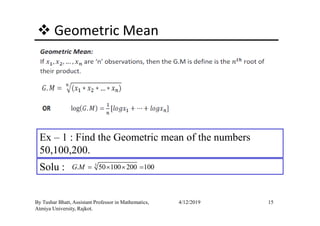
Ex – 1 : Find the Geometric mean of the numbers
50,100,200.
Solu : 3
. 50 100 200 100G M = × × =
Harmonic Mean
16By Tushar Bhatt, Assistant Professor in Mathematics,
Atmiya University, Rajkot.
4/12/2019
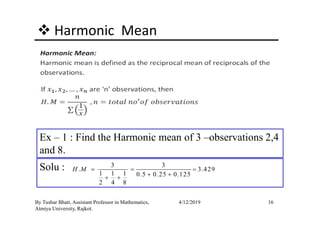
Ex – 1 : Find the Harmonic mean of 3 –observations 2,4
and 8.
Solu : 3 3
. 3.429
1 1 1 0.5 0.25 0.125
2 4 8
H M = = =
+ ++ +
Median
17By Tushar Bhatt, Assistant Professor in Mathematics,
Atmiya University, Rajkot.
4/12/2019
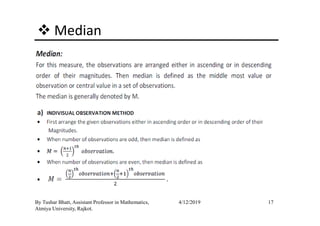
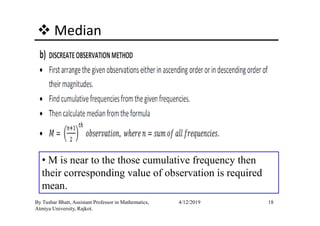
Median
18By Tushar Bhatt, Assistant Professor in Mathematics,
Atmiya University, Rajkot.
4/12/2019
• M is near to the those cumulative frequency then
their corresponding value of observation is required
mean.
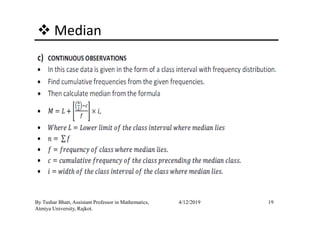
Median
19By Tushar Bhatt, Assistant Professor in Mathematics,
Atmiya University, Rajkot.
4/12/2019
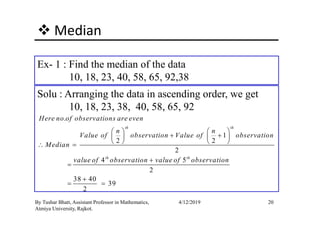
Median
Ex- 1 : Find the median of the data
10, 18, 23, 40, 58, 65, 92,38
Solu : Arranging the data in ascending order, we get
10, 18, 23, 38, 40, 58, 65, 92
20By Tushar Bhatt, Assistant Professor in Mathematics,
Atmiya University, Rajkot.
4/12/2019
.
1
2 2
2
4 5
2
38 40
39
2
th th
th th
Here no of observations are even
n n
Value of observation Value of observation
Median
value of observation value of observation
   
+ +   
   ∴ =
+
=
+
= =
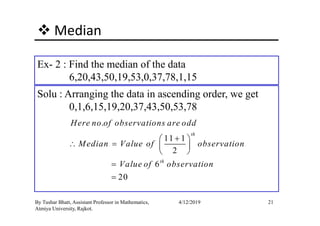
Median
Ex- 2 : Find the median of the data
6,20,43,50,19,53,0,37,78,1,15
Solu : Arranging the data in ascending order, we get
0,1,6,15,19,20,37,43,50,53,78
21By Tushar Bhatt, Assistant Professor in Mathematics,
Atmiya University, Rajkot.
4/12/2019
.
11 1
2
6
20
th
th
Here no of observations are odd
Median Value of observation
Value of observation
+ 
∴ =  
 
=
=
Median
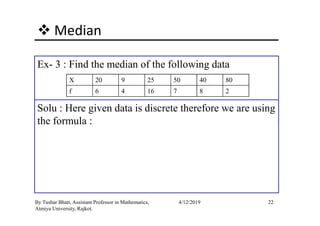
Ex- 3 : Find the median of the following data
Solu : Here given data is discrete therefore we are using
X 20 9 25 50 40 80
f 6 4 16 7 8 2
22By Tushar Bhatt, Assistant Professor in Mathematics,
Atmiya University, Rajkot.
4/12/2019
Solu : Here given data is discrete therefore we are using
the formula :
Median
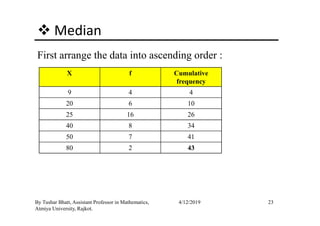
First arrange the data into ascending order :
X f Cumulative
frequency
9 4 4
20 6 10
25 16 26
23By Tushar Bhatt, Assistant Professor in Mathematics,
Atmiya University, Rajkot.
4/12/2019
25 16 26
40 8 34
50 7 41
80 2 43
Median
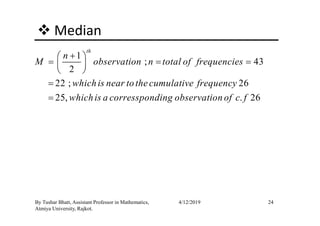
1
; 43
2
22 ; 26
25, . 26
th
n
M observation n total of frequencies
whichis near tothecumulative frequency
whichis a corressponding observation of c f
+ 
= = = 
 
=
=
24By Tushar Bhatt, Assistant Professor in Mathematics,
Atmiya University, Rajkot.
4/12/2019
Median
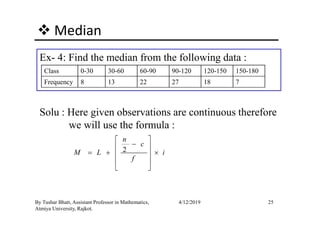
Ex- 4: Find the median from the following data :
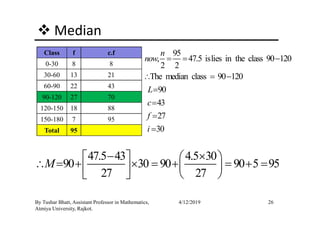
Class 0-30 30-60 60-90 90-120 120-150 150-180
Frequency 8 13 22 27 18 7
Solu : Here given observations are continuous therefore
25By Tushar Bhatt, Assistant Professor in Mathematics,
Atmiya University, Rajkot.
4/12/2019
Solu : Here given observations are continuous therefore
we will use the formula :
2
n
c
M L i
f
 
− 
= + × 
 
 
Median
Class f c.f
0-30 8 8
30-60 13 21
60-90 22 43
90-120 27 70
120-150 18 88
95
, 47.5 islies in the class 90 120
2 2
The median class 90 120
90
43
27
n
now
L
c
f
= = −
∴ = −
=
=
=
26By Tushar Bhatt, Assistant Professor in Mathematics,
Atmiya University, Rajkot.
4/12/2019
150-180 7 95
Total 95
27
30
f
i
=
=
47.5 43 4.5 30
90 30 90 90 5 95
27 27
M
− ×   
∴ = + × = + = + =     
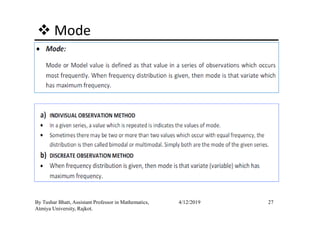
Mode
27By Tushar Bhatt, Assistant Professor in Mathematics,
Atmiya University, Rajkot.
4/12/2019
Mode
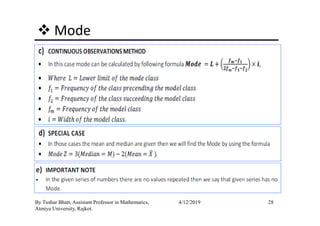
28By Tushar Bhatt, Assistant Professor in Mathematics,
Atmiya University, Rajkot.
4/12/2019
Mode
29By Tushar Bhatt, Assistant Professor in Mathematics,
Atmiya University, Rajkot.
4/12/2019
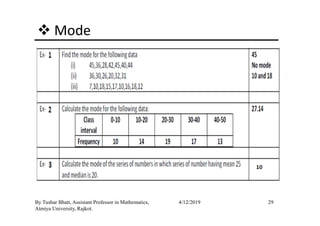
Mode
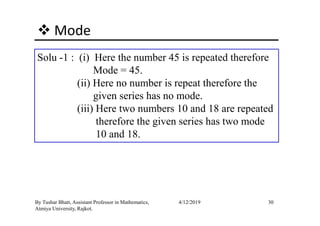
Solu -1 : (i) Here the number 45 is repeated therefore
Mode = 45.
(ii) Here no number is repeat therefore the
given series has no mode.
(iii) Here two numbers 10 and 18 are repeated
30By Tushar Bhatt, Assistant Professor in Mathematics,
Atmiya University, Rajkot.
4/12/2019
(iii) Here two numbers 10 and 18 are repeated
therefore the given series has two mode
10 and 18.
Mode
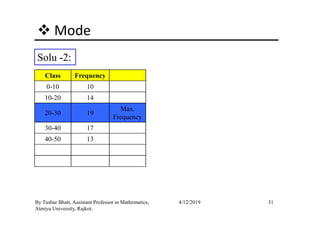
Solu -2:
Class Frequency
0-10 10
10-20 14
20-30 19
Max.
31By Tushar Bhatt, Assistant Professor in Mathematics,
Atmiya University, Rajkot.
4/12/2019
20-30 19
Frequency
30-40 17
40-50 13
Mode
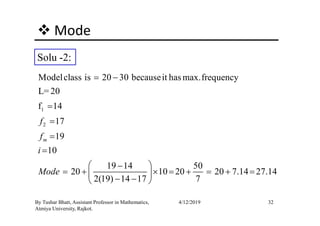
Solu -2:
1
Modelclass is 20 30 becauseit has max.frequency
L= 20
f 14
= −
=
32By Tushar Bhatt, Assistant Professor in Mathematics,
Atmiya University, Rajkot.
4/12/2019
2 17
19
10
19 14 50
20 10 20 20 7.14 27.14
2(19) 14 17 7
m
f
f
i
Mode
=
=
=
 −
= + × = + = + = 
− − 
Mode
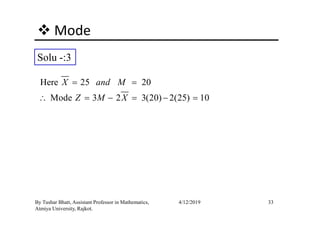
Solu -:3
Here 25 20
Mode 3 2 3(20) 2(25) 10
X and M
Z M X
= =
∴ = − = − =
33By Tushar Bhatt, Assistant Professor in Mathematics,
Atmiya University, Rajkot.
4/12/2019
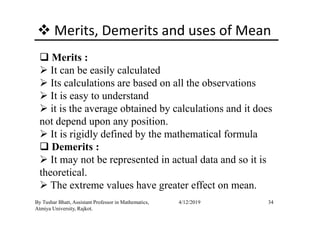
Merits, Demerits and uses of Mean
Merits :
It can be easily calculated
Its calculations are based on all the observations
It is easy to understand
it is the average obtained by calculations and it does
34By Tushar Bhatt, Assistant Professor in Mathematics,
Atmiya University, Rajkot.
4/12/2019
it is the average obtained by calculations and it does
not depend upon any position.
It is rigidly defined by the mathematical formula
Demerits :
It may not be represented in actual data and so it is
theoretical.
The extreme values have greater effect on mean.
Merits, Demerits and uses of Mean
Demerits :
It can not be calculated if all the values are not
known.
It can not be determined for the qualitative data like
beauty, honesty etc.,.
35By Tushar Bhatt, Assistant Professor in Mathematics,
Atmiya University, Rajkot.
4/12/2019
beauty, honesty etc.,.
Uses of Mean :
It is extensively used in practical statistics
Estimates are always obtained by mean
Merits, Demerits and uses of Median
Merits :
It is easily understood.
It is not affected by extreme values
It can be located graphically
It is the best measure for qualitative data like beauty,
36By Tushar Bhatt, Assistant Professor in Mathematics,
Atmiya University, Rajkot.
4/12/2019
It is the best measure for qualitative data like beauty,
honesty etc.,.
Demerits :
It is not subject to algebraic treatments
It can not represent the irregular distribution series
It is a positional average and is based on the middle
item.
Merits, Demerits and uses of Median
Uses of Median :
It is useful in those cases where numerical
measurements are not possible.
It is generally used in studying phenomena like skill,
honesty, intelligence, etc.
37By Tushar Bhatt, Assistant Professor in Mathematics,
Atmiya University, Rajkot.
4/12/2019
honesty, intelligence, etc.
Thank
You
38By Tushar Bhatt, Assistant Professor in Mathematics,
Atmiya University, Rajkot.
4/12/2019
You
ByBy
Tushar Bhatt
4/12/2019Atmiya University - Rajkot 1
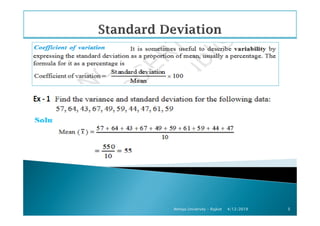
Variance
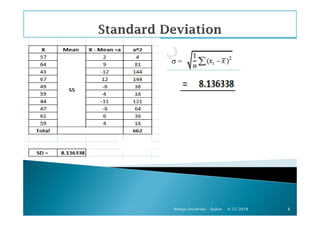
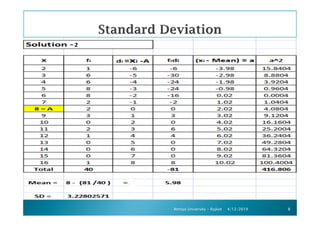
Standard Deviation
Meaning and Types of Skewness
4/12/2019Atmiya University - Rajkot 2
4/12/2019Atmiya University - Rajkot 3
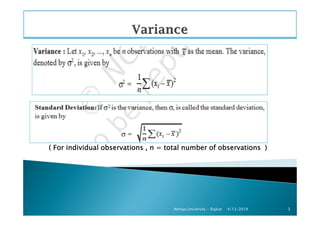
( For individual observations , n = total number of observations )( For individual observations , n = total number of observations )( For individual observations , n = total number of observations )( For individual observations , n = total number of observations )
4/12/2019Atmiya University - Rajkot 4
4/12/2019Atmiya University - Rajkot 5
4/12/2019Atmiya University - Rajkot 6
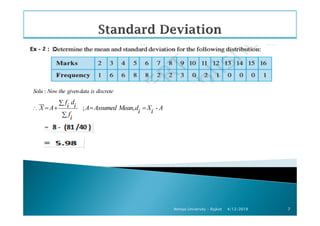
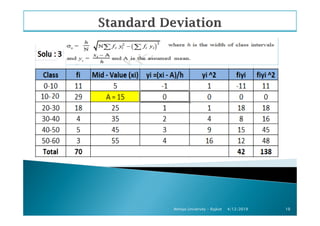
:
; , -
Solu Now the givendata is discrete
f di iX A A Assumed Mean d X Ai if
∴
∑
= + = =
∑
4/12/2019Atmiya University - Rajkot 7
i if
i∑
4/12/2019Atmiya University - Rajkot 8
4/12/2019Atmiya University - Rajkot 9
4/12/2019Atmiya University - Rajkot 10
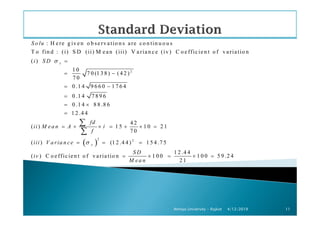
2
: H ere g iven o b servatio n s are co n tin u o u s
T o fin d : (i) S D (ii) M ean (iii) V arian ce (iv) C o efficien t o f variatio n
( )
1 0
7 0 (1 3 8 ) (4 2 )
7 0
0 .1 4 9 6 6 0 1 7 6 4
0 .1 4 7 8 9 6
0 .1 4 8 8 .8 6
1 2 .4 4
x
S o lu
i S D σ =
= −
= −
=
= ×
=
4/12/2019Atmiya University - Rajkot 11
1 2 .4 4
4 2
( ) 1 5 1 0 2 1
7 0
(
fd
ii M ea n A i
f
ii
=
= + × = + × =
∑
∑
( )
2 2
) (1 2 .4 4 ) 1 5 4 .7 5
1 2 .4 4
( ) C o efficien t o f v ariatio n 1 0 0 1 0 0 5 9 .2 4
2 1
xi V a ria n ce
S D
iv
M ea n
σ= = =
= × = × =
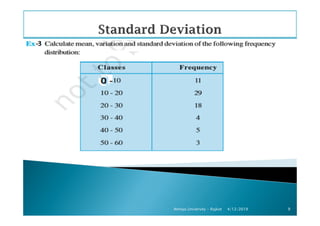
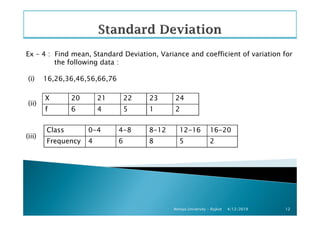
Ex – 4 : Find mean, Standard Deviation, Variance and coefficient of variation for
the following data :
(i) 16,26,36,46,56,66,76
(ii)
X 20 21 22 23 24
f 6 4 5 1 2
4/12/2019Atmiya University - Rajkot 12
(iii)
Class 0-4 4-8 8-12 12-16 16-20
Frequency 4 6 8 5 2
4/12/2019Atmiya University - Rajkot 13
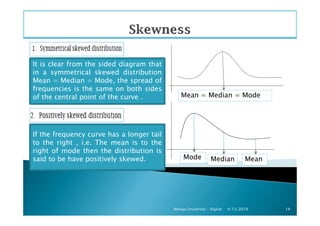
It is clear from the sided diagram that
in a symmetrical skewed distribution
Mean = Median = Mode, the spread of
frequencies is the same on both sides
of the central point of the curve . Mean = Median = Mode
4/12/2019Atmiya University - Rajkot 14
If the frequency curve has a longer tail
to the right , i.e. The mean is to the
right of mode then the distribution is
said to be have positively skewed. Mode MeanMedian
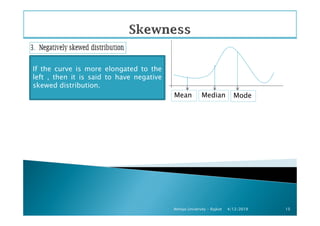
If the curve is more elongated to the
left , then it is said to have negative
skewed distribution.
ModeMean Median
4/12/2019Atmiya University - Rajkot 15
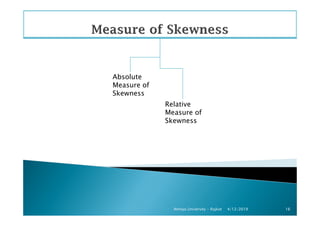
Relative
Measure of
Absolute
Measure of
Skewness
4/12/2019Atmiya University - Rajkot 16
Measure of
Skewness
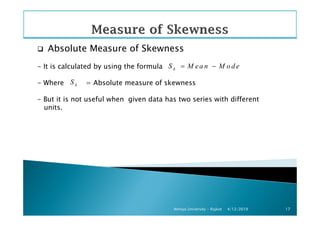
Absolute Measure of Skewness
- It is calculated by using the formula
- Where = Absolute measure of skewness
- But it is not useful when given data has two series with different
units.
kS M ea n M o d e= −
kS
4/12/2019Atmiya University - Rajkot 17
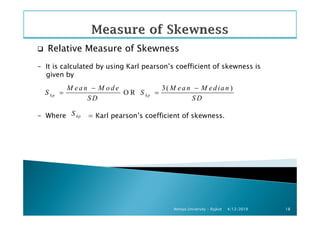
Relative Measure of Skewness
- It is calculated by using Karl pearson’s coefficient of skewness is
given by
- Where = Karl pearson’s coefficient of skewness.
3( )
O Rkp kp
M ea n M o d e M ea n M ed ia n
S S
S D S D
− −
= =
S
4/12/2019Atmiya University - Rajkot 18
- Where = Karl pearson’s coefficient of skewness.kpS
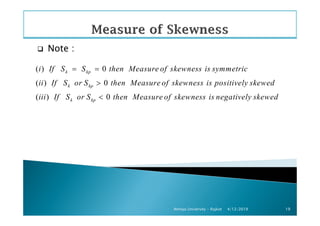
Note :
( ) 0
( ) 0
( ) 0
k kp
k kp
k kp
i If S S then Measure of skewness is symmetric
ii If S or S then Measure of skewness is positively skewed
iii If S or S then Measure of skewness is negatively skewed
= =
>
<
4/12/2019Atmiya University - Rajkot 19
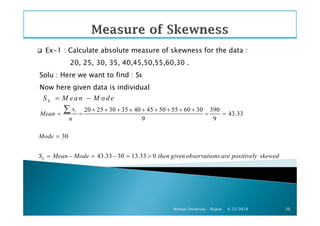
Ex-1 : Calculate absolute measure of skewness for the data :
20, 25, 30, 35, 40,45,50,55,60,30 .
Solu : Here we want to find : Sk
Now here given data is individual
kS M ea n M o d e= −
20 25 30 35 40 45 50 55 60 30 390
43.33ix
Mean
+ + + + + + + + +
= = = =
∑
4/12/2019Atmiya University - Rajkot 20
20 25 30 35 40 45 50 55 60 30 390
43.33
9 9
30
43.33 30 13.33 0
i
k
Mean
n
Mode
S Mean Mode then given observations are positively skewed
+ + + + + + + + +
= = = =
=
= − = − = >
∑
Ex – 2 : Find absolute measure of skewness for the following data :
(i) 16,26,36,46,56,66,76,26
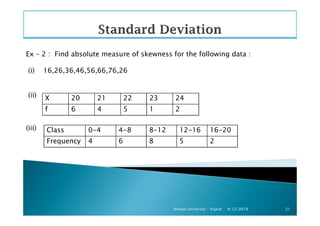
(ii) X 20 21 22 23 24
f 6 4 5 1 2
4/12/2019Atmiya University - Rajkot 21
(iii) Class 0-4 4-8 8-12 12-16 16-20
Frequency 4 6 8 5 2
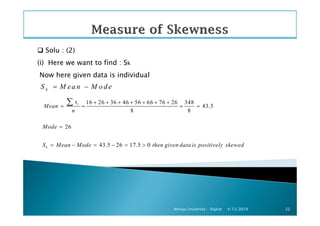
Solu : (2)
(i) Here we want to find : Sk
Now here given data is individual
kS M ea n M o d e= −
16 26 36 46 56 66 76 26 348
43.5
8 8
ix
Mean
n
+ + + + + + +
= = = =
∑
4/12/2019Atmiya University - Rajkot 22
8 8
26
43.5 26 17.5 0k
n
Mode
S Mean Mode then given data is positively skewed
=
= − = − = >
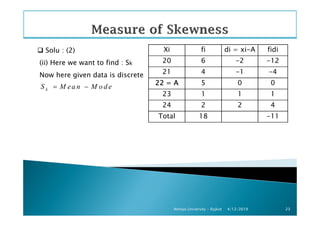
Solu : (2)
(ii) Here we want to find : Sk
Now here given data is discrete
kS M ea n M o d e= −
Xi fi di = xi-A fidi
20 6 -2 -12
21 4 -1 -4
22 = A22 = A22 = A22 = A 5 0 0
23 1 1 1
24 2 2 4
Total 18 -11
4/12/2019Atmiya University - Rajkot 23
Total 18 -11
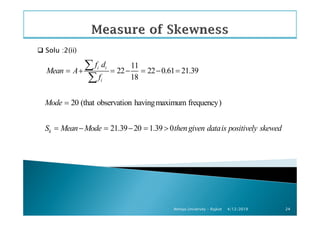
Solu :2(ii)
11
22 22 0.61 21.39
18
20 (that observation havingmaximum frequency)
i i
i
f d
Mean A
f
Mode
= + = − = − =
=
∑
∑
4/12/2019Atmiya University - Rajkot 24
21.39 20 1.39 0kS Mean Mode thengiven datais positively skewed= − = − = >
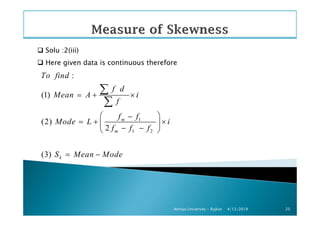
Solu :2(iii)
Here given data is continuous therefore
:
(1)
To find
f d
Mean A i
f
f f
= + ×
 −
∑
∑
4/12/2019Atmiya University - Rajkot 25
1
1 2
(2)
2
(3)
m
m
k
f f
Mode L i
f f f
S Mean Mode
 −
= + × 
− − 
= −
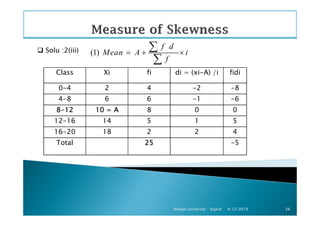
Solu :2(iii) (1)
f d
Mean A i
f
= + ×
∑
∑
Class Xi fi di = (xi-A) /i fidi
0-4 2 4 -2 -8
4-8 6 6 -1 -6
8888----12121212 10 = A10 = A10 = A10 = A 8 0 0
4/12/2019Atmiya University - Rajkot 26
8888----12121212 10 = A10 = A10 = A10 = A 8 0 0
12-16 14 5 1 5
16-20 18 2 2 4
Total 25252525 -5
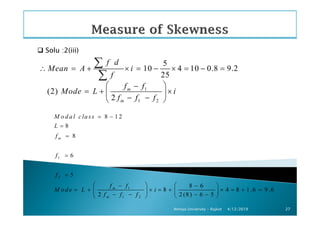
Solu :2(iii)
5
10 4 10 0.8 9.2
25
f d
Mean A i
f
∴ = + × = − × = − =
∑
∑
1
1 2
(2)
2
m
m
f f
Mode L i
f f f
 −
= + × 
− − 
4/12/2019Atmiya University - Rajkot 27
1
2
1
1 2
8 1 2
8
8
6
5
8 6
8 4 8 1 .6 9 .6
2 2 (8) 6 5
m
m
m
M o d a l cla ss
L
f
f
f
f f
M o d e L i
f f f
= −
=
=
=
=
   − −
= + × = + × = + =   
− − − −  
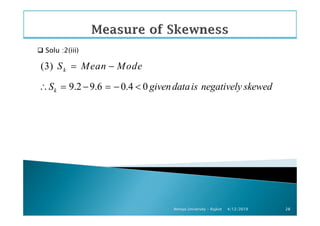
Solu :2(iii)
(3) kS Mean Mode= −
9.2 9.6 0.4 0kS givendatais negatively skewed∴ = − = − <
4/12/2019Atmiya University - Rajkot 28
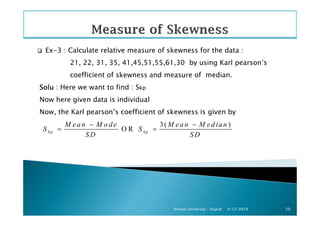
Ex-3 : Calculate relative measure of skewness for the data :
21, 22, 31, 35, 41,45,51,55,61,30 by using Karl pearson’s
coefficient of skewness and measure of median.
SoluSoluSoluSolu : Here we want to find : Skp
Now here given data is individual
Now, the Karl pearson’s coefficient of skewness is given by
4/12/2019Atmiya University - Rajkot 29
Now, the Karl pearson’s coefficient of skewness is given by
3( )
O Rkp kp
M ea n M o d e M ea n M ed ia n
S S
S D S D
− −
= =
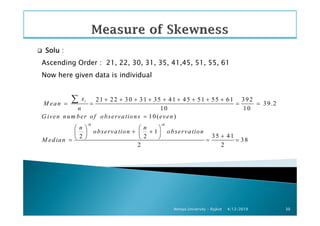
SoluSoluSoluSolu :
Ascending Order : 21, 22, 30, 31, 35, 41,45, 51, 55, 61
Now here given data is individual
21 22 30 31 35 41 45 51 55 61 392
39.2
10 10
10( )
ix
M ean
n
G iven num ber of observations even
+ + + + + + + + +
= = = =
=
∑
4/12/2019Atmiya University - Rajkot 30
10( )
1
35 412 2
38
2 2
th th
G iven num ber of observations even
n n
observation observation
M edian
=
   
+ +    +   = = =
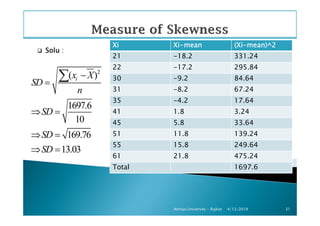
SoluSoluSoluSolu :
2
( )
1697.6
ix X
SD
n
SD
−
=
⇒ =
∑
XiXiXiXi XiXiXiXi----meanmeanmeanmean (Xi(Xi(Xi(Xi----mean)^2mean)^2mean)^2mean)^2
21 -18.2 331.24
22 -17.2 295.84
30 -9.2 84.64
31 -8.2 67.24
35 -4.2 17.64
41 1.8 3.24
4/12/2019Atmiya University - Rajkot 31
10
169.76
13.03
SD
SD
SD
⇒ =
⇒ =
⇒ =
41 1.8 3.24
45 5.8 33.64
51 11.8 139.24
55 15.8 249.64
61 21.8 475.24
Total 1697.6
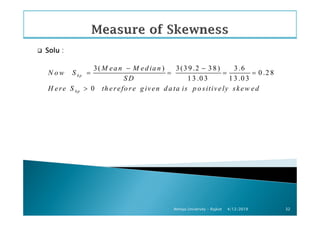
SoluSoluSoluSolu :
3( ) 3(3 9 .2 3 8) 3 .6
0 .2 8
1 3 .0 3 1 3 .0 3
0
kp
kp
M ea n M ed ia n
N o w S
S D
H ere S th erefo re g iven d a ta is p o sitively skew ed
− −
= = = =
>
4/12/2019Atmiya University - Rajkot 32
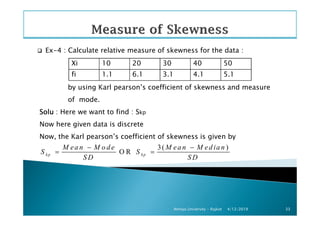
Ex-4 : Calculate relative measure of skewness for the data :
by using Karl pearson’s coefficient of skewness and measure
of mode.
SoluSoluSoluSolu : Here we want to find : Skp
Xi 10 20 30 40 50
fi 1.1 6.1 3.1 4.1 5.1
4/12/2019Atmiya University - Rajkot 33
SoluSoluSoluSolu : Here we want to find : Skp
Now here given data is discrete
Now, the Karl pearson’s coefficient of skewness is given by
3( )
O Rkp kp
M ea n M o d e M ea n M ed ia n
S S
S D S D
− −
= =
Solu :4
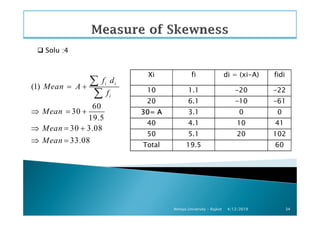
(1)
60
30
i i
i
f d
Mean A
f
Mean
= +
⇒ = +
∑
∑
Xi fi di = (xi-A) fidi
10 1.1 -20 -22
20 6.1 -10 -61
30= A30= A30= A30= A 3.1 0 0
4/12/2019Atmiya University - Rajkot 34
30
19.5
30 3.08
33.08
Mean
Mean
Mean
⇒ = +
⇒ = +
⇒ =
30= A30= A30= A30= A 3.1 0 0
40 4.1 10 41
50 5.1 20 102
Total 19.5 60
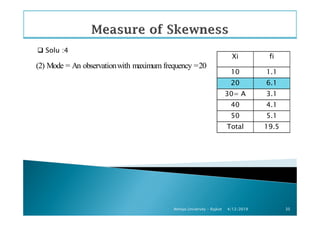
Solu :4
(2) Mode = An observationwith maximum frequency =20
Xi fi
10 1.1
20 6.1
30= A 3.1
40 4.1
50 5.1
4/12/2019Atmiya University - Rajkot 35
50 5.1
Total 19.5
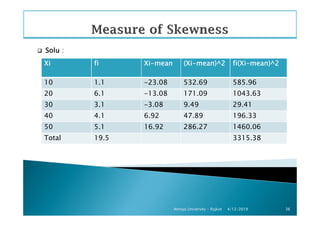
SoluSoluSoluSolu :
XiXiXiXi fifififi XiXiXiXi----meanmeanmeanmean (Xi(Xi(Xi(Xi----mean)^2mean)^2mean)^2mean)^2 fifififi(Xi(Xi(Xi(Xi----mean)^2mean)^2mean)^2mean)^2
10 1.1 -23.08 532.69 585.96
20 6.1 -13.08 171.09 1043.63
30 3.1 -3.08 9.49 29.41
40 4.1 6.92 47.89 196.33
4/12/2019Atmiya University - Rajkot 36
40 4.1 6.92 47.89 196.33
50 5.1 16.92 286.27 1460.06
Total 19.5 3315.38
SoluSoluSoluSolu :
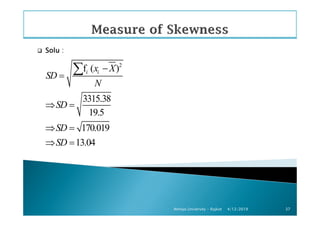
2
f ( )
3315.38
19.5
i ix X
SD
N
SD
−
=
⇒ =
∑
4/12/2019Atmiya University - Rajkot 37
19.5
170.019
13.04
SD
SD
⇒ =
⇒ =
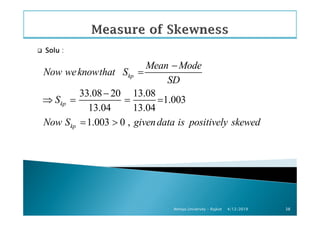
SoluSoluSoluSolu :
33.08 20 13.08
1.003
13.04 13.04
kp
kp
Mean Mode
Now weknowthat S
SD
S
−
=
−
⇒ = = =
4/12/2019Atmiya University - Rajkot 38
13.04 13.04
1.003 0 ,kpNow S givendata is positively skewed= >
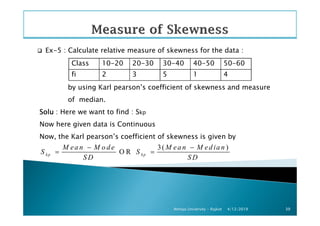
Ex-5 : Calculate relative measure of skewness for the data :
by using Karl pearson’s coefficient of skewness and measure
of median.
SoluSoluSoluSolu : Here we want to find : Skp
Class 10-20 20-30 30-40 40-50 50-60
fi 2 3 5 1 4
4/12/2019Atmiya University - Rajkot 39
SoluSoluSoluSolu : Here we want to find : Skp
Now here given data is Continuous
Now, the Karl pearson’s coefficient of skewness is given by
3( )
O Rkp kp
M ea n M o d e M ea n M ed ia n
S S
S D S D
− −
= =
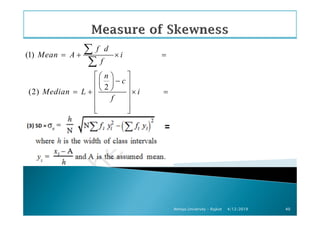
(1)
f d
Mean A i
f
= + × =
∑
∑
2
(2)
n
c
Median L i
f
  
−  
  = + × =
 
  
4/12/2019Atmiya University - Rajkot 40
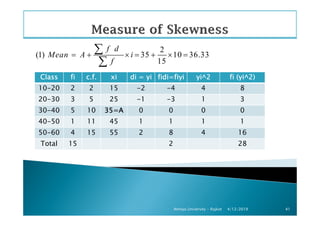
 
2
(1) 35 10 36.33
15
f d
Mean A i
f
= + × = + × =
∑
∑
ClassClassClassClass fifififi c.f.c.f.c.f.c.f. xixixixi didididi ==== yiyiyiyi fidifidifidifidi====fiyifiyifiyifiyi yi^2yi^2yi^2yi^2 fifififi (yi^2)(yi^2)(yi^2)(yi^2)
10-20 2 2 15 -2 -4 4 8
20-30 3 5 25 -1 -3 1 3
30-40 5 10 35=A35=A35=A35=A 0 0 0 0
4/12/2019Atmiya University - Rajkot 41
30-40 5 10 35=A35=A35=A35=A 0 0 0 0
40-50 1 11 45 1 1 1 1
50-60 4 15 55 2 8 4 16
Total 15 2 28
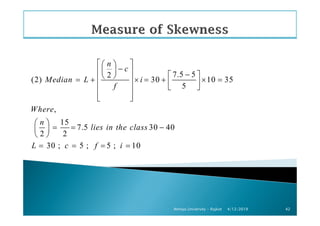
7.5 52
(2) 30 10 35
5
,
n
c
Median L i
f
Where
  
−   −   = + × = + × =   
  
4/12/2019Atmiya University - Rajkot 42
,
15
7.5 30 40
2 2
30 ; 5 ; 5 ; 10
Where
n
lies in the class
L c f i
 
= = − 
 
= = = =
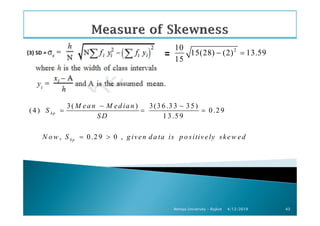
210
15(28) (2) 13.59
15
− =
3( ) 3(3 6 .3 3 3 5)
(4 ) 0 .2 9
1 3 .5 9
kp
M ea n M ed ia n
S
S D
− −
= = =
4/12/2019Atmiya University - Rajkot 43
(4 ) 0 .2 9
1 3 .5 9
, 0 .2 9 0 ,
kp
kp
S
S D
N o w S g iven d a ta is p o sitively skew ed
= = =
= >
Thank youThank you
4/12/2019Atmiya University - Rajkot 44
By
Tushar Bhatt
[M.Sc(Maths), M.Phil(Maths), M.Phil(Stat.),M.A(Edu.),P.G.D.C.A]
Assistant Professor in Mathematics,
Atmiya University,
Rajkot
Correlation and Regression
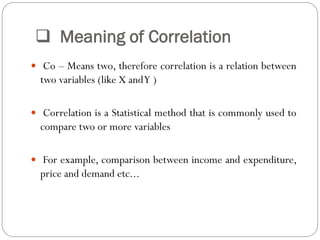
 Meaning of Correlation
 Co – Means two, therefore correlation is a relation between
two variables (like X andY )
 Correlation is a Statistical method that is commonly used to
compare two or more variables
 For example, comparison between income and expenditure,
price and demand etc...
 Definition of Correlation
 Correlation is a statistical measure for finding out degree
(strength) of association between two or more than two
variables.
 Types of Correlation
 There are three types of correlation as follows :
1. Type – 1 correlation
2. Type – 2 correlation
3. Type – 3 correlation
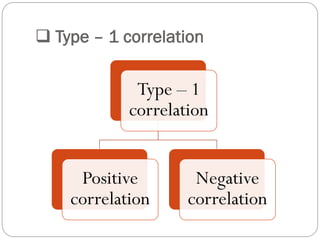
 Type – 1 correlation
Type – 1
correlation
Positive
correlation
Negative
correlation
 Positive Correlation
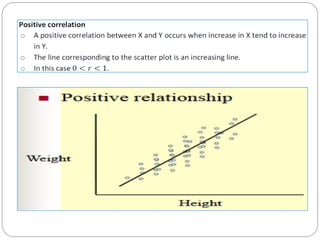
 The correlation is said to be positive, if the values of two
variables changing with same direction.
 In other words as X increasing ,Y is in increasing similarly as
X decreasing ,Y is in decreasing.
 For example :Water consumption andTemperature.
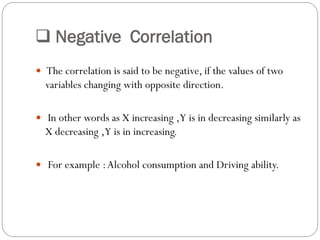
 Negative Correlation
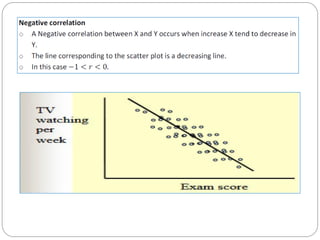
 The correlation is said to be negative, if the values of two
variables changing with opposite direction.
 In other words as X increasing ,Y is in decreasing similarly as
X decreasing ,Y is in increasing.
 For example :Alcohol consumption and Driving ability.
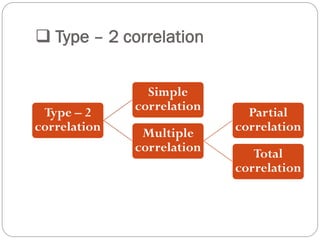
 Type – 2 correlation
Type – 2
correlation
Simple
correlation
Multiple
correlation
Partial
correlation
Total
correlation
 Simple Correlation
 Under simple correlation problem there are only two
variables are studied.
 Multiple Correlation
 Under multiple correlation problem there are three or
more than three variables are studied.
 Partial Correlation
 Under multiple correlation problem there are two
variables considered and other variables keeping as
constant, known as partial correlation.
 Total Correlation
 Total correlation is based on all the relevant variables, which
is normally not feasible .
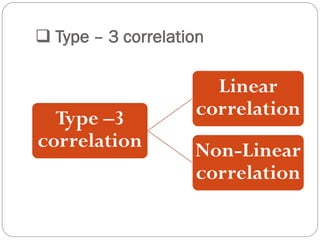
 Type – 3 correlation
Type –3
correlation
Linear
correlation
Non-Linear
correlation
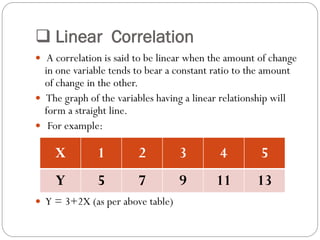
 Linear Correlation
 A correlation is said to be linear when the amount of change
in one variable tends to bear a constant ratio to the amount
of change in the other.
 The graph of the variables having a linear relationship will
form a straight line.
 For example:
 Y = 3+2X (as per above table)
X 1 2 3 4 5
Y 5 7 9 11 13
 Non – Linear Correlation
 The correlation would be non-linear, if the amount of change
in one variable does not bear a constant ratio to the amount
of change in the other variable.
 The methods to measure of correlation
 There are three methods to measure of correlation :
1. Karl Pearson’s coefficient of correlation method
2. Coefficient of correlation for Bivariate Grouped data
method
3. Spearman’s Rank correlation method
4. Scatter diagram method
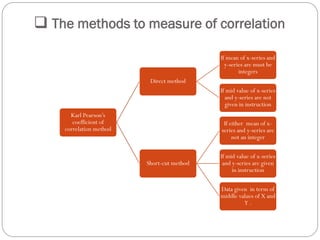
 The methods to measure of correlation
Karl Pearson’s
coefficient of
correlation method
Direct method
If mean of x-series and
y-series are must be
integers
If mid value of x-series
and y-series are not
given in instruction
Short-cut method
If either mean of x-
series and y-series are
not an integer
If mid value of x-series
and y-series are given
in instruction
Data given in term of
middle values of X and
Y .
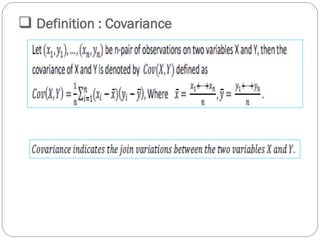
 Definition : Covariance
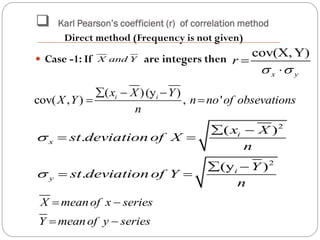
 Karl Pearson’s coefficient (r) of correlation method
 Case -1: If are integers then cov(X, Y)
x y
r
 


( )(y )
cov( , ) , 'i ix X Y
X Y n no of obsevations
n
  
 
2
2
( )
.
(y )
.
i
x
i
y
x X
st deviation of X
n
Y
st deviation of Y
n


 
 
 
 
X and Y
X meanof x series
Y meanof y series
 
 
Direct method (Frequency is not given)
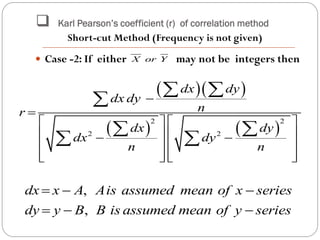
 Karl Pearson’s coefficient (r) of correlation method
 Case -2: If either may not be integers thenX or Y
  
   
2 2
2 2
dx dy
dx dy
nr
dx dy
dx dy
n n


   
    
   
      
 

 
 
,
,
dx x A Ais assumed mean of x series
dy y B B is assumed mean of y series
  
  
Short-cut Method (Frequency is not given)
 Examples
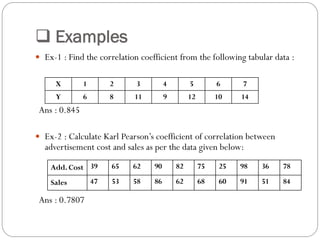
 Ex-1 : Find the correlation coefficient from the following tabular data :
Ans : 0.845
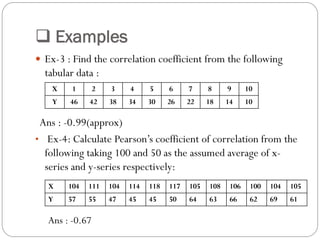
 Ex-2 : Calculate Karl Pearson’s coefficient of correlation between
advertisement cost and sales as per the data given below:
Ans : 0.7807
X 1 2 3 4 5 6 7
Y 6 8 11 9 12 10 14
Add. Cost 39 65 62 90 82 75 25 98 36 78
Sales 47 53 58 86 62 68 60 91 51 84
 Examples
 Ex-3 : Find the correlation coefficient from the following
tabular data :
Ans : -0.99(approx)
• Ex-4: Calculate Pearson’s coefficient of correlation from the
following taking 100 and 50 as the assumed average of x-
series and y-series respectively:
X 1 2 3 4 5 6 7 8 9 10
Y 46 42 38 34 30 26 22 18 14 10
X 104 111 104 114 118 117 105 108 106 100 104 105
Y 57 55 47 45 45 50 64 63 66 62 69 61
Ans : -0.67
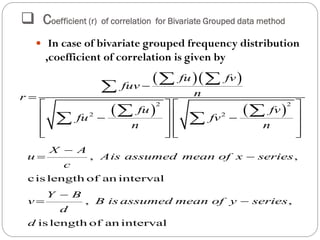
 Coefficient (r) of correlation for Bivariate Grouped data method
 In case of bivariate grouped frequency distribution
,coefficient of correlation is given by
  
   
2 2
2 2
fu fv
fuv
nr
fu fv
fu fv
n n


   
    
   
      
 

 
 
, ,
cis length of an interval
, ,
is length of an interval
X A
u Ais assumed mean of x series
c
Y B
v B is assumed mean of y series
d
d

 

 
 Examples
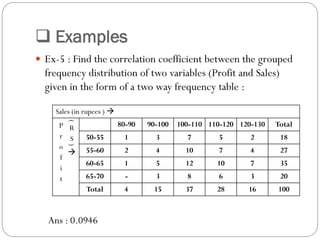
 Ex-5 : Find the correlation coefficient between the grouped
frequency distribution of two variables (Profit and Sales)
given in the form of a two way frequency table :
Ans : 0.0946
Sales (in rupees ) 
P
r
o
f
i
t
(
R
S
)

80-90 90-100 100-110 110-120 120-130 Total
50-55 1 3 7 5 2 18
55-60 2 4 10 7 4 27
60-65 1 5 12 10 7 35
65-70 - 3 8 6 3 20
Total 4 15 37 28 16 100
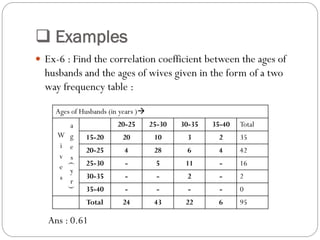
 Examples
 Ex-6 : Find the correlation coefficient between the ages of
husbands and the ages of wives given in the form of a two
way frequency table :
Ans : 0.61
Ages of Husbands (in years )
W
i
v
e
s
a
g
e
s
(
y
r
)
20-25 25-30 30-35 35-40 Total
15-20 20 10 3 2 35
20-25 4 28 6 4 42
25-30 - 5 11 - 16
30-35 - - 2 - 2
35-40 - - - - 0
Total 24 43 22 6 95
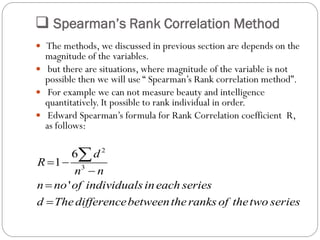
 Spearman’s Rank Correlation Method
 The methods, we discussed in previous section are depends on the
magnitude of the variables.
 but there are situations, where magnitude of the variable is not
possible then we will use “ Spearman’s Rank correlation method”.
 For example we can not measure beauty and intelligence
quantitatively. It possible to rank individual in order.
 Edward Spearman’s formula for Rank Correlation coefficient R,
as follows:
2
3
6
1
'
d
R
n n
n no of individualsineach series
d Thedifferencebetweentheranks of thetwo series
 




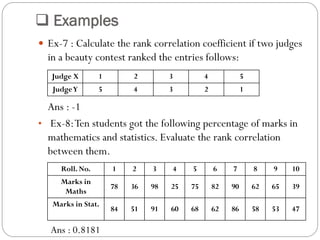
 Examples
 Ex-7 : Calculate the rank correlation coefficient if two judges
in a beauty contest ranked the entries follows:
Ans : -1
• Ex-8:Ten students got the following percentage of marks in
mathematics and statistics. Evaluate the rank correlation
between them.
Judge X 1 2 3 4 5
JudgeY 5 4 3 2 1
Roll. No. 1 2 3 4 5 6 7 8 9 10
Marks in
Maths
78 36 98 25 75 82 90 62 65 39
Marks in Stat.
84 51 91 60 68 62 86 58 53 47
Ans : 0.8181
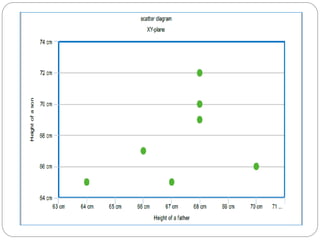
 Scatter Diagram Method
 In this method first we plot the observations in XY – plane .
 X - Independent variable along with horizontal axis.
 Y - Dependent variable along with vertical axis.
 Interpretation of correlation coefficient
 The closer the value of the correlation coefficient is to 1 or -1, the
stronger the relationship between the two variables and the more
the impact their fluctuations will have on each other.
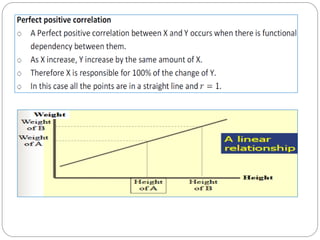
 If the value of r is 1, this denotes a perfect positive relationship
between the two and can be plotted on a graph as a line that goes
upwards, with a high slope.
 If the value of r is 0.5, this will denote a positive relationship
between the two variables and it can be plotted on a graph as a line
that goes upward, with a moderate slope.
 If the value of r is 0, there is no relationship at all between the
two variables.
 If the value of r is -0.5, this will denote a negative relationship
between the two variables and it can be plotted on a graph as a line
that goes downwards with a moderate slope.
 Interpretation of correlation coefficient
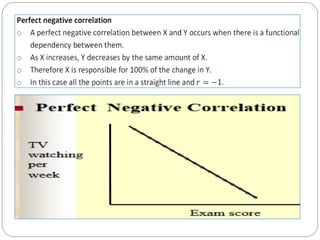
 If the value of r is -1, it will denote a negative relationship
between the two variables and it can be plotted on a graph as a line
that goes downwards with a steep slope.
 If the value of the correlation coefficient is between 0.1 to 0.5 or -
0.1 and -0.5, the two variables in the relationship are said to be
weakly related. If the value of the correlation coefficient is
between 0.9 and 1 or -0.9 and -1, the two variables are extremely
strongly related.
 As we discussed earlier, a positive coefficient will show variables
that rise at the same time.
 A negative coefficient, on the other hand, will show variables that
move in opposite directions. It’s easy to tell the relationship
between by checking the positive or negative value of the
coefficient.
Regression
 Types of Regression
 SIMPLE REGRESSION
Study only two variables at a time.
• MULTIPLE REGRESSION
 Study of more than two variables at a time.
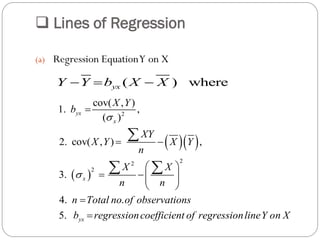
 Lines of Regression
(a) Regression EquationY on X
( ) whereyxY Y b X X  
  
 
2
22
2
cov( , )
1. ,
( )
2. cov( , ) ,
3.
4. .
5.
yx
x
x
yx
X Y
b
XY
X Y X Y
n
X X
n n
n Total no of observations
b regressioncoefficient of regressionlineY on X



 
 
   
 



 
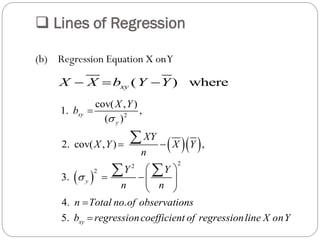
 Lines of Regression
(b) Regression Equation X onY
( ) wherexyX X b Y Y  
  
 
2
22
2
cov( , )
1. ,
( )
2. cov( , ) ,
3.
4. .
5.
xy
y
y
xy
X Y
b
XY
X Y X Y
n
Y Y
n n
n Total no of observations
b regressioncoefficient of regressionline X onY



 
 
   
 



 
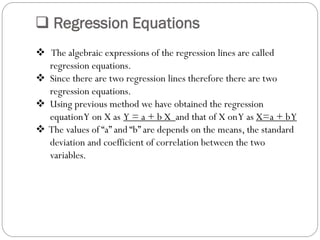
 Regression Equations
 The algebraic expressions of the regression lines are called
regression equations.
 Since there are two regression lines therefore there are two
regression equations.
 Using previous method we have obtained the regression
equationY on X as Y = a + b X and that of X onY as X=a + bY
 The values of “a” and “b” are depends on the means, the standard
deviation and coefficient of correlation between the two
variables.
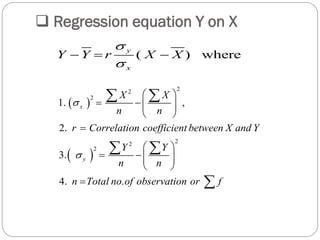
 Regression equation Y on X
( ) wherey
x
Y Y r X X


  
 
 
22
2
22
2
1. ,
2.
3.
4. .
x
y
X X
n n
r Correlation coefficient between X and Y
Y Y
n n
n Total no of observation or f


 
   
 

 
   
 

 
 

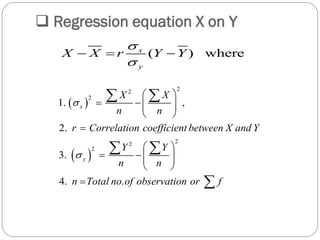
 Regression equation X on Y
( ) wherex
y
X X r Y Y


  
 
 
22
2
22
2
1. ,
2.
3.
4. .
x
y
X X
n n
r Correlation coefficient between X and Y
Y Y
n n
n Total no of observation or f


 
   
 

 
   
 

 
 

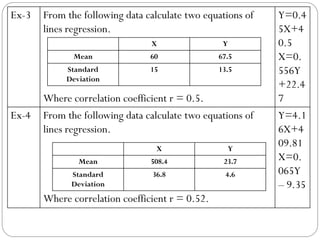
Ex-3 From the following data calculate two equations of
lines regression.
Where correlation coefficient r = 0.5.
Y=0.4
5X+4
0.5
X=0.
556Y
+22.4
7
Ex-4 From the following data calculate two equations of
lines regression.
Where correlation coefficient r = 0.52.
Y=4.1
6X+4
09.81
X=0.
065Y
– 9.35
X Y
Mean 60 67.5
Standard
Deviation
15 13.5
X Y
Mean 508.4 23.7
Standard
Deviation
36.8 4.6
 Difference between correlation and Regression
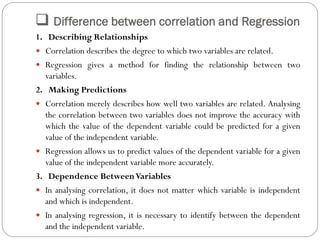
1. Describing Relationships
 Correlation describes the degree to which two variables are related.
 Regression gives a method for finding the relationship between two
variables.
2. Making Predictions
 Correlation merely describes how well two variables are related. Analysing
the correlation between two variables does not improve the accuracy with
which the value of the dependent variable could be predicted for a given
value of the independent variable.
 Regression allows us to predict values of the dependent variable for a given
value of the independent variable more accurately.
3. Dependence BetweenVariables
 In analysing correlation, it does not matter which variable is independent
and which is independent.
 In analysing regression, it is necessary to identify between the dependent
and the independent variable.
Assignment
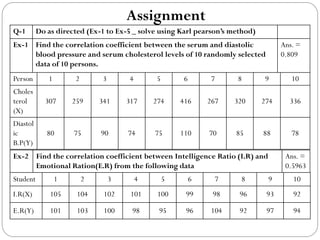
Q-1 Do as directed (Ex-1 to Ex-5 _ solve using Karl pearson’s method)
Ex-1 Find the correlation coefficient between the serum and diastolic
blood pressure and serum cholesterol levels of 10 randomly selected
data of 10 persons.
Ans. =
0.809
Person 1 2 3 4 5 6 7 8 9 10
Choles
terol
(X)
307 259 341 317 274 416 267 320 274 336
Diastol
ic
B.P(Y)
80 75 90 74 75 110 70 85 88 78
Ex-2 Find the correlation coefficient between Intelligence Ratio (I.R) and
Emotional Ration(E.R) from the following data
Ans. =
0.5963
Student 1 2 3 4 5 6 7 8 9 10
I.R(X) 105 104 102 101 100 99 98 96 93 92
E.R(Y) 101 103 100 98 95 96 104 92 97 94
Assignment
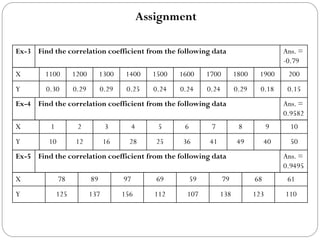
Ex-3 Find the correlation coefficient from the following data Ans. =
-0.79
X 1100 1200 1300 1400 1500 1600 1700 1800 1900 200
Y 0.30 0.29 0.29 0.25 0.24 0.24 0.24 0.29 0.18 0.15
Ex-4 Find the correlation coefficient from the following data Ans. =
0.9582
X 1 2 3 4 5 6 7 8 9 10
Y 10 12 16 28 25 36 41 49 40 50
Ex-5 Find the correlation coefficient from the following data Ans. =
0.9495
X 78 89 97 69 59 79 68 61
Y 125 137 156 112 107 138 123 110
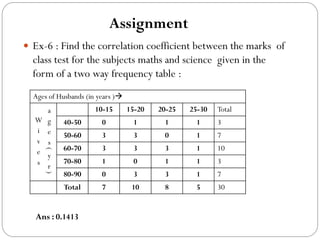
 Ex-6 : Find the correlation coefficient between the marks of
class test for the subjects maths and science given in the
form of a two way frequency table :
Assignment
Ages of Husbands (in years )
W
i
v
e
s
a
g
e
s
(
y
r
)
10-15 15-20 20-25 25-30 Total
40-50 0 1 1 1 3
50-60 3 3 0 1 7
60-70 3 3 3 1 10
70-80 1 0 1 1 3
80-90 0 3 3 1 7
Total 7 10 8 5 30
Ans : 0.1413
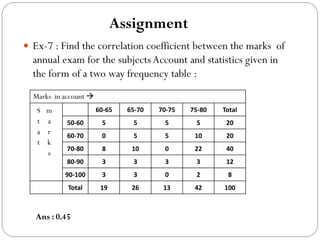
 Ex-7 : Find the correlation coefficient between the marks of
annual exam for the subjectsAccount and statistics given in
the form of a two way frequency table :
Assignment
Marks in account 
S
t
a
t
m
a
r
k
s
60-65 65-70 70-75 75-80 Total
50-60 5 5 5 5 20
60-70 0 5 5 10 20
70-80 8 10 0 22 40
80-90 3 3 3 3 12
90-100 3 3 0 2 8
Total 19 26 13 42 100
Ans : 0.45
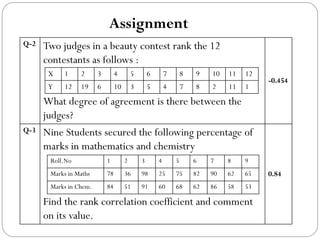
Q-2 Two judges in a beauty contest rank the 12
contestants as follows :
What degree of agreement is there between the
judges?
-0.454
Q-3 Nine Students secured the following percentage of
marks in mathematics and chemistry
Find the rank correlation coefficient and comment
on its value.
0.84
Assignment
X 1 2 3 4 5 6 7 8 9 10 11 12
Y 12 19 6 10 3 5 4 7 8 2 11 1
Roll.No 1 2 3 4 5 6 7 8 9
Marks in Maths 78 36 98 25 75 82 90 62 65
Marks in Chem. 84 51 91 60 68 62 86 58 53
Assignment
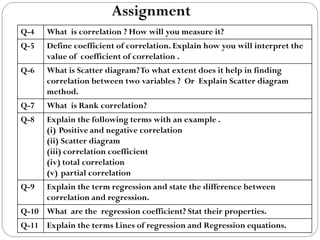
Q-4 What is correlation ? How will you measure it?
Q-5 Define coefficient of correlation. Explain how you will interpret the
value of coefficient of correlation .
Q-6 What is Scatter diagram?To what extent does it help in finding
correlation between two variables ? Or Explain Scatter diagram
method.
Q-7 What is Rank correlation?
Q-8 Explain the following terms with an example .
(i) Positive and negative correlation
(ii) Scatter diagram
(iii) correlation coefficient
(iv) total correlation
(v) partial correlation
Q-9 Explain the term regression and state the difference between
correlation and regression.
Q-10 What are the regression coefficient? Stat their properties.
Q-11 Explain the terms Lines of regression and Regression equations.
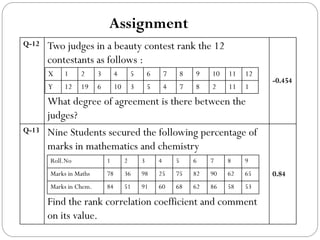
Q-12 Two judges in a beauty contest rank the 12
contestants as follows :
What degree of agreement is there between the
judges?
-0.454
Q-13 Nine Students secured the following percentage of
marks in mathematics and chemistry
Find the rank correlation coefficient and comment
on its value.
0.84
Assignment
X 1 2 3 4 5 6 7 8 9 10 11 12
Y 12 19 6 10 3 5 4 7 8 2 11 1
Roll.No 1 2 3 4 5 6 7 8 9
Marks in Maths 78 36 98 25 75 82 90 62 65
Marks in Chem. 84 51 91 60 68 62 86 58 53
Mathematicians are born not made
By
Tushar Bhatt
4/12/2019Atmiya University - Rajkot 1
Content
 Introduction
 Random Experiments
 Sample space
 Events and their probabilities
 Random variable probability distribution
 t-test, Paired t – test, F – test (ANOVA)
 Comparison of results of above tests
4/12/2019Atmiya University - Rajkot 2
 Introduction
4/12/2019Atmiya University - Rajkot 3
 Def : Experiment/ Random experiment
An activity or phenomenon that is under consideration is called an
experiment .
 Def : Trial
A single performance of an experiment is briefly called a trial.
 Def : Outcome or Sample points
The experiment can produce a variety of results called outcomes or
sample points.
 Introduction
4/12/2019Atmiya University - Rajkot 4
 Def : Sample space
The set of all possible outcomes of an experiment is called sample
space and it is denoted by S .
 For example :
1. A random experiment of tossing a coin then S = { H, T }
2. A random experiment of throwing a die then S = { 1,2,3,4,5,6 }
3. If two coins are tossed simultaneously then
S = { (H, H), (T, T), (H, T), (T, H) }
 Introduction
4/12/2019Atmiya University - Rajkot 5
 Def : Event
Any subset of sample space is called event.
 For example :
1. A random experiment of throwing a die then S = { 1,2,3,4,5,6 }
let A be an event that an odd number appears on the die then
A = { 1, 3, 5 }
 Introduction
4/12/2019Atmiya University - Rajkot 6
 Def : Favourable outcomes
If an event A is defined on sample space S then the sample points
which are included in A are called favourable outcomes for the
event A.
 For example :
1. A random experiment of throwing a die then S = { 1,2,3,4,5,6 }
let A = { 1,2,3,4 } in which 1,2,3,4 are favourable outcomes.
 Types of event
4/12/2019Atmiya University - Rajkot 7
 Def : Exhaustive events
The total number of all possible outcomes of an experiment is
called exhaustive events.
 For example :
1. In tossing a coin there are two exhaustive events (a) Head and
(b) Tail.
 Types of event
4/12/2019Atmiya University - Rajkot 8
 Def : Mutually exclusive events
-Events are said to be mutually exclusive or disjoint or
incompatible, if one and only one of them can take place at a time .
- If then the events A and B are said to be mutually
exclusive events.
 For example :
1. In tossing a coin the events (a) Head and (b) Tail are mutually
exclusive.
A B  
 Types of event
4/12/2019Atmiya University - Rajkot 9
 Def : Equally likely events
-Events are said to be equally likely , if one event can not perform
without help of other event.
 For example :
1. In tossing a coin the events (a) Head or(b) Tail are equally
likely events.
 Types of event
4/12/2019Atmiya University - Rajkot 10
 Def : Independent events
-Two or more events are said to be independent, if in performance
of one event does not effect on performance of other event.
- Otherwise they are said to be dependent.
 For example :
1. In tossing a coin, the result of the first toss does not effect on
result of the second toss.
 Types of event
4/12/2019Atmiya University - Rajkot 11
 Def : Certain events
-The event which is sure to occur, is called certain event.
- Sample space S is certain event.
 Def : Impossible events
- The event which is impossible to occur at all, is called impossible
event and it is denoted by 
 For example :
1. In tossing a die, the event that number 7 will occur is
impossible event.
 Types of event
4/12/2019Atmiya University - Rajkot 12
 Def : Favourable events
- All those events which result in the occurrence of the event,
under consideration is called favourable event.
 For example :
1. In throwing two die, the favourable events of getting the sum 5
is (1, 4), (4, 1), (2, 3), (3, 2).
 Types of event
4/12/2019Atmiya University - Rajkot 13
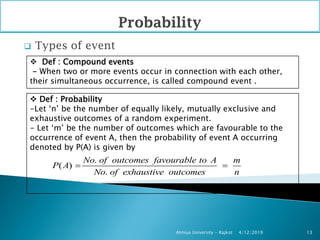
 Def : Compound events
- When two or more events occur in connection with each other,
their simultaneous occurrence, is called compound event .
 Def : Probability
-Let ‘n’ be the number of equally likely, mutually exclusive and
exhaustive outcomes of a random experiment.
- Let ‘m’ be the number of outcomes which are favourable to the
occurrence of event A, then the probability of event A occurring
denoted by P(A) is given by
.
( )
.
No of outcomes favourable to A m
P A
No of exhaustive outcomes n
 
 Probability
4/12/2019Atmiya University - Rajkot 14
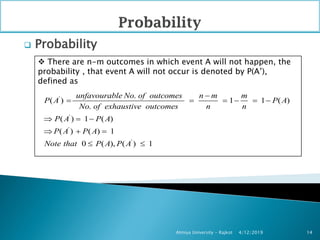
 There are n-m outcomes in which event A will not happen, the
probability , that event A will not occur is denoted by P(A’),
defined as
'
'
'
'
.
( ) 1 1 ( )
.
( ) 1 ( )
( ) ( ) 1
0 ( ), ( ) 1
unfavourable No of outcomes n m m
P A P A
No of exhaustive outcomes n n
P A P A
P A P A
Note that P A P A

     
  
  
 
 Probability
4/12/2019Atmiya University - Rajkot 15
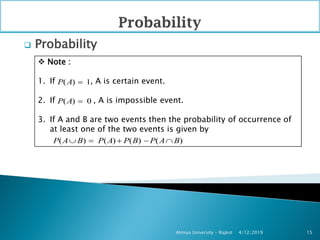
 Note :
1. If , A is certain event.
2. If , A is impossible event.
3. If A and B are two events then the probability of occurrence of
at least one of the two events is given by
( ) 1P A 
( ) 0P A 
( ) ( ) ( ) ( )P A B P A P B P A B    
 Probability
4/12/2019Atmiya University - Rajkot 16
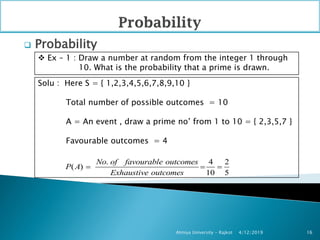
 Ex – 1 : Draw a number at random from the integer 1 through
10. What is the probability that a prime is drawn.
Solu : Here S = { 1,2,3,4,5,6,7,8,9,10 }
Total number of possible outcomes = 10
A = An event , draw a prime no’ from 1 to 10 = { 2,3,5,7 }
Favourable outcomes = 4
. 4 2
( )
10 5
No of favourable outcomes
P A
Exhaustive outcomes
  
 Probability
4/12/2019Atmiya University - Rajkot 17
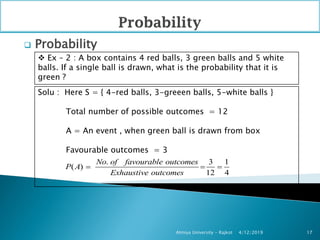
 Ex – 2 : A box contains 4 red balls, 3 green balls and 5 white
balls. If a single ball is drawn, what is the probability that it is
green ?
Solu : Here S = { 4-red balls, 3-greeen balls, 5-white balls }
Total number of possible outcomes = 12
A = An event , when green ball is drawn from box
Favourable outcomes = 3
. 3 1
( )
12 4
No of favourable outcomes
P A
Exhaustive outcomes
  
 Probability
4/12/2019Atmiya University - Rajkot 18
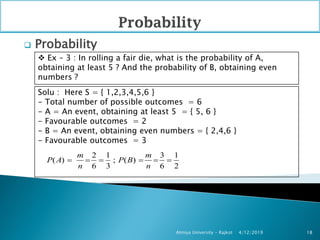
 Ex – 3 : In rolling a fair die, what is the probability of A,
obtaining at least 5 ? And the probability of B, obtaining even
numbers ?
Solu : Here S = { 1,2,3,4,5,6 }
- Total number of possible outcomes = 6
- A = An event, obtaining at least 5 = { 5, 6 }
- Favourable outcomes = 2
- B = An event, obtaining even numbers = { 2,4,6 }
- Favourable outcomes = 3
2 1 3 1
( ) ; ( )
6 3 6 2
m m
P A P B
n n
     
 Permutations
4/12/2019Atmiya University - Rajkot 19
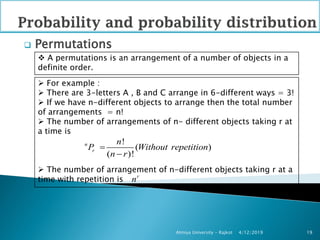
 A permutations is an arrangement of a number of objects in a
definite order.
 For example :
 There are 3-letters A , B and C arrange in 6-different ways = 3!
 If we have n-different objects to arrange then the total number
of arrangements = n!
 The number of arrangements of n- different objects taking r at
a time is
 The number of arrangement of n-different objects taking r at a
time with repetition is
!
( )
( )!
n
r
n
P Without repetition
n r


r
n
 Permutations
4/12/2019Atmiya University - Rajkot 20
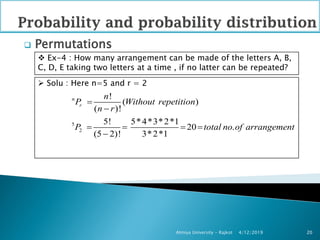
 Ex-4 : How many arrangement can be made of the letters A, B,
C, D, E taking two letters at a time , if no latter can be repeated?
 Solu : Here n=5 and r = 2
5
2
!
( )
( )!
5! 5*4*3*2*1
20 .
(5 2)! 3*2*1
n
r
n
P Without repetition
n r
P total no of arrangement


   

 Permutations
4/12/2019Atmiya University - Rajkot 21
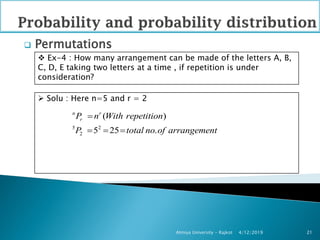
 Ex-4 : How many arrangement can be made of the letters A, B,
C, D, E taking two letters at a time , if repetition is under
consideration?
 Solu : Here n=5 and r = 2
5 2
2
( )
5 25 .
n r
rP n With repetition
P total no of arrangement

  
 Combinations :
4/12/2019Atmiya University - Rajkot 22
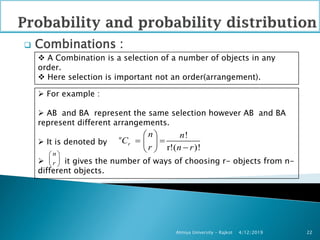
 A Combination is a selection of a number of objects in any
order.
 Here selection is important not an order(arrangement).
 For example :
 AB and BA represent the same selection however AB and BA
represent different arrangements.
 It is denoted by
 it gives the number of ways of choosing r- objects from n-
different objects.
!
r!( )!
n
r
n n
C
r n r
 
  
 n
r
 
 
 
 Combinations :
4/12/2019Atmiya University - Rajkot 23
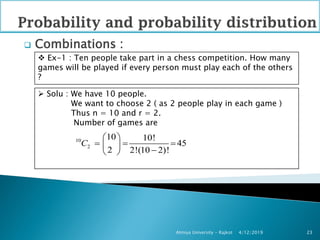
 Ex-1 : Ten people take part in a chess competition. How many
games will be played if every person must play each of the others
?
 Solu : We have 10 people.
We want to choose 2 ( as 2 people play in each game )
Thus n = 10 and r = 2.
Number of games are
10
2
10 10!
45
2 2!(10 2)!
C
 
   
 
 Note :
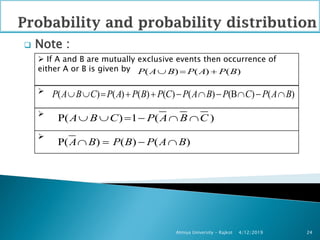
4/12/2019Atmiya University - Rajkot 24
 If A and B are mutually exclusive events then occurrence of
either A or B is given by ( ) ( ) ( )P A B P A P B  
 ( ) ( ) ( ) ( ) ( ) (B ) ( )P A B C P A P B P C P A B P C P A B          

P( ) 1 ( )A B C P A B C     

P( ) ( ) ( )A B P B P A B   
4/12/2019Atmiya University - Rajkot 25
4/12/2019Atmiya University - Rajkot 26
4/12/2019Atmiya University - Rajkot 27
4/12/2019Atmiya University - Rajkot 28
4/12/2019Atmiya University - Rajkot 29
4/12/2019Atmiya University - Rajkot 30
4/12/2019Atmiya University - Rajkot 31
4/12/2019Atmiya University - Rajkot 32
4/12/2019Atmiya University - Rajkot 33
4/12/2019Atmiya University - Rajkot 34
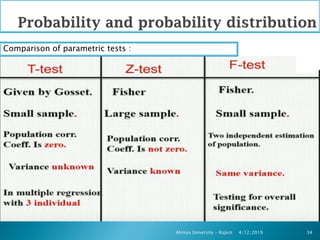
Comparison of parametric tests :
4/12/2019Atmiya University - Rajkot 35

Statistical Methods

  • 1.
    Module 1 Statistics –Definition and Scope OUTLINE ( Teaching Hours - 5) 1 1. Introduction 2. Sample and Population 3. Data Analysis : Classifications and Tabulations 4. Graphical representation and its interpretations By Tushar Bhatt, Assistant Professor in Mathematics, Atmiya University, Rajkot.4/12/201 9
  • 2.
    Classification of Data Qualitative Whenthe basis of classification according to characteristics like social status and etc., is called qualitative data. For example : 1. Reach and Poor Persons 2. Educated and Uneducated Persons etc., 2 Quantitative When the basis of classification according to differences in quantity means is made according to a numerical size is called quantitative data. For example : 1. A class of students split up into groups according to their heights or ages. By Tushar Bhatt, Assistant Professor in Mathematics, Atmiya University, Rajkot. 4/12/201 9
  • 3.
    Classification of Data Temporal Theclassification according to time is called temporal classification of data For example : 1. The students who got first class during the last three years are classified year wise. 3 Geographical The classification according to geographical location or place is called geographical classification of data. For example : 1. The production of wheat (in quintals) in different states. By Tushar Bhatt, Assistant Professor in Mathematics, Atmiya University, Rajkot. 4/12/201 9
  • 4.
    Tabulation of Data Thelast stage in compilation of data is tabulation. After the data have been collected and classified , it is essential to put them in the form of tables with rows and columns. 4 Tabulation is a scientific process used in setting out the collected data in an understandable form. By Tushar Bhatt, Assistant Professor in Mathematics, Atmiya University, Rajkot. 4/12/201 9
  • 5.
    Ex-1 : In1990, out of a total of 2000 students in a college 1400 were from graduation and the rest for post – graduation. Out of 1400 graduates students 100 were girls. However in all there were 600 girls in the college. In 1995, number of graduates students increased to 1700 out of which 250 were girls, but the number of post – graduate fall to 500 of which Tabulation girls, but the number of post – graduate fall to 500 of which only 50 were boys . In 2000, out of 800 girls 650 were from graduation , whereas the total number of graduates was 2200. The number of boys and girls in post – graduation classes was equal. Represent the above information in tabular form. Also calculate the percentage increase in the number of graduate students in 2000 as compared to 1990. 5By Tushar Bhatt, Assistant Professor in Mathematics, Atmiya University, Rajkot. 4/12/201 9
  • 6.
    Ex-2 : Ina sample study about coffee habit in two towns in the year 1990, the following information was received : • Town A : Females were 40% , total coffee drinkers were 45% and males non – coffee drinkers were 20%. • Town B : Males were 55% , Males non- coffee drinkers were Tabulation • Town B : Males were 55% , Males non- coffee drinkers were 30% and female coffee drinkers were 15%. Present the above data in a tabular form. 6By Tushar Bhatt, Assistant Professor in Mathematics, Atmiya University, Rajkot. 4/12/201 9
  • 7.
    Tabulation Town A Town B MF Total M F Total Coffee drinkers 40 5 45 25 15 40 Solution -2 7By Tushar Bhatt, Assistant Professor in Mathematics, Atmiya University, Rajkot. 4/12/201 9 Coffee drinkers 40 5 45 25 15 40 Non-Coffee drinkers 20 35 55 30 30 60 Total 60 40 100 55 45 100
  • 8.
    There are 3– methods to represent the Ungrouped data in graphical way : a) Pictograms b) Bar Charts c) Pie Diagrams Graphical Representations of Ungrouped data c) Pie Diagrams 8By Tushar Bhatt, Assistant Professor in Mathematics, Atmiya University, Rajkot. 4/12/201 9
  • 9.
    a) Pictograms : Inthis representation method the ungrouped data in which represent the frequency by horizontal line and square. Graphical Representations of Ungrouped data Ex – 3 : The number of television sets repaired in a workshop 9 Ex – 3 : The number of television sets repaired in a workshop by a technician is six, one month period is as shown below. Present these data as a pictogram. Month Number repaired January 11 February 06 March 15 April 09 May 13 June 08 By Tushar Bhatt, Assistant Professor in Mathematics, Atmiya University, Rajkot. 4/12/201 9
  • 10.
    Graphical Representations ofUngrouped data Month No. Of TV set repaired = 2 January February March April May Solution -3 10By Tushar Bhatt, Assistant Professor in Mathematics, Atmiya University, Rajkot. 4/12/201 9 May June
  • 11.
    b) Bar Charts: Bar Charts is a representation of a numbers using bars of uniform width and length of bars depends upon frequency and scale you have chosen. Graphical Representations of Ungrouped data 11 Horizontal Bar charts Vertical Bar charts The data represent by equally spaced in horizontal rectangles Rectangles parallel to X -axis The data represent by equally spaced in vertical rectangles Rectangles parallel to Y – axis By Tushar Bhatt, Assistant Professor in Mathematics, Atmiya University, Rajkot. 4/12/201 9
  • 12.
    Ex-4 : Thedistance in kilometers travelled by 4- salesman in a week are as shown below : Graphical Representations of Ungrouped data Salesman (Y) P Q R S Distance Travelled (X) 413 264 597 143 Use a horizontal bar chart to represent these data diagrammatically. 12By Tushar Bhatt, Assistant Professor in Mathematics, Atmiya University, Rajkot. 4/12/201 9 (X)
  • 13.
    Graphical Representations ofUngrouped data R S Distance Travelled in Km by a salesman Solution -4 13By Tushar Bhatt, Assistant Professor in Mathematics, Atmiya University, Rajkot. 4/12/201 9 0 200 400 600 800 P Q R Distance Travelled in Km by a sales man
  • 14.
    Ex-5 : Thenumber of tools from a store in a factory is observed for seven , one –hour period in a day and the results of the survey are as follows : Graphical Representations of Ungrouped data Perio d(X) 1 2 3 4 5 6 7 No. Present these data on a vertical bar chart. 14By Tushar Bhatt, Assistant Professor in Mathematics, Atmiya University, Rajkot. 4/12/201 9 No. Of issues (Y) 34 17 9 5 27 13 6
  • 15.
    Graphical Representations ofUngrouped data 25 30 35 40 No of tools issues by factory in one -hour period Solution -5 15By Tushar Bhatt, Assistant Professor in Mathematics, Atmiya University, Rajkot. 4/12/201 9 0 5 10 15 20 25 1 2 3 4 5 6 7 No of tools issues by factory in one -hour period
  • 16.
    (C) Pie Chart: The pie chart is represented by a circle. The are of circle represent the whole and the area of sectors of the circle are proportional to the part which make up the whole. Graphical Representations of Ungrouped data make up the whole. 16By Tushar Bhatt, Assistant Professor in Mathematics, Atmiya University, Rajkot. 4/12/201 9 * Steps for making a Pie Chart : Step -1 : Find total Step – 2 : Convert into % Step -3 : % convert into degree Step – 4 : Arrange in ascending order Step – 5 : Plot and Label.
  • 17.
    Ex-6 : InIGNOU university year 2005 , course wise admission data is given below : Graphical Representations of Ungrouped data Course Number of students M.A 200 M.com 600 Represent the above data on pie chart. 17By Tushar Bhatt, Assistant Professor in Mathematics, Atmiya University, Rajkot. 4/12/201 9 M.Sc 400 M.B.A 800
  • 18.
    Graphical Representations ofUngrouped data Solution -6 Courses No. Of students % Deg. Increasing order M.A 200 10% 36 1 M.com 600 30% 108 3 M.Sc 400 20% 72 2 18By Tushar Bhatt, Assistant Professor in Mathematics, Atmiya University, Rajkot. 4/12/201 9 M.Sc 400 20% 72 2 M.B.A 800 40% 144 4 TOTAL 2000 100% 360 ----------
  • 19.
    Graphical Representations ofUngrouped data M.A 10% M.ScM.B.A No. Of students in various courses of IGNOU university in year 2005 Solution -6 19By Tushar Bhatt, Assistant Professor in Mathematics, Atmiya University, Rajkot. 4/12/201 9 M.Sc 20% M.Com 30% M.B.A 40% Total number of students =2000
  • 20.
    Graphical Representations ofGrouped data o The Graphical representation of grouped data is classified into 3-categarioes : (a) Histogram (b) Frequency Polygon (c) Ogive 20By Tushar Bhatt, Assistant Professor in Mathematics, Atmiya University, Rajkot. 4/12/201 9 (c) Ogive
  • 21.
    Graphical Representations ofGrouped data (a) Histogram : The histogram is mainly used for presentation of grouped data in which the respective frequency of the classes are plot on a graph as a vertical adjacent rectangles. If class intervals are of equal length then the heights of rectangles of a histograms are equal to frequencies. If class intervals are of not equal length then the heights of 21By Tushar Bhatt, Assistant Professor in Mathematics, Atmiya University, Rajkot. 4/12/201 9 If class intervals are of not equal length then the heights of rectangles of a histograms are obtain by using following manner: 1. Upper class boundary+5 2. Lower class boundary -5 3. Class range = [(Upper class boundary+5) - (Lower class boundary -5)] 4. Heights of rectangles are = Frequency of the class / class range.
  • 22.
    Graphical Representations ofGrouped data Ex- 7 : Construct a histogram from the following tabular data : Class Frequency 70-72 1 73-75 2 76-78 7 79-81 12 22By Tushar Bhatt, Assistant Professor in Mathematics, Atmiya University, Rajkot. 4/12/201 9 79-81 12 82-84 9 85-87 6 88-90 3
  • 23.
    Graphical Representations ofGrouped data Solution : 7 Class Class Mid - Point Frequency 70-72 71 1 73-75 74 2 76-78 77 7 79-81 80 12 23By Tushar Bhatt, Assistant Professor in Mathematics, Atmiya University, Rajkot. 4/12/201 9 79-81 80 12 82-84 83 9 85-87 86 6 88-90 89 3
  • 24.
    Graphical Representations ofGrouped data Solution : 7 24By Tushar Bhatt, Assistant Professor in Mathematics, Atmiya University, Rajkot. 4/12/201 9
  • 25.
    Graphical Representations ofGrouped data Ex- 8 : Construct a histogram from the following tabular data : Class Frequency 20-40 2 50-70 6 80-90 12 100-110 14 25By Tushar Bhatt, Assistant Professor in Mathematics, Atmiya University, Rajkot. 4/12/201 9 100-110 14 120-140 4 150-170 2
  • 26.
    Graphical Representations ofGrouped data Solution : 8 Class Mid- Point Frequen cy Upper class Boundar y Lower class Boundar y Class Range Height of rectangle 20-40 30 2 45 15 30 2/30 = 0.06 50-70 60 6 75 45 30 6/30 = 0.20 80-90 85 12 95 75 20 12/20=0.60 26By Tushar Bhatt, Assistant Professor in Mathematics, Atmiya University, Rajkot. 4/12/201 9 80-90 85 12 95 75 20 12/20=0.60 100- 110 105 14 115 95 20 14/20=0.70 120- 140 130 4 145 115 30 4/30=0.13 150- 170 160 2 175 145 30 2/30=0.06
  • 27.
    Graphical Representations ofGrouped data Solution : 8 27By Tushar Bhatt, Assistant Professor in Mathematics, Atmiya University, Rajkot. 4/12/201 9
  • 28.
    Graphical Representations ofGrouped data (b) Frequency Polygon : The Frequency Polygon is a graph obtained by plotting frequency against mid-point values and joining the coordinates with straight lines. If the class intervals are very small then the frequency polygon assumes the form of a smooth curve known as the 28By Tushar Bhatt, Assistant Professor in Mathematics, Atmiya University, Rajkot. 4/12/201 9 polygon assumes the form of a smooth curve known as the frequency curve.
  • 29.
    Graphical Representations ofGrouped data Ex-9 : Draw the frequency polygon for the data given in following table : Class Mid-Point Frequency 7.1-7.3 7.2 3 7.4-7.6 7.5 5 29By Tushar Bhatt, Assistant Professor in Mathematics, Atmiya University, Rajkot. 4/12/201 9 7.5-7.9 7.8 9 8.0-8.2 8.1 14 8.1-8.5 8.4 11 8.2-8.8 8.7 6 8.9-9.1 9.0 2
  • 30.
    Graphical Representations ofGrouped data Solution : 9 12 14 16 Frequency Frequency Polygon 30By Tushar Bhatt, Assistant Professor in Mathematics, Atmiya University, Rajkot. 4/12/201 9 0 2 4 6 8 10 7.2 7.5 7.8 8.1 8.4 8.7 9 Frequency Class Mid-Point
  • 31.
    Graphical Representations ofGrouped data (C) Ogive or Cumulative Frequency Distribution curve : The curve is obtained by joining the coordinates of cumulative frequency (vertically ) against upper class boundary ( horizontally) is called an Ogive or Cumulative Frequency Distribution curve . 31By Tushar Bhatt, Assistant Professor in Mathematics, Atmiya University, Rajkot. 4/12/201 9
  • 32.
    Graphical Representations ofGrouped data Ex-10 : The frequency distribution for marks of 50 students is given in the following table. Form cumulative frequency distribution for these data and draw the corresponding Ogive. Class Frequency 0-10 2 10-20 4 32By Tushar Bhatt, Assistant Professor in Mathematics, Atmiya University, Rajkot. 4/12/201 9 20-30 10 30-40 4 40-50 3 50-60 8 60-70 1 70-80 5 80-90 11 90-100 2
  • 33.
    Graphical Representations ofGrouped data Solution : 10 Class Frequency Upper class Boundary Cumulative frequency 0-10 2 10 2 10-20 4 20 6 20-30 10 30 16 30-40 4 40 20 33By Tushar Bhatt, Assistant Professor in Mathematics, Atmiya University, Rajkot. 4/12/201 9 30-40 4 40 20 40-50 3 50 23 50-60 8 60 31 60-70 1 70 32 70-80 5 80 37 80-90 11 90 48 90-100 2 100 50
  • 34.
    Graphical Representations ofGrouped data Solution : 10 30 40 50 60 CumulativeFrequency Ogive 34By Tushar Bhatt, Assistant Professor in Mathematics, Atmiya University, Rajkot. 4/12/201 9 0 10 20 30 10 20 30 40 50 60 70 80 90 100 CumulativeFrequency Ogive Upper class boundary value in marks
  • 35.
    Thank You 35By Tushar Bhatt,Assistant Professor in Mathematics, Atmiya University, Rajkot. 4/12/2019 You
  • 36.
    Module 2 Measures ofCentral Tendency OUTLINE ( Teaching Hours - 5) 1. Introduction 1 1. Introduction 2. Mean 3. Median 4. Mode By Tushar Bhatt, Assistant Professor in Mathematics, Atmiya University, Rajkot. 4/12/2019
  • 37.
    Types of Data Herewe are study mainly 3-types of data (observations) : 2By Tushar Bhatt, Assistant Professor in Mathematics, Atmiya University, Rajkot. 4/12/2019
  • 38.
    Measure of CentralTendency A single expression, representing the whole group , is selected which may convey a fairly enough idea about the whole group . This single expression in statistics is known as the average . The average are generally the central part of the distribution and therefore they are also called the measure of central tendency. 3 Now there are five types of measure of central tendency which are commonly used . These are , 1. ARITHMATIC MEAN 2. GEOMETRIC MEAN 3. HARMONIC MEAN 4. MEDIAN 5. MODE By Tushar Bhatt, Assistant Professor in Mathematics, Atmiya University, Rajkot. 4/12/2019
  • 39.
    Arithmetic Mean There arethree ways to obtain A.M for the given data : 1. A.M for Individual Observations : Let 4By Tushar Bhatt, Assistant Professor in Mathematics, Atmiya University, Rajkot. 4/12/2019 2. A.M for Discrete Observations : Let ; , - f di iX A A Assumed Mean d X Ai ifi ∑ = + = = ∑
  • 40.
    Arithmetic Mean There arethree ways to obtain A.M for the given data : 3. A.M for Continuous Observations : In this type of observations we have class and their corresponding frequency are given then the A.M of the given data is defined as : 5By Tushar Bhatt, Assistant Professor in Mathematics, Atmiya University, Rajkot. 4/12/2019 the given data is defined as :
  • 41.
    Arithmetic Mean Ex-1 :Find the A.M of the marks obtained by 10 students of class X in mathematics in a certain examination. The marks obtained are : 25,30,21,55,47,10,15,17,45,35. Solu : Here the given observations are individual then A.M = 6By Tushar Bhatt, Assistant Professor in Mathematics, Atmiya University, Rajkot. 4/12/2019 A.M = Therefore A.M is
  • 42.
    Arithmetic Mean Ex-2 :Find the A.M from the following frequency table: Solu : Here the given observations are discrete then Marks 52 58 60 65 68 70 75 No. Of students 7 5 4 6 3 3 2 7By Tushar Bhatt, Assistant Professor in Mathematics, Atmiya University, Rajkot. 4/12/2019 Solu : Here the given observations are discrete then A.M = ; , - f di iX A A Assumed Mean d X Ai ifi ∑ = + = = ∑
  • 43.
    Arithmetic Mean Marks(x) fd = x-A fd 52 7 -13 -91 58 5 -7 -35 60 4 -5 -20 65=A 6 0 0 68 3 3 9 8By Tushar Bhatt, Assistant Professor in Mathematics, Atmiya University, Rajkot. 4/12/2019 68 3 3 9 70 3 5 15 75 2 10 20 Total 30 -7 -102
  • 44.
    Arithmetic Mean 102 65 3.461.6 30 65 f d i iX A f i = − = ∑ = + = − ∑ 9By Tushar Bhatt, Assistant Professor in Mathematics, Atmiya University, Rajkot. 4/12/2019
  • 45.
    Arithmetic Mean Ex-3 :Find the A.M from the following data : Class 0-30 30-60 60-90 90-120 120-150 150-180 Frequency 8 13 22 27 18 7 Solu : Here given data is continuous therefore, 10By Tushar Bhatt, Assistant Professor in Mathematics, Atmiya University, Rajkot. 4/12/2019 Where,
  • 46.
    Arithmetic Mean Class fMid Value(X) d = X- A/ i fd 0-30 8 15 -2 -16 30-60 13 45 -1 -13 60-90 22 75 = A 0 0 90-120 27 105 1 27 11By Tushar Bhatt, Assistant Professor in Mathematics, Atmiya University, Rajkot. 4/12/2019 90-120 27 105 1 27 120-150 18 135 2 36 150-180 7 165 3 21 Total 95 55
  • 47.
    Arithmetic Mean 55 75 30 95 7517.36 = + × = + 12By Tushar Bhatt, Assistant Professor in Mathematics, Atmiya University, Rajkot. 4/12/2019 75 17.36 92.36 = + =
  • 48.
    Arithmetic Mean Ex-4 :Find the A.M from the following data : Class < 10 < 20 < 30 < 40 < 50 Frequency 2 18 30 17 3 Solu : Here given data is continuous therefore, 13By Tushar Bhatt, Assistant Professor in Mathematics, Atmiya University, Rajkot. 4/12/2019 Where,
  • 49.
    Arithmetic Mean Class fMid Value(X) d = X- A/ i fd 0-10 2 5 -2 -4 10-20 18 15 -1 -18 20-30 30 25=A 0 0 30-40 17 35 1 17 14By Tushar Bhatt, Assistant Professor in Mathematics, Atmiya University, Rajkot. 4/12/2019 30-40 17 35 1 17 40-50 3 45 2 6 Total 70 1 1 25 10 25 0.14 25.14 70 X   = + × = + =   
  • 50.
    Geometric Mean 15By TusharBhatt, Assistant Professor in Mathematics, Atmiya University, Rajkot. 4/12/2019 Ex – 1 : Find the Geometric mean of the numbers 50,100,200. Solu : 3 . 50 100 200 100G M = × × =
  • 51.
    Harmonic Mean 16By TusharBhatt, Assistant Professor in Mathematics, Atmiya University, Rajkot. 4/12/2019 Ex – 1 : Find the Harmonic mean of 3 –observations 2,4 and 8. Solu : 3 3 . 3.429 1 1 1 0.5 0.25 0.125 2 4 8 H M = = = + ++ +
  • 52.
    Median 17By Tushar Bhatt,Assistant Professor in Mathematics, Atmiya University, Rajkot. 4/12/2019
  • 53.
    Median 18By Tushar Bhatt,Assistant Professor in Mathematics, Atmiya University, Rajkot. 4/12/2019 • M is near to the those cumulative frequency then their corresponding value of observation is required mean.
  • 54.
    Median 19By Tushar Bhatt,Assistant Professor in Mathematics, Atmiya University, Rajkot. 4/12/2019
  • 55.
    Median Ex- 1 :Find the median of the data 10, 18, 23, 40, 58, 65, 92,38 Solu : Arranging the data in ascending order, we get 10, 18, 23, 38, 40, 58, 65, 92 20By Tushar Bhatt, Assistant Professor in Mathematics, Atmiya University, Rajkot. 4/12/2019 . 1 2 2 2 4 5 2 38 40 39 2 th th th th Here no of observations are even n n Value of observation Value of observation Median value of observation value of observation     + +       ∴ = + = + = =
  • 56.
    Median Ex- 2 :Find the median of the data 6,20,43,50,19,53,0,37,78,1,15 Solu : Arranging the data in ascending order, we get 0,1,6,15,19,20,37,43,50,53,78 21By Tushar Bhatt, Assistant Professor in Mathematics, Atmiya University, Rajkot. 4/12/2019 . 11 1 2 6 20 th th Here no of observations are odd Median Value of observation Value of observation +  ∴ =     = =
  • 57.
    Median Ex- 3 :Find the median of the following data Solu : Here given data is discrete therefore we are using X 20 9 25 50 40 80 f 6 4 16 7 8 2 22By Tushar Bhatt, Assistant Professor in Mathematics, Atmiya University, Rajkot. 4/12/2019 Solu : Here given data is discrete therefore we are using the formula :
  • 58.
    Median First arrange thedata into ascending order : X f Cumulative frequency 9 4 4 20 6 10 25 16 26 23By Tushar Bhatt, Assistant Professor in Mathematics, Atmiya University, Rajkot. 4/12/2019 25 16 26 40 8 34 50 7 41 80 2 43
  • 59.
    Median 1 ; 43 2 22 ;26 25, . 26 th n M observation n total of frequencies whichis near tothecumulative frequency whichis a corressponding observation of c f +  = = =    = = 24By Tushar Bhatt, Assistant Professor in Mathematics, Atmiya University, Rajkot. 4/12/2019
  • 60.
    Median Ex- 4: Findthe median from the following data : Class 0-30 30-60 60-90 90-120 120-150 150-180 Frequency 8 13 22 27 18 7 Solu : Here given observations are continuous therefore 25By Tushar Bhatt, Assistant Professor in Mathematics, Atmiya University, Rajkot. 4/12/2019 Solu : Here given observations are continuous therefore we will use the formula : 2 n c M L i f   −  = + ×     
  • 61.
    Median Class f c.f 0-308 8 30-60 13 21 60-90 22 43 90-120 27 70 120-150 18 88 95 , 47.5 islies in the class 90 120 2 2 The median class 90 120 90 43 27 n now L c f = = − ∴ = − = = = 26By Tushar Bhatt, Assistant Professor in Mathematics, Atmiya University, Rajkot. 4/12/2019 150-180 7 95 Total 95 27 30 f i = = 47.5 43 4.5 30 90 30 90 90 5 95 27 27 M − ×    ∴ = + × = + = + =     
  • 62.
    Mode 27By Tushar Bhatt,Assistant Professor in Mathematics, Atmiya University, Rajkot. 4/12/2019
  • 63.
    Mode 28By Tushar Bhatt,Assistant Professor in Mathematics, Atmiya University, Rajkot. 4/12/2019
  • 64.
    Mode 29By Tushar Bhatt,Assistant Professor in Mathematics, Atmiya University, Rajkot. 4/12/2019
  • 65.
    Mode Solu -1 :(i) Here the number 45 is repeated therefore Mode = 45. (ii) Here no number is repeat therefore the given series has no mode. (iii) Here two numbers 10 and 18 are repeated 30By Tushar Bhatt, Assistant Professor in Mathematics, Atmiya University, Rajkot. 4/12/2019 (iii) Here two numbers 10 and 18 are repeated therefore the given series has two mode 10 and 18.
  • 66.
    Mode Solu -2: Class Frequency 0-1010 10-20 14 20-30 19 Max. 31By Tushar Bhatt, Assistant Professor in Mathematics, Atmiya University, Rajkot. 4/12/2019 20-30 19 Frequency 30-40 17 40-50 13
  • 67.
    Mode Solu -2: 1 Modelclass is20 30 becauseit has max.frequency L= 20 f 14 = − = 32By Tushar Bhatt, Assistant Professor in Mathematics, Atmiya University, Rajkot. 4/12/2019 2 17 19 10 19 14 50 20 10 20 20 7.14 27.14 2(19) 14 17 7 m f f i Mode = = =  − = + × = + = + =  − − 
  • 68.
    Mode Solu -:3 Here 2520 Mode 3 2 3(20) 2(25) 10 X and M Z M X = = ∴ = − = − = 33By Tushar Bhatt, Assistant Professor in Mathematics, Atmiya University, Rajkot. 4/12/2019
  • 69.
    Merits, Demerits anduses of Mean Merits : It can be easily calculated Its calculations are based on all the observations It is easy to understand it is the average obtained by calculations and it does 34By Tushar Bhatt, Assistant Professor in Mathematics, Atmiya University, Rajkot. 4/12/2019 it is the average obtained by calculations and it does not depend upon any position. It is rigidly defined by the mathematical formula Demerits : It may not be represented in actual data and so it is theoretical. The extreme values have greater effect on mean.
  • 70.
    Merits, Demerits anduses of Mean Demerits : It can not be calculated if all the values are not known. It can not be determined for the qualitative data like beauty, honesty etc.,. 35By Tushar Bhatt, Assistant Professor in Mathematics, Atmiya University, Rajkot. 4/12/2019 beauty, honesty etc.,. Uses of Mean : It is extensively used in practical statistics Estimates are always obtained by mean
  • 71.
    Merits, Demerits anduses of Median Merits : It is easily understood. It is not affected by extreme values It can be located graphically It is the best measure for qualitative data like beauty, 36By Tushar Bhatt, Assistant Professor in Mathematics, Atmiya University, Rajkot. 4/12/2019 It is the best measure for qualitative data like beauty, honesty etc.,. Demerits : It is not subject to algebraic treatments It can not represent the irregular distribution series It is a positional average and is based on the middle item.
  • 72.
    Merits, Demerits anduses of Median Uses of Median : It is useful in those cases where numerical measurements are not possible. It is generally used in studying phenomena like skill, honesty, intelligence, etc. 37By Tushar Bhatt, Assistant Professor in Mathematics, Atmiya University, Rajkot. 4/12/2019 honesty, intelligence, etc.
  • 73.
    Thank You 38By Tushar Bhatt,Assistant Professor in Mathematics, Atmiya University, Rajkot. 4/12/2019 You
  • 74.
  • 75.
    Variance Standard Deviation Meaning andTypes of Skewness 4/12/2019Atmiya University - Rajkot 2
  • 76.
    4/12/2019Atmiya University -Rajkot 3 ( For individual observations , n = total number of observations )( For individual observations , n = total number of observations )( For individual observations , n = total number of observations )( For individual observations , n = total number of observations )
  • 77.
  • 78.
  • 79.
  • 80.
    : ; , - SoluNow the givendata is discrete f di iX A A Assumed Mean d X Ai if ∴ ∑ = + = = ∑ 4/12/2019Atmiya University - Rajkot 7 i if i∑
  • 81.
  • 82.
  • 83.
  • 84.
    2 : H ereg iven o b servatio n s are co n tin u o u s T o fin d : (i) S D (ii) M ean (iii) V arian ce (iv) C o efficien t o f variatio n ( ) 1 0 7 0 (1 3 8 ) (4 2 ) 7 0 0 .1 4 9 6 6 0 1 7 6 4 0 .1 4 7 8 9 6 0 .1 4 8 8 .8 6 1 2 .4 4 x S o lu i S D σ = = − = − = = × = 4/12/2019Atmiya University - Rajkot 11 1 2 .4 4 4 2 ( ) 1 5 1 0 2 1 7 0 ( fd ii M ea n A i f ii = = + × = + × = ∑ ∑ ( ) 2 2 ) (1 2 .4 4 ) 1 5 4 .7 5 1 2 .4 4 ( ) C o efficien t o f v ariatio n 1 0 0 1 0 0 5 9 .2 4 2 1 xi V a ria n ce S D iv M ea n σ= = = = × = × =
  • 85.
    Ex – 4: Find mean, Standard Deviation, Variance and coefficient of variation for the following data : (i) 16,26,36,46,56,66,76 (ii) X 20 21 22 23 24 f 6 4 5 1 2 4/12/2019Atmiya University - Rajkot 12 (iii) Class 0-4 4-8 8-12 12-16 16-20 Frequency 4 6 8 5 2
  • 86.
  • 87.
    It is clearfrom the sided diagram that in a symmetrical skewed distribution Mean = Median = Mode, the spread of frequencies is the same on both sides of the central point of the curve . Mean = Median = Mode 4/12/2019Atmiya University - Rajkot 14 If the frequency curve has a longer tail to the right , i.e. The mean is to the right of mode then the distribution is said to be have positively skewed. Mode MeanMedian
  • 88.
    If the curveis more elongated to the left , then it is said to have negative skewed distribution. ModeMean Median 4/12/2019Atmiya University - Rajkot 15
  • 89.
    Relative Measure of Absolute Measure of Skewness 4/12/2019AtmiyaUniversity - Rajkot 16 Measure of Skewness
  • 90.
    Absolute Measure ofSkewness - It is calculated by using the formula - Where = Absolute measure of skewness - But it is not useful when given data has two series with different units. kS M ea n M o d e= − kS 4/12/2019Atmiya University - Rajkot 17
  • 91.
    Relative Measure ofSkewness - It is calculated by using Karl pearson’s coefficient of skewness is given by - Where = Karl pearson’s coefficient of skewness. 3( ) O Rkp kp M ea n M o d e M ea n M ed ia n S S S D S D − − = = S 4/12/2019Atmiya University - Rajkot 18 - Where = Karl pearson’s coefficient of skewness.kpS
  • 92.
    Note : ( )0 ( ) 0 ( ) 0 k kp k kp k kp i If S S then Measure of skewness is symmetric ii If S or S then Measure of skewness is positively skewed iii If S or S then Measure of skewness is negatively skewed = = > < 4/12/2019Atmiya University - Rajkot 19
  • 93.
    Ex-1 : Calculateabsolute measure of skewness for the data : 20, 25, 30, 35, 40,45,50,55,60,30 . Solu : Here we want to find : Sk Now here given data is individual kS M ea n M o d e= − 20 25 30 35 40 45 50 55 60 30 390 43.33ix Mean + + + + + + + + + = = = = ∑ 4/12/2019Atmiya University - Rajkot 20 20 25 30 35 40 45 50 55 60 30 390 43.33 9 9 30 43.33 30 13.33 0 i k Mean n Mode S Mean Mode then given observations are positively skewed + + + + + + + + + = = = = = = − = − = > ∑
  • 94.
    Ex – 2: Find absolute measure of skewness for the following data : (i) 16,26,36,46,56,66,76,26 (ii) X 20 21 22 23 24 f 6 4 5 1 2 4/12/2019Atmiya University - Rajkot 21 (iii) Class 0-4 4-8 8-12 12-16 16-20 Frequency 4 6 8 5 2
  • 95.
    Solu : (2) (i)Here we want to find : Sk Now here given data is individual kS M ea n M o d e= − 16 26 36 46 56 66 76 26 348 43.5 8 8 ix Mean n + + + + + + + = = = = ∑ 4/12/2019Atmiya University - Rajkot 22 8 8 26 43.5 26 17.5 0k n Mode S Mean Mode then given data is positively skewed = = − = − = >
  • 96.
    Solu : (2) (ii)Here we want to find : Sk Now here given data is discrete kS M ea n M o d e= − Xi fi di = xi-A fidi 20 6 -2 -12 21 4 -1 -4 22 = A22 = A22 = A22 = A 5 0 0 23 1 1 1 24 2 2 4 Total 18 -11 4/12/2019Atmiya University - Rajkot 23 Total 18 -11
  • 97.
    Solu :2(ii) 11 22 220.61 21.39 18 20 (that observation havingmaximum frequency) i i i f d Mean A f Mode = + = − = − = = ∑ ∑ 4/12/2019Atmiya University - Rajkot 24 21.39 20 1.39 0kS Mean Mode thengiven datais positively skewed= − = − = >
  • 98.
    Solu :2(iii) Here givendata is continuous therefore : (1) To find f d Mean A i f f f = + ×  − ∑ ∑ 4/12/2019Atmiya University - Rajkot 25 1 1 2 (2) 2 (3) m m k f f Mode L i f f f S Mean Mode  − = + ×  − −  = −
  • 99.
    Solu :2(iii) (1) fd Mean A i f = + × ∑ ∑ Class Xi fi di = (xi-A) /i fidi 0-4 2 4 -2 -8 4-8 6 6 -1 -6 8888----12121212 10 = A10 = A10 = A10 = A 8 0 0 4/12/2019Atmiya University - Rajkot 26 8888----12121212 10 = A10 = A10 = A10 = A 8 0 0 12-16 14 5 1 5 16-20 18 2 2 4 Total 25252525 -5
  • 100.
    Solu :2(iii) 5 10 410 0.8 9.2 25 f d Mean A i f ∴ = + × = − × = − = ∑ ∑ 1 1 2 (2) 2 m m f f Mode L i f f f  − = + ×  − −  4/12/2019Atmiya University - Rajkot 27 1 2 1 1 2 8 1 2 8 8 6 5 8 6 8 4 8 1 .6 9 .6 2 2 (8) 6 5 m m m M o d a l cla ss L f f f f f M o d e L i f f f = − = = = =    − − = + × = + × = + =    − − − −  
  • 101.
    Solu :2(iii) (3) kSMean Mode= − 9.2 9.6 0.4 0kS givendatais negatively skewed∴ = − = − < 4/12/2019Atmiya University - Rajkot 28
  • 102.
    Ex-3 : Calculaterelative measure of skewness for the data : 21, 22, 31, 35, 41,45,51,55,61,30 by using Karl pearson’s coefficient of skewness and measure of median. SoluSoluSoluSolu : Here we want to find : Skp Now here given data is individual Now, the Karl pearson’s coefficient of skewness is given by 4/12/2019Atmiya University - Rajkot 29 Now, the Karl pearson’s coefficient of skewness is given by 3( ) O Rkp kp M ea n M o d e M ea n M ed ia n S S S D S D − − = =
  • 103.
    SoluSoluSoluSolu : Ascending Order: 21, 22, 30, 31, 35, 41,45, 51, 55, 61 Now here given data is individual 21 22 30 31 35 41 45 51 55 61 392 39.2 10 10 10( ) ix M ean n G iven num ber of observations even + + + + + + + + + = = = = = ∑ 4/12/2019Atmiya University - Rajkot 30 10( ) 1 35 412 2 38 2 2 th th G iven num ber of observations even n n observation observation M edian =     + +    +   = = =
  • 104.
    SoluSoluSoluSolu : 2 ( ) 1697.6 ixX SD n SD − = ⇒ = ∑ XiXiXiXi XiXiXiXi----meanmeanmeanmean (Xi(Xi(Xi(Xi----mean)^2mean)^2mean)^2mean)^2 21 -18.2 331.24 22 -17.2 295.84 30 -9.2 84.64 31 -8.2 67.24 35 -4.2 17.64 41 1.8 3.24 4/12/2019Atmiya University - Rajkot 31 10 169.76 13.03 SD SD SD ⇒ = ⇒ = ⇒ = 41 1.8 3.24 45 5.8 33.64 51 11.8 139.24 55 15.8 249.64 61 21.8 475.24 Total 1697.6
  • 105.
    SoluSoluSoluSolu : 3( )3(3 9 .2 3 8) 3 .6 0 .2 8 1 3 .0 3 1 3 .0 3 0 kp kp M ea n M ed ia n N o w S S D H ere S th erefo re g iven d a ta is p o sitively skew ed − − = = = = > 4/12/2019Atmiya University - Rajkot 32
  • 106.
    Ex-4 : Calculaterelative measure of skewness for the data : by using Karl pearson’s coefficient of skewness and measure of mode. SoluSoluSoluSolu : Here we want to find : Skp Xi 10 20 30 40 50 fi 1.1 6.1 3.1 4.1 5.1 4/12/2019Atmiya University - Rajkot 33 SoluSoluSoluSolu : Here we want to find : Skp Now here given data is discrete Now, the Karl pearson’s coefficient of skewness is given by 3( ) O Rkp kp M ea n M o d e M ea n M ed ia n S S S D S D − − = =
  • 107.
    Solu :4 (1) 60 30 i i i fd Mean A f Mean = + ⇒ = + ∑ ∑ Xi fi di = (xi-A) fidi 10 1.1 -20 -22 20 6.1 -10 -61 30= A30= A30= A30= A 3.1 0 0 4/12/2019Atmiya University - Rajkot 34 30 19.5 30 3.08 33.08 Mean Mean Mean ⇒ = + ⇒ = + ⇒ = 30= A30= A30= A30= A 3.1 0 0 40 4.1 10 41 50 5.1 20 102 Total 19.5 60
  • 108.
    Solu :4 (2) Mode= An observationwith maximum frequency =20 Xi fi 10 1.1 20 6.1 30= A 3.1 40 4.1 50 5.1 4/12/2019Atmiya University - Rajkot 35 50 5.1 Total 19.5
  • 109.
    SoluSoluSoluSolu : XiXiXiXi fifififiXiXiXiXi----meanmeanmeanmean (Xi(Xi(Xi(Xi----mean)^2mean)^2mean)^2mean)^2 fifififi(Xi(Xi(Xi(Xi----mean)^2mean)^2mean)^2mean)^2 10 1.1 -23.08 532.69 585.96 20 6.1 -13.08 171.09 1043.63 30 3.1 -3.08 9.49 29.41 40 4.1 6.92 47.89 196.33 4/12/2019Atmiya University - Rajkot 36 40 4.1 6.92 47.89 196.33 50 5.1 16.92 286.27 1460.06 Total 19.5 3315.38
  • 110.
    SoluSoluSoluSolu : 2 f () 3315.38 19.5 i ix X SD N SD − = ⇒ = ∑ 4/12/2019Atmiya University - Rajkot 37 19.5 170.019 13.04 SD SD ⇒ = ⇒ =
  • 111.
    SoluSoluSoluSolu : 33.08 2013.08 1.003 13.04 13.04 kp kp Mean Mode Now weknowthat S SD S − = − ⇒ = = = 4/12/2019Atmiya University - Rajkot 38 13.04 13.04 1.003 0 ,kpNow S givendata is positively skewed= >
  • 112.
    Ex-5 : Calculaterelative measure of skewness for the data : by using Karl pearson’s coefficient of skewness and measure of median. SoluSoluSoluSolu : Here we want to find : Skp Class 10-20 20-30 30-40 40-50 50-60 fi 2 3 5 1 4 4/12/2019Atmiya University - Rajkot 39 SoluSoluSoluSolu : Here we want to find : Skp Now here given data is Continuous Now, the Karl pearson’s coefficient of skewness is given by 3( ) O Rkp kp M ea n M o d e M ea n M ed ia n S S S D S D − − = =
  • 113.
    (1) f d Mean Ai f = + × = ∑ ∑ 2 (2) n c Median L i f    −     = + × =      4/12/2019Atmiya University - Rajkot 40  
  • 114.
    2 (1) 35 1036.33 15 f d Mean A i f = + × = + × = ∑ ∑ ClassClassClassClass fifififi c.f.c.f.c.f.c.f. xixixixi didididi ==== yiyiyiyi fidifidifidifidi====fiyifiyifiyifiyi yi^2yi^2yi^2yi^2 fifififi (yi^2)(yi^2)(yi^2)(yi^2) 10-20 2 2 15 -2 -4 4 8 20-30 3 5 25 -1 -3 1 3 30-40 5 10 35=A35=A35=A35=A 0 0 0 0 4/12/2019Atmiya University - Rajkot 41 30-40 5 10 35=A35=A35=A35=A 0 0 0 0 40-50 1 11 45 1 1 1 1 50-60 4 15 55 2 8 4 16 Total 15 2 28
  • 115.
    7.5 52 (2) 3010 35 5 , n c Median L i f Where    −   −   = + × = + × =       4/12/2019Atmiya University - Rajkot 42 , 15 7.5 30 40 2 2 30 ; 5 ; 5 ; 10 Where n lies in the class L c f i   = = −    = = = =
  • 116.
    210 15(28) (2) 13.59 15 −= 3( ) 3(3 6 .3 3 3 5) (4 ) 0 .2 9 1 3 .5 9 kp M ea n M ed ia n S S D − − = = = 4/12/2019Atmiya University - Rajkot 43 (4 ) 0 .2 9 1 3 .5 9 , 0 .2 9 0 , kp kp S S D N o w S g iven d a ta is p o sitively skew ed = = = = >
  • 117.
    Thank youThank you 4/12/2019AtmiyaUniversity - Rajkot 44
  • 118.
    By Tushar Bhatt [M.Sc(Maths), M.Phil(Maths),M.Phil(Stat.),M.A(Edu.),P.G.D.C.A] Assistant Professor in Mathematics, Atmiya University, Rajkot Correlation and Regression
  • 119.
     Meaning ofCorrelation  Co – Means two, therefore correlation is a relation between two variables (like X andY )  Correlation is a Statistical method that is commonly used to compare two or more variables  For example, comparison between income and expenditure, price and demand etc...
  • 120.
     Definition ofCorrelation  Correlation is a statistical measure for finding out degree (strength) of association between two or more than two variables.
  • 121.
     Types ofCorrelation  There are three types of correlation as follows : 1. Type – 1 correlation 2. Type – 2 correlation 3. Type – 3 correlation
  • 122.
     Type –1 correlation Type – 1 correlation Positive correlation Negative correlation
  • 123.
     Positive Correlation The correlation is said to be positive, if the values of two variables changing with same direction.  In other words as X increasing ,Y is in increasing similarly as X decreasing ,Y is in decreasing.  For example :Water consumption andTemperature.
  • 124.
     Negative Correlation The correlation is said to be negative, if the values of two variables changing with opposite direction.  In other words as X increasing ,Y is in decreasing similarly as X decreasing ,Y is in increasing.  For example :Alcohol consumption and Driving ability.
  • 125.
     Type –2 correlation Type – 2 correlation Simple correlation Multiple correlation Partial correlation Total correlation
  • 126.
     Simple Correlation Under simple correlation problem there are only two variables are studied.  Multiple Correlation  Under multiple correlation problem there are three or more than three variables are studied.
  • 127.
     Partial Correlation Under multiple correlation problem there are two variables considered and other variables keeping as constant, known as partial correlation.  Total Correlation  Total correlation is based on all the relevant variables, which is normally not feasible .
  • 128.
     Type –3 correlation Type –3 correlation Linear correlation Non-Linear correlation
  • 129.
     Linear Correlation A correlation is said to be linear when the amount of change in one variable tends to bear a constant ratio to the amount of change in the other.  The graph of the variables having a linear relationship will form a straight line.  For example:  Y = 3+2X (as per above table) X 1 2 3 4 5 Y 5 7 9 11 13
  • 130.
     Non –Linear Correlation  The correlation would be non-linear, if the amount of change in one variable does not bear a constant ratio to the amount of change in the other variable.
  • 131.
     The methodsto measure of correlation  There are three methods to measure of correlation : 1. Karl Pearson’s coefficient of correlation method 2. Coefficient of correlation for Bivariate Grouped data method 3. Spearman’s Rank correlation method 4. Scatter diagram method
  • 132.
     The methodsto measure of correlation Karl Pearson’s coefficient of correlation method Direct method If mean of x-series and y-series are must be integers If mid value of x-series and y-series are not given in instruction Short-cut method If either mean of x- series and y-series are not an integer If mid value of x-series and y-series are given in instruction Data given in term of middle values of X and Y .
  • 133.
     Definition :Covariance
  • 134.
     Karl Pearson’scoefficient (r) of correlation method  Case -1: If are integers then cov(X, Y) x y r     ( )(y ) cov( , ) , 'i ix X Y X Y n no of obsevations n      2 2 ( ) . (y ) . i x i y x X st deviation of X n Y st deviation of Y n           X and Y X meanof x series Y meanof y series     Direct method (Frequency is not given)
  • 135.
     Karl Pearson’scoefficient (r) of correlation method  Case -2: If either may not be integers thenX or Y        2 2 2 2 dx dy dx dy nr dx dy dx dy n n                              , , dx x A Ais assumed mean of x series dy y B B is assumed mean of y series       Short-cut Method (Frequency is not given)
  • 136.
     Examples  Ex-1: Find the correlation coefficient from the following tabular data : Ans : 0.845  Ex-2 : Calculate Karl Pearson’s coefficient of correlation between advertisement cost and sales as per the data given below: Ans : 0.7807 X 1 2 3 4 5 6 7 Y 6 8 11 9 12 10 14 Add. Cost 39 65 62 90 82 75 25 98 36 78 Sales 47 53 58 86 62 68 60 91 51 84
  • 137.
     Examples  Ex-3: Find the correlation coefficient from the following tabular data : Ans : -0.99(approx) • Ex-4: Calculate Pearson’s coefficient of correlation from the following taking 100 and 50 as the assumed average of x- series and y-series respectively: X 1 2 3 4 5 6 7 8 9 10 Y 46 42 38 34 30 26 22 18 14 10 X 104 111 104 114 118 117 105 108 106 100 104 105 Y 57 55 47 45 45 50 64 63 66 62 69 61 Ans : -0.67
  • 138.
     Coefficient (r)of correlation for Bivariate Grouped data method  In case of bivariate grouped frequency distribution ,coefficient of correlation is given by        2 2 2 2 fu fv fuv nr fu fv fu fv n n                              , , cis length of an interval , , is length of an interval X A u Ais assumed mean of x series c Y B v B is assumed mean of y series d d      
  • 139.
     Examples  Ex-5: Find the correlation coefficient between the grouped frequency distribution of two variables (Profit and Sales) given in the form of a two way frequency table : Ans : 0.0946 Sales (in rupees )  P r o f i t ( R S )  80-90 90-100 100-110 110-120 120-130 Total 50-55 1 3 7 5 2 18 55-60 2 4 10 7 4 27 60-65 1 5 12 10 7 35 65-70 - 3 8 6 3 20 Total 4 15 37 28 16 100
  • 140.
     Examples  Ex-6: Find the correlation coefficient between the ages of husbands and the ages of wives given in the form of a two way frequency table : Ans : 0.61 Ages of Husbands (in years ) W i v e s a g e s ( y r ) 20-25 25-30 30-35 35-40 Total 15-20 20 10 3 2 35 20-25 4 28 6 4 42 25-30 - 5 11 - 16 30-35 - - 2 - 2 35-40 - - - - 0 Total 24 43 22 6 95
  • 141.
     Spearman’s RankCorrelation Method  The methods, we discussed in previous section are depends on the magnitude of the variables.  but there are situations, where magnitude of the variable is not possible then we will use “ Spearman’s Rank correlation method”.  For example we can not measure beauty and intelligence quantitatively. It possible to rank individual in order.  Edward Spearman’s formula for Rank Correlation coefficient R, as follows: 2 3 6 1 ' d R n n n no of individualsineach series d Thedifferencebetweentheranks of thetwo series      
  • 142.
     Examples  Ex-7: Calculate the rank correlation coefficient if two judges in a beauty contest ranked the entries follows: Ans : -1 • Ex-8:Ten students got the following percentage of marks in mathematics and statistics. Evaluate the rank correlation between them. Judge X 1 2 3 4 5 JudgeY 5 4 3 2 1 Roll. No. 1 2 3 4 5 6 7 8 9 10 Marks in Maths 78 36 98 25 75 82 90 62 65 39 Marks in Stat. 84 51 91 60 68 62 86 58 53 47 Ans : 0.8181
  • 143.
     Scatter DiagramMethod  In this method first we plot the observations in XY – plane .  X - Independent variable along with horizontal axis.  Y - Dependent variable along with vertical axis.
  • 157.
     Interpretation ofcorrelation coefficient  The closer the value of the correlation coefficient is to 1 or -1, the stronger the relationship between the two variables and the more the impact their fluctuations will have on each other.  If the value of r is 1, this denotes a perfect positive relationship between the two and can be plotted on a graph as a line that goes upwards, with a high slope.  If the value of r is 0.5, this will denote a positive relationship between the two variables and it can be plotted on a graph as a line that goes upward, with a moderate slope.  If the value of r is 0, there is no relationship at all between the two variables.  If the value of r is -0.5, this will denote a negative relationship between the two variables and it can be plotted on a graph as a line that goes downwards with a moderate slope.
  • 158.
     Interpretation ofcorrelation coefficient  If the value of r is -1, it will denote a negative relationship between the two variables and it can be plotted on a graph as a line that goes downwards with a steep slope.  If the value of the correlation coefficient is between 0.1 to 0.5 or - 0.1 and -0.5, the two variables in the relationship are said to be weakly related. If the value of the correlation coefficient is between 0.9 and 1 or -0.9 and -1, the two variables are extremely strongly related.  As we discussed earlier, a positive coefficient will show variables that rise at the same time.  A negative coefficient, on the other hand, will show variables that move in opposite directions. It’s easy to tell the relationship between by checking the positive or negative value of the coefficient.
  • 159.
  • 161.
     Types ofRegression  SIMPLE REGRESSION Study only two variables at a time. • MULTIPLE REGRESSION  Study of more than two variables at a time.
  • 162.
     Lines ofRegression (a) Regression EquationY on X ( ) whereyxY Y b X X        2 22 2 cov( , ) 1. , ( ) 2. cov( , ) , 3. 4. . 5. yx x x yx X Y b XY X Y X Y n X X n n n Total no of observations b regressioncoefficient of regressionlineY on X                  
  • 163.
     Lines ofRegression (b) Regression Equation X onY ( ) wherexyX X b Y Y        2 22 2 cov( , ) 1. , ( ) 2. cov( , ) , 3. 4. . 5. xy y y xy X Y b XY X Y X Y n Y Y n n n Total no of observations b regressioncoefficient of regressionline X onY                  
  • 164.
     Regression Equations The algebraic expressions of the regression lines are called regression equations.  Since there are two regression lines therefore there are two regression equations.  Using previous method we have obtained the regression equationY on X as Y = a + b X and that of X onY as X=a + bY  The values of “a” and “b” are depends on the means, the standard deviation and coefficient of correlation between the two variables.
  • 165.
     Regression equationY on X ( ) wherey x Y Y r X X          22 2 22 2 1. , 2. 3. 4. . x y X X n n r Correlation coefficient between X and Y Y Y n n n Total no of observation or f                         
  • 166.
     Regression equationX on Y ( ) wherex y X X r Y Y          22 2 22 2 1. , 2. 3. 4. . x y X X n n r Correlation coefficient between X and Y Y Y n n n Total no of observation or f                         
  • 168.
    Ex-3 From thefollowing data calculate two equations of lines regression. Where correlation coefficient r = 0.5. Y=0.4 5X+4 0.5 X=0. 556Y +22.4 7 Ex-4 From the following data calculate two equations of lines regression. Where correlation coefficient r = 0.52. Y=4.1 6X+4 09.81 X=0. 065Y – 9.35 X Y Mean 60 67.5 Standard Deviation 15 13.5 X Y Mean 508.4 23.7 Standard Deviation 36.8 4.6
  • 169.
     Difference betweencorrelation and Regression 1. Describing Relationships  Correlation describes the degree to which two variables are related.  Regression gives a method for finding the relationship between two variables. 2. Making Predictions  Correlation merely describes how well two variables are related. Analysing the correlation between two variables does not improve the accuracy with which the value of the dependent variable could be predicted for a given value of the independent variable.  Regression allows us to predict values of the dependent variable for a given value of the independent variable more accurately. 3. Dependence BetweenVariables  In analysing correlation, it does not matter which variable is independent and which is independent.  In analysing regression, it is necessary to identify between the dependent and the independent variable.
  • 170.
    Assignment Q-1 Do asdirected (Ex-1 to Ex-5 _ solve using Karl pearson’s method) Ex-1 Find the correlation coefficient between the serum and diastolic blood pressure and serum cholesterol levels of 10 randomly selected data of 10 persons. Ans. = 0.809 Person 1 2 3 4 5 6 7 8 9 10 Choles terol (X) 307 259 341 317 274 416 267 320 274 336 Diastol ic B.P(Y) 80 75 90 74 75 110 70 85 88 78 Ex-2 Find the correlation coefficient between Intelligence Ratio (I.R) and Emotional Ration(E.R) from the following data Ans. = 0.5963 Student 1 2 3 4 5 6 7 8 9 10 I.R(X) 105 104 102 101 100 99 98 96 93 92 E.R(Y) 101 103 100 98 95 96 104 92 97 94
  • 171.
    Assignment Ex-3 Find thecorrelation coefficient from the following data Ans. = -0.79 X 1100 1200 1300 1400 1500 1600 1700 1800 1900 200 Y 0.30 0.29 0.29 0.25 0.24 0.24 0.24 0.29 0.18 0.15 Ex-4 Find the correlation coefficient from the following data Ans. = 0.9582 X 1 2 3 4 5 6 7 8 9 10 Y 10 12 16 28 25 36 41 49 40 50 Ex-5 Find the correlation coefficient from the following data Ans. = 0.9495 X 78 89 97 69 59 79 68 61 Y 125 137 156 112 107 138 123 110
  • 172.
     Ex-6 :Find the correlation coefficient between the marks of class test for the subjects maths and science given in the form of a two way frequency table : Assignment Ages of Husbands (in years ) W i v e s a g e s ( y r ) 10-15 15-20 20-25 25-30 Total 40-50 0 1 1 1 3 50-60 3 3 0 1 7 60-70 3 3 3 1 10 70-80 1 0 1 1 3 80-90 0 3 3 1 7 Total 7 10 8 5 30 Ans : 0.1413
  • 173.
     Ex-7 :Find the correlation coefficient between the marks of annual exam for the subjectsAccount and statistics given in the form of a two way frequency table : Assignment Marks in account  S t a t m a r k s 60-65 65-70 70-75 75-80 Total 50-60 5 5 5 5 20 60-70 0 5 5 10 20 70-80 8 10 0 22 40 80-90 3 3 3 3 12 90-100 3 3 0 2 8 Total 19 26 13 42 100 Ans : 0.45
  • 174.
    Q-2 Two judgesin a beauty contest rank the 12 contestants as follows : What degree of agreement is there between the judges? -0.454 Q-3 Nine Students secured the following percentage of marks in mathematics and chemistry Find the rank correlation coefficient and comment on its value. 0.84 Assignment X 1 2 3 4 5 6 7 8 9 10 11 12 Y 12 19 6 10 3 5 4 7 8 2 11 1 Roll.No 1 2 3 4 5 6 7 8 9 Marks in Maths 78 36 98 25 75 82 90 62 65 Marks in Chem. 84 51 91 60 68 62 86 58 53
  • 175.
    Assignment Q-4 What iscorrelation ? How will you measure it? Q-5 Define coefficient of correlation. Explain how you will interpret the value of coefficient of correlation . Q-6 What is Scatter diagram?To what extent does it help in finding correlation between two variables ? Or Explain Scatter diagram method. Q-7 What is Rank correlation? Q-8 Explain the following terms with an example . (i) Positive and negative correlation (ii) Scatter diagram (iii) correlation coefficient (iv) total correlation (v) partial correlation Q-9 Explain the term regression and state the difference between correlation and regression. Q-10 What are the regression coefficient? Stat their properties. Q-11 Explain the terms Lines of regression and Regression equations.
  • 176.
    Q-12 Two judgesin a beauty contest rank the 12 contestants as follows : What degree of agreement is there between the judges? -0.454 Q-13 Nine Students secured the following percentage of marks in mathematics and chemistry Find the rank correlation coefficient and comment on its value. 0.84 Assignment X 1 2 3 4 5 6 7 8 9 10 11 12 Y 12 19 6 10 3 5 4 7 8 2 11 1 Roll.No 1 2 3 4 5 6 7 8 9 Marks in Maths 78 36 98 25 75 82 90 62 65 Marks in Chem. 84 51 91 60 68 62 86 58 53
  • 177.
  • 178.
  • 179.
    Content  Introduction  RandomExperiments  Sample space  Events and their probabilities  Random variable probability distribution  t-test, Paired t – test, F – test (ANOVA)  Comparison of results of above tests 4/12/2019Atmiya University - Rajkot 2
  • 180.
     Introduction 4/12/2019Atmiya University- Rajkot 3  Def : Experiment/ Random experiment An activity or phenomenon that is under consideration is called an experiment .  Def : Trial A single performance of an experiment is briefly called a trial.  Def : Outcome or Sample points The experiment can produce a variety of results called outcomes or sample points.
  • 181.
     Introduction 4/12/2019Atmiya University- Rajkot 4  Def : Sample space The set of all possible outcomes of an experiment is called sample space and it is denoted by S .  For example : 1. A random experiment of tossing a coin then S = { H, T } 2. A random experiment of throwing a die then S = { 1,2,3,4,5,6 } 3. If two coins are tossed simultaneously then S = { (H, H), (T, T), (H, T), (T, H) }
  • 182.
     Introduction 4/12/2019Atmiya University- Rajkot 5  Def : Event Any subset of sample space is called event.  For example : 1. A random experiment of throwing a die then S = { 1,2,3,4,5,6 } let A be an event that an odd number appears on the die then A = { 1, 3, 5 }
  • 183.
     Introduction 4/12/2019Atmiya University- Rajkot 6  Def : Favourable outcomes If an event A is defined on sample space S then the sample points which are included in A are called favourable outcomes for the event A.  For example : 1. A random experiment of throwing a die then S = { 1,2,3,4,5,6 } let A = { 1,2,3,4 } in which 1,2,3,4 are favourable outcomes.
  • 184.
     Types ofevent 4/12/2019Atmiya University - Rajkot 7  Def : Exhaustive events The total number of all possible outcomes of an experiment is called exhaustive events.  For example : 1. In tossing a coin there are two exhaustive events (a) Head and (b) Tail.
  • 185.
     Types ofevent 4/12/2019Atmiya University - Rajkot 8  Def : Mutually exclusive events -Events are said to be mutually exclusive or disjoint or incompatible, if one and only one of them can take place at a time . - If then the events A and B are said to be mutually exclusive events.  For example : 1. In tossing a coin the events (a) Head and (b) Tail are mutually exclusive. A B  
  • 186.
     Types ofevent 4/12/2019Atmiya University - Rajkot 9  Def : Equally likely events -Events are said to be equally likely , if one event can not perform without help of other event.  For example : 1. In tossing a coin the events (a) Head or(b) Tail are equally likely events.
  • 187.
     Types ofevent 4/12/2019Atmiya University - Rajkot 10  Def : Independent events -Two or more events are said to be independent, if in performance of one event does not effect on performance of other event. - Otherwise they are said to be dependent.  For example : 1. In tossing a coin, the result of the first toss does not effect on result of the second toss.
  • 188.
     Types ofevent 4/12/2019Atmiya University - Rajkot 11  Def : Certain events -The event which is sure to occur, is called certain event. - Sample space S is certain event.  Def : Impossible events - The event which is impossible to occur at all, is called impossible event and it is denoted by   For example : 1. In tossing a die, the event that number 7 will occur is impossible event.
  • 189.
     Types ofevent 4/12/2019Atmiya University - Rajkot 12  Def : Favourable events - All those events which result in the occurrence of the event, under consideration is called favourable event.  For example : 1. In throwing two die, the favourable events of getting the sum 5 is (1, 4), (4, 1), (2, 3), (3, 2).
  • 190.
     Types ofevent 4/12/2019Atmiya University - Rajkot 13  Def : Compound events - When two or more events occur in connection with each other, their simultaneous occurrence, is called compound event .  Def : Probability -Let ‘n’ be the number of equally likely, mutually exclusive and exhaustive outcomes of a random experiment. - Let ‘m’ be the number of outcomes which are favourable to the occurrence of event A, then the probability of event A occurring denoted by P(A) is given by . ( ) . No of outcomes favourable to A m P A No of exhaustive outcomes n  
  • 191.
     Probability 4/12/2019Atmiya University- Rajkot 14  There are n-m outcomes in which event A will not happen, the probability , that event A will not occur is denoted by P(A’), defined as ' ' ' ' . ( ) 1 1 ( ) . ( ) 1 ( ) ( ) ( ) 1 0 ( ), ( ) 1 unfavourable No of outcomes n m m P A P A No of exhaustive outcomes n n P A P A P A P A Note that P A P A               
  • 192.
     Probability 4/12/2019Atmiya University- Rajkot 15  Note : 1. If , A is certain event. 2. If , A is impossible event. 3. If A and B are two events then the probability of occurrence of at least one of the two events is given by ( ) 1P A  ( ) 0P A  ( ) ( ) ( ) ( )P A B P A P B P A B    
  • 193.
     Probability 4/12/2019Atmiya University- Rajkot 16  Ex – 1 : Draw a number at random from the integer 1 through 10. What is the probability that a prime is drawn. Solu : Here S = { 1,2,3,4,5,6,7,8,9,10 } Total number of possible outcomes = 10 A = An event , draw a prime no’ from 1 to 10 = { 2,3,5,7 } Favourable outcomes = 4 . 4 2 ( ) 10 5 No of favourable outcomes P A Exhaustive outcomes   
  • 194.
     Probability 4/12/2019Atmiya University- Rajkot 17  Ex – 2 : A box contains 4 red balls, 3 green balls and 5 white balls. If a single ball is drawn, what is the probability that it is green ? Solu : Here S = { 4-red balls, 3-greeen balls, 5-white balls } Total number of possible outcomes = 12 A = An event , when green ball is drawn from box Favourable outcomes = 3 . 3 1 ( ) 12 4 No of favourable outcomes P A Exhaustive outcomes   
  • 195.
     Probability 4/12/2019Atmiya University- Rajkot 18  Ex – 3 : In rolling a fair die, what is the probability of A, obtaining at least 5 ? And the probability of B, obtaining even numbers ? Solu : Here S = { 1,2,3,4,5,6 } - Total number of possible outcomes = 6 - A = An event, obtaining at least 5 = { 5, 6 } - Favourable outcomes = 2 - B = An event, obtaining even numbers = { 2,4,6 } - Favourable outcomes = 3 2 1 3 1 ( ) ; ( ) 6 3 6 2 m m P A P B n n      
  • 196.
     Permutations 4/12/2019Atmiya University- Rajkot 19  A permutations is an arrangement of a number of objects in a definite order.  For example :  There are 3-letters A , B and C arrange in 6-different ways = 3!  If we have n-different objects to arrange then the total number of arrangements = n!  The number of arrangements of n- different objects taking r at a time is  The number of arrangement of n-different objects taking r at a time with repetition is ! ( ) ( )! n r n P Without repetition n r   r n
  • 197.
     Permutations 4/12/2019Atmiya University- Rajkot 20  Ex-4 : How many arrangement can be made of the letters A, B, C, D, E taking two letters at a time , if no latter can be repeated?  Solu : Here n=5 and r = 2 5 2 ! ( ) ( )! 5! 5*4*3*2*1 20 . (5 2)! 3*2*1 n r n P Without repetition n r P total no of arrangement       
  • 198.
     Permutations 4/12/2019Atmiya University- Rajkot 21  Ex-4 : How many arrangement can be made of the letters A, B, C, D, E taking two letters at a time , if repetition is under consideration?  Solu : Here n=5 and r = 2 5 2 2 ( ) 5 25 . n r rP n With repetition P total no of arrangement    
  • 199.
     Combinations : 4/12/2019AtmiyaUniversity - Rajkot 22  A Combination is a selection of a number of objects in any order.  Here selection is important not an order(arrangement).  For example :  AB and BA represent the same selection however AB and BA represent different arrangements.  It is denoted by  it gives the number of ways of choosing r- objects from n- different objects. ! r!( )! n r n n C r n r       n r      
  • 200.
     Combinations : 4/12/2019AtmiyaUniversity - Rajkot 23  Ex-1 : Ten people take part in a chess competition. How many games will be played if every person must play each of the others ?  Solu : We have 10 people. We want to choose 2 ( as 2 people play in each game ) Thus n = 10 and r = 2. Number of games are 10 2 10 10! 45 2 2!(10 2)! C        
  • 201.
     Note : 4/12/2019AtmiyaUniversity - Rajkot 24  If A and B are mutually exclusive events then occurrence of either A or B is given by ( ) ( ) ( )P A B P A P B    ( ) ( ) ( ) ( ) ( ) (B ) ( )P A B C P A P B P C P A B P C P A B            P( ) 1 ( )A B C P A B C       P( ) ( ) ( )A B P B P A B   
  • 202.
  • 203.
  • 204.
  • 205.
  • 206.
  • 207.
  • 208.
  • 209.
  • 210.
  • 211.
    4/12/2019Atmiya University -Rajkot 34 Comparison of parametric tests :
  • 212.