Unit - III: Theory of Probability
Dr. Tushar J. Bhatt
Ph.D (Mathematics)
Assistant Professor in Mathematics
Department of Science and Humanities
Faculty of Engineering and Technology
Atmiya University
Rajkot - 360005
February 9, 2023
(Dr. Tushar J. Bhatt) Unit - III February 9, 2023 1 / 64
Table of Contents
1 Introduction
2 Types of events
3 Classical definition of probability
4 Examples on probability
5 Conditional probability
6 Bayes theorem
7 Random variables and Probability distributions
(Dr. Tushar J. Bhatt) Unit - III February 9, 2023 2 / 64
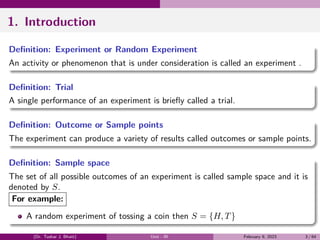
1. Introduction
Definition: Experiment or Random Experiment
An activity or phenomenon that is under consideration is called an experiment .
Definition: Trial
A single performance of an experiment is briefly called a trial.
Definition: Outcome or Sample points
The experiment can produce a variety of results called outcomes or sample points.
Definition: Sample space
The set of all possible outcomes of an experiment is called sample space and it is
denoted by S.
For example:
A random experiment of tossing a coin then S = {H, T}
(Dr. Tushar J. Bhatt) Unit - III February 9, 2023 3 / 64
1. Introduction
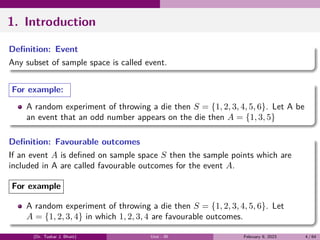
Definition: Event
Any subset of sample space is called event.
For example:
A random experiment of throwing a die then S = {1, 2, 3, 4, 5, 6}. Let A be
an event that an odd number appears on the die then A = {1, 3, 5}
Definition: Favourable outcomes
If an event A is defined on sample space S then the sample points which are
included in A are called favourable outcomes for the event A.
For example
A random experiment of throwing a die then S = {1, 2, 3, 4, 5, 6}. Let
A = {1, 2, 3, 4} in which 1, 2, 3, 4 are favourable outcomes.
(Dr. Tushar J. Bhatt) Unit - III February 9, 2023 4 / 64
1. Introduction
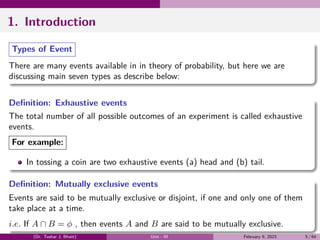
Types of Event
There are many events available in in theory of probability, but here we are
discussing main seven types as describe below:
Definition: Exhaustive events
The total number of all possible outcomes of an experiment is called exhaustive
events.
For example:
In tossing a coin are two exhaustive events (a) head and (b) tail.
Definition: Mutually exclusive events
Events are said to be mutually exclusive or disjoint, if one and only one of them
take place at a time.
i.e. If A ∩ B = ϕ , then events A and B are said to be mutually exclusive.
(Dr. Tushar J. Bhatt) Unit - III February 9, 2023 5 / 64
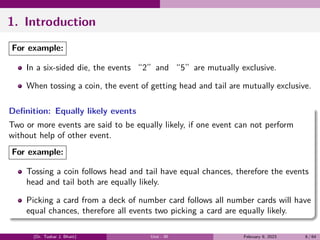
1. Introduction
For example:
In a six-sided die, the events “2”and “5”are mutually exclusive.
When tossing a coin, the event of getting head and tail are mutually exclusive.
Definition: Equally likely events
Two or more events are said to be equally likely, if one event can not perform
without help of other event.
For example:
Tossing a coin follows head and tail have equal chances, therefore the events
head and tail both are equally likely.
Picking a card from a deck of number card follows all number cards will have
equal chances, therefore all events two picking a card are equally likely.
(Dr. Tushar J. Bhatt) Unit - III February 9, 2023 6 / 64
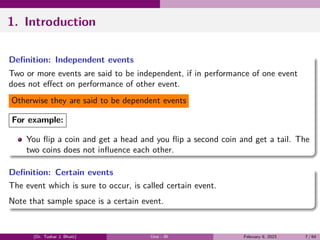
1. Introduction
Definition: Independent events
Two or more events are said to be independent, if in performance of one event
does not effect on performance of other event.
Otherwise they are said to be dependent events
For example:
You flip a coin and get a head and you flip a second coin and get a tail. The
two coins does not influence each other.
Definition: Certain events
The event which is sure to occur, is called certain event.
Note that sample space is a certain event.
(Dr. Tushar J. Bhatt) Unit - III February 9, 2023 7 / 64
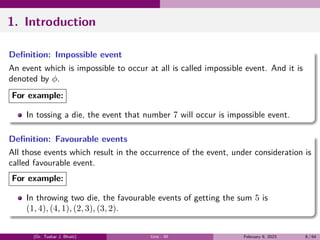
1. Introduction
Definition: Impossible event
An event which is impossible to occur at all is called impossible event. And it is
denoted by ϕ.
For example:
In tossing a die, the event that number 7 will occur is impossible event.
Definition: Favourable events
All those events which result in the occurrence of the event, under consideration is
called favourable event.
For example:
In throwing two die, the favourable events of getting the sum 5 is
(1, 4), (4, 1), (2, 3), (3, 2).
(Dr. Tushar J. Bhatt) Unit - III February 9, 2023 8 / 64
2. Definition of probability
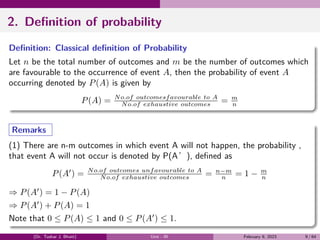
Definition: Classical definition of Probability
Let n be the total number of outcomes and m be the number of outcomes which
are favourable to the occurrence of event A, then the probability of event A
occurring denoted by P(A) is given by
P(A) = No.of outcomesfavourable to A
No.of exhaustive outcomes = m
n
Remarks
(1) There are n-m outcomes in which event A will not happen, the probability ,
that event A will not occur is denoted by P(A’), defined as
P(A′
) = No.of outcomes unfavourable to A
No.of exhaustive outcomes = n−m
n = 1 − m
n
⇒ P(A′
) = 1 − P(A)
⇒ P(A′
) + P(A) = 1
Note that 0 ≤ P(A) ≤ 1 and 0 ≤ P(A′
) ≤ 1.
(Dr. Tushar J. Bhatt) Unit - III February 9, 2023 9 / 64
2. Definition of probability
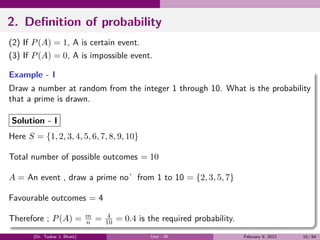
(2) If P(A) = 1, A is certain event.
(3) If P(A) = 0, A is impossible event.
Example - I
Draw a number at random from the integer 1 through 10. What is the probability
that a prime is drawn.
Solution - I
Here S = {1, 2, 3, 4, 5, 6, 7, 8, 9, 10}
Total number of possible outcomes = 10
A = An event , draw a prime no’from 1 to 10 = {2, 3, 5, 7}
Favourable outcomes = 4
Therefore ; P(A) = m
n = 4
10 = 0.4 is the required probability.
(Dr. Tushar J. Bhatt) Unit - III February 9, 2023 10 / 64
3. Examples on probability
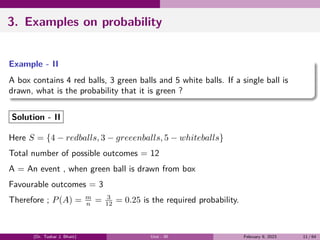
Example - II
A box contains 4 red balls, 3 green balls and 5 white balls. If a single ball is
drawn, what is the probability that it is green ?
Solution - II
Here S = {4 − redballs, 3 − greeenballs, 5 − whiteballs}
Total number of possible outcomes = 12
A = An event , when green ball is drawn from box
Favourable outcomes = 3
Therefore ; P(A) = m
n = 3
12 = 0.25 is the required probability.
(Dr. Tushar J. Bhatt) Unit - III February 9, 2023 11 / 64
3. Examples on probability
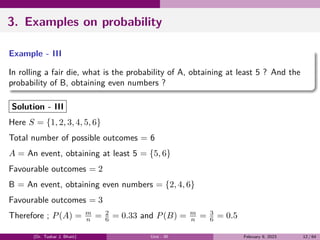
Example - III
In rolling a fair die, what is the probability of A, obtaining at least 5 ? And the
probability of B, obtaining even numbers ?
Solution - III
Here S = {1, 2, 3, 4, 5, 6}
Total number of possible outcomes = 6
A = An event, obtaining at least 5 = {5, 6}
Favourable outcomes = 2
B = An event, obtaining even numbers = {2, 4, 6}
Favourable outcomes = 3
Therefore ; P(A) = m
n = 2
6 = 0.33 and P(B) = m
n = 3
6 = 0.5
(Dr. Tushar J. Bhatt) Unit - III February 9, 2023 12 / 64
3. Examples on probability
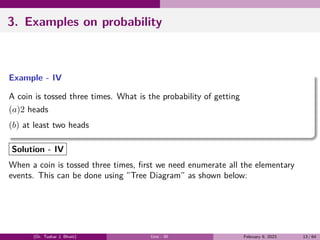
Example - IV
A coin is tossed three times. What is the probability of getting
(a)2 heads
(b) at least two heads
Solution - IV
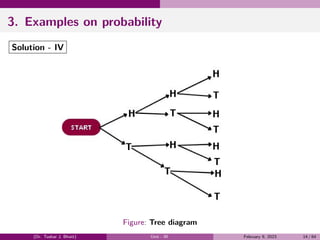
When a coin is tossed three times, first we need enumerate all the elementary
events. This can be done using ”Tree Diagram” as shown below:
(Dr. Tushar J. Bhatt) Unit - III February 9, 2023 13 / 64
3. Examples on probability
Solution - IV
Figure: Tree diagram
(Dr. Tushar J. Bhatt) Unit - III February 9, 2023 14 / 64
3. Examples on probability
Solution - IV
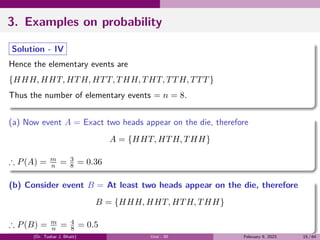
Hence the elementary events are
{HHH, HHT, HTH, HTT, THH, THT, TTH, TTT }
Thus the number of elementary events = n = 8.
(a) Now event A = Exact two heads appear on the die, therefore
A = {HHT, HTH, THH}
∴ P(A) = m
n = 3
8 = 0.36
(b) Consider event B = At least two heads appear on the die, therefore
B = {HHH, HHT, HTH, THH}
∴ P(B) = m
n = 4
8 = 0.5
(Dr. Tushar J. Bhatt) Unit - III February 9, 2023 15 / 64
3. Examples on probability
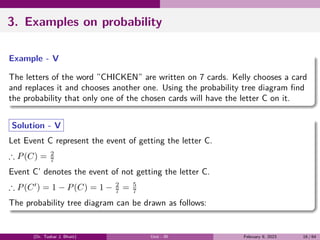
Example - V
The letters of the word ”CHICKEN” are written on 7 cards. Kelly chooses a card
and replaces it and chooses another one. Using the probability tree diagram find
the probability that only one of the chosen cards will have the letter C on it.
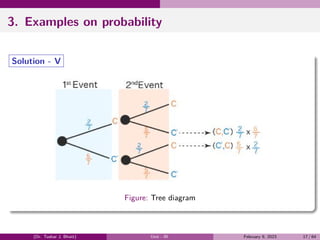
Solution - V
Let Event C represent the event of getting the letter C.
∴ P(C) = 2
7
Event C’ denotes the event of not getting the letter C.
∴ P(C′
) = 1 − P(C) = 1 − 2
7 = 5
7
The probability tree diagram can be drawn as follows:
(Dr. Tushar J. Bhatt) Unit - III February 9, 2023 16 / 64
3. Examples on probability
Solution - V
Figure: Tree diagram
(Dr. Tushar J. Bhatt) Unit - III February 9, 2023 17 / 64
3. Examples on probability
Solution - V
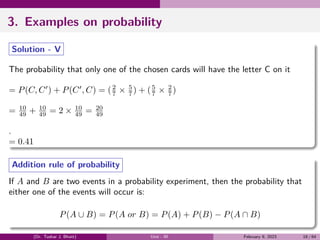
The probability that only one of the chosen cards will have the letter C on it
= P(C, C′
) + P(C′
, C) = (2
7 × 5
7 ) + (5
7 × 2
7 )
= 10
49 + 10
49 = 2 × 10
49 = 20
49
.
= 0.41
Addition rule of probability
If A and B are two events in a probability experiment, then the probability that
either one of the events will occur is:
P(A ∪ B) = P(A or B) = P(A) + P(B) − P(A ∩ B)
(Dr. Tushar J. Bhatt) Unit - III February 9, 2023 18 / 64
3. Examples on probability
If A and B are two mutually exclusive events follows P(A ∩ B) = 0 then
P(A ∪ B) = P(A) + P(B).
Example - VI
If you take out a single card from a regular pack of cards, what is probability that
the card is either an ace or spade?
Solution - VI
Let X be the event of picking an ace and Y be the event of picking a spade.
Now P(X) = 4
52 and P(Y ) = 13
52
The two events are not mutually exclusive, as there is one favorable outcome in
which the card can be both an ace and spade.
P(X ∩ Y ) = 1
52
Now P(X ∪ Y ) = P(X) + P(Y ) − P(X ∩ Y )
(Dr. Tushar J. Bhatt) Unit - III February 9, 2023 19 / 64
3. Examples on probability
Solution - VI
⇒ P(X ∪ Y ) = 4
52 + 13
52 − 1
52
⇒ P(X ∪ Y ) = 16
52 = 4
13 is the required probability.
Multiplication rule of probability
If X and Y are two independent events in an experiment, then the probability of
both events occurring simultaneously is given by:
P(X ∩ Y ) = P(X) × P(Y )
(Dr. Tushar J. Bhatt) Unit - III February 9, 2023 20 / 64
3. Examples on probability
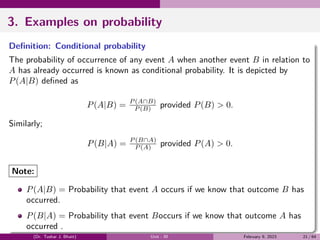
Definition: Conditional probability
The probability of occurrence of any event A when another event B in relation to
A has already occurred is known as conditional probability. It is depicted by
P(A|B) defined as
P(A|B) = P (A∩B)
P (B) provided P(B) > 0.
Similarly;
P(B|A) = P (B∩A)
P (A) provided P(A) > 0.
Note:
P(A|B) = Probability that event A occurs if we know that outcome B has
occurred.
P(B|A) = Probability that event Boccurs if we know that outcome A has
occurred .
(Dr. Tushar J. Bhatt) Unit - III February 9, 2023 21 / 64
3. Examples on probability
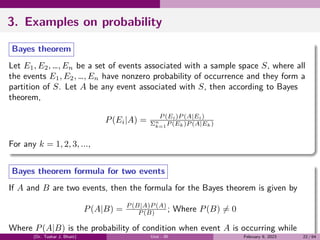
Bayes theorem
Let E1, E2, …, En be a set of events associated with a sample space S, where all
the events E1, E2, …, En have nonzero probability of occurrence and they form a
partition of S. Let A be any event associated with S, then according to Bayes
theorem,
P(Ei|A) = P (Ei)P (A|Ei)
Σn
k=1P (Ek)P (A|Ek)
For any k = 1, 2, 3, ...,
Bayes theorem formula for two events
If A and B are two events, then the formula for the Bayes theorem is given by
P(A|B) = P (B|A)P (A)
P (B) ; Where P(B) ̸= 0
Where P(A|B) is the probability of condition when event A is occurring while
(Dr. Tushar J. Bhatt) Unit - III February 9, 2023 22 / 64
3. Example on probability
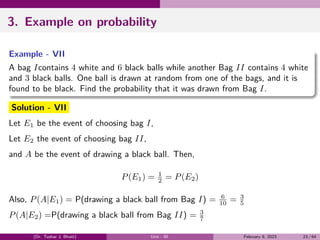
Example - VII
A bag Icontains 4 white and 6 black balls while another Bag II contains 4 white
and 3 black balls. One ball is drawn at random from one of the bags, and it is
found to be black. Find the probability that it was drawn from Bag I.
Solution - VII
Let E1 be the event of choosing bag I,
Let E2 the event of choosing bag II,
and A be the event of drawing a black ball. Then,
P(E1) = 1
2 = P(E2)
Also, P(A|E1) = P(drawing a black ball from Bag I) = 6
10 = 3
5
P(A|E2) =P(drawing a black ball from Bag II) = 3
7
(Dr. Tushar J. Bhatt) Unit - III February 9, 2023 23 / 64
3. Examples on probability
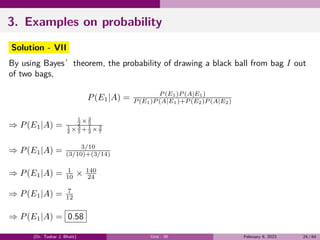
Solution - VII
By using Bayes’theorem, the probability of drawing a black ball from bag I out
of two bags,
P(E1|A) = P (E1)P (A|E1)
P (E1)P (A|E1)+P (E2)P (A|E2)
⇒ P(E1|A) =
1
2 × 3
5
1
2 × 3
5 + 1
2 × 3
7
⇒ P(E1|A) = 3/10
(3/10)+(3/14)
⇒ P(E1|A) = 1
10 × 140
24
⇒ P(E1|A) = 7
12
⇒ P(E1|A) = 0.58
(Dr. Tushar J. Bhatt) Unit - III February 9, 2023 24 / 64
4. Random Variables and Probability distributions
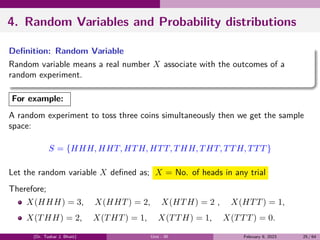
Definition: Random Variable
Random variable means a real number X associate with the outcomes of a
random experiment.
For example:
A random experiment to toss three coins simultaneously then we get the sample
space:
S = {HHH, HHT, HTH, HTT, THH, THT, TTH, TTT }
Let the random variable X defined as; X = No. of heads in any trial
Therefore;
X(HHH) = 3, X(HHT) = 2, X(HTH) = 2 , X(HTT) = 1,
X(THH) = 2, X(THT) = 1, X(TTH) = 1, X(TTT) = 0.
(Dr. Tushar J. Bhatt) Unit - III February 9, 2023 25 / 64
4. Random Variables and Probability distributions
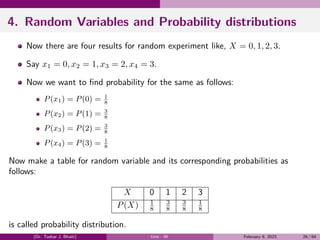
Now there are four results for random experiment like, X = 0, 1, 2, 3.
Say x1 = 0, x2 = 1, x3 = 2, x4 = 3.
Now we want to find probability for the same as follows:
P(x1) = P(0) = 1
8
P(x2) = P(1) = 3
8
P(x3) = P(2) = 3
8
P(x4) = P(3) = 1
8
Now make a table for random variable and its corresponding probabilities as
follows:
X 0 1 2 3
P(X) 1
8
3
8
3
8
1
8
is called probability distribution.
(Dr. Tushar J. Bhatt) Unit - III February 9, 2023 26 / 64
4. Random Variables and Probability distributions
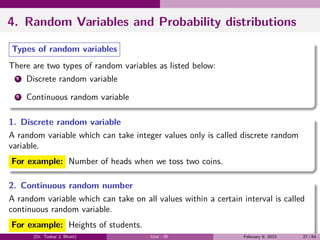
Types of random variables
There are two types of random variables as listed below:
1 Discrete random variable
2 Continuous random variable
1. Discrete random variable
A random variable which can take integer values only is called discrete random
variable.
For example: Number of heads when we toss two coins.
2. Continuous random number
A random variable which can take on all values within a certain interval is called
continuous random variable.
For example: Heights of students.
(Dr. Tushar J. Bhatt) Unit - III February 9, 2023 27 / 64
4. Random Variables and Probability distributions
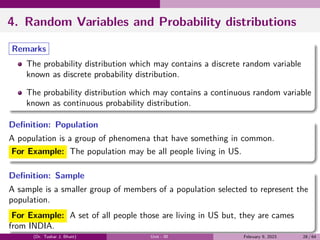
Remarks
The probability distribution which may contains a discrete random variable
known as discrete probability distribution.
The probability distribution which may contains a continuous random variable
known as continuous probability distribution.
Definition: Population
A population is a group of phenomena that have something in common.
For Example: The population may be all people living in US.
Definition: Sample
A sample is a smaller group of members of a population selected to represent the
population.
For Example: A set of all people those are living in US but, they are cames
from INDIA.
(Dr. Tushar J. Bhatt) Unit - III February 9, 2023 28 / 64
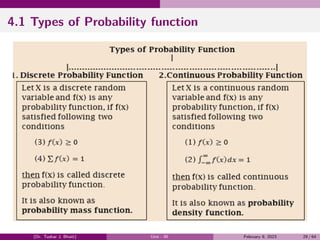
4.1 Types of Probability function
(Dr. Tushar J. Bhatt) Unit - III February 9, 2023 29 / 64
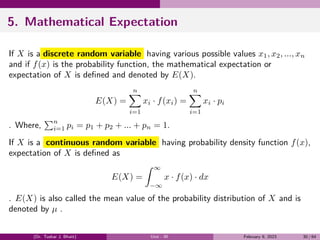
5. Mathematical Expectation
If X is a discrete random variable having various possible values x1, x2, ..., xn
and if f(x) is the probability function, the mathematical expectation or
expectation of X is defined and denoted by E(X).
E(X) =
n
∑
i=1
xi · f(xi) =
n
∑
i=1
xi · pi
. Where,
∑n
i=1 pi = p1 + p2 + ... + pn = 1.
If X is a continuous random variable having probability density function f(x),
expectation of X is defined as
E(X) =
∫ ∞
−∞
x · f(x) · dx
. E(X) is also called the mean value of the probability distribution of X and is
denoted by µ .
(Dr. Tushar J. Bhatt) Unit - III February 9, 2023 30 / 64
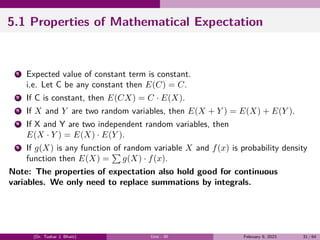
5.1 Properties of Mathematical Expectation
1 Expected value of constant term is constant.
i.e. Let C be any constant then E(C) = C.
2 If C is constant, then E(CX) = C · E(X).
3 If X and Y are two random variables, then E(X + Y ) = E(X) + E(Y ).
4 If X and Y are two independent random variables, then
E(X · Y ) = E(X) · E(Y ).
5 If g(X) is any function of random variable X and f(x) is probability density
function then E(X) =
∑
g(X) · f(x).
Note: The properties of expectation also hold good for continuous
variables. We only need to replace summations by integrals.
(Dr. Tushar J. Bhatt) Unit - III February 9, 2023 31 / 64
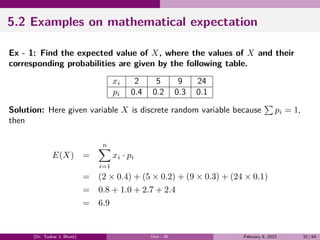
5.2 Examples on mathematical expectation
Ex - 1: Find the expected value of X, where the values of X and their
corresponding probabilities are given by the following table.
xi 2 5 9 24
pi 0.4 0.2 0.3 0.1
Solution: Here given variable X is discrete random variable because
∑
pi = 1,
then
E(X) =
n
∑
i=1
xi · pi
= (2 × 0.4) + (5 × 0.2) + (9 × 0.3) + (24 × 0.1)
= 0.8 + 1.0 + 2.7 + 2.4
= 6.9
(Dr. Tushar J. Bhatt) Unit - III February 9, 2023 32 / 64
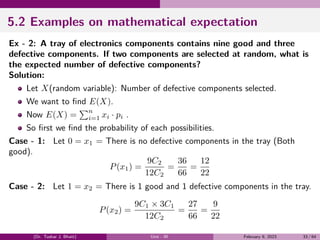
5.2 Examples on mathematical expectation
Ex - 2: A tray of electronics components contains nine good and three
defective components. If two components are selected at random, what is
the expected number of defective components?
Solution:
Let X(random variable): Number of defective components selected.
We want to find E(X).
Now E(X) =
∑n
i=1 xi · pi .
So first we find the probability of each possibilities.
Case - 1: Let 0 = x1 = There is no defective components in the tray (Both
good).
P(x1) =
9C2
12C2
=
36
66
=
12
22
Case - 2: Let 1 = x2 = There is 1 good and 1 defective components in the tray.
P(x2) =
9C1 × 3C1
12C2
=
27
66
=
9
22
(Dr. Tushar J. Bhatt) Unit - III February 9, 2023 33 / 64
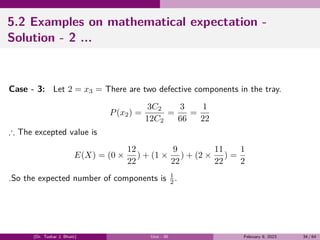
5.2 Examples on mathematical expectation -
Solution - 2 ...
Case - 3: Let 2 = x3 = There are two defective components in the tray.
P(x2) =
3C2
12C2
=
3
66
=
1
22
∴ The excepted value is
E(X) = (0 ×
12
22
) + (1 ×
9
22
) + (2 ×
11
22
) =
1
2
.So the expected number of components is 1
2 .
(Dr. Tushar J. Bhatt) Unit - III February 9, 2023 34 / 64
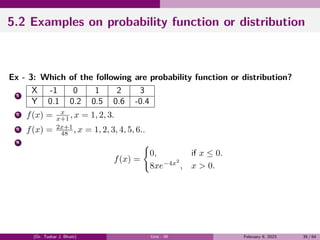
5.2 Examples on probability function or distribution
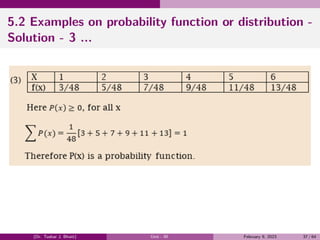
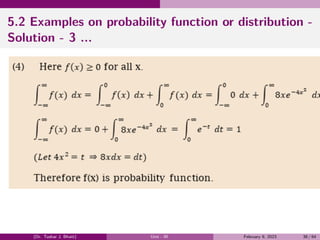
Ex - 3: Which of the following are probability function or distribution?
1
X -1 0 1 2 3
Y 0.1 0.2 0.5 0.6 -0.4
2 f(x) = x
x+1 , x = 1, 2, 3.
3 f(x) = 2x+1
48 , x = 1, 2, 3, 4, 5, 6..
4
f(x) =
{
0, if x ≤ 0.
8xe−4x2
, x > 0.
(Dr. Tushar J. Bhatt) Unit - III February 9, 2023 35 / 64
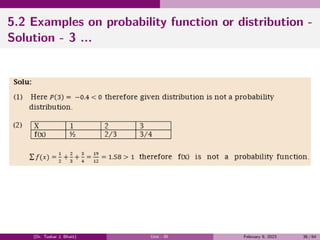
5.2 Examples on probability function or distribution -
Solution - 3 ...
(Dr. Tushar J. Bhatt) Unit - III February 9, 2023 36 / 64
5.2 Examples on probability function or distribution -
Solution - 3 ...
(Dr. Tushar J. Bhatt) Unit - III February 9, 2023 37 / 64
5.2 Examples on probability function or distribution -
Solution - 3 ...
(Dr. Tushar J. Bhatt) Unit - III February 9, 2023 38 / 64
5.2 Examples on mathematical expectation
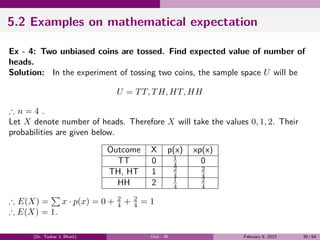
Ex - 4: Two unbiased coins are tossed. Find expected value of number of
heads.
Solution: In the experiment of tossing two coins, the sample space U will be
U = TT, TH, HT, HH
∴ n = 4 .
Let X denote number of heads. Therefore X will take the values 0, 1, 2. Their
probabilities are given below.
Outcome X p(x) xp(x)
TT 0 1
4 0
TH, HT 1 2
4
2
4
HH 2 1
4
2
4
∴ E(X) =
∑
x · p(x) = 0 + 2
4 + 2
4 = 1
∴ E(X) = 1.
(Dr. Tushar J. Bhatt) Unit - III February 9, 2023 39 / 64
5.2 Examples on mathematical expectation
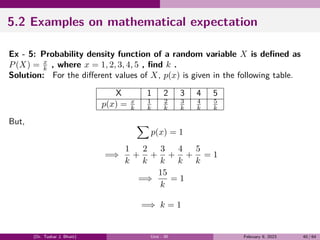
Ex - 5: Probability density function of a random variable X is defined as
P(X) = x
k , where x = 1, 2, 3, 4, 5 , find k .
Solution: For the different values of X, p(x) is given in the following table.
X 1 2 3 4 5
p(x) = x
k
1
k
2
k
3
k
4
k
5
k
But, ∑
p(x) = 1
=⇒
1
k
+
2
k
+
3
k
+
4
k
+
5
k
= 1
=⇒
15
k
= 1
=⇒ k = 1
(Dr. Tushar J. Bhatt) Unit - III February 9, 2023 40 / 64
6. Variance of a Random Variable
Variance is a characteristic of a random variable X and it is used of measure
dispersion (or variation) of X.
If X is a discrete random variable with probability density function f(x), then
expected value of [X − E(X)]2
is called the variance of X and it is denoted
by V (X).
That is V (X) = E[X − E(X)]2
.
If we put E(X) = µ , then V (X) = E(X − µ)2
.
(Dr. Tushar J. Bhatt) Unit - III February 9, 2023 41 / 64
6.1 Properties of variance
1 V (c) = 0, Where c is a constant.
2 V (cX) = c2
V (x), Where c is a constant.
3 V (X + c) = V (X),Where c is a constant.
4 If X and Y are the independent random variables, then
V (X + Y ) = V (X) + V (Y ).
5 V (X) = E(X2
) − µ2
or V (X) = E(X2
) − [E(X)]2
.
(Dr. Tushar J. Bhatt) Unit - III February 9, 2023 42 / 64
6.2 Standard deviation of a Random Variable
The positive square root of V (X) (variance of X ) is called standard deviation of
random variable X and is denoted by σ .
i.e. S.D. σ =
√
V (X).
Note:
1 σ2
is called variance of X.
2 It is customary to represent X in practice for convenience.
(Dr. Tushar J. Bhatt) Unit - III February 9, 2023 43 / 64
6.3 Examples on Standard deviation and Variance
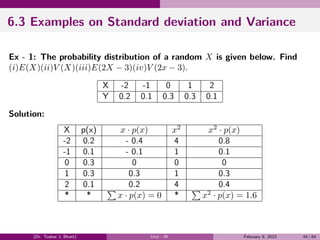
Ex - 1: The probability distribution of a random X is given below. Find
(i)E(X)(ii)V (X)(iii)E(2X − 3)(iv)V (2x − 3).
X -2 -1 0 1 2
Y 0.2 0.1 0.3 0.3 0.1
Solution:
X p(x) x · p(x) x2
x2
· p(x)
-2 0.2 - 0.4 4 0.8
-1 0.1 - 0.1 1 0.1
0 0.3 0 0 0
1 0.3 0.3 1 0.3
2 0.1 0.2 4 0.4
* *
∑
x · p(x) = 0 *
∑
x2
· p(x) = 1.6
(Dr. Tushar J. Bhatt) Unit - III February 9, 2023 44 / 64
6.3 Examples on Standard deviation and Variance -
Solution - 1 ...
Form the above table, we have
1 E(X) =
∑
x · p(x) = 0.
2 E(X2
) =
∑
x2
· p(x) = 1.6.
Now V (X) = E(X2
) − [E(X)]2
= 1.6 − 0 = 1.6.
3 E(2x − 3) = 2E(x) − 3 = 2 × 0 − 3 = −3.
4 V (2x − 3) = 22
· V (x) = 4 × 1.6 = 6.4.
(Dr. Tushar J. Bhatt) Unit - III February 9, 2023 45 / 64
6.3 Examples on Standard deviation and Variance
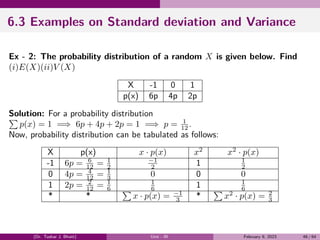
Ex - 2: The probability distribution of a random X is given below. Find
(i)E(X)(ii)V (X)
X -1 0 1
p(x) 6p 4p 2p
Solution: For a probability distribution
∑
p(x) = 1 =⇒ 6p + 4p + 2p = 1 =⇒ p = 1
12 .
Now, probability distribution can be tabulated as follows:
X p(x) x · p(x) x2
x2
· p(x)
-1 6p = 6
12 = 1
2
−1
2 1 1
2
0 4p = 4
12 = 1
3 0 0 0
1 2p = 2
12 = 1
6
1
6 1 1
6
* *
∑
x · p(x) = −1
3 *
∑
x2
· p(x) = 2
3
(Dr. Tushar J. Bhatt) Unit - III February 9, 2023 46 / 64
6.3 Examples on Standard deviation and Variance -
Solution - 2 ...
Form the above table, we have
1 E(X) =
∑
x · p(x) = −1
3 .
2 E(X2
) =
∑
x2
· p(x) = 2
3 .
Now V (X) = E(X2
) − [E(X)]2
= 1.6 − 0 = 1.6.
3 V (X) = E(X2
) − [E(X)]2
= 2
3 −
(
−1
3
)2
= 5
9 .
(Dr. Tushar J. Bhatt) Unit - III February 9, 2023 47 / 64
6.3 Examples on Standard deviation and Variance
Ex - 3: Mean and S.D. of a random variable X are 5 and 4 respectively.
Find (i) E(X2
) (ii) E(2x + 1)2
(iii) S.D. of V (5 − 3x).
Solution: Here Mean = 5 and S.D. (σ) = 4
∴ E(X) = 5 and V (X) = (S.D. = σ)2
= (4)2
= 16.
1 V (X) = E(X2
) − [E(X)]2
=⇒ 16 = E(X2
) − (5)2
=⇒ E(x2
) = 41.
2 E(2x+1)2
= E(4x2
+4x+1) = 4E(x2
)+4E(x)+1 = 4×41+4×5+1 = 185.
3 V (5 − 3x) = (−3)2
V (x) = 9 × 16 = 144
∴ S.D. of (5 − 3x) =
√
V (5 − 3x) =
√
144 = 12.
(Dr. Tushar J. Bhatt) Unit - III February 9, 2023 48 / 64
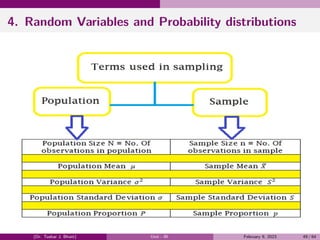
4. Random Variables and Probability distributions
(Dr. Tushar J. Bhatt) Unit - III February 9, 2023 49 / 64
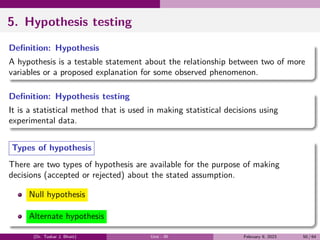
5. Hypothesis testing
Definition: Hypothesis
A hypothesis is a testable statement about the relationship between two of more
variables or a proposed explanation for some observed phenomenon.
Definition: Hypothesis testing
It is a statistical method that is used in making statistical decisions using
experimental data.
Types of hypothesis
There are two types of hypothesis are available for the purpose of making
decisions (accepted or rejected) about the stated assumption.
Null hypothesis
Alternate hypothesis
(Dr. Tushar J. Bhatt) Unit - III February 9, 2023 50 / 64
5. Hypothesis testing
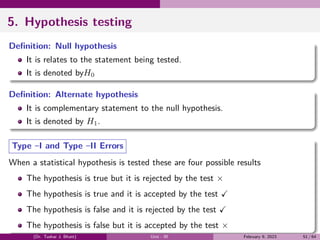
Definition: Null hypothesis
It is relates to the statement being tested.
It is denoted byH0
Definition: Alternate hypothesis
It is complementary statement to the null hypothesis.
It is denoted by H1.
Type –I and Type –II Errors
When a statistical hypothesis is tested these are four possible results
The hypothesis is true but it is rejected by the test ×
The hypothesis is true and it is accepted by the test ✓
The hypothesis is false and it is rejected by the test ✓
The hypothesis is false but it is accepted by the test ×
(Dr. Tushar J. Bhatt) Unit - III February 9, 2023 51 / 64
5. Hypothesis testing
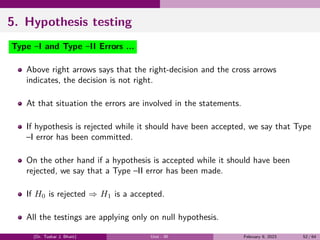
Type –I and Type –II Errors ...
Above right arrows says that the right-decision and the cross arrows
indicates, the decision is not right.
At that situation the errors are involved in the statements.
If hypothesis is rejected while it should have been accepted, we say that Type
–I error has been committed.
On the other hand if a hypothesis is accepted while it should have been
rejected, we say that a Type –II error has been made.
If H0 is rejected ⇒ H1 is a accepted.
All the testings are applying only on null hypothesis.
(Dr. Tushar J. Bhatt) Unit - III February 9, 2023 52 / 64
6. Z− test
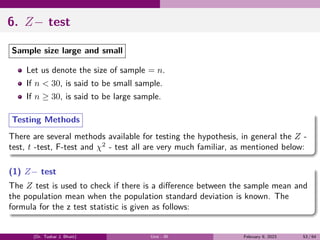
Sample size large and small
Let us denote the size of sample = n.
If n < 30, is said to be small sample.
If n ≥ 30, is said to be large sample.
Testing Methods
There are several methods available for testing the hypothesis, in general the Z -
test, t -test, F-test and χ2
- test all are very much familiar, as mentioned below:
(1) Z− test
The Z test is used to check if there is a difference between the sample mean and
the population mean when the population standard deviation is known. The
formula for the z test statistic is given as follows:
(Dr. Tushar J. Bhatt) Unit - III February 9, 2023 53 / 64
6. Z− test
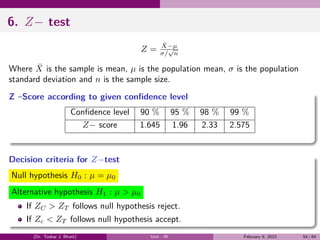
Z = X̄−µ
σ/
√
n
Where X̄ is the sample is mean, µ is the population mean, σ is the population
standard deviation and n is the sample size.
Z –Score according to given confidence level
Confidence level 90 % 95 % 98 % 99 %
Z− score 1.645 1.96 2.33 2.575
Decision criteria for Z−test
Null hypothesis H0 : µ = µ0
Alternative hypothesis H1 : µ > µ0
If ZC > ZT follows null hypothesis reject.
If Zc < ZT follows null hypothesis accept.
(Dr. Tushar J. Bhatt) Unit - III February 9, 2023 54 / 64
6. Z− test
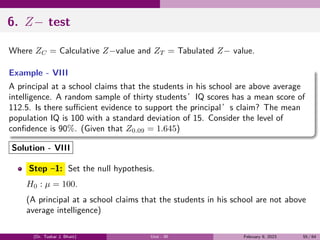
Where ZC = Calculative Z−value and ZT = Tabulated Z− value.
Example - VIII
A principal at a school claims that the students in his school are above average
intelligence. A random sample of thirty students’IQ scores has a mean score of
112.5. Is there sufficient evidence to support the principal’s claim? The mean
population IQ is 100 with a standard deviation of 15. Consider the level of
confidence is 90%. (Given that Z0.09 = 1.645)
Solution - VIII
Step –1: Set the null hypothesis.
H0 : µ = 100.
(A principal at a school claims that the students in his school are not above
average intelligence)
(Dr. Tushar J. Bhatt) Unit - III February 9, 2023 55 / 64
6. Z− test
Solution - VIII
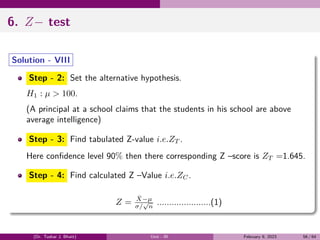
Step - 2: Set the alternative hypothesis.
H1 : µ > 100.
(A principal at a school claims that the students in his school are above
average intelligence)
Step - 3: Find tabulated Z-value i.e.ZT .
Here confidence level 90% then there corresponding Z –score is ZT =1.645.
Step - 4: Find calculated Z –Value i.e.ZC.
Z = X̄−µ
σ/
√
n
......................(1)
(Dr. Tushar J. Bhatt) Unit - III February 9, 2023 56 / 64
6. Z− test
Solution - VIII
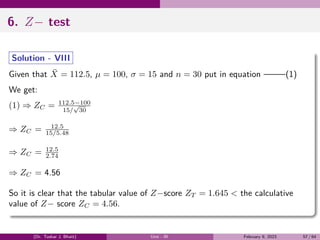
Given that X̄ = 112.5, µ = 100, σ = 15 and n = 30 put in equation ——–(1)
We get:
(1) ⇒ ZC = 112.5−100
15/
√
30
⇒ ZC = 12.5
15/5.48
⇒ ZC = 12.5
2.74
⇒ ZC = 4.56
So it is clear that the tabular value of Z−score ZT = 1.645 < the calculative
value of Z− score ZC = 4.56.
(Dr. Tushar J. Bhatt) Unit - III February 9, 2023 57 / 64
6. Z− test
Solution - VIII
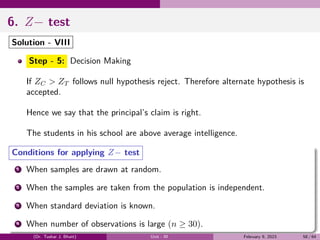
Step - 5: Decision Making
If ZC > ZT follows null hypothesis reject. Therefore alternate hypothesis is
accepted.
Hence we say that the principal’s claim is right.
The students in his school are above average intelligence.
Conditions for applying Z− test
1 When samples are drawn at random.
2 When the samples are taken from the population is independent.
3 When standard deviation is known.
4 When number of observations is large (n ≥ 30).
(Dr. Tushar J. Bhatt) Unit - III February 9, 2023 58 / 64
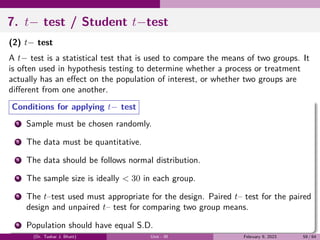
7. t− test / Student t−test
(2) t− test
A t− test is a statistical test that is used to compare the means of two groups. It
is often used in hypothesis testing to determine whether a process or treatment
actually has an effect on the population of interest, or whether two groups are
different from one another.
Conditions for applying t− test
1 Sample must be chosen randomly.
2 The data must be quantitative.
3 The data should be follows normal distribution.
4 The sample size is ideally < 30 in each group.
5 The t–test used must appropriate for the design. Paired t– test for the paired
design and unpaired t– test for comparing two group means.
6 Population should have equal S.D.
(Dr. Tushar J. Bhatt) Unit - III February 9, 2023 59 / 64
7. t− test
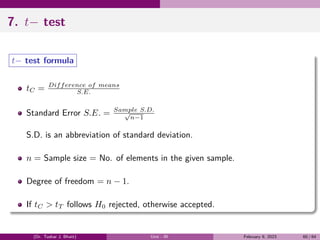
t− test formula
tC = Difference of means
S.E.
Standard Error S.E. = Sample S.D.
√
n−1
S.D. is an abbreviation of standard deviation.
n = Sample size = No. of elements in the given sample.
Degree of freedom = n − 1.
If tC > tT follows H0 rejected, otherwise accepted.
(Dr. Tushar J. Bhatt) Unit - III February 9, 2023 60 / 64
7. t− test
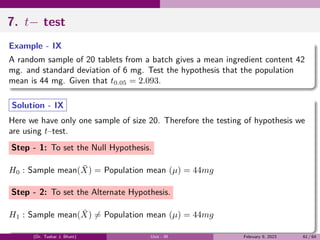
Example - IX
A random sample of 20 tablets from a batch gives a mean ingredient content 42
mg. and standard deviation of 6 mg. Test the hypothesis that the population
mean is 44 mg. Given that t0.05 = 2.093.
Solution - IX
Here we have only one sample of size 20. Therefore the testing of hypothesis we
are using t–test.
Step - 1: To set the Null Hypothesis.
H0 : Sample mean(X̄) = Population mean (µ) = 44mg
Step - 2: To set the Alternate Hypothesis.
H1 : Sample mean(X̄) ̸= Population mean (µ) = 44mg
(Dr. Tushar J. Bhatt) Unit - III February 9, 2023 61 / 64
7. t− test
Solution - IX
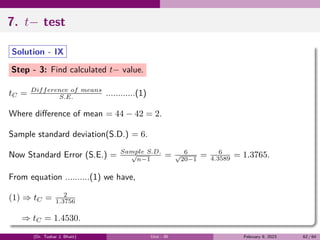
Step - 3: Find calculated t− value.
tC = Difference of means
S.E. ............(1)
Where difference of mean = 44 − 42 = 2.
Sample standard deviation(S.D.) = 6.
Now Standard Error (S.E.) = Sample S.D.
√
n−1
= 6
√
20−1
= 6
4.3589 = 1.3765.
From equation ..........(1) we have,
(1) ⇒ tC = 2
1.3756
⇒ tC = 1.4530.
(Dr. Tushar J. Bhatt) Unit - III February 9, 2023 62 / 64
7. t− test
Solution - IX
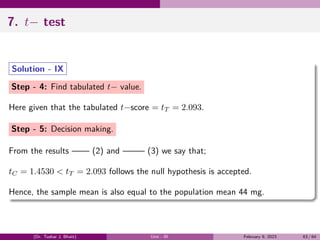
Step - 4: Find tabulated t− value.
Here given that the tabulated t−score = tT = 2.093.
Step - 5: Decision making.
From the results —— (2) and ——– (3) we say that;
tC = 1.4530 < tT = 2.093 follows the null hypothesis is accepted.
Hence, the sample mean is also equal to the population mean 44 mg.
(Dr. Tushar J. Bhatt) Unit - III February 9, 2023 63 / 64
Thank You
(Dr. Tushar J. Bhatt) Unit - III February 9, 2023 64 / 64

Theory_of_Probability .pdf

  • 1.
    Unit - III:Theory of Probability Dr. Tushar J. Bhatt Ph.D (Mathematics) Assistant Professor in Mathematics Department of Science and Humanities Faculty of Engineering and Technology Atmiya University Rajkot - 360005 February 9, 2023 (Dr. Tushar J. Bhatt) Unit - III February 9, 2023 1 / 64
  • 2.
    Table of Contents 1Introduction 2 Types of events 3 Classical definition of probability 4 Examples on probability 5 Conditional probability 6 Bayes theorem 7 Random variables and Probability distributions (Dr. Tushar J. Bhatt) Unit - III February 9, 2023 2 / 64
  • 3.
    1. Introduction Definition: Experimentor Random Experiment An activity or phenomenon that is under consideration is called an experiment . Definition: Trial A single performance of an experiment is briefly called a trial. Definition: Outcome or Sample points The experiment can produce a variety of results called outcomes or sample points. Definition: Sample space The set of all possible outcomes of an experiment is called sample space and it is denoted by S. For example: A random experiment of tossing a coin then S = {H, T} (Dr. Tushar J. Bhatt) Unit - III February 9, 2023 3 / 64
  • 4.
    1. Introduction Definition: Event Anysubset of sample space is called event. For example: A random experiment of throwing a die then S = {1, 2, 3, 4, 5, 6}. Let A be an event that an odd number appears on the die then A = {1, 3, 5} Definition: Favourable outcomes If an event A is defined on sample space S then the sample points which are included in A are called favourable outcomes for the event A. For example A random experiment of throwing a die then S = {1, 2, 3, 4, 5, 6}. Let A = {1, 2, 3, 4} in which 1, 2, 3, 4 are favourable outcomes. (Dr. Tushar J. Bhatt) Unit - III February 9, 2023 4 / 64
  • 5.
    1. Introduction Types ofEvent There are many events available in in theory of probability, but here we are discussing main seven types as describe below: Definition: Exhaustive events The total number of all possible outcomes of an experiment is called exhaustive events. For example: In tossing a coin are two exhaustive events (a) head and (b) tail. Definition: Mutually exclusive events Events are said to be mutually exclusive or disjoint, if one and only one of them take place at a time. i.e. If A ∩ B = ϕ , then events A and B are said to be mutually exclusive. (Dr. Tushar J. Bhatt) Unit - III February 9, 2023 5 / 64
  • 6.
    1. Introduction For example: Ina six-sided die, the events “2”and “5”are mutually exclusive. When tossing a coin, the event of getting head and tail are mutually exclusive. Definition: Equally likely events Two or more events are said to be equally likely, if one event can not perform without help of other event. For example: Tossing a coin follows head and tail have equal chances, therefore the events head and tail both are equally likely. Picking a card from a deck of number card follows all number cards will have equal chances, therefore all events two picking a card are equally likely. (Dr. Tushar J. Bhatt) Unit - III February 9, 2023 6 / 64
  • 7.
    1. Introduction Definition: Independentevents Two or more events are said to be independent, if in performance of one event does not effect on performance of other event. Otherwise they are said to be dependent events For example: You flip a coin and get a head and you flip a second coin and get a tail. The two coins does not influence each other. Definition: Certain events The event which is sure to occur, is called certain event. Note that sample space is a certain event. (Dr. Tushar J. Bhatt) Unit - III February 9, 2023 7 / 64
  • 8.
    1. Introduction Definition: Impossibleevent An event which is impossible to occur at all is called impossible event. And it is denoted by ϕ. For example: In tossing a die, the event that number 7 will occur is impossible event. Definition: Favourable events All those events which result in the occurrence of the event, under consideration is called favourable event. For example: In throwing two die, the favourable events of getting the sum 5 is (1, 4), (4, 1), (2, 3), (3, 2). (Dr. Tushar J. Bhatt) Unit - III February 9, 2023 8 / 64
  • 9.
    2. Definition ofprobability Definition: Classical definition of Probability Let n be the total number of outcomes and m be the number of outcomes which are favourable to the occurrence of event A, then the probability of event A occurring denoted by P(A) is given by P(A) = No.of outcomesfavourable to A No.of exhaustive outcomes = m n Remarks (1) There are n-m outcomes in which event A will not happen, the probability , that event A will not occur is denoted by P(A’), defined as P(A′ ) = No.of outcomes unfavourable to A No.of exhaustive outcomes = n−m n = 1 − m n ⇒ P(A′ ) = 1 − P(A) ⇒ P(A′ ) + P(A) = 1 Note that 0 ≤ P(A) ≤ 1 and 0 ≤ P(A′ ) ≤ 1. (Dr. Tushar J. Bhatt) Unit - III February 9, 2023 9 / 64
  • 10.
    2. Definition ofprobability (2) If P(A) = 1, A is certain event. (3) If P(A) = 0, A is impossible event. Example - I Draw a number at random from the integer 1 through 10. What is the probability that a prime is drawn. Solution - I Here S = {1, 2, 3, 4, 5, 6, 7, 8, 9, 10} Total number of possible outcomes = 10 A = An event , draw a prime no’from 1 to 10 = {2, 3, 5, 7} Favourable outcomes = 4 Therefore ; P(A) = m n = 4 10 = 0.4 is the required probability. (Dr. Tushar J. Bhatt) Unit - III February 9, 2023 10 / 64
  • 11.
    3. Examples onprobability Example - II A box contains 4 red balls, 3 green balls and 5 white balls. If a single ball is drawn, what is the probability that it is green ? Solution - II Here S = {4 − redballs, 3 − greeenballs, 5 − whiteballs} Total number of possible outcomes = 12 A = An event , when green ball is drawn from box Favourable outcomes = 3 Therefore ; P(A) = m n = 3 12 = 0.25 is the required probability. (Dr. Tushar J. Bhatt) Unit - III February 9, 2023 11 / 64
  • 12.
    3. Examples onprobability Example - III In rolling a fair die, what is the probability of A, obtaining at least 5 ? And the probability of B, obtaining even numbers ? Solution - III Here S = {1, 2, 3, 4, 5, 6} Total number of possible outcomes = 6 A = An event, obtaining at least 5 = {5, 6} Favourable outcomes = 2 B = An event, obtaining even numbers = {2, 4, 6} Favourable outcomes = 3 Therefore ; P(A) = m n = 2 6 = 0.33 and P(B) = m n = 3 6 = 0.5 (Dr. Tushar J. Bhatt) Unit - III February 9, 2023 12 / 64
  • 13.
    3. Examples onprobability Example - IV A coin is tossed three times. What is the probability of getting (a)2 heads (b) at least two heads Solution - IV When a coin is tossed three times, first we need enumerate all the elementary events. This can be done using ”Tree Diagram” as shown below: (Dr. Tushar J. Bhatt) Unit - III February 9, 2023 13 / 64
  • 14.
    3. Examples onprobability Solution - IV Figure: Tree diagram (Dr. Tushar J. Bhatt) Unit - III February 9, 2023 14 / 64
  • 15.
    3. Examples onprobability Solution - IV Hence the elementary events are {HHH, HHT, HTH, HTT, THH, THT, TTH, TTT } Thus the number of elementary events = n = 8. (a) Now event A = Exact two heads appear on the die, therefore A = {HHT, HTH, THH} ∴ P(A) = m n = 3 8 = 0.36 (b) Consider event B = At least two heads appear on the die, therefore B = {HHH, HHT, HTH, THH} ∴ P(B) = m n = 4 8 = 0.5 (Dr. Tushar J. Bhatt) Unit - III February 9, 2023 15 / 64
  • 16.
    3. Examples onprobability Example - V The letters of the word ”CHICKEN” are written on 7 cards. Kelly chooses a card and replaces it and chooses another one. Using the probability tree diagram find the probability that only one of the chosen cards will have the letter C on it. Solution - V Let Event C represent the event of getting the letter C. ∴ P(C) = 2 7 Event C’ denotes the event of not getting the letter C. ∴ P(C′ ) = 1 − P(C) = 1 − 2 7 = 5 7 The probability tree diagram can be drawn as follows: (Dr. Tushar J. Bhatt) Unit - III February 9, 2023 16 / 64
  • 17.
    3. Examples onprobability Solution - V Figure: Tree diagram (Dr. Tushar J. Bhatt) Unit - III February 9, 2023 17 / 64
  • 18.
    3. Examples onprobability Solution - V The probability that only one of the chosen cards will have the letter C on it = P(C, C′ ) + P(C′ , C) = (2 7 × 5 7 ) + (5 7 × 2 7 ) = 10 49 + 10 49 = 2 × 10 49 = 20 49 . = 0.41 Addition rule of probability If A and B are two events in a probability experiment, then the probability that either one of the events will occur is: P(A ∪ B) = P(A or B) = P(A) + P(B) − P(A ∩ B) (Dr. Tushar J. Bhatt) Unit - III February 9, 2023 18 / 64
  • 19.
    3. Examples onprobability If A and B are two mutually exclusive events follows P(A ∩ B) = 0 then P(A ∪ B) = P(A) + P(B). Example - VI If you take out a single card from a regular pack of cards, what is probability that the card is either an ace or spade? Solution - VI Let X be the event of picking an ace and Y be the event of picking a spade. Now P(X) = 4 52 and P(Y ) = 13 52 The two events are not mutually exclusive, as there is one favorable outcome in which the card can be both an ace and spade. P(X ∩ Y ) = 1 52 Now P(X ∪ Y ) = P(X) + P(Y ) − P(X ∩ Y ) (Dr. Tushar J. Bhatt) Unit - III February 9, 2023 19 / 64
  • 20.
    3. Examples onprobability Solution - VI ⇒ P(X ∪ Y ) = 4 52 + 13 52 − 1 52 ⇒ P(X ∪ Y ) = 16 52 = 4 13 is the required probability. Multiplication rule of probability If X and Y are two independent events in an experiment, then the probability of both events occurring simultaneously is given by: P(X ∩ Y ) = P(X) × P(Y ) (Dr. Tushar J. Bhatt) Unit - III February 9, 2023 20 / 64
  • 21.
    3. Examples onprobability Definition: Conditional probability The probability of occurrence of any event A when another event B in relation to A has already occurred is known as conditional probability. It is depicted by P(A|B) defined as P(A|B) = P (A∩B) P (B) provided P(B) > 0. Similarly; P(B|A) = P (B∩A) P (A) provided P(A) > 0. Note: P(A|B) = Probability that event A occurs if we know that outcome B has occurred. P(B|A) = Probability that event Boccurs if we know that outcome A has occurred . (Dr. Tushar J. Bhatt) Unit - III February 9, 2023 21 / 64
  • 22.
    3. Examples onprobability Bayes theorem Let E1, E2, …, En be a set of events associated with a sample space S, where all the events E1, E2, …, En have nonzero probability of occurrence and they form a partition of S. Let A be any event associated with S, then according to Bayes theorem, P(Ei|A) = P (Ei)P (A|Ei) Σn k=1P (Ek)P (A|Ek) For any k = 1, 2, 3, ..., Bayes theorem formula for two events If A and B are two events, then the formula for the Bayes theorem is given by P(A|B) = P (B|A)P (A) P (B) ; Where P(B) ̸= 0 Where P(A|B) is the probability of condition when event A is occurring while (Dr. Tushar J. Bhatt) Unit - III February 9, 2023 22 / 64
  • 23.
    3. Example onprobability Example - VII A bag Icontains 4 white and 6 black balls while another Bag II contains 4 white and 3 black balls. One ball is drawn at random from one of the bags, and it is found to be black. Find the probability that it was drawn from Bag I. Solution - VII Let E1 be the event of choosing bag I, Let E2 the event of choosing bag II, and A be the event of drawing a black ball. Then, P(E1) = 1 2 = P(E2) Also, P(A|E1) = P(drawing a black ball from Bag I) = 6 10 = 3 5 P(A|E2) =P(drawing a black ball from Bag II) = 3 7 (Dr. Tushar J. Bhatt) Unit - III February 9, 2023 23 / 64
  • 24.
    3. Examples onprobability Solution - VII By using Bayes’theorem, the probability of drawing a black ball from bag I out of two bags, P(E1|A) = P (E1)P (A|E1) P (E1)P (A|E1)+P (E2)P (A|E2) ⇒ P(E1|A) = 1 2 × 3 5 1 2 × 3 5 + 1 2 × 3 7 ⇒ P(E1|A) = 3/10 (3/10)+(3/14) ⇒ P(E1|A) = 1 10 × 140 24 ⇒ P(E1|A) = 7 12 ⇒ P(E1|A) = 0.58 (Dr. Tushar J. Bhatt) Unit - III February 9, 2023 24 / 64
  • 25.
    4. Random Variablesand Probability distributions Definition: Random Variable Random variable means a real number X associate with the outcomes of a random experiment. For example: A random experiment to toss three coins simultaneously then we get the sample space: S = {HHH, HHT, HTH, HTT, THH, THT, TTH, TTT } Let the random variable X defined as; X = No. of heads in any trial Therefore; X(HHH) = 3, X(HHT) = 2, X(HTH) = 2 , X(HTT) = 1, X(THH) = 2, X(THT) = 1, X(TTH) = 1, X(TTT) = 0. (Dr. Tushar J. Bhatt) Unit - III February 9, 2023 25 / 64
  • 26.
    4. Random Variablesand Probability distributions Now there are four results for random experiment like, X = 0, 1, 2, 3. Say x1 = 0, x2 = 1, x3 = 2, x4 = 3. Now we want to find probability for the same as follows: P(x1) = P(0) = 1 8 P(x2) = P(1) = 3 8 P(x3) = P(2) = 3 8 P(x4) = P(3) = 1 8 Now make a table for random variable and its corresponding probabilities as follows: X 0 1 2 3 P(X) 1 8 3 8 3 8 1 8 is called probability distribution. (Dr. Tushar J. Bhatt) Unit - III February 9, 2023 26 / 64
  • 27.
    4. Random Variablesand Probability distributions Types of random variables There are two types of random variables as listed below: 1 Discrete random variable 2 Continuous random variable 1. Discrete random variable A random variable which can take integer values only is called discrete random variable. For example: Number of heads when we toss two coins. 2. Continuous random number A random variable which can take on all values within a certain interval is called continuous random variable. For example: Heights of students. (Dr. Tushar J. Bhatt) Unit - III February 9, 2023 27 / 64
  • 28.
    4. Random Variablesand Probability distributions Remarks The probability distribution which may contains a discrete random variable known as discrete probability distribution. The probability distribution which may contains a continuous random variable known as continuous probability distribution. Definition: Population A population is a group of phenomena that have something in common. For Example: The population may be all people living in US. Definition: Sample A sample is a smaller group of members of a population selected to represent the population. For Example: A set of all people those are living in US but, they are cames from INDIA. (Dr. Tushar J. Bhatt) Unit - III February 9, 2023 28 / 64
  • 29.
    4.1 Types ofProbability function (Dr. Tushar J. Bhatt) Unit - III February 9, 2023 29 / 64
  • 30.
    5. Mathematical Expectation IfX is a discrete random variable having various possible values x1, x2, ..., xn and if f(x) is the probability function, the mathematical expectation or expectation of X is defined and denoted by E(X). E(X) = n ∑ i=1 xi · f(xi) = n ∑ i=1 xi · pi . Where, ∑n i=1 pi = p1 + p2 + ... + pn = 1. If X is a continuous random variable having probability density function f(x), expectation of X is defined as E(X) = ∫ ∞ −∞ x · f(x) · dx . E(X) is also called the mean value of the probability distribution of X and is denoted by µ . (Dr. Tushar J. Bhatt) Unit - III February 9, 2023 30 / 64
  • 31.
    5.1 Properties ofMathematical Expectation 1 Expected value of constant term is constant. i.e. Let C be any constant then E(C) = C. 2 If C is constant, then E(CX) = C · E(X). 3 If X and Y are two random variables, then E(X + Y ) = E(X) + E(Y ). 4 If X and Y are two independent random variables, then E(X · Y ) = E(X) · E(Y ). 5 If g(X) is any function of random variable X and f(x) is probability density function then E(X) = ∑ g(X) · f(x). Note: The properties of expectation also hold good for continuous variables. We only need to replace summations by integrals. (Dr. Tushar J. Bhatt) Unit - III February 9, 2023 31 / 64
  • 32.
    5.2 Examples onmathematical expectation Ex - 1: Find the expected value of X, where the values of X and their corresponding probabilities are given by the following table. xi 2 5 9 24 pi 0.4 0.2 0.3 0.1 Solution: Here given variable X is discrete random variable because ∑ pi = 1, then E(X) = n ∑ i=1 xi · pi = (2 × 0.4) + (5 × 0.2) + (9 × 0.3) + (24 × 0.1) = 0.8 + 1.0 + 2.7 + 2.4 = 6.9 (Dr. Tushar J. Bhatt) Unit - III February 9, 2023 32 / 64
  • 33.
    5.2 Examples onmathematical expectation Ex - 2: A tray of electronics components contains nine good and three defective components. If two components are selected at random, what is the expected number of defective components? Solution: Let X(random variable): Number of defective components selected. We want to find E(X). Now E(X) = ∑n i=1 xi · pi . So first we find the probability of each possibilities. Case - 1: Let 0 = x1 = There is no defective components in the tray (Both good). P(x1) = 9C2 12C2 = 36 66 = 12 22 Case - 2: Let 1 = x2 = There is 1 good and 1 defective components in the tray. P(x2) = 9C1 × 3C1 12C2 = 27 66 = 9 22 (Dr. Tushar J. Bhatt) Unit - III February 9, 2023 33 / 64
  • 34.
    5.2 Examples onmathematical expectation - Solution - 2 ... Case - 3: Let 2 = x3 = There are two defective components in the tray. P(x2) = 3C2 12C2 = 3 66 = 1 22 ∴ The excepted value is E(X) = (0 × 12 22 ) + (1 × 9 22 ) + (2 × 11 22 ) = 1 2 .So the expected number of components is 1 2 . (Dr. Tushar J. Bhatt) Unit - III February 9, 2023 34 / 64
  • 35.
    5.2 Examples onprobability function or distribution Ex - 3: Which of the following are probability function or distribution? 1 X -1 0 1 2 3 Y 0.1 0.2 0.5 0.6 -0.4 2 f(x) = x x+1 , x = 1, 2, 3. 3 f(x) = 2x+1 48 , x = 1, 2, 3, 4, 5, 6.. 4 f(x) = { 0, if x ≤ 0. 8xe−4x2 , x > 0. (Dr. Tushar J. Bhatt) Unit - III February 9, 2023 35 / 64
  • 36.
    5.2 Examples onprobability function or distribution - Solution - 3 ... (Dr. Tushar J. Bhatt) Unit - III February 9, 2023 36 / 64
  • 37.
    5.2 Examples onprobability function or distribution - Solution - 3 ... (Dr. Tushar J. Bhatt) Unit - III February 9, 2023 37 / 64
  • 38.
    5.2 Examples onprobability function or distribution - Solution - 3 ... (Dr. Tushar J. Bhatt) Unit - III February 9, 2023 38 / 64
  • 39.
    5.2 Examples onmathematical expectation Ex - 4: Two unbiased coins are tossed. Find expected value of number of heads. Solution: In the experiment of tossing two coins, the sample space U will be U = TT, TH, HT, HH ∴ n = 4 . Let X denote number of heads. Therefore X will take the values 0, 1, 2. Their probabilities are given below. Outcome X p(x) xp(x) TT 0 1 4 0 TH, HT 1 2 4 2 4 HH 2 1 4 2 4 ∴ E(X) = ∑ x · p(x) = 0 + 2 4 + 2 4 = 1 ∴ E(X) = 1. (Dr. Tushar J. Bhatt) Unit - III February 9, 2023 39 / 64
  • 40.
    5.2 Examples onmathematical expectation Ex - 5: Probability density function of a random variable X is defined as P(X) = x k , where x = 1, 2, 3, 4, 5 , find k . Solution: For the different values of X, p(x) is given in the following table. X 1 2 3 4 5 p(x) = x k 1 k 2 k 3 k 4 k 5 k But, ∑ p(x) = 1 =⇒ 1 k + 2 k + 3 k + 4 k + 5 k = 1 =⇒ 15 k = 1 =⇒ k = 1 (Dr. Tushar J. Bhatt) Unit - III February 9, 2023 40 / 64
  • 41.
    6. Variance ofa Random Variable Variance is a characteristic of a random variable X and it is used of measure dispersion (or variation) of X. If X is a discrete random variable with probability density function f(x), then expected value of [X − E(X)]2 is called the variance of X and it is denoted by V (X). That is V (X) = E[X − E(X)]2 . If we put E(X) = µ , then V (X) = E(X − µ)2 . (Dr. Tushar J. Bhatt) Unit - III February 9, 2023 41 / 64
  • 42.
    6.1 Properties ofvariance 1 V (c) = 0, Where c is a constant. 2 V (cX) = c2 V (x), Where c is a constant. 3 V (X + c) = V (X),Where c is a constant. 4 If X and Y are the independent random variables, then V (X + Y ) = V (X) + V (Y ). 5 V (X) = E(X2 ) − µ2 or V (X) = E(X2 ) − [E(X)]2 . (Dr. Tushar J. Bhatt) Unit - III February 9, 2023 42 / 64
  • 43.
    6.2 Standard deviationof a Random Variable The positive square root of V (X) (variance of X ) is called standard deviation of random variable X and is denoted by σ . i.e. S.D. σ = √ V (X). Note: 1 σ2 is called variance of X. 2 It is customary to represent X in practice for convenience. (Dr. Tushar J. Bhatt) Unit - III February 9, 2023 43 / 64
  • 44.
    6.3 Examples onStandard deviation and Variance Ex - 1: The probability distribution of a random X is given below. Find (i)E(X)(ii)V (X)(iii)E(2X − 3)(iv)V (2x − 3). X -2 -1 0 1 2 Y 0.2 0.1 0.3 0.3 0.1 Solution: X p(x) x · p(x) x2 x2 · p(x) -2 0.2 - 0.4 4 0.8 -1 0.1 - 0.1 1 0.1 0 0.3 0 0 0 1 0.3 0.3 1 0.3 2 0.1 0.2 4 0.4 * * ∑ x · p(x) = 0 * ∑ x2 · p(x) = 1.6 (Dr. Tushar J. Bhatt) Unit - III February 9, 2023 44 / 64
  • 45.
    6.3 Examples onStandard deviation and Variance - Solution - 1 ... Form the above table, we have 1 E(X) = ∑ x · p(x) = 0. 2 E(X2 ) = ∑ x2 · p(x) = 1.6. Now V (X) = E(X2 ) − [E(X)]2 = 1.6 − 0 = 1.6. 3 E(2x − 3) = 2E(x) − 3 = 2 × 0 − 3 = −3. 4 V (2x − 3) = 22 · V (x) = 4 × 1.6 = 6.4. (Dr. Tushar J. Bhatt) Unit - III February 9, 2023 45 / 64
  • 46.
    6.3 Examples onStandard deviation and Variance Ex - 2: The probability distribution of a random X is given below. Find (i)E(X)(ii)V (X) X -1 0 1 p(x) 6p 4p 2p Solution: For a probability distribution ∑ p(x) = 1 =⇒ 6p + 4p + 2p = 1 =⇒ p = 1 12 . Now, probability distribution can be tabulated as follows: X p(x) x · p(x) x2 x2 · p(x) -1 6p = 6 12 = 1 2 −1 2 1 1 2 0 4p = 4 12 = 1 3 0 0 0 1 2p = 2 12 = 1 6 1 6 1 1 6 * * ∑ x · p(x) = −1 3 * ∑ x2 · p(x) = 2 3 (Dr. Tushar J. Bhatt) Unit - III February 9, 2023 46 / 64
  • 47.
    6.3 Examples onStandard deviation and Variance - Solution - 2 ... Form the above table, we have 1 E(X) = ∑ x · p(x) = −1 3 . 2 E(X2 ) = ∑ x2 · p(x) = 2 3 . Now V (X) = E(X2 ) − [E(X)]2 = 1.6 − 0 = 1.6. 3 V (X) = E(X2 ) − [E(X)]2 = 2 3 − ( −1 3 )2 = 5 9 . (Dr. Tushar J. Bhatt) Unit - III February 9, 2023 47 / 64
  • 48.
    6.3 Examples onStandard deviation and Variance Ex - 3: Mean and S.D. of a random variable X are 5 and 4 respectively. Find (i) E(X2 ) (ii) E(2x + 1)2 (iii) S.D. of V (5 − 3x). Solution: Here Mean = 5 and S.D. (σ) = 4 ∴ E(X) = 5 and V (X) = (S.D. = σ)2 = (4)2 = 16. 1 V (X) = E(X2 ) − [E(X)]2 =⇒ 16 = E(X2 ) − (5)2 =⇒ E(x2 ) = 41. 2 E(2x+1)2 = E(4x2 +4x+1) = 4E(x2 )+4E(x)+1 = 4×41+4×5+1 = 185. 3 V (5 − 3x) = (−3)2 V (x) = 9 × 16 = 144 ∴ S.D. of (5 − 3x) = √ V (5 − 3x) = √ 144 = 12. (Dr. Tushar J. Bhatt) Unit - III February 9, 2023 48 / 64
  • 49.
    4. Random Variablesand Probability distributions (Dr. Tushar J. Bhatt) Unit - III February 9, 2023 49 / 64
  • 50.
    5. Hypothesis testing Definition:Hypothesis A hypothesis is a testable statement about the relationship between two of more variables or a proposed explanation for some observed phenomenon. Definition: Hypothesis testing It is a statistical method that is used in making statistical decisions using experimental data. Types of hypothesis There are two types of hypothesis are available for the purpose of making decisions (accepted or rejected) about the stated assumption. Null hypothesis Alternate hypothesis (Dr. Tushar J. Bhatt) Unit - III February 9, 2023 50 / 64
  • 51.
    5. Hypothesis testing Definition:Null hypothesis It is relates to the statement being tested. It is denoted byH0 Definition: Alternate hypothesis It is complementary statement to the null hypothesis. It is denoted by H1. Type –I and Type –II Errors When a statistical hypothesis is tested these are four possible results The hypothesis is true but it is rejected by the test × The hypothesis is true and it is accepted by the test ✓ The hypothesis is false and it is rejected by the test ✓ The hypothesis is false but it is accepted by the test × (Dr. Tushar J. Bhatt) Unit - III February 9, 2023 51 / 64
  • 52.
    5. Hypothesis testing Type–I and Type –II Errors ... Above right arrows says that the right-decision and the cross arrows indicates, the decision is not right. At that situation the errors are involved in the statements. If hypothesis is rejected while it should have been accepted, we say that Type –I error has been committed. On the other hand if a hypothesis is accepted while it should have been rejected, we say that a Type –II error has been made. If H0 is rejected ⇒ H1 is a accepted. All the testings are applying only on null hypothesis. (Dr. Tushar J. Bhatt) Unit - III February 9, 2023 52 / 64
  • 53.
    6. Z− test Samplesize large and small Let us denote the size of sample = n. If n < 30, is said to be small sample. If n ≥ 30, is said to be large sample. Testing Methods There are several methods available for testing the hypothesis, in general the Z - test, t -test, F-test and χ2 - test all are very much familiar, as mentioned below: (1) Z− test The Z test is used to check if there is a difference between the sample mean and the population mean when the population standard deviation is known. The formula for the z test statistic is given as follows: (Dr. Tushar J. Bhatt) Unit - III February 9, 2023 53 / 64
  • 54.
    6. Z− test Z= X̄−µ σ/ √ n Where X̄ is the sample is mean, µ is the population mean, σ is the population standard deviation and n is the sample size. Z –Score according to given confidence level Confidence level 90 % 95 % 98 % 99 % Z− score 1.645 1.96 2.33 2.575 Decision criteria for Z−test Null hypothesis H0 : µ = µ0 Alternative hypothesis H1 : µ > µ0 If ZC > ZT follows null hypothesis reject. If Zc < ZT follows null hypothesis accept. (Dr. Tushar J. Bhatt) Unit - III February 9, 2023 54 / 64
  • 55.
    6. Z− test WhereZC = Calculative Z−value and ZT = Tabulated Z− value. Example - VIII A principal at a school claims that the students in his school are above average intelligence. A random sample of thirty students’IQ scores has a mean score of 112.5. Is there sufficient evidence to support the principal’s claim? The mean population IQ is 100 with a standard deviation of 15. Consider the level of confidence is 90%. (Given that Z0.09 = 1.645) Solution - VIII Step –1: Set the null hypothesis. H0 : µ = 100. (A principal at a school claims that the students in his school are not above average intelligence) (Dr. Tushar J. Bhatt) Unit - III February 9, 2023 55 / 64
  • 56.
    6. Z− test Solution- VIII Step - 2: Set the alternative hypothesis. H1 : µ > 100. (A principal at a school claims that the students in his school are above average intelligence) Step - 3: Find tabulated Z-value i.e.ZT . Here confidence level 90% then there corresponding Z –score is ZT =1.645. Step - 4: Find calculated Z –Value i.e.ZC. Z = X̄−µ σ/ √ n ......................(1) (Dr. Tushar J. Bhatt) Unit - III February 9, 2023 56 / 64
  • 57.
    6. Z− test Solution- VIII Given that X̄ = 112.5, µ = 100, σ = 15 and n = 30 put in equation ——–(1) We get: (1) ⇒ ZC = 112.5−100 15/ √ 30 ⇒ ZC = 12.5 15/5.48 ⇒ ZC = 12.5 2.74 ⇒ ZC = 4.56 So it is clear that the tabular value of Z−score ZT = 1.645 < the calculative value of Z− score ZC = 4.56. (Dr. Tushar J. Bhatt) Unit - III February 9, 2023 57 / 64
  • 58.
    6. Z− test Solution- VIII Step - 5: Decision Making If ZC > ZT follows null hypothesis reject. Therefore alternate hypothesis is accepted. Hence we say that the principal’s claim is right. The students in his school are above average intelligence. Conditions for applying Z− test 1 When samples are drawn at random. 2 When the samples are taken from the population is independent. 3 When standard deviation is known. 4 When number of observations is large (n ≥ 30). (Dr. Tushar J. Bhatt) Unit - III February 9, 2023 58 / 64
  • 59.
    7. t− test/ Student t−test (2) t− test A t− test is a statistical test that is used to compare the means of two groups. It is often used in hypothesis testing to determine whether a process or treatment actually has an effect on the population of interest, or whether two groups are different from one another. Conditions for applying t− test 1 Sample must be chosen randomly. 2 The data must be quantitative. 3 The data should be follows normal distribution. 4 The sample size is ideally < 30 in each group. 5 The t–test used must appropriate for the design. Paired t– test for the paired design and unpaired t– test for comparing two group means. 6 Population should have equal S.D. (Dr. Tushar J. Bhatt) Unit - III February 9, 2023 59 / 64
  • 60.
    7. t− test t−test formula tC = Difference of means S.E. Standard Error S.E. = Sample S.D. √ n−1 S.D. is an abbreviation of standard deviation. n = Sample size = No. of elements in the given sample. Degree of freedom = n − 1. If tC > tT follows H0 rejected, otherwise accepted. (Dr. Tushar J. Bhatt) Unit - III February 9, 2023 60 / 64
  • 61.
    7. t− test Example- IX A random sample of 20 tablets from a batch gives a mean ingredient content 42 mg. and standard deviation of 6 mg. Test the hypothesis that the population mean is 44 mg. Given that t0.05 = 2.093. Solution - IX Here we have only one sample of size 20. Therefore the testing of hypothesis we are using t–test. Step - 1: To set the Null Hypothesis. H0 : Sample mean(X̄) = Population mean (µ) = 44mg Step - 2: To set the Alternate Hypothesis. H1 : Sample mean(X̄) ̸= Population mean (µ) = 44mg (Dr. Tushar J. Bhatt) Unit - III February 9, 2023 61 / 64
  • 62.
    7. t− test Solution- IX Step - 3: Find calculated t− value. tC = Difference of means S.E. ............(1) Where difference of mean = 44 − 42 = 2. Sample standard deviation(S.D.) = 6. Now Standard Error (S.E.) = Sample S.D. √ n−1 = 6 √ 20−1 = 6 4.3589 = 1.3765. From equation ..........(1) we have, (1) ⇒ tC = 2 1.3756 ⇒ tC = 1.4530. (Dr. Tushar J. Bhatt) Unit - III February 9, 2023 62 / 64
  • 63.
    7. t− test Solution- IX Step - 4: Find tabulated t− value. Here given that the tabulated t−score = tT = 2.093. Step - 5: Decision making. From the results —— (2) and ——– (3) we say that; tC = 1.4530 < tT = 2.093 follows the null hypothesis is accepted. Hence, the sample mean is also equal to the population mean 44 mg. (Dr. Tushar J. Bhatt) Unit - III February 9, 2023 63 / 64
  • 64.
    Thank You (Dr. TusharJ. Bhatt) Unit - III February 9, 2023 64 / 64