Course name:
Probability and Random process
Chapter 5.
EXPONENTIAL DISTRIBUTIONS
Eng. Abdirahman Farah Ali
c.raxmaanfc@gmail.com
The Exponential Distribution
The exponential distribution is a probability distribution that is primarily
concerned with calculating the time when an event may occur.
Typically, exponential distribution follows a pattern under which there are more
numbers of small values and only a few large values.
One of the most important properties of an exponential distribution is
memoryless, which means that the information that an event has already occurred
in the past has no effect on the future probability of the occurrence of the same
event.
It is mainly about events that happen continuously and independently
at a constant average rate.
• The exponential distribution is used to model items with a constant failure
rate, usually electronics.
• This is probably the most important distribution in reliability work and
is used almost exclusively for reliability prediction of electronic
equipment.
• It describes the situation wherein the hazard rate is constant which can
be shown to be generated by a Poisson process. This distribution is
valuable if properly used.
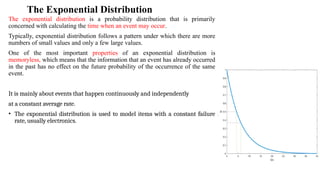
The exponential probability density function
is shown in the figure below.
Examples of Exponential Distribution applications
Predict the time when an Earthquake might occur
• The exponential distribution is prominently used by seismologists and
earth scientists to predict the approximate time when an earthquake
is likely to occur in a particular locality.
• For this purpose, the history of the earthquakes and other natural
calamities occurring in a particular locality is recorded and monitored.
This data acts as the information and is fed to the exponential
distribution function.
• The output gives an approximate time when the earthquake might
occur.
• This helps the environmental engineers and disaster management
officials draft the essential measures to avoid the loss of lives and to
minimize the property destruction rate.
Life Span of Electronic Gadgets
• Exponential distribution finds its prime application in
calculating the reliability of electronic gadgets such as a
laptop, battery, processor, mobile phone, etc.
• It helps the engineers and manufacturers to know an
approximate time after which the product will get ruptured.
The engineers use this data to improve the quality of their
products by replacing the low-quality components with
those having comparatively high quality.
Establishing a New Shop
• While establishing a new shop, a person tends to consider a
variety of factors that may affect his/her business. One of
such key factors is the number of customers arriving at the
shop during the first week.
• For this purpose, the entrepreneur makes use of the
exponential distribution to roughly estimate the number of
customers expected to visit the shop on the inauguration
day and on the following days.
• This helps the shopkeeper keep an appropriate amount of
products ready to serve all of his/her customers.
• The exponential distribution also helps to predict the time
duration between the arrival of two consecutive customers.
Call Duration
• Let us assume that according to a survey, the average amount of
time a person accesses a public telephone for conversation is
about fifteen minutes. In such a case, the exponential distribution
function can be used to find out the probability that the person
standing ahead of you will take less than ten minutes to complete
his/her conversation.
Example 1: Time Between Geyser
Eruptions
• The number of minutes between eruptions for a certain geyser can be modeled by the exponential distribution. For
example, suppose the mean number of minutes between eruptions for a certain geyser is 40 minutes. If a geyser just
erupts, what is the probability that we’ll have to wait less than 50 minutes for the next eruption?
• Solution
• To solve this, we need to first calculate the rate parameter:
• = 1/
λ μ
• = 1/40
λ
• = .025
λ
• We can plug in = .025 and x = 50 to the formula for the CDF:
λ
• P(X ≤ x) = 1 – e- x
λ
• P(X ≤ 50) = 1 – e-025(50)
• P(X ≤ 50) = 0.7135
• The probability that we’ll have to wait less than
50 minutes for the next eruption is 0.7135.
Example 2: Time Between Customers
• The number of minutes between customers who enter a certain shop can be modeled by the
exponential distribution.
• For example, suppose a new customer enters a shop every two minutes, on average. After a
customer arrives, find the probability that a new customer arrives in less than one minute.
• Solution
• To solve this, we can start by knowing that the average time between customers is two minutes.
Thus, the rate can be calculated as:
• = 1/
λ μ
• = 1/2
λ
• = 0.5
λ We can plug in = 0.5 and x = 1 to the formula for the CDF:
λ
• P(X ≤ x) = 1 – e- x
λ
, P(X ≤ 1) = 1 – e-0.5(1) ,
P(X ≤ 1) = 0.3935
• The probability that we’ll have to wait less than one minute for the next customer to arrive
is 0.3935.
Example 3: Time Between Earthquakes
• The time between earthquake occurrences can be modeled using an exponential
distribution.
• For example, suppose an earthquake occurs every 400 days in a certain region, on
average. After an earthquake occurs, find the probability that it will take more than
500 days for the next earthquake to occur.
• Solution
• To solve this, we start by knowing that the average time between earthquakes is 400
days. Thus, the rate can be calculated as:
• = 1/
λ μ = 1/400
λ = 0.0025
λ
• We can plug in = 0.0025 and x = 500 to the formula for the CDF:
λ
• P(X ≤ x) = 1 – e- x
λ
P(X ≤ 1) = 1 – e-0.0025(500)
• P(X ≤ 1) = 0.7135
• The probability that we’ll have to wait less than 500 days for the next earthquake is
0.7135.
• Thus, the probability that we’ll have to wait more than 500 days for the next
earthquake is 1 – 0.7135 = 0.2865.
Example 4: Time Between Calls
• The time between customer calls at different businesses can be modeled using an exponential
distribution.
• For example, suppose a bank receives a new call every 10 minutes, on average. After a customer
calls, find the probability that a new customer calls within 10 to 15 minutes.
• Solution
• To solve this , we start by knowing that the average time between calls is 10 minutes. Thus, the
rate can be calculated as:
• = 1/
λ μ = 1/10
λ = 0.1
λ We can use the following formula to
calculate the probability that a new customer calls within 10 to 15 minutes:
• P(10 < X ≤ 15) = (1 – e-0.1(15))
– (1 – e-0.1(10))
• P(10 < X ≤ 15) = .7769 – .6321
• P(10 < X ≤ 15) = 0.1448
• The probability that a new customer calls within 10 to 15 minutes. is 0.1448.
Activity 1
• The mean time to failure (MTTF = θ, for this case) of an airborne fire
control system is 10 hours. What is the probability that it will not fail
during a 3 hour mission?
• Solution
• A resistor has a constant failure rate of 0.04 per hour. What is the
resistor's reliability at 100 hours? If 100 resistors are tested, how many
would be expected to be in a failed state after 25 hours?
Exercise
• The time between failures in a hemming machine modeled with the exponential
distribution has a MBT rate of 112.4 hours. The Six JUST team has a goal to
increase the MBT to greater than or equal to 150 hours.
Solution
• To help understand the current state, what is the probability that the time until the
next failure is less than 150 hours?
• Lambda (λ) = 1 / 112.4 = 0.008897
• F (time between events is < x) = 1 − e−λt
• F (time between events is < 150) = 1-e-0.008897×150
= 1 - 0.263277 = 0.736723
• The probability of the hemming machine failing in < 150 hours is 73.7% in its
current state. This is a baseline measurement for the team.
• End

Chapter_5 Exponential distribution.pptx

  • 1.
    Course name: Probability andRandom process Chapter 5. EXPONENTIAL DISTRIBUTIONS Eng. Abdirahman Farah Ali c.raxmaanfc@gmail.com
  • 2.
    The Exponential Distribution Theexponential distribution is a probability distribution that is primarily concerned with calculating the time when an event may occur. Typically, exponential distribution follows a pattern under which there are more numbers of small values and only a few large values. One of the most important properties of an exponential distribution is memoryless, which means that the information that an event has already occurred in the past has no effect on the future probability of the occurrence of the same event. It is mainly about events that happen continuously and independently at a constant average rate. • The exponential distribution is used to model items with a constant failure rate, usually electronics.
  • 3.
    • This isprobably the most important distribution in reliability work and is used almost exclusively for reliability prediction of electronic equipment. • It describes the situation wherein the hazard rate is constant which can be shown to be generated by a Poisson process. This distribution is valuable if properly used.
  • 7.
    The exponential probabilitydensity function is shown in the figure below.
  • 8.
    Examples of ExponentialDistribution applications Predict the time when an Earthquake might occur • The exponential distribution is prominently used by seismologists and earth scientists to predict the approximate time when an earthquake is likely to occur in a particular locality. • For this purpose, the history of the earthquakes and other natural calamities occurring in a particular locality is recorded and monitored. This data acts as the information and is fed to the exponential distribution function. • The output gives an approximate time when the earthquake might occur. • This helps the environmental engineers and disaster management officials draft the essential measures to avoid the loss of lives and to minimize the property destruction rate.
  • 9.
    Life Span ofElectronic Gadgets • Exponential distribution finds its prime application in calculating the reliability of electronic gadgets such as a laptop, battery, processor, mobile phone, etc. • It helps the engineers and manufacturers to know an approximate time after which the product will get ruptured. The engineers use this data to improve the quality of their products by replacing the low-quality components with those having comparatively high quality.
  • 10.
    Establishing a NewShop • While establishing a new shop, a person tends to consider a variety of factors that may affect his/her business. One of such key factors is the number of customers arriving at the shop during the first week. • For this purpose, the entrepreneur makes use of the exponential distribution to roughly estimate the number of customers expected to visit the shop on the inauguration day and on the following days. • This helps the shopkeeper keep an appropriate amount of products ready to serve all of his/her customers. • The exponential distribution also helps to predict the time duration between the arrival of two consecutive customers.
  • 11.
    Call Duration • Letus assume that according to a survey, the average amount of time a person accesses a public telephone for conversation is about fifteen minutes. In such a case, the exponential distribution function can be used to find out the probability that the person standing ahead of you will take less than ten minutes to complete his/her conversation.
  • 12.
    Example 1: TimeBetween Geyser Eruptions • The number of minutes between eruptions for a certain geyser can be modeled by the exponential distribution. For example, suppose the mean number of minutes between eruptions for a certain geyser is 40 minutes. If a geyser just erupts, what is the probability that we’ll have to wait less than 50 minutes for the next eruption? • Solution • To solve this, we need to first calculate the rate parameter: • = 1/ λ μ • = 1/40 λ • = .025 λ • We can plug in = .025 and x = 50 to the formula for the CDF: λ • P(X ≤ x) = 1 – e- x λ • P(X ≤ 50) = 1 – e-025(50) • P(X ≤ 50) = 0.7135 • The probability that we’ll have to wait less than 50 minutes for the next eruption is 0.7135.
  • 13.
    Example 2: TimeBetween Customers • The number of minutes between customers who enter a certain shop can be modeled by the exponential distribution. • For example, suppose a new customer enters a shop every two minutes, on average. After a customer arrives, find the probability that a new customer arrives in less than one minute. • Solution • To solve this, we can start by knowing that the average time between customers is two minutes. Thus, the rate can be calculated as: • = 1/ λ μ • = 1/2 λ • = 0.5 λ We can plug in = 0.5 and x = 1 to the formula for the CDF: λ • P(X ≤ x) = 1 – e- x λ , P(X ≤ 1) = 1 – e-0.5(1) , P(X ≤ 1) = 0.3935 • The probability that we’ll have to wait less than one minute for the next customer to arrive is 0.3935.
  • 14.
    Example 3: TimeBetween Earthquakes • The time between earthquake occurrences can be modeled using an exponential distribution. • For example, suppose an earthquake occurs every 400 days in a certain region, on average. After an earthquake occurs, find the probability that it will take more than 500 days for the next earthquake to occur. • Solution • To solve this, we start by knowing that the average time between earthquakes is 400 days. Thus, the rate can be calculated as: • = 1/ λ μ = 1/400 λ = 0.0025 λ • We can plug in = 0.0025 and x = 500 to the formula for the CDF: λ • P(X ≤ x) = 1 – e- x λ P(X ≤ 1) = 1 – e-0.0025(500) • P(X ≤ 1) = 0.7135 • The probability that we’ll have to wait less than 500 days for the next earthquake is 0.7135. • Thus, the probability that we’ll have to wait more than 500 days for the next earthquake is 1 – 0.7135 = 0.2865.
  • 15.
    Example 4: TimeBetween Calls • The time between customer calls at different businesses can be modeled using an exponential distribution. • For example, suppose a bank receives a new call every 10 minutes, on average. After a customer calls, find the probability that a new customer calls within 10 to 15 minutes. • Solution • To solve this , we start by knowing that the average time between calls is 10 minutes. Thus, the rate can be calculated as: • = 1/ λ μ = 1/10 λ = 0.1 λ We can use the following formula to calculate the probability that a new customer calls within 10 to 15 minutes: • P(10 < X ≤ 15) = (1 – e-0.1(15)) – (1 – e-0.1(10)) • P(10 < X ≤ 15) = .7769 – .6321 • P(10 < X ≤ 15) = 0.1448 • The probability that a new customer calls within 10 to 15 minutes. is 0.1448.
  • 16.
    Activity 1 • Themean time to failure (MTTF = θ, for this case) of an airborne fire control system is 10 hours. What is the probability that it will not fail during a 3 hour mission? • Solution
  • 17.
    • A resistorhas a constant failure rate of 0.04 per hour. What is the resistor's reliability at 100 hours? If 100 resistors are tested, how many would be expected to be in a failed state after 25 hours?
  • 18.
    Exercise • The timebetween failures in a hemming machine modeled with the exponential distribution has a MBT rate of 112.4 hours. The Six JUST team has a goal to increase the MBT to greater than or equal to 150 hours. Solution • To help understand the current state, what is the probability that the time until the next failure is less than 150 hours? • Lambda (λ) = 1 / 112.4 = 0.008897 • F (time between events is < x) = 1 − e−λt • F (time between events is < 150) = 1-e-0.008897×150 = 1 - 0.263277 = 0.736723 • The probability of the hemming machine failing in < 150 hours is 73.7% in its current state. This is a baseline measurement for the team.
  • 19.