Raise Boring,
Shaft sinking operation
RAISE BORING
Rock conditions and their variability.
 Very hard rock, their system is slow.
EQUIPMENTS FOR SOFT ROCK
(European coal fields):-
• Pilot hole diameter
• Drill pipe diameter
• Reaming Torque
• Type of driver (AC, DC ,hydraulic)gear reducer
• RPM
• Power: Pilot hole thrust & feed rates reaming pull, size of
drill pipe base plate and derrick dimensions, type of
transporter, water and air consumption.
• Diameter/length/advance per unit time .
• Costs reduced due development of improved cutters with
average life being extended by fire fold.
Purpose of Raise Boring:-
• Ore passes
• Ventilation
• Ventilation shafts
• Full sized shafts for coal mining.
Advantages of Raise Boring:-
• No worker needs to be present while
excavation is on .
• Cost thus gets reduced (in developed
countries).
• Faster progress.
• Less damage to surrounding rock/thus
minimum support is needed.
• Smooth, stable walls, lead resistance for
ventilation.
Disadvantages of Raise Boring:-
• Change on rock conditions
• Costs are high for hard rocks.
• Access necessary.
• Initial cost of rig is high.
• Shaft should be dry.
Operations :-
1. The machine drills Pilot hole and then reamer is
attached in place of drill bit.
2. The raise drill pulls the reamer towards itself.
3. Tailings fall down the shaft and are removed.
CLUTCH COMPONENTS:-
• Rig – Rigid plate and structure
• Hydraulic, drilling and electrical equipment are
housed
Crawler Driven by
Compressed Air/Railwheels:-
• Pilot hole is drilled through the stem with stabilizers and a
conventional drilling bit.
• Drill rod diameter (20 -31 cm)
• Length of the section is 1.5 m.
• Purpose of stabilizer is to ensure directional accuracy of the
pilot hole .
• Stem longest /reamer-stages / structural analysis of
required/balancing of tool by positioning cutters optimally.
• Geared reamers/conventional type .
• Best performance is achieved when cutter life and ROP are
optimized.
• Structural features- Ductility/Brittle abrasivity.
• Removal of cuttings (should be effective )
Reduce rocks layer of cuttings 40%
• Drilling –air /water/foam/drilling fluid
D=W
Where D is DOP and W is applied load.
• Reaming
• RPM – wear/vibrations
• Adequate room/interference with production
Drilling down/reaming up is the cheapest option.
Rock quality and its response can change the boring
direction.
• Lining – strong rocks no lines/shotcrete/rockbolt /± wire
mesh/steel lining.
• Cost
Diameter Length
(move/
min)
Mobilization
(cost/move/
m)
Setup
(cost)
Pilot
holes
Ream/
m
3 m 600/37
m/min
58286/4436
Rs-sec/m
29100/4
500 Rs/-
28/12 81/47
m-1
Khetri Shaft Details:-
• Adit section : For exploitation of ore body above 424 MRL
• Decline section: 5 mX3.25m size ,11N 9 from surface to364MRL and
306 MRL .
• Production shaft section:424 MRL
Production Shaft:-
• Up cast shaft-5.5 m diameter.
• Concrete lined.
• Tower mounted 2870 KW 6 rope friction hoist with 2/14 t ships in
counter balance.
• Emerging escape and c ladder way
• Hoisting speed : 2 stages 1)8m/s 2)18 m/s
Service Shaft:-
• Rectangular in shape
• Size : 6.11m X 4.93m.
• 2 cage hoisting compartments.
• Emergency escape cage & c ladder way.
• Double deck cages guided by rigid rail guides.
• Shaft is provided with a steel head frame and
is1600 cylindrical double drum hoist with one
drum cluthed.
ORGANISATION OF SHAFT SINKING:-
 Drilling + mucking/hoisting + lining
(shorter holes will take one cycle/shift)
Optimum would be the length that assures
a unit advance with minimum time taken.
 Min. Cost principle ( Drilling of holes ,
explosives, Mucking, Time taken).
Drilling Pattern :-
 Accuracy in the shape of excavation.
 Clean separation up to the desired depth.
 Uniform fragmentation.
 Minimum misfires(should be avoided).
 Damage is controlled (nearby structures).
Pattern :-
o Shape of the section
o Rock strength.
o Cleavage.
o Dip of strata.
o Water inflow.
o Hole loading structure.
Cartridge No. Of circles Diameter of holes Holes rate
32mm. 3 0.37,0.66,0.93 1-2-3
4 0.35,0.54,0.7,0.93 1-2-3-4
5 0.27,0.43,0.6,0.93 1-2-3-4-5
45mm. 3 0.3,0.6,0.95 1-3-6
4 0.25,0.48,0.72,0.96 1-2-3-5
LINING IN SHAFTS
• Factors:-
Type of lining.
Hydro geological conditions (geotechnical parameters).
Shaft function.
Planned life time.
Shape of shaft section.
Depth.
Availability of construction materials.
Construction cost .
Chemical activity.
Repairs and maintenance .
Temporary lining:-
• Against falling rocks (6-40m).
• Necessary when tech. is advancing.
Permanent lining:-
• Timber
• Brick
• Concrete blocks
• Concrete monolithic
• Reinforced concrete
• Tubbers (cast iron and pre cast elements)
• Shotcrete (with wire mesh)
• Anchor bolts (a combination some times)
1.Brick lining:-
• Bricking lining was popular/ability to carry load
immediately /ease of repairs and resistance to
corrosive factors.
2.Concrete block lining:-
• Decreased seams
• Higher strength
• Less labour
• Intensive in comparison to brick lining
3.Timber Lining:-
Seldom.
Disadvantage:-
 Time and labour consuming
 Low strength
 High cost
 Substantial permeability.
Timber Lining
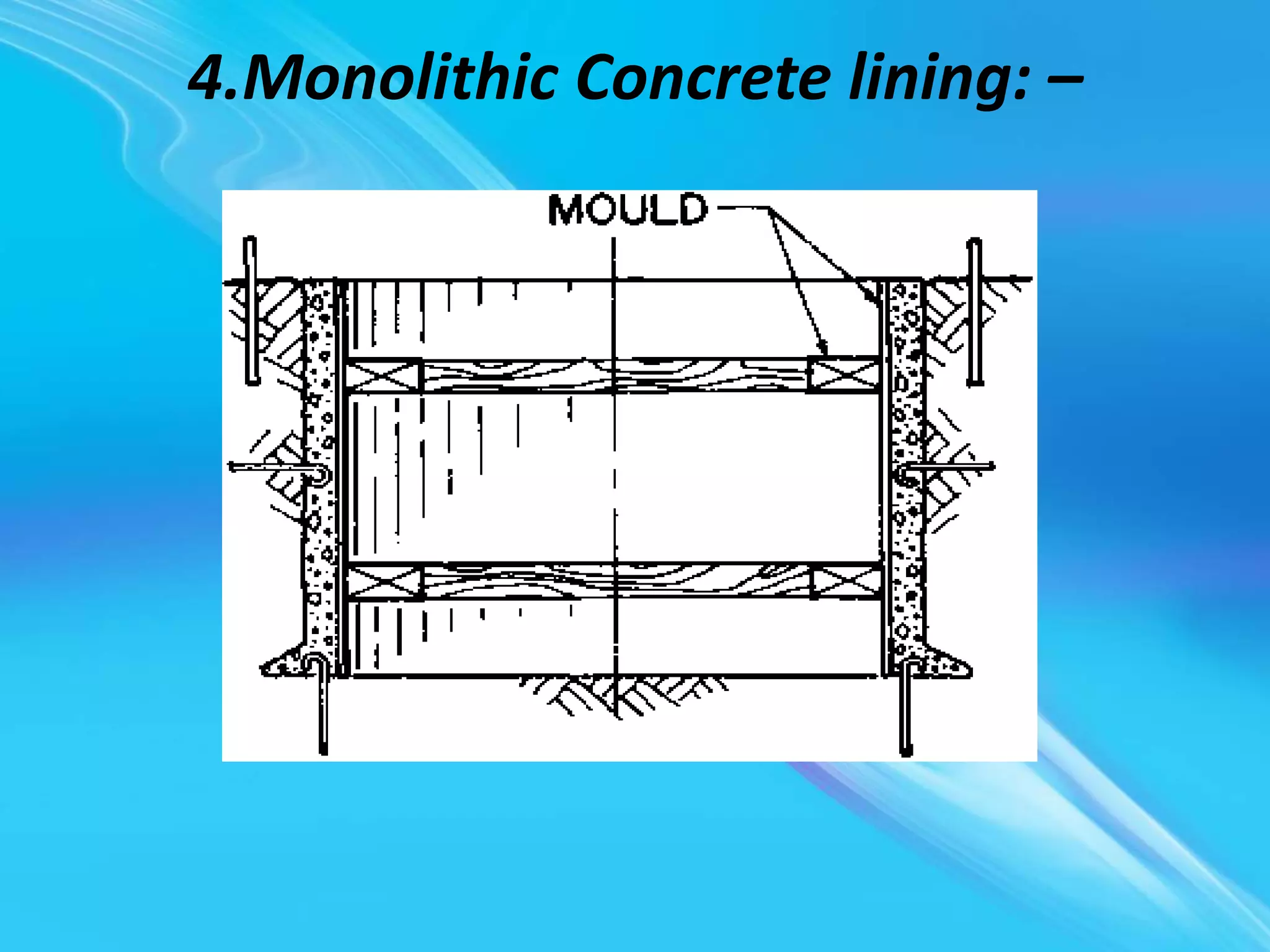
4.Monolithic Concrete lining: –
Advantages of Monolithic
Concrete lining:-
• Complete mechanization possible.
• Good bond between lining and shaft.
• Decreased labour cost.
• High strength.
Disadvantages of Monolithic
Concrete lining :-
• Less resistance to corrosive water
• Sensitivity to rock mass movement
• Inability to take load immediately
• Difficult to repairs
 17-25Mpa is sufficient.
 Minimum thickness of lining is 200mm.
 Maximum thickness of lining is 800 mm.
 Collapsible steel forms /segment with seam
 Sliding type – longer segments
Some Important facts :-
5.Shotcrete lining:-
Composition:-
• Shotcrete
• Shotcrete + rock bolts +mesh
• RCC
• RCC +bolts (temp. supports)
Applicable in dry shafts
Very good bonding
High strength due to low water
{ t=r0-ri , r = r0-ri }
σt(max)/F.S = 2P0(t+ri)2/t(t+2ri)
P0 = r h ( tan r(π/4-φ/2))
Φ = angle of internal friction
σt = (P0r0
2/(r0
2-ri
2))((1+ri
2)/r0
2)
= 2P0r0
2
σt = (P0)((r0=ri)2-2r0ri)/(r0+ri)(r0-ri)
=P0(r0+ri)/(r0-ri)-(2P0r0ri)/(r0
2-ri
2)
Primary Stresses:-
σr=∑rh
h=thickness of rock stratum
for 500 σr/σt=2to 3
Polyethylene – membrance to prevent corrosive
waters.
The following are the three categories
Cohesion less
Cohesive
Rocks
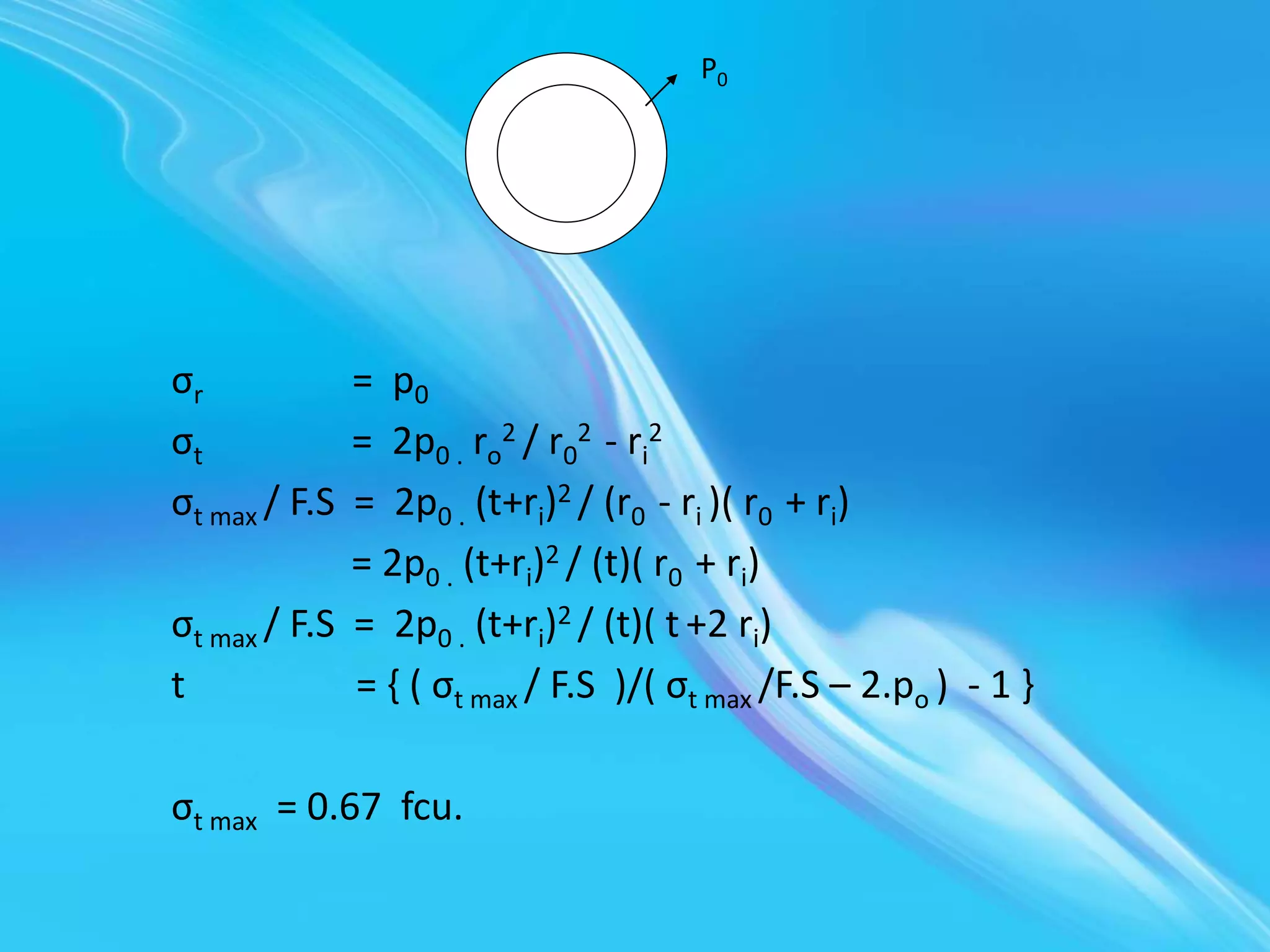
σr = p0
σt = 2p0 . ro
2 / r0
2 - ri
2
σt max / F.S = 2p0 . (t+ri)2 / (r0 - ri )( r0 + ri)
= 2p0 . (t+ri)2 / (t)( r0 + ri)
σt max / F.S = 2p0 . (t+ri)2 / (t)( t +2 ri)
t = { ( σt max / F.S )/( σt max /F.S – 2.po ) - 1 }
σt max = 0.67 fcu.
P0
fcu : Cube strength of concrete after 28 days
(British standard code )
rf : for applied load
rm : different srength in concrete
(due in sufficient copaction & difference in curving ).
rm = 1.5 and rf = 1.4
0.67/1.4 x1.5 = 2x0.01xd(t+ri)2 / (t)( t+2 ri)
.: t =ri [ (0.67fcu/2.1)/(0.67fcu/2.1 – 2x0.01d)} - 1]
d in mts , ri in mts , t in mm and fcu in N/mm2
Some Points :-
• Support of Shaft equipment and walls .
• Shallow square (timber support).
• Deep circular or spherical.
• Concrete lining mostly – mechanized/utilizes the
structure features of concrete, easy least air flow
resistance.
• Strengths 20 to 50 Mpa .
• Cast iron tubbings with concrete mantle welded
steel lining (water heads).
• Bitumen envelop for preventing damage due to
subsiding strata.
• Temporary support fos = 1.
• Permanent fos > 1 (lining conditions and life
space ).
• Primary stress σ v = Σ γ h.
• σ h /σ v = 2 to 3 < 500m depth .
• σh = σv . Ka Ka : co efficient of active stress.
• Stress distribution around shaft existing cracks ,
shaft diameter ,method of (D and B or boring
),time of exposure without support type of temp.
Support used and delay instead of permanent
lining .
• σh = σv . Ka Ka : co efficient of active stress.
• Polyethylene membrane for preventing corrosion
of concrete for water insulation.
• RMR and Q  Ka ( Horizontal design stress).
• Un supported span ( 15 – 25 m).
Thank You

Raise boring,organisation of shaft sinking,lining

  • 2.
  • 3.
    RAISE BORING Rock conditionsand their variability.  Very hard rock, their system is slow.
  • 4.
    EQUIPMENTS FOR SOFTROCK (European coal fields):- • Pilot hole diameter • Drill pipe diameter • Reaming Torque • Type of driver (AC, DC ,hydraulic)gear reducer • RPM • Power: Pilot hole thrust & feed rates reaming pull, size of drill pipe base plate and derrick dimensions, type of transporter, water and air consumption. • Diameter/length/advance per unit time . • Costs reduced due development of improved cutters with average life being extended by fire fold.
  • 5.
    Purpose of RaiseBoring:- • Ore passes • Ventilation • Ventilation shafts • Full sized shafts for coal mining.
  • 6.
    Advantages of RaiseBoring:- • No worker needs to be present while excavation is on . • Cost thus gets reduced (in developed countries). • Faster progress. • Less damage to surrounding rock/thus minimum support is needed. • Smooth, stable walls, lead resistance for ventilation.
  • 7.
    Disadvantages of RaiseBoring:- • Change on rock conditions • Costs are high for hard rocks. • Access necessary. • Initial cost of rig is high. • Shaft should be dry.
  • 8.
    Operations :- 1. Themachine drills Pilot hole and then reamer is attached in place of drill bit. 2. The raise drill pulls the reamer towards itself. 3. Tailings fall down the shaft and are removed. CLUTCH COMPONENTS:- • Rig – Rigid plate and structure • Hydraulic, drilling and electrical equipment are housed
  • 9.
    Crawler Driven by CompressedAir/Railwheels:- • Pilot hole is drilled through the stem with stabilizers and a conventional drilling bit. • Drill rod diameter (20 -31 cm) • Length of the section is 1.5 m. • Purpose of stabilizer is to ensure directional accuracy of the pilot hole . • Stem longest /reamer-stages / structural analysis of required/balancing of tool by positioning cutters optimally. • Geared reamers/conventional type . • Best performance is achieved when cutter life and ROP are optimized.
  • 10.
    • Structural features-Ductility/Brittle abrasivity. • Removal of cuttings (should be effective ) Reduce rocks layer of cuttings 40% • Drilling –air /water/foam/drilling fluid D=W Where D is DOP and W is applied load. • Reaming • RPM – wear/vibrations • Adequate room/interference with production Drilling down/reaming up is the cheapest option. Rock quality and its response can change the boring direction. • Lining – strong rocks no lines/shotcrete/rockbolt /± wire mesh/steel lining. • Cost
  • 11.
    Diameter Length (move/ min) Mobilization (cost/move/ m) Setup (cost) Pilot holes Ream/ m 3 m600/37 m/min 58286/4436 Rs-sec/m 29100/4 500 Rs/- 28/12 81/47 m-1
  • 12.
    Khetri Shaft Details:- •Adit section : For exploitation of ore body above 424 MRL • Decline section: 5 mX3.25m size ,11N 9 from surface to364MRL and 306 MRL . • Production shaft section:424 MRL Production Shaft:- • Up cast shaft-5.5 m diameter. • Concrete lined. • Tower mounted 2870 KW 6 rope friction hoist with 2/14 t ships in counter balance. • Emerging escape and c ladder way • Hoisting speed : 2 stages 1)8m/s 2)18 m/s
  • 13.
    Service Shaft:- • Rectangularin shape • Size : 6.11m X 4.93m. • 2 cage hoisting compartments. • Emergency escape cage & c ladder way. • Double deck cages guided by rigid rail guides. • Shaft is provided with a steel head frame and is1600 cylindrical double drum hoist with one drum cluthed.
  • 14.
    ORGANISATION OF SHAFTSINKING:-  Drilling + mucking/hoisting + lining (shorter holes will take one cycle/shift) Optimum would be the length that assures a unit advance with minimum time taken.  Min. Cost principle ( Drilling of holes , explosives, Mucking, Time taken).
  • 15.
    Drilling Pattern :- Accuracy in the shape of excavation.  Clean separation up to the desired depth.  Uniform fragmentation.  Minimum misfires(should be avoided).  Damage is controlled (nearby structures).
  • 16.
    Pattern :- o Shapeof the section o Rock strength. o Cleavage. o Dip of strata. o Water inflow. o Hole loading structure.
  • 17.
    Cartridge No. Ofcircles Diameter of holes Holes rate 32mm. 3 0.37,0.66,0.93 1-2-3 4 0.35,0.54,0.7,0.93 1-2-3-4 5 0.27,0.43,0.6,0.93 1-2-3-4-5 45mm. 3 0.3,0.6,0.95 1-3-6 4 0.25,0.48,0.72,0.96 1-2-3-5
  • 18.
    LINING IN SHAFTS •Factors:- Type of lining. Hydro geological conditions (geotechnical parameters). Shaft function. Planned life time. Shape of shaft section. Depth. Availability of construction materials. Construction cost . Chemical activity. Repairs and maintenance .
  • 19.
    Temporary lining:- • Againstfalling rocks (6-40m). • Necessary when tech. is advancing. Permanent lining:- • Timber • Brick • Concrete blocks • Concrete monolithic • Reinforced concrete • Tubbers (cast iron and pre cast elements) • Shotcrete (with wire mesh) • Anchor bolts (a combination some times)
  • 20.
    1.Brick lining:- • Brickinglining was popular/ability to carry load immediately /ease of repairs and resistance to corrosive factors. 2.Concrete block lining:- • Decreased seams • Higher strength • Less labour • Intensive in comparison to brick lining
  • 21.
    3.Timber Lining:- Seldom. Disadvantage:-  Timeand labour consuming  Low strength  High cost  Substantial permeability.
  • 22.
  • 23.
  • 24.
    Advantages of Monolithic Concretelining:- • Complete mechanization possible. • Good bond between lining and shaft. • Decreased labour cost. • High strength.
  • 25.
    Disadvantages of Monolithic Concretelining :- • Less resistance to corrosive water • Sensitivity to rock mass movement • Inability to take load immediately • Difficult to repairs
  • 26.
     17-25Mpa issufficient.  Minimum thickness of lining is 200mm.  Maximum thickness of lining is 800 mm.  Collapsible steel forms /segment with seam  Sliding type – longer segments Some Important facts :-
  • 27.
    5.Shotcrete lining:- Composition:- • Shotcrete •Shotcrete + rock bolts +mesh • RCC • RCC +bolts (temp. supports) Applicable in dry shafts Very good bonding High strength due to low water
  • 28.
    { t=r0-ri ,r = r0-ri } σt(max)/F.S = 2P0(t+ri)2/t(t+2ri) P0 = r h ( tan r(π/4-φ/2)) Φ = angle of internal friction σt = (P0r0 2/(r0 2-ri 2))((1+ri 2)/r0 2) = 2P0r0 2 σt = (P0)((r0=ri)2-2r0ri)/(r0+ri)(r0-ri) =P0(r0+ri)/(r0-ri)-(2P0r0ri)/(r0 2-ri 2)
  • 29.
    Primary Stresses:- σr=∑rh h=thickness ofrock stratum for 500 σr/σt=2to 3 Polyethylene – membrance to prevent corrosive waters. The following are the three categories Cohesion less Cohesive Rocks
  • 30.
    σr = p0 σt= 2p0 . ro 2 / r0 2 - ri 2 σt max / F.S = 2p0 . (t+ri)2 / (r0 - ri )( r0 + ri) = 2p0 . (t+ri)2 / (t)( r0 + ri) σt max / F.S = 2p0 . (t+ri)2 / (t)( t +2 ri) t = { ( σt max / F.S )/( σt max /F.S – 2.po ) - 1 } σt max = 0.67 fcu. P0
  • 31.
    fcu : Cubestrength of concrete after 28 days (British standard code ) rf : for applied load rm : different srength in concrete (due in sufficient copaction & difference in curving ). rm = 1.5 and rf = 1.4 0.67/1.4 x1.5 = 2x0.01xd(t+ri)2 / (t)( t+2 ri) .: t =ri [ (0.67fcu/2.1)/(0.67fcu/2.1 – 2x0.01d)} - 1] d in mts , ri in mts , t in mm and fcu in N/mm2
  • 32.
    Some Points :- •Support of Shaft equipment and walls . • Shallow square (timber support). • Deep circular or spherical. • Concrete lining mostly – mechanized/utilizes the structure features of concrete, easy least air flow resistance. • Strengths 20 to 50 Mpa . • Cast iron tubbings with concrete mantle welded steel lining (water heads).
  • 33.
    • Bitumen envelopfor preventing damage due to subsiding strata. • Temporary support fos = 1. • Permanent fos > 1 (lining conditions and life space ). • Primary stress σ v = Σ γ h. • σ h /σ v = 2 to 3 < 500m depth . • σh = σv . Ka Ka : co efficient of active stress. • Stress distribution around shaft existing cracks , shaft diameter ,method of (D and B or boring ),time of exposure without support type of temp. Support used and delay instead of permanent lining .
  • 34.
    • σh =σv . Ka Ka : co efficient of active stress. • Polyethylene membrane for preventing corrosion of concrete for water insulation. • RMR and Q  Ka ( Horizontal design stress). • Un supported span ( 15 – 25 m). Thank You