High Speed
Mechanised
Shaft Sinking
Background Information
 Shaft sinking: (i) Conventional Method(drilling
and blasting) & (ii) Mechanized Method
 Mechanisation of mine development is
becoming increasingly important in mines with
increased emphasis on safe and efficient
mining.
 While boring machines technology in
mechanical tunneling and their
auxiliary equipment have advanced rapidly, the
methods used in today's shaft construction
are still comparatively conventional
Reasons for low degree
of mechanization
 Diameter or cross section
 Depth
 Geology
 Pressure of ground-water
 Construction lining/enlargement
Objective(s)
 To achieve high sinking rate in deep u/g
excavations.
 Drilling up to higher depth coping with
different hydrogeological conditions.
 Simultaneous sinking operation.
 To improve excavation performance and
labor safety.
 Reducing cost.
Methods of Mechanized
Shaft Sinking
1. Shaft Drilling
2. Shaft Boring
3. Raise Boring
4. Box-hole Drilling
Shaft drilling Machine
• Excavation: Pilot hole is drilled. Using
successively larger diameter or under
reaming bits, shaft diameter is increased
either top downwards or bottom upwards
respectively.
• Mucking: Muck removal by reverse
circulation mud flush with air lift assistance.
• Mud also maintains stability prior to lining
installation.
Three basic types of shaft
drilling machines:
1. Modified oil-field
drilling rig
2. Purpose built drilling
rig
3. Combination shaft
drill and raise borer
Credit: Engineering in Rock Masses, edited by F
G Bell
Fig.1. Shaft drilling (Hughes Micon CSD 300
rig)
Shaft Boring
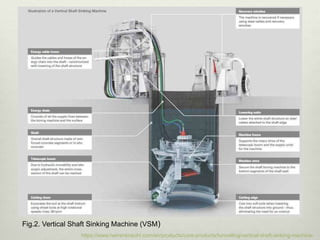
1. Vertical Shaft Sinking Machine
(VSM):
• Developed by Herrenknecht AG.
• Depth: shallow shaft, upto100m
• Geology: Water-bearing soil or soft rock with
compressive strength up to 80MPa
• Excavation Diameters: 4.5 -16m
• Excavation: A cutting drum equipped with
excavation tools loosens the soil on the shaft
• Removal: Hydraulic removal of the
excavated material to the surface using a
submersible pump.
• Thrust: Controlled lowering of the shaft
structure using the lowering units.
• Shaft construction: Shaft construction at the
surface with pre-cast reinforced concrete
segments or in-situ concrete casting
https://www.herrenknecht.com/en/products/core-products/tunnelling/vertical-shaft-sinking-machine-
Fig.2. Vertical Shaft Sinking Machine (VSM)
Advantages:
 Quick: Simultaneous excavating and lining.
High advance rates of up to 5 m per shift.
 Accurate: Controlled lowering using hydraulic
strand jacks
 Remotely Controlled
 Safe
 Cost saving: Applicable below groundwater
 Space-saving
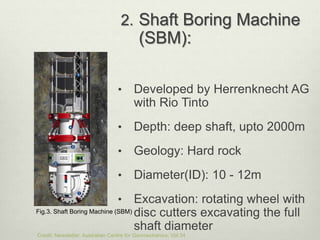
2. Shaft Boring Machine
(SBM):
• Developed by Herrenknecht AG
with Rio Tinto
• Depth: deep shaft, upto 2000m
• Geology: Hard rock
• Diameter(ID): 10 - 12m
• Excavation: rotating wheel with
disc cutters excavating the full
shaft diameter
Fig.3. Shaft Boring Machine (SBM)
Credit: Newsletter, Australian Centre for Geomechanics, Vol.34
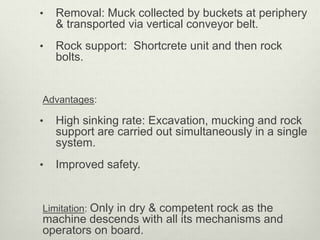
• Removal: Muck collected by buckets at periphery
& transported via vertical conveyor belt.
• Rock support: Shortcrete unit and then rock
bolts.
Advantages:
• High sinking rate: Excavation, mucking and rock
support are carried out simultaneously in a single
system.
• Improved safety.
Limitation: Only in dry & competent rock as the
machine descends with all its mechanisms and
operators on board.
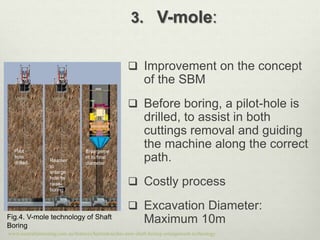
3. V-mole:
 Improvement on the concept
of the SBM
 Before boring, a pilot-hole is
drilled, to assist in both
cuttings removal and guiding
the machine along the correct
path.
 Costly process
 Excavation Diameter:
Maximum 10mFig.4. V-mole technology of Shaft
Boring
www.australianmining.com.au/features/herrenknechts-new-shaft-boring-enlargement-technology
Pilot
hole
drilled Reamer
to
enlarge
hole by
raise-
boring
Enlargeme
nt to final
diameter
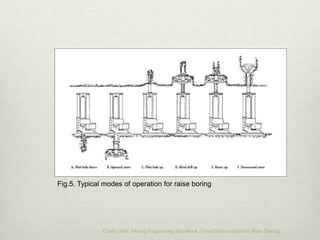
Raise Boring Machine
 Depth: down to 2000m
 Geology: Hard competent rock; strata must be
either dry or subjected to pre-treatment if acquifer
zones are present.
 Excavation: Drilling pilot hole and then reaming to
shaft diameter.
 Removal: Muck retrieval via free fall.
 Rock Support: Rock bolts installed manually. Steel
lining required in unstable formations.
 Limitation: Geology
Fig.5. Typical modes of operation for raise boring
Credit: SME Mining Engineering Handbook, Third Edition edited by Peter Darling
Box-Hole Drilling
Machine
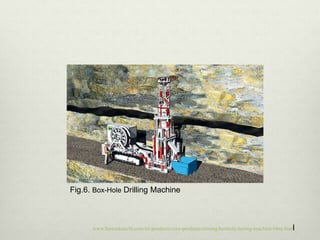
• Excavation: Location of machine is u/g.
Drilling upwards from shaft bottom in single
pass or in stages
• Removal: Muck retrieval via free fall.
• Shaft dimension: Restricted to small
diameter shafts (2m or less) and shallow
depths (less than 400m).
• Limitation: Difficulty of controlling drill-stem
direction while drilling upwards.
Fig.6. Box-Hole Drilling Machine
www.herrenknecht.com/en/products/core-products/mining/boxhole-boring-machine-bbm.html
Conclusion
 Mechanical excavations systems can have
significant advantages over conventional
drill and blast methods for sinking of shafts.
 Enhanced level of health and safety.
 High production performance.
 Breakthrough technologies: VSM and SBM.
 Future prospect of shaft sinking.
References
 [1] Auld, A. Shafts and Raises in Rock Masses. Edited by Bell, F.G. (1994).Chapter
24.,Sec.24.3. In,Engineering in Rock Masses, paperback edition, pp.480-502. ISBN: 0-7506-
1965-1.
 [2] Neye,E., Burger,W.,…& Kunstle,B. Future Trends in Shaft Development Edited by
Kicki,J., Sobczyk,E.J. & Kaminski,P. (2015). In,Vertical and Decline Shaft Snking: Good
Practices in Techniques and Technology. International Mining Forum 2015.ISBN: 978-1-138-
02820-3.
 [3] Herrenknecht AG. Products Brochure. Available at www.herrenknecht.com
 [4] Tuck,M.A. Underground Horizontal and Inclined Developments. Edited by Darling,P.
(2011). Chapter 12.4.In SME Mining Engineering Handbook, 3d ed.,pp.1195-1196. ISBN:
978-0-87335-264-2.
 [5] Frenzel,C., Burger,W., Delabbio,F. Shaft Boring Systems for Mechanical Excavation of
Deep Shafts. In, Newsletter,Australian Center for Geomechanics, vol.34, May 2010, pp.2-4.
 [6] Australian Mining (2014), Herrenknecht’s New Shaft Boring Enlargement Technology,
Available at www.australianmining.com.au

High speed mechanised shaft sinking

  • 1.
  • 2.
    Background Information  Shaftsinking: (i) Conventional Method(drilling and blasting) & (ii) Mechanized Method  Mechanisation of mine development is becoming increasingly important in mines with increased emphasis on safe and efficient mining.  While boring machines technology in mechanical tunneling and their auxiliary equipment have advanced rapidly, the methods used in today's shaft construction are still comparatively conventional
  • 3.
    Reasons for lowdegree of mechanization  Diameter or cross section  Depth  Geology  Pressure of ground-water  Construction lining/enlargement
  • 4.
    Objective(s)  To achievehigh sinking rate in deep u/g excavations.  Drilling up to higher depth coping with different hydrogeological conditions.  Simultaneous sinking operation.  To improve excavation performance and labor safety.  Reducing cost.
  • 5.
    Methods of Mechanized ShaftSinking 1. Shaft Drilling 2. Shaft Boring 3. Raise Boring 4. Box-hole Drilling
  • 6.
    Shaft drilling Machine •Excavation: Pilot hole is drilled. Using successively larger diameter or under reaming bits, shaft diameter is increased either top downwards or bottom upwards respectively. • Mucking: Muck removal by reverse circulation mud flush with air lift assistance. • Mud also maintains stability prior to lining installation.
  • 7.
    Three basic typesof shaft drilling machines: 1. Modified oil-field drilling rig 2. Purpose built drilling rig 3. Combination shaft drill and raise borer Credit: Engineering in Rock Masses, edited by F G Bell Fig.1. Shaft drilling (Hughes Micon CSD 300 rig)
  • 8.
    Shaft Boring 1. VerticalShaft Sinking Machine (VSM): • Developed by Herrenknecht AG. • Depth: shallow shaft, upto100m • Geology: Water-bearing soil or soft rock with compressive strength up to 80MPa • Excavation Diameters: 4.5 -16m • Excavation: A cutting drum equipped with excavation tools loosens the soil on the shaft
  • 9.
    • Removal: Hydraulicremoval of the excavated material to the surface using a submersible pump. • Thrust: Controlled lowering of the shaft structure using the lowering units. • Shaft construction: Shaft construction at the surface with pre-cast reinforced concrete segments or in-situ concrete casting
  • 10.
  • 11.
    Advantages:  Quick: Simultaneousexcavating and lining. High advance rates of up to 5 m per shift.  Accurate: Controlled lowering using hydraulic strand jacks  Remotely Controlled  Safe  Cost saving: Applicable below groundwater  Space-saving
  • 12.
    2. Shaft BoringMachine (SBM): • Developed by Herrenknecht AG with Rio Tinto • Depth: deep shaft, upto 2000m • Geology: Hard rock • Diameter(ID): 10 - 12m • Excavation: rotating wheel with disc cutters excavating the full shaft diameter Fig.3. Shaft Boring Machine (SBM) Credit: Newsletter, Australian Centre for Geomechanics, Vol.34
  • 13.
    • Removal: Muckcollected by buckets at periphery & transported via vertical conveyor belt. • Rock support: Shortcrete unit and then rock bolts. Advantages: • High sinking rate: Excavation, mucking and rock support are carried out simultaneously in a single system. • Improved safety. Limitation: Only in dry & competent rock as the machine descends with all its mechanisms and operators on board.
  • 14.
    3. V-mole:  Improvementon the concept of the SBM  Before boring, a pilot-hole is drilled, to assist in both cuttings removal and guiding the machine along the correct path.  Costly process  Excavation Diameter: Maximum 10mFig.4. V-mole technology of Shaft Boring www.australianmining.com.au/features/herrenknechts-new-shaft-boring-enlargement-technology Pilot hole drilled Reamer to enlarge hole by raise- boring Enlargeme nt to final diameter
  • 15.
    Raise Boring Machine Depth: down to 2000m  Geology: Hard competent rock; strata must be either dry or subjected to pre-treatment if acquifer zones are present.  Excavation: Drilling pilot hole and then reaming to shaft diameter.  Removal: Muck retrieval via free fall.  Rock Support: Rock bolts installed manually. Steel lining required in unstable formations.  Limitation: Geology
  • 16.
    Fig.5. Typical modesof operation for raise boring Credit: SME Mining Engineering Handbook, Third Edition edited by Peter Darling
  • 17.
    Box-Hole Drilling Machine • Excavation:Location of machine is u/g. Drilling upwards from shaft bottom in single pass or in stages • Removal: Muck retrieval via free fall. • Shaft dimension: Restricted to small diameter shafts (2m or less) and shallow depths (less than 400m). • Limitation: Difficulty of controlling drill-stem direction while drilling upwards.
  • 18.
    Fig.6. Box-Hole DrillingMachine www.herrenknecht.com/en/products/core-products/mining/boxhole-boring-machine-bbm.html
  • 19.
    Conclusion  Mechanical excavationssystems can have significant advantages over conventional drill and blast methods for sinking of shafts.  Enhanced level of health and safety.  High production performance.  Breakthrough technologies: VSM and SBM.  Future prospect of shaft sinking.
  • 20.
    References  [1] Auld,A. Shafts and Raises in Rock Masses. Edited by Bell, F.G. (1994).Chapter 24.,Sec.24.3. In,Engineering in Rock Masses, paperback edition, pp.480-502. ISBN: 0-7506- 1965-1.  [2] Neye,E., Burger,W.,…& Kunstle,B. Future Trends in Shaft Development Edited by Kicki,J., Sobczyk,E.J. & Kaminski,P. (2015). In,Vertical and Decline Shaft Snking: Good Practices in Techniques and Technology. International Mining Forum 2015.ISBN: 978-1-138- 02820-3.  [3] Herrenknecht AG. Products Brochure. Available at www.herrenknecht.com  [4] Tuck,M.A. Underground Horizontal and Inclined Developments. Edited by Darling,P. (2011). Chapter 12.4.In SME Mining Engineering Handbook, 3d ed.,pp.1195-1196. ISBN: 978-0-87335-264-2.  [5] Frenzel,C., Burger,W., Delabbio,F. Shaft Boring Systems for Mechanical Excavation of Deep Shafts. In, Newsletter,Australian Center for Geomechanics, vol.34, May 2010, pp.2-4.  [6] Australian Mining (2014), Herrenknecht’s New Shaft Boring Enlargement Technology, Available at www.australianmining.com.au