HIGH ANGLE CONVEYING
IN SURFACE MINES
INTRODUCTION
Trucks, traditionally, have long been a favourite tool
in surface mines for hauling material from the pits.
However, the increasing strain of an inflationary
economy has caused mine operators to look at
alternatives to the longstanding workhorses (trucks)
in material haulage.
The intent of any major modification of the time-
honoured material handling by trucks is to achieve
the goal of a marked reduction in haulage costs;
sufficient not only to recoup the capital investment,
but to make the final product more competitive in
today's world market. In-pit crushing and belt
conveyor systems are one prominent alternative that
has gained popularity.
Conventional conveyor belts offer an economical
method for transporting bulk material at certain
inclined angles ranging from a low of 7 degree for
fine and somewhat lubricious material such as soda
ash brickets, to a high of 30 degree for cinder
concrete and ground phosphate fertilizers. Typical
recommended inclination angles for open-pit mine
products such as excavated earth including
anthracite coal, bituminous coal, lignite and
crushed rock, vary from 15 degree to 22 degree with
respective angles of repose from 29 degree to
44 degree.
The conventional conveyor is often the most
economical, reliable and safe means for transporting
such bulk materials. There are, however, many cases
that strongly warrant an increase in conveying
angles.
In a static case, cohesion less material on a rubber
conveyor belt will begin to slide back when the
inclination angle of the belt surface just exceeds the
angle of internal friction of the material or the friction
angle of the material to belt surface interface,
whichever is smaller. The angle of internal friction is
equal to the angle of repose of such materials.
Both the angle of repose and the friction angle for
bulk materials on rubber will vary from one material
to the next and will be affected, even for the same
type of material, by the maximum lump size, the lump
size distribution, the orientation of the conveyor
cross-section, and the shape that the particles or
lumps take as a result of the reduction process, i.e.,
blasting and the varying degrees and methods of
crushing.
The recommended conveying angles are in general
far below the recommended friction angles. This is
due to the dynamics induced in a moving belt
conveyor, which result in relative motion between
adjacent particles or lumps of the bulk material and
between the material and carrying surface of the
conveyor belt.
Various approaches have been made in an effort to
convey particular material at high angles. All of these
are directed to solving the problem of conveying bulk
material at steep angles and high conveying rates
efficiently and economically.

HIGH ANGLE CONVEYORS
– DIFFERENT TYPES
A high angle conveyor can be defined as any
conveyor that transports material along a slope
exceeding the dynamic stability angle of the
transported material. Typical recommended
inclination angles of conventional conveyors for
open-pit mine products (such as excavated earth
including anthracite coal, bituminous coal, lignite and
crushed rock) vary from 15 degree to 22 degree with
respective angles of repose from 29 degree to
44 degree, but the high angle conveyors may carry
the material at an angle more than this and in some
cases even at 90 degree.
Broadly available types of high angle conveying
systems are – Sandwich Belt conveying systems,
Pipe/Tube conveying systems, Flexowell conveying
systems, Pocketlift conveying systems, etc.. Of
these available systems, Sandwich Belt conveyor,
particularly the Continental HAC (High Angle
Conveyor) systems, has become very popular in
surface mining applications. The Continental HAC
(High Angle Conveyor) systems has been discussed
later in somewhat detail. Other methods are typically
expensive, of limited capacity, unable to completely
discharge sticky material, and do not lend
themselves to continuous cleaning by belt scrapers
or plows.
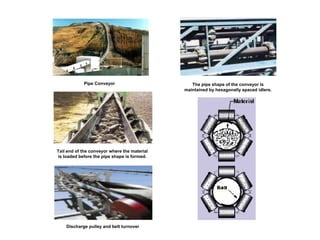
Pipe Conveyor
The ‘Pipe Conveyor’ is a recent adaptation of belt
conveyor design that encloses the conveyed
material completely by forming the belt into a ‘pipe’
or tube shape while carrying the material. This
eliminates spillage and reduces potential
environmental problems.
This type of conveyor has the added advantage of
being able to curve horizontally and vertically to a
greater degree than conventional belt conveyors.
This can substantially solve layout, transfer points’
and cost problems generally associated with
standard belt conveyor design.
Pipe Conveyor
Tail end of the conveyor where the material
is loaded before the pipe shape is formed.
The pipe shape of the conveyor is
maintained by hexagonally spaced idlers.
Discharge pulley and belt turnover
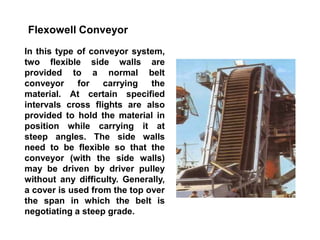
Flexowell Conveyor
In this type of conveyor system,
two flexible side walls are
provided to a normal belt
conveyor for carrying the
material. At certain specified
intervals cross flights are also
provided to hold the material in
position while carrying it at
steep angles. The side walls
need to be flexible so that the
conveyor (with the side walls)
may be driven by driver pulley
without any difficulty. Generally,
a cover is used from the top over
the span in which the belt is
negotiating a steep grade.
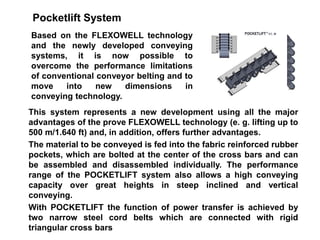
Pocketlift System
Based on the FLEXOWELL technology
and the newly developed conveying
systems, it is now possible to
overcome the performance limitations
of conventional conveyor belting and to
move into new dimensions in
conveying technology.
This system represents a new development using all the major
advantages of the prove FLEXOWELL technology (e. g. lifting up to
500 m/1.640 ft) and, in addition, offers further advantages.
The material to be conveyed is fed into the fabric reinforced rubber
pockets, which are bolted at the center of the cross bars and can
be assembled and disassembled individually. The performance
range of the POCKETLIFT system also allows a high conveying
capacity over great heights in steep inclined and vertical
conveying.
With POCKETLIFT the function of power transfer is achieved by
two narrow steel cord belts which are connected with rigid
triangular cross bars
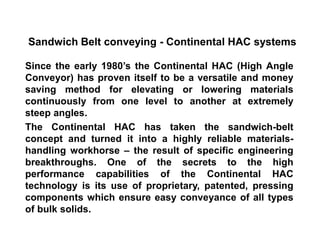
Sandwich Belt conveying - Continental HAC systems
Since the early 1980’s the Continental HAC (High Angle
Conveyor) has proven itself to be a versatile and money
saving method for elevating or lowering materials
continuously from one level to another at extremely
steep angles.
The Continental HAC has taken the sandwich-belt
concept and turned it into a highly reliable materials-
handling workhorse – the result of specific engineering
breakthroughs. One of the secrets to the high
performance capabilities of the Continental HAC
technology is its use of proprietary, patented, pressing
components which ensure easy conveyance of all types
of bulk solids.
The fully-equalized pressing mechanism secures
material toward the center of the belt while gently,
but effectively, sealing the belt edges together. The
HAC system holds the conveyed material continually
– eliminating relative movement between material
and belts. It does not confront materials; rather it
conforms to surface shapes without incurring high
local forces. Soft, gentle pressure assures the
preservation of product quality and long life for the
equipment.
The use of standard conveyor hardware in the HAC
system means interchangeability of components and
fast replacement of parts. HAC® systems in place
around the world have demonstrated high availability
and low maintenance costs.
Also, the use of these standard components in
the HAC facilitates high conveying speeds. Belts
and hardware are available in sizes up to 120
inches wide, which make capacities greater than
15,000 tons per hour easily achievable. Lifts
beyond 1000 ft. are achievable with standard
fabric belts, and much higher single-run lifts are
possible with steel cord or aramid fiber belts.
The HAC lends itself to multi-module conveying
systems using self-contained units, as well as
single-run systems using externally anchored
high angle conveyors. In both cases the
conveyor unit may be shortened or lengthened
or the conveying angle may be altered according
to the requirements of a new location.
High angle conveying modules may be mounted
on rails, rubber tired or crawler type transporters,
or they may be equipped with walking feet for
optimal mobility.
Standard, smooth surface belts allow continuous
cleaning by belt scrapers or plows. This is
especially important in handling wet and sticky
material. The Continental® HAC is clearly the
most efficient and economical option for virtually
every steep angle application.
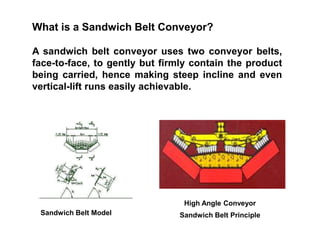
A sandwich belt conveyor uses two conveyor belts,
face-to-face, to gently but firmly contain the product
being carried, hence making steep incline and even
vertical-lift runs easily achievable.
What is a Sandwich Belt Conveyor?
Sandwich Belt Model
High Angle Conveyor
Sandwich Belt Principle
This unique sandwich belt principle permits the use
of standard conveyor components to achieve high
conveying angles at high capacities while retaining
the low cost, high reliability features of conventional
conveyors. The Continental system consists of a
carrying conveyor belt which is supported on
standard troughing idlers and a cover belt which is
softly pressed onto the conveyed material by
equalized pressing rolls. The required material-
hugging pressure varies according to the conveying
angle, material characteristics and dynamics of the
system.
Extensive research, including the input of open pit
copper, coal, lignite and other mine operators and
consultants, has determined the operational
superiority of sandwich belt, high angle conveyors in
open pit mine applications. The Continental system
offers the following advantages.
Advantages
1. Simplicity of Approach
The use of all conventional conveyor hardware
means interchangeability of components, fast
delivery of replacement parts, high availability and
low maintenance costs.
2. Virtually Unlimited in Capacity
The use of conventional conveyor components
permits high conveying speeds. Available belts
and hardware to ten feet wide make possible
capacities well in excess of 10,000 TPH.
The continental sandwich conveyor lends itself to a
multi-module conveying system or a very high
single run system. In either case, a conveyor unit
may be shortened or lengthened or the conveying
angle may be altered according to the requirements
of the new location. High angle conveying modules
may be mounted on rails, rubber tire or or crawler
type transporters or may be equipped with walking
feet for optional mobility.
3. High Lifts and High Conveying Angles
Lifts to 350 feet are possible with standard fabric
belts, and single run lifts to approximately 900 feet
are possible with steel cord belts. High angles in
excess of 45.degree are possible without excessive
wear because of a soft, floating, pressing
mechanism.
4. Flexibility in Planning and in Operation
During operation, the material is sealed between
the carrying and cover belts. Well-centered loading
and ample belt edge distance result in no spillage
along the conveyor length. Dust control efforts
need only be at transfer points.
5. Belts are Easily Cleaned and Quickly Repaired
Smooth surfaced belts allow continuous cleaning
by belt scrapers or plows. This is especially
important in handling wet and sticky materials.
Smooth surfaced belts present no obstructions to
quick repair of a damaged belt by hot or cold
vulcanizing. Quick repair means less costly
downtime.
6. Spillage-Free Operation
Continental HAC has been developed utilizing
standard, long-life Continental components that have
been proven in the field handling millions of tons of
material. Continental's 60" wide HAC demonstration
prototype is over 100 feet long and can be elevated
from 30° to 60°.
Continental sandwich belt conveyors are engineered
to customer requirements. Conveying angles to 60°,
high lifts and high capacities are now possible.
Advantages of HAC Over Traditional Truck
Haulage System in Open Pit Mine Applications:
In open pit mine applications, a high angle
conveying system offers many advantages over the
traditional truck haulage system.
1. Superior Energy Efficiencies
Trucks must transport their own dead load in
addition to the payload. Dead load can range up
to 45% of the total gross hauled weight when the
truck is loaded to capacity. In a high angle
conveyor the energy goes towards elevating
material with only a very small amount lost to
idler friction.
2. Less Dependency on Petroleum Products
The dependency on imported oil and the prospect
of diesel fuel rationing need not concern the mine
planner because electrical power for operating a
high angle conveyor system is generated more
and more by coal, hydro and nuclear power.
3. Less Sensitive to Inflation
A high angle conveyor system will have a longer
life and much lower maintenance costs when
compared to trucks which are replaced every six
to eight years.
4. Less Total Excavation
High angle conveyors may be supported along
any stable slope. Total excavation is therefor
determined by geotechnical stability
considerations and not by the 8% to 10%
maximum slope requirements of truck haulage
ramps. This also makes a high angle conveyor
system superior to a conventional conveyor
system with maximum slope of about 27% or 15
degrees.
5. Less Haulage Road Maintenance
A high angle conveyor system requires only
small access roads for maintenance vehicles.
This greatly reduces the large maintenance
crews, equipment fleets and costs required for
large truck haulage groups.
APPLICATIONS OF HAC SYSTEMS
IN SURFACE MINES
The following are some of the possible
applications of HAC systems in different cases of
surface mining operations.
Deep Open Pit Mines
Multiple HAC units may be arranged in series with the
lower module discharging onto the upper module to
achieve high lifts from deep open pits. The system
generally consists of truck haulage from the mine face
to an in-pit movable crusher, the movable crusher, one
or more HAC units, and an on-land conveying system
to the plant and waste dumps. Waste and overburden
disposal at each dump site is by means of shiftable
conveyor, tripper-car and spreader.
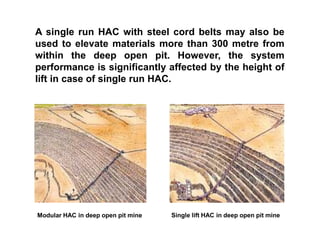
A single run HAC with steel cord belts may also be
used to elevate materials more than 300 metre from
within the deep open pit. However, the system
performance is significantly affected by the height of
lift in case of single run HAC.
Modular HAC in deep open pit mine Single lift HAC in deep open pit mine
Thick Seam Mines
In case of surface coal mines mining thick seam
under thick overburden requiring multi bench
operation, multiple HAC installation may be proved
to be very effective for transporting the coal to the
out-of-pit coal handling plant. Coal may be loaded
directly to the mobile crusher by shovel or FEL. Such
a system may consist of one or more crawler
mounted mobile crusher (feeder breaker or roll type),
crawler mounted belt wagon, in-pit shiftable
conveyor with hopper car, a HAC with connecting
conveyor bridge and loading car, and an overland
conveyor to the plant.
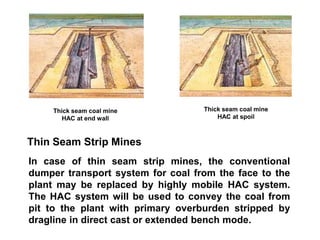
Thick seam coal mine
HAC at end wall
Thick seam coal mine
HAC at spoil
In case of thin seam strip mines, the conventional
dumper transport system for coal from the face to the
plant may be replaced by highly mobile HAC system.
The HAC system will be used to convey the coal from
pit to the plant with primary overburden stripped by
dragline in direct cast or extended bench mode.
Thin Seam Strip Mines
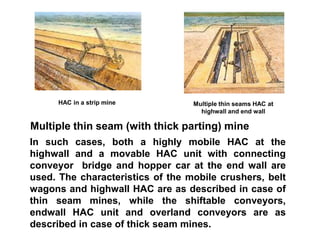
Multiple thin seam (with thick parting) mine
In such cases, both a highly mobile HAC at the
highwall and a movable HAC unit with connecting
conveyor bridge and hopper car at the end wall are
used. The characteristics of the mobile crushers, belt
wagons and highwall HAC are as described in case of
thin seam mines, while the shiftable conveyors,
endwall HAC unit and overland conveyors are as
described in case of thick seam mines.
HAC in a strip mine Multiple thin seams HAC at
highwall and end wall
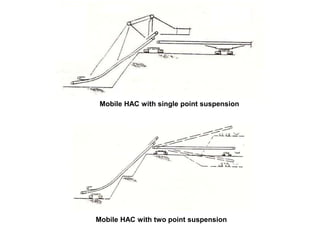
Mobile HAC with single point suspension
Mobile HAC with two point suspension
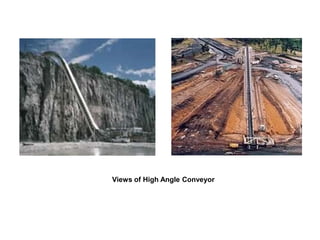
Views of High Angle Conveyor
High angle conveying

High angle conveying

  • 1.
  • 3.
    INTRODUCTION Trucks, traditionally, havelong been a favourite tool in surface mines for hauling material from the pits. However, the increasing strain of an inflationary economy has caused mine operators to look at alternatives to the longstanding workhorses (trucks) in material haulage. The intent of any major modification of the time- honoured material handling by trucks is to achieve the goal of a marked reduction in haulage costs; sufficient not only to recoup the capital investment, but to make the final product more competitive in today's world market. In-pit crushing and belt conveyor systems are one prominent alternative that has gained popularity.
  • 4.
    Conventional conveyor beltsoffer an economical method for transporting bulk material at certain inclined angles ranging from a low of 7 degree for fine and somewhat lubricious material such as soda ash brickets, to a high of 30 degree for cinder concrete and ground phosphate fertilizers. Typical recommended inclination angles for open-pit mine products such as excavated earth including anthracite coal, bituminous coal, lignite and crushed rock, vary from 15 degree to 22 degree with respective angles of repose from 29 degree to 44 degree. The conventional conveyor is often the most economical, reliable and safe means for transporting such bulk materials. There are, however, many cases that strongly warrant an increase in conveying angles.
  • 5.
    In a staticcase, cohesion less material on a rubber conveyor belt will begin to slide back when the inclination angle of the belt surface just exceeds the angle of internal friction of the material or the friction angle of the material to belt surface interface, whichever is smaller. The angle of internal friction is equal to the angle of repose of such materials. Both the angle of repose and the friction angle for bulk materials on rubber will vary from one material to the next and will be affected, even for the same type of material, by the maximum lump size, the lump size distribution, the orientation of the conveyor cross-section, and the shape that the particles or lumps take as a result of the reduction process, i.e., blasting and the varying degrees and methods of crushing.
  • 6.
    The recommended conveyingangles are in general far below the recommended friction angles. This is due to the dynamics induced in a moving belt conveyor, which result in relative motion between adjacent particles or lumps of the bulk material and between the material and carrying surface of the conveyor belt. Various approaches have been made in an effort to convey particular material at high angles. All of these are directed to solving the problem of conveying bulk material at steep angles and high conveying rates efficiently and economically.
  • 7.
    HIGH ANGLE CONVEYORS –DIFFERENT TYPES A high angle conveyor can be defined as any conveyor that transports material along a slope exceeding the dynamic stability angle of the transported material. Typical recommended inclination angles of conventional conveyors for open-pit mine products (such as excavated earth including anthracite coal, bituminous coal, lignite and crushed rock) vary from 15 degree to 22 degree with respective angles of repose from 29 degree to 44 degree, but the high angle conveyors may carry the material at an angle more than this and in some cases even at 90 degree.
  • 8.
    Broadly available typesof high angle conveying systems are – Sandwich Belt conveying systems, Pipe/Tube conveying systems, Flexowell conveying systems, Pocketlift conveying systems, etc.. Of these available systems, Sandwich Belt conveyor, particularly the Continental HAC (High Angle Conveyor) systems, has become very popular in surface mining applications. The Continental HAC (High Angle Conveyor) systems has been discussed later in somewhat detail. Other methods are typically expensive, of limited capacity, unable to completely discharge sticky material, and do not lend themselves to continuous cleaning by belt scrapers or plows.
  • 9.
    Pipe Conveyor The ‘PipeConveyor’ is a recent adaptation of belt conveyor design that encloses the conveyed material completely by forming the belt into a ‘pipe’ or tube shape while carrying the material. This eliminates spillage and reduces potential environmental problems. This type of conveyor has the added advantage of being able to curve horizontally and vertically to a greater degree than conventional belt conveyors. This can substantially solve layout, transfer points’ and cost problems generally associated with standard belt conveyor design.
  • 10.
    Pipe Conveyor Tail endof the conveyor where the material is loaded before the pipe shape is formed. The pipe shape of the conveyor is maintained by hexagonally spaced idlers. Discharge pulley and belt turnover
  • 11.
    Flexowell Conveyor In thistype of conveyor system, two flexible side walls are provided to a normal belt conveyor for carrying the material. At certain specified intervals cross flights are also provided to hold the material in position while carrying it at steep angles. The side walls need to be flexible so that the conveyor (with the side walls) may be driven by driver pulley without any difficulty. Generally, a cover is used from the top over the span in which the belt is negotiating a steep grade.
  • 12.
    Pocketlift System Based onthe FLEXOWELL technology and the newly developed conveying systems, it is now possible to overcome the performance limitations of conventional conveyor belting and to move into new dimensions in conveying technology. This system represents a new development using all the major advantages of the prove FLEXOWELL technology (e. g. lifting up to 500 m/1.640 ft) and, in addition, offers further advantages. The material to be conveyed is fed into the fabric reinforced rubber pockets, which are bolted at the center of the cross bars and can be assembled and disassembled individually. The performance range of the POCKETLIFT system also allows a high conveying capacity over great heights in steep inclined and vertical conveying. With POCKETLIFT the function of power transfer is achieved by two narrow steel cord belts which are connected with rigid triangular cross bars
  • 13.
    Sandwich Belt conveying- Continental HAC systems Since the early 1980’s the Continental HAC (High Angle Conveyor) has proven itself to be a versatile and money saving method for elevating or lowering materials continuously from one level to another at extremely steep angles. The Continental HAC has taken the sandwich-belt concept and turned it into a highly reliable materials- handling workhorse – the result of specific engineering breakthroughs. One of the secrets to the high performance capabilities of the Continental HAC technology is its use of proprietary, patented, pressing components which ensure easy conveyance of all types of bulk solids.
  • 14.
    The fully-equalized pressingmechanism secures material toward the center of the belt while gently, but effectively, sealing the belt edges together. The HAC system holds the conveyed material continually – eliminating relative movement between material and belts. It does not confront materials; rather it conforms to surface shapes without incurring high local forces. Soft, gentle pressure assures the preservation of product quality and long life for the equipment. The use of standard conveyor hardware in the HAC system means interchangeability of components and fast replacement of parts. HAC® systems in place around the world have demonstrated high availability and low maintenance costs.
  • 15.
    Also, the useof these standard components in the HAC facilitates high conveying speeds. Belts and hardware are available in sizes up to 120 inches wide, which make capacities greater than 15,000 tons per hour easily achievable. Lifts beyond 1000 ft. are achievable with standard fabric belts, and much higher single-run lifts are possible with steel cord or aramid fiber belts. The HAC lends itself to multi-module conveying systems using self-contained units, as well as single-run systems using externally anchored high angle conveyors. In both cases the conveyor unit may be shortened or lengthened or the conveying angle may be altered according to the requirements of a new location.
  • 16.
    High angle conveyingmodules may be mounted on rails, rubber tired or crawler type transporters, or they may be equipped with walking feet for optimal mobility. Standard, smooth surface belts allow continuous cleaning by belt scrapers or plows. This is especially important in handling wet and sticky material. The Continental® HAC is clearly the most efficient and economical option for virtually every steep angle application.
  • 17.
    A sandwich beltconveyor uses two conveyor belts, face-to-face, to gently but firmly contain the product being carried, hence making steep incline and even vertical-lift runs easily achievable. What is a Sandwich Belt Conveyor? Sandwich Belt Model High Angle Conveyor Sandwich Belt Principle
  • 18.
    This unique sandwichbelt principle permits the use of standard conveyor components to achieve high conveying angles at high capacities while retaining the low cost, high reliability features of conventional conveyors. The Continental system consists of a carrying conveyor belt which is supported on standard troughing idlers and a cover belt which is softly pressed onto the conveyed material by equalized pressing rolls. The required material- hugging pressure varies according to the conveying angle, material characteristics and dynamics of the system.
  • 19.
    Extensive research, includingthe input of open pit copper, coal, lignite and other mine operators and consultants, has determined the operational superiority of sandwich belt, high angle conveyors in open pit mine applications. The Continental system offers the following advantages. Advantages 1. Simplicity of Approach The use of all conventional conveyor hardware means interchangeability of components, fast delivery of replacement parts, high availability and low maintenance costs. 2. Virtually Unlimited in Capacity The use of conventional conveyor components permits high conveying speeds. Available belts and hardware to ten feet wide make possible capacities well in excess of 10,000 TPH.
  • 20.
    The continental sandwichconveyor lends itself to a multi-module conveying system or a very high single run system. In either case, a conveyor unit may be shortened or lengthened or the conveying angle may be altered according to the requirements of the new location. High angle conveying modules may be mounted on rails, rubber tire or or crawler type transporters or may be equipped with walking feet for optional mobility. 3. High Lifts and High Conveying Angles Lifts to 350 feet are possible with standard fabric belts, and single run lifts to approximately 900 feet are possible with steel cord belts. High angles in excess of 45.degree are possible without excessive wear because of a soft, floating, pressing mechanism. 4. Flexibility in Planning and in Operation
  • 21.
    During operation, thematerial is sealed between the carrying and cover belts. Well-centered loading and ample belt edge distance result in no spillage along the conveyor length. Dust control efforts need only be at transfer points. 5. Belts are Easily Cleaned and Quickly Repaired Smooth surfaced belts allow continuous cleaning by belt scrapers or plows. This is especially important in handling wet and sticky materials. Smooth surfaced belts present no obstructions to quick repair of a damaged belt by hot or cold vulcanizing. Quick repair means less costly downtime. 6. Spillage-Free Operation
  • 22.
    Continental HAC hasbeen developed utilizing standard, long-life Continental components that have been proven in the field handling millions of tons of material. Continental's 60" wide HAC demonstration prototype is over 100 feet long and can be elevated from 30° to 60°. Continental sandwich belt conveyors are engineered to customer requirements. Conveying angles to 60°, high lifts and high capacities are now possible.
  • 23.
    Advantages of HACOver Traditional Truck Haulage System in Open Pit Mine Applications: In open pit mine applications, a high angle conveying system offers many advantages over the traditional truck haulage system. 1. Superior Energy Efficiencies Trucks must transport their own dead load in addition to the payload. Dead load can range up to 45% of the total gross hauled weight when the truck is loaded to capacity. In a high angle conveyor the energy goes towards elevating material with only a very small amount lost to idler friction.
  • 24.
    2. Less Dependencyon Petroleum Products The dependency on imported oil and the prospect of diesel fuel rationing need not concern the mine planner because electrical power for operating a high angle conveyor system is generated more and more by coal, hydro and nuclear power. 3. Less Sensitive to Inflation A high angle conveyor system will have a longer life and much lower maintenance costs when compared to trucks which are replaced every six to eight years.
  • 25.
    4. Less TotalExcavation High angle conveyors may be supported along any stable slope. Total excavation is therefor determined by geotechnical stability considerations and not by the 8% to 10% maximum slope requirements of truck haulage ramps. This also makes a high angle conveyor system superior to a conventional conveyor system with maximum slope of about 27% or 15 degrees. 5. Less Haulage Road Maintenance A high angle conveyor system requires only small access roads for maintenance vehicles. This greatly reduces the large maintenance crews, equipment fleets and costs required for large truck haulage groups.
  • 26.
    APPLICATIONS OF HACSYSTEMS IN SURFACE MINES The following are some of the possible applications of HAC systems in different cases of surface mining operations. Deep Open Pit Mines Multiple HAC units may be arranged in series with the lower module discharging onto the upper module to achieve high lifts from deep open pits. The system generally consists of truck haulage from the mine face to an in-pit movable crusher, the movable crusher, one or more HAC units, and an on-land conveying system to the plant and waste dumps. Waste and overburden disposal at each dump site is by means of shiftable conveyor, tripper-car and spreader.
  • 27.
    A single runHAC with steel cord belts may also be used to elevate materials more than 300 metre from within the deep open pit. However, the system performance is significantly affected by the height of lift in case of single run HAC. Modular HAC in deep open pit mine Single lift HAC in deep open pit mine
  • 28.
    Thick Seam Mines Incase of surface coal mines mining thick seam under thick overburden requiring multi bench operation, multiple HAC installation may be proved to be very effective for transporting the coal to the out-of-pit coal handling plant. Coal may be loaded directly to the mobile crusher by shovel or FEL. Such a system may consist of one or more crawler mounted mobile crusher (feeder breaker or roll type), crawler mounted belt wagon, in-pit shiftable conveyor with hopper car, a HAC with connecting conveyor bridge and loading car, and an overland conveyor to the plant.
  • 29.
    Thick seam coalmine HAC at end wall Thick seam coal mine HAC at spoil In case of thin seam strip mines, the conventional dumper transport system for coal from the face to the plant may be replaced by highly mobile HAC system. The HAC system will be used to convey the coal from pit to the plant with primary overburden stripped by dragline in direct cast or extended bench mode. Thin Seam Strip Mines
  • 30.
    Multiple thin seam(with thick parting) mine In such cases, both a highly mobile HAC at the highwall and a movable HAC unit with connecting conveyor bridge and hopper car at the end wall are used. The characteristics of the mobile crushers, belt wagons and highwall HAC are as described in case of thin seam mines, while the shiftable conveyors, endwall HAC unit and overland conveyors are as described in case of thick seam mines. HAC in a strip mine Multiple thin seams HAC at highwall and end wall
  • 31.
    Mobile HAC withsingle point suspension Mobile HAC with two point suspension
  • 32.
    Views of HighAngle Conveyor