DIFFERENT RAISING
TECHNIQUES
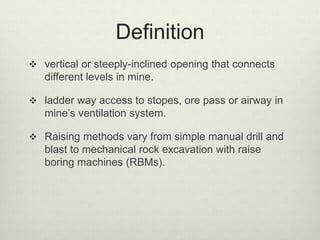
Definition
 vertical or steeply-inclined opening that connects
different levels in mine.
 ladder way access to stopes, ore pass or airway in
mine’s ventilation system.
 Raising methods vary from simple manual drill and
blast to mechanical rock excavation with raise
boring machines (RBMs).
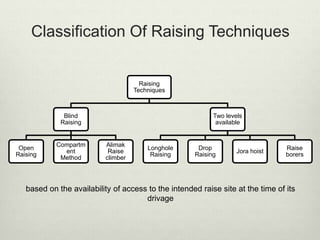
Classification Of Raising Techniques
Raising
Techniques
Blind
Raising
Open
Raising
Compartm
ent
Method
Alimak
Raise
climber
Two levels
available
Longhole
Raising
Drop
Raising
Jora hoist
Raise
borers
based on the availability of access to the intended raise site at the time of its
drivage
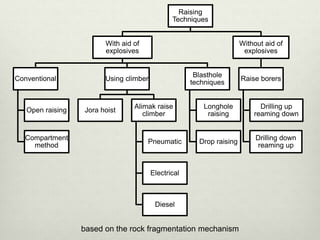
Raising
Techniques
With aid of
explosives
Conventional
Open raising
Compartment
method
Using climber
Jora hoist
Alimak raise
climber
Pneumatic
Electrical
Diesel
Blasthole
techniques
Longhole
raising
Drop raising
Without aid of
explosives
Raise borers
Drilling up
reaming down
Drilling down
reaming up
based on the rock fragmentation mechanism
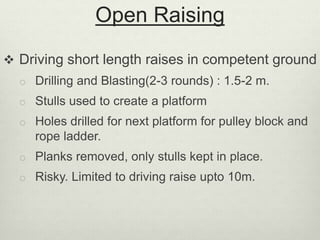
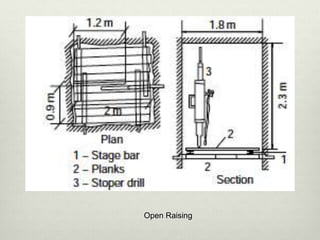
Open Raising
 Driving short length raises in competent ground
o Drilling and Blasting(2-3 rounds) : 1.5-2 m.
o Stulls used to create a platform
o Holes drilled for next platform for pulley block and
rope ladder.
o Planks removed, only stulls kept in place.
o Risky. Limited to driving raise upto 10m.
Open Raising
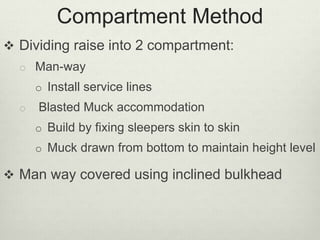
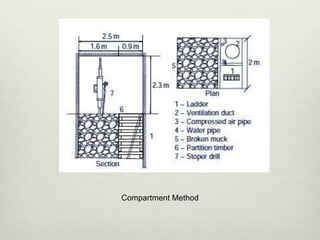
Compartment Method
 Dividing raise into 2 compartment:
o Man-way
o Install service lines
o Blasted Muck accommodation
o Build by fixing sleepers skin to skin
o Muck drawn from bottom to maintain height level
 Man way covered using inclined bulkhead
Compartment Method
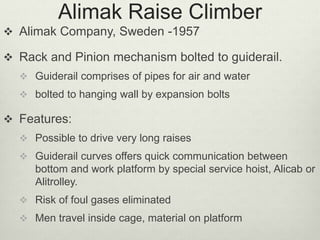
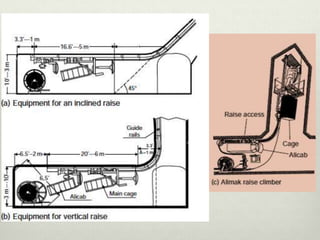
Alimak Raise Climber
 Alimak Company, Sweden -1957
 Rack and Pinion mechanism bolted to guiderail.
 Guiderail comprises of pipes for air and water
 bolted to hanging wall by expansion bolts
 Features:
 Possible to drive very long raises
 Guiderail curves offers quick communication between
bottom and work platform by special service hoist, Alicab or
Alitrolley.
 Risk of foul gases eliminated
 Men travel inside cage, material on platform
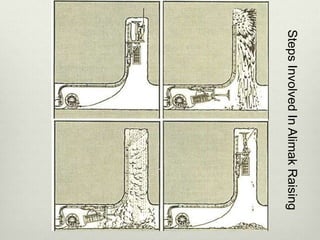
StepsInvolvedInAlimakRaising
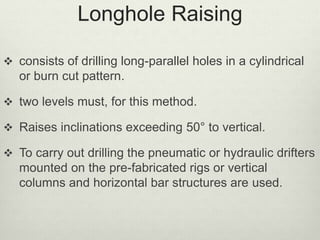
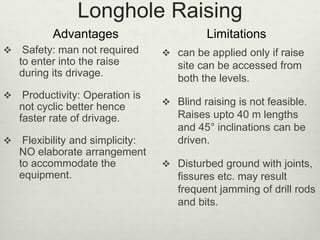
Longhole Raising
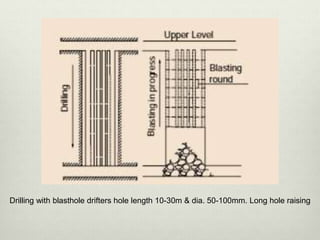
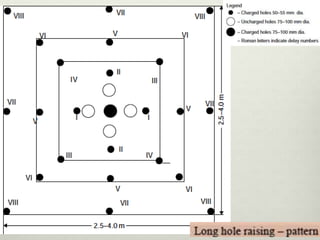
 consists of drilling long-parallel holes in a cylindrical
or burn cut pattern.
 two levels must, for this method.
 Raises inclinations exceeding 50° to vertical.
 To carry out drilling the pneumatic or hydraulic drifters
mounted on the pre-fabricated rigs or vertical
columns and horizontal bar structures are used.
 Safety: man not required
to enter into the raise
during its drivage.
 Productivity: Operation is
not cyclic better hence
faster rate of drivage.
 Flexibility and simplicity:
NO elaborate arrangement
to accommodate the
equipment.
 can be applied only if raise
site can be accessed from
both the levels.
 Blind raising is not feasible.
Raises upto 40 m lengths
and 45° inclinations can be
driven.
 Disturbed ground with joints,
fissures etc. may result
frequent jamming of drill rods
and bits.
Advantages Limitations
Longhole Raising
Drilling with blasthole drifters hole length 10-30m & dia. 50-100mm. Long hole raising
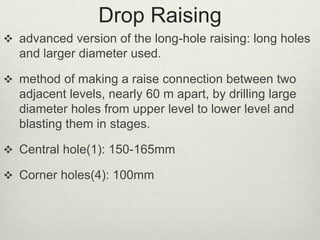
Drop Raising
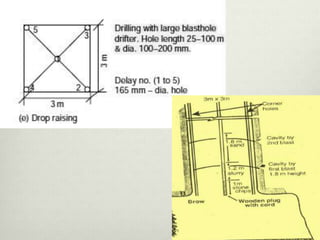
 advanced version of the long-hole raising: long holes
and larger diameter used.
 method of making a raise connection between two
adjacent levels, nearly 60 m apart, by drilling large
diameter holes from upper level to lower level and
blasting them in stages.
 Central hole(1): 150-165mm
 Corner holes(4): 100mm
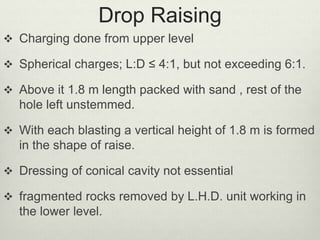
 Charging done from upper level
 Spherical charges; L:D ≤ 4:1, but not exceeding 6:1.
 Above it 1.8 m length packed with sand , rest of the
hole left unstemmed.
 With each blasting a vertical height of 1.8 m is formed
in the shape of raise.
 Dressing of conical cavity not essential
 fragmented rocks removed by L.H.D. unit working in
the lower level.
Drop Raising
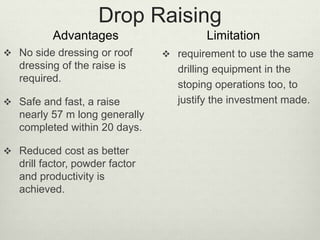
 No side dressing or roof
dressing of the raise is
required.
 Safe and fast, a raise
nearly 57 m long generally
completed within 20 days.
 Reduced cost as better
drill factor, powder factor
and productivity is
achieved.
 requirement to use the same
drilling equipment in the
stoping operations too, to
justify the investment made.
Advantages Limitation
Drop Raising
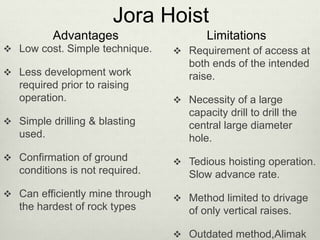
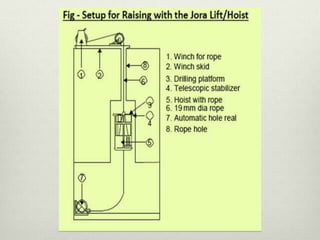
Jora Hoist
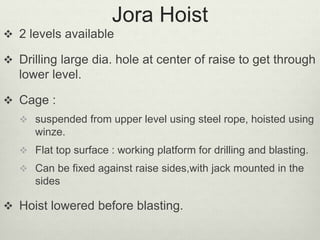
 2 levels available
 Drilling large dia. hole at center of raise to get through
lower level.
 Cage :
 suspended from upper level using steel rope, hoisted using
winze.
 Flat top surface : working platform for drilling and blasting.
 Can be fixed against raise sides,with jack mounted in the
sides
 Hoist lowered before blasting.
 Low cost. Simple technique.
 Less development work
required prior to raising
operation.
 Simple drilling & blasting
used.
 Confirmation of ground
conditions is not required.
 Can efficiently mine through
the hardest of rock types
 Requirement of access at
both ends of the intended
raise.
 Necessity of a large
capacity drill to drill the
central large diameter
hole.
 Tedious hoisting operation.
Slow advance rate.
 Method limited to drivage
of only vertical raises.
 Outdated method,Alimak
Advantages Limitations
Jora Hoist
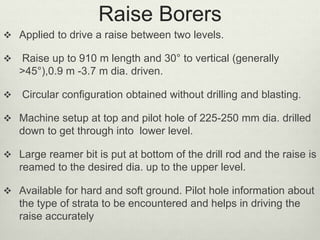
Raise Borers
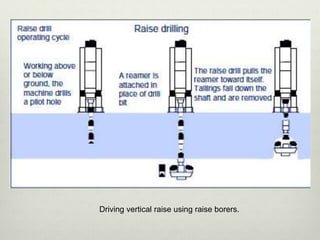
 Applied to drive a raise between two levels.
 Raise up to 910 m length and 30° to vertical (generally
>45°),0.9 m -3.7 m dia. driven.
 Circular configuration obtained without drilling and blasting.
 Machine setup at top and pilot hole of 225-250 mm dia. drilled
down to get through into lower level.
 Large reamer bit is put at bottom of the drill rod and the raise is
reamed to the desired dia. up to the upper level.
 Available for hard and soft ground. Pilot hole information about
the type of strata to be encountered and helps in driving the
raise accurately
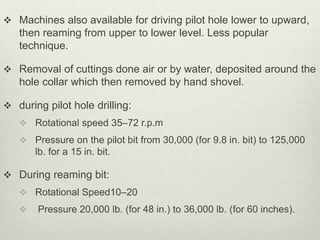
 Machines also available for driving pilot hole lower to upward,
then reaming from upper to lower level. Less popular
technique.
 Removal of cuttings done air or by water, deposited around the
hole collar which then removed by hand shovel.
 during pilot hole drilling:
 Rotational speed 35–72 r.p.m
 Pressure on the pilot bit from 30,000 (for 9.8 in. bit) to 125,000
lb. for a 15 in. bit.
 During reaming bit:
 Rotational Speed10–20
 Pressure 20,000 lb. (for 48 in.) to 36,000 lb. (for 60 inches).
Driving vertical raise using raise borers.
Conclusion
Raising is one of the most important tool for the
extraction purpose whether in coal mines or
metalliferous mines, generally used for the stope
development.
Alimak raise climber method is the best method
adopted, first deployed in India by the Jadugura
uranium mines in the year 1972
Raising has also huge application in other sectors like
civil construction apart from mining.
References
 Tatiya,R.R.(2005).Excavations in upward direction –
raising.Chapter 13.In,Surface and Underground
Excavations – Methods, Techniques and Equipment
, pp.331-349.ISBN: 90-5809-627-0.
 Mine Portal.Underground Metal Mining Methods.
Available at http://www.mineportal.in/

Different Raising Techniques in mining

  • 1.
  • 2.
    Definition  vertical orsteeply-inclined opening that connects different levels in mine.  ladder way access to stopes, ore pass or airway in mine’s ventilation system.  Raising methods vary from simple manual drill and blast to mechanical rock excavation with raise boring machines (RBMs).
  • 3.
    Classification Of RaisingTechniques Raising Techniques Blind Raising Open Raising Compartm ent Method Alimak Raise climber Two levels available Longhole Raising Drop Raising Jora hoist Raise borers based on the availability of access to the intended raise site at the time of its drivage
  • 4.
    Raising Techniques With aid of explosives Conventional Openraising Compartment method Using climber Jora hoist Alimak raise climber Pneumatic Electrical Diesel Blasthole techniques Longhole raising Drop raising Without aid of explosives Raise borers Drilling up reaming down Drilling down reaming up based on the rock fragmentation mechanism
  • 5.
    Open Raising  Drivingshort length raises in competent ground o Drilling and Blasting(2-3 rounds) : 1.5-2 m. o Stulls used to create a platform o Holes drilled for next platform for pulley block and rope ladder. o Planks removed, only stulls kept in place. o Risky. Limited to driving raise upto 10m.
  • 6.
  • 7.
    Compartment Method  Dividingraise into 2 compartment: o Man-way o Install service lines o Blasted Muck accommodation o Build by fixing sleepers skin to skin o Muck drawn from bottom to maintain height level  Man way covered using inclined bulkhead
  • 8.
  • 9.
    Alimak Raise Climber Alimak Company, Sweden -1957  Rack and Pinion mechanism bolted to guiderail.  Guiderail comprises of pipes for air and water  bolted to hanging wall by expansion bolts  Features:  Possible to drive very long raises  Guiderail curves offers quick communication between bottom and work platform by special service hoist, Alicab or Alitrolley.  Risk of foul gases eliminated  Men travel inside cage, material on platform
  • 10.
  • 12.
    Longhole Raising  consistsof drilling long-parallel holes in a cylindrical or burn cut pattern.  two levels must, for this method.  Raises inclinations exceeding 50° to vertical.  To carry out drilling the pneumatic or hydraulic drifters mounted on the pre-fabricated rigs or vertical columns and horizontal bar structures are used.
  • 13.
     Safety: mannot required to enter into the raise during its drivage.  Productivity: Operation is not cyclic better hence faster rate of drivage.  Flexibility and simplicity: NO elaborate arrangement to accommodate the equipment.  can be applied only if raise site can be accessed from both the levels.  Blind raising is not feasible. Raises upto 40 m lengths and 45° inclinations can be driven.  Disturbed ground with joints, fissures etc. may result frequent jamming of drill rods and bits. Advantages Limitations Longhole Raising
  • 14.
    Drilling with blastholedrifters hole length 10-30m & dia. 50-100mm. Long hole raising
  • 16.
    Drop Raising  advancedversion of the long-hole raising: long holes and larger diameter used.  method of making a raise connection between two adjacent levels, nearly 60 m apart, by drilling large diameter holes from upper level to lower level and blasting them in stages.  Central hole(1): 150-165mm  Corner holes(4): 100mm
  • 17.
     Charging donefrom upper level  Spherical charges; L:D ≤ 4:1, but not exceeding 6:1.  Above it 1.8 m length packed with sand , rest of the hole left unstemmed.  With each blasting a vertical height of 1.8 m is formed in the shape of raise.  Dressing of conical cavity not essential  fragmented rocks removed by L.H.D. unit working in the lower level. Drop Raising
  • 18.
     No sidedressing or roof dressing of the raise is required.  Safe and fast, a raise nearly 57 m long generally completed within 20 days.  Reduced cost as better drill factor, powder factor and productivity is achieved.  requirement to use the same drilling equipment in the stoping operations too, to justify the investment made. Advantages Limitation Drop Raising
  • 20.
    Jora Hoist  2levels available  Drilling large dia. hole at center of raise to get through lower level.  Cage :  suspended from upper level using steel rope, hoisted using winze.  Flat top surface : working platform for drilling and blasting.  Can be fixed against raise sides,with jack mounted in the sides  Hoist lowered before blasting.
  • 21.
     Low cost.Simple technique.  Less development work required prior to raising operation.  Simple drilling & blasting used.  Confirmation of ground conditions is not required.  Can efficiently mine through the hardest of rock types  Requirement of access at both ends of the intended raise.  Necessity of a large capacity drill to drill the central large diameter hole.  Tedious hoisting operation. Slow advance rate.  Method limited to drivage of only vertical raises.  Outdated method,Alimak Advantages Limitations Jora Hoist
  • 23.
    Raise Borers  Appliedto drive a raise between two levels.  Raise up to 910 m length and 30° to vertical (generally >45°),0.9 m -3.7 m dia. driven.  Circular configuration obtained without drilling and blasting.  Machine setup at top and pilot hole of 225-250 mm dia. drilled down to get through into lower level.  Large reamer bit is put at bottom of the drill rod and the raise is reamed to the desired dia. up to the upper level.  Available for hard and soft ground. Pilot hole information about the type of strata to be encountered and helps in driving the raise accurately
  • 24.
     Machines alsoavailable for driving pilot hole lower to upward, then reaming from upper to lower level. Less popular technique.  Removal of cuttings done air or by water, deposited around the hole collar which then removed by hand shovel.  during pilot hole drilling:  Rotational speed 35–72 r.p.m  Pressure on the pilot bit from 30,000 (for 9.8 in. bit) to 125,000 lb. for a 15 in. bit.  During reaming bit:  Rotational Speed10–20  Pressure 20,000 lb. (for 48 in.) to 36,000 lb. (for 60 inches).
  • 25.
    Driving vertical raiseusing raise borers.
  • 26.
    Conclusion Raising is oneof the most important tool for the extraction purpose whether in coal mines or metalliferous mines, generally used for the stope development. Alimak raise climber method is the best method adopted, first deployed in India by the Jadugura uranium mines in the year 1972 Raising has also huge application in other sectors like civil construction apart from mining.
  • 27.
    References  Tatiya,R.R.(2005).Excavations inupward direction – raising.Chapter 13.In,Surface and Underground Excavations – Methods, Techniques and Equipment , pp.331-349.ISBN: 90-5809-627-0.  Mine Portal.Underground Metal Mining Methods. Available at http://www.mineportal.in/