LIGHTING TERMINOLOGYAND
THEIR UNITS
2
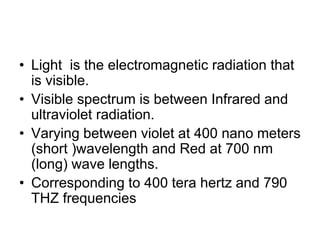
• Light is the electromagnetic radiation that
is visible.
• Visible spectrum is between Infrared and
ultraviolet radiation.
• Varying between violet at 400 nano meters
(short )wavelength and Red at 700 nm
(long) wave lengths.
• Corresponding to 400 tera hertz and 790
THZ frequencies
• Illumination :--is the process of lighting an
object.
• Illuminance:- The flux incident on a
surface per unit area.
• Flux :-The light emitted by a
source such as lamp irrespective of
direction. The rate of flow of luminous
energy.
• Lamp :-A generic term for a man made
source of radiation in and near the visible
portion of the Electromagnetic spectrum
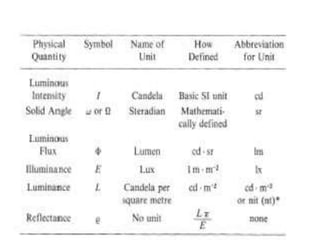
• Lumen :-SI unit of luminous flux and is
analogous to power. It is the rate of flow of
luminous energy. The flux emitted in unit solid
angle (one steradian) by a source of uniform intensity of
one candela.
• A 100W lamp emits about 1200 lumens.
• Abbreviation lm,
• Candlepower :- Luminous intensity
expressed in candelas.
• Candela :- The SI unit of luminous intensity in a
particular direction.
Abbreviation cd.
• Candela per square metre:-The SI unit of luminance.
-Abbreviation cd- m-2•
• Candlepower distribution curve:-A curve on a graph showing the
variations of luminous intensity of a light emitting source, relative to
angles.
• Circuit efficacy :-The ratio of the
luminous lux emitted by a lamp to the
total power consumed by the lamp and
its control gear.
• Unit is of lux is lumen per watt, Lm . W-l.
Foot Candle:- Unit of Illuminace-
1 Lumen distributed over
1Foot Square
• Lux :-The SI unit of illuminance,
equal to one lumen per
square metre.
Abbreviation lx.
• Photometry :-Science of measuring light.
• Point vision :-The mode of vision of a source
of light so small that the sensation is determined
by its intensity (or point brilliance) rather than by
its size (or angular subtense).
• Reflectance :A measure of how well light
bounces off an object. The ratio of the flux
reflected from a surface to the flux incident on it.
• Reflection :-the process by which flux
leaves a surface or medium from the
incident side.
• Objects reflect light if they shift the
direction of light away from themselves.
• Vision :Visual perception. The
reception of light by the cells in the eye
and the brain's evaluation of the
information contained in the light.
LIGHT UNITS
• S I International system Metric
• IES Illumination Engineering Society
-U S Standard
light measurements can be quoted either in units of illuminance
expressed in terms of uniform luminous flux incident per unit area
(lm/m2);
or in units of luminance which is the luminous intensity leaving a unit
area (cd/m2).
This means there are two approaches to light measurement:
one based upon the light incident on a surface, illuminance;
the other based upon the light radiant from a surface, luminance.
The illuminance unit is usually used for lighting design work
whereas the luminance unit is commonly used in visual
performance studies.
• there are two different ways to describe the light
producing ability of a source.
• One is the total luminous flux or lumens put out by a light
source, which may also be expressed in terms of the
efficacy of the source, lumens per watt.
The other is the luminous intensity of the source
expressed in candelas, which is the luminous flux per
steradian.
It is common to rate a lamp in lumens and
a luminaire in candelas.
• When measuring light, the photometric instrument is
recording a quantity of electromagnetic radiation; but
only that part of the radiant energy that provides visual
sensation is of interest.
• we can measure the radiant energy of light directly
through radiometry but instead prefer to measure the
human visual response to radiant energy with a
photometer.
• In order to make instruments capable of measuring
human response, it became necessary to determine the
standard reaction to light of the average eye.
• The resulting light sensing photometers were
made to filter out most of the ultraviolet and
infrared and to respond to the visible portion in a
manner similar to that of the average eye
• The input of radiometric energy is processed by
a suitable arrangement of filters and photocells
that correspond to the Standard Luminous
Efficiency Function thus providing an output of
photometric energy.
• The units defined relate to visual
sensation.
• They are photometric units, a special
subset of radiometric unit
• The candela (cd) is the unit used to measure the intensity
of a source and takes the place of the candle.
• It is the photometric base unit from which all other units are derived.
• Defined as the luminous intensity, in a given direction, of a
source which is emitting monochromatic radiation of frequency
540.1012 Hertz and whose radiant intensity in that
direction is 1/683 W per steradian.
• This definition is of interest to national laboratories responsible for
maintaining physical standards of measurement
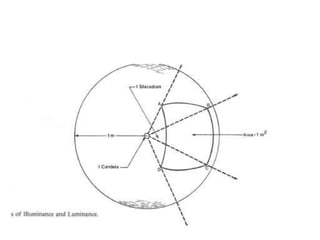
• The steradian (sr) - is a measure of the unit solid angle at the
centre of a sphere.
• the area ABCD on the surface of the sphere is equal to 1m2 and the
radius of the sphere is 1m.
• If the subtended area of a spherical surface is equal to the square of
the radius, the sub tended solidangle is a steradian.
• Since the surface area of a sphere is 4πr there are 4π r or 12.57
steradians in a sphere.
• The steradian is a geometric unit and on its own has nothing
to do with light, but it is needed in the definition of the next
photometric unit.
• The lumen (lm) is the unit of measurement
of luminous lux.
• Luminous flux is the time rate of flow of
light.
• The lumen is defined as the luminous flux
emitted within one steradian by this point
source when the uniform luminous
intensity is one candela.
• If a one candela source is located at the centre of a
sphere. The amount of flux passing through ABCD is
one lumen and the amount of flux passing through the
entire
surface of the sphere is 4π r lm or 12.57 lm.
• The lumen output of a commercial source and to be
specified by the manufacturer.
• The flow of light from a 100W incandescent lamp is
about 1740 1m and from a 40 W fluorescent lamp is
about 3200 1m
• The lux (lx) is the unit used to measure illuminance.
• Illuminance is the light falling on a surface unit area.
• Defined more precisely, illuminance is the density of uniform
luminous flux incident at a point on a surface, or the quotient of the
flux divided by the area of the surface
when the flux is uniformly distributed.
• One lumen of light incident on one square metre of a surface area
produces one lux of illuminance.
• for example, the illuminance on the surface ABCD is 1 lm per meter
square = 1 lux (lx).
• The candela per metre square (cd. m-2) is the unit used to
measure luminance.
• The lumen per metre squared was given the special name of lux but
no special name has been assigned to the SI luminance unit.
• Luminance is defined as the luminous flux per unit of projected area
and unit solid angle (lm/ sr- m2) either leaving a surface at a given
point I and direction or arriving at a given point on a surface
from a given direction.
• Alternatively, it is the luminous intensity of any surface in a given
direction per unit of projected area (cd-m-2) of the surface as viewed
from that direction.
• Reflectance (e) is the ratio of the total reflected luminous flux to the
total incident luminous flux.
• Since it is a ratio it has no units.
• Engineers involved in mine lighting find the concept of reflectance
essential in their work because the eye makes use of reflected light.
• In a mine with untreated surfaces, a large amount of the incident
light flux is absorbed upon striking an object.
The reflected light (luminance) is more difficult to measure with a
photometer than is the incident light (illuminance).
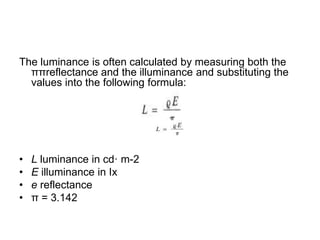
The luminance is often calculated by measuring both the
ππreflectance and the illuminance and substituting the
values into the following formula:
• L luminance in cd· m-2
• E illuminance in Ix
• e reflectance
• π = 3.142
• The formula assumes the surface is a uniform diffuser.
• Actually, no surface is a uniform diffuser, but the dusty
surfaces in mines come close enough to permit the use
of the formula in practical work.
• In Fig. if the illuminance on ABCD were 100 lx, and if
the surface reflected 10 070 of the light which struck it,
the amount of reflected light or luminance would be
3.183 cd m-2•
The Concept of Luminance and
Brightness
• Brightness refers to the subjective
assessment of the intensity of sensation
that results from viewing surfaces or
spaces that emit light to the eye.
• This sensation is determined in part by the
measurable luminance but also by the
• conditions of observation such as the
adaptation state of the eye
Lighting terminlologyand their units

Lighting terminlologyand their units

  • 2.
  • 3.
    • Light isthe electromagnetic radiation that is visible. • Visible spectrum is between Infrared and ultraviolet radiation. • Varying between violet at 400 nano meters (short )wavelength and Red at 700 nm (long) wave lengths. • Corresponding to 400 tera hertz and 790 THZ frequencies
  • 4.
    • Illumination :--isthe process of lighting an object. • Illuminance:- The flux incident on a surface per unit area. • Flux :-The light emitted by a source such as lamp irrespective of direction. The rate of flow of luminous energy.
  • 5.
    • Lamp :-Ageneric term for a man made source of radiation in and near the visible portion of the Electromagnetic spectrum • Lumen :-SI unit of luminous flux and is analogous to power. It is the rate of flow of luminous energy. The flux emitted in unit solid angle (one steradian) by a source of uniform intensity of one candela. • A 100W lamp emits about 1200 lumens. • Abbreviation lm,
  • 6.
    • Candlepower :-Luminous intensity expressed in candelas. • Candela :- The SI unit of luminous intensity in a particular direction. Abbreviation cd. • Candela per square metre:-The SI unit of luminance. -Abbreviation cd- m-2• • Candlepower distribution curve:-A curve on a graph showing the variations of luminous intensity of a light emitting source, relative to angles.
  • 7.
    • Circuit efficacy:-The ratio of the luminous lux emitted by a lamp to the total power consumed by the lamp and its control gear. • Unit is of lux is lumen per watt, Lm . W-l.
  • 8.
    Foot Candle:- Unitof Illuminace- 1 Lumen distributed over 1Foot Square
  • 9.
    • Lux :-TheSI unit of illuminance, equal to one lumen per square metre. Abbreviation lx. • Photometry :-Science of measuring light.
  • 10.
    • Point vision:-The mode of vision of a source of light so small that the sensation is determined by its intensity (or point brilliance) rather than by its size (or angular subtense). • Reflectance :A measure of how well light bounces off an object. The ratio of the flux reflected from a surface to the flux incident on it.
  • 11.
    • Reflection :-theprocess by which flux leaves a surface or medium from the incident side. • Objects reflect light if they shift the direction of light away from themselves.
  • 12.
    • Vision :Visualperception. The reception of light by the cells in the eye and the brain's evaluation of the information contained in the light.
  • 13.
    LIGHT UNITS • SI International system Metric • IES Illumination Engineering Society -U S Standard
  • 14.
    light measurements canbe quoted either in units of illuminance expressed in terms of uniform luminous flux incident per unit area (lm/m2); or in units of luminance which is the luminous intensity leaving a unit area (cd/m2). This means there are two approaches to light measurement: one based upon the light incident on a surface, illuminance; the other based upon the light radiant from a surface, luminance. The illuminance unit is usually used for lighting design work whereas the luminance unit is commonly used in visual performance studies.
  • 15.
    • there aretwo different ways to describe the light producing ability of a source. • One is the total luminous flux or lumens put out by a light source, which may also be expressed in terms of the efficacy of the source, lumens per watt. The other is the luminous intensity of the source expressed in candelas, which is the luminous flux per steradian. It is common to rate a lamp in lumens and a luminaire in candelas.
  • 16.
    • When measuringlight, the photometric instrument is recording a quantity of electromagnetic radiation; but only that part of the radiant energy that provides visual sensation is of interest. • we can measure the radiant energy of light directly through radiometry but instead prefer to measure the human visual response to radiant energy with a photometer. • In order to make instruments capable of measuring human response, it became necessary to determine the standard reaction to light of the average eye.
  • 17.
    • The resultinglight sensing photometers were made to filter out most of the ultraviolet and infrared and to respond to the visible portion in a manner similar to that of the average eye • The input of radiometric energy is processed by a suitable arrangement of filters and photocells that correspond to the Standard Luminous Efficiency Function thus providing an output of photometric energy.
  • 18.
    • The unitsdefined relate to visual sensation. • They are photometric units, a special subset of radiometric unit
  • 19.
    • The candela(cd) is the unit used to measure the intensity of a source and takes the place of the candle. • It is the photometric base unit from which all other units are derived. • Defined as the luminous intensity, in a given direction, of a source which is emitting monochromatic radiation of frequency 540.1012 Hertz and whose radiant intensity in that direction is 1/683 W per steradian. • This definition is of interest to national laboratories responsible for maintaining physical standards of measurement
  • 20.
    • The steradian(sr) - is a measure of the unit solid angle at the centre of a sphere. • the area ABCD on the surface of the sphere is equal to 1m2 and the radius of the sphere is 1m. • If the subtended area of a spherical surface is equal to the square of the radius, the sub tended solidangle is a steradian. • Since the surface area of a sphere is 4πr there are 4π r or 12.57 steradians in a sphere. • The steradian is a geometric unit and on its own has nothing to do with light, but it is needed in the definition of the next photometric unit.
  • 22.
    • The lumen(lm) is the unit of measurement of luminous lux. • Luminous flux is the time rate of flow of light. • The lumen is defined as the luminous flux emitted within one steradian by this point source when the uniform luminous intensity is one candela.
  • 23.
    • If aone candela source is located at the centre of a sphere. The amount of flux passing through ABCD is one lumen and the amount of flux passing through the entire surface of the sphere is 4π r lm or 12.57 lm. • The lumen output of a commercial source and to be specified by the manufacturer. • The flow of light from a 100W incandescent lamp is about 1740 1m and from a 40 W fluorescent lamp is about 3200 1m
  • 24.
    • The lux(lx) is the unit used to measure illuminance. • Illuminance is the light falling on a surface unit area. • Defined more precisely, illuminance is the density of uniform luminous flux incident at a point on a surface, or the quotient of the flux divided by the area of the surface when the flux is uniformly distributed. • One lumen of light incident on one square metre of a surface area produces one lux of illuminance. • for example, the illuminance on the surface ABCD is 1 lm per meter square = 1 lux (lx).
  • 25.
    • The candelaper metre square (cd. m-2) is the unit used to measure luminance. • The lumen per metre squared was given the special name of lux but no special name has been assigned to the SI luminance unit. • Luminance is defined as the luminous flux per unit of projected area and unit solid angle (lm/ sr- m2) either leaving a surface at a given point I and direction or arriving at a given point on a surface from a given direction. • Alternatively, it is the luminous intensity of any surface in a given direction per unit of projected area (cd-m-2) of the surface as viewed from that direction.
  • 26.
    • Reflectance (e)is the ratio of the total reflected luminous flux to the total incident luminous flux. • Since it is a ratio it has no units. • Engineers involved in mine lighting find the concept of reflectance essential in their work because the eye makes use of reflected light. • In a mine with untreated surfaces, a large amount of the incident light flux is absorbed upon striking an object. The reflected light (luminance) is more difficult to measure with a photometer than is the incident light (illuminance).
  • 27.
    The luminance isoften calculated by measuring both the ππreflectance and the illuminance and substituting the values into the following formula: • L luminance in cd· m-2 • E illuminance in Ix • e reflectance • π = 3.142
  • 28.
    • The formulaassumes the surface is a uniform diffuser. • Actually, no surface is a uniform diffuser, but the dusty surfaces in mines come close enough to permit the use of the formula in practical work. • In Fig. if the illuminance on ABCD were 100 lx, and if the surface reflected 10 070 of the light which struck it, the amount of reflected light or luminance would be 3.183 cd m-2•
  • 29.
    The Concept ofLuminance and Brightness • Brightness refers to the subjective assessment of the intensity of sensation that results from viewing surfaces or spaces that emit light to the eye. • This sensation is determined in part by the measurable luminance but also by the • conditions of observation such as the adaptation state of the eye