Radioactive isotopes in the investigation of biogenetic studies
Radioactive isotopes have many useful applications in medicine and research. In medicine, cobalt-60 is used as a radiation source to treat cancer. Radioactive isotopes are also used as tracers in diagnostic tests and to study metabolic processes. Tracer techniques involve using radioactive or stable isotopes as markers incorporated into precursor compounds to study biosynthetic pathways in plants. Different isotopes are used depending on the application, and their detection methods include mass spectroscopy and NMR spectroscopy.
Introduction to the role of radioactive isotopes in biogenetic studies by Mrs. Kulkarni D.M. from Yash Institute of Pharmacy.
Radioactive isotopes, or radioisotopes, are unstable elements emitting radiation. Cobalt-60 in cancer treatment and tracers for metabolic research are highlighted.
Tracer techniques use labelled compounds for biogenic experiments, with radioactive and stable isotopes for tracing metabolic pathways.
Describes methods for tracer techniques, including isolation and purification of constituents using radioactivity, and discusses disadvantages.
Explores specific applications in biogenetic studies, including stopping hordenine production and biogenesis of various alkaloids.
Competitive feeding method distinguishes normal from subsidiary synthesis pathways, illustrated by alkaloid studies in hemlock.
Details methods in isotope incorporation and sequential analysis to study bond cleavage and metabolic pathways in plants.
Application of sequential analysis using 14CO2 to elucidate carbon in photosynthesis and various biosynthetic sequences.
Application of tracer techniques for studying scopoletin formation, calcium uptake, and phosphorus tracking in plants.
Links to YouTube videos for additional educational resources on the discussed topics.
Radioactive isotopes in the investigation of biogenetic studies
1.
Radioactive isotopes inthe
investigation of Biogenetic studies
Prepared By,
Mrs. Kulkarni D.M.
Assistant Professor,
Yash Institute of Pharmacy,
Aurangabd
2.
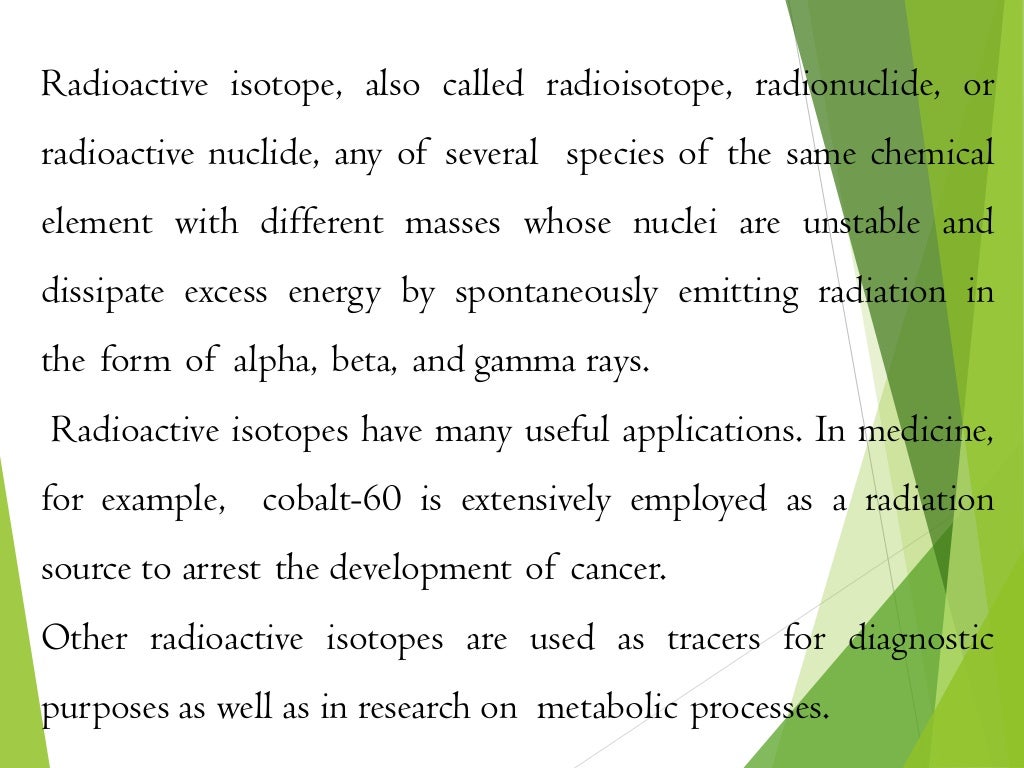
Radioactive isotope, alsocalled radioisotope, radionuclide, or
radioactive nuclide, any of several species of the same chemical
element with different masses whose nuclei are unstable and
dissipate excess energy by spontaneously emitting radiation in
the form of alpha, beta, and gamma rays.
Radioactive isotopes have many useful applications. In medicine,
for example, cobalt-60 is extensively employed as a radiation
source to arrest the development of cancer.
Other radioactive isotopes are used as tracers for diagnostic
purposes as well as in research on metabolic processes.
3.
Radioactive isotopes havemany useful applications.
In medicine, for example, cobalt-60 is extensively
employed as a radiation source to arrest the
development of cancer.
Other radioactive isotopes are used as tracers for
diagnostic purposes as well as in research on
metabolic processes.
4.
TRACERTECHNIQUES
It can bedefined as technique which utilizes a labelled
compound to find out or to trace the different intermediates
and various steps in biosynthetic pathways in plants, at a given
rate ,time.
In this technique different isotope, mainly the radioactive
isotopes which are incorporated into presumed precursor of
plant metabolites and are used as marker in biogenic
experiments.
What is labelled compounds
The labelled compound can be prepared by use of two types of
isotopes.
1.Radioactive isotopes 2. Stable isotopes
5.
Radioactive isotopes: -[e.g. 1
H, 14
C, 24
Na, 42
K, 35
S, 35
P, 131
I
decay with emission of radiation]
–For biological investigation – carbon & hydrogen.
–For metabolic studies – S, P, and alkali and alkaline earth
metals are used.
–For studies on protein, alkaloids, and amino acid –
labelled nitrogen atom give more specific information.
–3
H compound is commercially available.
• Stable isotopes: - [e.g. 2
H, 13
C, 15
N, 18
O]
–Used for labeling
compounds as possible intermediates in biosynthetic
pathways.
–Usual method of detection are: – MASS spectroscopy
[15
N, 18
O
–NMR spectroscopy [2
H, 13
C]
6.
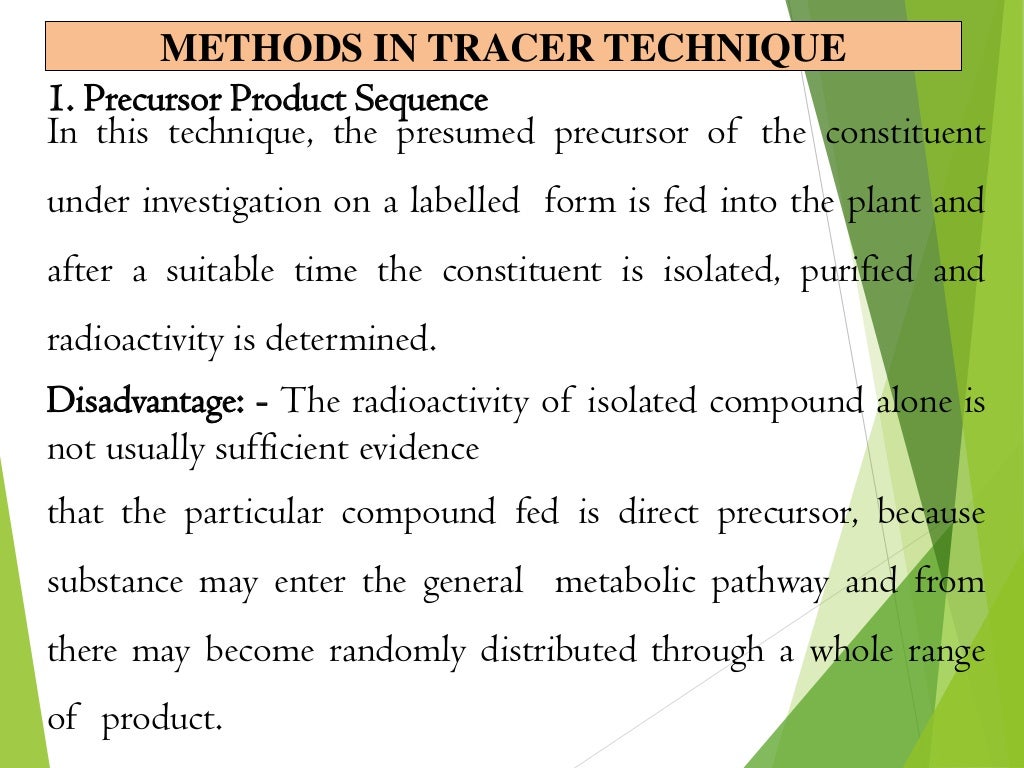
METHODS IN TRACERTECHNIQUE
In this technique, the presumed precursor of the constituent
under investigation on a labelled form is fed into the plant and
after a suitable time the constituent is isolated, purified and
radioactivity is determined.
Disadvantage: - The radioactivity of isolated compound alone is
not usually sufficient evidence
that the particular compound fed is direct precursor, because
substance may enter the general metabolic pathway and from
there may become randomly distributed through a whole range
of product.
1. Precursor Product Sequence
7.
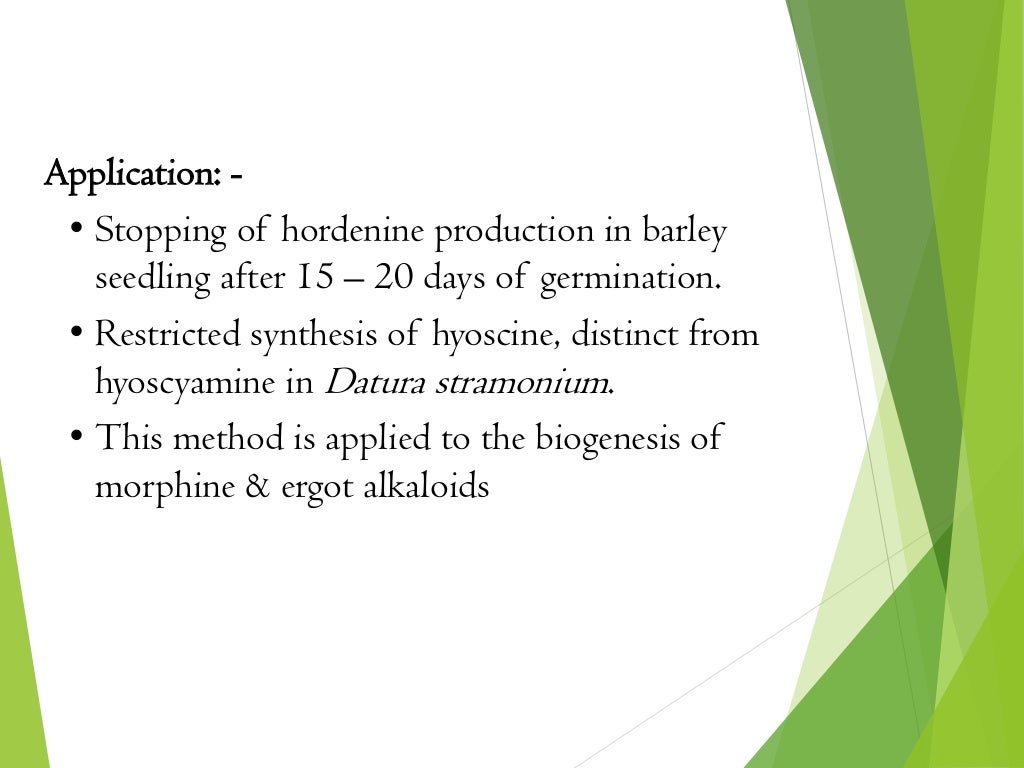
Application: -
• Stoppingof hordenine production in barley
seedling after 15 – 20 days of germination.
• Restricted synthesis of hyoscine, distinct from
hyoscyamine in Datura stramonium.
• This method is applied to the biogenesis of
morphine & ergot alkaloids
8.
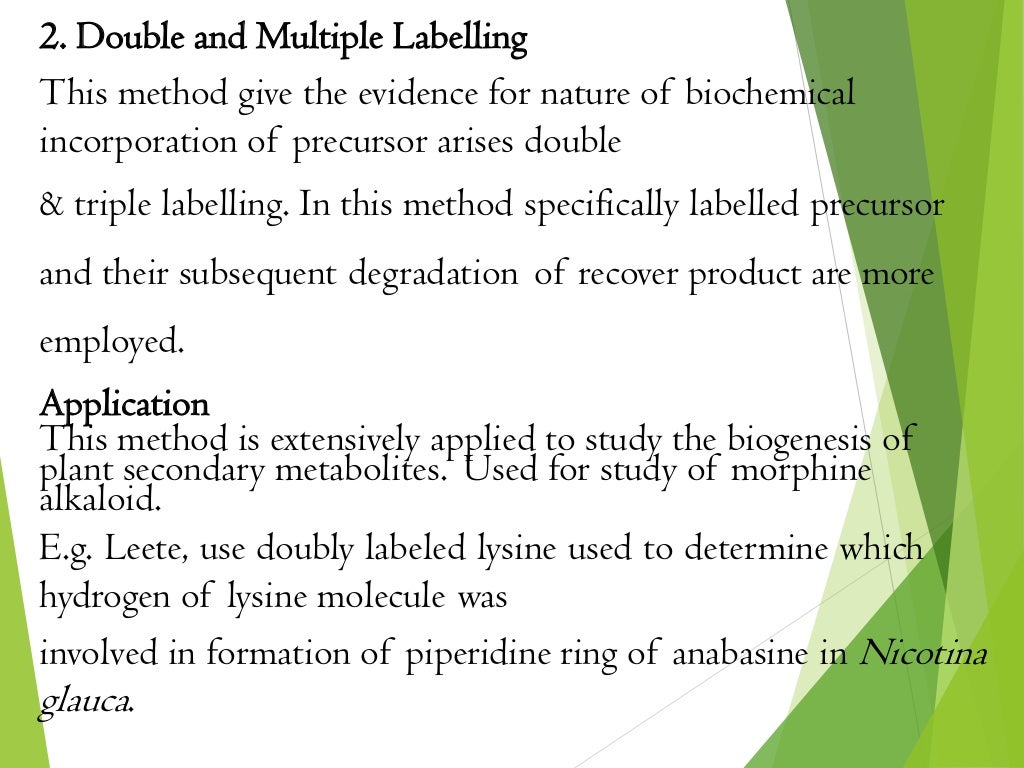
2. Double andMultiple Labelling
This method give the evidence for nature of biochemical
incorporation of precursor arises double
& triple labelling. In this method specifically labelled precursor
and their subsequent degradation of recover product are more
employed.
Application
This method is extensively applied to study the biogenesis of
plant secondary metabolites. Used for study of morphine
alkaloid.
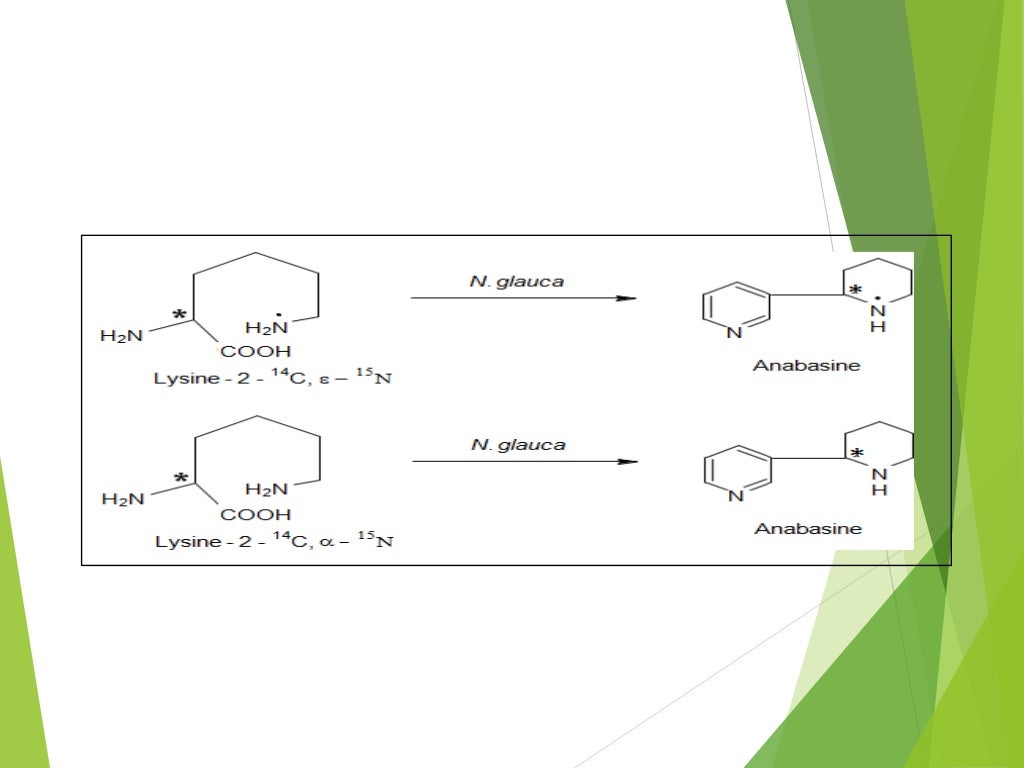
E.g. Leete, use doubly labeled lysine used to determine which
hydrogen of lysine molecule was
involved in formation of piperidine ring of anabasine in Nicotina
glauca.
11.
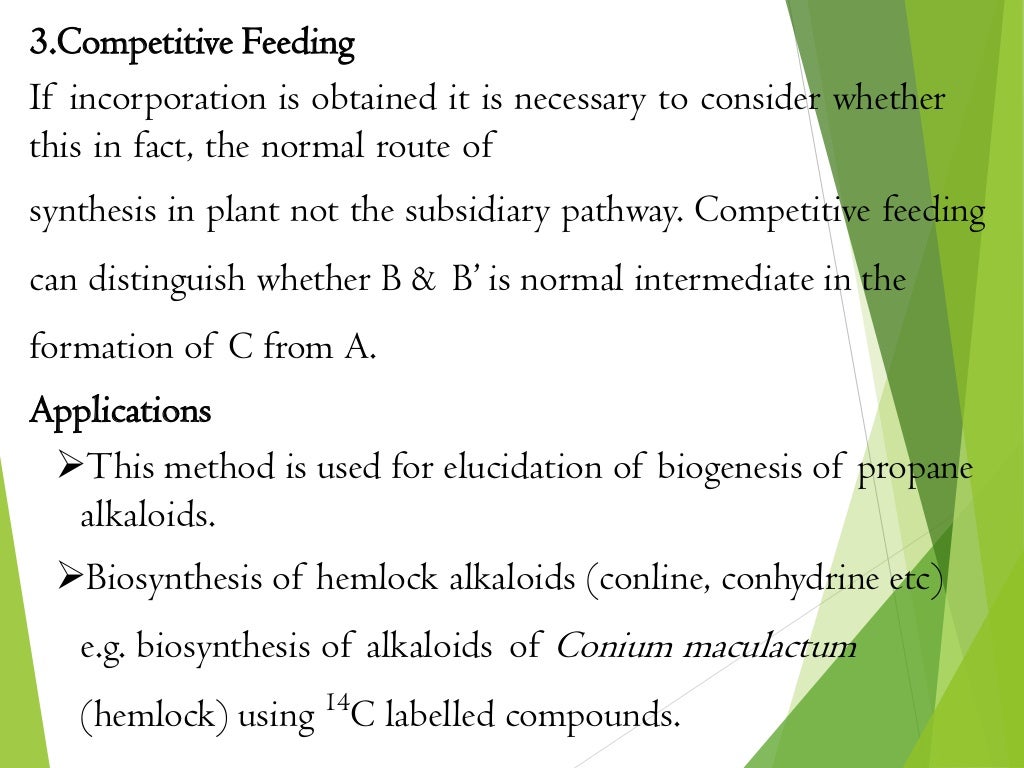
3.Competitive Feeding
If incorporationis obtained it is necessary to consider whether
this in fact, the normal route of
synthesis in plant not the subsidiary pathway. Competitive feeding
can distinguish whether B & B’ is normal intermediate in the
formation of C from A.
Applications
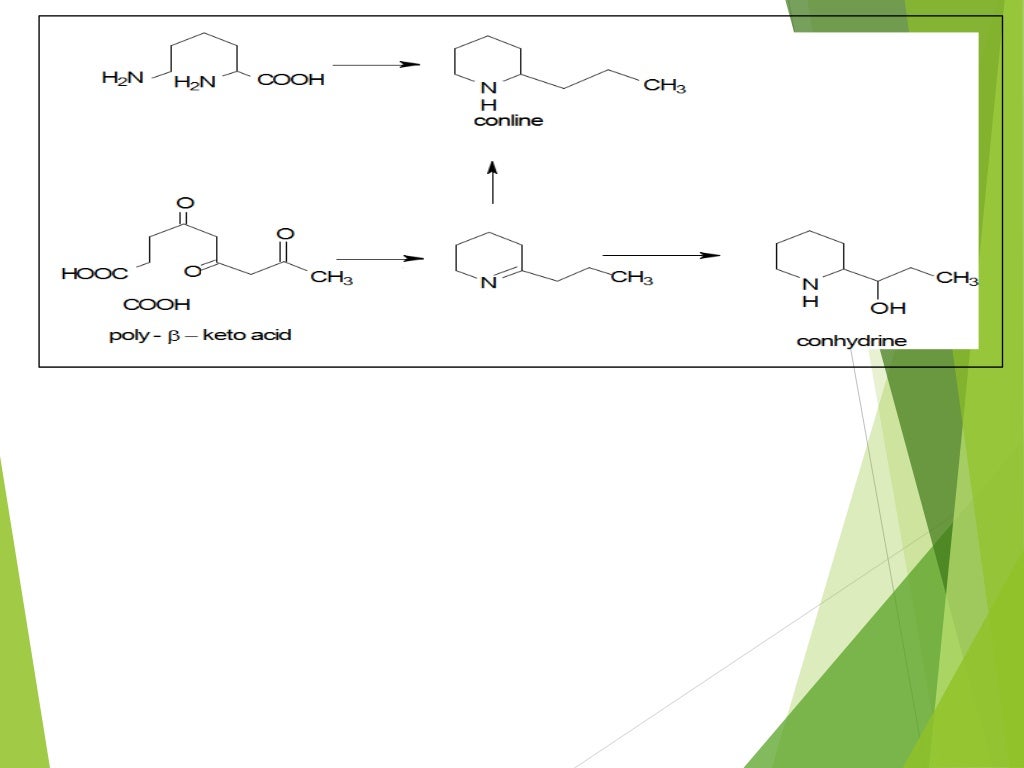
This method is used for elucidation of biogenesis of propane
alkaloids.
Biosynthesis of hemlock alkaloids (conline, conhydrine etc)
e.g. biosynthesis of alkaloids of Conium maculactum
(hemlock) using 14
C labelled compounds.
12.
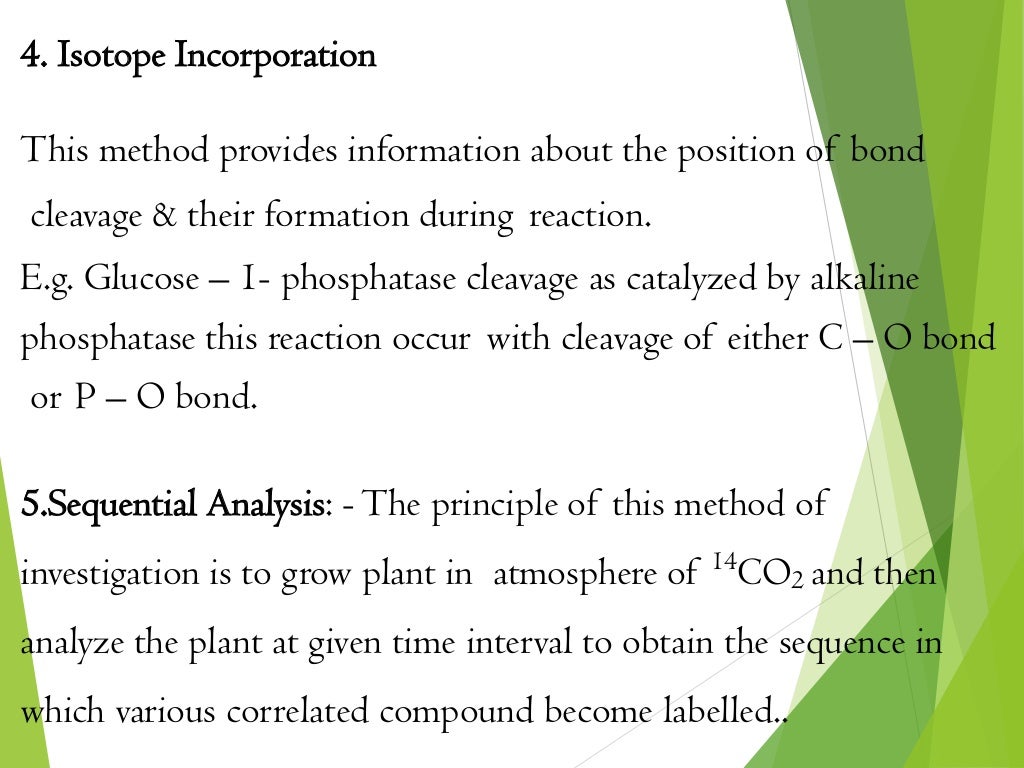
4. Isotope Incorporation
Thismethod provides information about the position of bond
cleavage & their formation during reaction.
E.g. Glucose – 1- phosphatase cleavage as catalyzed by alkaline
phosphatase this reaction occur with cleavage of either C – O bond
or P – O bond.
5.Sequential Analysis: -The principle of this method of
investigation is to grow plant in atmosphere of 14
CO2 and then
analyze the plant at given time interval to obtain the sequence in
which various correlated compound become labelled..
13.
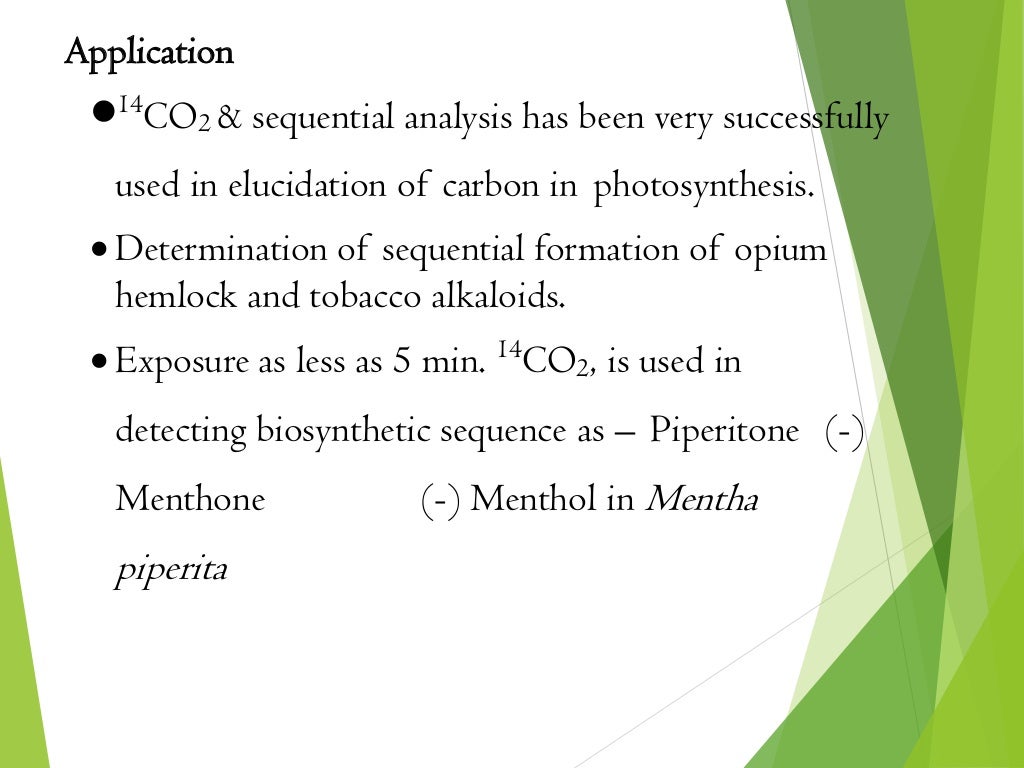
Application
14
CO2 & sequentialanalysis has been very successfully
used in elucidation of carbon in photosynthesis.
Determination of sequential formation of opium
hemlock and tobacco alkaloids.
Exposure as less as 5 min. 14
CO2, is used in
detecting biosynthetic sequence as – Piperitone (-)
Menthone (-) Menthol in Mentha
piperita
14.
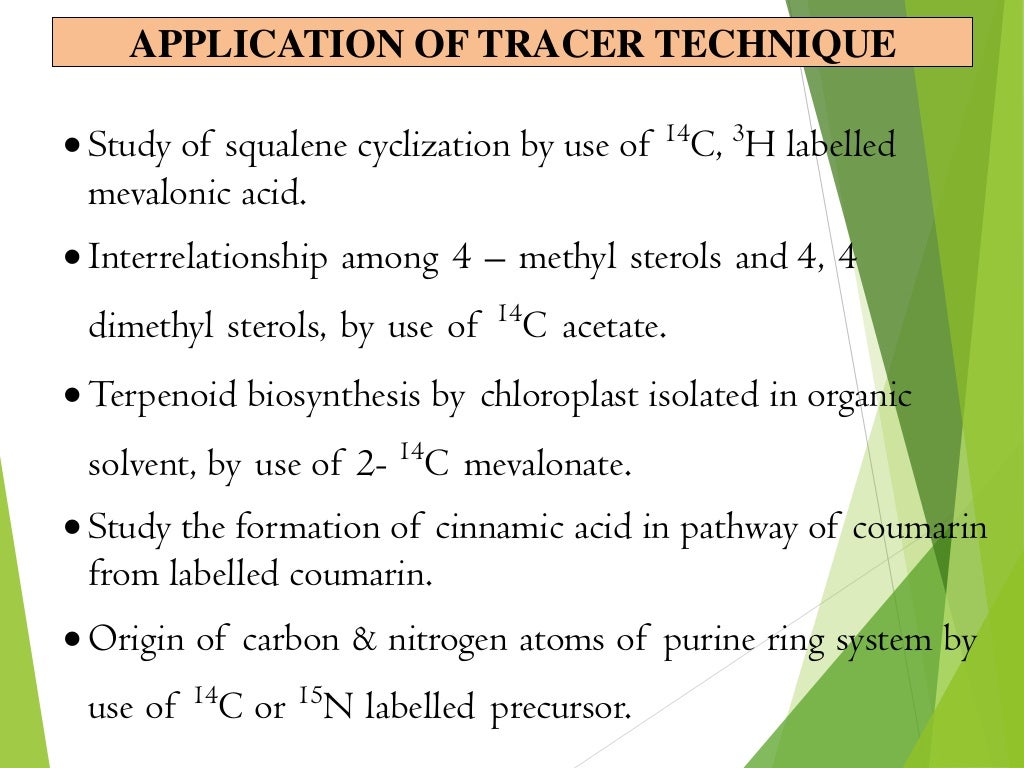
Study ofsqualene cyclization by use of 14
C, 3
H labelled
mevalonic acid.
Interrelationship among 4 – methyl sterols and 4, 4
dimethyl sterols, by use of 14
C acetate.
Terpenoid biosynthesis by chloroplast isolated in organic
solvent, by use of 2- 14
C mevalonate.
Study the formation of cinnamic acid in pathway of coumarin
from labelled coumarin.
Origin of carbon & nitrogen atoms of purine ring system by
use of 14
C or 15
N labelled precursor.
APPLICATION OF TRACER TECHNIQUE
15.
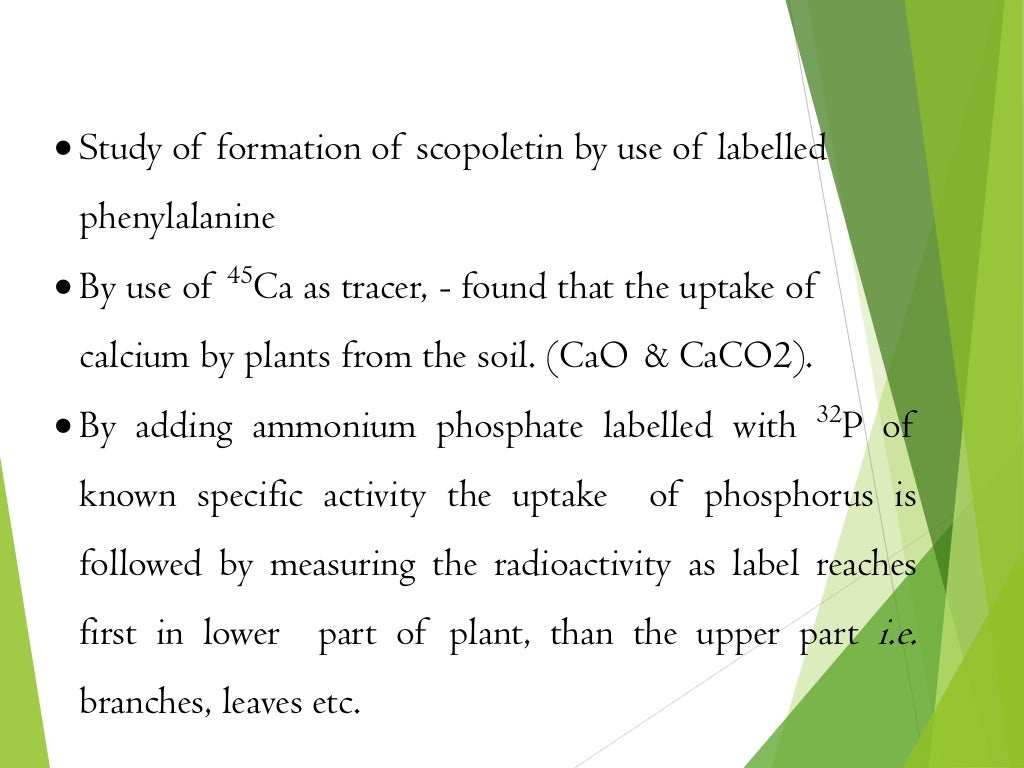
Study offormation of scopoletin by use of labelled
phenylalanine
By use of 45
Ca as tracer, - found that the uptake of
calcium by plants from the soil. (CaO & CaCO2).
By adding ammonium phosphate labelled with 32
P of
known specific activity the uptake of phosphorus is
followed by measuring the radioactivity as label reaches
first in lower part of plant, than the upper part i.e.
branches, leaves etc.
![Radioactive isotopes: - [e.g. 1
H, 14
C, 24
Na, 42
K, 35
S, 35
P, 131
I
decay with emission of radiation]
–For biological investigation – carbon & hydrogen.
–For metabolic studies – S, P, and alkali and alkaline earth
metals are used.
–For studies on protein, alkaloids, and amino acid –
labelled nitrogen atom give more specific information.
–3
H compound is commercially available.
• Stable isotopes: - [e.g. 2
H, 13
C, 15
N, 18
O]
–Used for labeling
compounds as possible intermediates in biosynthetic
pathways.
–Usual method of detection are: – MASS spectroscopy
[15
N, 18
O
–NMR spectroscopy [2
H, 13
C]](https://image.slidesharecdn.com/radioactiveisotopesintheinvestigationofbiogeneticstudies-211223053859/95/Radioactive-isotopes-in-the-investigation-of-biogenetic-studies-5-1024.jpg)