A presentation on
Project title
BIOSYNTHETIC PATHWAYS IN PLANTS AND RADIO-TRACER TECHNIQUES
Presented by
Shivangi Srivastava
M pharm- Pharmacognosy
Under the guidance of
Prof. (Dr) Shalini Tripathi
Rameshwaram Institute of Technology and Management, Lucknow
Dr. A. P.J. Abdul Kalam Technical University, Uttar Pradesh,
Lucknow
CONTENTS
 INTRODUCTION
 PLANT BIOSYNTHESIS
 METABOLITES
 BIOSYNTHESIS OF PRIMARY METABOLITES
 BIOSYNTHESIS OF SECONDARY METABOLITES
 RADIO-TRACER TECHNIQUES
 CRITERIA FOR TRACER / ISOTOPE SELECTION FOR LABELLING
 STEPS INVOLVED IN TRACER TECHNIQUE
 METHODS IN TRACER TECHNIQUE
 APPLICATION OF TRACER TECHNIQUE
 CONCLUSION
 BIBLIOGRAPHY
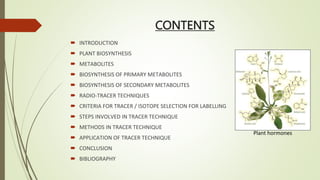
Plant hormones
INTRODUCTION
 The biosynthetic processes for primary metabolites involve photosynthesis, Calvin cycle and pentose
phosphate pathway while the secondary metabolites are synthesised by Shikimic acid pathway,
acetate pathways(malonate and mevalonate) and amino acid pathways.
 By incorporation of radioactive isotope into the precursors / starting material, the whole
biosynthetic pathway can be traced .
 The use of radiotracers involves the substitution of a radioactive isotope for one of the naturally
occurring isotopes of a particular element. use of radiotracers particularly useful for studying the
dynamic processes that comprise specific biological pathways to facilitate our understanding of plant
biology.
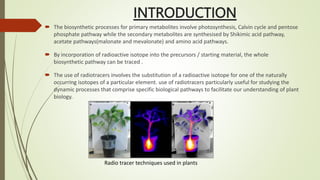
Radio tracer techniques used in plants
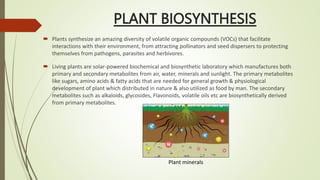
PLANT BIOSYNTHESIS
 Plants synthesize an amazing diversity of volatile organic compounds (VOCs) that facilitate
interactions with their environment, from attracting pollinators and seed dispersers to protecting
themselves from pathogens, parasites and herbivores.
 Living plants are solar-powered biochemical and biosynthetic laboratory which manufactures both
primary and secondary metabolites from air, water, minerals and sunlight. The primary metabolites
like sugars, amino acids & fatty acids that are needed for general growth & physiological
development of plant which distributed in nature & also utilized as food by man. The secondary
metabolites such as alkaloids, glycosides, Flavonoids, volatile oils etc are biosynthetically derived
from primary metabolites.
Plant minerals
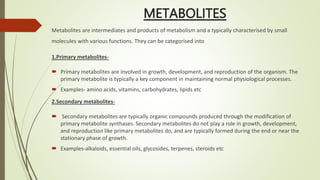
METABOLITES
Metabolites are intermediates and products of metabolism and a typically characterised by small
molecules with various functions. They can be categorised into
1.Primary metabolites-
 Primary metabolites are involved in growth, development, and reproduction of the organism. The
primary metabolite is typically a key component in maintaining normal physiological processes.
 Examples- amino acids, vitamins, carbohydrates, lipids etc
2.Secondary metabolites-
 Secondary metabolites are typically organic compounds produced through the modification of
primary metabolite synthases. Secondary metabolites do not play a role in growth, development,
and reproduction like primary metabolites do, and are typically formed during the end or near the
stationary phase of growth.
 Examples-alkaloids, essential oils, glycosides, terpenes, steroids etc
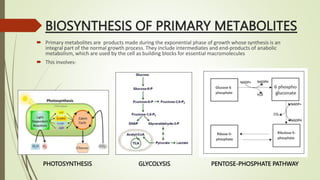
BIOSYNTHESIS OF PRIMARY METABOLITES
 Primary metabolites are products made during the exponential phase of growth whose synthesis is an
integral part of the normal growth process. They include intermediates and end‐products of anabolic
metabolism, which are used by the cell as building blocks for essential macromolecules
 This involves-
PHOTOSYNTHESIS GLYCOLYSIS PENTOSE-PHOSPHATE PATHWAY
BIOSYNTHESIS OF SECONDARY
METABOLITES
Secondary metabolites is a term for pathways for small molecule and products of metabolism that are
not absolutely required for the survival of the organism. A secondary metabolite has an important
ecological function.
1.Shikimic acid pathway
the shikimate pathway is a seven step metabolic route used by bacteria, fungi, algae, parasites,
and plants for the biosynthesis of aromatic amino acids (phenylalanine, tyrosine, and
tryptophan).
2.Acetate malonate pathway
Acetate-Malonate pathway includes synthesis of fatty acids and aromatic compounds with the
help of secondary metabolites.Main precursors of Acetate-Malonate Pathway are Acetyl-CoA
and Malonyl-CoA. End product of this pathway can be saturated or unsaturated fatty acids or
polyketides.
3.Acetate mevalonate pathway
Acetate mevalonate pathway is the basic metabolism pathway which is useful for the
biosynthesis of various secondary metabolites like hemiterpenes, sesquiterpenes,
carotenoids, squalene, steroids, etc. The mevalonate pathway begins with acetyl-CoA
and ends with the production of Isopentenyl pyrophosphate (IPP)and Dimethylallyl
pyrophosphate (DMAPP) which are used to make isoprenoids, a diverse class of over
30,000 biomolecules such as cholesterols , Vitamin K, and all steroid hormones.
4.Amino acid pathway
Amino acids are organic compounds containing amine (-NH2) and carboxyl (-COOH)
functional groups, along with a side chain(R group) specific to each amino acid. Amino
acids precursors are intermediates in glycolysis, the citric acid cycle, or the pentose
phosphate pathway. They are used to make nucleotide.
RADIOTRACER TECHNIQUES
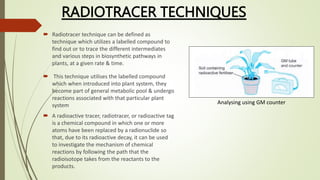
 Radiotracer technique can be defined as
technique which utilizes a labelled compound to
find out or to trace the different intermediates
and various steps in biosynthetic pathways in
plants, at a given rate & time.
 This technique utilises the labelled compound
which when introduced into plant system, they
become part of general metabolic pool & undergo
reactions associated with that particular plant
system
 A radioactive tracer, radiotracer, or radioactive tag
is a chemical compound in which one or more
atoms have been replaced by a radionuclide so
that, due to its radioactive decay, it can be used
to investigate the mechanism of chemical
reactions by following the path that the
radioisotope takes from the reactants to the
products.
Analysing using GM counter
CRITERIA FOR TRACER / ISOTOPE SELECTION FOR
LABELLING
 Following points must be considered before selection-
 The starting concentration of tracer must be sufficient enough to withstand dilution in
course of metabolism.
 Physical & chemical nature of compound must be known for proper labelling.
 Higher Half-life.
 Should actively participate during synthesis.
 Should not damage the system (Harmless)
 Specificity of radioactive tracer.
 Tracer should be highly pure.
 Binding of tracer during entire course of biosynthetic metabolism.
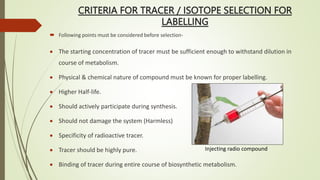
Injecting radio compound
STEPS INVOLVED IN TRACER TECHNIQUE
 Steps involved in radio tracer technique are as follows
1.Preparation of labelled compound.
The labeled compound produces 14CO2 by increasing it in the atmosphere. All carbon
compounds are labeled 14C.
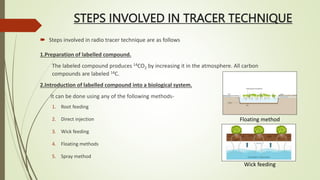
2.Introduction of labelled compound into a biological system.
It can be done using any of the following methods-
1. Root feeding
2. Direct injection
3. Wick feeding
4. Floating methods
5. Spray method
Floating method
Wick feeding
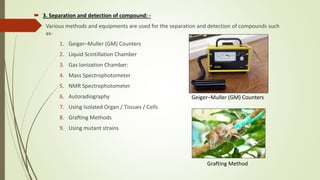
 3. Separation and detection of compound: -
Various methods and equipments are used for the separation and detection of compounds such
as-
1. Geiger–Muller (GM) Counters
2. Liquid Scintillation Chamber
3. Gas Ionization Chamber:
4. Mass Spectrophotometer
5. NMR Spectrophotometer
6. Autoradiography
7. Using Isolated Organ / Tissues / Cells
8. Grafting Methods
9. Using mutant strains
Geiger–Muller (GM) Counters
Grafting Method
METHODS IN TRACER TECHNIQUE
1.Precursor product sequence:
 In this technique, the presumed precursor of the constituent under investigation on a labelled
form is fed into the plant and after a suitable time the constituent is isolated, purified and
radioactivity is determined.
2. Double & multiple labelling:
 This method gives the evidence for nature of biochemical incorporation of precursor arises
double & triple labelling. In this method specifically labelled precursor and their subsequent
degradation of recover product are more employed.
3.Competitive feeding:
 If incorporation is obtained it is necessary to consider whether this in fact, the normal route of
synthesis in plant not the subsidiary pathway. Example- This method is used for elucidation of
biogenesis of propane alkaloids.
4.Isotope incorporation:
 This method provides information about the position of bond cleavage & their formation
during reaction. E.g. Glucose – 1- phosphatase cleavage as catalyzed by alkaline
phosphatase this reaction occurs with cleavage of either C – O bond or P – O bond.
5.Sequential analysis:
 The principle of this method of investigation is to grow plant in atmosphere of 14CO2 & then
analyze the plant at given time interval to obtain the sequence in which various correlated
compound become labelled.
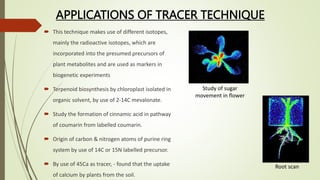
 This technique makes use of different isotopes,
mainly the radioactive isotopes, which are
incorporated into the presumed precursors of
plant metabolites and are used as markers in
biogenetic experiments
 Terpenoid biosynthesis by chloroplast isolated in
organic solvent, by use of 2-14C mevalonate.
 Study the formation of cinnamic acid in pathway
of coumarin from labelled coumarin.
 Origin of carbon & nitrogen atoms of purine ring
system by use of 14C or 15N labelled precursor.
 By use of 45Ca as tracer, - found that the uptake
of calcium by plants from the soil.
APPLICATIONS OF TRACER TECHNIQUE
Study of sugar
movement in flower
Root scan
CONCLUSION
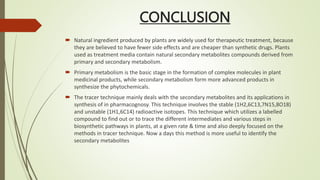
 Natural ingredient produced by plants are widely used for therapeutic treatment, because
they are believed to have fewer side effects and are cheaper than synthetic drugs. Plants
used as treatment media contain natural secondary metabolites compounds derived from
primary and secondary metabolism.
 Primary metabolism is the basic stage in the formation of complex molecules in plant
medicinal products, while secondary metabolism form more advanced products in
synthesize the phytochemicals.
 The tracer technique mainly deals with the secondary metabolites and its applications in
synthesis of in pharmacognosy. This technique involves the stable (1H2,6C13,7N15,8O18)
and unstable (1H1,6C14) radioactive isotopes. This technique which utilizes a labelled
compound to find out or to trace the different intermediates and various steps in
biosynthetic pathways in plants, at a given rate & time and also deeply focused on the
methods in tracer technique. Now a days this method is more useful to identify the
secondary metabolites
BIBLIOGRAPHY
Research papers and websites-
 https://bio.libretexts.org/Bookshelves/Microbiology/Book%3A_Microbiology_(Boundless)/17%3A_Industrial_Microbiology/
17.1%3A_Industrial_Microbiology/17.1C%3A_Primary_and_Secondary_Metabolites
 https://chem.libretexts.org/Bookshelves/Biological_Chemistry/Supplemental_Modules_(Biological_Chemistry)/Metabolism/
Anabolism/Pentose_Phosphate_Pathway
 https://pubmed.ncbi.nlm.nih.gov/25243985/
 https://link.springer.com/chapter/10.1007/978-1-349-86109-5_5
 https://www.ncbi.nlm.nih.gov/pmc/articles/PMC3815394/
 https://www.ncbi.nlm.nih.gov/pmc/articles/PMC4883961/
 https://www.frontiersin.org/articles/10.3389/fendo.2020.00365/full
 https://mospace.umsystem.edu/xmlui/bitstream/handle/10355/42983/research.pdf?sequence=1&isAllowed=y
biosynthetic pathways and radiotracer techniques.pptx

biosynthetic pathways and radiotracer techniques.pptx

  • 1.
    A presentation on Projecttitle BIOSYNTHETIC PATHWAYS IN PLANTS AND RADIO-TRACER TECHNIQUES Presented by Shivangi Srivastava M pharm- Pharmacognosy Under the guidance of Prof. (Dr) Shalini Tripathi Rameshwaram Institute of Technology and Management, Lucknow Dr. A. P.J. Abdul Kalam Technical University, Uttar Pradesh, Lucknow
  • 2.
    CONTENTS  INTRODUCTION  PLANTBIOSYNTHESIS  METABOLITES  BIOSYNTHESIS OF PRIMARY METABOLITES  BIOSYNTHESIS OF SECONDARY METABOLITES  RADIO-TRACER TECHNIQUES  CRITERIA FOR TRACER / ISOTOPE SELECTION FOR LABELLING  STEPS INVOLVED IN TRACER TECHNIQUE  METHODS IN TRACER TECHNIQUE  APPLICATION OF TRACER TECHNIQUE  CONCLUSION  BIBLIOGRAPHY Plant hormones
  • 3.
    INTRODUCTION  The biosyntheticprocesses for primary metabolites involve photosynthesis, Calvin cycle and pentose phosphate pathway while the secondary metabolites are synthesised by Shikimic acid pathway, acetate pathways(malonate and mevalonate) and amino acid pathways.  By incorporation of radioactive isotope into the precursors / starting material, the whole biosynthetic pathway can be traced .  The use of radiotracers involves the substitution of a radioactive isotope for one of the naturally occurring isotopes of a particular element. use of radiotracers particularly useful for studying the dynamic processes that comprise specific biological pathways to facilitate our understanding of plant biology. Radio tracer techniques used in plants
  • 4.
    PLANT BIOSYNTHESIS  Plantssynthesize an amazing diversity of volatile organic compounds (VOCs) that facilitate interactions with their environment, from attracting pollinators and seed dispersers to protecting themselves from pathogens, parasites and herbivores.  Living plants are solar-powered biochemical and biosynthetic laboratory which manufactures both primary and secondary metabolites from air, water, minerals and sunlight. The primary metabolites like sugars, amino acids & fatty acids that are needed for general growth & physiological development of plant which distributed in nature & also utilized as food by man. The secondary metabolites such as alkaloids, glycosides, Flavonoids, volatile oils etc are biosynthetically derived from primary metabolites. Plant minerals
  • 5.
    METABOLITES Metabolites are intermediatesand products of metabolism and a typically characterised by small molecules with various functions. They can be categorised into 1.Primary metabolites-  Primary metabolites are involved in growth, development, and reproduction of the organism. The primary metabolite is typically a key component in maintaining normal physiological processes.  Examples- amino acids, vitamins, carbohydrates, lipids etc 2.Secondary metabolites-  Secondary metabolites are typically organic compounds produced through the modification of primary metabolite synthases. Secondary metabolites do not play a role in growth, development, and reproduction like primary metabolites do, and are typically formed during the end or near the stationary phase of growth.  Examples-alkaloids, essential oils, glycosides, terpenes, steroids etc
  • 6.
    BIOSYNTHESIS OF PRIMARYMETABOLITES  Primary metabolites are products made during the exponential phase of growth whose synthesis is an integral part of the normal growth process. They include intermediates and end‐products of anabolic metabolism, which are used by the cell as building blocks for essential macromolecules  This involves- PHOTOSYNTHESIS GLYCOLYSIS PENTOSE-PHOSPHATE PATHWAY
  • 7.
    BIOSYNTHESIS OF SECONDARY METABOLITES Secondarymetabolites is a term for pathways for small molecule and products of metabolism that are not absolutely required for the survival of the organism. A secondary metabolite has an important ecological function. 1.Shikimic acid pathway the shikimate pathway is a seven step metabolic route used by bacteria, fungi, algae, parasites, and plants for the biosynthesis of aromatic amino acids (phenylalanine, tyrosine, and tryptophan). 2.Acetate malonate pathway Acetate-Malonate pathway includes synthesis of fatty acids and aromatic compounds with the help of secondary metabolites.Main precursors of Acetate-Malonate Pathway are Acetyl-CoA and Malonyl-CoA. End product of this pathway can be saturated or unsaturated fatty acids or polyketides.
  • 8.
    3.Acetate mevalonate pathway Acetatemevalonate pathway is the basic metabolism pathway which is useful for the biosynthesis of various secondary metabolites like hemiterpenes, sesquiterpenes, carotenoids, squalene, steroids, etc. The mevalonate pathway begins with acetyl-CoA and ends with the production of Isopentenyl pyrophosphate (IPP)and Dimethylallyl pyrophosphate (DMAPP) which are used to make isoprenoids, a diverse class of over 30,000 biomolecules such as cholesterols , Vitamin K, and all steroid hormones. 4.Amino acid pathway Amino acids are organic compounds containing amine (-NH2) and carboxyl (-COOH) functional groups, along with a side chain(R group) specific to each amino acid. Amino acids precursors are intermediates in glycolysis, the citric acid cycle, or the pentose phosphate pathway. They are used to make nucleotide.
  • 9.
    RADIOTRACER TECHNIQUES  Radiotracertechnique can be defined as technique which utilizes a labelled compound to find out or to trace the different intermediates and various steps in biosynthetic pathways in plants, at a given rate & time.  This technique utilises the labelled compound which when introduced into plant system, they become part of general metabolic pool & undergo reactions associated with that particular plant system  A radioactive tracer, radiotracer, or radioactive tag is a chemical compound in which one or more atoms have been replaced by a radionuclide so that, due to its radioactive decay, it can be used to investigate the mechanism of chemical reactions by following the path that the radioisotope takes from the reactants to the products. Analysing using GM counter
  • 10.
    CRITERIA FOR TRACER/ ISOTOPE SELECTION FOR LABELLING  Following points must be considered before selection-  The starting concentration of tracer must be sufficient enough to withstand dilution in course of metabolism.  Physical & chemical nature of compound must be known for proper labelling.  Higher Half-life.  Should actively participate during synthesis.  Should not damage the system (Harmless)  Specificity of radioactive tracer.  Tracer should be highly pure.  Binding of tracer during entire course of biosynthetic metabolism. Injecting radio compound
  • 11.
    STEPS INVOLVED INTRACER TECHNIQUE  Steps involved in radio tracer technique are as follows 1.Preparation of labelled compound. The labeled compound produces 14CO2 by increasing it in the atmosphere. All carbon compounds are labeled 14C. 2.Introduction of labelled compound into a biological system. It can be done using any of the following methods- 1. Root feeding 2. Direct injection 3. Wick feeding 4. Floating methods 5. Spray method Floating method Wick feeding
  • 12.
     3. Separationand detection of compound: - Various methods and equipments are used for the separation and detection of compounds such as- 1. Geiger–Muller (GM) Counters 2. Liquid Scintillation Chamber 3. Gas Ionization Chamber: 4. Mass Spectrophotometer 5. NMR Spectrophotometer 6. Autoradiography 7. Using Isolated Organ / Tissues / Cells 8. Grafting Methods 9. Using mutant strains Geiger–Muller (GM) Counters Grafting Method
  • 13.
    METHODS IN TRACERTECHNIQUE 1.Precursor product sequence:  In this technique, the presumed precursor of the constituent under investigation on a labelled form is fed into the plant and after a suitable time the constituent is isolated, purified and radioactivity is determined. 2. Double & multiple labelling:  This method gives the evidence for nature of biochemical incorporation of precursor arises double & triple labelling. In this method specifically labelled precursor and their subsequent degradation of recover product are more employed. 3.Competitive feeding:  If incorporation is obtained it is necessary to consider whether this in fact, the normal route of synthesis in plant not the subsidiary pathway. Example- This method is used for elucidation of biogenesis of propane alkaloids.
  • 14.
    4.Isotope incorporation:  Thismethod provides information about the position of bond cleavage & their formation during reaction. E.g. Glucose – 1- phosphatase cleavage as catalyzed by alkaline phosphatase this reaction occurs with cleavage of either C – O bond or P – O bond. 5.Sequential analysis:  The principle of this method of investigation is to grow plant in atmosphere of 14CO2 & then analyze the plant at given time interval to obtain the sequence in which various correlated compound become labelled.
  • 15.
     This techniquemakes use of different isotopes, mainly the radioactive isotopes, which are incorporated into the presumed precursors of plant metabolites and are used as markers in biogenetic experiments  Terpenoid biosynthesis by chloroplast isolated in organic solvent, by use of 2-14C mevalonate.  Study the formation of cinnamic acid in pathway of coumarin from labelled coumarin.  Origin of carbon & nitrogen atoms of purine ring system by use of 14C or 15N labelled precursor.  By use of 45Ca as tracer, - found that the uptake of calcium by plants from the soil. APPLICATIONS OF TRACER TECHNIQUE Study of sugar movement in flower Root scan
  • 16.
    CONCLUSION  Natural ingredientproduced by plants are widely used for therapeutic treatment, because they are believed to have fewer side effects and are cheaper than synthetic drugs. Plants used as treatment media contain natural secondary metabolites compounds derived from primary and secondary metabolism.  Primary metabolism is the basic stage in the formation of complex molecules in plant medicinal products, while secondary metabolism form more advanced products in synthesize the phytochemicals.  The tracer technique mainly deals with the secondary metabolites and its applications in synthesis of in pharmacognosy. This technique involves the stable (1H2,6C13,7N15,8O18) and unstable (1H1,6C14) radioactive isotopes. This technique which utilizes a labelled compound to find out or to trace the different intermediates and various steps in biosynthetic pathways in plants, at a given rate & time and also deeply focused on the methods in tracer technique. Now a days this method is more useful to identify the secondary metabolites
  • 17.
    BIBLIOGRAPHY Research papers andwebsites-  https://bio.libretexts.org/Bookshelves/Microbiology/Book%3A_Microbiology_(Boundless)/17%3A_Industrial_Microbiology/ 17.1%3A_Industrial_Microbiology/17.1C%3A_Primary_and_Secondary_Metabolites  https://chem.libretexts.org/Bookshelves/Biological_Chemistry/Supplemental_Modules_(Biological_Chemistry)/Metabolism/ Anabolism/Pentose_Phosphate_Pathway  https://pubmed.ncbi.nlm.nih.gov/25243985/  https://link.springer.com/chapter/10.1007/978-1-349-86109-5_5  https://www.ncbi.nlm.nih.gov/pmc/articles/PMC3815394/  https://www.ncbi.nlm.nih.gov/pmc/articles/PMC4883961/  https://www.frontiersin.org/articles/10.3389/fendo.2020.00365/full  https://mospace.umsystem.edu/xmlui/bitstream/handle/10355/42983/research.pdf?sequence=1&isAllowed=y