ASHOKA INSTITUTE OF TECHNOLOGY & MANAGEMENT
DEPARTMENT OF PHARMACY
Ashoka Engineering Chauraha, Paharia, Sarnath, Varanasi
Name Of Unit
Metabolic Pathways in Higher Plants
and Their Determination
Subject /Course Pharmacognosy and Photochemistry-II
Subject/Course ID BP 504T
Class: B.Pharm. Semester 5th
Course Coordinator Mr. Anubhav Gupta
Learning Outcome
To outline the metabolic pathway in higher plants and their biogenetic studies.
1
Anubhav Gupta
2
Module Content Topic
 The basic metabolic pathways producing secondary
metabolites .
 Shikimic acid pathway
 Shikimic acid pathway produced secondary metabolites .
 The Acetate (acetate-malonate) pathway producing Fatty
acids .
 The Acetate-Mevalonte (Isoprenoid) pathway
 The Acetate-Mevalonte (Isoprenoid) pathway produced
secondary metabolites .
 The Amino acid Pathway
 Radioactive isotopes in the investigation of biogenetic
studies- Tracer techniques .
Anubhav Gupta
Anubhav Gupta 3
STUDY OF UTILIZATION OF RADIOACTIVE ISOTOPES IN THE
INVESTIGATION OF BIOGENETIC STUDIES
BIOGENETIC STUDIES
It is a branch of biology focused on understanding the biosynthetic pathways of
living organisms, particularly how plants synthesize and transform natural
products.
The primary goal is to draw out the sequence of biochemical reactions
(biosynthetic pathways) that plants and other organisms use to create specific
compounds.
These studies often employ tracer techniques using radioisotopes.
Anubhav Gupta 4
APPLICATIONS:
 Tracing Metabolic Pathways:
Identifying the sequence of chemical reactions involved in the formation of plant
metabolites, such as cynogenetic glycosides.
 Understanding Plant Metabolism:
Gaining insights into the complex biochemical processes that occur within plants.
 Characterizing Natural Products:
Determining the origins and structural components of various natural products.
Anubhav Gupta 5
BIOGENETIC STUDIES
There are 5 techniques used for the investigation of biosynthetic pathway of
primary and secondary metabolites.
1. Tracer technique
2. Use of isolated organ and tissues
3. Grafting method
4. Use of Mutant strains
5. Enzymatic studies
Out of the above 5 methods, in Tracer technique method, radioactive isotopes
are used for the investigation of biogenetic pathways.
Anubhav Gupta 6
TRACER TECHNIQUE
Tracer techniques utilizes radioactive isotope labelled compound to find out or to trace
the different intermediates and various steps in biosynthetic pathways in plants, at a
given rate & time.
Isotopes
Elements with identical chemical properties or same atomic no. but different atomic
weights/ mass no. are called isotopes. In other words, isotopes are atoms of same element
whose nuclei contain same no. of protons but different no. of neutrons.
Stable isotopes
They are stable and do not emit radiation, e.g- 2H, 13C, 15N, 18O
Radioactive isotopes
They are unstable and emit radiations. The phenomenon of emitting radiation is called
radioactivity and such isotopes are called radioactive isotopes.
Anubhav Gupta 7
Significance of tracer techniques
 High sensitivity
 More effective
 Simple administration and isolation.
 Shows accurate results when enough metabolic time & technique is used.
 Position & Quantity of compound containing tracer isotope 14C marked glucose
is used for glucose determination in the biological system.
 For different studies, different tracers can be used.
 Biosynthetic pathway can be traced by incorporating radioactive isotopes into
the precursor or starting material.
 Location and quantity can be determined in biological system.
Anubhav Gupta 8
Different trace elements used for different studies
 For studies on nitrogen and amino acid, Labelled nitrogen gives specific information
than carbon.
 For studies on protein, alkaloids and amino acid, nitrogen atom gives more specific
information than carbon.
 For studies on glycosidic linkage- O, N, S and C atom.
 For studies on terpenoids- O atom.
Steps involved in tracer techniques
1. Preparation of labelled compound
2. Incorporation of labelled compound
3. Separation and isolation of labelled compound
4. Determination of nature of metabolites in various biochemical fractions.
Anubhav Gupta 9
1. PREPARATION OF LABELLED COMPOUND
In biological investigation, the use of bioactive isotopes enables the metabolism of
compounds to be followed in living organisms for detection and estimation of soft and
easily absorbed radiation from labelled compound.
 Labelled compounds may be prepared by use of radioactive isotopes and stable
isotopes e,g- Radioactive isotopes- 14C, 3H, 32P, 131I
 Stable isotopes- 2H, 15N, 13C, 18O
 Radioactive carbon and hydrogen are mostly used in biological investigation.
 Radioactive isotopes having long half-life are used.
Criteria for selection of trace elements:
 Starting concentration of trace element must be sufficient to withstand dilution in the
course of metabolism.
 Physical and chemical nature of compound must be known.
 Should not damage the tissue system
 Should have low radiation energy.
Anubhav Gupta 10
2. INCORPORATION OF LABELLED COMPOUND TO TISSUE SYSTEM
i) Root feeding Hydroponic feeding of roots e.g- Tobacco.
ii) Stem feeding Through the cut ends of stem immersed in a solution.
iii) Direct injection This method is used in plants with hallow stem. e.g-
Umbelliferae and capsule plants (opium poppy). Microsyringe is used to
inject labelled compound solution.
iv) Infiltration (wick feeding) A thread is drawn through the stem which is
dipped into radioactive solution or a flap can be cut in stem and this
dipped in the solution.
v) Floating method When a small amount of material is available, this
method is used. Leaf disc/chopped leaves are floated on labelled
compound solution.
vi) Spraying technique Compounds have been absorbed after being sprayed
on leaves. e.g- steroids.
Anubhav Gupta 11
3. SEPARATION AND ISOLATION OF LABELLED COMPOUND
 Soft tissue (Fresh)- Infusion, Maceration
 Hard tissue- Decoction and hot percolation
 Unorganized drug- Maceration with solvent
 Fat and oil- Non-polar solvent
 Alkaloids, Glycosides, Flavonoids- Slightly polar solvent
 Plant phenol- Polar solvent
Anubhav Gupta 12
4. DETERMINATION OF NATURE OF METABOLITES IN VARIOUS
BIOCHEMICAL FRACTIONS
a. GEIGER-MULLER COUNTER
 It is a type of particle detector that measures ionizing radiation, e.g. alpha, beta
particles or gamma rays.
 It works by measuring the conductance of electrical charges when a particle or
photon of radiation makes the gas conductive by
ionization.
 Ionization is produced in low-pressure gas, usually
helium, neon or argon with halogens added in the
Geiger-Muller tube.
Fig A: Geiger-Muller Counter
Anubhav Gupta 13
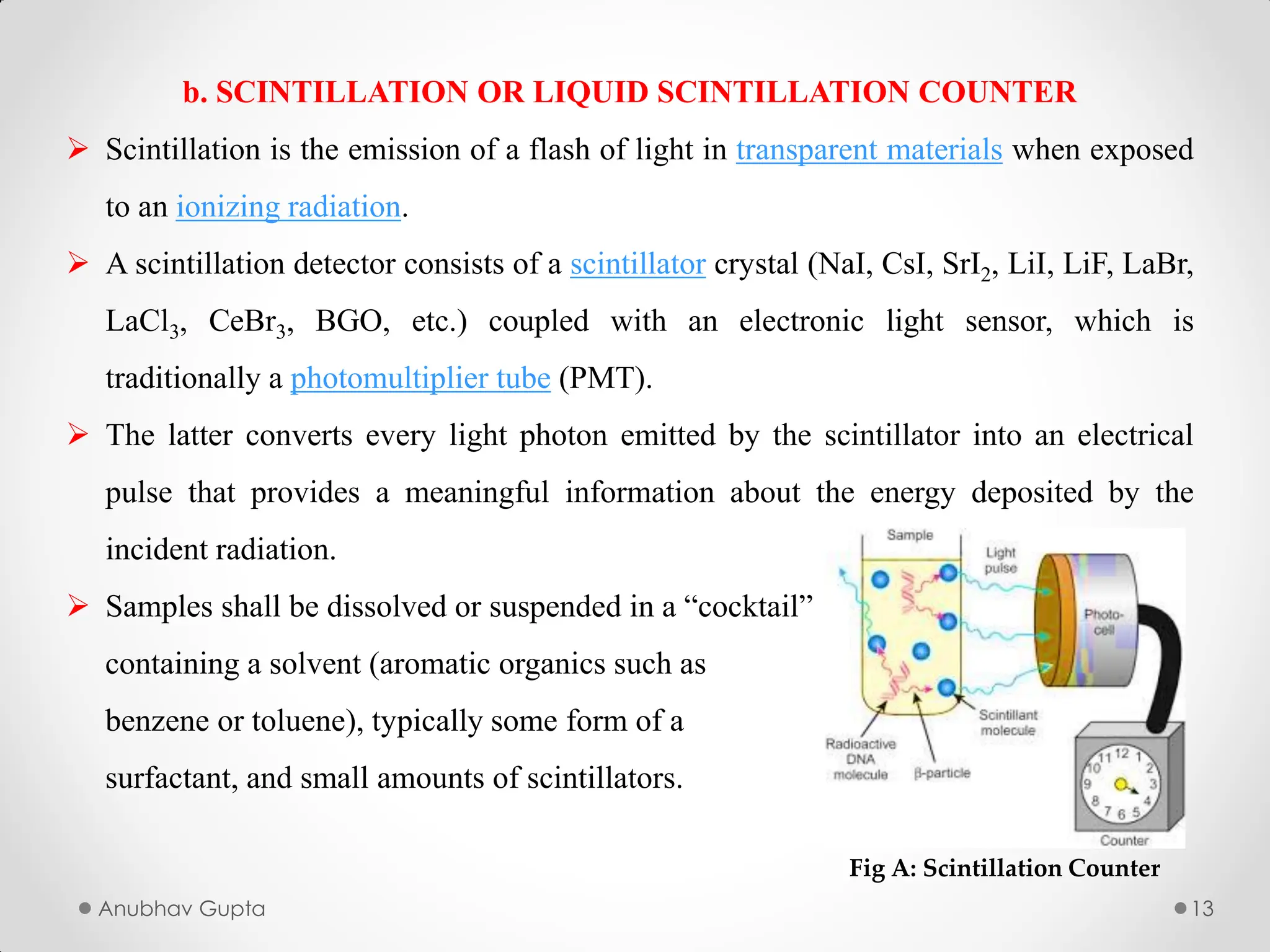
b. SCINTILLATION OR LIQUID SCINTILLATION COUNTER
 Scintillation is the emission of a flash of light in transparent materials when exposed
to an ionizing radiation.
 A scintillation detector consists of a scintillator crystal (NaI, CsI, SrI2, LiI, LiF, LaBr,
LaCl3, CeBr3, BGO, etc.) coupled with an electronic light sensor, which is
traditionally a photomultiplier tube (PMT).
 The latter converts every light photon emitted by the scintillator into an electrical
pulse that provides a meaningful information about the energy deposited by the
incident radiation.
 Samples shall be dissolved or suspended in a “cocktail”
containing a solvent (aromatic organics such as
benzene or toluene), typically some form of a
surfactant, and small amounts of scintillators.
Fig A: Scintillation Counter
Anubhav Gupta 14
c. MASS SPECTROPHOTOMETER
 Mass spectrometry (MS) is an analytical technique used to measure the mass-to-charge
ratio of charged particles.
 It is used to determine the mass of the particles, to determine the elemental
composition of the sample or molecule.
 It also helps in elucidation of the chemical structures of molecules, such as peptides
and other chemical compounds.
d. NMR SPECTROPHOTOMETER
 NMR spectroscopy gives the magnetic properties of certain atomic nuclei to determine
the physical and chemical properties of the atoms or molecules they contain.
 It relies on the phenomenon of nuclear magnetic resonance and can provide detailed
information on the structure, dynamics, reaction status and chemical environment of
the molecules.
Anubhav Gupta 15
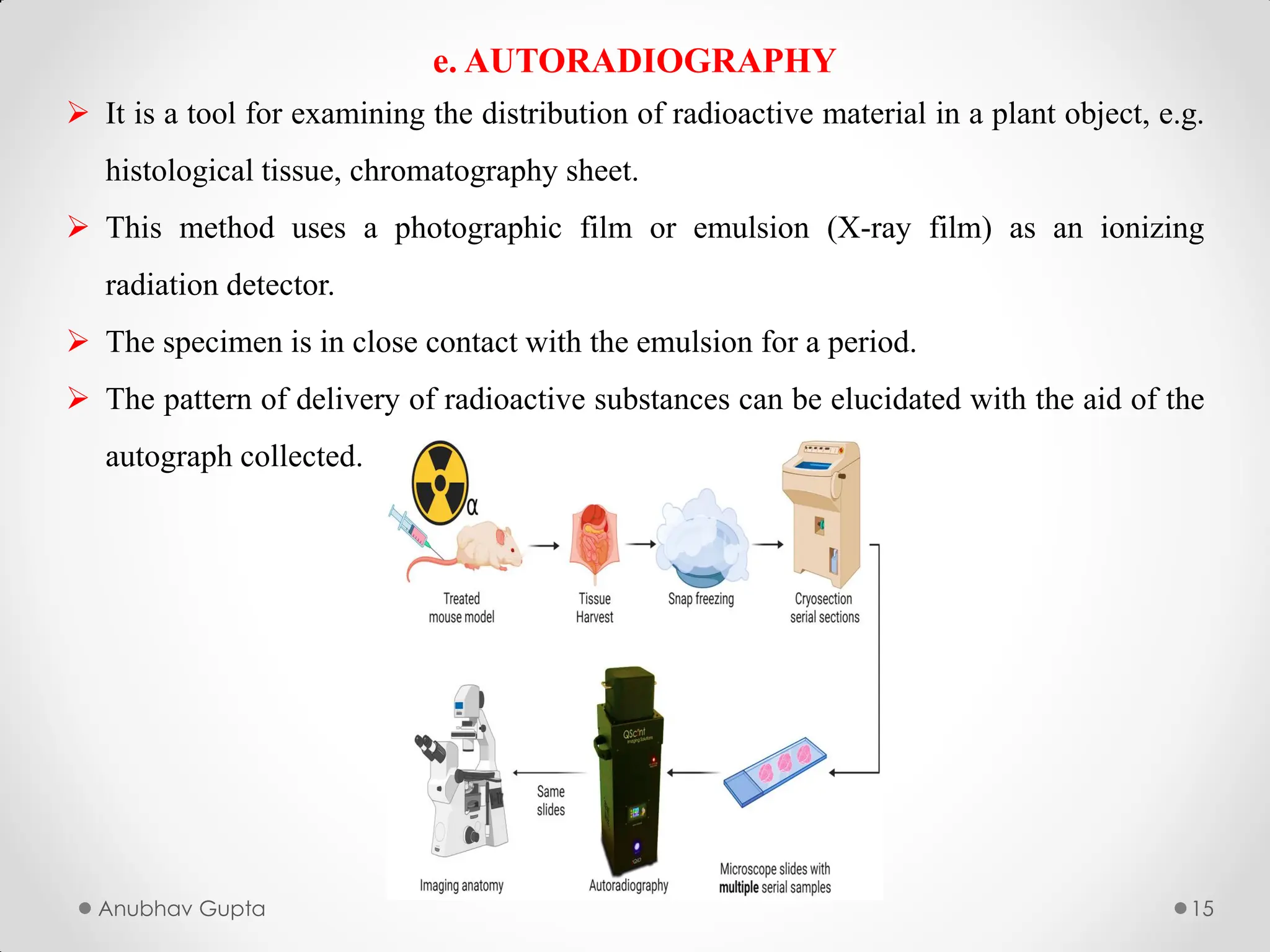
e. AUTORADIOGRAPHY
 It is a tool for examining the distribution of radioactive material in a plant object, e.g.
histological tissue, chromatography sheet.
 This method uses a photographic film or emulsion (X-ray film) as an ionizing
radiation detector.
 The specimen is in close contact with the emulsion for a period.
 The pattern of delivery of radioactive substances can be elucidated with the aid of the
autograph collected.
Anubhav Gupta 16
METHODS OF TRACER TECHNIQUES
1. PRECURSOR PRODUCT SEQUENCE
The presumed precursor of the constituent under investigation on a labelled form is fed
into the plant and after a suitable time the constituent is isolated, purified and
radioactivity is determined.
Anubhav Gupta 17
2. COMPETITIVE FEEDING
 Competitive feeding helps in determining which of two potential compounds (A or
B) is the actual intermediate in a metabolic pathway, where a precursor (P) forms a
product (C) via a normal intermediate.
 By feeding a radioactive tracer along with each potential intermediate to separate
plant groups, we observe which group shows radioactivity in the final product,
revealing the true biosynthetic pathway.
 This method is particularly useful for
studying the biosynthesis of alkaloids
and other secondary metabolites in
plants.
Anubhav Gupta 18
3. SEQUENTIALANALYSIS
 Principle of this method is to grow a plant in an atmosphere of 14CO2 & then
analyze the plant at given time interval to obtain the sequence in which various
correlated compound become labeled.
 Degradation of isolated radioactive compounds is important, because some units of
molecule may become labelled more rapidly than others.
 This method is used in the elucidation of path of carbon in photosynthesis.
Application
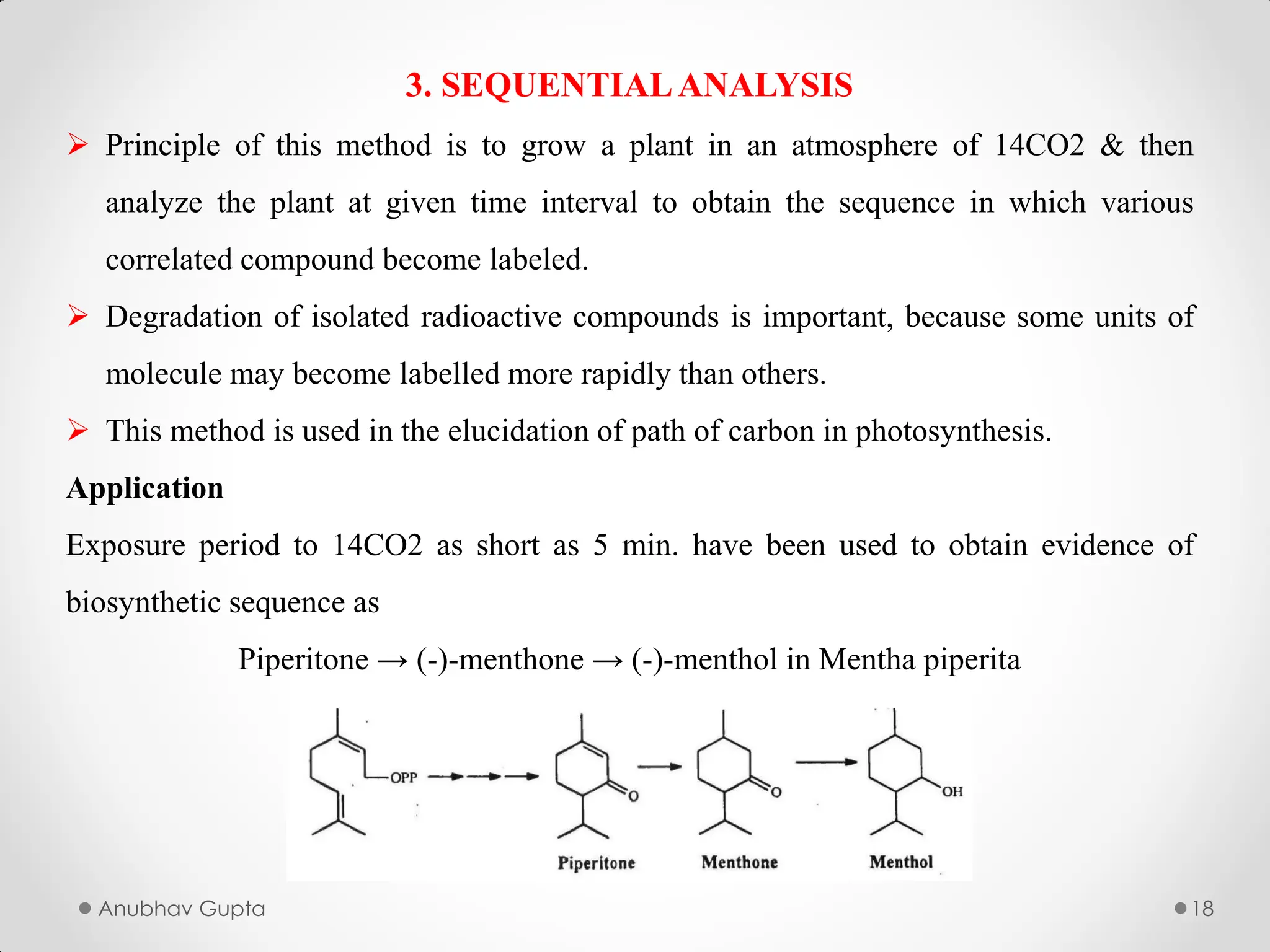
Exposure period to 14CO2 as short as 5 min. have been used to obtain evidence of
biosynthetic sequence as
Piperitone → (-)-menthone → (-)-menthol in Mentha piperita

BP504T Pharmacognosy UNIT 01 PART 2 Tracer Technique

  • 1.
    ASHOKA INSTITUTE OFTECHNOLOGY & MANAGEMENT DEPARTMENT OF PHARMACY Ashoka Engineering Chauraha, Paharia, Sarnath, Varanasi Name Of Unit Metabolic Pathways in Higher Plants and Their Determination Subject /Course Pharmacognosy and Photochemistry-II Subject/Course ID BP 504T Class: B.Pharm. Semester 5th Course Coordinator Mr. Anubhav Gupta Learning Outcome To outline the metabolic pathway in higher plants and their biogenetic studies. 1 Anubhav Gupta
  • 2.
    2 Module Content Topic The basic metabolic pathways producing secondary metabolites .  Shikimic acid pathway  Shikimic acid pathway produced secondary metabolites .  The Acetate (acetate-malonate) pathway producing Fatty acids .  The Acetate-Mevalonte (Isoprenoid) pathway  The Acetate-Mevalonte (Isoprenoid) pathway produced secondary metabolites .  The Amino acid Pathway  Radioactive isotopes in the investigation of biogenetic studies- Tracer techniques . Anubhav Gupta
  • 3.
    Anubhav Gupta 3 STUDYOF UTILIZATION OF RADIOACTIVE ISOTOPES IN THE INVESTIGATION OF BIOGENETIC STUDIES BIOGENETIC STUDIES It is a branch of biology focused on understanding the biosynthetic pathways of living organisms, particularly how plants synthesize and transform natural products. The primary goal is to draw out the sequence of biochemical reactions (biosynthetic pathways) that plants and other organisms use to create specific compounds. These studies often employ tracer techniques using radioisotopes.
  • 4.
    Anubhav Gupta 4 APPLICATIONS: Tracing Metabolic Pathways: Identifying the sequence of chemical reactions involved in the formation of plant metabolites, such as cynogenetic glycosides.  Understanding Plant Metabolism: Gaining insights into the complex biochemical processes that occur within plants.  Characterizing Natural Products: Determining the origins and structural components of various natural products.
  • 5.
    Anubhav Gupta 5 BIOGENETICSTUDIES There are 5 techniques used for the investigation of biosynthetic pathway of primary and secondary metabolites. 1. Tracer technique 2. Use of isolated organ and tissues 3. Grafting method 4. Use of Mutant strains 5. Enzymatic studies Out of the above 5 methods, in Tracer technique method, radioactive isotopes are used for the investigation of biogenetic pathways.
  • 6.
    Anubhav Gupta 6 TRACERTECHNIQUE Tracer techniques utilizes radioactive isotope labelled compound to find out or to trace the different intermediates and various steps in biosynthetic pathways in plants, at a given rate & time. Isotopes Elements with identical chemical properties or same atomic no. but different atomic weights/ mass no. are called isotopes. In other words, isotopes are atoms of same element whose nuclei contain same no. of protons but different no. of neutrons. Stable isotopes They are stable and do not emit radiation, e.g- 2H, 13C, 15N, 18O Radioactive isotopes They are unstable and emit radiations. The phenomenon of emitting radiation is called radioactivity and such isotopes are called radioactive isotopes.
  • 7.
    Anubhav Gupta 7 Significanceof tracer techniques  High sensitivity  More effective  Simple administration and isolation.  Shows accurate results when enough metabolic time & technique is used.  Position & Quantity of compound containing tracer isotope 14C marked glucose is used for glucose determination in the biological system.  For different studies, different tracers can be used.  Biosynthetic pathway can be traced by incorporating radioactive isotopes into the precursor or starting material.  Location and quantity can be determined in biological system.
  • 8.
    Anubhav Gupta 8 Differenttrace elements used for different studies  For studies on nitrogen and amino acid, Labelled nitrogen gives specific information than carbon.  For studies on protein, alkaloids and amino acid, nitrogen atom gives more specific information than carbon.  For studies on glycosidic linkage- O, N, S and C atom.  For studies on terpenoids- O atom. Steps involved in tracer techniques 1. Preparation of labelled compound 2. Incorporation of labelled compound 3. Separation and isolation of labelled compound 4. Determination of nature of metabolites in various biochemical fractions.
  • 9.
    Anubhav Gupta 9 1.PREPARATION OF LABELLED COMPOUND In biological investigation, the use of bioactive isotopes enables the metabolism of compounds to be followed in living organisms for detection and estimation of soft and easily absorbed radiation from labelled compound.  Labelled compounds may be prepared by use of radioactive isotopes and stable isotopes e,g- Radioactive isotopes- 14C, 3H, 32P, 131I  Stable isotopes- 2H, 15N, 13C, 18O  Radioactive carbon and hydrogen are mostly used in biological investigation.  Radioactive isotopes having long half-life are used. Criteria for selection of trace elements:  Starting concentration of trace element must be sufficient to withstand dilution in the course of metabolism.  Physical and chemical nature of compound must be known.  Should not damage the tissue system  Should have low radiation energy.
  • 10.
    Anubhav Gupta 10 2.INCORPORATION OF LABELLED COMPOUND TO TISSUE SYSTEM i) Root feeding Hydroponic feeding of roots e.g- Tobacco. ii) Stem feeding Through the cut ends of stem immersed in a solution. iii) Direct injection This method is used in plants with hallow stem. e.g- Umbelliferae and capsule plants (opium poppy). Microsyringe is used to inject labelled compound solution. iv) Infiltration (wick feeding) A thread is drawn through the stem which is dipped into radioactive solution or a flap can be cut in stem and this dipped in the solution. v) Floating method When a small amount of material is available, this method is used. Leaf disc/chopped leaves are floated on labelled compound solution. vi) Spraying technique Compounds have been absorbed after being sprayed on leaves. e.g- steroids.
  • 11.
    Anubhav Gupta 11 3.SEPARATION AND ISOLATION OF LABELLED COMPOUND  Soft tissue (Fresh)- Infusion, Maceration  Hard tissue- Decoction and hot percolation  Unorganized drug- Maceration with solvent  Fat and oil- Non-polar solvent  Alkaloids, Glycosides, Flavonoids- Slightly polar solvent  Plant phenol- Polar solvent
  • 12.
    Anubhav Gupta 12 4.DETERMINATION OF NATURE OF METABOLITES IN VARIOUS BIOCHEMICAL FRACTIONS a. GEIGER-MULLER COUNTER  It is a type of particle detector that measures ionizing radiation, e.g. alpha, beta particles or gamma rays.  It works by measuring the conductance of electrical charges when a particle or photon of radiation makes the gas conductive by ionization.  Ionization is produced in low-pressure gas, usually helium, neon or argon with halogens added in the Geiger-Muller tube. Fig A: Geiger-Muller Counter
  • 13.
    Anubhav Gupta 13 b.SCINTILLATION OR LIQUID SCINTILLATION COUNTER  Scintillation is the emission of a flash of light in transparent materials when exposed to an ionizing radiation.  A scintillation detector consists of a scintillator crystal (NaI, CsI, SrI2, LiI, LiF, LaBr, LaCl3, CeBr3, BGO, etc.) coupled with an electronic light sensor, which is traditionally a photomultiplier tube (PMT).  The latter converts every light photon emitted by the scintillator into an electrical pulse that provides a meaningful information about the energy deposited by the incident radiation.  Samples shall be dissolved or suspended in a “cocktail” containing a solvent (aromatic organics such as benzene or toluene), typically some form of a surfactant, and small amounts of scintillators. Fig A: Scintillation Counter
  • 14.
    Anubhav Gupta 14 c.MASS SPECTROPHOTOMETER  Mass spectrometry (MS) is an analytical technique used to measure the mass-to-charge ratio of charged particles.  It is used to determine the mass of the particles, to determine the elemental composition of the sample or molecule.  It also helps in elucidation of the chemical structures of molecules, such as peptides and other chemical compounds. d. NMR SPECTROPHOTOMETER  NMR spectroscopy gives the magnetic properties of certain atomic nuclei to determine the physical and chemical properties of the atoms or molecules they contain.  It relies on the phenomenon of nuclear magnetic resonance and can provide detailed information on the structure, dynamics, reaction status and chemical environment of the molecules.
  • 15.
    Anubhav Gupta 15 e.AUTORADIOGRAPHY  It is a tool for examining the distribution of radioactive material in a plant object, e.g. histological tissue, chromatography sheet.  This method uses a photographic film or emulsion (X-ray film) as an ionizing radiation detector.  The specimen is in close contact with the emulsion for a period.  The pattern of delivery of radioactive substances can be elucidated with the aid of the autograph collected.
  • 16.
    Anubhav Gupta 16 METHODSOF TRACER TECHNIQUES 1. PRECURSOR PRODUCT SEQUENCE The presumed precursor of the constituent under investigation on a labelled form is fed into the plant and after a suitable time the constituent is isolated, purified and radioactivity is determined.
  • 17.
    Anubhav Gupta 17 2.COMPETITIVE FEEDING  Competitive feeding helps in determining which of two potential compounds (A or B) is the actual intermediate in a metabolic pathway, where a precursor (P) forms a product (C) via a normal intermediate.  By feeding a radioactive tracer along with each potential intermediate to separate plant groups, we observe which group shows radioactivity in the final product, revealing the true biosynthetic pathway.  This method is particularly useful for studying the biosynthesis of alkaloids and other secondary metabolites in plants.
  • 18.
    Anubhav Gupta 18 3.SEQUENTIALANALYSIS  Principle of this method is to grow a plant in an atmosphere of 14CO2 & then analyze the plant at given time interval to obtain the sequence in which various correlated compound become labeled.  Degradation of isolated radioactive compounds is important, because some units of molecule may become labelled more rapidly than others.  This method is used in the elucidation of path of carbon in photosynthesis. Application Exposure period to 14CO2 as short as 5 min. have been used to obtain evidence of biosynthetic sequence as Piperitone → (-)-menthone → (-)-menthol in Mentha piperita