INDUSTRIAL PRODUCTION,ESTIMATION
AND UTILIZATION OF THE
PHYOTCONSTITUENT ATROPINE
SOURCE
Atropine is a synthetically-derived form of the endogenous
Tropane alkaloid isolated from the plant Atropa belladonna
 Atropa belladonna,
 Datura stramonium and
 Duboisia myoporoides.
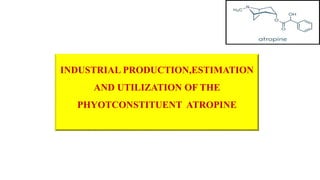
ATROPINE :
 Molecular Formula: C17H23NO3
 Synonyms Of ATROPINE
 dl-Hyoscyamine
 Tropine tropate
 Atropin
 Atropen
 Molecular Weight: 289.4 g/mol
Introduction
MECHANISM OF ACTION
• Atropine competitively blocks acetylcholine, a neurotransmitter, from acting on the
muscarinic receptors in the body.
• As a result, atropine dilates the pupils, increases heart rate, and reduces salivation
and other secretions.
INDUSTRIAL PRODUCTION OF ATROPINE
New,
 Efficient and
Commercially feasible process for the preparation of atropine and
atropine salts has been developed
The process provides a high yield.
 In addition, the process has the advantage of proceeding efficiently,
for many of the steps, at ambient temperature.
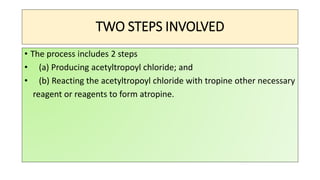
TWO STEPS INVOLVED
• The process includes 2 steps
• (a) Producing acetyltropoyl chloride; and
• (b) Reacting the acetyltropoyl chloride with tropine other necessary
reagent or reagents to form atropine.
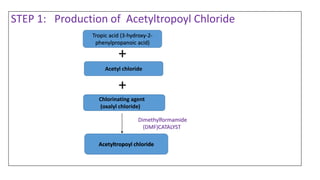
STEP 1: Production of Acetyltropoyl Chloride
Acetyltropoyl chloride
Dimethylformamide
(DMF)CATALYST
Tropic acid (3-hydroxy-2-
phenylpropanoic acid)
Acetyl chloride
Chlorinating agent
(oxalyl chloride)
+
+
Step 2: Reacting the acetyltropoyl chloride with tropine to form Atropine
It involves 2 steps
Step a:
The tropine is first reacted with methanesulfonic acid to form tropine
methanesulfonate
Step B:
The acetyltropoyl chloride solution is contacted with the tropine
methanesulfonate to form Atropine
Tropine
+
Acetyltropoyl chloride Atropine
+
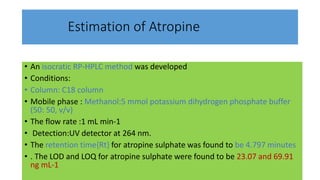
Estimation of Atropine
• An isocratic RP-HPLC method was developed
• Conditions:
• Column: C18 column
• Mobile phase : Methanol:5 mmol potassium dihydrogen phosphate buffer
(50: 50, v/v)
• The flow rate :1 mL min-1
• Detection:UV detector at 264 nm.
• The retention time{Rt} for atropine sulphate was found to be 4.797 minutes
• . The LOD and LOQ for atropine sulphate were found to be 23.07 and 69.91
ng mL-1
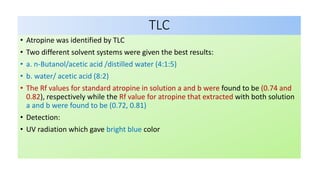
TLC
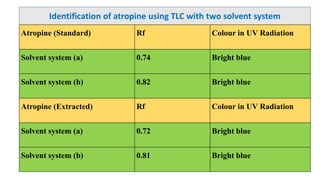
• Atropine was identified by TLC
• Two different solvent systems were given the best results:
• a. n-Butanol/acetic acid /distilled water (4:1:5)
• b. water/ acetic acid (8:2)
• The Rf values for standard atropine in solution a and b were found to be (0.74 and
0.82), respectively while the Rf value for atropine that extracted with both solution
a and b were found to be (0.72, 0.81)
• Detection:
• UV radiation which gave bright blue color
Identification of atropine using TLC with two solvent system
Atropine (Standard) Rf Colour in UV Radiation
Solvent system (a) 0.74 Bright blue
Solvent system (b) 0.82 Bright blue
Atropine (Extracted) Rf Colour in UV Radiation
Solvent system (a) 0.72 Bright blue
Solvent system (b) 0.81 Bright blue
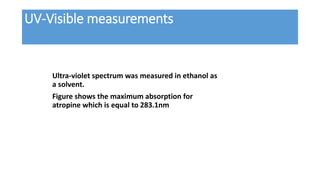
UV-Visible measurements
Ultra-violet spectrum was measured in ethanol as
a solvent.
Figure shows the maximum absorption for
atropine which is equal to 283.1nm
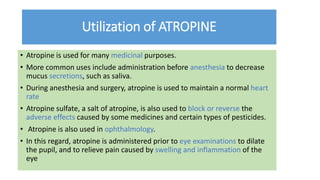
Utilization of ATROPINE
• Atropine is used for many medicinal purposes.
• More common uses include administration before anesthesia to decrease
mucus secretions, such as saliva.
• During anesthesia and surgery, atropine is used to maintain a normal heart
rate
• Atropine sulfate, a salt of atropine, is also used to block or reverse the
adverse effects caused by some medicines and certain types of pesticides.
• Atropine is also used in ophthalmology.
• In this regard, atropine is administered prior to eye examinations to dilate
the pupil, and to relieve pain caused by swelling and inflammation of the
eye
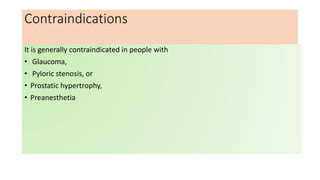
Contraindications
It is generally contraindicated in people with
• Glaucoma,
• Pyloric stenosis, or
• Prostatic hypertrophy,
• Preanesthetia
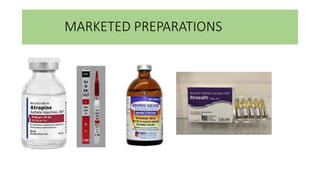
MARKETED PREPARATIONS