SUB –
PHYTOCHEMISTRY AND
PHARMACOGNOSY II
UNIT III
ISOLATION
IDENTIFICATION AND
ANALYSIS OF ALKALOIDS
Prepared by : Snehal Uttam Kashid (Asso. professor)
Department of Pharmacognosy, SPMs college of pharmacy,
akluj
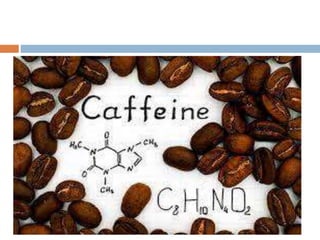
Caffeine
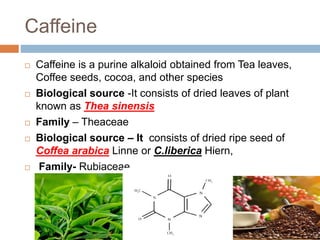
 Caffeine is a purine alkaloid obtained from Tea leaves,
Coffee seeds, cocoa, and other species
 Biological source -It consists of dried leaves of plant
known as Thea sinensis
 Family – Theaceae
 Biological source – It consists of dried ripe seed of
Coffea arabica Linne or C.liberica Hiern,
 Family- Rubiaceae.
Caffeine
 It is chemically 1,3,7, trimethyl xanthine.
 Tea leaves contains 1-4% of caffeine and coffee
contains 1- 2% of caffeine
 It is isolated from tea and coffee seeds during
decaffeination process.
 It is white powder or white ,glistering needles,
 odour - less
 Taste - bitter
 Soluble in hot water.
Isolation of caffeine
The powder tea leaves is extracted with boiling
water and the aqueous extract is filtered while
hot
The warm extract is treated with lead
acetate to precipitate tannins and filtered
The filtrate is treated with excess of dilute
sulphuric acid to precipitate lead in the
form of lead sulphate
Isolation of caffeine
Filter and collect the filtrate
The filtrate is boiled with Activated charcoal to remove
colouring matter, if any and filtered to remove charcoal
The filtered decolourized solution is extracted with
chloroform successively .
Combined the chloroform extracts evaporate on water bath
to yield caffeine (white powder)
It is recrystallized with alcohol (M.P 235-237 °C)
Characterization of caffeine
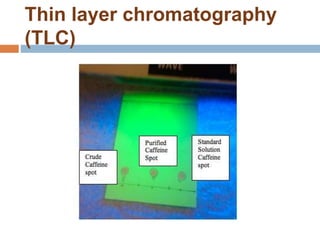
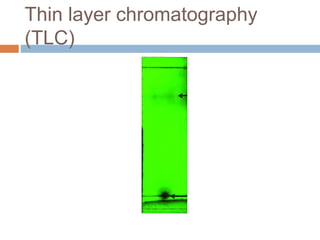
Thin layer chromatography (TLC)
 Sample preparation – Dissolved 1mg of
caffeine in 1ml of methanol or chloroform
 Stationary phase - Silica gel –G
 Standard sample - Caffeine
 Mobile phase – Ethyl acetate: methanol :
acetic acid (80:10:10)
 Detecting agent – Expose to vapors of iodine
 RF Value – 0.41
Thin layer chromatography
(TLC)
Characterization of caffeine
Identification test –
 Murexide test – To the caffeine add
hydrochloric acid and potassium chlorate,
heated to dryness. A purple colour is obtained
by exposing the residue to vapours of dilute
ammonia.
Uses
 Caffeine is a CNS stimulant
 Diuretic
 Used in acute elevation of blood pressure,
 increased metabolic rate
 Migraine
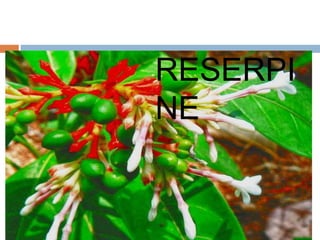
RESERPI
NE
RESERPINE
 Biological source – Reserpine is an indole alkaloid
obtained from the roots of Rauwolfia serpentina,
R.vomiforia, R. tertaphylla
 Family – Apocyanaceae
 C.C. - it also contain ajmaline, ajmalicine, reserpinine,
serpentine and yohimbine
 It is a white or pale buff to slightly yellow, odourless,
crystalline powder
Isolation of Reserpine
Rauwolfia root powder is exhaustively extracted with
90% alcohol by percolation
The alcoholic extract is concentrated and dried under
reduced pressure below 60 c to yield Rauwolfia dry
extract.
Rauwolfia dry extract is extracted with Ether-chloroform-
90%alcohol (20:8:2.5)
Collect the extract and add little dilute ammonia with
intermittent shaking.
Add water and allow the drug to settle after vigorous
shaking.
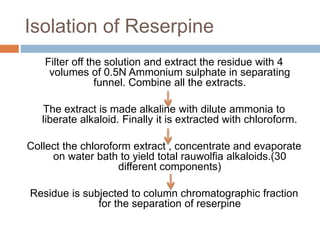
Isolation of Reserpine
Filter off the solution and extract the residue with 4
volumes of 0.5N Ammonium sulphate in separating
funnel. Combine all the extracts.
The extract is made alkaline with dilute ammonia to
liberate alkaloid. Finally it is extracted with chloroform.
Collect the chloroform extract , concentrate and evaporate
on water bath to yield total rauwolfia alkaloids.(30
different components)
Residue is subjected to column chromatographic fraction
for the separation of reserpine
Characterization of Reserpine
Thin layer chromatography (TLC)
 Sample preparation – Dissolved 1mg of
Reserpine in 1ml of methanol or chloroform
 Stationary phase - Silica gel – G
 Standard sample - Reserpine
 Mobile phase – Chloroform: acetone :diethyl
amine (50:40:10)
 Detecting agent – Dragendroffs reagent
 RF Value – 0.72
Thin layer chromatography
(TLC)
Characterization of Reserpine
Identification test –
 Red coloration of medullary rays observed when
freshly fractured surface treated with conc. nitric
acid.
 Reserpine shows voilet red colour when treated
with solution of vanillin in acetic acid
Uses
 Reserpine is an antihypertensive
 antipsychotic agent
 It is used to treat snakebite.
 It also helps in treating insomnia.
 It also helps to treat insanity.
 prolonged tranqulizing action it was once used
to treat schizopherin
Bibliography
 Kokate, C.K., Purohit, A.P. and Gohkale,
S.B. (2019) Pharmacognosy. In
Terpenoids, 57th Edition, Nirali
Prakashan, Pune.
 Pharmacognosy And Phytochemistry By
Vinod Rangari. 2009 2nd edition, Career
Publications.
ISOLATION IDENTIFICATION of alkloids reserpine & caffine.pptx