

Why Bother with
Data Governance?
1
2
Hundreds of resources
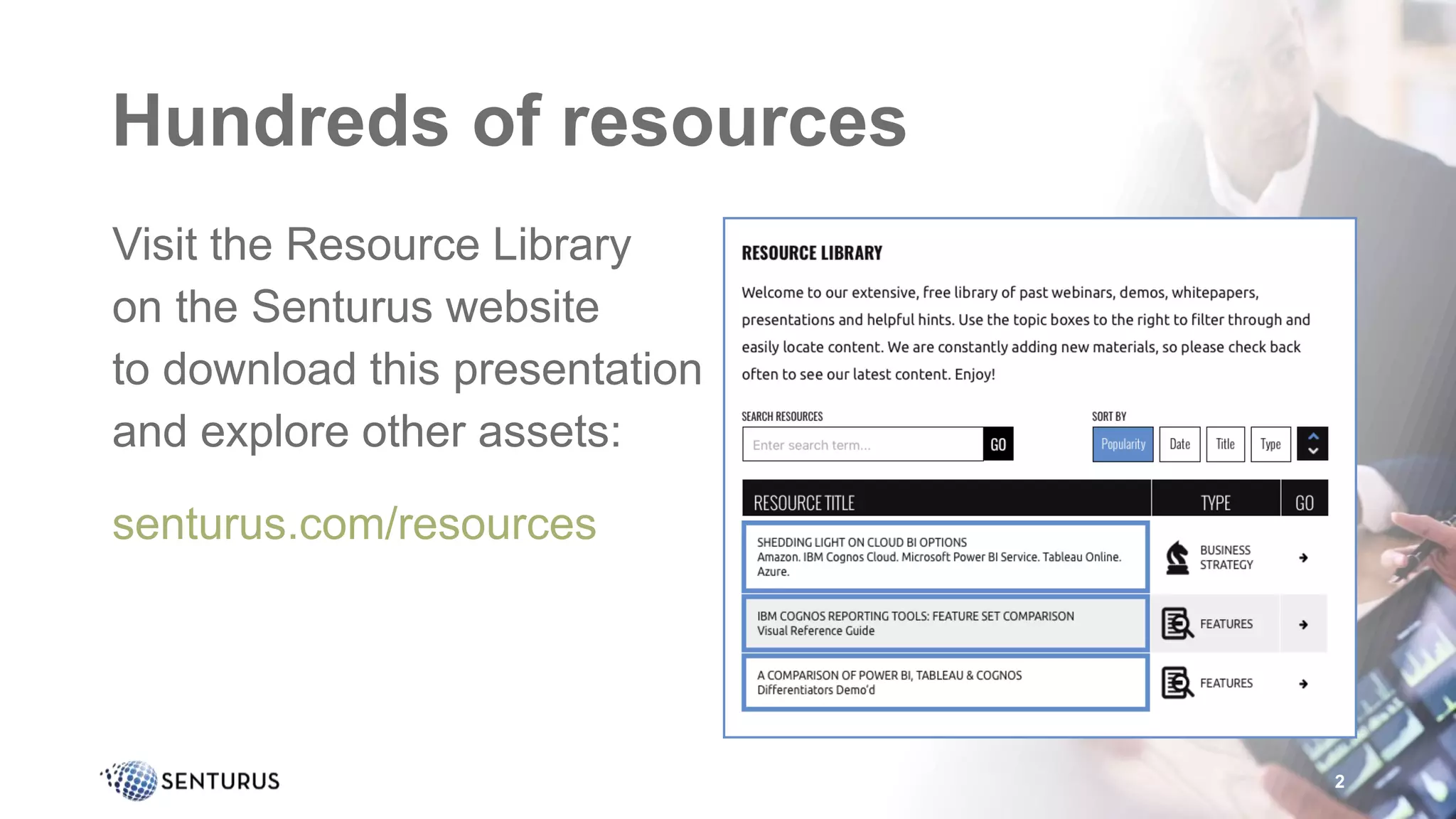
Visit the Resource Library
on the Senturus website
to download this presentation
and explore other assets:
senturus.com/resources
2
3
Introductions
Shawn Alpay
Microsoft BI Senior Architect
Senturus, Inc.
Michael Weinhauer
Director
Senturus, Inc.
3
Agenda
• Introduction
• Why data governance?
• Warning signs of complacency
• What does data governance do?
• Data governance process
• Senturus overview
• Additional resources
• Q&A
4
Enjoy the full webinar presentation
This slide deck is from the webinar Why Bother with Data
Governance?
To view the FREE video recording and download this deck,
go to https://senturus.com/resources/data-governance-for-
business-analytics
5
• According to Gartner, enterprises are increasingly pushing
for growth through digital transformation, which puts more
pressure on existing technical frameworks
• Even top-tier organizations struggle to implement good data
governance – but they’re doing because it’s worth doing
Data governance is hard
6
How we’ll approach governance
• Review the warning signs of “data complacency” (aka risk!)
• Define data governance and detail its purpose/value
• Break down implementation into consumable chunks
• We’ll be focused on the high level, not tips and tricks
• This will be filtered through the lens of a business intelligence architect
• Filter this talk through your lens
• What here applies to you and your org?
• How do you disagree with me? Your mileage may vary!
7
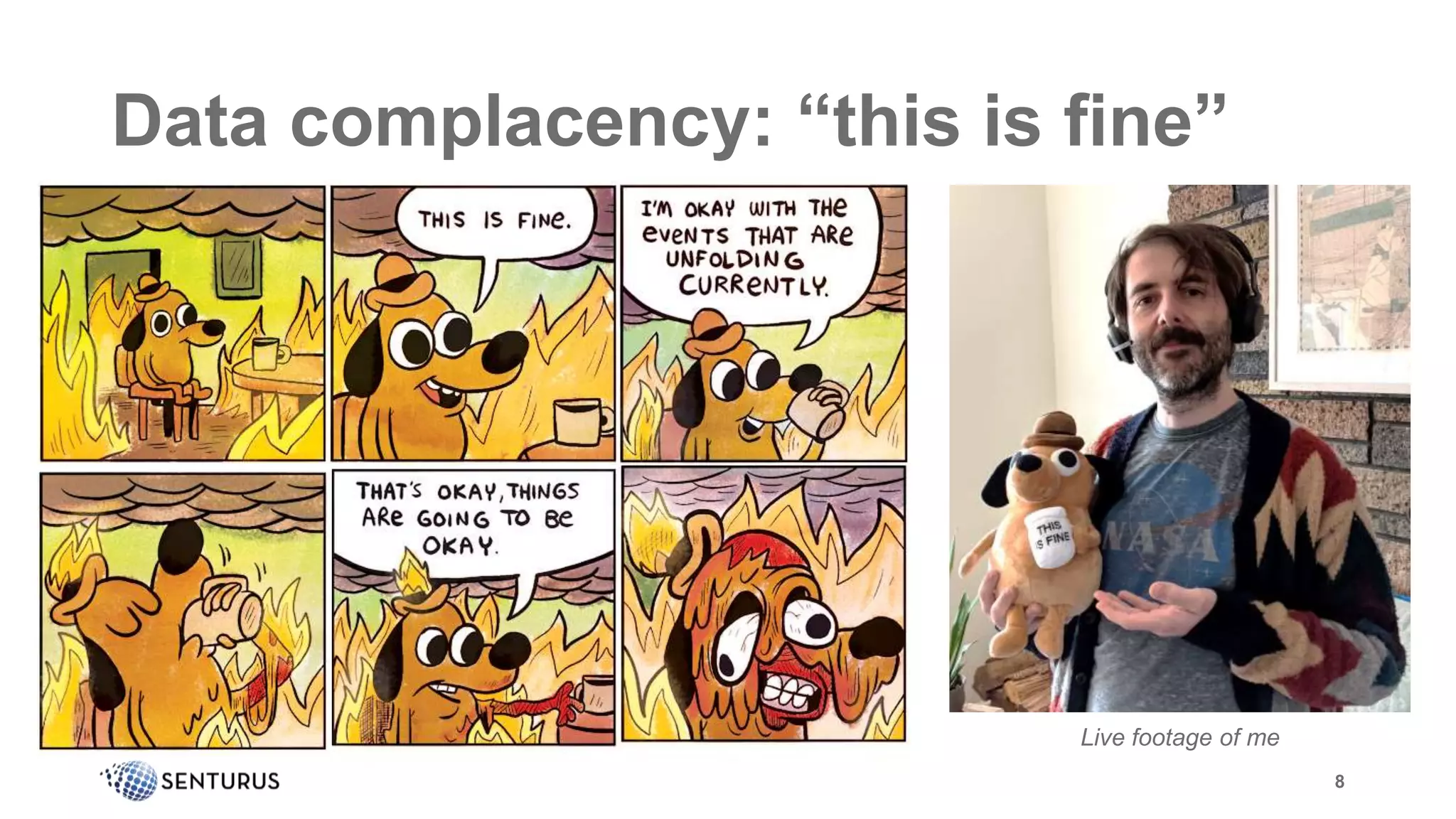
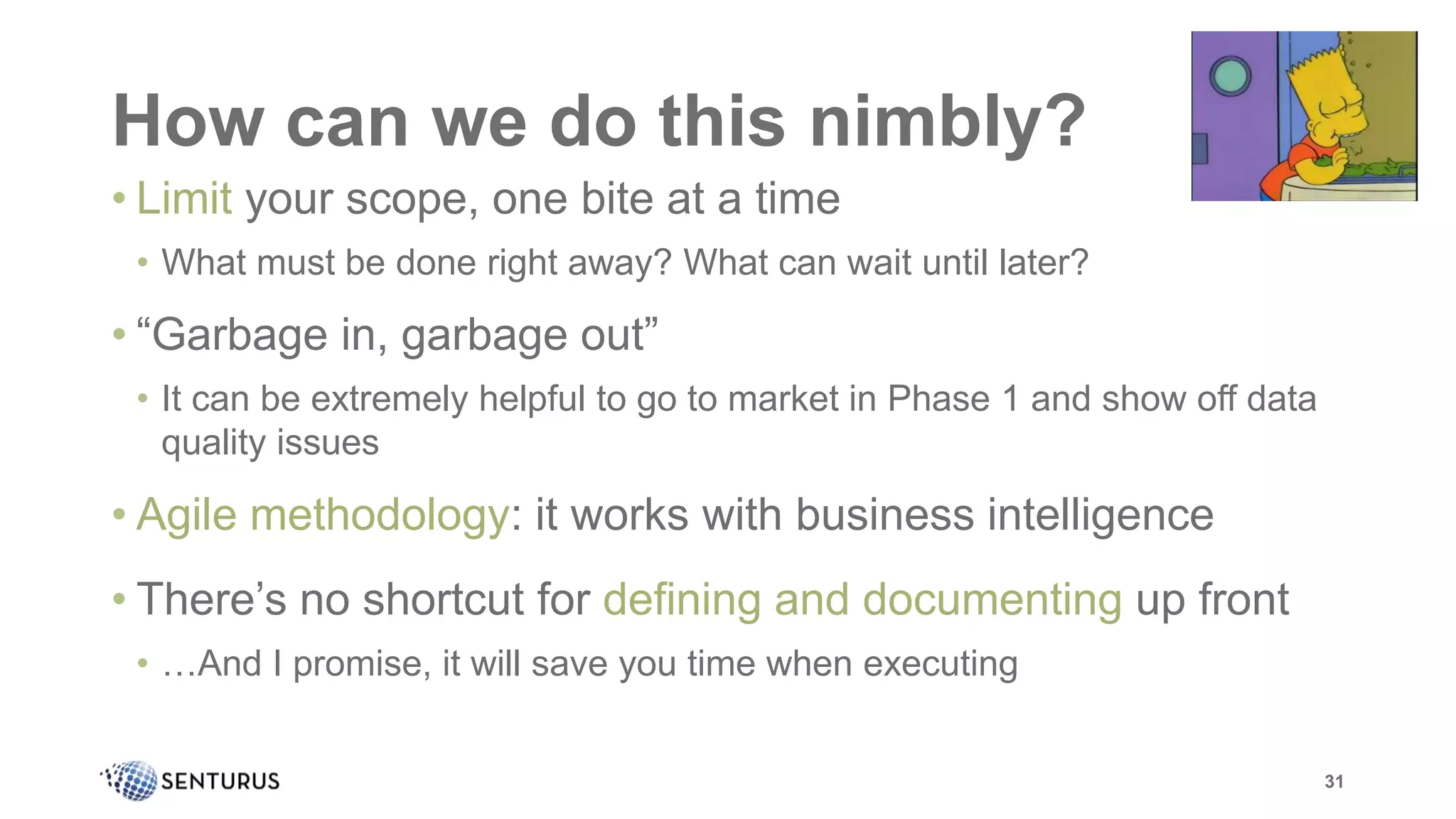
Data complacency: “this is fine”
8
Live footage of me
Warning signs of complacency
• Why won’t IT fix these data inaccuracies?
• It’s fine that the data doesn’t agree across systems, if it’s
“directionally accurate”
• It’s not fine that the data quality is bad, but it’s been decided it’s
too hard/expensive to solve
• Is this net sales number the Finance version or Operations?
• Oh wait, it’s probably the Marketing one
• Someone deleted the entire main reporting folder (again)
9
What does data governance do?
• Establishes the business as data owners – not IT
• Positions data issues as cross-functional
• Treats data as an entity separate from its container(s)
• Prioritizes measurements to define success/failure
• Reduces costs of time and money (really!)
• Increases trust across the organization
10
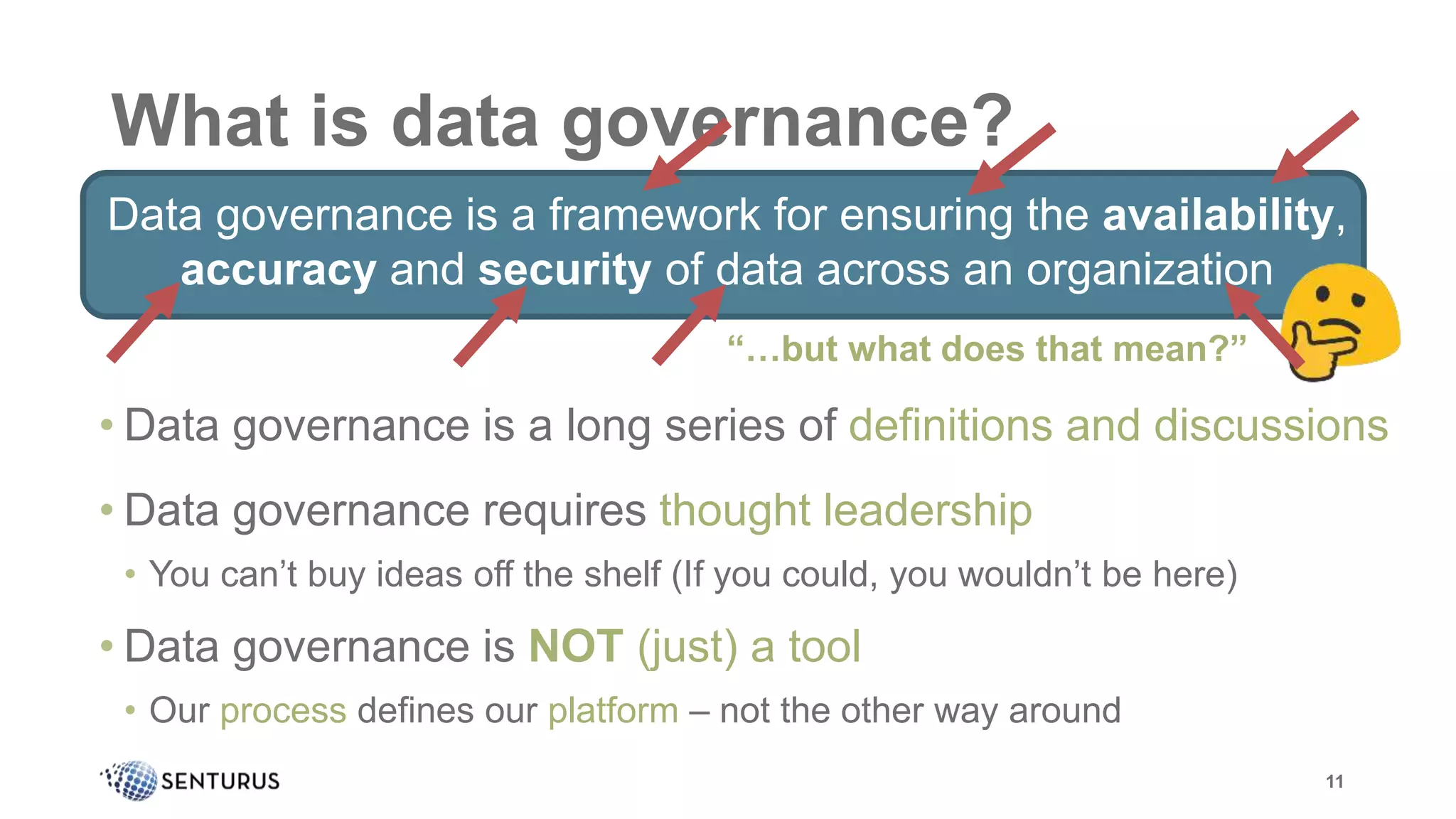
What is data governance?
Data governance is a framework for ensuring the availability,
accuracy and security of data across an organization
11
• Data governance is a long series of definitions and discussions
• Data governance requires thought leadership
• You can’t buy ideas off the shelf (If you could, you wouldn’t be here)
• Data governance is NOT (just) a tool
• Our process defines our platform – not the other way around
“…but what does that mean?”
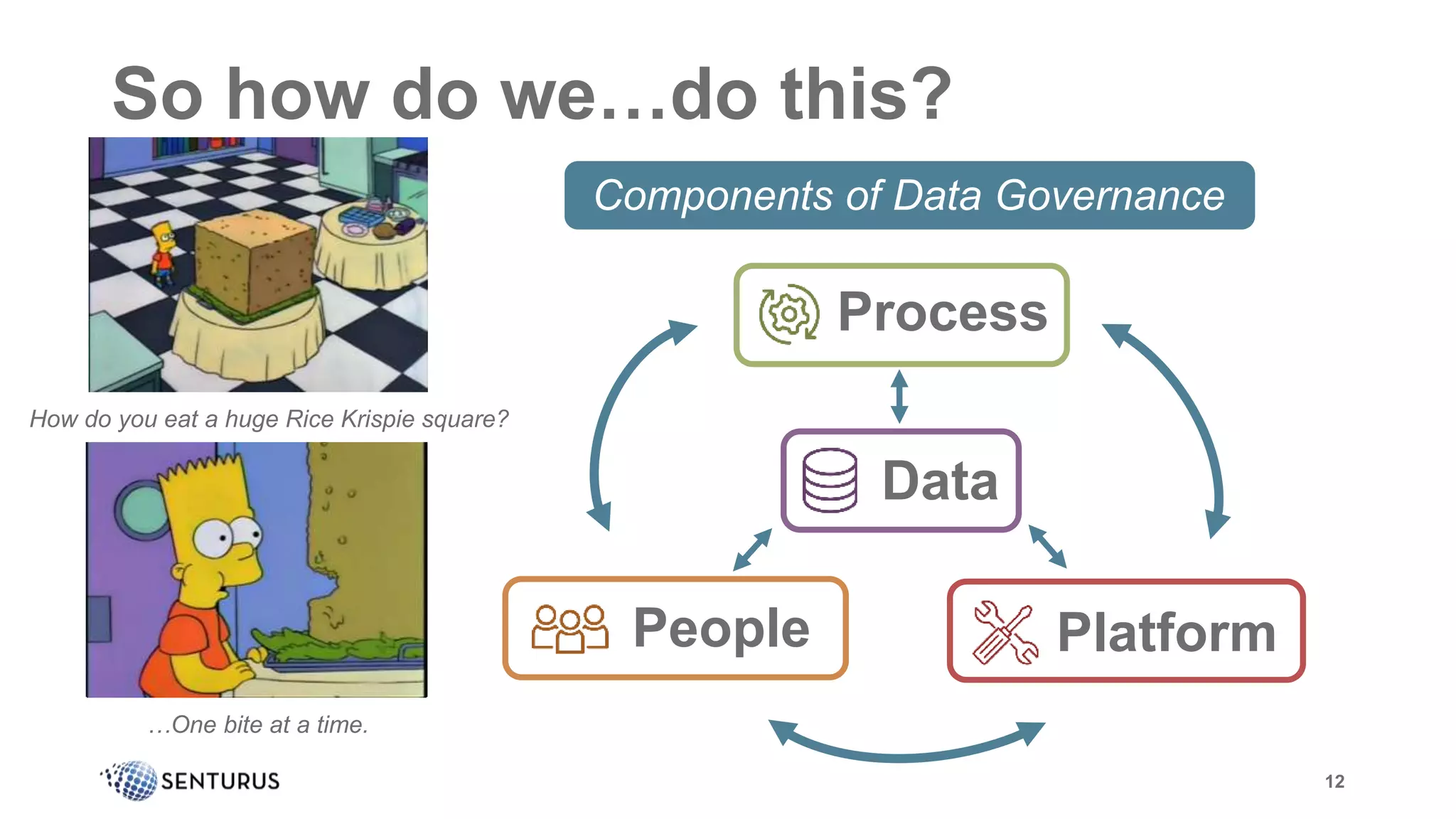
So how do we…do this?
12
Process
Data
PlatformPeople
Components of Data Governance
How do you eat a huge Rice Krispie square?
…One bite at a time.
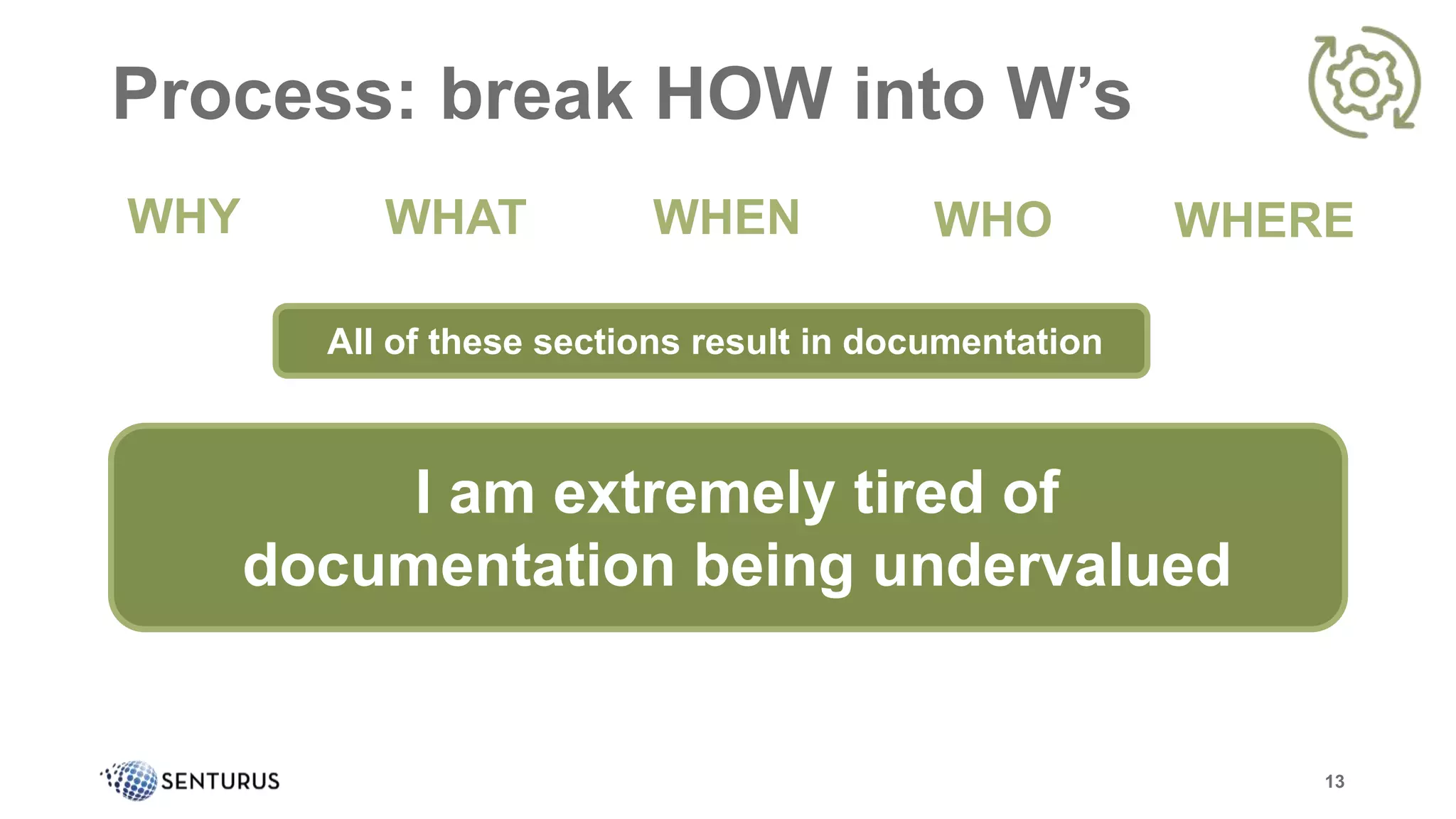
Process: break HOW into W’s
13
WHY WHAT WHEN WHO WHERE
All of these sections result in documentation
I am extremely tired of
documentation being undervalued
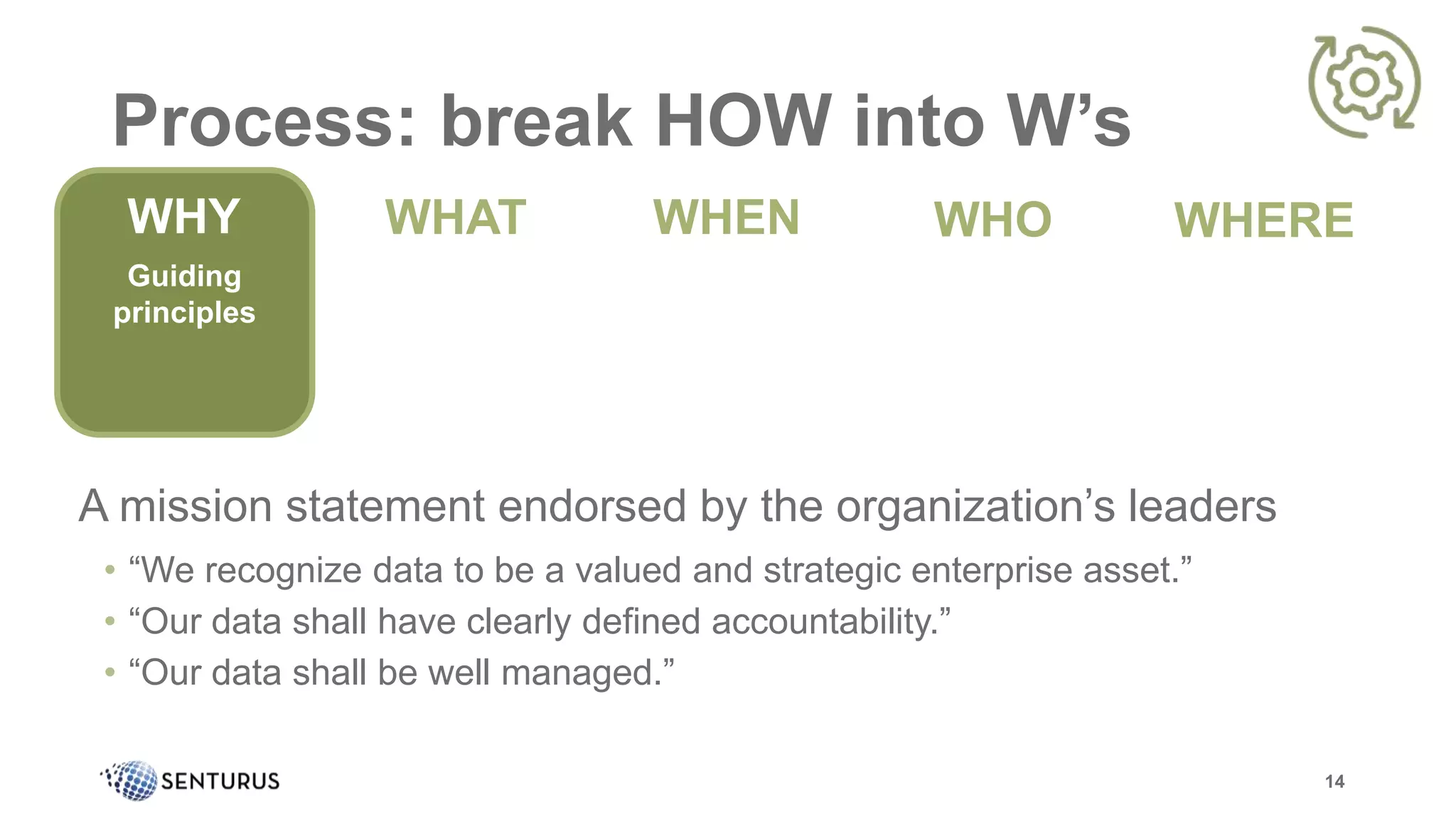
Process: break HOW into W’s
A mission statement endorsed by the organization’s leaders
• “We recognize data to be a valued and strategic enterprise asset.”
• “Our data shall have clearly defined accountability.”
• “Our data shall be well managed.”
14
WHAT WHEN WHO WHERE
Guiding
principles
WHYWHY
Guiding
principles
Process: break HOW into W’s
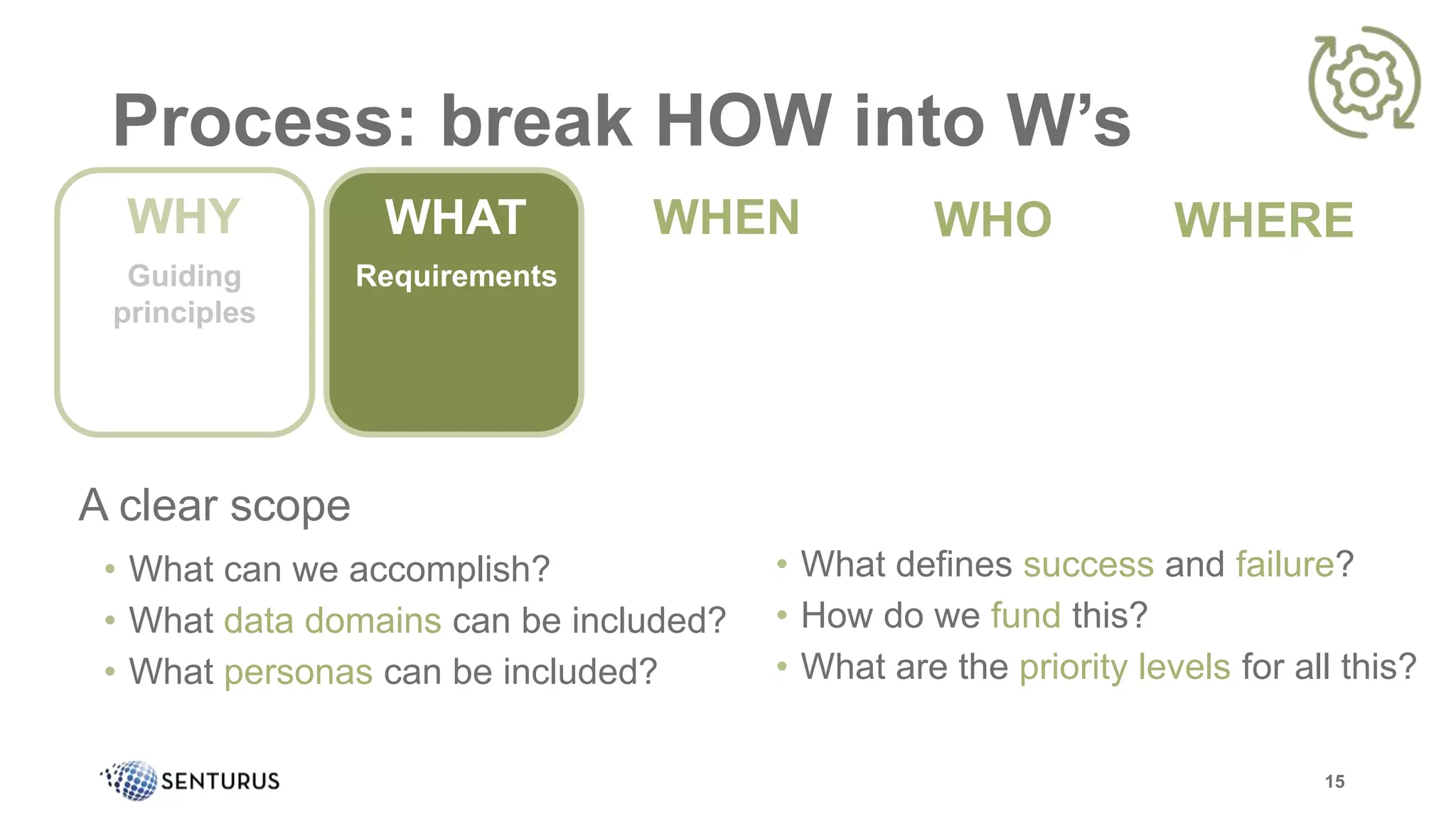
A clear scope
• What can we accomplish?
• What data domains can be included?
• What personas can be included?
15
WHEN WHO WHERE
Guiding
principles
WHYWHY
Guiding
principles
WHAT
Requirements
• What defines success and failure?
• How do we fund this?
• What are the priority levels for all this?
Process: break HOW into W’s
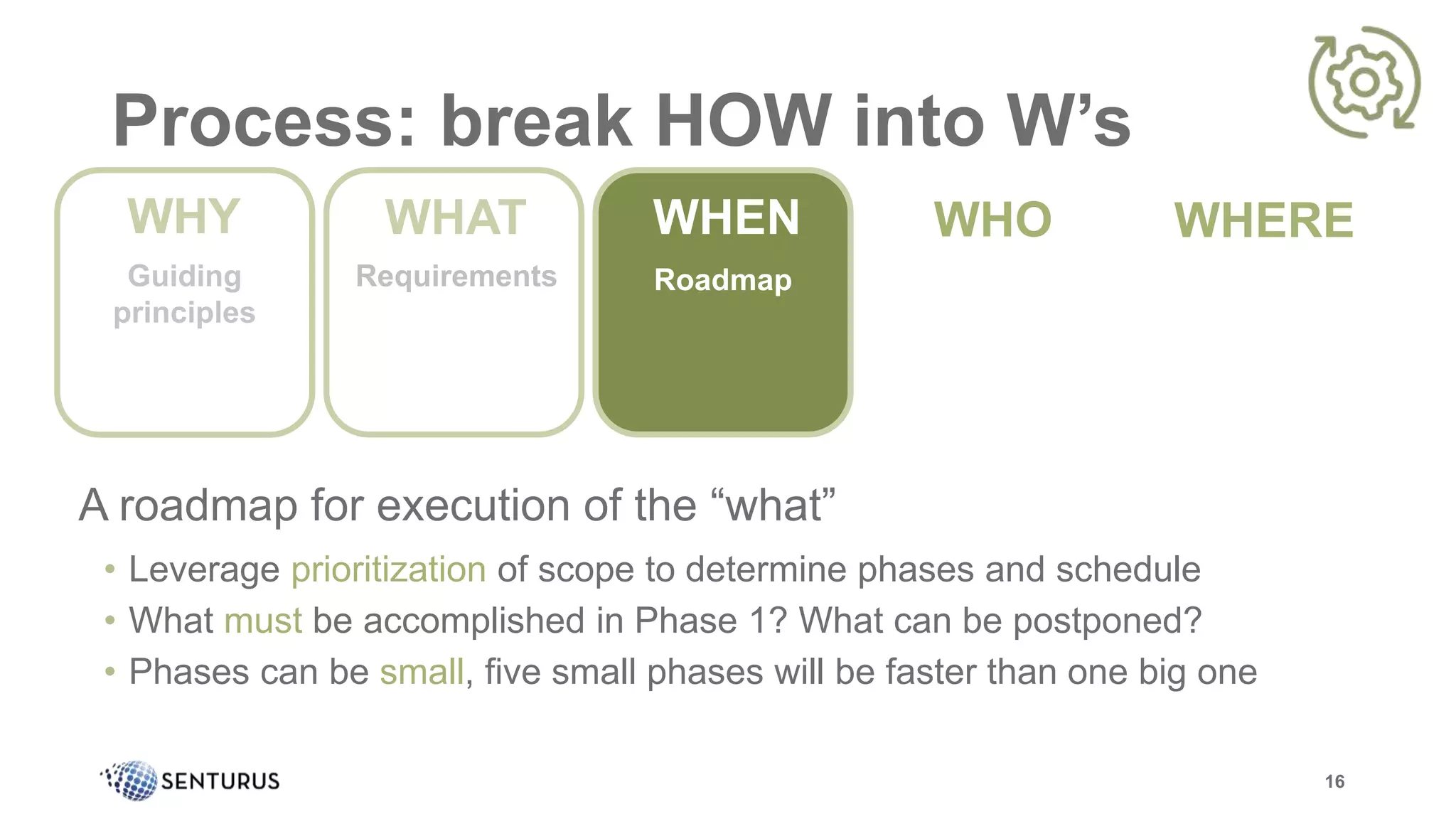
A roadmap for execution of the “what”
• Leverage prioritization of scope to determine phases and schedule
• What must be accomplished in Phase 1? What can be postponed?
• Phases can be small, five small phases will be faster than one big one
16
WHO WHERE
Guiding
principles
WHYWHY
Guiding
principles
WHAT
Requirements
WHEN
Roadmap
Process: break HOW into W’s
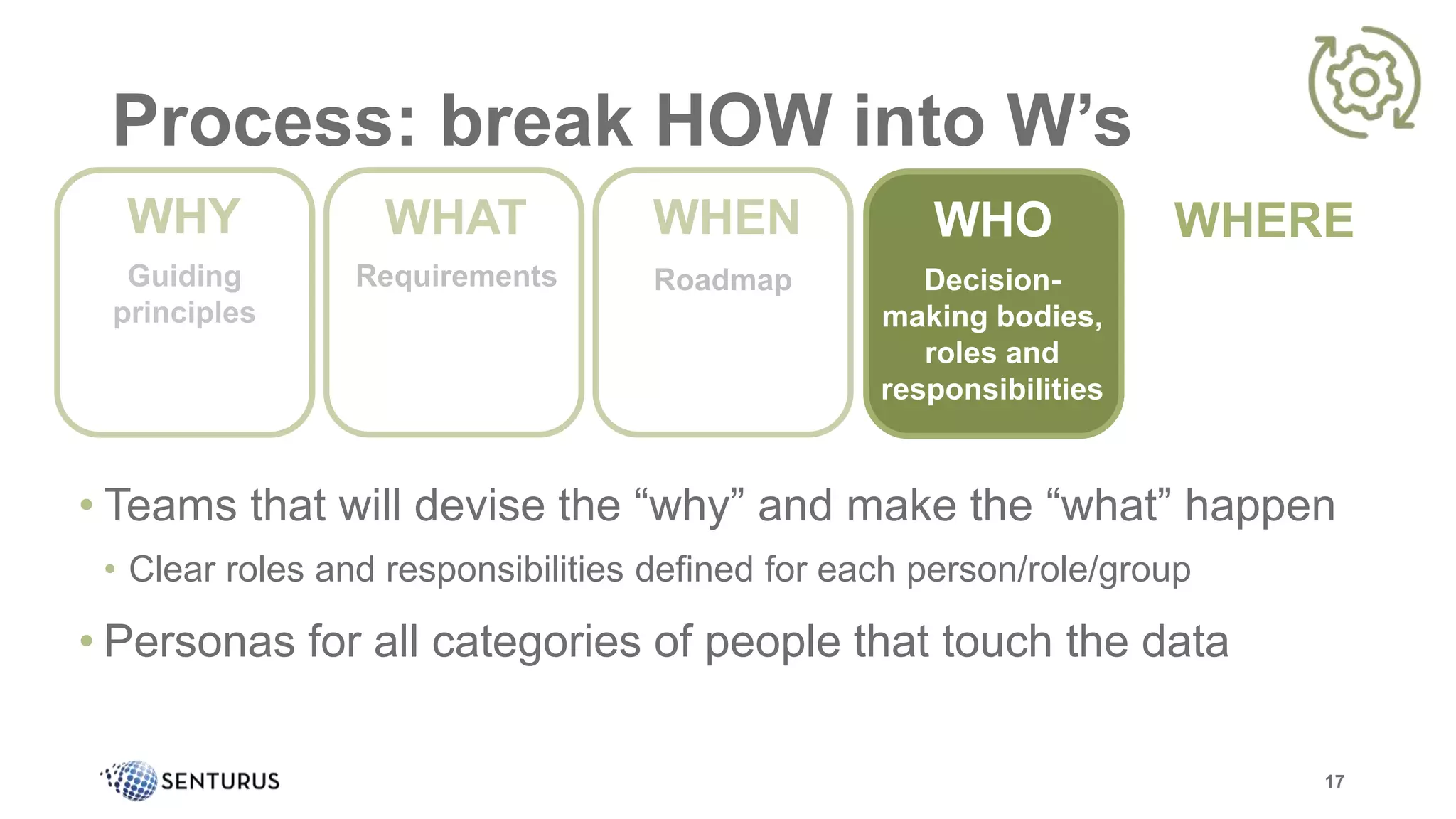
• Teams that will devise the “why” and make the “what” happen
• Clear roles and responsibilities defined for each person/role/group
• Personas for all categories of people that touch the data
17
WHERE
Guiding
principles
WHYWHY
Guiding
principles
WHAT
Requirements
WHO
Decision-
making bodies,
roles and
responsibilities
WHEN
Roadmap
Process: break HOW into W’s
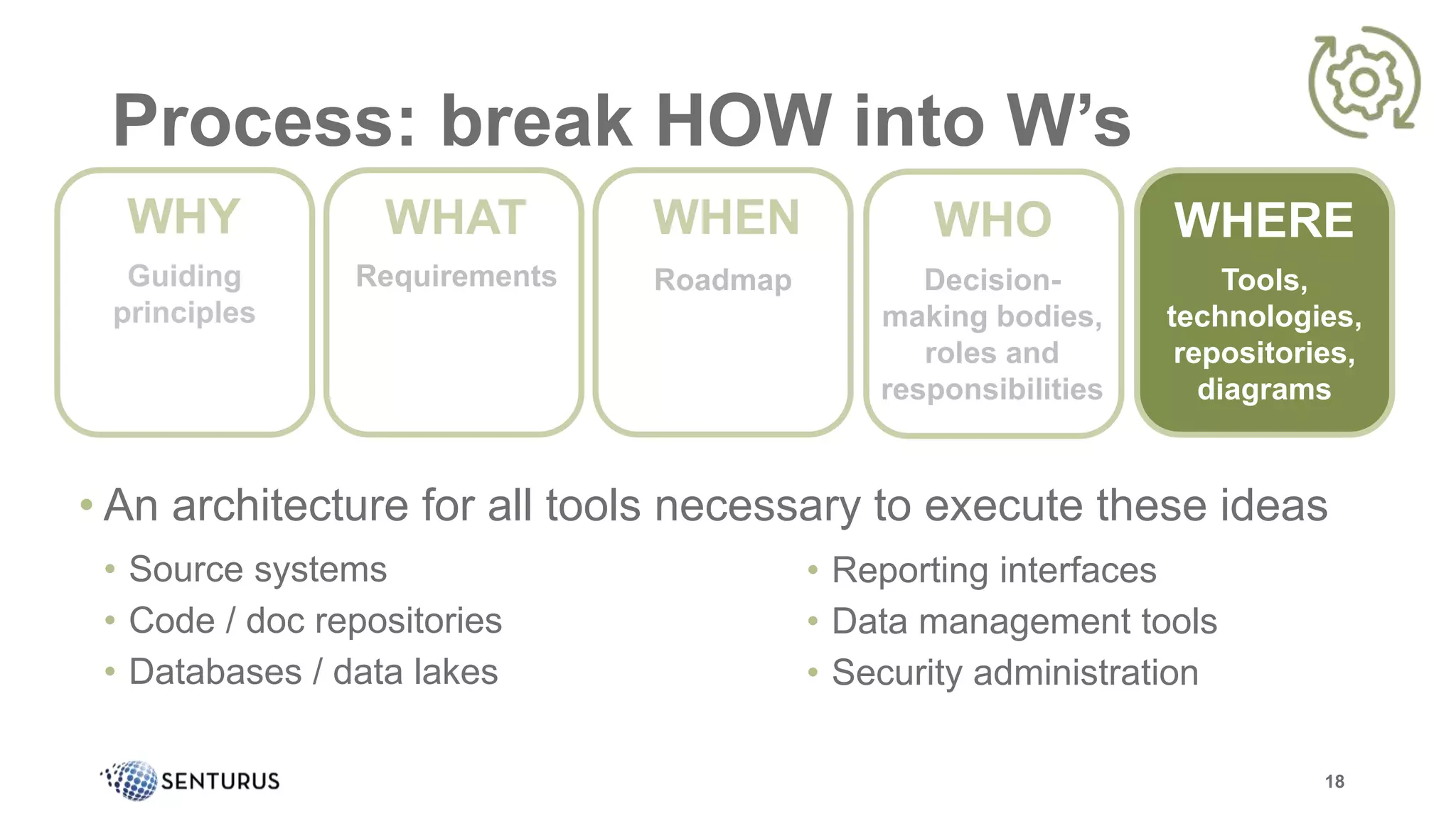
• An architecture for all tools necessary to execute these ideas
• Source systems
• Code / doc repositories
• Databases / data lakes
18
Guiding
principles
WHYWHY
Guiding
principles
WHAT
Requirements
WHO
Decision-
making bodies,
roles and
responsibilities
WHEN
Roadmap
WHO
Decision-
making bodies,
roles and
responsibilities
WHERE
Tools,
technologies,
repositories,
diagrams
• Reporting interfaces
• Data management tools
• Security administration
Like what you see?
To view the video recording and download the slide deck go
to https://senturus.com/resources/data-governance-for-
business-analytics/
Visit our website to access our library of free BI knowledge
resources including events, blogs, demos, whitepapers, other
on-demand webinars and our dashboard gallery
https://senturus.com/senturus-resources/
19
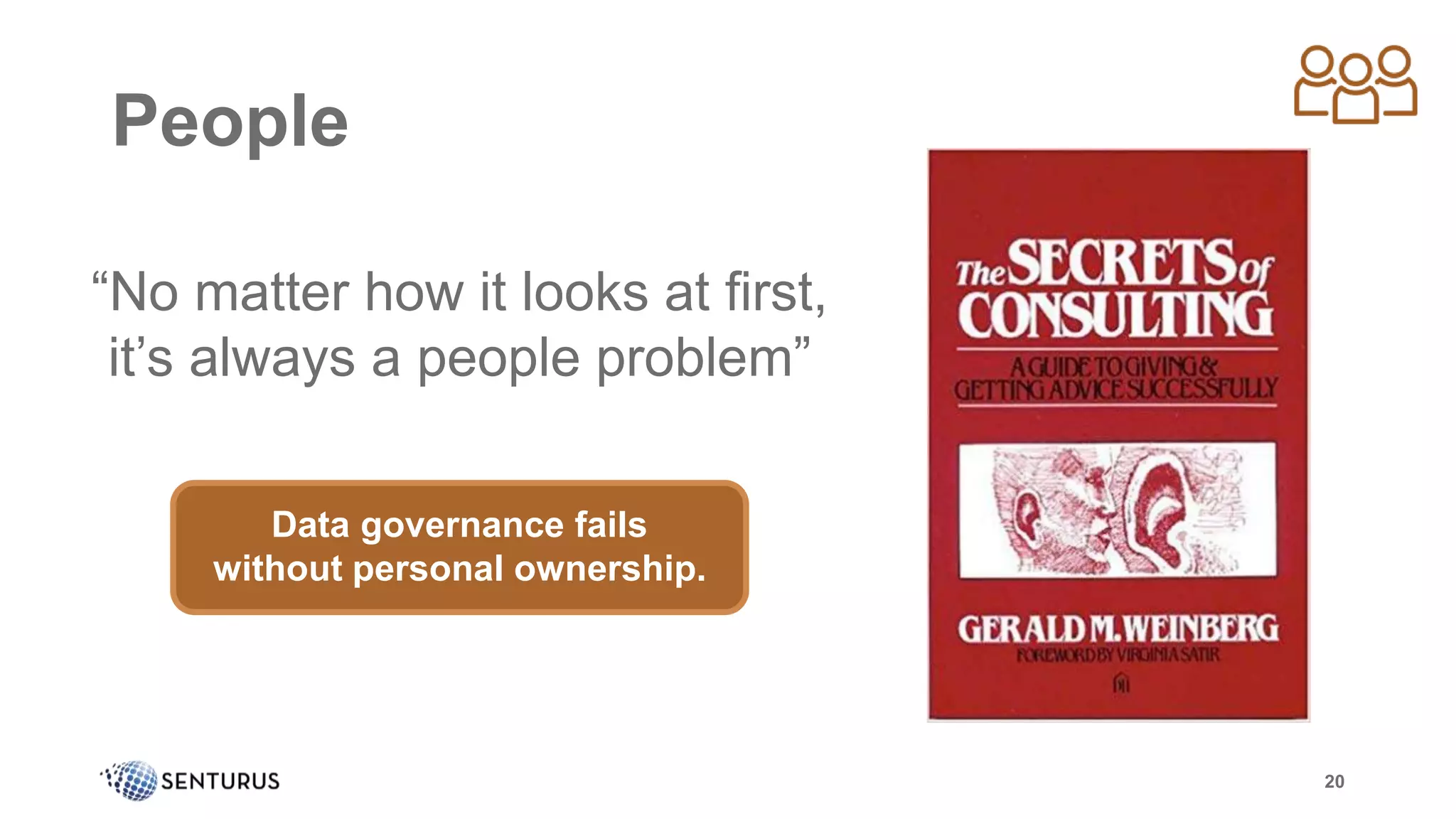
People
“No matter how it looks at first,
it’s always a people problem”
20
Data governance fails
without personal ownership.
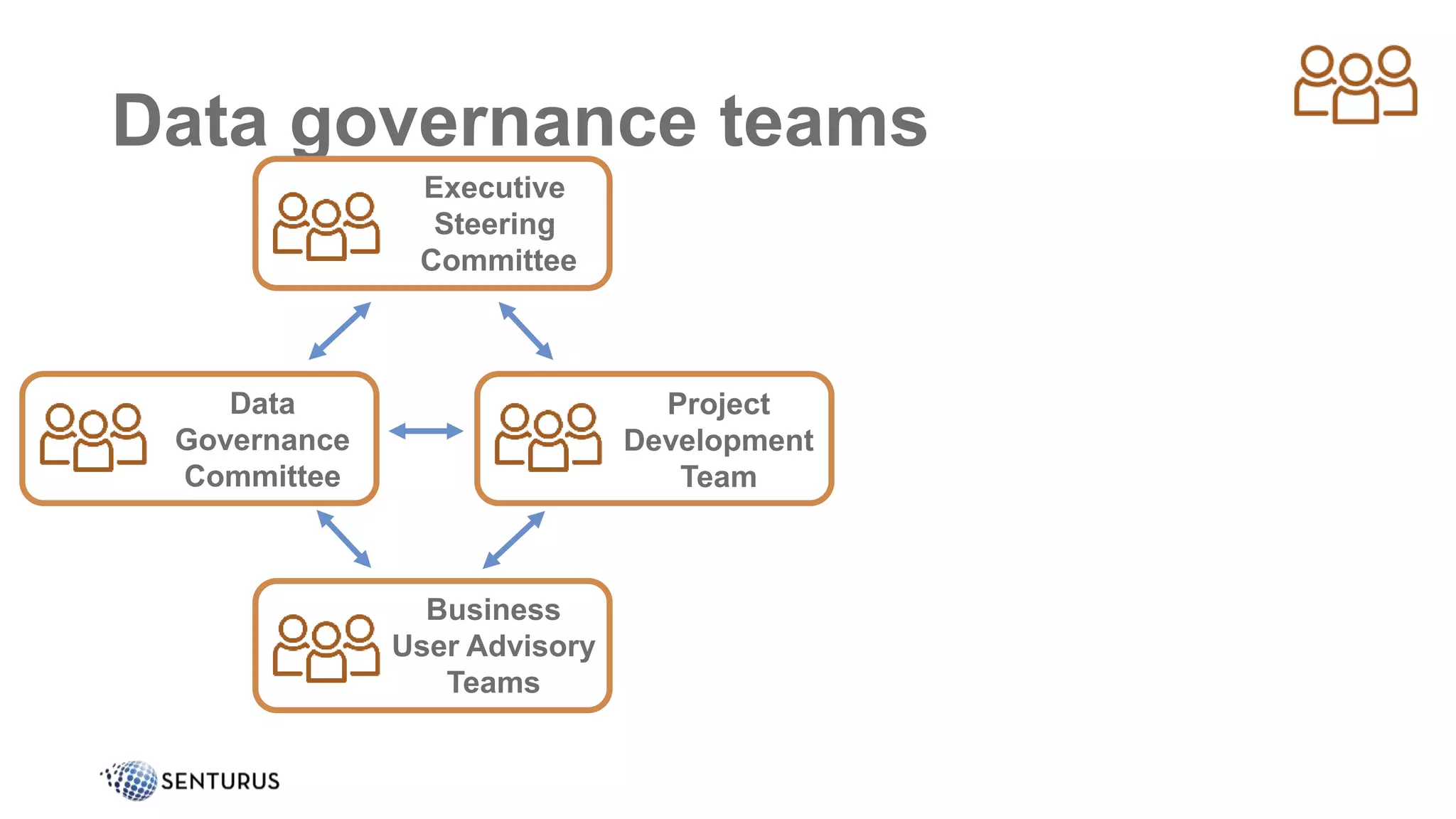
Data governance teams
Data
Governance
Committee
Business
User Advisory
Teams
Project
Development
Team
Executive
Steering
Committee
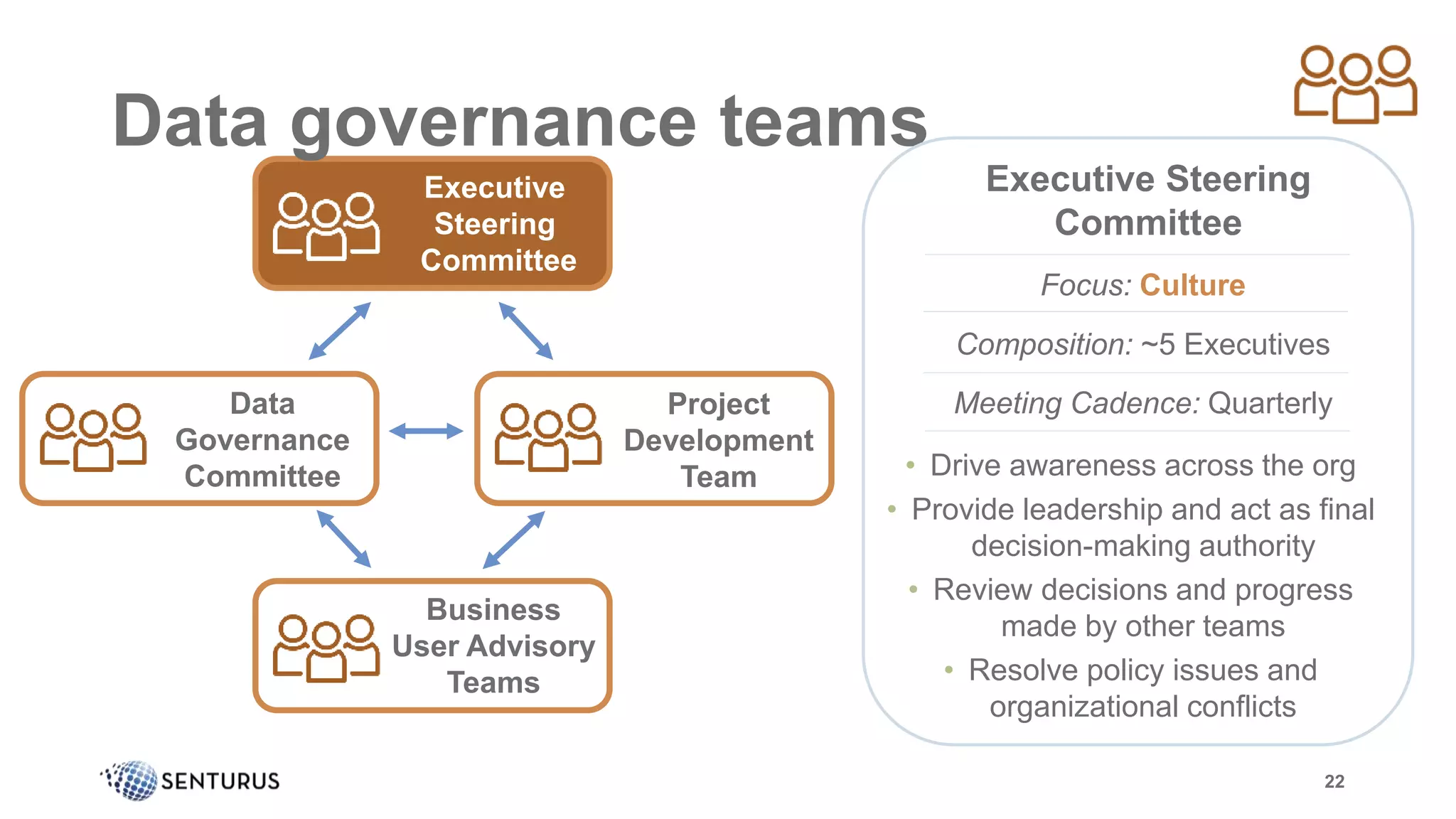
Data governance teams
22
Executive
Steering
Committee
Data
Governance
Committee
Business
User Advisory
Teams
• Drive awareness across the org
• Provide leadership and act as final
decision-making authority
• Review decisions and progress
made by other teams
• Resolve policy issues and
organizational conflicts
Executive Steering
Committee
Focus: Culture
Composition: ~5 Executives
Meeting Cadence: QuarterlyProject
Development
Team
Data governance teams
23
Executive
Steering
Committee
Data
Governance
Committee
Business
User Advisory
Teams
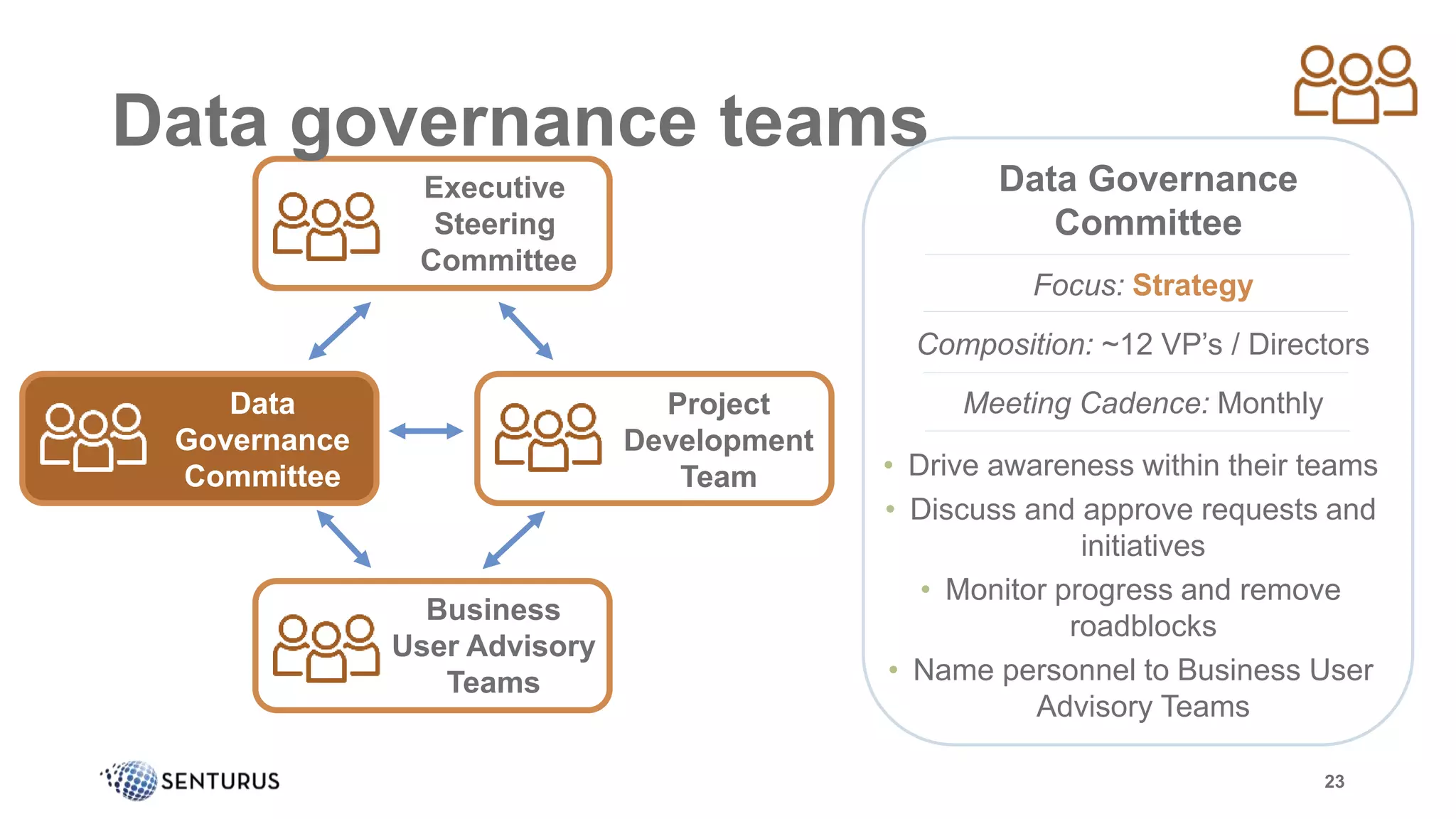
Data Governance
Committee
Focus: Strategy
Composition: ~12 VP’s / Directors
• Drive awareness within their teams
• Discuss and approve requests and
initiatives
• Monitor progress and remove
roadblocks
• Name personnel to Business User
Advisory Teams
Meeting Cadence: MonthlyProject
Development
Team
Data governance teams
24
Executive
Steering
Committee
Business
User Advisory
Teams
Project
Development
Team
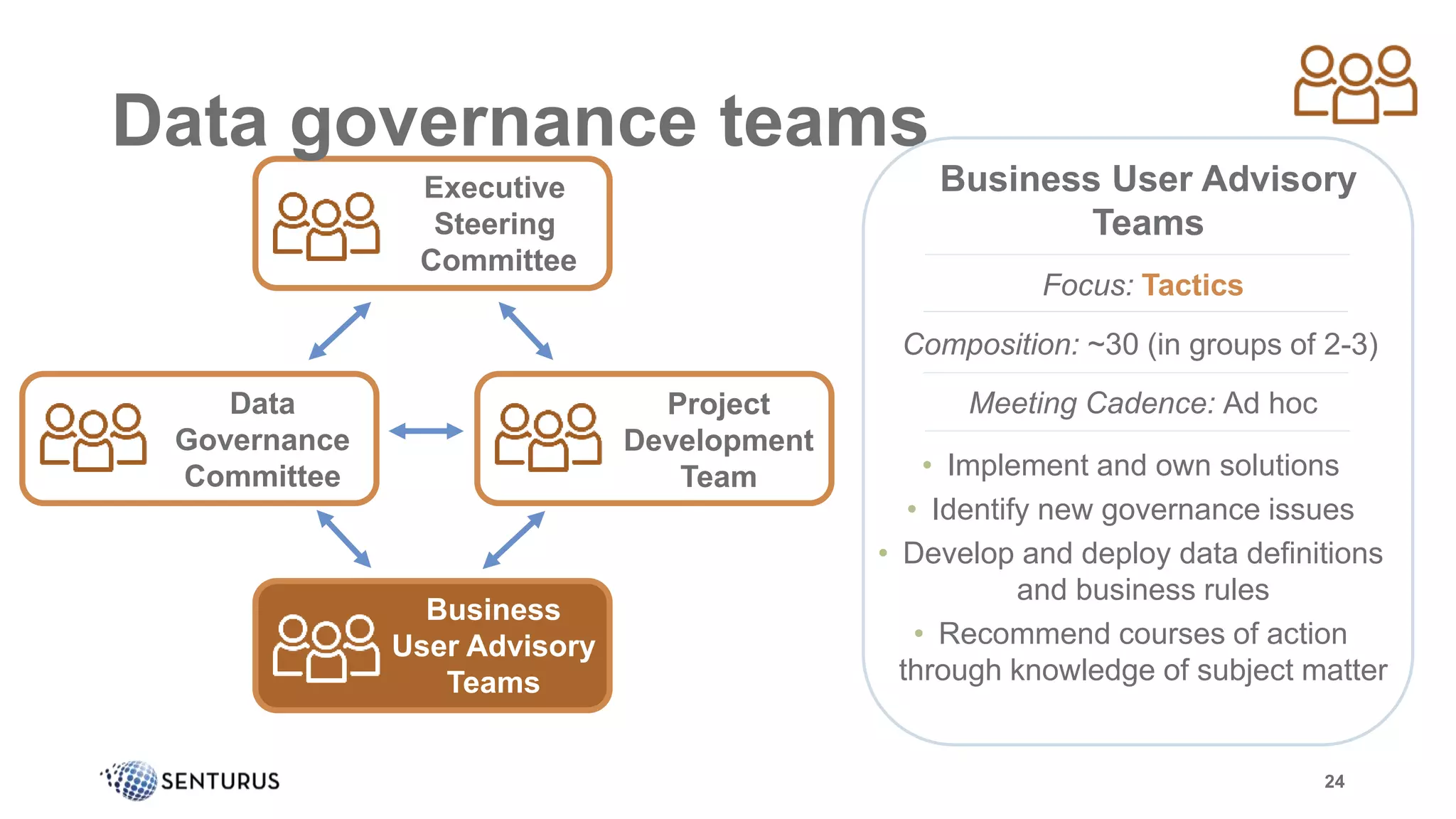
Business User Advisory
Teams
Focus: Tactics
Composition: ~30 (in groups of 2-3)
• Implement and own solutions
• Identify new governance issues
• Develop and deploy data definitions
and business rules
• Recommend courses of action
through knowledge of subject matter
Meeting Cadence: Ad hocData
Governance
Committee
Data governance teams
25
Executive
Steering
Committee
Project
Development
Team
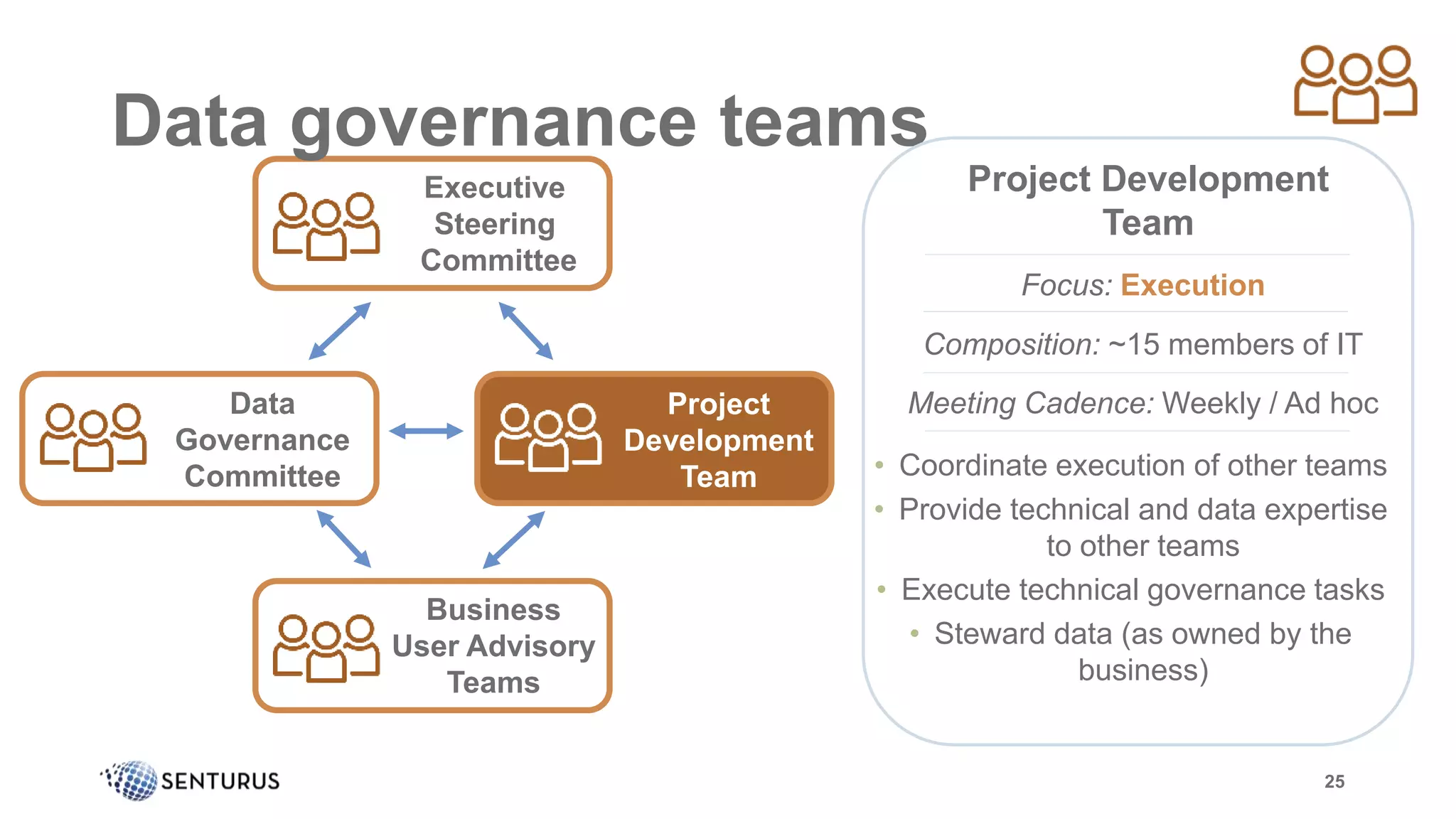
Project Development
Team
Focus: Execution
Composition: ~15 members of IT
• Coordinate execution of other teams
• Provide technical and data expertise
to other teams
• Execute technical governance tasks
• Steward data (as owned by the
business)
Meeting Cadence: Weekly / Ad hocData
Governance
Committee
Business
User Advisory
Teams
Roles and responsibilities
26
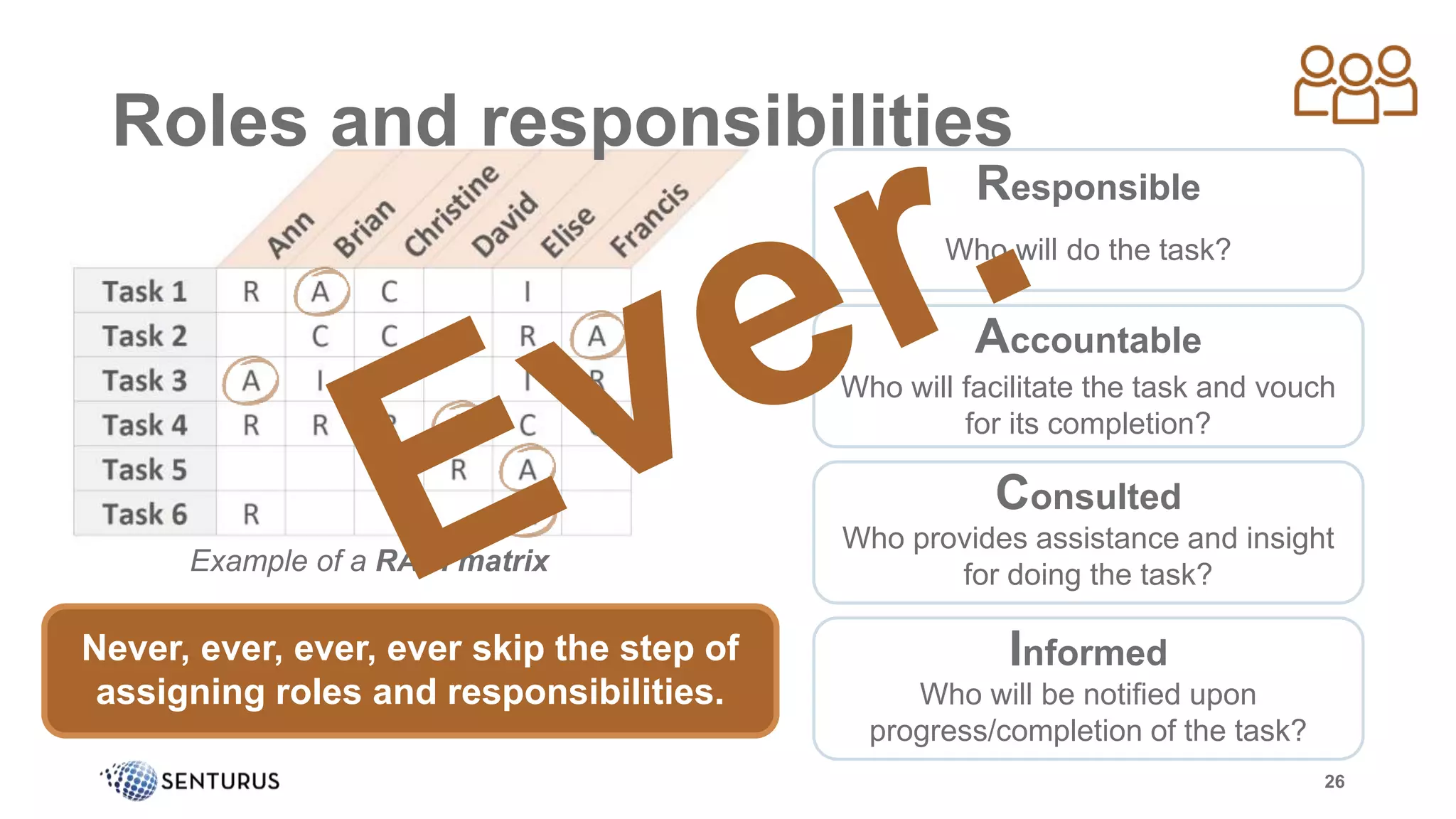
Responsible
Who will do the task?
Accountable
Who will facilitate the task and vouch
for its completion?
Consulted
Who provides assistance and insight
for doing the task?
Informed
Who will be notified upon
progress/completion of the task?
Example of a RACI matrix
Never, ever, ever, ever skip the step of
assigning roles and responsibilities.
Personas
27
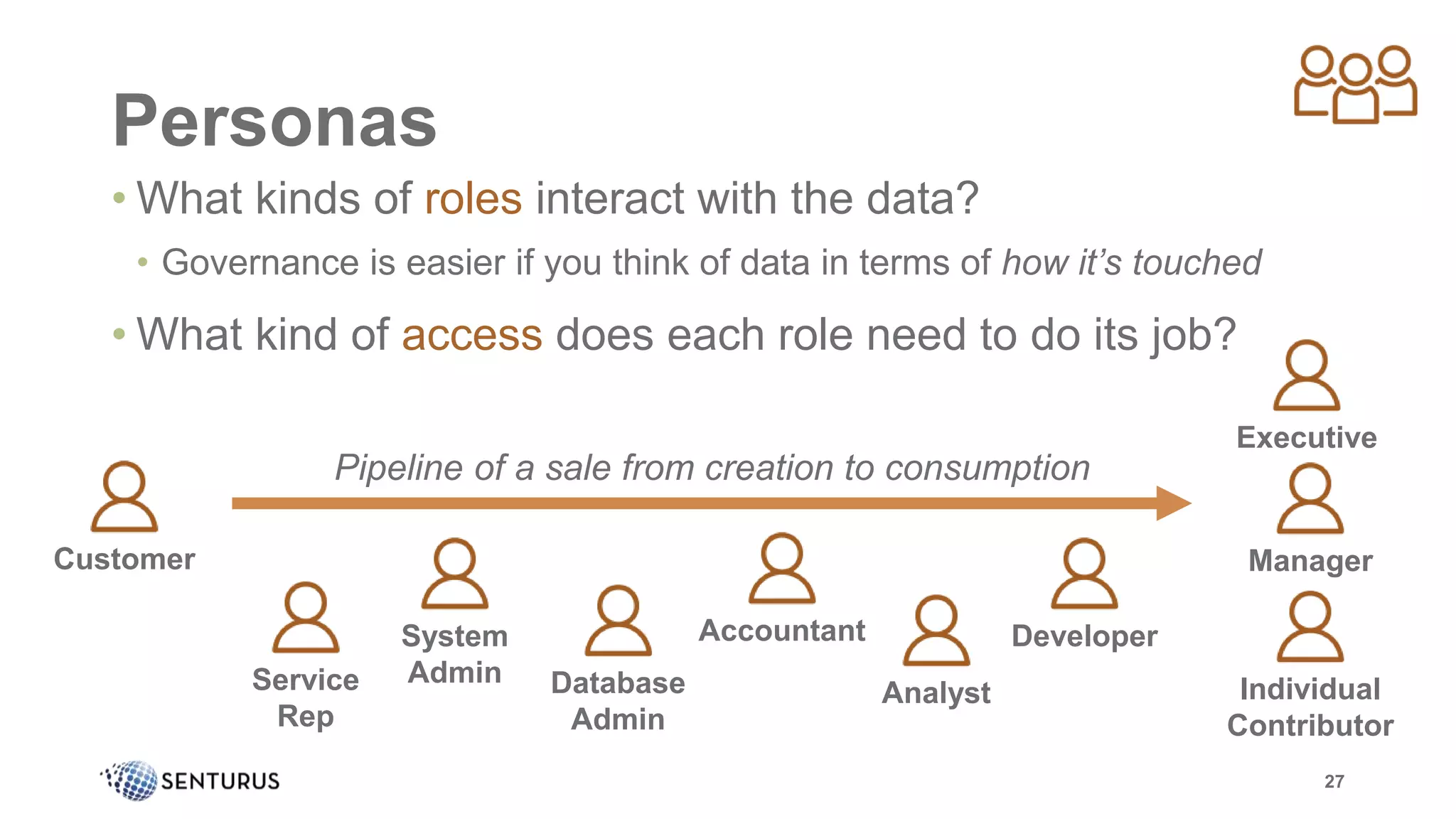
• What kinds of roles interact with the data?
• Governance is easier if you think of data in terms of how it’s touched
• What kind of access does each role need to do its job?
Customer
System
Admin
Executive
Manager
Individual
Contributor
Database
Admin
Service
Rep
Accountant
Analyst
Developer
Pipeline of a sale from creation to consumption
Data
28
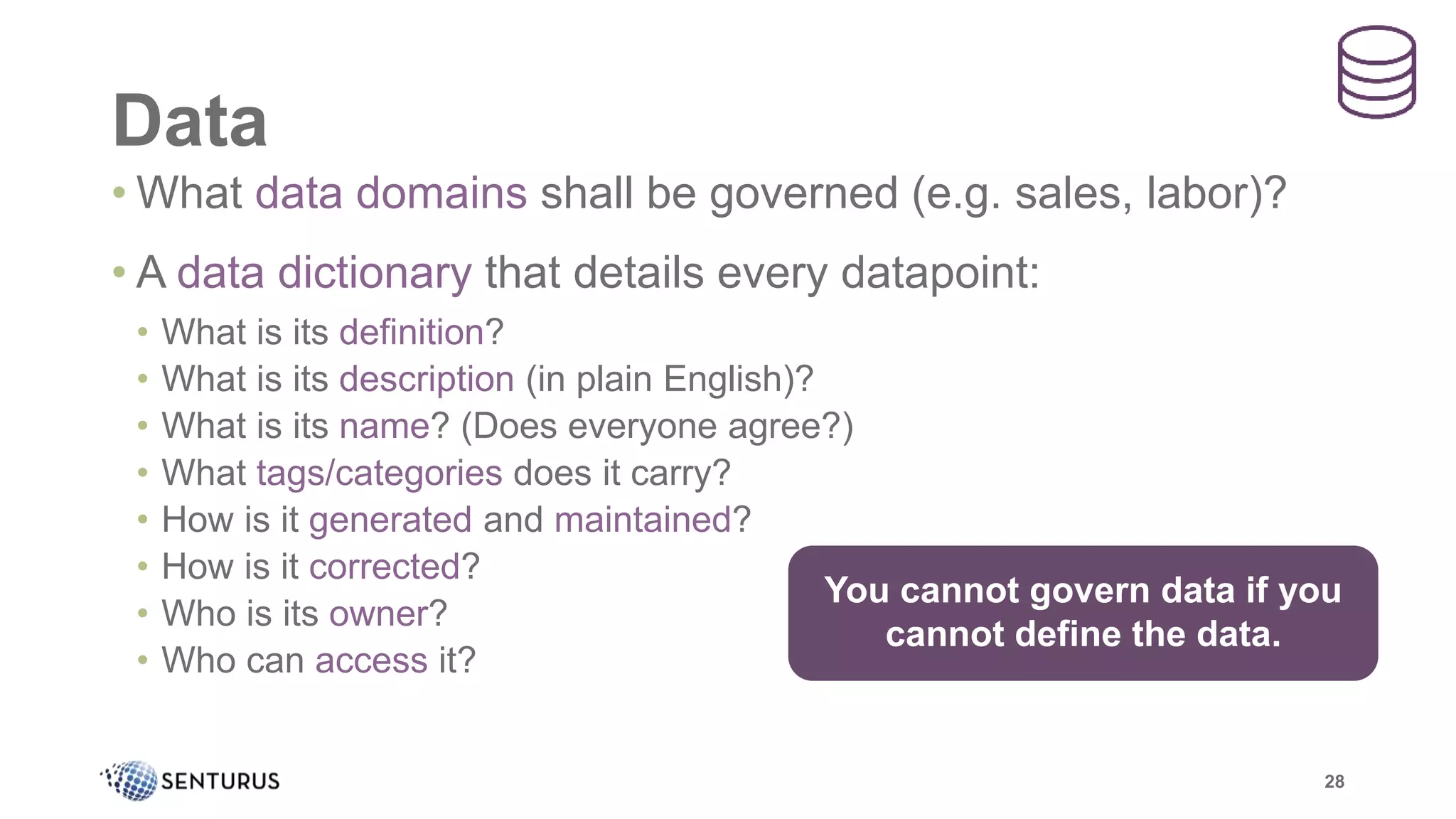
• What data domains shall be governed (e.g. sales, labor)?
• A data dictionary that details every datapoint:
• What is its definition?
• What is its description (in plain English)?
• What is its name? (Does everyone agree?)
• What tags/categories does it carry?
• How is it generated and maintained?
• How is it corrected?
• Who is its owner?
• Who can access it?
You cannot govern data if you
cannot define the data.
Platform
29
This is where the rubber meets the road
• …But everything we’ve discussed so far needs to be figured out first
• Think of technology more as the WHERE than the HOW
• If you are really committed to the Process and People, this is the easy
part
Your tasks define your tools –
NOT the other way around.
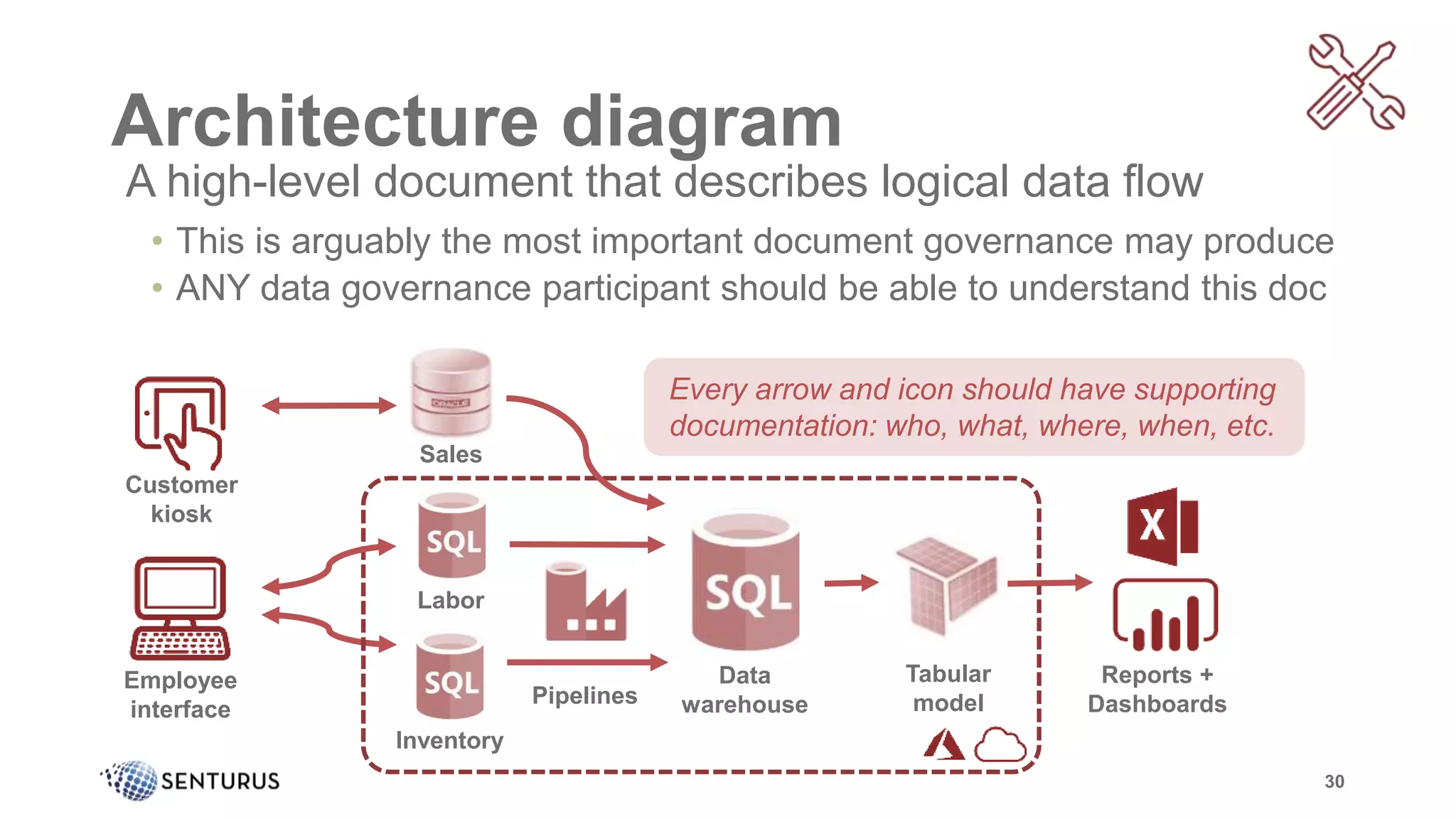
A high-level document that describes logical data flow
• This is arguably the most important document governance may produce
• ANY data governance participant should be able to understand this doc
Architecture diagram
30
Sales
Labor
Inventory
Data
warehouse
Tabular
model
Reports +
Dashboards
Employee
interface
Every arrow and icon should have supporting
documentation: who, what, where, when, etc.
Customer
kiosk
Pipelines
How can we do this nimbly?
31
• Limit your scope, one bite at a time
• What must be done right away? What can wait until later?
• “Garbage in, garbage out”
• It can be extremely helpful to go to market in Phase 1 and show off data
quality issues
• Agile methodology: it works with business intelligence
• There’s no shortcut for defining and documenting up front
• …And I promise, it will save you time when executing
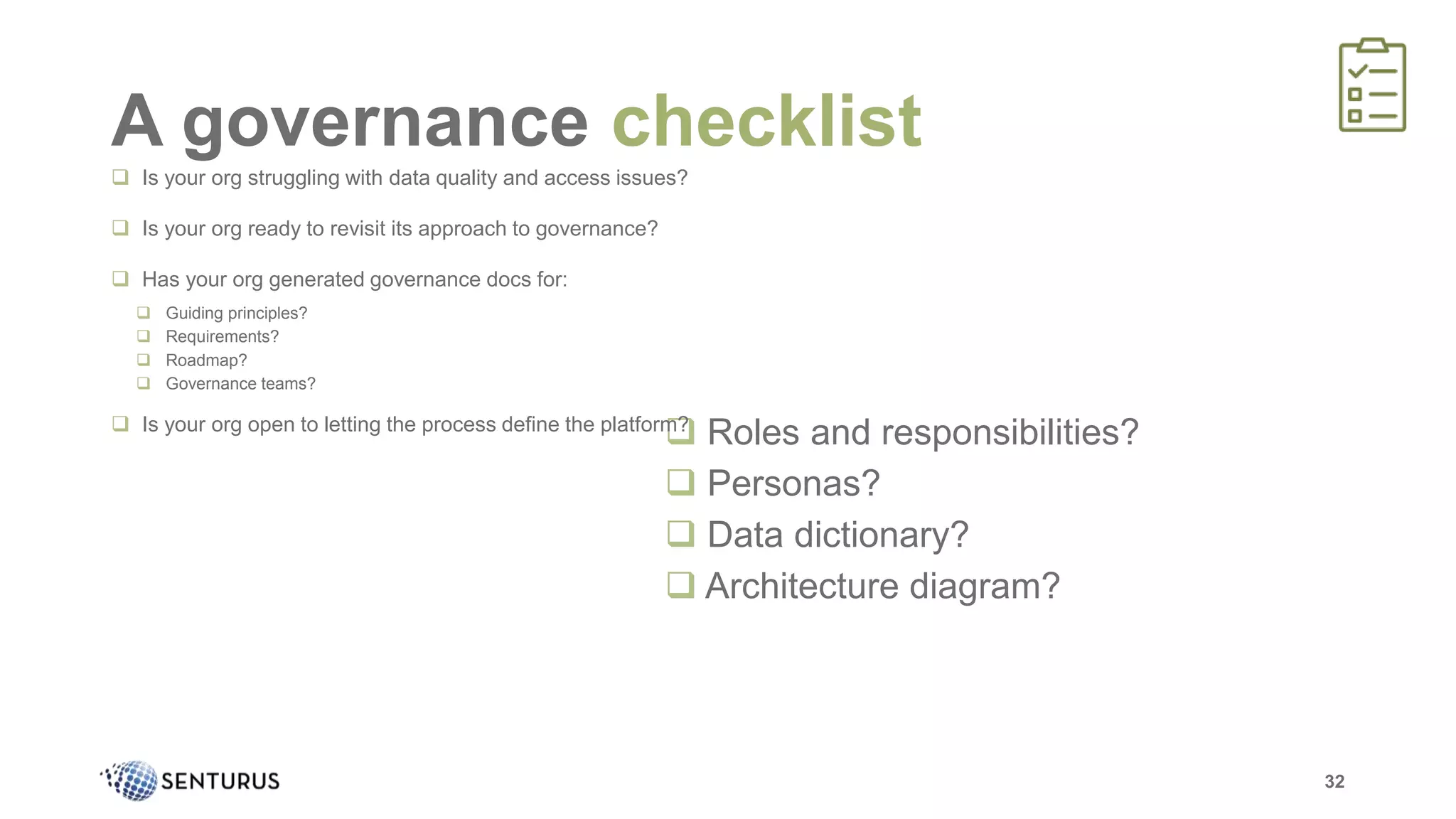
 Roles and responsibilities?
 Personas?
 Data dictionary?
 Architecture diagram?
A governance checklist
32
 Is your org struggling with data quality and access issues?
 Is your org ready to revisit its approach to governance?
 Has your org generated governance docs for:
 Guiding principles?
 Requirements?
 Roadmap?
 Governance teams?
 Is your org open to letting the process define the platform?
Some closing thoughts…
33
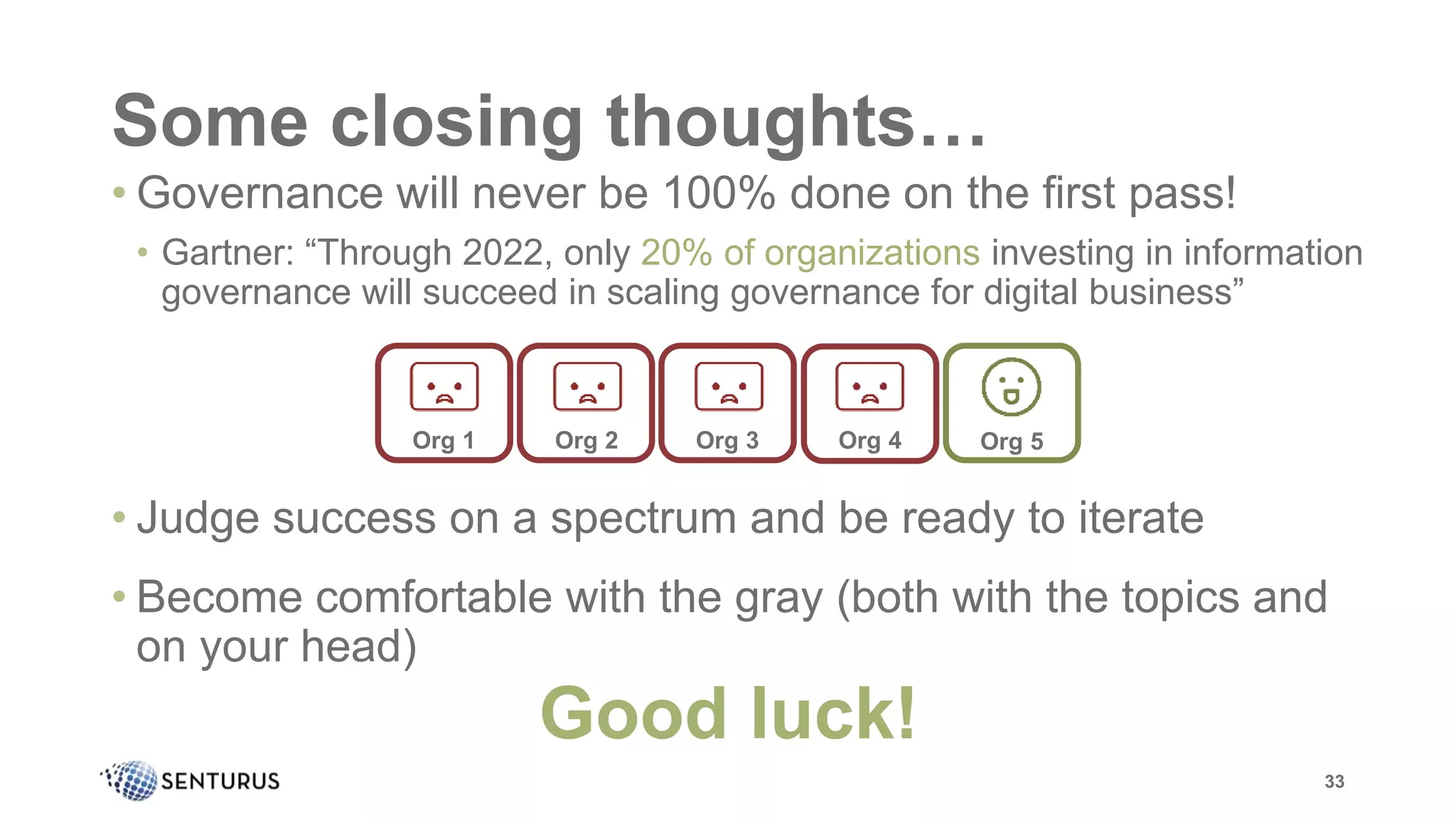
• Governance will never be 100% done on the first pass!
• Gartner: “Through 2022, only 20% of organizations investing in information
governance will succeed in scaling governance for digital business”
• Judge success on a spectrum and be ready to iterate
• Become comfortable with the gray (both with the topics and
on your head)
Good luck!
Org 1 Org 2 Org 3 Org 4 Org 5
34
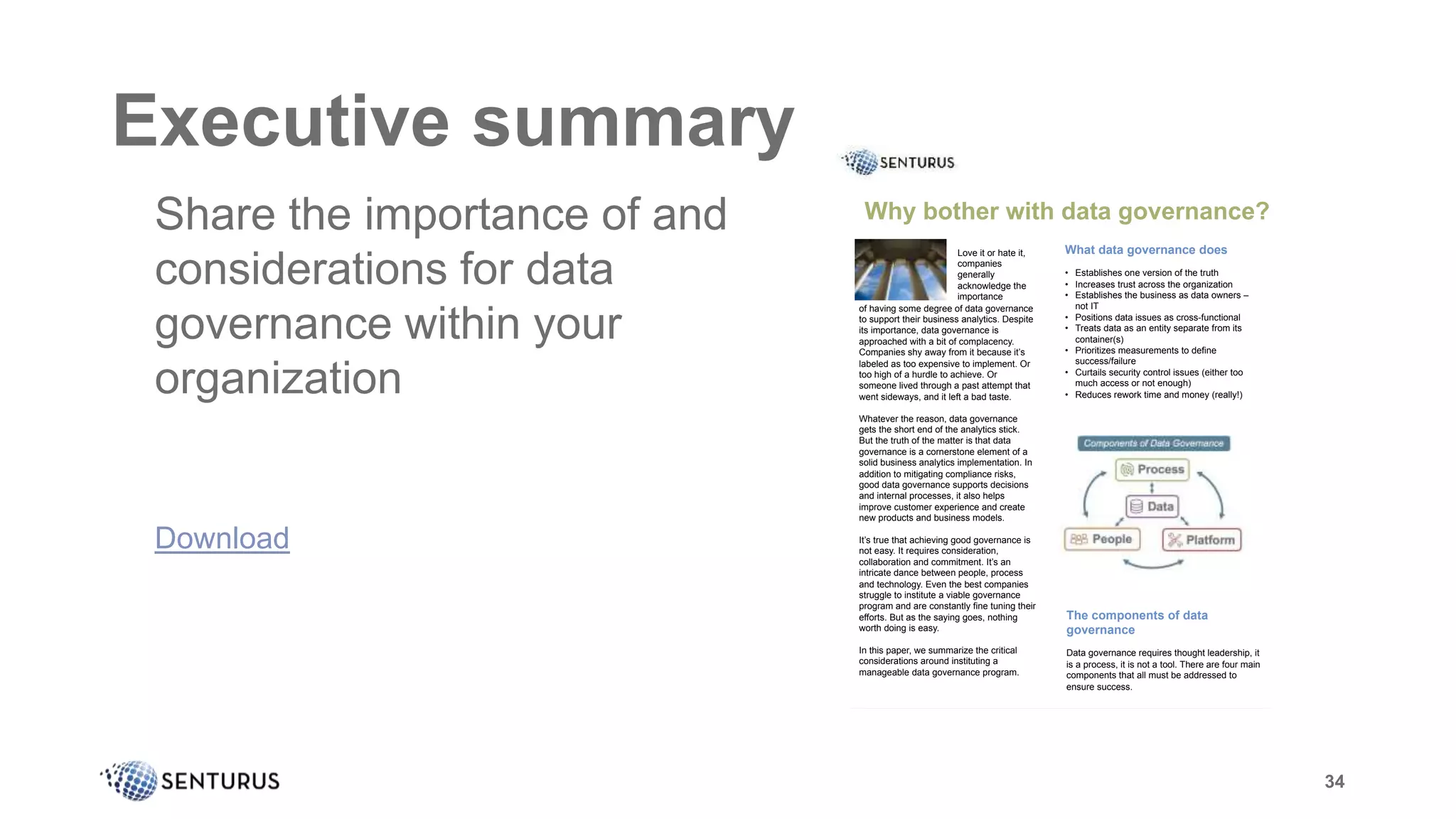
Executive summary
It
of having some degree of data governance
to support their business analytics. Despite
its importance, data governance is
approached with a bit of complacency.
Companies shy away from it because it’s
labeled as too expensive to implement. Or
too high of a hurdle to achieve. Or
someone lived through a past attempt that
went sideways, and it left a bad taste.
Whatever the reason, data governance
gets the short end of the analytics stick.
But the truth of the matter is that data
governance is a cornerstone element of a
solid business analytics implementation. In
addition to mitigating compliance risks,
good data governance supports decisions
and internal processes, it also helps
improve customer experience and create
new products and business models.
It’s true that achieving good governance is
not easy. It requires consideration,
collaboration and commitment. It’s an
intricate dance between people, process
and technology. Even the best companies
struggle to institute a viable governance
program and are constantly fine tuning their
efforts. But as the saying goes, nothing
worth doing is easy.
In this paper, we summarize the critical
considerations around instituting a
manageable data governance program.
Why bother with data governance?
What data governance does
• Establishes one version of the truth
• Increases trust across the organization
• Establishes the business as data owners –
not IT
• Positions data issues as cross-functional
• Treats data as an entity separate from its
container(s)
• Prioritizes measurements to define
success/failure
• Curtails security control issues (either too
much access or not enough)
• Reduces rework time and money (really!)
Love it or hate it,
companies
generally
acknowledge the
importance
The components of data
governance
Data governance requires thought leadership, it
is a process, it is not a tool. There are four main
components that all must be addressed to
ensure success.
34
Share the importance of and
considerations for data
governance within your
organization
Download
Like what you see?
To view the video recording and download the slide deck go
to https://senturus.com/resources/data-governance-for-
business-analytics
Visit our website to access our library of free BI knowledge
resources including events, blogs, demos, whitepapers, other
on-demand webinars and our dashboard gallery
https://senturus.com/senturus-resources/
35
The authority in
Business Intelligence
36
Exclusively focused on BI,
Senturus is unrivaled in its
expertise across the BI stack.
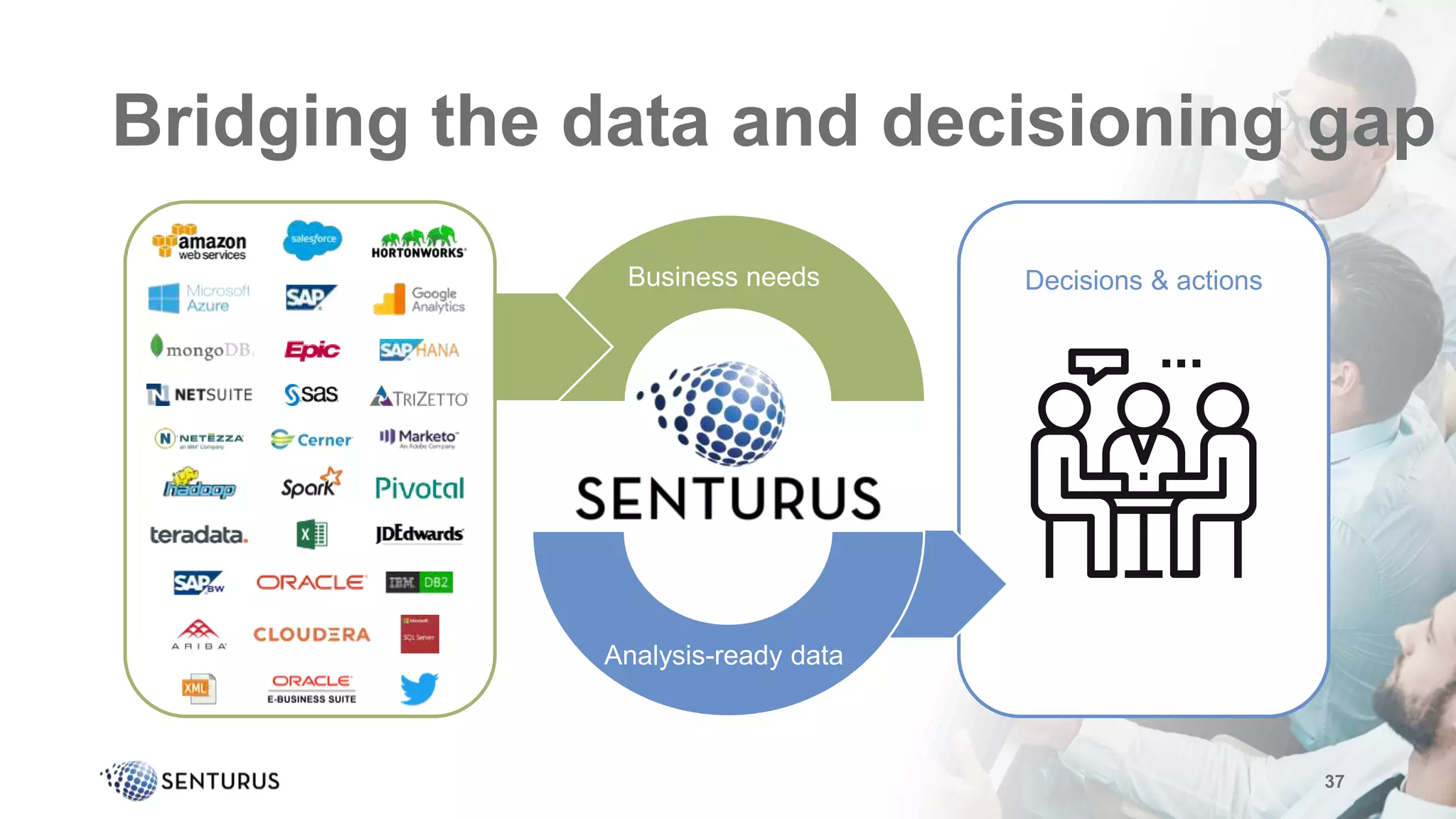
Decisions & actionsBusiness needs
Bridging the data and decisioning gap
37
Analysis-ready data
Full spectrum BI services
•Dashboards, reporting and visualizations
•Data preparation and modern data warehousing
•Hybrid BI environments (migrations, security, etc.)
•Software to enable bimodal BI and platform migrations
•BI support retainer (expertise on demand)
•Training and mentoring
38
A long, strong history of success
•19+ years
•1300+ clients
•2500+ projects
39
Expand your knowledge
40
Find more resources
on the Senturus website:
senturus.com/senturus-resources
Upcoming event
•How to Successfully Implement Self-Service Analytics
•Agile, governed self-service BI with a focus on Cognos Analytics
•Thursday, Sep 24, 2020, 11am PT/2pm ET
•Register: https://senturus.com/events/how-to-successfully-implement-self-service-analytics/
41
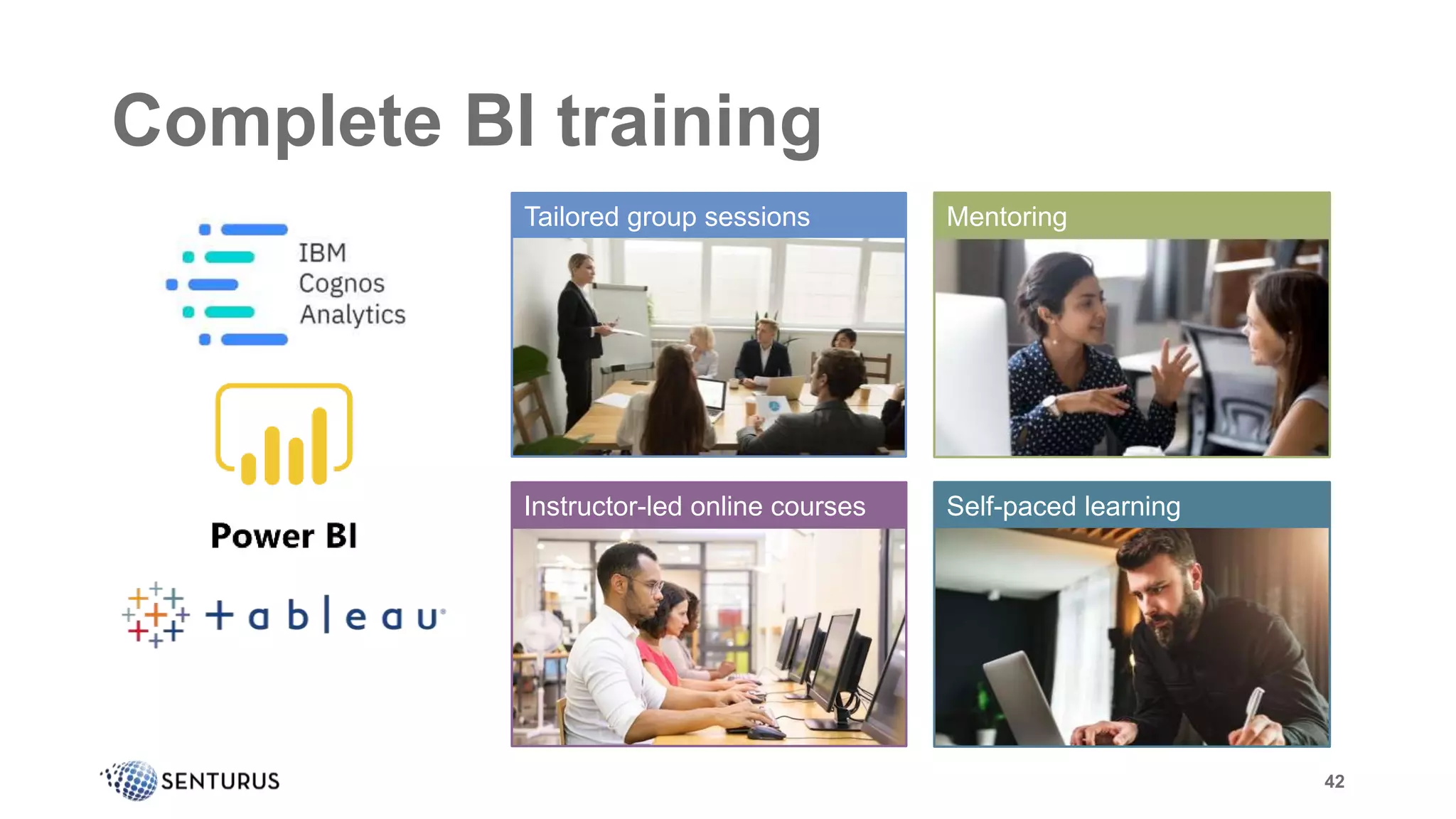
Complete BI training
42
Instructor-led online courses Self-paced learning
MentoringTailored group sessions
Additional resources
43
Insider viewpointsTechnical tipsUnbiased product reviews
Product demos Upcoming eventsMore on this subject
© 2020 by Senturus, Inc. This presentation may not be reused or distributed without the written consent of Senturus, Inc.
www.senturus.com 888 601 6010 info@senturus.com
Thank You

Data Governance: Why, What & How

  • 1.
    Why Bother with DataGovernance? 1
  • 2.
    2 Hundreds of resources Visitthe Resource Library on the Senturus website to download this presentation and explore other assets: senturus.com/resources 2
  • 3.
    3 Introductions Shawn Alpay Microsoft BISenior Architect Senturus, Inc. Michael Weinhauer Director Senturus, Inc. 3
  • 4.
    Agenda • Introduction • Whydata governance? • Warning signs of complacency • What does data governance do? • Data governance process • Senturus overview • Additional resources • Q&A 4
  • 5.
    Enjoy the fullwebinar presentation This slide deck is from the webinar Why Bother with Data Governance? To view the FREE video recording and download this deck, go to https://senturus.com/resources/data-governance-for- business-analytics 5
  • 6.
    • According toGartner, enterprises are increasingly pushing for growth through digital transformation, which puts more pressure on existing technical frameworks • Even top-tier organizations struggle to implement good data governance – but they’re doing because it’s worth doing Data governance is hard 6
  • 7.
    How we’ll approachgovernance • Review the warning signs of “data complacency” (aka risk!) • Define data governance and detail its purpose/value • Break down implementation into consumable chunks • We’ll be focused on the high level, not tips and tricks • This will be filtered through the lens of a business intelligence architect • Filter this talk through your lens • What here applies to you and your org? • How do you disagree with me? Your mileage may vary! 7
  • 8.
    Data complacency: “thisis fine” 8 Live footage of me
  • 9.
    Warning signs ofcomplacency • Why won’t IT fix these data inaccuracies? • It’s fine that the data doesn’t agree across systems, if it’s “directionally accurate” • It’s not fine that the data quality is bad, but it’s been decided it’s too hard/expensive to solve • Is this net sales number the Finance version or Operations? • Oh wait, it’s probably the Marketing one • Someone deleted the entire main reporting folder (again) 9
  • 10.
    What does datagovernance do? • Establishes the business as data owners – not IT • Positions data issues as cross-functional • Treats data as an entity separate from its container(s) • Prioritizes measurements to define success/failure • Reduces costs of time and money (really!) • Increases trust across the organization 10
  • 11.
    What is datagovernance? Data governance is a framework for ensuring the availability, accuracy and security of data across an organization 11 • Data governance is a long series of definitions and discussions • Data governance requires thought leadership • You can’t buy ideas off the shelf (If you could, you wouldn’t be here) • Data governance is NOT (just) a tool • Our process defines our platform – not the other way around “…but what does that mean?”
  • 12.
    So how dowe…do this? 12 Process Data PlatformPeople Components of Data Governance How do you eat a huge Rice Krispie square? …One bite at a time.
  • 13.
    Process: break HOWinto W’s 13 WHY WHAT WHEN WHO WHERE All of these sections result in documentation I am extremely tired of documentation being undervalued
  • 14.
    Process: break HOWinto W’s A mission statement endorsed by the organization’s leaders • “We recognize data to be a valued and strategic enterprise asset.” • “Our data shall have clearly defined accountability.” • “Our data shall be well managed.” 14 WHAT WHEN WHO WHERE Guiding principles WHYWHY Guiding principles
  • 15.
    Process: break HOWinto W’s A clear scope • What can we accomplish? • What data domains can be included? • What personas can be included? 15 WHEN WHO WHERE Guiding principles WHYWHY Guiding principles WHAT Requirements • What defines success and failure? • How do we fund this? • What are the priority levels for all this?
  • 16.
    Process: break HOWinto W’s A roadmap for execution of the “what” • Leverage prioritization of scope to determine phases and schedule • What must be accomplished in Phase 1? What can be postponed? • Phases can be small, five small phases will be faster than one big one 16 WHO WHERE Guiding principles WHYWHY Guiding principles WHAT Requirements WHEN Roadmap
  • 17.
    Process: break HOWinto W’s • Teams that will devise the “why” and make the “what” happen • Clear roles and responsibilities defined for each person/role/group • Personas for all categories of people that touch the data 17 WHERE Guiding principles WHYWHY Guiding principles WHAT Requirements WHO Decision- making bodies, roles and responsibilities WHEN Roadmap
  • 18.
    Process: break HOWinto W’s • An architecture for all tools necessary to execute these ideas • Source systems • Code / doc repositories • Databases / data lakes 18 Guiding principles WHYWHY Guiding principles WHAT Requirements WHO Decision- making bodies, roles and responsibilities WHEN Roadmap WHO Decision- making bodies, roles and responsibilities WHERE Tools, technologies, repositories, diagrams • Reporting interfaces • Data management tools • Security administration
  • 19.
    Like what yousee? To view the video recording and download the slide deck go to https://senturus.com/resources/data-governance-for- business-analytics/ Visit our website to access our library of free BI knowledge resources including events, blogs, demos, whitepapers, other on-demand webinars and our dashboard gallery https://senturus.com/senturus-resources/ 19
  • 20.
    People “No matter howit looks at first, it’s always a people problem” 20 Data governance fails without personal ownership.
  • 21.
    Data governance teams Data Governance Committee Business UserAdvisory Teams Project Development Team Executive Steering Committee
  • 22.
    Data governance teams 22 Executive Steering Committee Data Governance Committee Business UserAdvisory Teams • Drive awareness across the org • Provide leadership and act as final decision-making authority • Review decisions and progress made by other teams • Resolve policy issues and organizational conflicts Executive Steering Committee Focus: Culture Composition: ~5 Executives Meeting Cadence: QuarterlyProject Development Team
  • 23.
    Data governance teams 23 Executive Steering Committee Data Governance Committee Business UserAdvisory Teams Data Governance Committee Focus: Strategy Composition: ~12 VP’s / Directors • Drive awareness within their teams • Discuss and approve requests and initiatives • Monitor progress and remove roadblocks • Name personnel to Business User Advisory Teams Meeting Cadence: MonthlyProject Development Team
  • 24.
    Data governance teams 24 Executive Steering Committee Business UserAdvisory Teams Project Development Team Business User Advisory Teams Focus: Tactics Composition: ~30 (in groups of 2-3) • Implement and own solutions • Identify new governance issues • Develop and deploy data definitions and business rules • Recommend courses of action through knowledge of subject matter Meeting Cadence: Ad hocData Governance Committee
  • 25.
    Data governance teams 25 Executive Steering Committee Project Development Team ProjectDevelopment Team Focus: Execution Composition: ~15 members of IT • Coordinate execution of other teams • Provide technical and data expertise to other teams • Execute technical governance tasks • Steward data (as owned by the business) Meeting Cadence: Weekly / Ad hocData Governance Committee Business User Advisory Teams
  • 26.
    Roles and responsibilities 26 Responsible Whowill do the task? Accountable Who will facilitate the task and vouch for its completion? Consulted Who provides assistance and insight for doing the task? Informed Who will be notified upon progress/completion of the task? Example of a RACI matrix Never, ever, ever, ever skip the step of assigning roles and responsibilities.
  • 27.
    Personas 27 • What kindsof roles interact with the data? • Governance is easier if you think of data in terms of how it’s touched • What kind of access does each role need to do its job? Customer System Admin Executive Manager Individual Contributor Database Admin Service Rep Accountant Analyst Developer Pipeline of a sale from creation to consumption
  • 28.
    Data 28 • What datadomains shall be governed (e.g. sales, labor)? • A data dictionary that details every datapoint: • What is its definition? • What is its description (in plain English)? • What is its name? (Does everyone agree?) • What tags/categories does it carry? • How is it generated and maintained? • How is it corrected? • Who is its owner? • Who can access it? You cannot govern data if you cannot define the data.
  • 29.
    Platform 29 This is wherethe rubber meets the road • …But everything we’ve discussed so far needs to be figured out first • Think of technology more as the WHERE than the HOW • If you are really committed to the Process and People, this is the easy part Your tasks define your tools – NOT the other way around.
  • 30.
    A high-level documentthat describes logical data flow • This is arguably the most important document governance may produce • ANY data governance participant should be able to understand this doc Architecture diagram 30 Sales Labor Inventory Data warehouse Tabular model Reports + Dashboards Employee interface Every arrow and icon should have supporting documentation: who, what, where, when, etc. Customer kiosk Pipelines
  • 31.
    How can wedo this nimbly? 31 • Limit your scope, one bite at a time • What must be done right away? What can wait until later? • “Garbage in, garbage out” • It can be extremely helpful to go to market in Phase 1 and show off data quality issues • Agile methodology: it works with business intelligence • There’s no shortcut for defining and documenting up front • …And I promise, it will save you time when executing
  • 32.
     Roles andresponsibilities?  Personas?  Data dictionary?  Architecture diagram? A governance checklist 32  Is your org struggling with data quality and access issues?  Is your org ready to revisit its approach to governance?  Has your org generated governance docs for:  Guiding principles?  Requirements?  Roadmap?  Governance teams?  Is your org open to letting the process define the platform?
  • 33.
    Some closing thoughts… 33 •Governance will never be 100% done on the first pass! • Gartner: “Through 2022, only 20% of organizations investing in information governance will succeed in scaling governance for digital business” • Judge success on a spectrum and be ready to iterate • Become comfortable with the gray (both with the topics and on your head) Good luck! Org 1 Org 2 Org 3 Org 4 Org 5
  • 34.
    34 Executive summary It of havingsome degree of data governance to support their business analytics. Despite its importance, data governance is approached with a bit of complacency. Companies shy away from it because it’s labeled as too expensive to implement. Or too high of a hurdle to achieve. Or someone lived through a past attempt that went sideways, and it left a bad taste. Whatever the reason, data governance gets the short end of the analytics stick. But the truth of the matter is that data governance is a cornerstone element of a solid business analytics implementation. In addition to mitigating compliance risks, good data governance supports decisions and internal processes, it also helps improve customer experience and create new products and business models. It’s true that achieving good governance is not easy. It requires consideration, collaboration and commitment. It’s an intricate dance between people, process and technology. Even the best companies struggle to institute a viable governance program and are constantly fine tuning their efforts. But as the saying goes, nothing worth doing is easy. In this paper, we summarize the critical considerations around instituting a manageable data governance program. Why bother with data governance? What data governance does • Establishes one version of the truth • Increases trust across the organization • Establishes the business as data owners – not IT • Positions data issues as cross-functional • Treats data as an entity separate from its container(s) • Prioritizes measurements to define success/failure • Curtails security control issues (either too much access or not enough) • Reduces rework time and money (really!) Love it or hate it, companies generally acknowledge the importance The components of data governance Data governance requires thought leadership, it is a process, it is not a tool. There are four main components that all must be addressed to ensure success. 34 Share the importance of and considerations for data governance within your organization Download
  • 35.
    Like what yousee? To view the video recording and download the slide deck go to https://senturus.com/resources/data-governance-for- business-analytics Visit our website to access our library of free BI knowledge resources including events, blogs, demos, whitepapers, other on-demand webinars and our dashboard gallery https://senturus.com/senturus-resources/ 35
  • 36.
    The authority in BusinessIntelligence 36 Exclusively focused on BI, Senturus is unrivaled in its expertise across the BI stack.
  • 37.
    Decisions & actionsBusinessneeds Bridging the data and decisioning gap 37 Analysis-ready data
  • 38.
    Full spectrum BIservices •Dashboards, reporting and visualizations •Data preparation and modern data warehousing •Hybrid BI environments (migrations, security, etc.) •Software to enable bimodal BI and platform migrations •BI support retainer (expertise on demand) •Training and mentoring 38
  • 39.
    A long, stronghistory of success •19+ years •1300+ clients •2500+ projects 39
  • 40.
    Expand your knowledge 40 Findmore resources on the Senturus website: senturus.com/senturus-resources
  • 41.
    Upcoming event •How toSuccessfully Implement Self-Service Analytics •Agile, governed self-service BI with a focus on Cognos Analytics •Thursday, Sep 24, 2020, 11am PT/2pm ET •Register: https://senturus.com/events/how-to-successfully-implement-self-service-analytics/ 41
  • 42.
    Complete BI training 42 Instructor-ledonline courses Self-paced learning MentoringTailored group sessions
  • 43.
    Additional resources 43 Insider viewpointsTechnicaltipsUnbiased product reviews Product demos Upcoming eventsMore on this subject
  • 44.
    © 2020 bySenturus, Inc. This presentation may not be reused or distributed without the written consent of Senturus, Inc. www.senturus.com 888 601 6010 info@senturus.com Thank You

Editor's Notes

  • #3 The first question we usually get is “Can I get a copy of the presentation?” Absolutely! It’s available on Senturus.com. Select the Resources tab and then Resources Library. Or you can click the link that was just posted in the GoToWebinar Control panel. Be sure to bookmark the resource library. It has tons of valuable content addressing a wide variety of business analytics topics.
  • #4 Joining us today is…..Shawn Alpay Shawn is well-versed across the entire Microsoft BI stack and its wide range of offerings, having built ETL, data warehouse, reporting and analysis solutions from the ground up. In his various development and architecture roles, he often serves as the client’s project manager and business analyst, partnering directly with their team to gather requirements and deliver insight.
  • #35 You can download it from the resource section of our website—where the deck and soon the recording will be.
  • #37 At Senturus we concentrate our expertise on business intelligence with a depth of knowledge across the entire BI stack.
  • #38 At Senturus, our clients know us for providing clarity from the chaos of complex business requirements, disparate data sources and constantly moving targets. We have made a name for ourselves because of our strength at bridging the gap between IT and business users. We deliver solutions that give you access to reliable, analysis-ready data across the organization so you can quickly and easily get answers at the point of impact: the Decisions you Make and Actions you Take.
  • #39 Our consultants are leading experts in the field of analytics, with years of pragmatic, real-world expertise and experience advancing the state-of-the-art. We’re so confident in our team and our methodology that we back our projects with a 100% money back guarantee that is unique in the industry.
  • #40 We have been focused exclusively on business intelligence for 19 years. We work across the spectrum from Fortune 500 to mid market, We solve business problems across many industries and function areas including in the office of finance, sales and marketing, manufacturing, operations, HR and IT Our team is large enough to meet all your business analytics needs yet small enough to provide personal attention.
  • #41 Senturus has 100s of free resources on our website, from webinars on all things BI, to our fabulous up-to-the-minute, easily consumable blogs.
  • #42 We’re finalizing our upcoming events schedule – these will be added to our website shortly, check back to register.
  • #43 We provide training in the three top BI platforms. We are ideal for organizations running multiple platforms or those moving from one to another. We can provide training in many modes and can mix and match to suit your user community.
  • #44 Senturus provides 100s of free resources on our website. We have been committed to sharing our BI expertise for over a decade.