One Point Lessons (OPLs)
www.optimumfx.com
Intent of Session
• To understand One Point Lessons
• To explain how these are put together
• To understand the opportunities to use them in
the work environment
What are they?
• When we buy something like a mobile phone, there are
usually two user documents:
– A manual – 20 pages or more of detailed text
– A ‘Quick Guide’ – normally one piece of paper with graphics
• We can consider the Standard Operating Procedure as
our ‘manual’, and the One Point Lesson as the ‘Quick
Guide’
• One Point Lesson – the vital information, kept near to
hand
What are OPLs
• One Point Lessons are used to explain a single point task at a
work station
• They are short visual presentations on a single point
• They can be explained in about 10 minutes
• Detailed on one or two pages
• Supported by diagrams, photographs, or drawings
• Are generated and used at the point of need
OPL Use
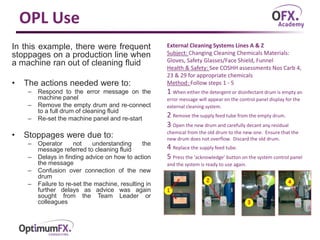
In this example, there were frequent
stoppages on a production line when
a machine ran out of cleaning fluid
• The actions needed were to:
– Respond to the error message on the
machine panel
– Remove the empty drum and re-connect
to a full drum of cleaning fluid
– Re-set the machine panel and re-start
• Stoppages were due to:
– Operator not understanding the
message referred to cleaning fluid
– Delays in finding advice on how to action
the message
– Confusion over connection of the new
drum
– Failure to re-set the machine, resulting in
further delays as advice was again
sought from the Team Leader or
colleagues
External Cleaning Systems Lines A & Z
Subject: Changing Cleaning Chemicals Materials:
Gloves, Safety Glasses/Face Shield, Funnel
Health & Safety: See COSHH assessments Nos Carb 4,
23 & 29 for appropriate chemicals
Method: Follow steps 1 - 5
1 When either the detergent or disinfectant drum is empty an
error message will appear on the control panel display for the
external cleaning system.
2 Remove the supply feed tube from the empty drum.
3 Open the new drum and carefully decant any residual
chemical from the old drum to the new one. Ensure that the
new drum does not overflow. Discard the old drum.
4 Replace the supply feed tube.
5 Press the ‘acknowledge’ button on the system control panel
and the system is ready to use again.
Identifying Opportunities for OPLs
• Where are the opportunities to use One Point Lessons?
– Quality
– Inventory
– Equipment Operation
– Safety
– Maintenance
– Inspection
– Improvement
• Wherever teams need key information to perform their jobs
• Where this ‘key information’ is missing, a One Point lesson
can be used to provide it
About One Point Lessons
• One Point Lessons sharpen job related knowledge and skills
by communicating information about specific problems and
improvements
• Team leaders and members who have acquired special skills
or knowledge can share this with their teammates
• Sharing important information just-in-time
• Improving the team’s performance
• Positively affecting employees’ abilities to perform daily tasks
• Improving cost efficiency and product quality
Effective Writing of OPLs
• One A4 sheet if possible, maximum two
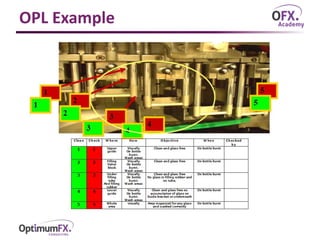
• Use photographs and text with arrows – the information needs
to be accessed quickly
• Ensure the subject can be explained in a maximum of 10
minutes – otherwise consider a Standard Operating
Procedure
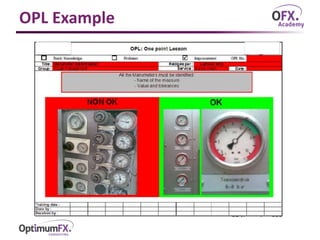
• Show ‘correct’ and ‘incorrect’ topic photos if possible
• Consider where the information should be displayed – where
the task is performed is best
OPL Example
OPL Example
What If
• Without One Point Lessons we risk:
– Not having the vital knowledge available when required at the workplace
– Delays and errors through individuals not having the correct information
available
– Team Leaders and Managers dealing with frequent interruptions
– Missed opportunities for staff development
• With One Point Lessons we have:
– The vital knowledge for the task visible and acceptable
– Fewer problems for teams and increased efficiency
– Team Leaders and Managers able to concentrate on value-adding
activities
– Development of staff through knowledge and self-reliance

One point lessons (OPLs)

  • 1.
    One Point Lessons(OPLs) www.optimumfx.com
  • 2.
    Intent of Session •To understand One Point Lessons • To explain how these are put together • To understand the opportunities to use them in the work environment
  • 3.
    What are they? •When we buy something like a mobile phone, there are usually two user documents: – A manual – 20 pages or more of detailed text – A ‘Quick Guide’ – normally one piece of paper with graphics • We can consider the Standard Operating Procedure as our ‘manual’, and the One Point Lesson as the ‘Quick Guide’ • One Point Lesson – the vital information, kept near to hand
  • 4.
    What are OPLs •One Point Lessons are used to explain a single point task at a work station • They are short visual presentations on a single point • They can be explained in about 10 minutes • Detailed on one or two pages • Supported by diagrams, photographs, or drawings • Are generated and used at the point of need
  • 5.
    OPL Use In thisexample, there were frequent stoppages on a production line when a machine ran out of cleaning fluid • The actions needed were to: – Respond to the error message on the machine panel – Remove the empty drum and re-connect to a full drum of cleaning fluid – Re-set the machine panel and re-start • Stoppages were due to: – Operator not understanding the message referred to cleaning fluid – Delays in finding advice on how to action the message – Confusion over connection of the new drum – Failure to re-set the machine, resulting in further delays as advice was again sought from the Team Leader or colleagues External Cleaning Systems Lines A & Z Subject: Changing Cleaning Chemicals Materials: Gloves, Safety Glasses/Face Shield, Funnel Health & Safety: See COSHH assessments Nos Carb 4, 23 & 29 for appropriate chemicals Method: Follow steps 1 - 5 1 When either the detergent or disinfectant drum is empty an error message will appear on the control panel display for the external cleaning system. 2 Remove the supply feed tube from the empty drum. 3 Open the new drum and carefully decant any residual chemical from the old drum to the new one. Ensure that the new drum does not overflow. Discard the old drum. 4 Replace the supply feed tube. 5 Press the ‘acknowledge’ button on the system control panel and the system is ready to use again.
  • 6.
    Identifying Opportunities forOPLs • Where are the opportunities to use One Point Lessons? – Quality – Inventory – Equipment Operation – Safety – Maintenance – Inspection – Improvement • Wherever teams need key information to perform their jobs • Where this ‘key information’ is missing, a One Point lesson can be used to provide it
  • 7.
    About One PointLessons • One Point Lessons sharpen job related knowledge and skills by communicating information about specific problems and improvements • Team leaders and members who have acquired special skills or knowledge can share this with their teammates • Sharing important information just-in-time • Improving the team’s performance • Positively affecting employees’ abilities to perform daily tasks • Improving cost efficiency and product quality
  • 8.
    Effective Writing ofOPLs • One A4 sheet if possible, maximum two • Use photographs and text with arrows – the information needs to be accessed quickly • Ensure the subject can be explained in a maximum of 10 minutes – otherwise consider a Standard Operating Procedure • Show ‘correct’ and ‘incorrect’ topic photos if possible • Consider where the information should be displayed – where the task is performed is best
  • 9.
  • 10.
  • 11.
    What If • WithoutOne Point Lessons we risk: – Not having the vital knowledge available when required at the workplace – Delays and errors through individuals not having the correct information available – Team Leaders and Managers dealing with frequent interruptions – Missed opportunities for staff development • With One Point Lessons we have: – The vital knowledge for the task visible and acceptable – Fewer problems for teams and increased efficiency – Team Leaders and Managers able to concentrate on value-adding activities – Development of staff through knowledge and self-reliance