@BACoach
@BACoach
Roles and Responsibilities
Collection: By Ali Morshedsoluk
@BACoach
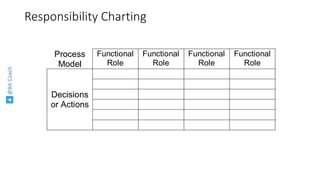
Responsibility Charting
• Responsibility Charting is a technique for identifying functional areas
where there are process ambiguities, bringing the differences out in the
open and resolving them through a cross-functional collaborative effort.
• Responsibility Charting enables managers from the same or different
organizational levels or programs to actively participate in a focused and
systematic discussion about process related descriptions of the actions that
must be accomplished in order to deliver a successful end product or
service.
• Responsibility Charting is a way of systematically clarifying relationships
pertaining to:
• 1. Communication or actions required to deliver an acceptable product or service
• 2. Functional roles or departmental positions (no personal names)
• 3. Participation expectations assigned to roles by decisions or actions
@BACoach
Responsibility Charting
@BACoach
THE RESPONSIBILITY CHARTING THEORY
• Managers and supervisors are not accountable for everything in their
organization.
• Responsibility charting ensures accountability is placed with the person
who really can be accountable for specific work. Often this results in
accountabilities for actions being moved down to the most appropriate
level.
• Everyone has some process role in their job. Because of differing
perceptions, one person’s view of their role may be quite different than
another’s.
• Role perceptions held today will change tomorrow even though the job
activities remain the same.
• There are three (3) basic assumptions in any role:
• Role Conception
• Role Expectation
• Role Behaviour
@BACoach
Role Assumptions
• Role Conception
• What a person thinks his/her job is and how the person has been taught to do
it. His/her thinking may well be influenced by many false assumptions (e.g.,
misleading titles, training received from a predecessor during his or her last
week on the job, etc.)
• Role Expectation
• What others in the organization think the person is responsible for, and how
he/she should carry out those responsibilities. Others’ ideas may also be
influenced by incorrect information (e.g., the way it was at a former job,
priority changes, assumptions, inconsistent messages from leadership, etc.).
The role expectation is usually based on the output of results expected from
the role.
• Role Behaviour
• What a person actually does in carrying out the job.
@BACoach
The RACI technique
• “Responsibility charting” reconciles
• ROLE CONCEPTION (what a person thinks his or her hob is) with
• ROLE EXPECTATION (what others expect of that job) and thus:
• ROLE BEHAVIOR (how the job is actually performed) becomes
• more predictable and productive!.
• The “RACI” technique is a tool to lock all elements in place, provides a real
time consensus that clarifies “who is to do what, with whom and when”,
this is of great benefit for overall process performance.
• A substandard product or process can often be tracked back to a fault in
the chart. Common faults in the chart include:
• an action not included on the chart (that should be),
• a position failing to perform as assigned or
• a missing or misapplied responsibility code.
• The highly visible and collaborative nature of the charting process
promotes rapid and effective updates/corrections as well as better
understanding by those involved in the work.
@BACoach
Responsibility charting: an ongoing activity
• The need for managers and supervisors to
“clarify roles and responsibilities”
• does not end after the Responsibility Charting process is complete;
• It must be an ongoing activity
• Managers need to acquire a “sixth sense” so they can recognize the
symptoms of role confusion and determine when the RACI process
needs to be repeated
• Perception “drift” is natural
• The identification and elimination of “drift” is important to the
company’s overall well being as it relates to cost, service and quality
@BACoach
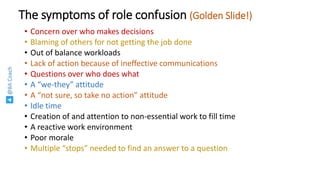
The symptoms of role confusion (Golden Slide!)
• Concern over who makes decisions
• Blaming of others for not getting the job done
• Out of balance workloads
• Lack of action because of ineffective communications
• Questions over who does what
• A “we-they” attitude
• A “not sure, so take no action” attitude
• Idle time
• Creation of and attention to non-essential work to fill time
• A reactive work environment
• Poor morale
• Multiple “stops” needed to find an answer to a question
@BACoach
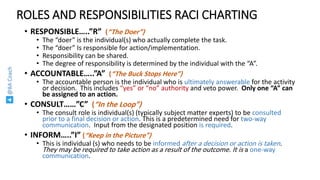
ROLES AND RESPONSIBILITIES RACI CHARTING
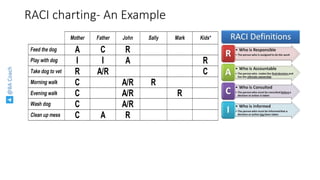
• RESPONSIBLE…..”R” (“The Doer”)
• The “doer” is the individual(s) who actually complete the task.
• The “doer” Is responsible for action/implementation.
• Responsibility can be shared.
• The degree of responsibility is determined by the individual with the “A”.
• ACCOUNTABLE…..”A” (“The Buck Stops Here”)
• The accountable person is the individual who is ultimately answerable for the activity
or decision. This includes “yes” or “no” authority and veto power. Only one “A” can
be assigned to an action.
• CONSULT……”C” (“In the Loop”)
• The consult role is individual(s) (typically subject matter experts) to be consulted
prior to a final decision or action. This is a predetermined need for two-way
communication. Input from the designated position is required.
• INFORM…..”I” (“Keep in the Picture”)
• This is individual (s) who needs to be informed after a decision or action is taken.
They may be required to take action as a result of the outcome. It is a one-way
communication.
@BACoach
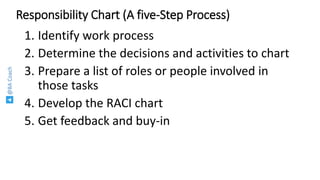
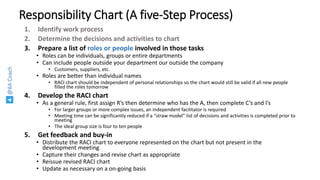
Responsibility Chart (A five-Step Process)
1. Identify work process
2. Determine the decisions and activities to chart
3. Prepare a list of roles or people involved in
those tasks
4. Develop the RACI chart
5. Get feedback and buy-in
@BACoach
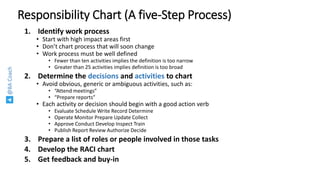
Responsibility Chart (A five-Step Process)
1. Identify work process
• Start with high impact areas first
• Don’t chart process that will soon change
• Work process must be well defined
• Fewer than ten activities implies the definition is too narrow
• Greater than 25 activities implies definition is too broad
2. Determine the decisions and activities to chart
• Avoid obvious, generic or ambiguous activities, such as:
• “Attend meetings”
• “Prepare reports”
• Each activity or decision should begin with a good action verb
• Evaluate Schedule Write Record Determine
• Operate Monitor Prepare Update Collect
• Approve Conduct Develop Inspect Train
• Publish Report Review Authorize Decide
3. Prepare a list of roles or people involved in those tasks
4. Develop the RACI chart
5. Get feedback and buy-in
@BACoach
Responsibility Chart (A five-Step Process)
1. Identify work process
2. Determine the decisions and activities to chart
3. Prepare a list of roles or people involved in those tasks
• Roles can be individuals, groups or entire departments
• Can include people outside your department our outside the company
• Customers, suppliers, etc.
• Roles are better than individual names
• RACI chart should be independent of personal relationships so the chart would still be valid if all new people
filled the roles tomorrow
4. Develop the RACI chart
• As a general rule, first assign R’s then determine who has the A, then complete C’s and I’s
• For larger groups or more complex issues, an independent facilitator is required
• Meeting time can be significantly reduced if a “straw model” list of decisions and activities is completed prior to
meeting
• The ideal group size is four to ten people
5. Get feedback and buy-in
• Distribute the RACI chart to everyone represented on the chart but not present in the
development meeting
• Capture their changes and revise chart as appropriate
• Reissue revised RACI chart
• Update as necessary on a on-going basis
@BACoach
RACI charting- An Example
@BACoach
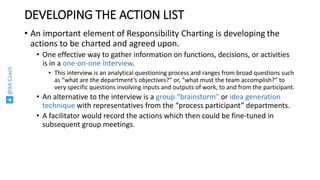
DEVELOPING THE ACTION LIST
• An important element of Responsibility Charting is developing the
actions to be charted and agreed upon.
• One effective way to gather information on functions, decisions, or activities
is in a one-on-one interview.
• This interview is an analytical questioning process and ranges from broad questions such
as “what are the department’s objectives?” or, “what must the team accomplish?” to
very specific questions involving inputs and outputs of work, to and from the participant.
• An alternative to the interview is a group “brainstorm” or idea generation
technique with representatives from the “process participant” departments.
• A facilitator would record the actions which then could be fine-tuned in
subsequent group meetings.
@BACoach
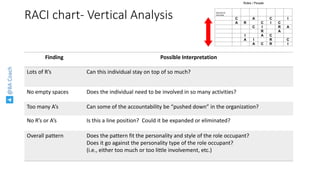
RACI chart- Vertical Analysis
Finding Possible Interpretation
Lots of R’s Can this individual stay on top of so much?
No empty spaces Does the individual need to be involved in so many activities?
Too many A’s Can some of the accountability be “pushed down” in the organization?
No R’s or A’s Is this a line position? Could it be expanded or eliminated?
Overall pattern Does the pattern fit the personality and style of the role occupant?
Does it go against the personality type of the role occupant?
(i.e., either too much or too little involvement, etc.)
@BACoach
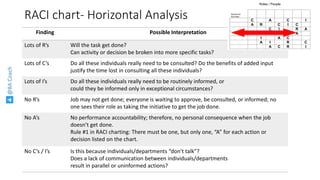
RACI chart- Horizontal Analysis
Finding Possible Interpretation
Lots of R’s Will the task get done?
Can activity or decision be broken into more specific tasks?
Lots of C’s Do all these individuals really need to be consulted? Do the benefits of added input
justify the time lost in consulting all these individuals?
Lots of I’s Do all these individuals really need to be routinely informed, or
could they be informed only in exceptional circumstances?
No R’s Job may not get done; everyone is waiting to approve, be consulted, or informed; no
one sees their role as taking the initiative to get the job done.
No A’s No performance accountability; therefore, no personal consequence when the job
doesn’t get done.
Rule #1 in RACI charting: There must be one, but only one, “A” for each action or
decision listed on the chart.
No C’s / I’s Is this because individuals/departments “don’t talk”?
Does a lack of communication between individuals/departments
result in parallel or uninformed actions?
@BACoach
R A C I Closing Guidelines
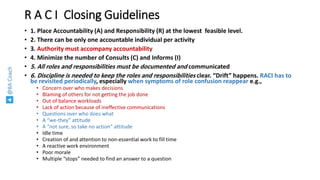
• 1. Place Accountability (A) and Responsibility (R) at the lowest feasible level.
• 2. There can be only one accountable individual per activity
• 3. Authority must accompany accountability
• 4. Minimize the number of Consults (C) and Informs (I)
• 5. All roles and responsibilities must be documented and communicated
• 6. Discipline is needed to keep the roles and responsibilities clear. “Drift” happens. RACI has to
be revisited periodically, especially when symptoms of role confusion reappear e.g.,
• Concern over who makes decisions
• Blaming of others for not getting the job done
• Out of balance workloads
• Lack of action because of ineffective communications
• Questions over who does what
• A “we-they” attitude
• A “not sure, so take no action” attitude
• Idle time
• Creation of and attention to non-essential work to fill time
• A reactive work environment
• Poor morale
• Multiple “stops” needed to find an answer to a question
@BACoach
When To Use Responsibility Charting
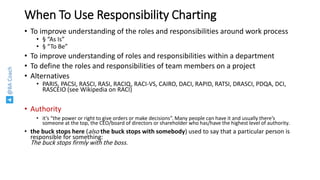
• To improve understanding of the roles and responsibilities around work process
• § “As Is”
• § “To Be”
• To improve understanding of roles and responsibilities within a department
• To define the roles and responsibilities of team members on a project
• Alternatives
• PARIS, PACSI, RASCI, RASI, RACIQ, RACI-VS, CAIRO, DACI, RAPID, RATSI, DRASCI, PDQA, DCI,
RASCEIO (see Wikipedia on RACI)
• Authority
• it’s “the power or right to give orders or make decisions”. Many people can have it and usually there’s
someone at the top, the CEO/board of directors or shareholder who has/have the highest level of authority.
• the buck stops here (also the buck stops with somebody) used to say that a particular person is
responsible for something:
The buck stops firmly with the boss.
@BACoach
Role behavior
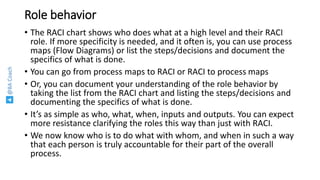
• The RACI chart shows who does what at a high level and their RACI
role. If more specificity is needed, and it often is, you can use process
maps (Flow Diagrams) or list the steps/decisions and document the
specifics of what is done.
• You can go from process maps to RACI or RACI to process maps
• Or, you can document your understanding of the role behavior by
taking the list from the RACI chart and listing the steps/decisions and
documenting the specifics of what is done.
• It’s as simple as who, what, when, inputs and outputs. You can expect
more resistance clarifying the roles this way than just with RACI.
• We now know who is to do what with whom, and when in such a way
that each person is truly accountable for their part of the overall
process.
@BACoach
Accountability
vs.
Responsibility
By Ali Morshedsolouk
@BACoach
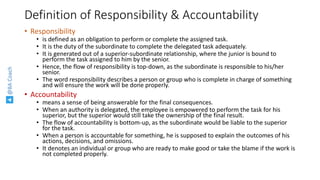
Definition of Responsibility & Accountability
• Responsibility
• is defined as an obligation to perform or complete the assigned task.
• It is the duty of the subordinate to complete the delegated task adequately.
• It is generated out of a superior-subordinate relationship, where the junior is bound to
perform the task assigned to him by the senior.
• Hence, the flow of responsibility is top-down, as the subordinate is responsible to his/her
senior.
• The word responsibility describes a person or group who is complete in charge of something
and will ensure the work will be done properly.
• Accountability
• means a sense of being answerable for the final consequences.
• When an authority is delegated, the employee is empowered to perform the task for his
superior, but the superior would still take the ownership of the final result.
• The flow of accountability is bottom-up, as the subordinate would be liable to the superior
for the task.
• When a person is accountable for something, he is supposed to explain the outcomes of his
actions, decisions, and omissions.
• It denotes an individual or group who are ready to make good or take the blame if the work is
not completed properly.
@BACoach
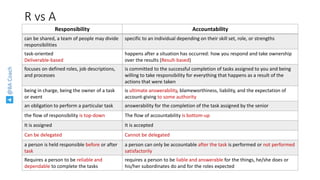
R vs A
Responsibility Accountability
can be shared, a team of people may divide
responsibilities
specific to an individual depending on their skill set, role, or strengths
task-oriented
Deliverable-based
happens after a situation has occurred: how you respond and take ownership
over the results (Result-based)
focuses on defined roles, job descriptions,
and processes
is committed to the successful completion of tasks assigned to you and being
willing to take responsibility for everything that happens as a result of the
actions that were taken
being in charge, being the owner of a task
or event
is ultimate answerability, blameworthiness, liability, and the expectation of
account-giving to some authority
an obligation to perform a particular task answerability for the completion of the task assigned by the senior
the flow of responsibility is top-down The flow of accountability is bottom-up
It is assigned It is accepted
Can be delegated Cannot be delegated
a person is held responsible before or after
task
a person can only be accountable after the task is performed or not performed
satisfactorily
Requires a person to be reliable and
dependable to complete the tasks
requires a person to be liable and answerable for the things, he/she does or
his/her subordinates do and for the roles expected
@BACoach
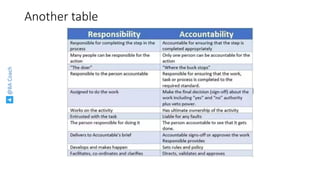
Another table
@BACoach
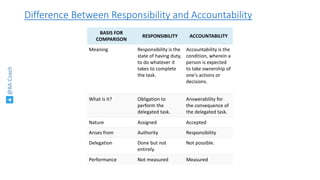
Difference Between Responsibility and Accountability
BASIS FOR
COMPARISON
RESPONSIBILITY ACCOUNTABILITY
Meaning Responsibility is the
state of having duty,
to do whatever it
takes to complete
the task.
Accountability is the
condition, wherein a
person is expected
to take ownership of
one's actions or
decisions.
What is it? Obligation to
perform the
delegated task.
Answerability for
the consequence of
the delegated task.
Nature Assigned Accepted
Arises from Authority Responsibility
Delegation Done but not
entirely.
Not possible.
Performance Not measured Measured
@BACoach
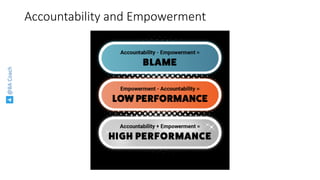
Accountability and Empowerment
@BACoach
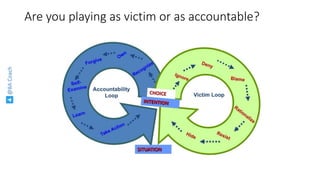
Are you playing as victim or as accountable?
@BACoach
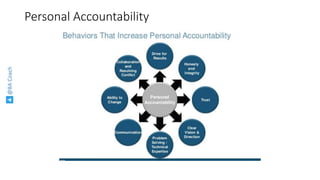
Personal Accountability
@BACoach
sources
• Role & Responsibility Charting (RACI).pdf
• by Michael L Smith and James Erwin (Internet Search)
• https://en.wikipedia.org/wiki/Responsibility_assignment_matrix
• BABOK 3.0 framework (technique #10.39)
• http://www.resourcesinaction.com/articles/PDFs/acctability_vicitm.p
df
• https://spark.adobe.com/page/vZ8Be/

RACI chart, Accountability and Responsibility

  • 1.
  • 2.
  • 3.
    @BACoach Responsibility Charting • ResponsibilityCharting is a technique for identifying functional areas where there are process ambiguities, bringing the differences out in the open and resolving them through a cross-functional collaborative effort. • Responsibility Charting enables managers from the same or different organizational levels or programs to actively participate in a focused and systematic discussion about process related descriptions of the actions that must be accomplished in order to deliver a successful end product or service. • Responsibility Charting is a way of systematically clarifying relationships pertaining to: • 1. Communication or actions required to deliver an acceptable product or service • 2. Functional roles or departmental positions (no personal names) • 3. Participation expectations assigned to roles by decisions or actions
  • 4.
  • 5.
    @BACoach THE RESPONSIBILITY CHARTINGTHEORY • Managers and supervisors are not accountable for everything in their organization. • Responsibility charting ensures accountability is placed with the person who really can be accountable for specific work. Often this results in accountabilities for actions being moved down to the most appropriate level. • Everyone has some process role in their job. Because of differing perceptions, one person’s view of their role may be quite different than another’s. • Role perceptions held today will change tomorrow even though the job activities remain the same. • There are three (3) basic assumptions in any role: • Role Conception • Role Expectation • Role Behaviour
  • 6.
    @BACoach Role Assumptions • RoleConception • What a person thinks his/her job is and how the person has been taught to do it. His/her thinking may well be influenced by many false assumptions (e.g., misleading titles, training received from a predecessor during his or her last week on the job, etc.) • Role Expectation • What others in the organization think the person is responsible for, and how he/she should carry out those responsibilities. Others’ ideas may also be influenced by incorrect information (e.g., the way it was at a former job, priority changes, assumptions, inconsistent messages from leadership, etc.). The role expectation is usually based on the output of results expected from the role. • Role Behaviour • What a person actually does in carrying out the job.
  • 7.
    @BACoach The RACI technique •“Responsibility charting” reconciles • ROLE CONCEPTION (what a person thinks his or her hob is) with • ROLE EXPECTATION (what others expect of that job) and thus: • ROLE BEHAVIOR (how the job is actually performed) becomes • more predictable and productive!. • The “RACI” technique is a tool to lock all elements in place, provides a real time consensus that clarifies “who is to do what, with whom and when”, this is of great benefit for overall process performance. • A substandard product or process can often be tracked back to a fault in the chart. Common faults in the chart include: • an action not included on the chart (that should be), • a position failing to perform as assigned or • a missing or misapplied responsibility code. • The highly visible and collaborative nature of the charting process promotes rapid and effective updates/corrections as well as better understanding by those involved in the work.
  • 8.
    @BACoach Responsibility charting: anongoing activity • The need for managers and supervisors to “clarify roles and responsibilities” • does not end after the Responsibility Charting process is complete; • It must be an ongoing activity • Managers need to acquire a “sixth sense” so they can recognize the symptoms of role confusion and determine when the RACI process needs to be repeated • Perception “drift” is natural • The identification and elimination of “drift” is important to the company’s overall well being as it relates to cost, service and quality
  • 9.
    @BACoach The symptoms ofrole confusion (Golden Slide!) • Concern over who makes decisions • Blaming of others for not getting the job done • Out of balance workloads • Lack of action because of ineffective communications • Questions over who does what • A “we-they” attitude • A “not sure, so take no action” attitude • Idle time • Creation of and attention to non-essential work to fill time • A reactive work environment • Poor morale • Multiple “stops” needed to find an answer to a question
  • 10.
    @BACoach ROLES AND RESPONSIBILITIESRACI CHARTING • RESPONSIBLE…..”R” (“The Doer”) • The “doer” is the individual(s) who actually complete the task. • The “doer” Is responsible for action/implementation. • Responsibility can be shared. • The degree of responsibility is determined by the individual with the “A”. • ACCOUNTABLE…..”A” (“The Buck Stops Here”) • The accountable person is the individual who is ultimately answerable for the activity or decision. This includes “yes” or “no” authority and veto power. Only one “A” can be assigned to an action. • CONSULT……”C” (“In the Loop”) • The consult role is individual(s) (typically subject matter experts) to be consulted prior to a final decision or action. This is a predetermined need for two-way communication. Input from the designated position is required. • INFORM…..”I” (“Keep in the Picture”) • This is individual (s) who needs to be informed after a decision or action is taken. They may be required to take action as a result of the outcome. It is a one-way communication.
  • 11.
    @BACoach Responsibility Chart (Afive-Step Process) 1. Identify work process 2. Determine the decisions and activities to chart 3. Prepare a list of roles or people involved in those tasks 4. Develop the RACI chart 5. Get feedback and buy-in
  • 12.
    @BACoach Responsibility Chart (Afive-Step Process) 1. Identify work process • Start with high impact areas first • Don’t chart process that will soon change • Work process must be well defined • Fewer than ten activities implies the definition is too narrow • Greater than 25 activities implies definition is too broad 2. Determine the decisions and activities to chart • Avoid obvious, generic or ambiguous activities, such as: • “Attend meetings” • “Prepare reports” • Each activity or decision should begin with a good action verb • Evaluate Schedule Write Record Determine • Operate Monitor Prepare Update Collect • Approve Conduct Develop Inspect Train • Publish Report Review Authorize Decide 3. Prepare a list of roles or people involved in those tasks 4. Develop the RACI chart 5. Get feedback and buy-in
  • 13.
    @BACoach Responsibility Chart (Afive-Step Process) 1. Identify work process 2. Determine the decisions and activities to chart 3. Prepare a list of roles or people involved in those tasks • Roles can be individuals, groups or entire departments • Can include people outside your department our outside the company • Customers, suppliers, etc. • Roles are better than individual names • RACI chart should be independent of personal relationships so the chart would still be valid if all new people filled the roles tomorrow 4. Develop the RACI chart • As a general rule, first assign R’s then determine who has the A, then complete C’s and I’s • For larger groups or more complex issues, an independent facilitator is required • Meeting time can be significantly reduced if a “straw model” list of decisions and activities is completed prior to meeting • The ideal group size is four to ten people 5. Get feedback and buy-in • Distribute the RACI chart to everyone represented on the chart but not present in the development meeting • Capture their changes and revise chart as appropriate • Reissue revised RACI chart • Update as necessary on a on-going basis
  • 14.
  • 15.
    @BACoach DEVELOPING THE ACTIONLIST • An important element of Responsibility Charting is developing the actions to be charted and agreed upon. • One effective way to gather information on functions, decisions, or activities is in a one-on-one interview. • This interview is an analytical questioning process and ranges from broad questions such as “what are the department’s objectives?” or, “what must the team accomplish?” to very specific questions involving inputs and outputs of work, to and from the participant. • An alternative to the interview is a group “brainstorm” or idea generation technique with representatives from the “process participant” departments. • A facilitator would record the actions which then could be fine-tuned in subsequent group meetings.
  • 16.
    @BACoach RACI chart- VerticalAnalysis Finding Possible Interpretation Lots of R’s Can this individual stay on top of so much? No empty spaces Does the individual need to be involved in so many activities? Too many A’s Can some of the accountability be “pushed down” in the organization? No R’s or A’s Is this a line position? Could it be expanded or eliminated? Overall pattern Does the pattern fit the personality and style of the role occupant? Does it go against the personality type of the role occupant? (i.e., either too much or too little involvement, etc.)
  • 17.
    @BACoach RACI chart- HorizontalAnalysis Finding Possible Interpretation Lots of R’s Will the task get done? Can activity or decision be broken into more specific tasks? Lots of C’s Do all these individuals really need to be consulted? Do the benefits of added input justify the time lost in consulting all these individuals? Lots of I’s Do all these individuals really need to be routinely informed, or could they be informed only in exceptional circumstances? No R’s Job may not get done; everyone is waiting to approve, be consulted, or informed; no one sees their role as taking the initiative to get the job done. No A’s No performance accountability; therefore, no personal consequence when the job doesn’t get done. Rule #1 in RACI charting: There must be one, but only one, “A” for each action or decision listed on the chart. No C’s / I’s Is this because individuals/departments “don’t talk”? Does a lack of communication between individuals/departments result in parallel or uninformed actions?
  • 18.
    @BACoach R A CI Closing Guidelines • 1. Place Accountability (A) and Responsibility (R) at the lowest feasible level. • 2. There can be only one accountable individual per activity • 3. Authority must accompany accountability • 4. Minimize the number of Consults (C) and Informs (I) • 5. All roles and responsibilities must be documented and communicated • 6. Discipline is needed to keep the roles and responsibilities clear. “Drift” happens. RACI has to be revisited periodically, especially when symptoms of role confusion reappear e.g., • Concern over who makes decisions • Blaming of others for not getting the job done • Out of balance workloads • Lack of action because of ineffective communications • Questions over who does what • A “we-they” attitude • A “not sure, so take no action” attitude • Idle time • Creation of and attention to non-essential work to fill time • A reactive work environment • Poor morale • Multiple “stops” needed to find an answer to a question
  • 19.
    @BACoach When To UseResponsibility Charting • To improve understanding of the roles and responsibilities around work process • § “As Is” • § “To Be” • To improve understanding of roles and responsibilities within a department • To define the roles and responsibilities of team members on a project • Alternatives • PARIS, PACSI, RASCI, RASI, RACIQ, RACI-VS, CAIRO, DACI, RAPID, RATSI, DRASCI, PDQA, DCI, RASCEIO (see Wikipedia on RACI) • Authority • it’s “the power or right to give orders or make decisions”. Many people can have it and usually there’s someone at the top, the CEO/board of directors or shareholder who has/have the highest level of authority. • the buck stops here (also the buck stops with somebody) used to say that a particular person is responsible for something: The buck stops firmly with the boss.
  • 20.
    @BACoach Role behavior • TheRACI chart shows who does what at a high level and their RACI role. If more specificity is needed, and it often is, you can use process maps (Flow Diagrams) or list the steps/decisions and document the specifics of what is done. • You can go from process maps to RACI or RACI to process maps • Or, you can document your understanding of the role behavior by taking the list from the RACI chart and listing the steps/decisions and documenting the specifics of what is done. • It’s as simple as who, what, when, inputs and outputs. You can expect more resistance clarifying the roles this way than just with RACI. • We now know who is to do what with whom, and when in such a way that each person is truly accountable for their part of the overall process.
  • 21.
  • 22.
    @BACoach Definition of Responsibility& Accountability • Responsibility • is defined as an obligation to perform or complete the assigned task. • It is the duty of the subordinate to complete the delegated task adequately. • It is generated out of a superior-subordinate relationship, where the junior is bound to perform the task assigned to him by the senior. • Hence, the flow of responsibility is top-down, as the subordinate is responsible to his/her senior. • The word responsibility describes a person or group who is complete in charge of something and will ensure the work will be done properly. • Accountability • means a sense of being answerable for the final consequences. • When an authority is delegated, the employee is empowered to perform the task for his superior, but the superior would still take the ownership of the final result. • The flow of accountability is bottom-up, as the subordinate would be liable to the superior for the task. • When a person is accountable for something, he is supposed to explain the outcomes of his actions, decisions, and omissions. • It denotes an individual or group who are ready to make good or take the blame if the work is not completed properly.
  • 23.
    @BACoach R vs A ResponsibilityAccountability can be shared, a team of people may divide responsibilities specific to an individual depending on their skill set, role, or strengths task-oriented Deliverable-based happens after a situation has occurred: how you respond and take ownership over the results (Result-based) focuses on defined roles, job descriptions, and processes is committed to the successful completion of tasks assigned to you and being willing to take responsibility for everything that happens as a result of the actions that were taken being in charge, being the owner of a task or event is ultimate answerability, blameworthiness, liability, and the expectation of account-giving to some authority an obligation to perform a particular task answerability for the completion of the task assigned by the senior the flow of responsibility is top-down The flow of accountability is bottom-up It is assigned It is accepted Can be delegated Cannot be delegated a person is held responsible before or after task a person can only be accountable after the task is performed or not performed satisfactorily Requires a person to be reliable and dependable to complete the tasks requires a person to be liable and answerable for the things, he/she does or his/her subordinates do and for the roles expected
  • 24.
  • 25.
    @BACoach Difference Between Responsibilityand Accountability BASIS FOR COMPARISON RESPONSIBILITY ACCOUNTABILITY Meaning Responsibility is the state of having duty, to do whatever it takes to complete the task. Accountability is the condition, wherein a person is expected to take ownership of one's actions or decisions. What is it? Obligation to perform the delegated task. Answerability for the consequence of the delegated task. Nature Assigned Accepted Arises from Authority Responsibility Delegation Done but not entirely. Not possible. Performance Not measured Measured
  • 26.
  • 27.
    @BACoach Are you playingas victim or as accountable?
  • 28.
  • 29.
    @BACoach sources • Role &Responsibility Charting (RACI).pdf • by Michael L Smith and James Erwin (Internet Search) • https://en.wikipedia.org/wiki/Responsibility_assignment_matrix • BABOK 3.0 framework (technique #10.39) • http://www.resourcesinaction.com/articles/PDFs/acctability_vicitm.p df • https://spark.adobe.com/page/vZ8Be/