RABIES 
PRESENTED BY 
MISS SUJATA MOHAPATRA.
DEFINITION 
• Rabies is an acute, progressive 
encephalomyelitis or highly fatal 
viral disease. 
• It is an Epizootic disorder. 
• The case to fatality rate is the 
highest of any infectious disease.
HISTORY 
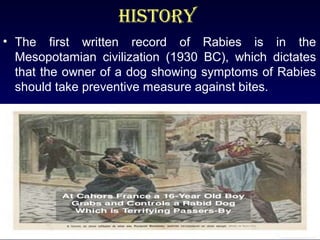
• The first written record of Rabies is in the 
Mesopotamian civilization (1930 BC), which dictates 
that the owner of a dog showing symptoms of Rabies 
should take preventive measure against bites.
DISTRIBUTION 
 Rabies is distributed on all 
continents (with the exception of 
Antarctica). 
 Occurs in more than 150 countries 
& territories. 
 Globally more than 55,000 people 
die of rabies every year. 
 Every year, more than 15 million 
people worldwide receive a post-exposure 
preventive regimen which 
is estimated to prevent 3,27,000 
cases annually.
EPIDEMIOLOGY 
AGENT 
Rabies is caused by RNA viruses belong to 
the family Rhabdoviridae, genus Lyssavirus. 
It is a bullet shaped neurotropic RNA 
containing virus.
HOST & RESERVOIR 
Mammals are the natural hosts of 
rabies. 
All warm-blooded vertebrates including 
Man are susceptible to Rabies. 
Reservoirs consist of the Carnivorous 
such as dog, cat, mongoose, bat etc.
Source of Infection 
 The source of infection to man is the 
saliva of rabid animals. 
 In dogs & cats, the virus may be present in 
the saliva for 3-4 days before the clinical 
onset & during the course of illness till 
death. 
Cause > 90% of the 
Human cases 
3 – 5% of Human 
cases
MODE OF TRANSMISSION
INCUBATION PERIOD 
• It is highly variable in man, commonly 3-8 
weeks following exposure. 
– The closer the bite to the brain, the shorter 
the incubation. 
– Rabies virus travels 1 cm per day.
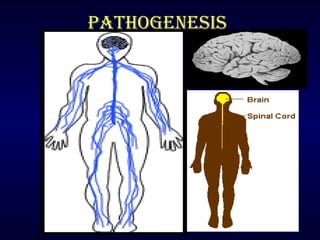
PATHOGENESIS
CLINICAL FEATURES 
Mainly neurologic; 
–Early signs (non-specific) 
•Fever, headache, weakness, achy muscles 
–Late signs 
i.Incoordination, confusion, ssttrraannggee bbeehhaavviioorr 
iiii..AAttttaacckkiinngg aanndd bbiittiinngg mmoovviinngg aatt ssttaattiioonnaarryy 
oobbjjeeccttss 
iii.Salivation (can’t swallow, like choking) 
iv.Hydrophobia, Photophobia, Aerophobia 
v.Paralysis, Seizures 
–DDeeaatthh wwiitthhiinn 22 wweeeekkss ooff sshhoowwiinngg 
ssiiggnnss
RABIES RECOVERY? 
WORLDWIDE 
• Five historical human 
case recoveries, after 
vaccination, but before 
illness onset. 
• Only one documented 
unvaccinated human 
survivor after clinical 
presentation.
DIAGNOSIS
PREVENTION 
• PRE EXPOSURE PROPHYLAXIS 
• POST EXPOSURE PROPHYLAXIS
PRE ExPOsuRE PROPhylaxIs 
• Provided to subjects at risk before 
occupational or vocational exposure 
to rabies. 
• Subjects include diagnosticians, 
laboratory & vaccine workers, 
veterinarians, cavers, etc. 
• Simplifies post exposure 
management. 
• Only vaccines used.
PEP (POsT ExPOsuRE PROPhylaxIs) 
• Provided to subjects after rabies 
exposure. 
• Consists of wound care, rabies immune 
globulin, and vaccine. 
• Cleansing 
• Chemical Treatment 
• Suturing 
• Anti-Rabies Serum 
• Antibiotics & anti-tetanus measure 
• Observe the animal for 10 days.
POsTExPOsuRE PROPhylaxIs 
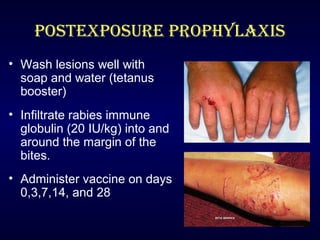
• Wash lesions well with 
soap and water (tetanus 
booster) 
• Infiltrate rabies immune 
globulin (20 IU/kg) into and 
around the margin of the 
bites. 
• Administer vaccine on days 
0,3,7,14, and 28
RaBIEs VaCCINE 
1. Nervous Tissue Vaccine (NTV) 
2. Duck Embryo Vaccine (DEV) 
Purified Chick Embryo Cell RabAvert® (PCEC) 
3. Cell-culture Vaccine (HDC) 
Human Diploid Cell Vaccine Imovax® (HDCV)
VACCINE ADMINISTRATION 
Class of 
treatment 
ADULT CHILDREN Duration of 
Treatment 
Class I 2ml 1ml 7days 
Class II 3ml 3ml 10days 
Class III 5ml 3ml 10days 
(Dosage schedule by Pasture institute, Coonoor) 
CLASS –I (Slight risk) 
CLASS—II (Moderate risk) 
CLASS– III (Severe risk)
Vaccine Administration 
1. Intramuscular Schedules 
 6 doses schedule 
Reduced multisite intramuscular 
regimen (2-1-1) 
2. Intradermal Schedules 
2-Site Intradermal schedule(2-2- 
2-0-1-1) 
8-Site intradermal schedule(8-0- 
4-0-1-1)
RABIES IMMUNoGLoBULIN 
ONLY IN PEP 
• Two Human Rabies 
Immunoglobulins are 
available; 
HyperRabTM S/D 
Imogam® Rabies-HT 
• Both supplied in vials at ~ 
150 IU/ml
ADVERSE REACTIoNS 
• PEP should not be interrupted because of 
local or mild systemic adverse reactions. 
• Use of anti-inflammatory, antihistaminic, and 
antipyretic agents suggested. 
• Serious systemic, anaphylactic, or 
neuroparalytic reactions are rare.
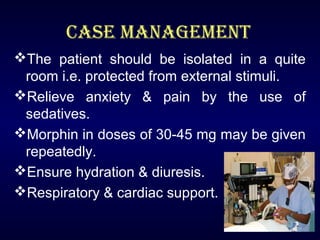
CASE MANAGEMENT 
The patient should be isolated in a quite 
room i.e. protected from external stimuli. 
Relieve anxiety & pain by the use of 
sedatives. 
Morphin in doses of 30-45 mg may be given 
repeatedly. 
Ensure hydration & diuresis. 
Respiratory & cardiac support.
NURSING RESPoNSIBILITY 
Nursing personnel should be warned 
against possible risk of contamination. 
They should wear masks, gloves, 
goggles & aprons to protect themselves. 
Nurses having bruises, cuts or open 
wounds should not be entrusted to look 
after the patient. 
Pre- exposure prophylaxis with 2-3 
doses of HDC vaccine is recommended.
SUMMARIZATIoN
OPEN DISCUSSION

Rabies: Considerations to Nursing

  • 1.
    RABIES PRESENTED BY MISS SUJATA MOHAPATRA.
  • 2.
    DEFINITION • Rabiesis an acute, progressive encephalomyelitis or highly fatal viral disease. • It is an Epizootic disorder. • The case to fatality rate is the highest of any infectious disease.
  • 3.
    HISTORY • Thefirst written record of Rabies is in the Mesopotamian civilization (1930 BC), which dictates that the owner of a dog showing symptoms of Rabies should take preventive measure against bites.
  • 4.
    DISTRIBUTION  Rabiesis distributed on all continents (with the exception of Antarctica).  Occurs in more than 150 countries & territories.  Globally more than 55,000 people die of rabies every year.  Every year, more than 15 million people worldwide receive a post-exposure preventive regimen which is estimated to prevent 3,27,000 cases annually.
  • 5.
    EPIDEMIOLOGY AGENT Rabiesis caused by RNA viruses belong to the family Rhabdoviridae, genus Lyssavirus. It is a bullet shaped neurotropic RNA containing virus.
  • 6.
    HOST & RESERVOIR Mammals are the natural hosts of rabies. All warm-blooded vertebrates including Man are susceptible to Rabies. Reservoirs consist of the Carnivorous such as dog, cat, mongoose, bat etc.
  • 7.
    Source of Infection  The source of infection to man is the saliva of rabid animals.  In dogs & cats, the virus may be present in the saliva for 3-4 days before the clinical onset & during the course of illness till death. Cause > 90% of the Human cases 3 – 5% of Human cases
  • 8.
  • 9.
    INCUBATION PERIOD •It is highly variable in man, commonly 3-8 weeks following exposure. – The closer the bite to the brain, the shorter the incubation. – Rabies virus travels 1 cm per day.
  • 10.
  • 12.
    CLINICAL FEATURES Mainlyneurologic; –Early signs (non-specific) •Fever, headache, weakness, achy muscles –Late signs i.Incoordination, confusion, ssttrraannggee bbeehhaavviioorr iiii..AAttttaacckkiinngg aanndd bbiittiinngg mmoovviinngg aatt ssttaattiioonnaarryy oobbjjeeccttss iii.Salivation (can’t swallow, like choking) iv.Hydrophobia, Photophobia, Aerophobia v.Paralysis, Seizures –DDeeaatthh wwiitthhiinn 22 wweeeekkss ooff sshhoowwiinngg ssiiggnnss
  • 13.
    RABIES RECOVERY? WORLDWIDE • Five historical human case recoveries, after vaccination, but before illness onset. • Only one documented unvaccinated human survivor after clinical presentation.
  • 14.
  • 15.
    PREVENTION • PREEXPOSURE PROPHYLAXIS • POST EXPOSURE PROPHYLAXIS
  • 16.
    PRE ExPOsuRE PROPhylaxIs • Provided to subjects at risk before occupational or vocational exposure to rabies. • Subjects include diagnosticians, laboratory & vaccine workers, veterinarians, cavers, etc. • Simplifies post exposure management. • Only vaccines used.
  • 17.
    PEP (POsT ExPOsuREPROPhylaxIs) • Provided to subjects after rabies exposure. • Consists of wound care, rabies immune globulin, and vaccine. • Cleansing • Chemical Treatment • Suturing • Anti-Rabies Serum • Antibiotics & anti-tetanus measure • Observe the animal for 10 days.
  • 18.
    POsTExPOsuRE PROPhylaxIs •Wash lesions well with soap and water (tetanus booster) • Infiltrate rabies immune globulin (20 IU/kg) into and around the margin of the bites. • Administer vaccine on days 0,3,7,14, and 28
  • 19.
    RaBIEs VaCCINE 1.Nervous Tissue Vaccine (NTV) 2. Duck Embryo Vaccine (DEV) Purified Chick Embryo Cell RabAvert® (PCEC) 3. Cell-culture Vaccine (HDC) Human Diploid Cell Vaccine Imovax® (HDCV)
  • 20.
    VACCINE ADMINISTRATION Classof treatment ADULT CHILDREN Duration of Treatment Class I 2ml 1ml 7days Class II 3ml 3ml 10days Class III 5ml 3ml 10days (Dosage schedule by Pasture institute, Coonoor) CLASS –I (Slight risk) CLASS—II (Moderate risk) CLASS– III (Severe risk)
  • 21.
    Vaccine Administration 1.Intramuscular Schedules  6 doses schedule Reduced multisite intramuscular regimen (2-1-1) 2. Intradermal Schedules 2-Site Intradermal schedule(2-2- 2-0-1-1) 8-Site intradermal schedule(8-0- 4-0-1-1)
  • 22.
    RABIES IMMUNoGLoBULIN ONLYIN PEP • Two Human Rabies Immunoglobulins are available; HyperRabTM S/D Imogam® Rabies-HT • Both supplied in vials at ~ 150 IU/ml
  • 23.
    ADVERSE REACTIoNS •PEP should not be interrupted because of local or mild systemic adverse reactions. • Use of anti-inflammatory, antihistaminic, and antipyretic agents suggested. • Serious systemic, anaphylactic, or neuroparalytic reactions are rare.
  • 24.
    CASE MANAGEMENT Thepatient should be isolated in a quite room i.e. protected from external stimuli. Relieve anxiety & pain by the use of sedatives. Morphin in doses of 30-45 mg may be given repeatedly. Ensure hydration & diuresis. Respiratory & cardiac support.
  • 25.
    NURSING RESPoNSIBILITY Nursingpersonnel should be warned against possible risk of contamination. They should wear masks, gloves, goggles & aprons to protect themselves. Nurses having bruises, cuts or open wounds should not be entrusted to look after the patient. Pre- exposure prophylaxis with 2-3 doses of HDC vaccine is recommended.
  • 26.
  • 27.