













BLOOD
TRANSFUSION
THERAPY
Presented by:
GAUTAMI TIRPUDE
SUHRC, PUNE
BLOOD
FLUID CONNECTIVE TISSUE
Ph: 7.35-7.45
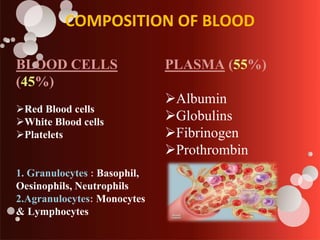
COMPOSITION OF BLOOD
BLOOD CELLS
(45%)
Red Blood cells
White Blood cells
Platelets
1. Granulocytes : Basophil,
Oesinophils, Neutrophils
2.Agranulocytes: Monocytes
& Lymphocytes
PLASMA (55%)
Albumin
Globulins
Fibrinogen
Prothrombin
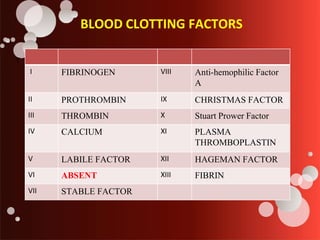
BLOOD CLOTTING FACTORS
T
I FIBRINOGEN VIII Anti-hemophilic Factor
A
II PROTHROMBIN IX CHRISTMAS FACTOR
III THROMBIN X Stuart Prower Factor
IV CALCIUM XI PLASMA
THROMBOPLASTIN
V LABILE FACTOR XII HAGEMAN FACTOR
VI ABSENT XIII FIBRIN
VII STABLE FACTOR
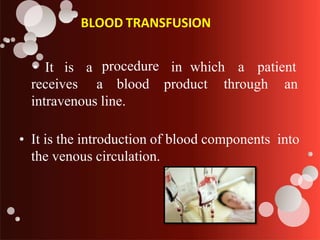
BLOOD TRANSFUSION
• It is a procedure in which a patient
receives a blood product through an
intravenous line.
• It is the introduction of blood components into
the venous circulation.
Purposes
• To replace blood lost during surgery or a serious
injury.
• To restore oxygen-carrying capacity of the blood.
• T
o provide plasma factors to prevent or treat
bleeding.
• Done if patient’s body is not capable of making
blood properly because of an illness.
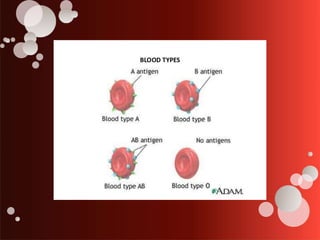
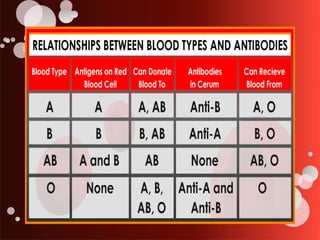
BLOOD TYPES
 The blood used in a transfusion must be
compatible with the patient's blood type.
Type "O" : Universal donor
Type "AB": Universal recipients
People with Rh-positive blood can get Rh-
positive or Rh-negative blood. But people with
Rh-negative blood should get only Rh-
negative blood.
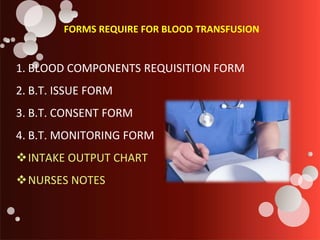
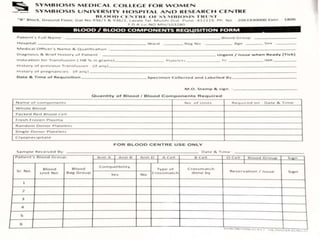
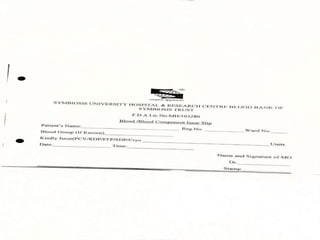
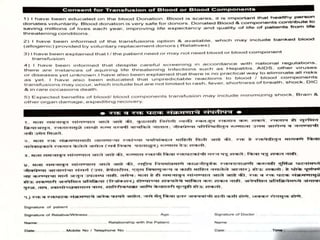
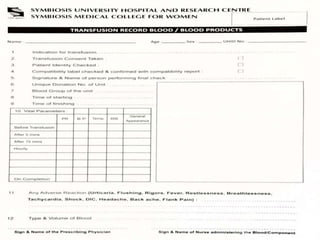
FORMS REQUIRE FOR BLOOD TRANSFUSION
1. BLOOD COMPONENTS REQUISITION FORM
2. B.T. ISSUE FORM
3. B.T. CONSENT FORM
4. B.T. MONITORING FORM
INTAKE OUTPUT CHART
NURSES NOTES
PRE-TRANSFUSION NURSING RESPONSIBILITIES
Verify Doctor’s Order. Inform the Patient &
explain the purpose of the Procedure.
Obtain & Record Baseline Vital Signs
PRACTICE STRICT ASEPSIS
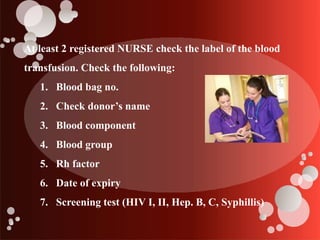
At least 2 registered NURSE check the label of the blood
transfusion. Check the following:
1. Blood bag no.
2. Check donor’s name
3. Blood component
4. Blood group
5. Rh factor
6. Date of expiry
7. Screening test (HIV I, II, Hep. B, C, Syphillis)
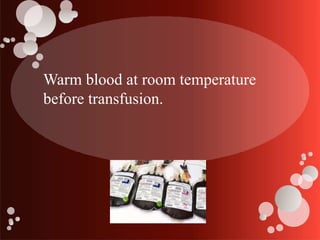
Warm blood at room temperature
before transfusion.
Identify client properly. Two Nurses
check the client’s identification.
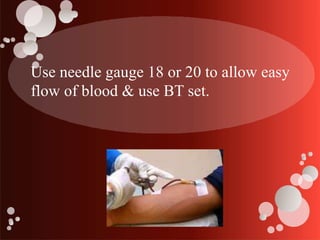
Use needle gauge 18 or 20 to allow easy
flow of blood & use BT set.
ADMINISTERING BLOOD
 The procedure usually takes one to four
hours.
The time depends on how much blood is
needed, which blood product is given, and
whether the patient's body can safely
receive blood quickly or not.
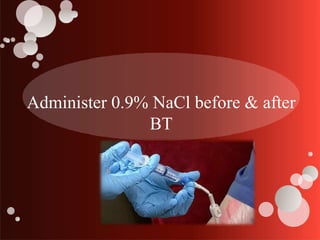
Administer 0.9% NaCl before & after
BT
Observe for potential complications.
Notify physician.
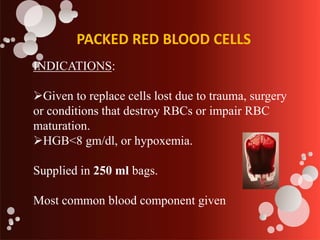
PACKED RED BLOOD CELLS
INDICATIONS:
Given to replace cells lost due to trauma, surgery
or conditions that destroy RBCs or impair RBC
maturation.
HGB<8 gm/dl, or hypoxemia.
Supplied in 250 ml bags.
Most common blood component given
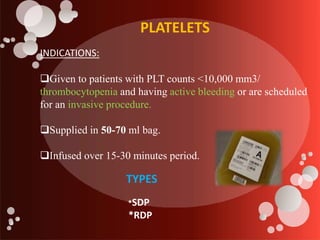
PLATELETS
INDICATIONS:
Given to patients with PLT counts <10,000 mm3/
thrombocytopenia and having active bleeding or are scheduled
for an invasive procedure.
Supplied in 50-70 ml bag.
Infused over 15-30 minutes period.
TYPES
*SDP
*RDP
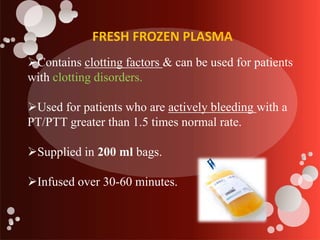
FRESH FROZEN PLASMA
Contains clotting factors & can be used for patients
with clotting disorders.
Used for patients who are actively bleeding with a
PT/PTT greater than 1.5 times normal rate.
Supplied in 200 ml bags.
Infused over 30-60 minutes.
GRANULOCYTES (WBC)
For patients with infections.
Suspended in 400 ml plasma.
Infuse in 45-60 minutes.
CRYOPRECIPITATE
Derived from plasma.
For clients with clotting factor disorders.
Contains: Clotting factors VIII, XIII, Van Willebrand’s factor &
fibrinogen.
Infused @ 10-15 ml/unit; usually given by IV push within 3
minutes
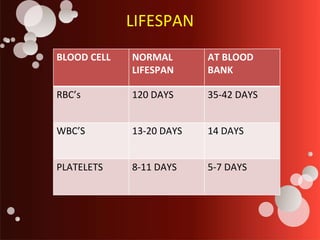
LIFESPAN
BLOOD CELL NORMAL
LIFESPAN
AT BLOOD
BANK
RBC’s 120 DAYS 35-42 DAYS
WBC’S 13-20 DAYS 14 DAYS
PLATELETS 8-11 DAYS 5-7 DAYS
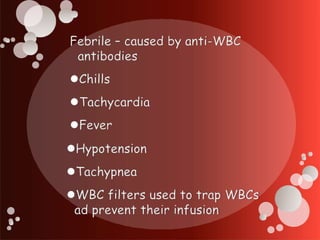
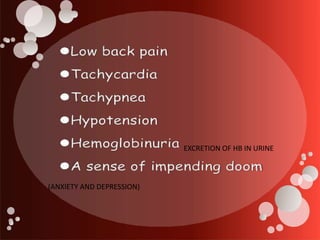
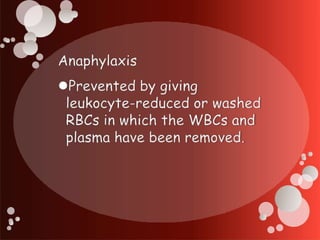
Blood Transfusion
Reaction
EXCRETION OF HB IN URINE
(ANXIETY AND DEPRESSION)
(RASH OF SKIN)
(NARROWING OF BRONCHI)
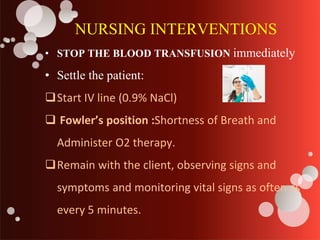
NURSING INTERVENTIONS
• STOP THE BLOOD TRANSFUSION immediately
• Settle the patient:
Start IV line (0.9% NaCl)
 Fowler’s position :Shortness of Breath and
Administer O2 therapy.
Remain with the client, observing signs and
symptoms and monitoring vital signs as often as
every 5 minutes.
NURSING INTERVENTIONS CONTD.....
• Inform the Doctor & Incharge Sister immediately.
• Prepare to administer emergency drugs.
• Obtain a urine specimen & blood sample from
opposite hand.
• Send blood bag, blood set, and sample to blood bank.
• Fill the post transfusion feedback form.
Blood transfusion & nursing responsibilities

Blood transfusion & nursing responsibilities

  • 2.
  • 7.
  • 8.
    COMPOSITION OF BLOOD BLOODCELLS (45%) Red Blood cells White Blood cells Platelets 1. Granulocytes : Basophil, Oesinophils, Neutrophils 2.Agranulocytes: Monocytes & Lymphocytes PLASMA (55%) Albumin Globulins Fibrinogen Prothrombin
  • 9.
    BLOOD CLOTTING FACTORS T IFIBRINOGEN VIII Anti-hemophilic Factor A II PROTHROMBIN IX CHRISTMAS FACTOR III THROMBIN X Stuart Prower Factor IV CALCIUM XI PLASMA THROMBOPLASTIN V LABILE FACTOR XII HAGEMAN FACTOR VI ABSENT XIII FIBRIN VII STABLE FACTOR
  • 10.
    BLOOD TRANSFUSION • Itis a procedure in which a patient receives a blood product through an intravenous line. • It is the introduction of blood components into the venous circulation.
  • 11.
    Purposes • To replaceblood lost during surgery or a serious injury. • To restore oxygen-carrying capacity of the blood. • T o provide plasma factors to prevent or treat bleeding. • Done if patient’s body is not capable of making blood properly because of an illness.
  • 12.
    BLOOD TYPES  Theblood used in a transfusion must be compatible with the patient's blood type. Type "O" : Universal donor Type "AB": Universal recipients People with Rh-positive blood can get Rh- positive or Rh-negative blood. But people with Rh-negative blood should get only Rh- negative blood.
  • 15.
    FORMS REQUIRE FORBLOOD TRANSFUSION 1. BLOOD COMPONENTS REQUISITION FORM 2. B.T. ISSUE FORM 3. B.T. CONSENT FORM 4. B.T. MONITORING FORM INTAKE OUTPUT CHART NURSES NOTES
  • 16.
  • 17.
    Verify Doctor’s Order.Inform the Patient & explain the purpose of the Procedure.
  • 18.
    Obtain & RecordBaseline Vital Signs
  • 19.
  • 20.
    At least 2registered NURSE check the label of the blood transfusion. Check the following: 1. Blood bag no. 2. Check donor’s name 3. Blood component 4. Blood group 5. Rh factor 6. Date of expiry 7. Screening test (HIV I, II, Hep. B, C, Syphillis)
  • 21.
    Warm blood atroom temperature before transfusion.
  • 22.
    Identify client properly.Two Nurses check the client’s identification.
  • 23.
    Use needle gauge18 or 20 to allow easy flow of blood & use BT set.
  • 24.
    ADMINISTERING BLOOD  Theprocedure usually takes one to four hours. The time depends on how much blood is needed, which blood product is given, and whether the patient's body can safely receive blood quickly or not.
  • 28.
    Administer 0.9% NaClbefore & after BT
  • 29.
    Observe for potentialcomplications. Notify physician.
  • 31.
    PACKED RED BLOODCELLS INDICATIONS: Given to replace cells lost due to trauma, surgery or conditions that destroy RBCs or impair RBC maturation. HGB<8 gm/dl, or hypoxemia. Supplied in 250 ml bags. Most common blood component given
  • 32.
    PLATELETS INDICATIONS: Given to patientswith PLT counts <10,000 mm3/ thrombocytopenia and having active bleeding or are scheduled for an invasive procedure. Supplied in 50-70 ml bag. Infused over 15-30 minutes period. TYPES *SDP *RDP
  • 33.
    FRESH FROZEN PLASMA Containsclotting factors & can be used for patients with clotting disorders. Used for patients who are actively bleeding with a PT/PTT greater than 1.5 times normal rate. Supplied in 200 ml bags. Infused over 30-60 minutes.
  • 34.
    GRANULOCYTES (WBC) For patientswith infections. Suspended in 400 ml plasma. Infuse in 45-60 minutes.
  • 35.
    CRYOPRECIPITATE Derived from plasma. Forclients with clotting factor disorders. Contains: Clotting factors VIII, XIII, Van Willebrand’s factor & fibrinogen. Infused @ 10-15 ml/unit; usually given by IV push within 3 minutes
  • 36.
    LIFESPAN BLOOD CELL NORMAL LIFESPAN ATBLOOD BANK RBC’s 120 DAYS 35-42 DAYS WBC’S 13-20 DAYS 14 DAYS PLATELETS 8-11 DAYS 5-7 DAYS
  • 37.
  • 40.
    EXCRETION OF HBIN URINE (ANXIETY AND DEPRESSION)
  • 41.
  • 47.
    NURSING INTERVENTIONS • STOPTHE BLOOD TRANSFUSION immediately • Settle the patient: Start IV line (0.9% NaCl)  Fowler’s position :Shortness of Breath and Administer O2 therapy. Remain with the client, observing signs and symptoms and monitoring vital signs as often as every 5 minutes.
  • 48.
    NURSING INTERVENTIONS CONTD..... •Inform the Doctor & Incharge Sister immediately. • Prepare to administer emergency drugs. • Obtain a urine specimen & blood sample from opposite hand. • Send blood bag, blood set, and sample to blood bank. • Fill the post transfusion feedback form.