
.
CRITICAL CARE UNIT
Critical care unit is a specially
designed and equipped facility
staffed by skilled personnel to
provide effective and safe care for
dependent patients with a life
threatening problem.
CRITICAL CARE
NURSING
Critical care nursing is that
specialty within nursing that deals
specifically with human
responses to life-threatening
problems.
CRITICAL CARE
NURSE
A critical care nurse is a licensed
professional nurse who is
responsible for ensuring that
acutely and critically ill patients
and their families receive optimal
care .
Compassion
Communication (with patient and family).
Consideration (to patients, relatives and
colleagues) and avoidance of Conflict.
Comfort: prevention of suffering
Carefulness (avoidance of injury)
Consistency
Closure (ethics and withdrawal of care).
SEVEN CS OF CRITICAL
CARE
There are two types of ICUs,
 An open :- In this type, physicians
admit, treat and discharge.
A closed: in this type, the admission,
discharge and referral policies are
under the control of intensivists.
TYPES OF ICUS
Level I: This can be referred as high
dependency , where close monitoring,
resuscitation, and short term ventilation
will be provided for <24hrs. Nurse patient
ratio is 1:3 and medical staff are not
present in the unit all the time.
ICU’S CAN BE CLASSIFIED AS:
Level II: Provides observation ,
monitoring and long term ventilation
with Resident Doctors. The Nurse–Patient
ratio is 1:2 and junior meical staff is
available in the unit all the time and
Consultant medical staff is available if
needed.
Level III: Located in a major tertiary
hospital, which is a referral hospital. It
should provide all aspects of intensive care
required.(dialysis, cath lab services,etc)
TYPES OF CRITICAL CARE UNITS
 NEONATAL INTENSIVE CARE UNIT(NICU)
{1-28days}
 PEDIATRIC INTENSIVE CARE UNIT(PICU)
{1 month-14yrs}
 PSYCHIATRIC INTENSIVE CAE UNIT
 CORONARY CARE UNIT(CCU)
 CARDIAC SURGERY INTENSIVE CARE UNIT (CSICU)
 CARDIO-VASCULAR INTENSIVE CARE UNIT (CVICU)
 MEDICAL INTENSIVE CARE UNIT (MICU)
 MEDICAL SURGICAL INTENSIVE CARE UNIT (MSICU)
.
 NEURO SURGERY INTENSIVE CARE UNIT
(NSICU)
 BURN INTENSIVE CARE UNIT (BNICU)
 SURGICAL INTENSIVE CARE UNIT (SICU)
 TRAUMA INTENSIVE CARE UNIT / TRAUMA
CARE AND EMERGENCY CARE SERVICES (TICU /
TC&EMS)
 RESPIRATORY INTENSIVE CARE UNIT (RICU)
 GERIATRIC INTENSIVE CARE UNIT (GICU)
PRINCIPALS OF CRITICAL CARE
NURSING
ANTICIPATION:
*The first principals in critical care is
Anticipation. One has to recognize the high
risk patients and anticipate the requirements,
*CCN can be prepared to meet any emergency
. Unit is properly organised in which all
necessary equipments and supplies are
mandatory for smooth running of the unit.
.
EARLY DETECTION AND
PROMPT ACTION:
The prognosis of the patient depends
on the early detection of variation ,
prompt and appropriate action to
prevent or combat complication.
Eg:-Monitoring of cardiac respiratory
function is of prime importance in
assessment.
.
COLLABORATIVE PRACTICE:
Critical care, which has originated as
technical sub-specialized body of knowledge
has evolved into a comprehensive discipline
requiring a very specialized body of
knowledge for the physicians and nurses
working in the critical care unit fosters a
partnerships for decision making and
ensures quality and compassionate patient
care .
Collaborate practice is more and more
warranted for critical care more then in any
other field.
.
COMMUNICATION:
* Intra professional, inter departmental
and inter personal communication has a
significant importance in the smooth
running of unit.
*Collaborative practice of communication
model unlike the traditional practice
model enhances better outcome as far as
patients, nurse, physician and hospital are
concerned.This model centers around the
patient, fosters individual clinical decision
making , uses integrated medical records
and join review of care.
.
PREVENTION OF INFECTION:
Nosocomial infection cost a lot in the
health care services . Critically ill patients
requiring intensive care are at a greter risk
than other patients due to the immuno-
compromised state with the antibiotic
usage and stress, invasive lines,
mechanical ventilators, prologed stay and
severity of illness and environment of the
critical unit itself.
.
CRISIS INTERVENTION AND
STRESS REDUCTION:
Partnerships are formulated during crisis.
Bonds between nurses , patients and
families are stronger during
hospitalization. As patient advocates ,
nurses assist the patient to express fear ,
confusion, and identify their grieving
pattern and provide avenues for positive
coping.
STAFFING
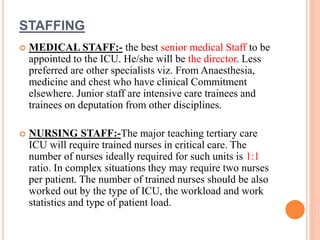
 MEDICAL STAFF:- the best senior medical Staff to be
appointed to the ICU. He/she will be the director. Less
preferred are other specialists viz. From Anaesthesia,
medicine and chest who have clinical Commitment
elsewhere. Junior staff are intensive care trainees and
trainees on deputation from other disciplines.
 NURSING STAFF:-The major teaching tertiary care
ICU will require trained nurses in critical care. The
number of nurses ideally required for such units is 1:1
ratio. In complex situations they may require two nurses
per patient. The number of trained nurses should be also
worked out by the type of ICU, the workload and work
statistics and type of patient load.
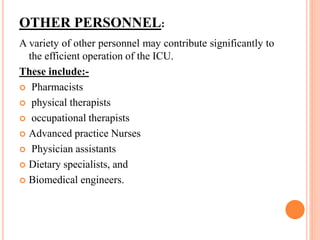
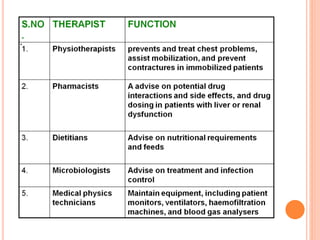
OTHER PERSONNEL:
A variety of other personnel may contribute significantly to
the efficient operation of the ICU.
These include:-
 Pharmacists
 physical therapists
 occupational therapists
 Advanced practice Nurses
 Physician assistants
 Dietary specialists, and
 Biomedical engineers.
.
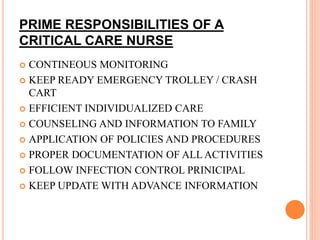
PRIME RESPONSIBILITIES OF A
CRITICAL CARE NURSE
 CONTINEOUS MONITORING
 KEEP READY EMERGENCY TROLLEY / CRASH
CART
 EFFICIENT INDIVIDUALIZED CARE
 COUNSELING AND INFORMATION TO FAMILY
 APPLICATION OF POLICIES AND PROCEDURES
 PROPER DOCUMENTATION OF ALL ACTIVITIES
 FOLLOW INFECTION CONTROL PRINICIPAL
 KEEP UPDATE WITH ADVANCE INFORMATION
QUICK REFERENCE PROTOCOL FOR
MANAGING EMERGENCY IN ICU
 Quickly review the patient- identify,History, Physical
exam.
 Be with patient , ask for help.
 Place the patient in a suitable position.
 Attach the cardiac monitor and call for crash cart.
 Maintain ABC along with expert team .
 Introduce IV ,CV line and TPNI
 Administer medication as needed.
 Carry on investigation –ABG, ECG. RFT LFT TFT,
CARDIAC ENZYMES.etc
.
 Careful onitoring of hemodynamic status of patient.
 Maintain fluid intake and eletrolytes balance.
 Record right things at right time rightly.
CRITICAL CARE NURSE:-
FACTORS TO BE CONSIDERED IN RECRUITING
CRITICAL CARE NURSES ARE
Intra and interpersonal factors.
Technical qualifications.
Educational background.
Clinical experience.
ORGANIZATIONAL MODELS FOR ICUS:
 the open model allows many different members
of the medical staff to manage patients in the
ICU.
 the closed model is limited to ICU-certified
physicians managing the care of all patients; and
 the hybrid model, which combines aspects of
open and closed models by staffing the ICU with
an attending physician and/or team to work in
tandem with primary physicians.
DEFINITION OF INTENSIVE CARE UNIT
EQUIPMENTS:-
 Intensive care unit (ICU) equipment includes
patient monitoring, respiratory and cardiac
support, pain management, emergency
resuscitation devices, and other life support
equipment designed to care for patients who are
seriously injured, have a critical or life-
threatening illness, or have undergone a major
surgical procedure, thereby requiring 24-hour
care and monitoring.
DESCRIPTION
Intensive care unit equipment
includes:-
patient monitoring
 life support and emergency
resuscitation devices
 diagnostic devices
PATIENT MONITORING EQUIPMENTS
Acute physiologic monitoring system
Pulse oximeter
Intracranial pressure monitor
Apnea monitor
LIFE SUPPORT & RESUSCITATIVE
EQUIPMENTS
VENTILATOR(Invasive /Non invasive)
INFUSION PUMP
CRASH CART
INTRAAORTIC BALOON PUMP
DIAGNOSTIC EQUIPMENTS
MOBILE X-RAYS
PORTABLE CLINICAL LAB. DEVICES
BLOOD ANALYZER
.
 .

Critical care Nursing .

  • 1.
  • 2.
    CRITICAL CARE UNIT Criticalcare unit is a specially designed and equipped facility staffed by skilled personnel to provide effective and safe care for dependent patients with a life threatening problem.
  • 3.
    CRITICAL CARE NURSING Critical carenursing is that specialty within nursing that deals specifically with human responses to life-threatening problems.
  • 4.
    CRITICAL CARE NURSE A criticalcare nurse is a licensed professional nurse who is responsible for ensuring that acutely and critically ill patients and their families receive optimal care .
  • 5.
    Compassion Communication (with patientand family). Consideration (to patients, relatives and colleagues) and avoidance of Conflict. Comfort: prevention of suffering Carefulness (avoidance of injury) Consistency Closure (ethics and withdrawal of care). SEVEN CS OF CRITICAL CARE
  • 6.
    There are twotypes of ICUs,  An open :- In this type, physicians admit, treat and discharge. A closed: in this type, the admission, discharge and referral policies are under the control of intensivists. TYPES OF ICUS
  • 7.
    Level I: Thiscan be referred as high dependency , where close monitoring, resuscitation, and short term ventilation will be provided for <24hrs. Nurse patient ratio is 1:3 and medical staff are not present in the unit all the time. ICU’S CAN BE CLASSIFIED AS:
  • 8.
    Level II: Providesobservation , monitoring and long term ventilation with Resident Doctors. The Nurse–Patient ratio is 1:2 and junior meical staff is available in the unit all the time and Consultant medical staff is available if needed. Level III: Located in a major tertiary hospital, which is a referral hospital. It should provide all aspects of intensive care required.(dialysis, cath lab services,etc)
  • 9.
    TYPES OF CRITICALCARE UNITS  NEONATAL INTENSIVE CARE UNIT(NICU) {1-28days}  PEDIATRIC INTENSIVE CARE UNIT(PICU) {1 month-14yrs}  PSYCHIATRIC INTENSIVE CAE UNIT  CORONARY CARE UNIT(CCU)  CARDIAC SURGERY INTENSIVE CARE UNIT (CSICU)  CARDIO-VASCULAR INTENSIVE CARE UNIT (CVICU)  MEDICAL INTENSIVE CARE UNIT (MICU)  MEDICAL SURGICAL INTENSIVE CARE UNIT (MSICU)
  • 10.
    .  NEURO SURGERYINTENSIVE CARE UNIT (NSICU)  BURN INTENSIVE CARE UNIT (BNICU)  SURGICAL INTENSIVE CARE UNIT (SICU)  TRAUMA INTENSIVE CARE UNIT / TRAUMA CARE AND EMERGENCY CARE SERVICES (TICU / TC&EMS)  RESPIRATORY INTENSIVE CARE UNIT (RICU)  GERIATRIC INTENSIVE CARE UNIT (GICU)
  • 11.
    PRINCIPALS OF CRITICALCARE NURSING ANTICIPATION: *The first principals in critical care is Anticipation. One has to recognize the high risk patients and anticipate the requirements, *CCN can be prepared to meet any emergency . Unit is properly organised in which all necessary equipments and supplies are mandatory for smooth running of the unit.
  • 12.
    . EARLY DETECTION AND PROMPTACTION: The prognosis of the patient depends on the early detection of variation , prompt and appropriate action to prevent or combat complication. Eg:-Monitoring of cardiac respiratory function is of prime importance in assessment.
  • 13.
    . COLLABORATIVE PRACTICE: Critical care,which has originated as technical sub-specialized body of knowledge has evolved into a comprehensive discipline requiring a very specialized body of knowledge for the physicians and nurses working in the critical care unit fosters a partnerships for decision making and ensures quality and compassionate patient care . Collaborate practice is more and more warranted for critical care more then in any other field.
  • 14.
    . COMMUNICATION: * Intra professional,inter departmental and inter personal communication has a significant importance in the smooth running of unit. *Collaborative practice of communication model unlike the traditional practice model enhances better outcome as far as patients, nurse, physician and hospital are concerned.This model centers around the patient, fosters individual clinical decision making , uses integrated medical records and join review of care.
  • 15.
    . PREVENTION OF INFECTION: Nosocomialinfection cost a lot in the health care services . Critically ill patients requiring intensive care are at a greter risk than other patients due to the immuno- compromised state with the antibiotic usage and stress, invasive lines, mechanical ventilators, prologed stay and severity of illness and environment of the critical unit itself.
  • 16.
    . CRISIS INTERVENTION AND STRESSREDUCTION: Partnerships are formulated during crisis. Bonds between nurses , patients and families are stronger during hospitalization. As patient advocates , nurses assist the patient to express fear , confusion, and identify their grieving pattern and provide avenues for positive coping.
  • 17.
    STAFFING  MEDICAL STAFF:-the best senior medical Staff to be appointed to the ICU. He/she will be the director. Less preferred are other specialists viz. From Anaesthesia, medicine and chest who have clinical Commitment elsewhere. Junior staff are intensive care trainees and trainees on deputation from other disciplines.  NURSING STAFF:-The major teaching tertiary care ICU will require trained nurses in critical care. The number of nurses ideally required for such units is 1:1 ratio. In complex situations they may require two nurses per patient. The number of trained nurses should be also worked out by the type of ICU, the workload and work statistics and type of patient load.
  • 18.
    OTHER PERSONNEL: A varietyof other personnel may contribute significantly to the efficient operation of the ICU. These include:-  Pharmacists  physical therapists  occupational therapists  Advanced practice Nurses  Physician assistants  Dietary specialists, and  Biomedical engineers.
  • 19.
  • 20.
    PRIME RESPONSIBILITIES OFA CRITICAL CARE NURSE  CONTINEOUS MONITORING  KEEP READY EMERGENCY TROLLEY / CRASH CART  EFFICIENT INDIVIDUALIZED CARE  COUNSELING AND INFORMATION TO FAMILY  APPLICATION OF POLICIES AND PROCEDURES  PROPER DOCUMENTATION OF ALL ACTIVITIES  FOLLOW INFECTION CONTROL PRINICIPAL  KEEP UPDATE WITH ADVANCE INFORMATION
  • 21.
    QUICK REFERENCE PROTOCOLFOR MANAGING EMERGENCY IN ICU  Quickly review the patient- identify,History, Physical exam.  Be with patient , ask for help.  Place the patient in a suitable position.  Attach the cardiac monitor and call for crash cart.  Maintain ABC along with expert team .  Introduce IV ,CV line and TPNI  Administer medication as needed.  Carry on investigation –ABG, ECG. RFT LFT TFT, CARDIAC ENZYMES.etc
  • 22.
    .  Careful onitoringof hemodynamic status of patient.  Maintain fluid intake and eletrolytes balance.  Record right things at right time rightly.
  • 23.
    CRITICAL CARE NURSE:- FACTORSTO BE CONSIDERED IN RECRUITING CRITICAL CARE NURSES ARE Intra and interpersonal factors. Technical qualifications. Educational background. Clinical experience.
  • 24.
    ORGANIZATIONAL MODELS FORICUS:  the open model allows many different members of the medical staff to manage patients in the ICU.  the closed model is limited to ICU-certified physicians managing the care of all patients; and  the hybrid model, which combines aspects of open and closed models by staffing the ICU with an attending physician and/or team to work in tandem with primary physicians.
  • 25.
    DEFINITION OF INTENSIVECARE UNIT EQUIPMENTS:-  Intensive care unit (ICU) equipment includes patient monitoring, respiratory and cardiac support, pain management, emergency resuscitation devices, and other life support equipment designed to care for patients who are seriously injured, have a critical or life- threatening illness, or have undergone a major surgical procedure, thereby requiring 24-hour care and monitoring.
  • 26.
    DESCRIPTION Intensive care unitequipment includes:- patient monitoring  life support and emergency resuscitation devices  diagnostic devices
  • 27.
    PATIENT MONITORING EQUIPMENTS Acutephysiologic monitoring system Pulse oximeter Intracranial pressure monitor Apnea monitor
  • 28.
    LIFE SUPPORT &RESUSCITATIVE EQUIPMENTS VENTILATOR(Invasive /Non invasive) INFUSION PUMP CRASH CART INTRAAORTIC BALOON PUMP
  • 29.
    DIAGNOSTIC EQUIPMENTS MOBILE X-RAYS PORTABLECLINICAL LAB. DEVICES BLOOD ANALYZER
  • 30.