OCCUPATIONAL 
HEALTH AND SAFETY
Definition of 
occupational health 
Occupational health is broadly defined in the 
occupational health and safety encyclopedia 
as being concerned with physical mental and 
social wellbeing of man in relation to his 
work and working environment, his adjustment 
to work and adjustment of work to him. 
[Forsman1976].
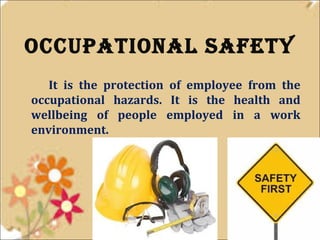
occupational safety 
It is the protection of employee from the 
occupational hazards. It is the health and 
wellbeing of people employed in a work 
environment.
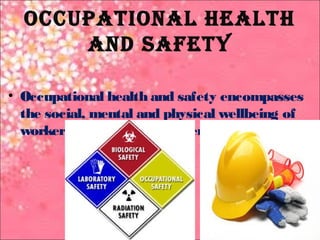
occupational health 
anD safety 
• Occupational health and safety encompasses 
the social, mental and physical wellbeing of 
worker that is the ‘whole person’.
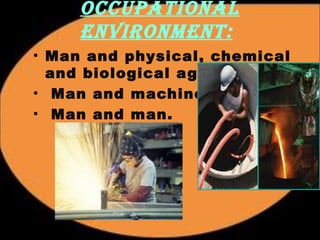
occupational 
enViRonMent: 
• Man and physical, chemical 
and biological agents. 
• Man and machine. 
• Man and man.
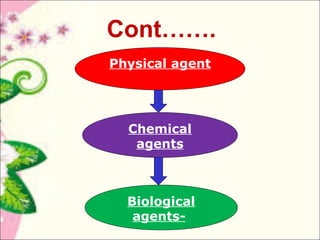
Cont……. 
Physical agent 
Chemical 
agents 
Biological 
agents-
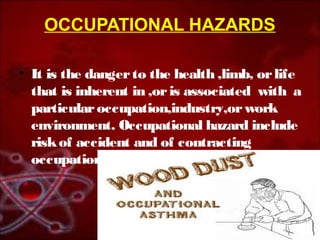
OCCUPATIONAL HAZARDS 
• It is the danger to the health ,limb, or life 
that is inherent in ,or is associated with a 
particular occupation,industry,or work 
environment. Occupational hazard include 
risk of accident and of contracting 
occupational diseases
TYPES OF OCCUPATIONAL 
HAZARDS 
• 1) Physical hazards. 
• 2) Chemical hazards. 
• 3) Biological hazards. 
• 4) Mechanical hazards. 
• 5) Psychosocial hazards
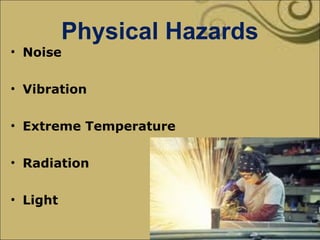
Physical Hazards 
• Noise 
• Vibration 
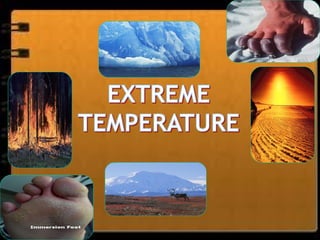
• Extreme Temperature 
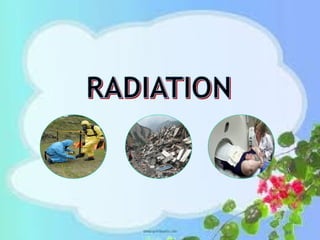
• Radiation 
• Light
.. 
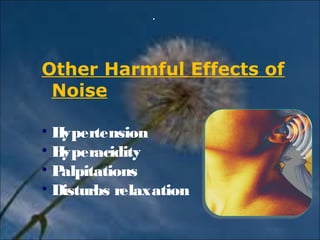
Other Harmful Effects of 
Noise 
• Hypertension 
• Hyperacidity 
• Palpitations 
• Disturbs relaxation
.. 
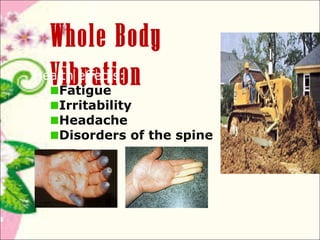
Vibration
Whole Body 
HeaVltihb erffaecttis:on 
Fatigue 
Irritability 
Headache 
Disorders of the spine
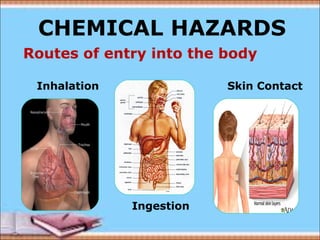
CHEMICAL HAZARDS 
Routes of entry into the body 
Inhalation 
Ingestion 
Skin Contact
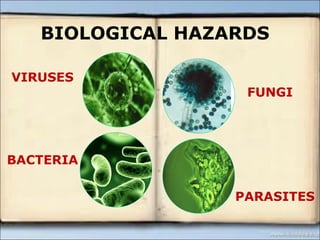
BIOLOGICAL HAZARDS 
VIRUSES 
BACTERIA 
FUNGI 
PARASITES
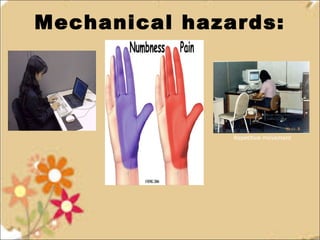
Mechanical hazards: 
Repetitive movement
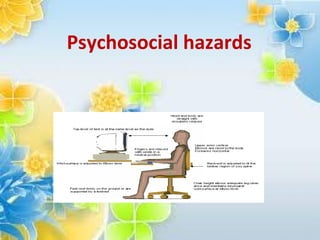
Psychosocial hazards
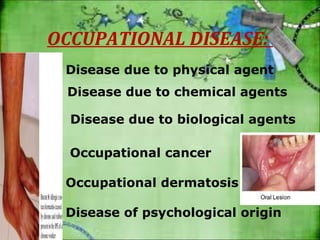
OCCUPATIONAL DISEASE: 
Disease due to physical agent 
Disease due to chemical agents 
Disease due to biological agents 
Occupational cancer 
Occupational dermatosis 
Disease of psychological origin
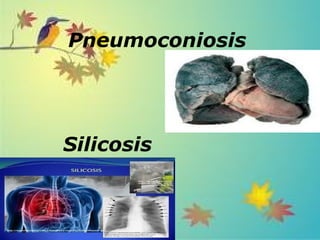
Pneumoconiosis 
Silicosis
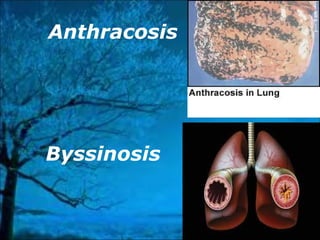
Anthracosis 
Byssinosis
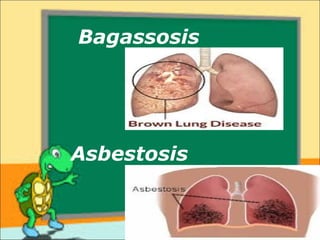
Bagassosis 
Asbestosis
Preventive m. easures: 
1. Use of safer types of asbestos 
2. Substitution of other insulants – glass fiber, 
mineral wood, calcium silicate, plastic foams. 
3. Dust control and biological monitoring 
4. Periodic examination of workers and 
continuing research.
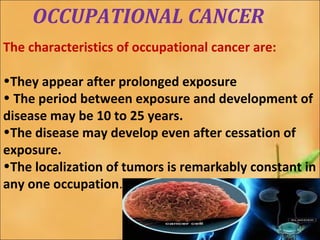
OCCUPATIONAL CANCER 
The characteristics of occupational cancer are: 
•They appear after prolonged exposure 
• The period between exposure and development of 
disease may be 10 to 25 years. 
•The disease may develop even after cessation of 
exposure. 
•The localization of tumors is remarkably constant in 
any one occupation.
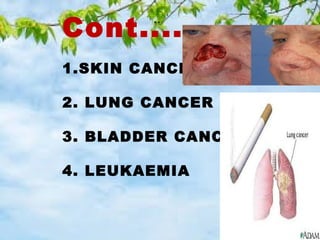
Cont...... 
.. 
1.SKIN CANCER 
2. LUNG CANCER 
3. BLADDER CANCER 
4. LEUKAEMIA
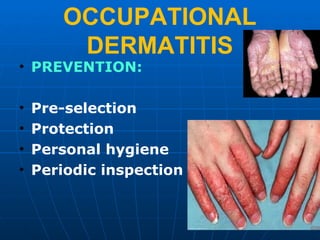
OCCUPATIONAL 
DERMATITIS 
• PREVENTION: 
• Pre-selection 
• Protection 
• Personal hygiene 
• Periodic inspection
RADIATION HAZARDS 
Preventive measures: 
•Shielding of workers in x-ray field 
•The employees should be monitored at intervals 
•Suitable protective clothing 
•Adequate ventilation in work place to prevent 
inhalation of harmful gases and dust. 
•Replacement and periodic examination of workers in 
every 2 months. 
•Pregnant women should not be allowed to work in 
risky areas.
LEAD POISONING 
Preventive measures: 
•Substitution of lead with less toxic materials. 
•Isolation of all 
•Local exhaust ventilation. 
•Personal protection, personal hygiene and good 
housekeeping 
•Periodic examination of workers and health education. 
•Medical management
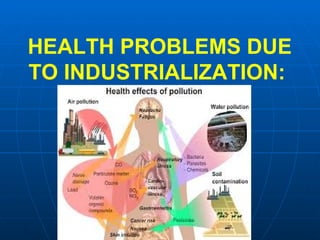
HEALTH PROBLEMS DUE 
TO INDUSTRIALIZATION:
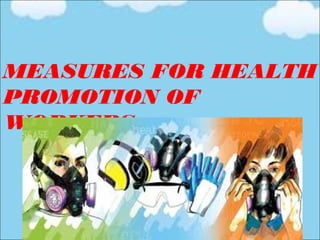
MEASURES FOR HEALTH 
PROMOTION OF 
WORKERS:
PREVENTION OF 
OCCUPATIONAL 
DISEASES:
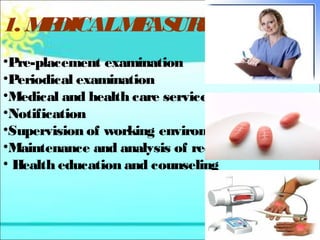
1. MEDICAL MEASURES: 
•Pre-placement examination 
•Periodical examination 
•Medical and health care services 
•Notification 
•Supervision of working environment 
•Maintenance and analysis of records 
• Health education and counseling
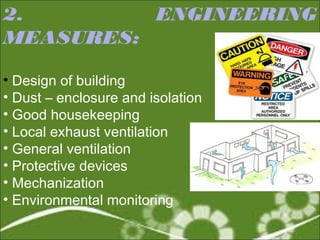
2. ENGINEERING 
MEASURES: 
• Design of building 
• Dust – enclosure and isolation 
• Good housekeeping 
• Local exhaust ventilation 
• General ventilation 
• Protective devices 
• Mechanization 
• Environmental monitoring
• LEGISLATION: 
The most important factory laws in India today 
are ; 
•The Factory Act , 1948 
The Employees State Insurance Act , 1948
NOSOCOMIAL INFECTION 
CONTROL 
The hospital infection control nurse and 
infection control committee are concerned with 
the prevention, surveillance and control of 
nosocomial infection. 
For airborne and droplet aerosol exposure, skin 
exposure ,preventive measures should taken. 
FOOD SAFETY 
Hospital kitchens prepares meals for inpatient 
and many cases prepare meals for staff canteen 
.The food storage ,handling and preparation 
should be done to the highest standard to avoid 
any risk to already sick or compromised patient. 
DISASTER MANAGEMENT
IMPORTANCE OF 
OCCUPATIONAL HEALTH IN 
HOSPITALS
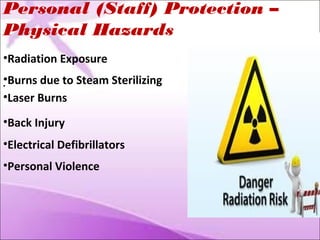
Personal (Staff) Protection – 
Physical Hazards 
•Radiation Exposure 
•Burns due to Steam Sterilizing 
• 
•Laser Burns 
•Back Injury 
•Electrical Defibrillators 
•Personal Violence
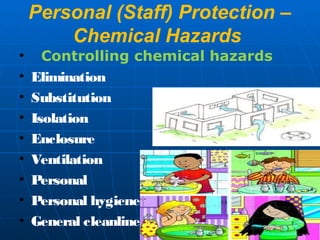
Personal (Staff) Protection – 
Chemical Hazards 
• Controlling che mical hazards 
• Elimination 
• Substitution 
• Isolation 
• Enclosure 
• Ventilation 
• Personal 
• Personal hygiene 
• General cleanliness
Personal (Staff) Protection – 
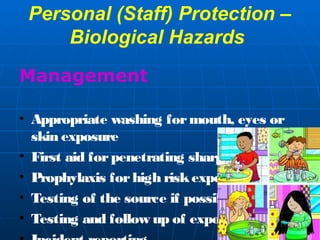
Biological Hazards 
Management 
• Appropriate washing for mouth, eyes or 
skin exposure 
• First aid for penetrating sharps injury 
• Prophylaxis for high risk exposure 
• Testing of the source if possible 
• Testing and follow up of exposed staff 
• Incident reporting.
Personal (Staff) Protection – 
Psychological Hazards 
• Shift work, on call d uty, fatigue and 
―burn out‖. 
• High workload and demand. 
• High or unrealistic patient expectations. 
• Verbal abuse or threats from intoxicated 
patients. 
• High or unrealistic expectations from 
supervisors and management. 
• Problematic interpersonal work 
relationships.
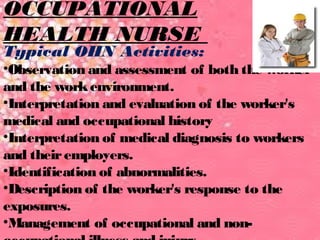
OCCUPATIONAL 
HEALTH NURSE 
Typical OHN Activities: 
•Observation and assessment of both the worker 
and the work environment. 
•Interpretation and evaluation of the worker's 
medical and occupational history 
•Interpretation of medical diagnosis to workers 
and their employers. 
•Identification of abnormalities. 
•Description of the worker's response to the 
exposures. 
•Management of occupational and non-occupational 
illness and injury.
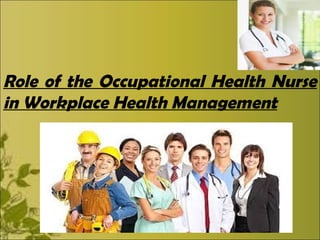
Role of the Occupational Health Nurse 
in Workplace Health Management
ETHICS IN OCCUPATIONAL 
NURSING 
1.Occupational Health Practice must be 
performed according to the highest 
professional standards and ethical principles 
2. The obligations of occupational health 
professionals include protecting the life and 
the health of the worker, respecting human 
dignity 
3. Occupational health professionals are 
experts who must enjoy full professional 
independence in the execution of their 
functions.
SUMMERIZATION
ANY DOUBT ???
CONCLUSION
thank you

Occupational health Consideration in Nursing

  • 1.
  • 2.
    Definition of occupationalhealth Occupational health is broadly defined in the occupational health and safety encyclopedia as being concerned with physical mental and social wellbeing of man in relation to his work and working environment, his adjustment to work and adjustment of work to him. [Forsman1976].
  • 3.
    occupational safety Itis the protection of employee from the occupational hazards. It is the health and wellbeing of people employed in a work environment.
  • 4.
    occupational health anDsafety • Occupational health and safety encompasses the social, mental and physical wellbeing of worker that is the ‘whole person’.
  • 5.
    occupational enViRonMent: •Man and physical, chemical and biological agents. • Man and machine. • Man and man.
  • 6.
    Cont……. Physical agent Chemical agents Biological agents-
  • 7.
    OCCUPATIONAL HAZARDS •It is the danger to the health ,limb, or life that is inherent in ,or is associated with a particular occupation,industry,or work environment. Occupational hazard include risk of accident and of contracting occupational diseases
  • 8.
    TYPES OF OCCUPATIONAL HAZARDS • 1) Physical hazards. • 2) Chemical hazards. • 3) Biological hazards. • 4) Mechanical hazards. • 5) Psychosocial hazards
  • 9.
    Physical Hazards •Noise • Vibration • Extreme Temperature • Radiation • Light
  • 11.
    .. Other HarmfulEffects of Noise • Hypertension • Hyperacidity • Palpitations • Disturbs relaxation
  • 12.
  • 13.
    Whole Body HeaVltihberffaecttis:on Fatigue Irritability Headache Disorders of the spine
  • 16.
    CHEMICAL HAZARDS Routesof entry into the body Inhalation Ingestion Skin Contact
  • 17.
    BIOLOGICAL HAZARDS VIRUSES BACTERIA FUNGI PARASITES
  • 18.
  • 19.
  • 20.
    OCCUPATIONAL DISEASE: Diseasedue to physical agent Disease due to chemical agents Disease due to biological agents Occupational cancer Occupational dermatosis Disease of psychological origin
  • 21.
  • 22.
  • 23.
  • 24.
    Preventive m. easures: 1. Use of safer types of asbestos 2. Substitution of other insulants – glass fiber, mineral wood, calcium silicate, plastic foams. 3. Dust control and biological monitoring 4. Periodic examination of workers and continuing research.
  • 25.
    OCCUPATIONAL CANCER Thecharacteristics of occupational cancer are: •They appear after prolonged exposure • The period between exposure and development of disease may be 10 to 25 years. •The disease may develop even after cessation of exposure. •The localization of tumors is remarkably constant in any one occupation.
  • 26.
    Cont...... .. 1.SKINCANCER 2. LUNG CANCER 3. BLADDER CANCER 4. LEUKAEMIA
  • 27.
    OCCUPATIONAL DERMATITIS •PREVENTION: • Pre-selection • Protection • Personal hygiene • Periodic inspection
  • 28.
    RADIATION HAZARDS Preventivemeasures: •Shielding of workers in x-ray field •The employees should be monitored at intervals •Suitable protective clothing •Adequate ventilation in work place to prevent inhalation of harmful gases and dust. •Replacement and periodic examination of workers in every 2 months. •Pregnant women should not be allowed to work in risky areas.
  • 29.
    LEAD POISONING Preventivemeasures: •Substitution of lead with less toxic materials. •Isolation of all •Local exhaust ventilation. •Personal protection, personal hygiene and good housekeeping •Periodic examination of workers and health education. •Medical management
  • 30.
    HEALTH PROBLEMS DUE TO INDUSTRIALIZATION:
  • 31.
    MEASURES FOR HEALTH PROMOTION OF WORKERS:
  • 32.
  • 33.
    1. MEDICAL MEASURES: •Pre-placement examination •Periodical examination •Medical and health care services •Notification •Supervision of working environment •Maintenance and analysis of records • Health education and counseling
  • 34.
    2. ENGINEERING MEASURES: • Design of building • Dust – enclosure and isolation • Good housekeeping • Local exhaust ventilation • General ventilation • Protective devices • Mechanization • Environmental monitoring
  • 35.
    • LEGISLATION: Themost important factory laws in India today are ; •The Factory Act , 1948 The Employees State Insurance Act , 1948
  • 36.
    NOSOCOMIAL INFECTION CONTROL The hospital infection control nurse and infection control committee are concerned with the prevention, surveillance and control of nosocomial infection. For airborne and droplet aerosol exposure, skin exposure ,preventive measures should taken. FOOD SAFETY Hospital kitchens prepares meals for inpatient and many cases prepare meals for staff canteen .The food storage ,handling and preparation should be done to the highest standard to avoid any risk to already sick or compromised patient. DISASTER MANAGEMENT
  • 37.
    IMPORTANCE OF OCCUPATIONALHEALTH IN HOSPITALS
  • 38.
    Personal (Staff) Protection– Physical Hazards •Radiation Exposure •Burns due to Steam Sterilizing • •Laser Burns •Back Injury •Electrical Defibrillators •Personal Violence
  • 39.
    Personal (Staff) Protection– Chemical Hazards • Controlling che mical hazards • Elimination • Substitution • Isolation • Enclosure • Ventilation • Personal • Personal hygiene • General cleanliness
  • 40.
    Personal (Staff) Protection– Biological Hazards Management • Appropriate washing for mouth, eyes or skin exposure • First aid for penetrating sharps injury • Prophylaxis for high risk exposure • Testing of the source if possible • Testing and follow up of exposed staff • Incident reporting.
  • 41.
    Personal (Staff) Protection– Psychological Hazards • Shift work, on call d uty, fatigue and ―burn out‖. • High workload and demand. • High or unrealistic patient expectations. • Verbal abuse or threats from intoxicated patients. • High or unrealistic expectations from supervisors and management. • Problematic interpersonal work relationships.
  • 42.
    OCCUPATIONAL HEALTH NURSE Typical OHN Activities: •Observation and assessment of both the worker and the work environment. •Interpretation and evaluation of the worker's medical and occupational history •Interpretation of medical diagnosis to workers and their employers. •Identification of abnormalities. •Description of the worker's response to the exposures. •Management of occupational and non-occupational illness and injury.
  • 43.
    Role of theOccupational Health Nurse in Workplace Health Management
  • 44.
    ETHICS IN OCCUPATIONAL NURSING 1.Occupational Health Practice must be performed according to the highest professional standards and ethical principles 2. The obligations of occupational health professionals include protecting the life and the health of the worker, respecting human dignity 3. Occupational health professionals are experts who must enjoy full professional independence in the execution of their functions.
  • 45.
  • 46.
  • 47.
  • 48.