TERMINOLOGIES
MENTAL HEALTH
NURSING
1
Mr. Basavaraj S Hukkeri
MR. BASAVARAJ S HUKKERI
DEPT OF MENTAL HEALTH NURSING
BELGAUM, KARNATAKA
MENTAL HEALTH
It is a state of balance between the individual
and surrounding world, a state of harmony
between oneself and others, a co-existence between
the realities of the self and that of other people and
the environment.
An adjustment of human beings to the world
& to each other with a maximum of effectiveness
& happiness.
2
Mr. Basavaraj S Hukkeri
PSYCHIATRY
It is a branch of medicine that deals
with the diagnosis, treatment and
prevention of mental illness
3
Mr. Basavaraj S Hukkeri
PSYCHIATRIC NURSING
Mental health nursing, also known as
psychiatric nursing, is a specialized field of
nursing practice that involves the care of
individuals with a mental health disorder to help
them recover and improve their quality of life.
4
Mr. Basavaraj S Hukkeri
TERMINOLOGIES
ABREACTION:
A treatment procedure whereby repressed
painful experiences are voluntarily recalled to
awareness.
ADDICTION:
Strong dependence, both physical and
emotional, on alcohol or some other material.
5
Mr. Basavaraj S Hukkeri
AFFECT:
A short lived emotional response to an idea or an
event.
AGITATION:
Presence of anxiety with severe motor restlessness.
AGNOSIA:
A rare disorder whereby a patient is unable to
recognize and identify objects, persons, or sounds using
one or more of their senses despite otherwise normally
functioning senses.
6
Mr. Basavaraj S Hukkeri
AGOROPHOBIA:
Fear of being in a place from which escape
might be difficult.
AKATHISIA:
Motor restlessness, inability to sit still.
AMBIVALENCE:
The co-existence of two opposing drives,
desires, feelings or emotions towards the same
person, object or goal; a conflict to do or not to do.
7
Mr. Basavaraj S Hukkeri
AMNESIA:
Pathological impairment of memory.
ANHEDONIA:
Inability to experience pleasure in any activity.
ANOREXIA NERVOSA:
Disorder characterized by extreme concern with
body weight, an intense fear of becoming fat, and
maintenance of body weight below expected levels
for height and age.
8
Mr. Basavaraj S Hukkeri
ANXIETY:
A feeling of being anxious or excessive
uneasiness
ANXIOLYTIC:
Drug agent used to counteract or diminish
anxiety.
APATHY:
Lack of emotional feeling.
9
Mr. Basavaraj S Hukkeri
APHASIA:
Absence or impairment of the ability to
communicate through speech, writing, or signs, due
to dysfunction of brain centers.
APRAXIA:
Inability to carryout normal activities despite
intact motor function.
AVOLITION:
Lack of motivation.
10
Mr. Anilkumar Jarali
BLACK OUT:
Sudden loss of consciousness; an episode of
forgetting all part of what occurred during or
following a period of alcohol intake.
BULIMIA NERVOSA
Eating disorder characterized by periods of
significant overeating and inappropriate methods of
compensating for the overeating to prevent weight
gain such as self-induced vomiting, use of laxative or
diuretics, and excessive exercises 11
Mr. Anilkumar Jarali
CATAPLEXY
Temporary loss of muscle tone and weakness
precipitated by a variety of emotional states.
CIRCUMSTANTIALITY
A pattern of communication that is
demonstrated by the speakers inclusion of many
irrelevant and unnecessary details in his speech
before he is able to come to the point.
12
Mr. Anilkumar Jarali
CONFABULATION;
The unconscious filling of memory gaps by
imagined or untrue experience due to memory
impairment. It is most often associated with
organic pathology.
CONVERSION:
Process by which a psychological thought,
event, or memory is transferred to a physical or
sensory symptom.
13
Mr. Basavaraj S Hukkeri
CRAVING:
Strong inner drive to use a substance in
situations of substance dependence.
CRISIS:
Psychological disequilibrium in a person who
confronts a hazardous circumstances that
constitutes an important problem which for the
time he or she can neither escape nor solve with
usual problem solving resources.
14
Mr. Anilkumar Jarali
CYCLOTHYMIA:
A chronic mood disturbance involving
numerous episodes of hypomania and depression
mood, of insufficient severity or duration to meet
the criteria for bipolar disorder.
DELIRIUM:
A state of mental confusion and excitement
that happens in a short period of time and is
characterized by disorientation for time and
place usually with illusions and hallucinations. 15
Mr. Anilkumar Jarali
DELUSION:
A false, unshakeable belief.
DEMENTIA:
Broad impairment of intellectual function that
is progressive and interferes with normal social
and occupational activities.
DEPERSONALIZATION:
A person’s subjective sense of being unreal,
strange or unfamiliar.
16
Mr. Anilkumar Jarali
DEREALIZATION:
A subjective sense that the environment is
strange or unreal; a feeling of changed reality.
DISORIENTATION:
Inability to be cognizant of time, direction or
location, and person.
DYSTONIA:
Muscle rigidity that affects posture, gait, eye
movements.
17
Mr. Basavaraj S Hukkeri
ECHOLALIA:
Pathological repetition by imitation of the
speech of other.
ECHOPRAXIA:
Pathological repetition of the behaviour of
another.
ECT:
Electroconvulsive therapy.
18
Mr. Basavaraj S Hukkeri
ENCOPRESIS:
Involuntary passage of feces in inappropriate
places after age of voluntary control has been
established.
ENURESIS:
Involuntary passage of urine after age of
voluntary control has been established.
EUPHORIA:
Excessive feeling of happiness or elation.
19
Mr. Basavaraj S Hukkeri
FLIGHT OF IDEAS:
Rapid shift between topics that are unrelated
to each other.
GRIEF:
Emotional process of coping with a loss.
HALLUCINATIONS:
A false sensory perception in the absence of
an actual external stimulus.
20
Mr. Basavaraj S Hukkeri
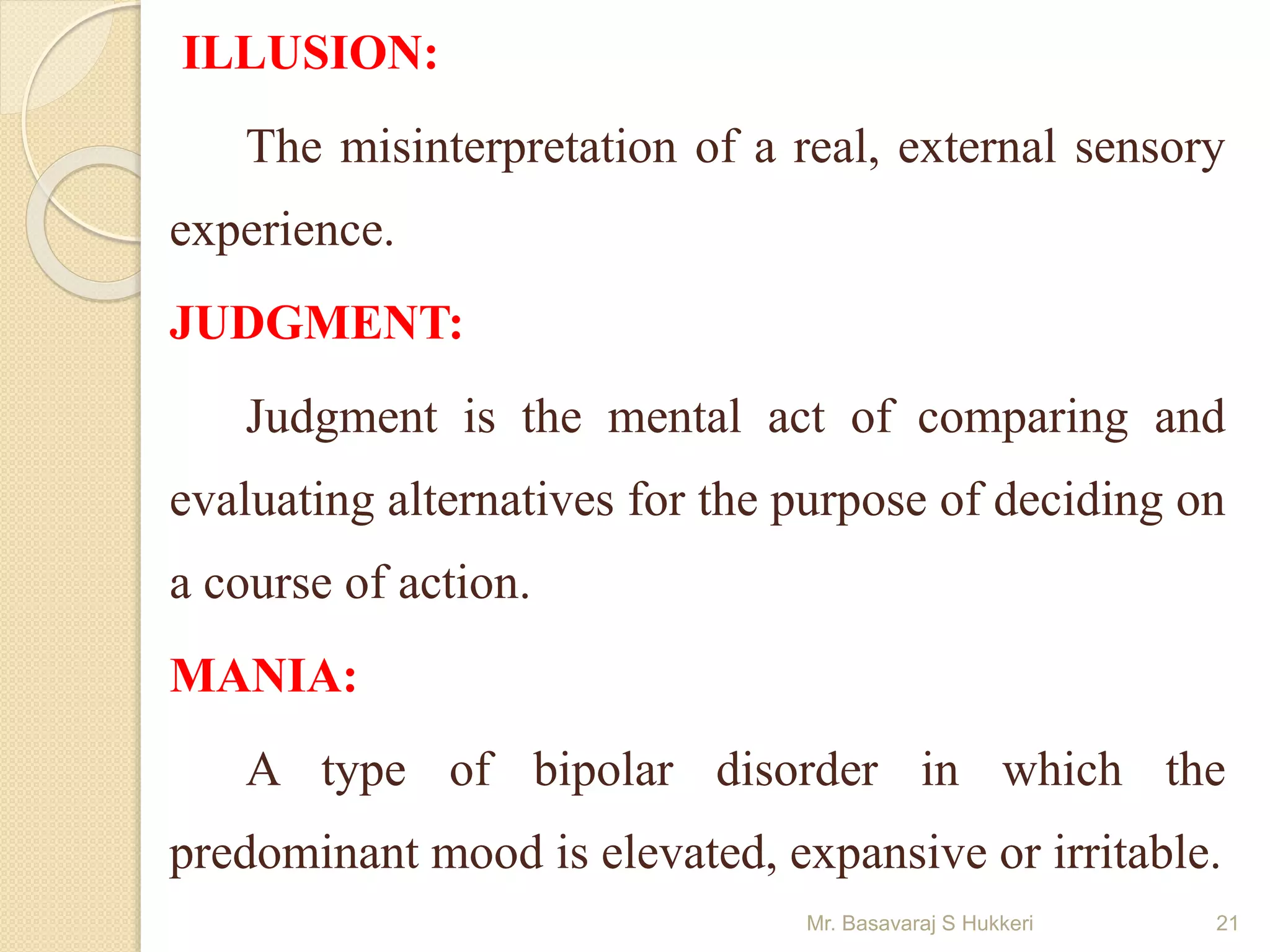
ILLUSION:
The misinterpretation of a real, external sensory
experience.
JUDGMENT:
Judgment is the mental act of comparing and
evaluating alternatives for the purpose of deciding on
a course of action.
MANIA:
A type of bipolar disorder in which the
predominant mood is elevated, expansive or irritable.
21
Mr. Basavaraj S Hukkeri
MOOD:
Emotion that is prolonged to the point that it
colors a person’s entire psychological thinking.
NEOLOGISM:
A word newly coined or an everyday word
used in a special way, not readily understood by
others.
22
Mr. Basavaraj S Hukkeri
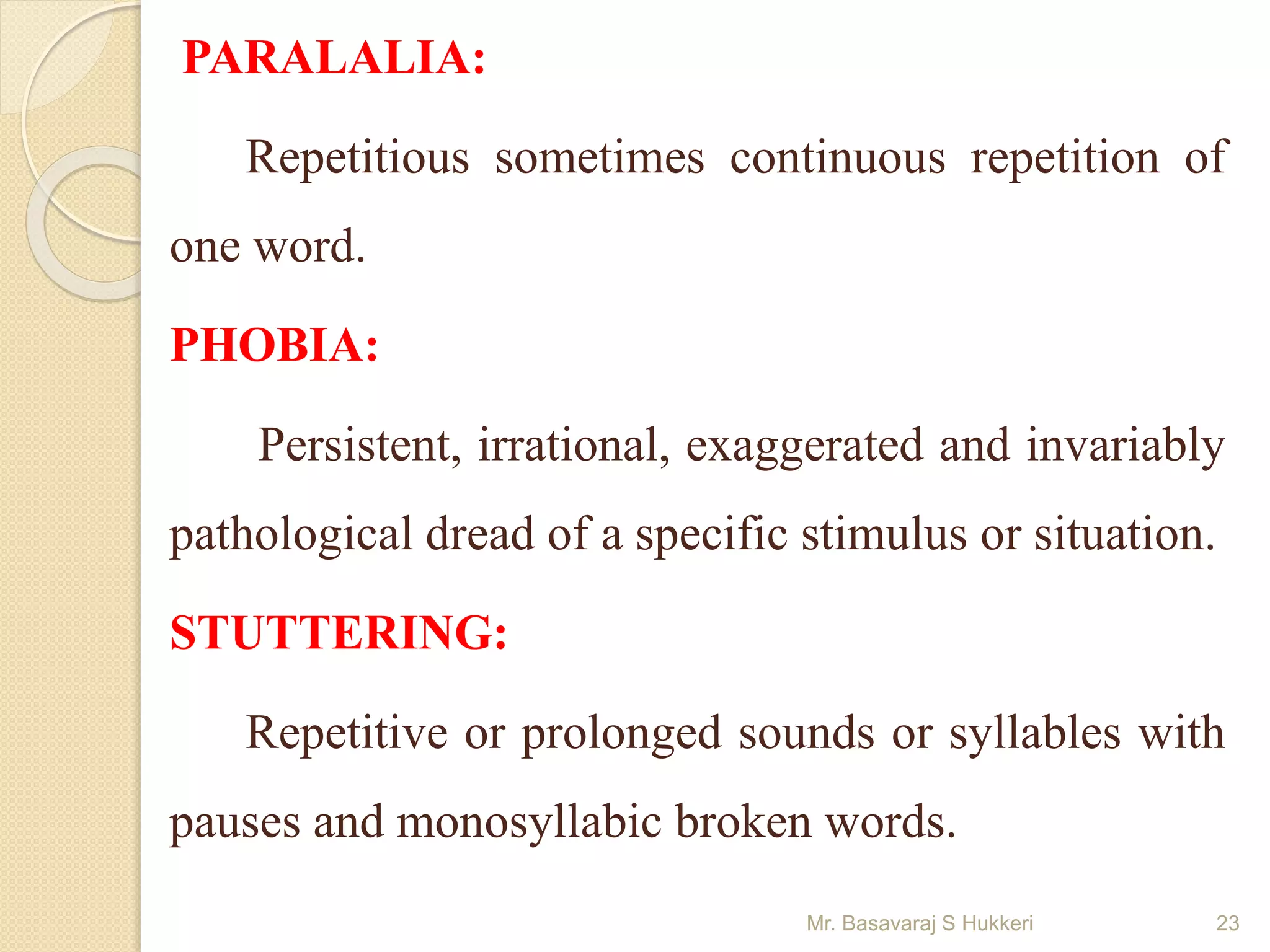
PARALALIA:
Repetitious sometimes continuous repetition of
one word.
PHOBIA:
Persistent, irrational, exaggerated and invariably
pathological dread of a specific stimulus or situation.
STUTTERING:
Repetitive or prolonged sounds or syllables with
pauses and monosyllabic broken words.
23
Mr. Basavaraj S Hukkeri
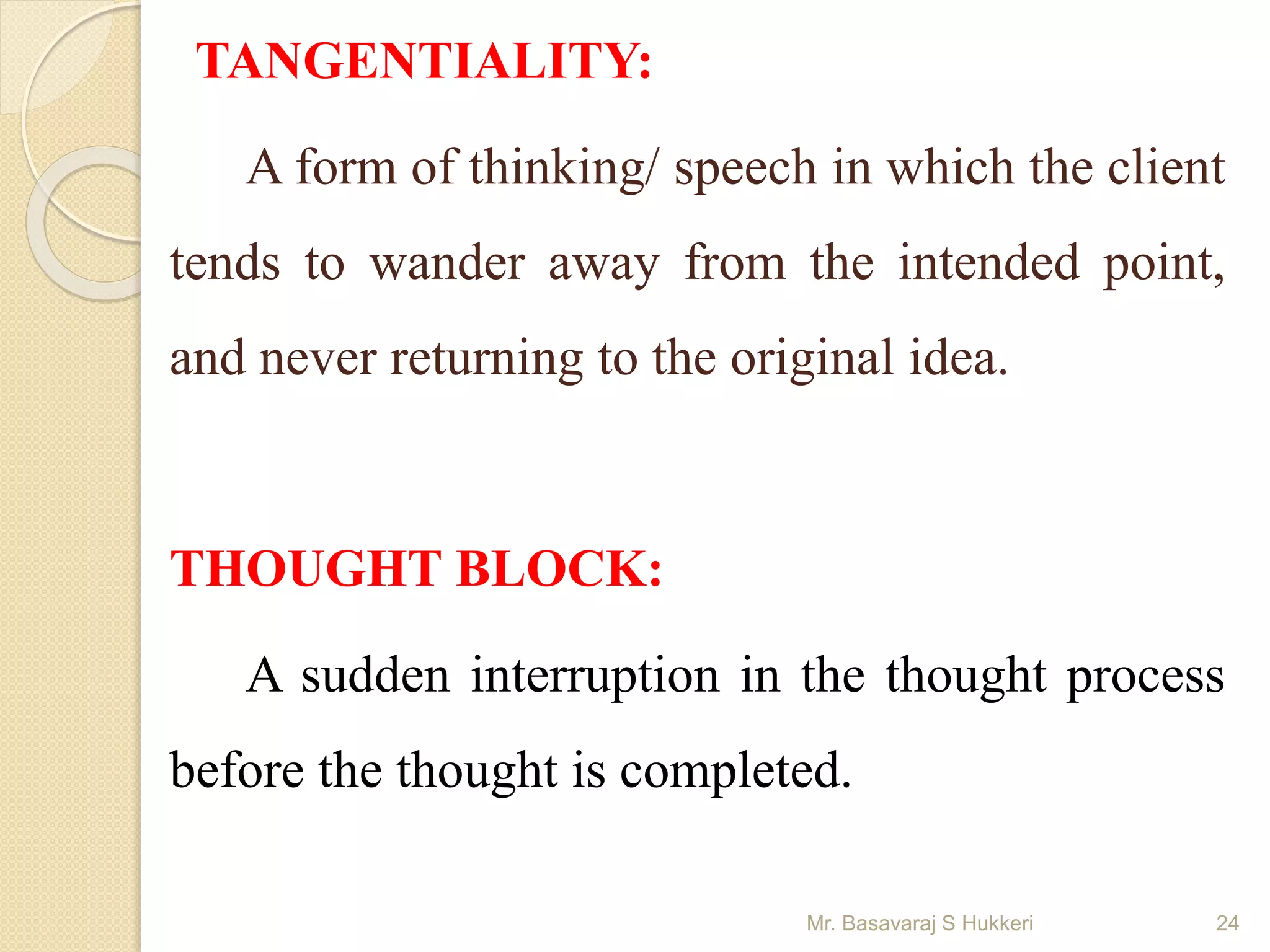
TANGENTIALITY:
A form of thinking/ speech in which the client
tends to wander away from the intended point,
and never returning to the original idea.
THOUGHT BLOCK:
A sudden interruption in the thought process
before the thought is completed.
24
Mr. Basavaraj S Hukkeri
WAXY FLEXIBILITY:
A condition by which the individual with
schizophrenia passively yields all movable parts
of the body to any efforts made at placing them
in certain positions.
WORD SALAD:
Meaningless and incoherent mixture of words
or phrases.
25
Mr. Basavaraj S Hukkeri

TERMINOLOGY IN MENTAL HEALTH NURSING, PSYCHITRIC NURSING

  • 1.
    TERMINOLOGIES MENTAL HEALTH NURSING 1 Mr. BasavarajS Hukkeri MR. BASAVARAJ S HUKKERI DEPT OF MENTAL HEALTH NURSING BELGAUM, KARNATAKA
  • 2.
    MENTAL HEALTH It isa state of balance between the individual and surrounding world, a state of harmony between oneself and others, a co-existence between the realities of the self and that of other people and the environment. An adjustment of human beings to the world & to each other with a maximum of effectiveness & happiness. 2 Mr. Basavaraj S Hukkeri
  • 3.
    PSYCHIATRY It is abranch of medicine that deals with the diagnosis, treatment and prevention of mental illness 3 Mr. Basavaraj S Hukkeri
  • 4.
    PSYCHIATRIC NURSING Mental healthnursing, also known as psychiatric nursing, is a specialized field of nursing practice that involves the care of individuals with a mental health disorder to help them recover and improve their quality of life. 4 Mr. Basavaraj S Hukkeri
  • 5.
    TERMINOLOGIES ABREACTION: A treatment procedurewhereby repressed painful experiences are voluntarily recalled to awareness. ADDICTION: Strong dependence, both physical and emotional, on alcohol or some other material. 5 Mr. Basavaraj S Hukkeri
  • 6.
    AFFECT: A short livedemotional response to an idea or an event. AGITATION: Presence of anxiety with severe motor restlessness. AGNOSIA: A rare disorder whereby a patient is unable to recognize and identify objects, persons, or sounds using one or more of their senses despite otherwise normally functioning senses. 6 Mr. Basavaraj S Hukkeri
  • 7.
    AGOROPHOBIA: Fear of beingin a place from which escape might be difficult. AKATHISIA: Motor restlessness, inability to sit still. AMBIVALENCE: The co-existence of two opposing drives, desires, feelings or emotions towards the same person, object or goal; a conflict to do or not to do. 7 Mr. Basavaraj S Hukkeri
  • 8.
    AMNESIA: Pathological impairment ofmemory. ANHEDONIA: Inability to experience pleasure in any activity. ANOREXIA NERVOSA: Disorder characterized by extreme concern with body weight, an intense fear of becoming fat, and maintenance of body weight below expected levels for height and age. 8 Mr. Basavaraj S Hukkeri
  • 9.
    ANXIETY: A feeling ofbeing anxious or excessive uneasiness ANXIOLYTIC: Drug agent used to counteract or diminish anxiety. APATHY: Lack of emotional feeling. 9 Mr. Basavaraj S Hukkeri
  • 10.
    APHASIA: Absence or impairmentof the ability to communicate through speech, writing, or signs, due to dysfunction of brain centers. APRAXIA: Inability to carryout normal activities despite intact motor function. AVOLITION: Lack of motivation. 10 Mr. Anilkumar Jarali
  • 11.
    BLACK OUT: Sudden lossof consciousness; an episode of forgetting all part of what occurred during or following a period of alcohol intake. BULIMIA NERVOSA Eating disorder characterized by periods of significant overeating and inappropriate methods of compensating for the overeating to prevent weight gain such as self-induced vomiting, use of laxative or diuretics, and excessive exercises 11 Mr. Anilkumar Jarali
  • 12.
    CATAPLEXY Temporary loss ofmuscle tone and weakness precipitated by a variety of emotional states. CIRCUMSTANTIALITY A pattern of communication that is demonstrated by the speakers inclusion of many irrelevant and unnecessary details in his speech before he is able to come to the point. 12 Mr. Anilkumar Jarali
  • 13.
    CONFABULATION; The unconscious fillingof memory gaps by imagined or untrue experience due to memory impairment. It is most often associated with organic pathology. CONVERSION: Process by which a psychological thought, event, or memory is transferred to a physical or sensory symptom. 13 Mr. Basavaraj S Hukkeri
  • 14.
    CRAVING: Strong inner driveto use a substance in situations of substance dependence. CRISIS: Psychological disequilibrium in a person who confronts a hazardous circumstances that constitutes an important problem which for the time he or she can neither escape nor solve with usual problem solving resources. 14 Mr. Anilkumar Jarali
  • 15.
    CYCLOTHYMIA: A chronic mooddisturbance involving numerous episodes of hypomania and depression mood, of insufficient severity or duration to meet the criteria for bipolar disorder. DELIRIUM: A state of mental confusion and excitement that happens in a short period of time and is characterized by disorientation for time and place usually with illusions and hallucinations. 15 Mr. Anilkumar Jarali
  • 16.
    DELUSION: A false, unshakeablebelief. DEMENTIA: Broad impairment of intellectual function that is progressive and interferes with normal social and occupational activities. DEPERSONALIZATION: A person’s subjective sense of being unreal, strange or unfamiliar. 16 Mr. Anilkumar Jarali
  • 17.
    DEREALIZATION: A subjective sensethat the environment is strange or unreal; a feeling of changed reality. DISORIENTATION: Inability to be cognizant of time, direction or location, and person. DYSTONIA: Muscle rigidity that affects posture, gait, eye movements. 17 Mr. Basavaraj S Hukkeri
  • 18.
    ECHOLALIA: Pathological repetition byimitation of the speech of other. ECHOPRAXIA: Pathological repetition of the behaviour of another. ECT: Electroconvulsive therapy. 18 Mr. Basavaraj S Hukkeri
  • 19.
    ENCOPRESIS: Involuntary passage offeces in inappropriate places after age of voluntary control has been established. ENURESIS: Involuntary passage of urine after age of voluntary control has been established. EUPHORIA: Excessive feeling of happiness or elation. 19 Mr. Basavaraj S Hukkeri
  • 20.
    FLIGHT OF IDEAS: Rapidshift between topics that are unrelated to each other. GRIEF: Emotional process of coping with a loss. HALLUCINATIONS: A false sensory perception in the absence of an actual external stimulus. 20 Mr. Basavaraj S Hukkeri
  • 21.
    ILLUSION: The misinterpretation ofa real, external sensory experience. JUDGMENT: Judgment is the mental act of comparing and evaluating alternatives for the purpose of deciding on a course of action. MANIA: A type of bipolar disorder in which the predominant mood is elevated, expansive or irritable. 21 Mr. Basavaraj S Hukkeri
  • 22.
    MOOD: Emotion that isprolonged to the point that it colors a person’s entire psychological thinking. NEOLOGISM: A word newly coined or an everyday word used in a special way, not readily understood by others. 22 Mr. Basavaraj S Hukkeri
  • 23.
    PARALALIA: Repetitious sometimes continuousrepetition of one word. PHOBIA: Persistent, irrational, exaggerated and invariably pathological dread of a specific stimulus or situation. STUTTERING: Repetitive or prolonged sounds or syllables with pauses and monosyllabic broken words. 23 Mr. Basavaraj S Hukkeri
  • 24.
    TANGENTIALITY: A form ofthinking/ speech in which the client tends to wander away from the intended point, and never returning to the original idea. THOUGHT BLOCK: A sudden interruption in the thought process before the thought is completed. 24 Mr. Basavaraj S Hukkeri
  • 25.
    WAXY FLEXIBILITY: A conditionby which the individual with schizophrenia passively yields all movable parts of the body to any efforts made at placing them in certain positions. WORD SALAD: Meaningless and incoherent mixture of words or phrases. 25 Mr. Basavaraj S Hukkeri