A growing public health concern
Department of community medicine
Skims, Srinagar
 Introduction
 Scenario
 Epidemiology
 Clinical picture and diagnosis
 Prevention
 Rabies in dogs
 Global strategic plan for rabies control
 Man described the disease in 2300 B.C.
 The origin “rabhas”, meaning “to do violence” comes from ancient Indian
Sanskrit dating 3000 B.C.
 Louis Pasteur was the first person to diagnose that rabies targeted the CNS.
 Also determined that nervous tissue of an infected human or animal also
contained the virus.
 In 1890 created the rabies vaccine and saved 9 year old Joseph Meister after
he had been bit by a rabid dog.
 Acute rapid progressive & highly fatal(100%) viral disease of CNS.
 Zoonotic disease of warm blooded animals (dogs, cats , bats, racoons,
skunks, foxes )
 Transmitted to man by bite of rabid animal.
 Non-bite exposures : aerosols; generated in labs , caves with bats , corneal
transplantation.
 Human to human transmission extremely rare.
 Transmission of RABV by dogs is responsible for up to 99% of
human rabies cases in rabies-endemic regions, with a small
proportion due to transmission via wildlife (such as foxes, wolves,
jackals, bats, raccoons, skunks or mongoose)
 Not reported in : rodents,rats,squirrel , birds.
 Responsible for an estimated 59 000 human deaths and over 3.7
million disability-adjusted life years (DALYs) lost every year.
 Most cases occur in Africa and Asia, with approximately 40% of
cases in children aged <15 years
Global scenario
 Rabies is present on all continents, except Antarctica, with over 95%
of human deaths occurring in the Asia and Africa regions.
 Rabies is one of the neglected tropical diseases that predominantly
affects poor and vulnerable populations who live in remote rural
locations.
 Every year, more than 15 million people worldwide receive a post-
bite vaccination. This is estimated to prevent hundreds of thousands
of rabies deaths annually.
 India is endemic for rabies accounting for 36% of the world’s
deaths.
 causes 18,000-20,000 deaths every year.
 About 30-60% of reported rabies cases and deaths in India occur in
children under the age of 15 years.
 The national health profile 2018 which was released recently, shows
that over half of India's rabies cases are reported from just two
states-west Bengal and Karnataka.
 There were 110 rabies cases in west Bengal and Karnataka in the
years 2016 and 2017,which is 58% of the total 190 cases reported
nationwide.
 In 2017,26 people from west Bengal lost their lives to the rabies
infection, while the death count 15 in Karnataka out of a total of 97.
 In India, Andaman - Nicobar and Lakshadweep are free of rabies.
 Rabies virus belongs to family Rhabdoviridae , genus Lyssavirus &
serotype 1.
 Bullet shaped neurotropic single stranded RNA non-segmented
antisense genome consists of 11,932 nucleotides and encodes 5
proteins.
STREET VIRUS
 Definition: the virus recovered
from naturally occurring cases
of rabies is called “street virus”
 Sources: it is naturally occurring
virus. It is found in saliva of
infected animal.
FIXED VIRUS
 Definition: the virus which has a
short, fixed and reproducible
incubation period is called “fixed
virus
 Sources: it is prepared by
repeated culture in brain of rabbit
such that its I.P. is reduced &
fixed
Features
 It produces Negri bodies
 Incubation period is long i.e.
20 to 60 days
 It is pathogenic for all
mammals
 Cannot be used for preparation
of vaccine
Features
• It does not form Negri bodies
 Incubation period is constant
between 4-6 days
 It can pathogenic for humans
under certain conditions
 Is used for preparation of
antirabies vaccine
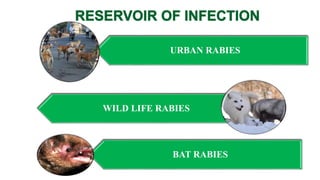
URBAN RABIES
WILD LIFE RABIES
BAT RABIES
 Incubation period : 20-90 days.
 STAGES:
1) Virus inoculated by bite.
2) Replication in muscles: virus binds to nicotinic acetylcholine receptors on post synaptic
membranes at NMJ.
3) Retrograde axonal transport :Spreads centripetally along peripheral nerves towards
CNS( ~ 250 mm/day) through local dorsal root ganglion, spinal cord. 4) CNS
dissemination
5) Centrifugal spread along sensory & autonomic nerves
 Prodromal symptoms
Headache, malaise, sore throat, low fever, pain at the site of bite
 Excitation Symptoms
 sensory system involvement Aero phobia, excitation of N.S.
 Motor system involvement increase reflexes, muscle spasm,
 Symp:inv. dilatation of Pupils. increase perspiration, salivation, and
Lacrimation,
 Mental changes fear of death, anger, irritability and depression
 Hydrophobia
 ( Fear of water) sight or sound of water may produce spasm of
degulation
 the duration of illness is 2-3 days may be prolonged to 5-6 days
 Stage of paralysis & coma
 DEATH / Recovery
1. History
2. Sign and symptom
3. Examination
4. Detection of Antigen
by taking Skin Biopsy using Immunofluorescence
by virus isolation from Saliva & other secretions.
The WHO case definition for human rabies defines a human clinical case
as follows:
“A subject presenting with
 an acute neurological syndrome (encephalitis) dominated by forms of :
 hyperactivity (furious rabies) or
 paralytic signs (paralytic rabies) progressing towards coma and death,
 usually by cardiac or respiratory failure,
 typically within 7–10 days after the first sign”
The standard human case classification for rabies is:
a. suspected: a case that is compatible with a clinical case definition
b. probable: a suspected case plus a reliable history of contact with a
suspected, probable or confirmed rabid animal
c. confirmed: a suspected or probable case that is laboratory-confirmed
(usually post-mortem).
Guillian Barre Syndrome :
Paralytic rabies mimic GBS
Fever , bladder dysfunction , CSF pleocytosis favor rabies.
Rabies Hysteria :
Characterized by shorter incubation period , inability to communicate ,
aggressive behavior , long course with recovery.
Allergic Encephalomyelitis :
History of rabies vaccine.
Tetanus :
Presence of hydrophobia , aerophobia favours rabies.
Poliomyelitis :
Acute onset of flaccid paralysis in one or more limbs with decreased /
absent tendon reflexes & without sensory or cognitive loss.
 No established treatment.
 Isolation in quiet room ( as bright light , noise , cold
draughts precipitates spasms / convulsions )
 sedatives to relieve anxiety.
 Hydration.
 Intensive respiratory & cardiac support
 Eliminating rabies in dogs
 Awareness on rabies and preventing dog bites
 Preventive immunization in people
 Vaccinating dogs is the most cost-effective strategy for preventing
rabies in people.
 Dog vaccination reduces deaths attributable to rabies and the need
for PEP as a part of dog bite patient care
 Education on dog behavior and bite prevention for both children and
adults.
 Increasing awareness of rabies prevention and control in
communities includes education and information on responsible pet
ownership, how to prevent dog bites, and immediate care measures
after a bite.
 Engagement and ownership of the programme at the community
level increases reach and uptake of key messages
 Post-exposure prophylaxis (PEP) which includes extensive and thorough
wound washing at the RABV-exposure site, together with RIG
administration if indicated, and the administration of a course of several
doses of rabies vaccine;
 Pre-exposure prophylaxis (PrEP) which is the administration of
several doses of rabies vaccine before an exposure to RABV.
 Nervous Tissue Vaccine Suckling Mouse Brain Vaccine
 Duck Embryo Vaccine Purified Duck Embryo Vaccine
 Human Diploid Cell Vaccine :
2nd Gen. Tissue culture Vaccine
a. Purified Chick Embryo Cell Vaccine
b. Purified Vero Cell Vaccine
 Cell culture and embryonated egg-based rabies vaccines (CCEEVs) are
intended for use in both pre-exposure prophylaxis (PrEP) and for post-
exposure prophylaxis (PEP).
 Since 1984, WHO has strongly recommended discontinuation of
production and use of nerve tissue vaccines and their replacement by
modern, concentrated, purified CCEEVs.
 CCEEVs have been shown to be safe, highly immunogenic and well
tolerated.
 Who approved rabies vaccines :
Rabipur(PCEC),1 ml
Virorab ( PVRV),0.5 ml
 Vaccines approved by DCGI in India :
Vaxirab-N(PCEC),1 ml
Abhayrab (PVRV) ,0.5 ml
Indirab (PVRV), 0.5 ml
 For both PEP and PrEP,
vaccines can be administered by
either the ID or IM route.
 – One ID dose is 0.1 mL of
vaccine;
 – One IM dose is 0.5 mL or 1.0
mL depending on the product,
i.e. the entire content of the vial.
 If any doses are delayed, vaccination should be resumed, not
restarted.
 A change in the route of administration or in vaccine product during
a PEP or PrEP course is acceptable if such a change is unavoidable.
 Category I touching or feeding animals, animal licks on intact skin
(no exposure);
 Category II nibbling of uncovered skin, minor scratches or abrasions
without bleeding (exposure);
 Category III single or multiple transdermal bites or scratches,
contamination of mucous membrane or broken skin with saliva from
animal licks, exposures due to direct contact with bats (severe
exposure).
 Essen regimen: 1 dose on days 0, 3, 7, 14 and 28.
 Zagreb regimen: 2-1-1 regimen: 2 doses on day 0,7 and 21.
 Thai Red Cross regimen: 2-site intradermal method (2-2-2-0-1-1 and 2-2-2-0-2) for use
with purified vero cell vaccine (PVRV), purified primary chick embryo cell vaccine
(PCECV) and human diploid cell (HCDV)
› 0.1 ml per intradermal injection site – days 0, 3 and 7: 0.1 ml at each of 2 sites,
intradermally on upper arm, over each deltoid.
› Days 28 and 90: 0.1 ml at 1 site, on upper arm.
› the single dose of vaccine given on day 90 of the original Thai Red Cross regimen (2–
2–2–0–1–1 regimen) can be replaced if two doses of vaccine are given on day 28 (2–
2–2–0–2 regimen). (Updated Thai Red Cross regimen)
 8-site intradermal method (8-0-4-0-1-1) for use with human diploid cell
vaccine HDCV,and PCECV.
› Regimen: day 0: 0.1 ml at each of 8 sites. Inject intradermally over deltoid,
lateral thigh, suprascapular region and lower quadrant of the abdomen.
› Day 7: 0.1 ml of vaccine at each of 4 sites over deltoids and thighs.
› Days 28 and 90: 0.1 ml of vaccine at 1 site, over deltoid.
Category I
exposure
Category II
exposure
Category III
exposure
Immunologically
naive individuals of
all age groups
 Washing of
exposed skin
surfaces
 No PEP
required
 Wound washing
and immediate
vaccination.
2-sites ID on days
0, 3 and 7
or
1-site IM on days :
0, 3, 7 and 14–28
or
2-sites IM on days
0 and
1-site IM on days
7, 21
 RIG is NOT
 Wound washing and
immediate vaccination
2-sites ID on days
0, 3 and 7
or
1-site IM on days
0, 3, 7 and day 14–28
or
2-sites IM on
days 0 and
1-site IM on days
7, 21
 RIG administration is
recommended.
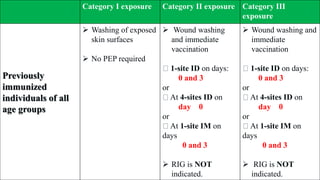
Category I exposure Category II exposure Category III
exposure
Previously
immunized
individuals of all
age groups
 Washing of exposed
skin surfaces
 No PEP required
 Wound washing
and immediate
vaccination
1-site ID on days:
0 and 3
or
At 4-sites ID on
day 0
or
At 1-site IM on
days
0 and 3
 RIG is NOT
indicated.
 Wound washing and
immediate
vaccination
1-site ID on days:
0 and 3
or
At 4-sites ID on
day 0
or
At 1-site IM on
days
0 and 3
 RIG is NOT
indicated.
 There are no contraindications to PEP.
 PEP can be safely given to infants, pregnant women and immunocompromised
individuals, including children with HIV/AIDS.
 As for all vaccinations, recipients should be kept under medical supervision for at least
15–20 min after vaccination.
 A previous severe reaction to any component of a rabies vaccine is a contraindication for
use of the same vaccine for PrEP or PEP, and the vaccine product should be changed.
 RIG should be administered only once, preferably at, or as soon as
possible after, the initiation of PEP.
 RIG is infiltrated into and around the wound
 For optimal effectiveness, the maximum dose calculation for RIG is
40 IU/kg body weight for equine derived RIG (eRIG) products, and
20 IU/kg body weight for human derived RIG (hRIG). Skin testing
before eRIG administration should not be done because of unreliable
prediction of adverse effects.
 Even if RIG is not available at the first visit (PEP day 0), RIG can be
given up to day 7 after the first rabies vaccine administration.
 Local reactions :- pain , erythema , edema , pruritus
 systemic reactions : fever , myalgias , headache , nausea
 Anti-inflammatory & anti-pyretics may be used.
 Immunization should not be discontinued.
 Systemic allergic reactions are uncommon but anaphylaxis rarely occur (
treated with epinephrine and antihistamines )
 WHO recommends PrEP for individuals at high risk of RABV exposure.
 These include :
 sub-populations in highly endemic settings with limited access to timely and
adequate PEP,
 individuals at occupational risk, and
 travelers who may be at risk of exposure.
 PrEP should be considered in populations living in rabies endemic areas, where
the dog bite incidence is >5% per year or vampire bat rabies is known to be
present.
 2-site ID vaccine administered on days 0 and 7.
Or
 1-site IM vaccine administration on days 0 and 7.
 Incubation period : 3 – 8 weeks
 Manifests in two forms :
 Furious Rabies : Mad dog syndrome characterized by change in
behavior , run away from home , wander aimlessly , biting humans &
animals , excessive salivation from angle of mouth , progressive
paralysis leading to coma and death.
 Dumb Rabies : Paralytic predominantly , dog withdraws itself from
being disturbed , elapses into stage of sleepiness and dies.
 Registration, licensing & taxation of dog.
 Muzzling of dogs
 Yearly mass vaccination of dog
 Destruction of stray dogs
 Facilities for diagnosis of rabies in dogs
 Destruction of wildlife where the animals are known to be the reservoir
of infection.
 Publicity
In 2015, WHO and organization for animal health(OIE), in collaboration
with FAO and the Global Alliance for Rabies Control (GARC), organized a
global rabies conference in Geneva, bringing together partners and
stakeholders in veterinary and human health, government and the private
sector, and launched the Global framework for the elimination of dog-
mediated human rabies, outlining the commitment and actions required to
achieve a common goal of zero human rabies deaths by 2030, worldwide
The Global Strategic Plan set three objectives for affected countries, development
partners, and key stakeholders:
(1) to effectively use vaccines, medicines, tools, and technologies that will stop
dog rabies transmission and reduce the risk of human rabies deaths;
(2) to generate evidence-based guidance and high-quality data to measure impact
and inform policy decisions; and
(3) to harness multi-stakeholder engagement to sustain commitment and
resources.
 the global rabies response needs to be placed on a sustainable footing over the next 5
years.
 This requires a phased, multipronged strategy in all affected countries, based on close
coordination between the human and veterinary sectors and the extended community of
practice
 It requires engaging communities and health workers
• to build awareness of the problem and prevent bite exposures;
• to prevent transmission by managing dog populations and ensure herd immunity through
dog vaccination;
• and to provide post-exposure prophylaxis and care for exposed victims.
Through implementation of the Global strategic plan to end human deaths
from dog-mediated rabies by 2030, affected countries will move a
significant step closer to the Sustainable Development Goal (SDG) 3
target of “ending the epidemics of AIDS, tuberculosis, malaria and
neglected tropical diseases”. They will also make critical progress
towards SDG 3.8 on achieving universal health coverage.
 World’s Rabies Day- September 28
 Co-operative global event planned to
reduce suffering from rabies.
 This day celebrates Dr Louis Pastuer ‘s
vision of rabies free world.
Rabies 2018

Rabies 2018

  • 1.
    A growing publichealth concern Department of community medicine Skims, Srinagar
  • 2.
     Introduction  Scenario Epidemiology  Clinical picture and diagnosis  Prevention  Rabies in dogs  Global strategic plan for rabies control
  • 3.
     Man describedthe disease in 2300 B.C.  The origin “rabhas”, meaning “to do violence” comes from ancient Indian Sanskrit dating 3000 B.C.  Louis Pasteur was the first person to diagnose that rabies targeted the CNS.  Also determined that nervous tissue of an infected human or animal also contained the virus.  In 1890 created the rabies vaccine and saved 9 year old Joseph Meister after he had been bit by a rabid dog.
  • 4.
     Acute rapidprogressive & highly fatal(100%) viral disease of CNS.  Zoonotic disease of warm blooded animals (dogs, cats , bats, racoons, skunks, foxes )  Transmitted to man by bite of rabid animal.  Non-bite exposures : aerosols; generated in labs , caves with bats , corneal transplantation.  Human to human transmission extremely rare.
  • 5.
     Transmission ofRABV by dogs is responsible for up to 99% of human rabies cases in rabies-endemic regions, with a small proportion due to transmission via wildlife (such as foxes, wolves, jackals, bats, raccoons, skunks or mongoose)  Not reported in : rodents,rats,squirrel , birds.
  • 6.
     Responsible foran estimated 59 000 human deaths and over 3.7 million disability-adjusted life years (DALYs) lost every year.  Most cases occur in Africa and Asia, with approximately 40% of cases in children aged <15 years Global scenario
  • 7.
     Rabies ispresent on all continents, except Antarctica, with over 95% of human deaths occurring in the Asia and Africa regions.  Rabies is one of the neglected tropical diseases that predominantly affects poor and vulnerable populations who live in remote rural locations.  Every year, more than 15 million people worldwide receive a post- bite vaccination. This is estimated to prevent hundreds of thousands of rabies deaths annually.
  • 8.
     India isendemic for rabies accounting for 36% of the world’s deaths.  causes 18,000-20,000 deaths every year.  About 30-60% of reported rabies cases and deaths in India occur in children under the age of 15 years.
  • 9.
     The nationalhealth profile 2018 which was released recently, shows that over half of India's rabies cases are reported from just two states-west Bengal and Karnataka.  There were 110 rabies cases in west Bengal and Karnataka in the years 2016 and 2017,which is 58% of the total 190 cases reported nationwide.  In 2017,26 people from west Bengal lost their lives to the rabies infection, while the death count 15 in Karnataka out of a total of 97.  In India, Andaman - Nicobar and Lakshadweep are free of rabies.
  • 12.
     Rabies virusbelongs to family Rhabdoviridae , genus Lyssavirus & serotype 1.  Bullet shaped neurotropic single stranded RNA non-segmented antisense genome consists of 11,932 nucleotides and encodes 5 proteins.
  • 13.
    STREET VIRUS  Definition:the virus recovered from naturally occurring cases of rabies is called “street virus”  Sources: it is naturally occurring virus. It is found in saliva of infected animal. FIXED VIRUS  Definition: the virus which has a short, fixed and reproducible incubation period is called “fixed virus  Sources: it is prepared by repeated culture in brain of rabbit such that its I.P. is reduced & fixed
  • 14.
    Features  It producesNegri bodies  Incubation period is long i.e. 20 to 60 days  It is pathogenic for all mammals  Cannot be used for preparation of vaccine Features • It does not form Negri bodies  Incubation period is constant between 4-6 days  It can pathogenic for humans under certain conditions  Is used for preparation of antirabies vaccine
  • 15.
    URBAN RABIES WILD LIFERABIES BAT RABIES
  • 16.
     Incubation period: 20-90 days.  STAGES: 1) Virus inoculated by bite. 2) Replication in muscles: virus binds to nicotinic acetylcholine receptors on post synaptic membranes at NMJ. 3) Retrograde axonal transport :Spreads centripetally along peripheral nerves towards CNS( ~ 250 mm/day) through local dorsal root ganglion, spinal cord. 4) CNS dissemination 5) Centrifugal spread along sensory & autonomic nerves
  • 18.
     Prodromal symptoms Headache,malaise, sore throat, low fever, pain at the site of bite  Excitation Symptoms  sensory system involvement Aero phobia, excitation of N.S.  Motor system involvement increase reflexes, muscle spasm,  Symp:inv. dilatation of Pupils. increase perspiration, salivation, and Lacrimation,  Mental changes fear of death, anger, irritability and depression
  • 19.
     Hydrophobia  (Fear of water) sight or sound of water may produce spasm of degulation  the duration of illness is 2-3 days may be prolonged to 5-6 days  Stage of paralysis & coma  DEATH / Recovery
  • 21.
    1. History 2. Signand symptom 3. Examination 4. Detection of Antigen by taking Skin Biopsy using Immunofluorescence by virus isolation from Saliva & other secretions.
  • 22.
    The WHO casedefinition for human rabies defines a human clinical case as follows: “A subject presenting with  an acute neurological syndrome (encephalitis) dominated by forms of :  hyperactivity (furious rabies) or  paralytic signs (paralytic rabies) progressing towards coma and death,  usually by cardiac or respiratory failure,  typically within 7–10 days after the first sign”
  • 23.
    The standard humancase classification for rabies is: a. suspected: a case that is compatible with a clinical case definition b. probable: a suspected case plus a reliable history of contact with a suspected, probable or confirmed rabid animal c. confirmed: a suspected or probable case that is laboratory-confirmed (usually post-mortem).
  • 24.
    Guillian Barre Syndrome: Paralytic rabies mimic GBS Fever , bladder dysfunction , CSF pleocytosis favor rabies. Rabies Hysteria : Characterized by shorter incubation period , inability to communicate , aggressive behavior , long course with recovery.
  • 25.
    Allergic Encephalomyelitis : Historyof rabies vaccine. Tetanus : Presence of hydrophobia , aerophobia favours rabies. Poliomyelitis : Acute onset of flaccid paralysis in one or more limbs with decreased / absent tendon reflexes & without sensory or cognitive loss.
  • 26.
     No establishedtreatment.  Isolation in quiet room ( as bright light , noise , cold draughts precipitates spasms / convulsions )  sedatives to relieve anxiety.  Hydration.  Intensive respiratory & cardiac support
  • 27.
     Eliminating rabiesin dogs  Awareness on rabies and preventing dog bites  Preventive immunization in people
  • 28.
     Vaccinating dogsis the most cost-effective strategy for preventing rabies in people.  Dog vaccination reduces deaths attributable to rabies and the need for PEP as a part of dog bite patient care
  • 29.
     Education ondog behavior and bite prevention for both children and adults.  Increasing awareness of rabies prevention and control in communities includes education and information on responsible pet ownership, how to prevent dog bites, and immediate care measures after a bite.  Engagement and ownership of the programme at the community level increases reach and uptake of key messages
  • 31.
     Post-exposure prophylaxis(PEP) which includes extensive and thorough wound washing at the RABV-exposure site, together with RIG administration if indicated, and the administration of a course of several doses of rabies vaccine;  Pre-exposure prophylaxis (PrEP) which is the administration of several doses of rabies vaccine before an exposure to RABV.
  • 32.
     Nervous TissueVaccine Suckling Mouse Brain Vaccine  Duck Embryo Vaccine Purified Duck Embryo Vaccine  Human Diploid Cell Vaccine : 2nd Gen. Tissue culture Vaccine a. Purified Chick Embryo Cell Vaccine b. Purified Vero Cell Vaccine
  • 33.
     Cell cultureand embryonated egg-based rabies vaccines (CCEEVs) are intended for use in both pre-exposure prophylaxis (PrEP) and for post- exposure prophylaxis (PEP).  Since 1984, WHO has strongly recommended discontinuation of production and use of nerve tissue vaccines and their replacement by modern, concentrated, purified CCEEVs.  CCEEVs have been shown to be safe, highly immunogenic and well tolerated.
  • 34.
     Who approvedrabies vaccines : Rabipur(PCEC),1 ml Virorab ( PVRV),0.5 ml  Vaccines approved by DCGI in India : Vaxirab-N(PCEC),1 ml Abhayrab (PVRV) ,0.5 ml Indirab (PVRV), 0.5 ml
  • 35.
     For bothPEP and PrEP, vaccines can be administered by either the ID or IM route.  – One ID dose is 0.1 mL of vaccine;  – One IM dose is 0.5 mL or 1.0 mL depending on the product, i.e. the entire content of the vial.
  • 36.
     If anydoses are delayed, vaccination should be resumed, not restarted.  A change in the route of administration or in vaccine product during a PEP or PrEP course is acceptable if such a change is unavoidable.
  • 37.
     Category Itouching or feeding animals, animal licks on intact skin (no exposure);  Category II nibbling of uncovered skin, minor scratches or abrasions without bleeding (exposure);  Category III single or multiple transdermal bites or scratches, contamination of mucous membrane or broken skin with saliva from animal licks, exposures due to direct contact with bats (severe exposure).
  • 39.
     Essen regimen:1 dose on days 0, 3, 7, 14 and 28.  Zagreb regimen: 2-1-1 regimen: 2 doses on day 0,7 and 21.
  • 40.
     Thai RedCross regimen: 2-site intradermal method (2-2-2-0-1-1 and 2-2-2-0-2) for use with purified vero cell vaccine (PVRV), purified primary chick embryo cell vaccine (PCECV) and human diploid cell (HCDV) › 0.1 ml per intradermal injection site – days 0, 3 and 7: 0.1 ml at each of 2 sites, intradermally on upper arm, over each deltoid. › Days 28 and 90: 0.1 ml at 1 site, on upper arm. › the single dose of vaccine given on day 90 of the original Thai Red Cross regimen (2– 2–2–0–1–1 regimen) can be replaced if two doses of vaccine are given on day 28 (2– 2–2–0–2 regimen). (Updated Thai Red Cross regimen)
  • 41.
     8-site intradermalmethod (8-0-4-0-1-1) for use with human diploid cell vaccine HDCV,and PCECV. › Regimen: day 0: 0.1 ml at each of 8 sites. Inject intradermally over deltoid, lateral thigh, suprascapular region and lower quadrant of the abdomen. › Day 7: 0.1 ml of vaccine at each of 4 sites over deltoids and thighs. › Days 28 and 90: 0.1 ml of vaccine at 1 site, over deltoid.
  • 44.
    Category I exposure Category II exposure CategoryIII exposure Immunologically naive individuals of all age groups  Washing of exposed skin surfaces  No PEP required  Wound washing and immediate vaccination. 2-sites ID on days 0, 3 and 7 or 1-site IM on days : 0, 3, 7 and 14–28 or 2-sites IM on days 0 and 1-site IM on days 7, 21  RIG is NOT  Wound washing and immediate vaccination 2-sites ID on days 0, 3 and 7 or 1-site IM on days 0, 3, 7 and day 14–28 or 2-sites IM on days 0 and 1-site IM on days 7, 21  RIG administration is recommended.
  • 45.
    Category I exposureCategory II exposure Category III exposure Previously immunized individuals of all age groups  Washing of exposed skin surfaces  No PEP required  Wound washing and immediate vaccination 1-site ID on days: 0 and 3 or At 4-sites ID on day 0 or At 1-site IM on days 0 and 3  RIG is NOT indicated.  Wound washing and immediate vaccination 1-site ID on days: 0 and 3 or At 4-sites ID on day 0 or At 1-site IM on days 0 and 3  RIG is NOT indicated.
  • 46.
     There areno contraindications to PEP.  PEP can be safely given to infants, pregnant women and immunocompromised individuals, including children with HIV/AIDS.  As for all vaccinations, recipients should be kept under medical supervision for at least 15–20 min after vaccination.  A previous severe reaction to any component of a rabies vaccine is a contraindication for use of the same vaccine for PrEP or PEP, and the vaccine product should be changed.
  • 47.
     RIG shouldbe administered only once, preferably at, or as soon as possible after, the initiation of PEP.  RIG is infiltrated into and around the wound  For optimal effectiveness, the maximum dose calculation for RIG is 40 IU/kg body weight for equine derived RIG (eRIG) products, and 20 IU/kg body weight for human derived RIG (hRIG). Skin testing before eRIG administration should not be done because of unreliable prediction of adverse effects.  Even if RIG is not available at the first visit (PEP day 0), RIG can be given up to day 7 after the first rabies vaccine administration.
  • 49.
     Local reactions:- pain , erythema , edema , pruritus  systemic reactions : fever , myalgias , headache , nausea  Anti-inflammatory & anti-pyretics may be used.  Immunization should not be discontinued.  Systemic allergic reactions are uncommon but anaphylaxis rarely occur ( treated with epinephrine and antihistamines )
  • 51.
     WHO recommendsPrEP for individuals at high risk of RABV exposure.  These include :  sub-populations in highly endemic settings with limited access to timely and adequate PEP,  individuals at occupational risk, and  travelers who may be at risk of exposure.  PrEP should be considered in populations living in rabies endemic areas, where the dog bite incidence is >5% per year or vampire bat rabies is known to be present.
  • 52.
     2-site IDvaccine administered on days 0 and 7. Or  1-site IM vaccine administration on days 0 and 7.
  • 53.
     Incubation period: 3 – 8 weeks  Manifests in two forms :  Furious Rabies : Mad dog syndrome characterized by change in behavior , run away from home , wander aimlessly , biting humans & animals , excessive salivation from angle of mouth , progressive paralysis leading to coma and death.  Dumb Rabies : Paralytic predominantly , dog withdraws itself from being disturbed , elapses into stage of sleepiness and dies.
  • 54.
     Registration, licensing& taxation of dog.  Muzzling of dogs  Yearly mass vaccination of dog  Destruction of stray dogs  Facilities for diagnosis of rabies in dogs  Destruction of wildlife where the animals are known to be the reservoir of infection.  Publicity
  • 55.
    In 2015, WHOand organization for animal health(OIE), in collaboration with FAO and the Global Alliance for Rabies Control (GARC), organized a global rabies conference in Geneva, bringing together partners and stakeholders in veterinary and human health, government and the private sector, and launched the Global framework for the elimination of dog- mediated human rabies, outlining the commitment and actions required to achieve a common goal of zero human rabies deaths by 2030, worldwide
  • 57.
    The Global StrategicPlan set three objectives for affected countries, development partners, and key stakeholders: (1) to effectively use vaccines, medicines, tools, and technologies that will stop dog rabies transmission and reduce the risk of human rabies deaths; (2) to generate evidence-based guidance and high-quality data to measure impact and inform policy decisions; and (3) to harness multi-stakeholder engagement to sustain commitment and resources.
  • 58.
     the globalrabies response needs to be placed on a sustainable footing over the next 5 years.  This requires a phased, multipronged strategy in all affected countries, based on close coordination between the human and veterinary sectors and the extended community of practice  It requires engaging communities and health workers • to build awareness of the problem and prevent bite exposures; • to prevent transmission by managing dog populations and ensure herd immunity through dog vaccination; • and to provide post-exposure prophylaxis and care for exposed victims.
  • 59.
    Through implementation ofthe Global strategic plan to end human deaths from dog-mediated rabies by 2030, affected countries will move a significant step closer to the Sustainable Development Goal (SDG) 3 target of “ending the epidemics of AIDS, tuberculosis, malaria and neglected tropical diseases”. They will also make critical progress towards SDG 3.8 on achieving universal health coverage.
  • 60.
     World’s RabiesDay- September 28  Co-operative global event planned to reduce suffering from rabies.  This day celebrates Dr Louis Pastuer ‘s vision of rabies free world.