ETHICAL COMMITTEE
INTRODUCTION 
Most Indian hospitals have instituted a 
committee for the purpose of checking 
whether proposals submitted for research 
meet established guidelines. 
It improve not only the quality of research 
undertaken by the institution but also the 
care of patients in the institution.
‘Mission statement of the 
committee’ 
Care of the patient in this institution. 
Research. 
Education of the staff on biomedical ethics.
COMMITTEE 
Administration 
Clinicians - medical, surgical, other disciplines 
Social workers 
Nurses 
Rehabilitation personnel 
Priests/philosophers 
Lawyers 
Statisticians
SUBCOMMITTEES 
Monthly meetings of a large, single committee 
once a month over an hour and a half or two 
hours 
Frequency of meetings will depend on the 
goals set for the committee. 
Most ethics committees meet at least once a 
month 
Each member must attend at least 75% of all 
meetings.
CARE OF PATIENTS 
The art of bedside medicine 
Relief of suffering 
Cure of disease 
Cost to patient: tests, drugs, other costs. Can 
these be lowered? 
Prompt attention to needs of the patient. 
Care of the seriously ill 
Care of the dying patients 
Care of the dead patient
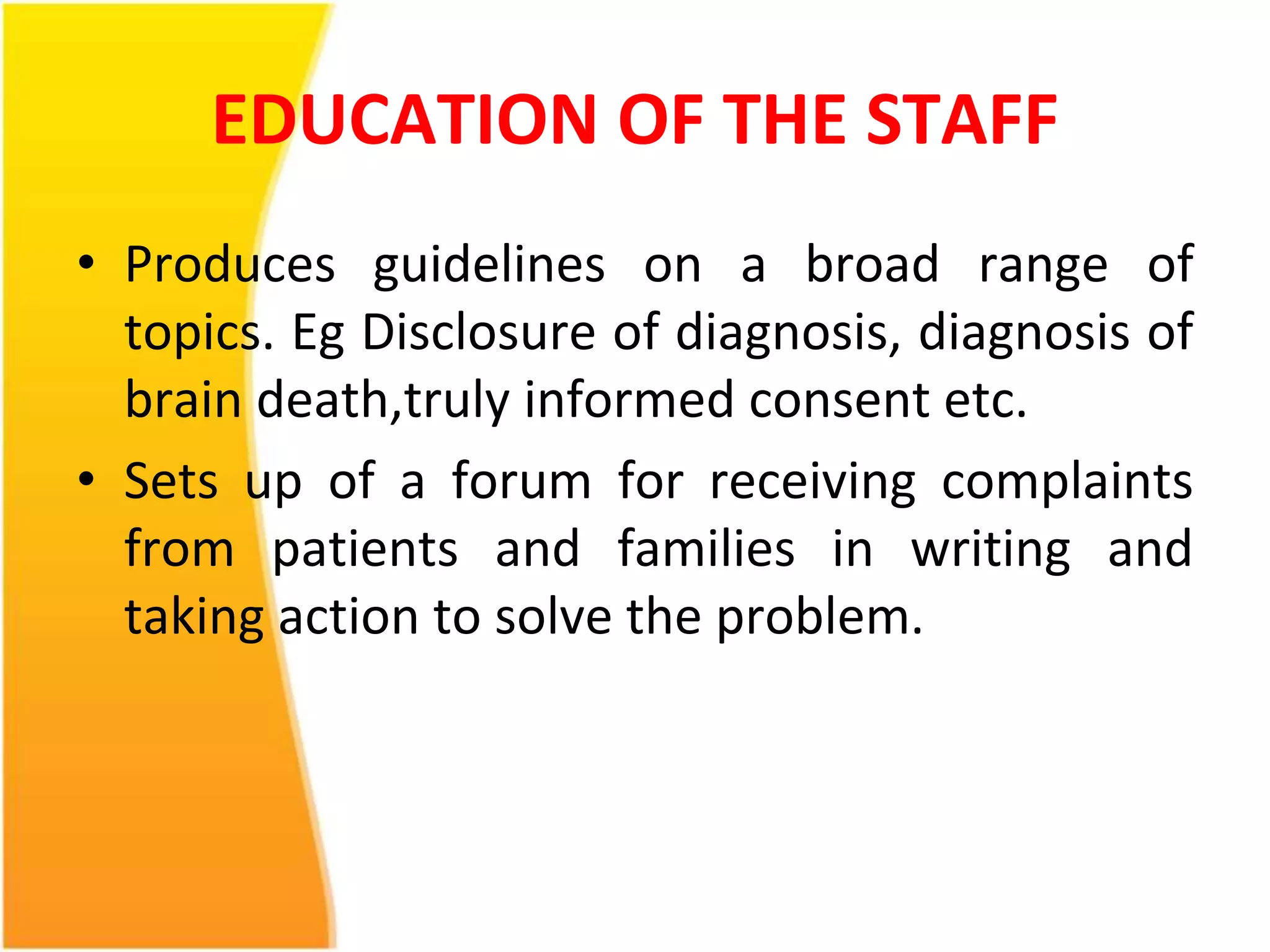
EDUCATION OF THE STAFF 
• Produces guidelines on a broad range of 
topics. Eg Disclosure of diagnosis, diagnosis of 
brain death,truly informed consent etc. 
• Sets up of a forum for receiving complaints 
from patients and families in writing and 
taking action to solve the problem.
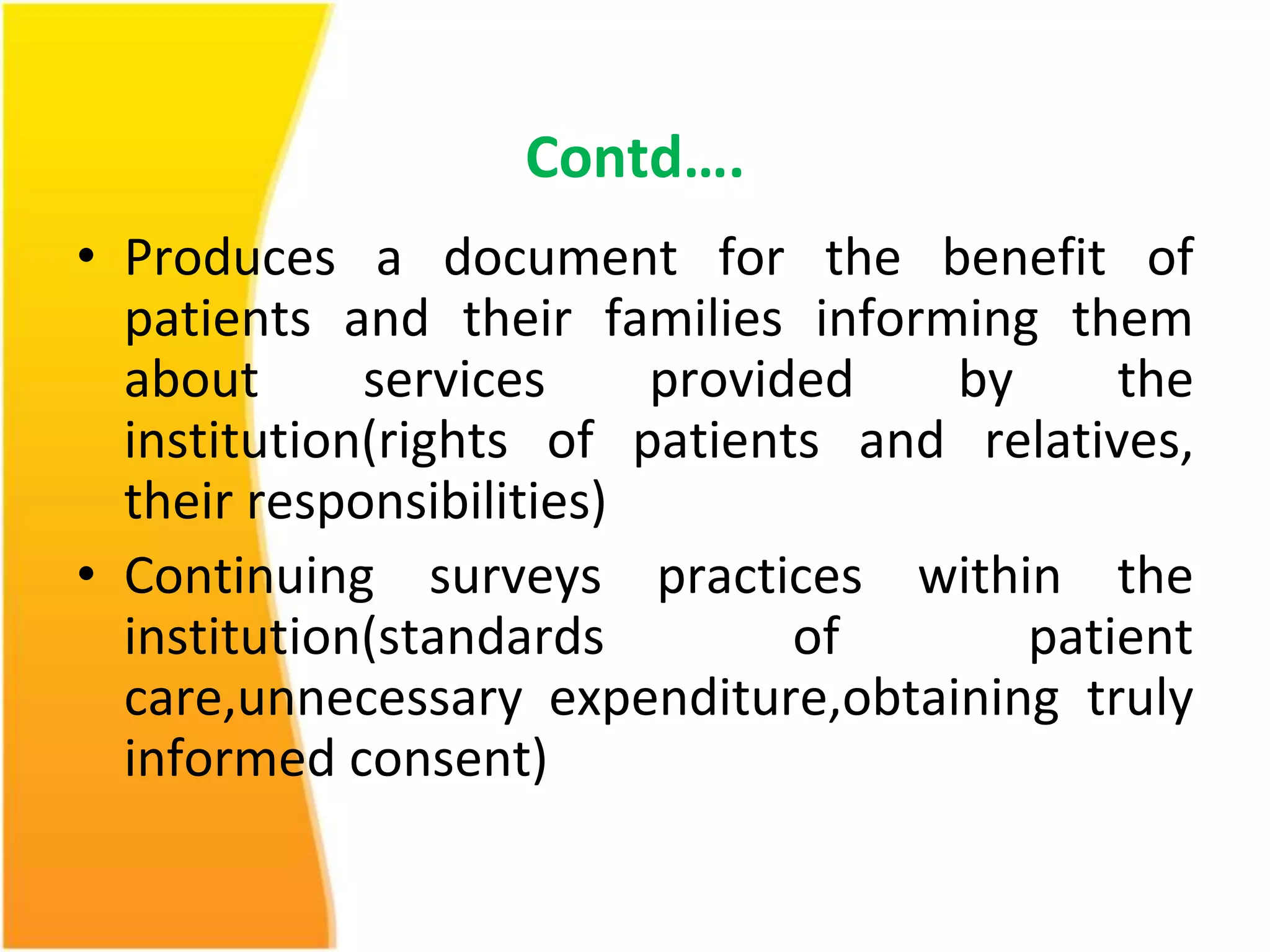
Contd…. 
• Produces a document for the benefit of 
patients and their families informing them 
about services provided by the 
institution(rights of patients and relatives, 
their responsibilities) 
• Continuing surveys practices within the 
institution(standards of patient 
care,unnecessary expenditure,obtaining truly 
informed consent)
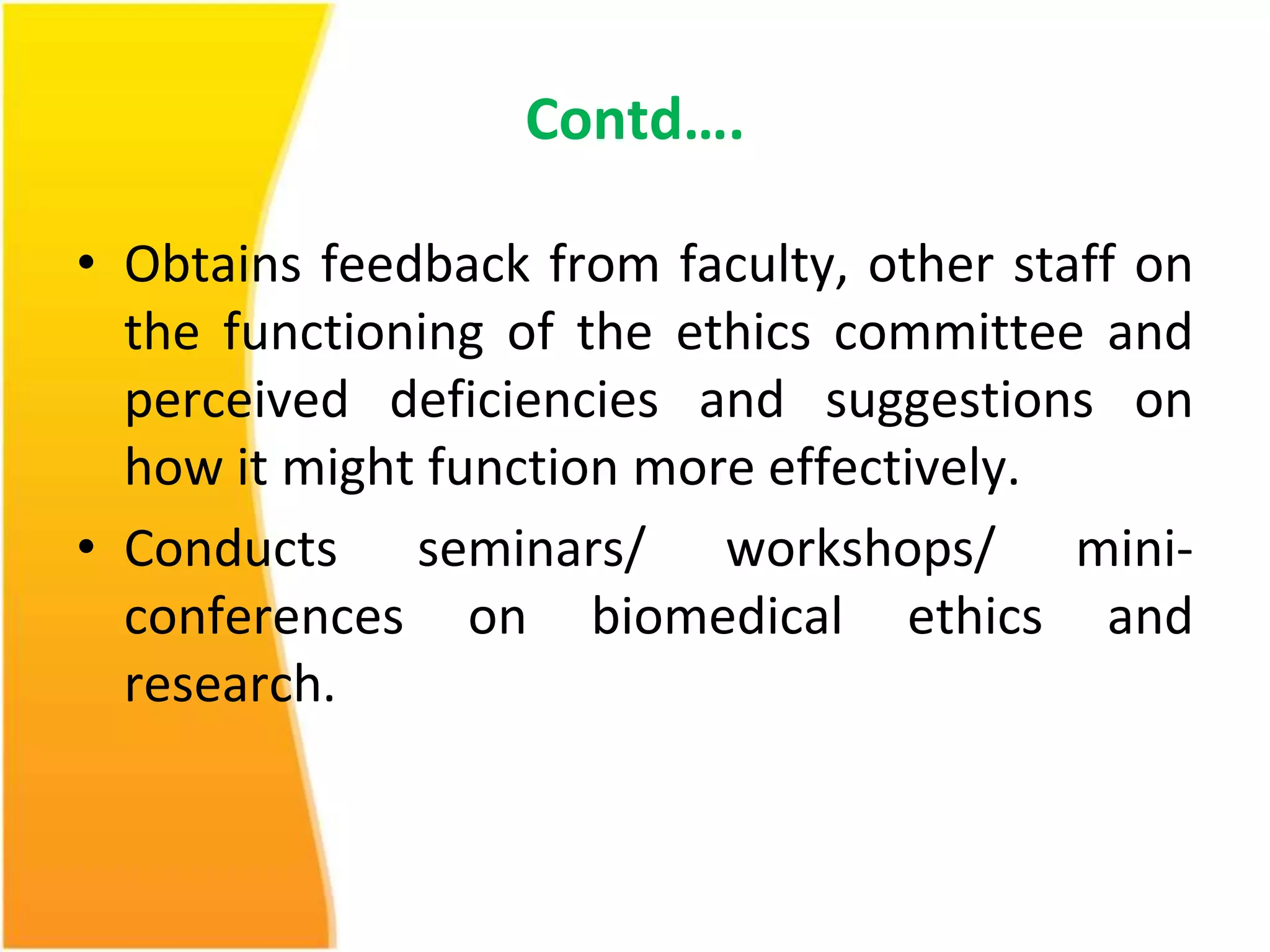
Contd…. 
• Obtains feedback from faculty, other staff on 
the functioning of the ethics committee and 
perceived deficiencies and suggestions on 
how it might function more effectively. 
• Conducts seminars/ workshops/ mini-conferences 
on biomedical ethics and 
research.
WHY DO SOME ETHICS COMMITTEES 
FAIL 
GOALS THAT ARE TOO AMBITIOUS. 
LACK OF SUPPORT BY THE INSTITUTION. 
POOR SELECTION OF MEMBERS ON THE 
COMMITTEE.
INSTITUTIONAL ETHICS COMMITTEE 
Institutional Ethics Committee (IECs)help to 
strengthen the human rights reserved 
exclusively for all members of society which 
the individual physicians and research 
workers may not be able to do alone.
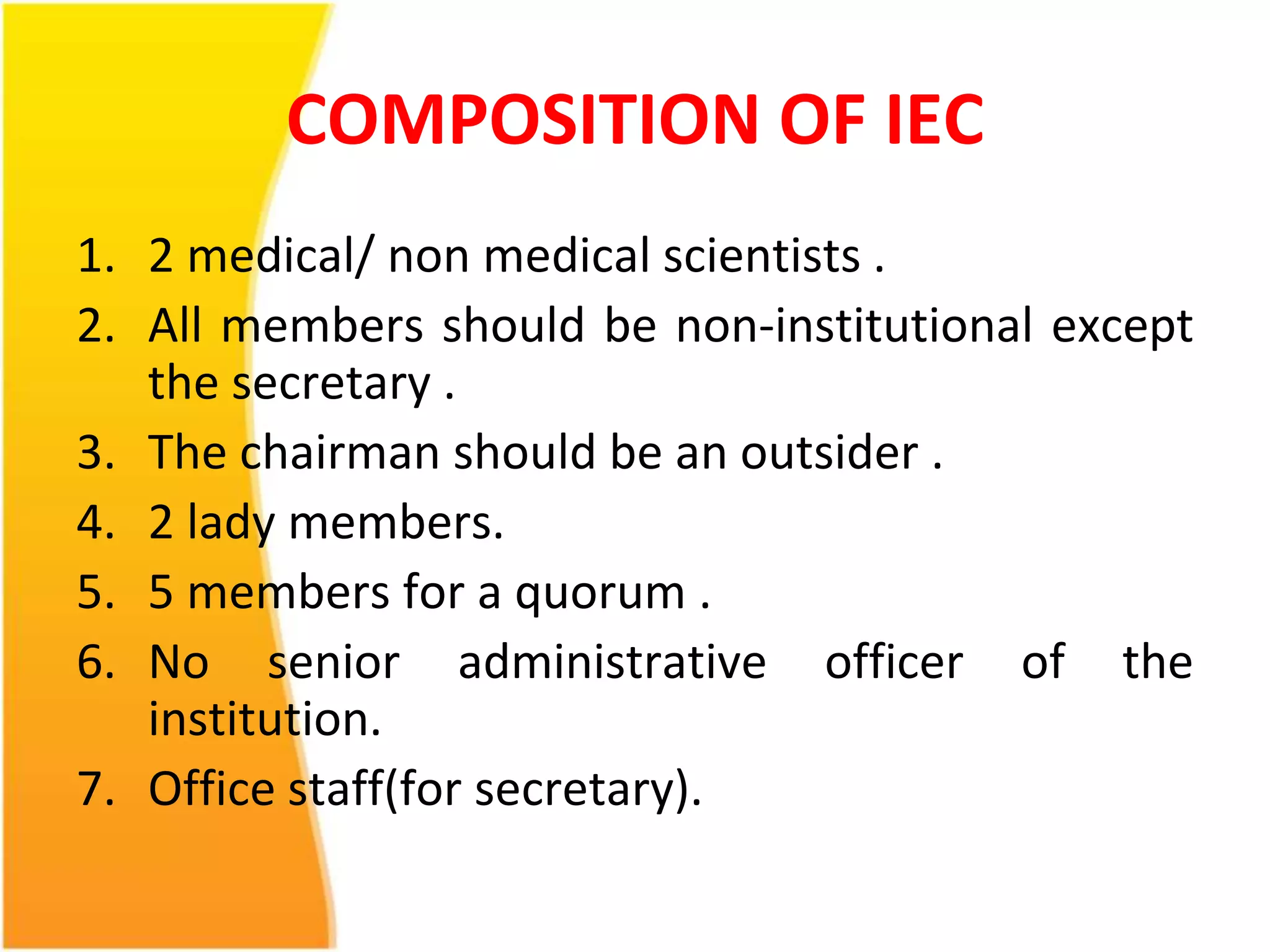
COMPOSITION OF IEC 
1. 2 medical/ non medical scientists . 
2. All members should be non-institutional except 
the secretary . 
3. The chairman should be an outsider . 
4. 2 lady members. 
5. 5 members for a quorum . 
6. No senior administrative officer of the 
institution. 
7. Office staff(for secretary).
THE ROLES OF IECS 
1. Secretary should be available for clarifying 
ethical problems that may arise from the 
project. 
2. Make sure that "informed consent "has been 
properly obtained. 
3. Multi-center trials require a uniform protocol 
and a unified assessment system.
Contd…. 
4.Periodic follow up should be made by the IEC 
5. Informed consent obtained from volunteers 
who are to participate in a field trial must be 
properly executed. 
6. Clinical trials of drugs or therapy conducted 
by clinicians.
LEGAL ROLE OF THE NURSE 
1) Provider of Service 
Ensure that client receives competent, safe, & 
holistic care . 
Supervise/evaluate the care provider. 
Documentation of care. 
Maintain clinical quality of care.
Contd…. 
2) Responsibility of appointing and assigning . 
4) Responsibility for equipment . 
5) Responsibility for observation and reporting. 
6) Responsibility to protect public . 
7) Responsibility for record keeping and reporting . 
8) Responsibility for death and dying . 
===
CODE OF ETHICS AND 
PROFESSIONAL CONDUCT
introduction 
Ethics refers to the moral code for nursing 
and is based on obligation to service and 
respect for human life. 
–Melanie and Evelyn. 
Ethics are the rules or principles that govern 
right conduct and are designed to protect the 
rights of human beings. 
- Sister Nancy.
CODE OF ETHICS 
A code of ethics is a set of ethical principles 
that are accepted by all members of a 
profession. 
-Potter and Perry 
Code of ethics is a guideline for performance 
and standards and personal responsibility. 
-LillieM S and Juanita Lee
NEED 
Helps the students/ RN to practice ethically 
Helps the nurse to identify the ethical issues 
in her work place 
Protecting patients right and dignity 
Providing care with minimum risk to the 
nurses health 
Ethical reasoning
Contd…. 
Helps the nurse to respond to ethical conflicts 
Helps to differentiate right /wrong . 
Guide for a professional behavior . 
Help teachers to plan education. 
Prevent below standard practice. 
Protect a nurse if falsely accused for legal 
action .
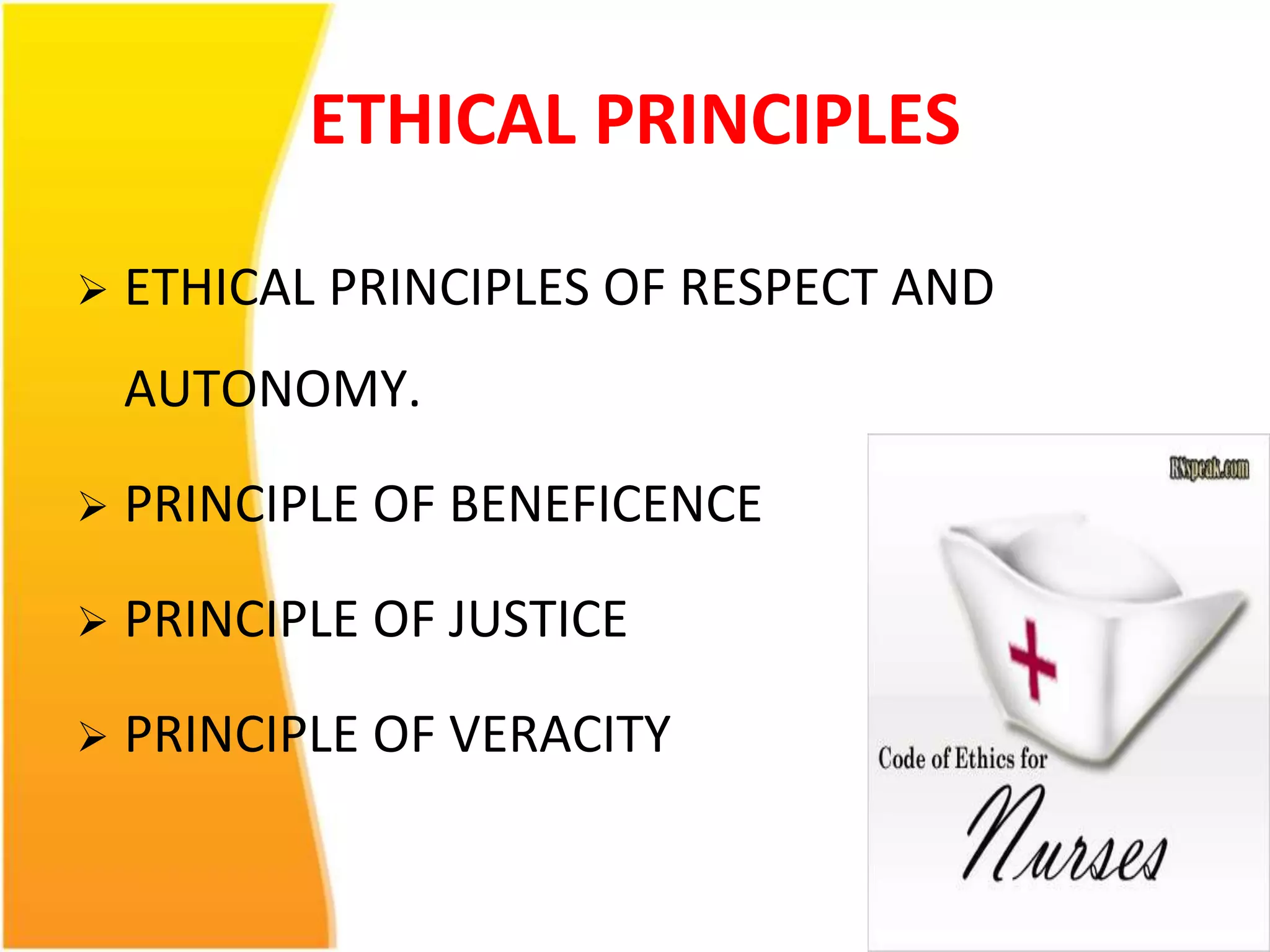
ETHICAL PRINCIPLES 
 ETHICAL PRINCIPLES OF RESPECT AND 
AUTONOMY. 
 PRINCIPLE OF BENEFICENCE 
 PRINCIPLE OF JUSTICE 
 PRINCIPLE OF VERACITY
Contd…. 
PRINCIPLE OF FIDELITY 
FREEDOM 
NON- MALEFICENCE 
RIGHTS 
CONFIDENTIALITY
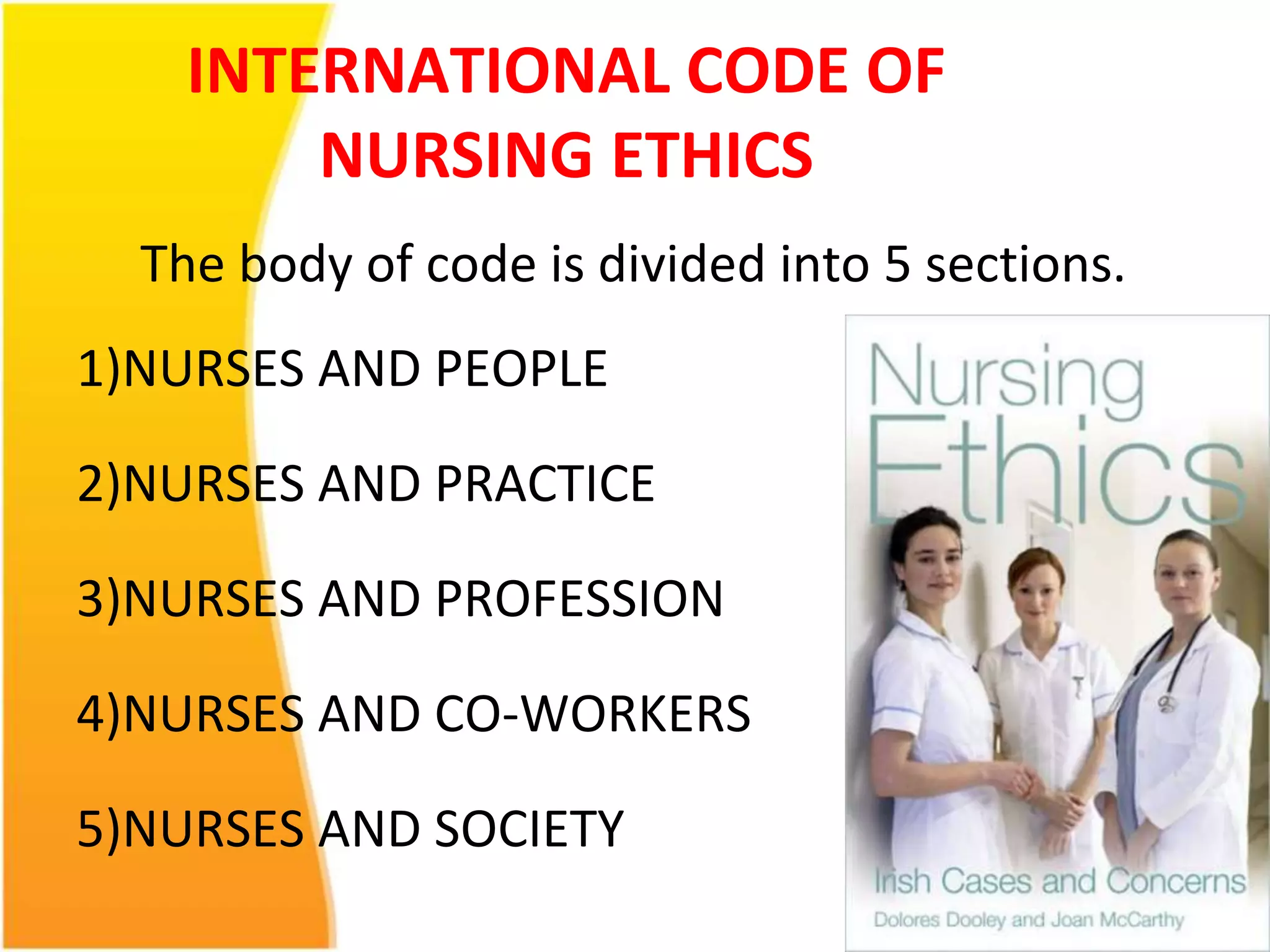
INTERNATIONAL CODE OF 
NURSING ETHICS 
The body of code is divided into 5 sections. 
1)NURSES AND PEOPLE 
2)NURSES AND PRACTICE 
3)NURSES AND PROFESSION 
4)NURSES AND CO-WORKERS 
5)NURSES AND SOCIETY
ETHICAL DILEMMA
Contd…. 
An ethical dilemma occurs when there is 
conflict between two or more ethical 
principles. 
No correct decision exists 
Need to obtain patients informed consent for 
care treatment orders and measures such as 
With holding/with drawing nutrition and 
fluids 
Starting / discontinuing life support system
Contd…. 
The nurse must make a choice between two 
alternatives that are equally unsatisfactory. 
Such dilemmas may occur as a result of 
differences in cultural or religious beliefs. 
Need to protect autonomy rights of children. 
Need to make treatment and care of decisions 
for terminally ill patients.
STEPS FOR RESOLVING ETHICAL 
DILEMMA 
Step – I: Collect, Analyze and interpret the 
data 
Step – II: State the Dilemma 
Step – III: Consider the choices of action 
Step – IV: Analyze the advantage and 
disadvantages of each course of action 
Step – V: Make the decision and act on it.
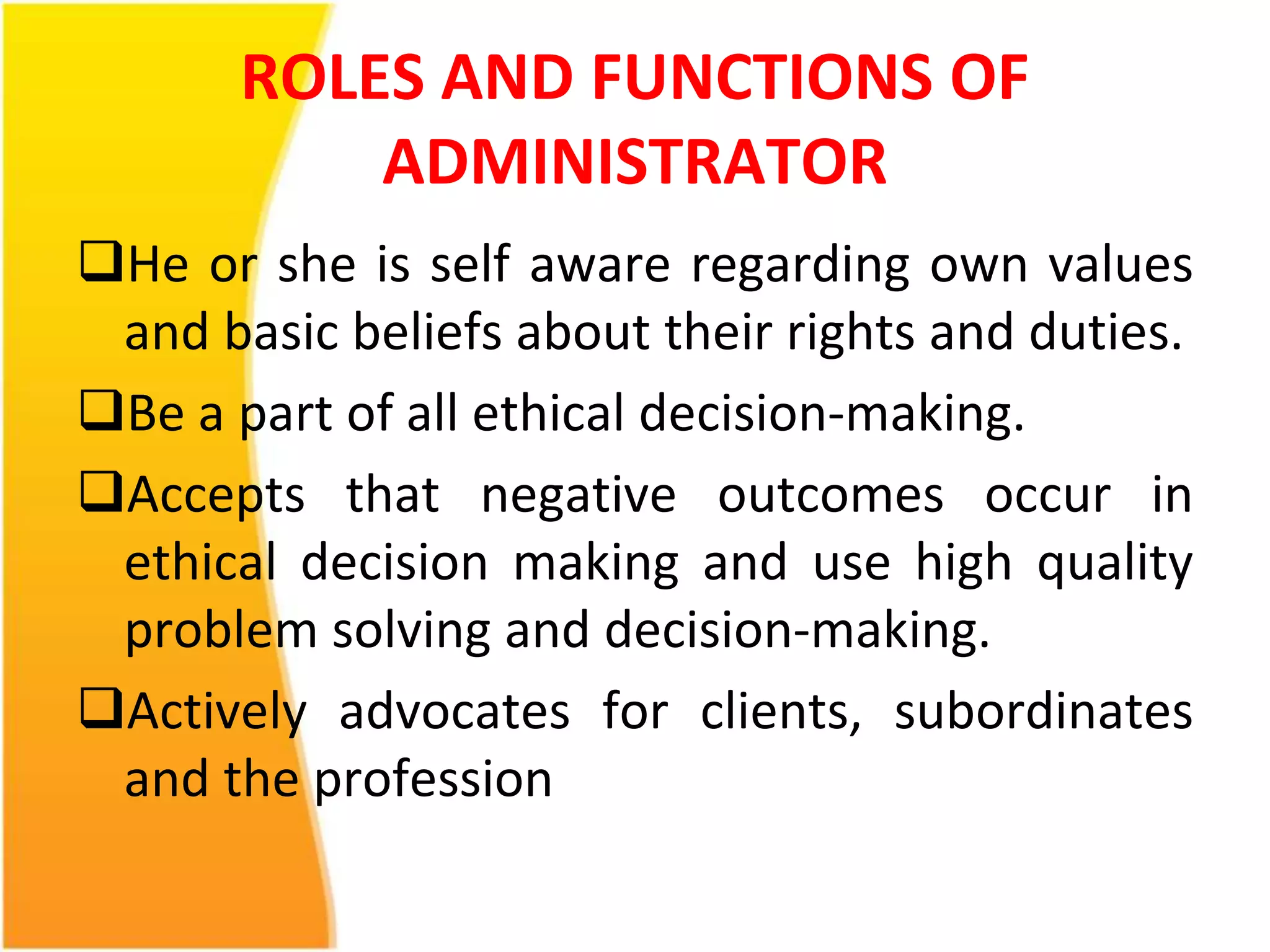
ROLES AND FUNCTIONS OF 
ADMINISTRATOR 
He or she is self aware regarding own values 
and basic beliefs about their rights and duties. 
Be a part of all ethical decision-making. 
Accepts that negative outcomes occur in 
ethical decision making and use high quality 
problem solving and decision-making. 
Actively advocates for clients, subordinates 
and the profession
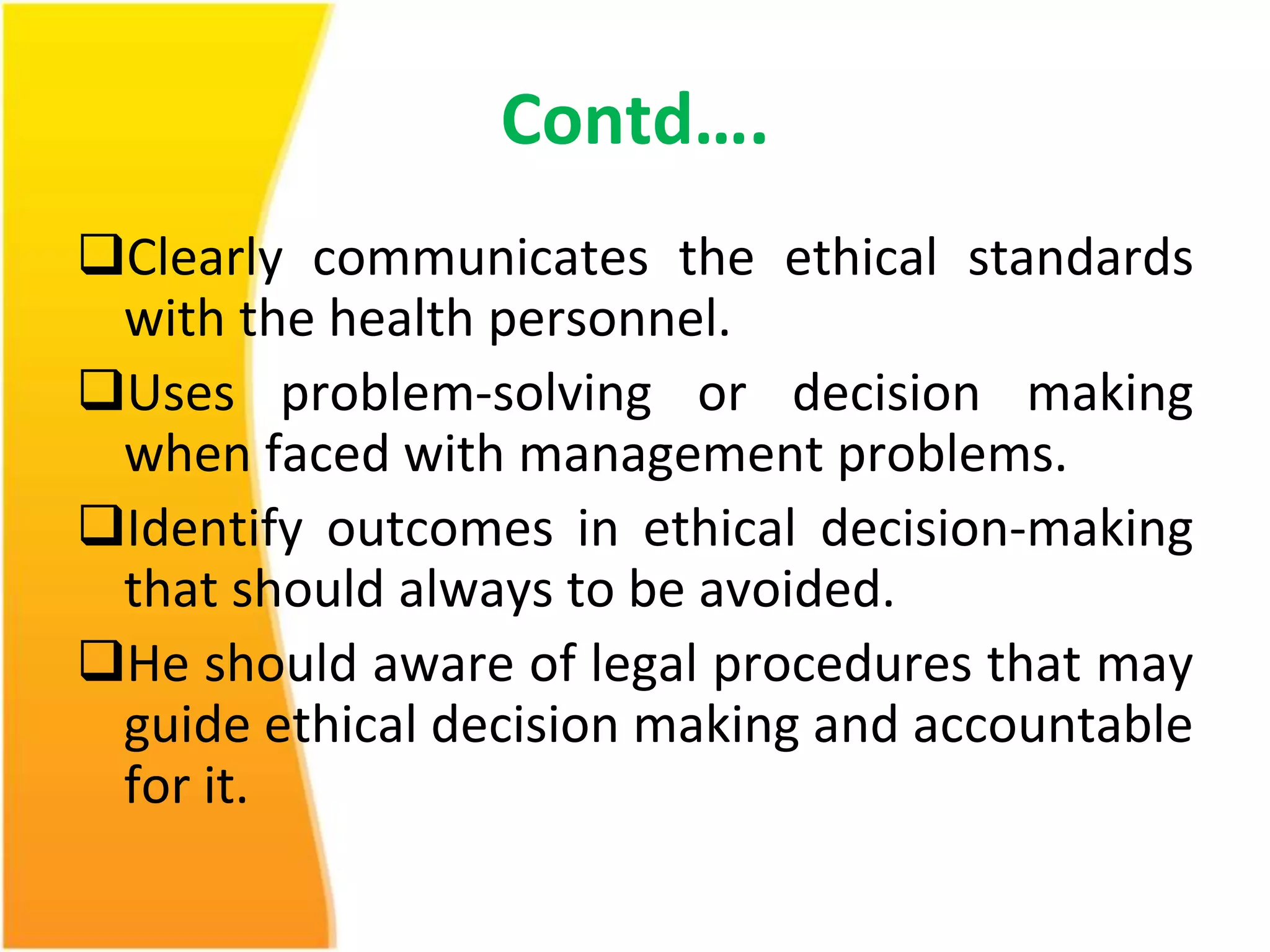
Contd…. 
Clearly communicates the ethical standards 
with the health personnel. 
Uses problem-solving or decision making 
when faced with management problems. 
Identify outcomes in ethical decision-making 
that should always to be avoided. 
He should aware of legal procedures that may 
guide ethical decision making and accountable 
for it.
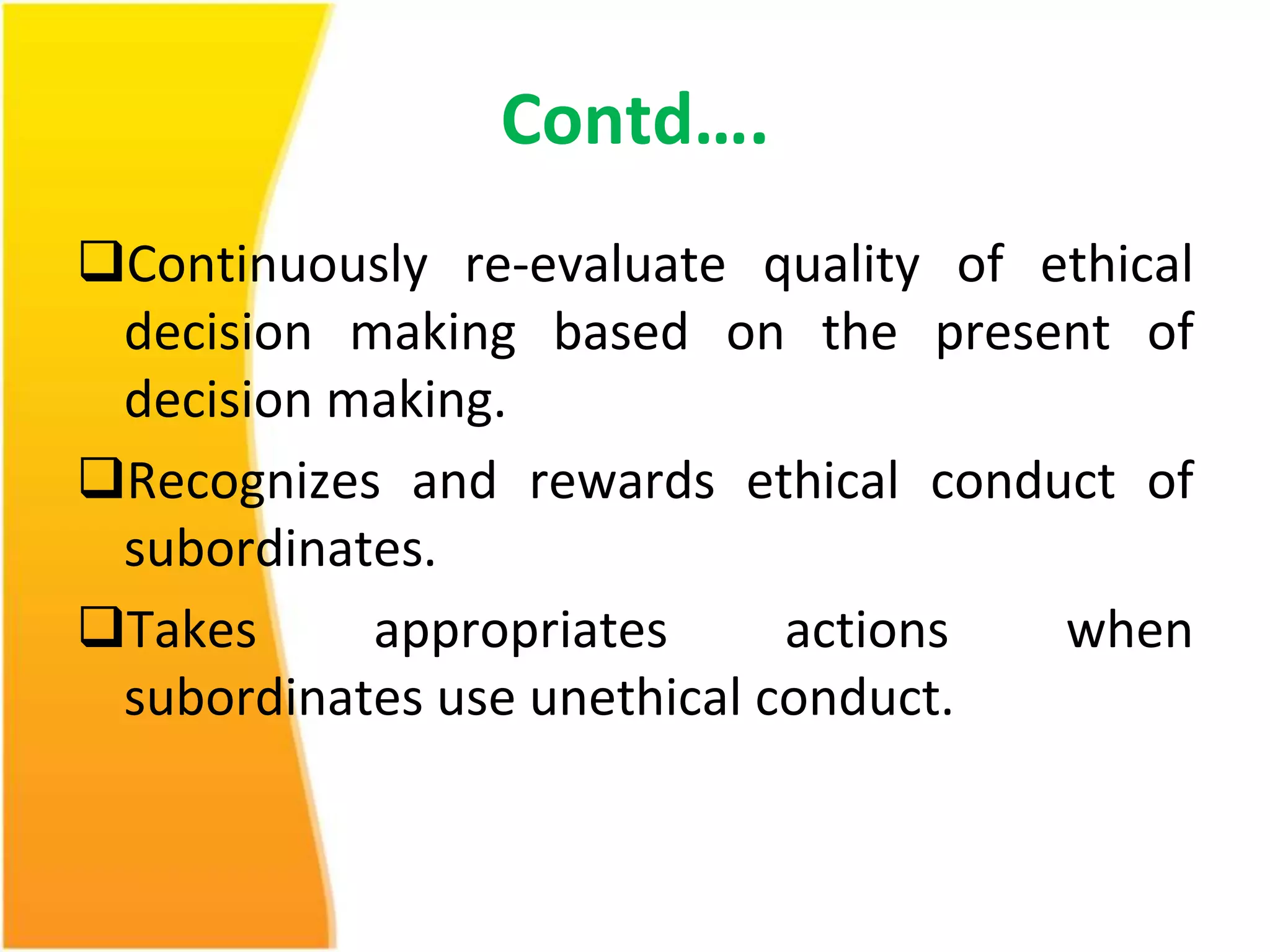
Contd…. 
Continuously re-evaluate quality of ethical 
decision making based on the present of 
decision making. 
Recognizes and rewards ethical conduct of 
subordinates. 
Takes appropriates actions when 
subordinates use unethical conduct.
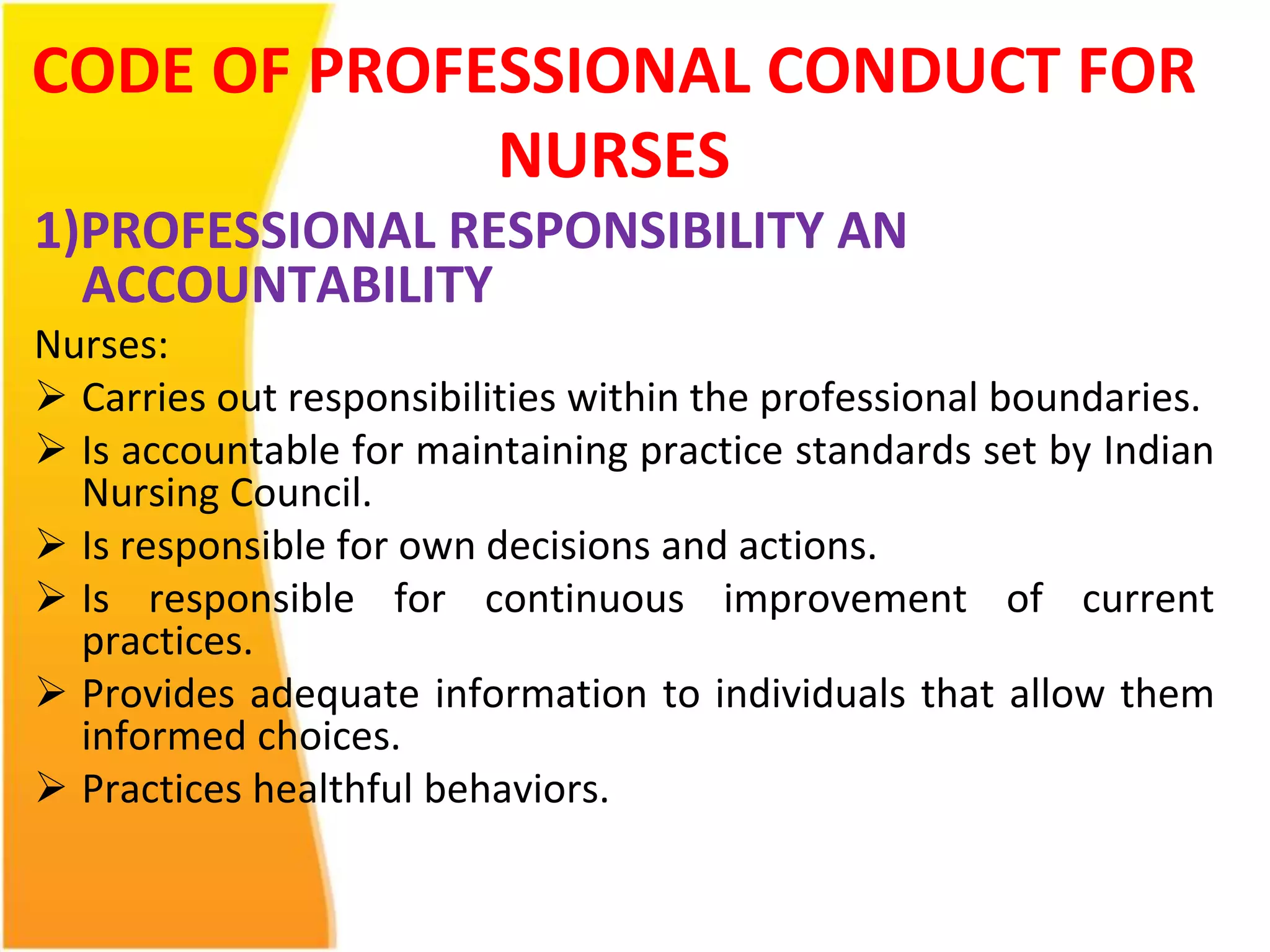
CODE OF PROFESSIONAL CONDUCT FOR 
NURSES 
1)PROFESSIONAL RESPONSIBILITY AN 
ACCOUNTABILITY 
Nurses: 
 Carries out responsibilities within the professional boundaries. 
 Is accountable for maintaining practice standards set by Indian 
Nursing Council. 
 Is responsible for own decisions and actions. 
 Is responsible for continuous improvement of current 
practices. 
 Provides adequate information to individuals that allow them 
informed choices. 
 Practices healthful behaviors.
2)NURSING PRACTICE 
NURSES: 
 Provides care in accordance with set standards of 
practice. 
 Respects individuals and families need to promoting 
healthy practices and discouraging harmful practices. 
 Treat all individuals and families with human dignity to 
providing physical,psychological,spiritual,emotional 
and social aspects of care. 
 Promotes participation of individuals and significant 
others in the care.
3)COMMUNICATION AND 
INTERPERSONAL RELATIONSHIP 
NURSES: 
Esablishes and maintains effective interpersonal 
relationship with individuals,families and 
communities. 
Uphold the dignity of team members and 
maintains effective interpersonal relationship 
with them. 
Co-operates with other health professionals to 
meet the needs of the individuals,families and 
communities.
4)VALUING HUMAN BEING 
NURSES: 
 Takes appropriate action to protect individuals from 
harmful unethical practice. 
 Encourages and supports individuals in their right to 
speak for themselves on issues affecting their health 
and welfare. 
 Respects and supports choices made by individuals.
5)MANAGEMENT 
NURSE: 
Ensures appropriate allocation and utilization 
of available resources. 
Participates in supervision and education of 
students. 
Communicates effectively following 
appropriate channels of communication. 
Participates in evaluation of nursing services.
6)PROFESSIONAL ADVANCEMENT 
NURSES: 
Ensures the protection of the human rights while 
pursuing the advancement of knowledge. 
 Contributes to the development of nursing 
practice. 
 Contributes to care professional knowledge by 
conducting and participating in research.
PROFESSIONAL MISCONDUCT
Contd…. 
1. Any failure to uphold personal and 
professional integrity in one’s practice,such 
as 
a. falsifying records 
b. abusing clients verbally, physically or 
emotionally 
c. abusing the nurse-client relationship 
d. signing or issuing a document containing false 
and misleading information
Contd…. 
e.Misappropriating property from clients or 
workplace 
f. Involving in inappropriate relationships with 
clients
Contd…. 
3. Any contravention of statutory 
requirements, such as: 
a. Practicing without any valid nursing 
registration and/or licences. 
b. Using another nurse/midwife’s name and/or 
registration in the course of providing or 
offering services to clients.
Contd…. 
c. being found guilty of professional misconduct 
by other nursing regulatory bodies. 
d. failure to appear before an inquiry convened 
by the SNB and/or co-operate with 
investigations carried out by the SNB.
SUMMARIZATION
ANY DOUBT
BIBLIOGRAPHY 
1. Basavanthappa BT. Management of Nursing Services & Education. New 
Delhi: JAYPEE publication.1st ed;2011.p539-586 
2. Jogindra Vati.Principles & Practice of Nursing Management & 
Administration. New Delhi: JAYPEE publication.1st ed;2013.p 46-63 
3. Shebeer BP,Khan SY. A concise text book of advanced nursing practice. 
Bangalore: Emmess medical publishers.1st ed;2012.p 9 -13. 
4. Basavanthappa BT. Fundamental of nursing. New Delhi: JAYPEE 
publication.2nd ed;2004.p 173-179 
5. Kaur L,Kaur M. A text book of nursing foundation. Jalandhaa: PV 
books.2nd ed;2009.p 37-39 
6. Kozier,Erb. Fundamental of nursing concepts,process and practice. 
Dorling Kindersley(India)Pvt.Ltd.8th ed;2009.p 85-95 
7. http:/www.nursingworld.org . 
8. http:/www.ehow.com. 
9. http:/www.nursingcouncil.org.in 
10. http:/www.ezinearticles.com
Ethical Committee, Code of ethics and Professional conduct In Nursing

Ethical Committee, Code of ethics and Professional conduct In Nursing

  • 1.
  • 2.
    INTRODUCTION Most Indianhospitals have instituted a committee for the purpose of checking whether proposals submitted for research meet established guidelines. It improve not only the quality of research undertaken by the institution but also the care of patients in the institution.
  • 3.
    ‘Mission statement ofthe committee’ Care of the patient in this institution. Research. Education of the staff on biomedical ethics.
  • 4.
    COMMITTEE Administration Clinicians- medical, surgical, other disciplines Social workers Nurses Rehabilitation personnel Priests/philosophers Lawyers Statisticians
  • 5.
    SUBCOMMITTEES Monthly meetingsof a large, single committee once a month over an hour and a half or two hours Frequency of meetings will depend on the goals set for the committee. Most ethics committees meet at least once a month Each member must attend at least 75% of all meetings.
  • 6.
    CARE OF PATIENTS The art of bedside medicine Relief of suffering Cure of disease Cost to patient: tests, drugs, other costs. Can these be lowered? Prompt attention to needs of the patient. Care of the seriously ill Care of the dying patients Care of the dead patient
  • 7.
    EDUCATION OF THESTAFF • Produces guidelines on a broad range of topics. Eg Disclosure of diagnosis, diagnosis of brain death,truly informed consent etc. • Sets up of a forum for receiving complaints from patients and families in writing and taking action to solve the problem.
  • 8.
    Contd…. • Producesa document for the benefit of patients and their families informing them about services provided by the institution(rights of patients and relatives, their responsibilities) • Continuing surveys practices within the institution(standards of patient care,unnecessary expenditure,obtaining truly informed consent)
  • 9.
    Contd…. • Obtainsfeedback from faculty, other staff on the functioning of the ethics committee and perceived deficiencies and suggestions on how it might function more effectively. • Conducts seminars/ workshops/ mini-conferences on biomedical ethics and research.
  • 10.
    WHY DO SOMEETHICS COMMITTEES FAIL GOALS THAT ARE TOO AMBITIOUS. LACK OF SUPPORT BY THE INSTITUTION. POOR SELECTION OF MEMBERS ON THE COMMITTEE.
  • 11.
    INSTITUTIONAL ETHICS COMMITTEE Institutional Ethics Committee (IECs)help to strengthen the human rights reserved exclusively for all members of society which the individual physicians and research workers may not be able to do alone.
  • 12.
    COMPOSITION OF IEC 1. 2 medical/ non medical scientists . 2. All members should be non-institutional except the secretary . 3. The chairman should be an outsider . 4. 2 lady members. 5. 5 members for a quorum . 6. No senior administrative officer of the institution. 7. Office staff(for secretary).
  • 13.
    THE ROLES OFIECS 1. Secretary should be available for clarifying ethical problems that may arise from the project. 2. Make sure that "informed consent "has been properly obtained. 3. Multi-center trials require a uniform protocol and a unified assessment system.
  • 14.
    Contd…. 4.Periodic followup should be made by the IEC 5. Informed consent obtained from volunteers who are to participate in a field trial must be properly executed. 6. Clinical trials of drugs or therapy conducted by clinicians.
  • 15.
    LEGAL ROLE OFTHE NURSE 1) Provider of Service Ensure that client receives competent, safe, & holistic care . Supervise/evaluate the care provider. Documentation of care. Maintain clinical quality of care.
  • 16.
    Contd…. 2) Responsibilityof appointing and assigning . 4) Responsibility for equipment . 5) Responsibility for observation and reporting. 6) Responsibility to protect public . 7) Responsibility for record keeping and reporting . 8) Responsibility for death and dying . ===
  • 17.
    CODE OF ETHICSAND PROFESSIONAL CONDUCT
  • 18.
    introduction Ethics refersto the moral code for nursing and is based on obligation to service and respect for human life. –Melanie and Evelyn. Ethics are the rules or principles that govern right conduct and are designed to protect the rights of human beings. - Sister Nancy.
  • 19.
    CODE OF ETHICS A code of ethics is a set of ethical principles that are accepted by all members of a profession. -Potter and Perry Code of ethics is a guideline for performance and standards and personal responsibility. -LillieM S and Juanita Lee
  • 20.
    NEED Helps thestudents/ RN to practice ethically Helps the nurse to identify the ethical issues in her work place Protecting patients right and dignity Providing care with minimum risk to the nurses health Ethical reasoning
  • 21.
    Contd…. Helps thenurse to respond to ethical conflicts Helps to differentiate right /wrong . Guide for a professional behavior . Help teachers to plan education. Prevent below standard practice. Protect a nurse if falsely accused for legal action .
  • 22.
    ETHICAL PRINCIPLES ETHICAL PRINCIPLES OF RESPECT AND AUTONOMY.  PRINCIPLE OF BENEFICENCE  PRINCIPLE OF JUSTICE  PRINCIPLE OF VERACITY
  • 23.
    Contd…. PRINCIPLE OFFIDELITY FREEDOM NON- MALEFICENCE RIGHTS CONFIDENTIALITY
  • 24.
    INTERNATIONAL CODE OF NURSING ETHICS The body of code is divided into 5 sections. 1)NURSES AND PEOPLE 2)NURSES AND PRACTICE 3)NURSES AND PROFESSION 4)NURSES AND CO-WORKERS 5)NURSES AND SOCIETY
  • 25.
  • 26.
    Contd…. An ethicaldilemma occurs when there is conflict between two or more ethical principles. No correct decision exists Need to obtain patients informed consent for care treatment orders and measures such as With holding/with drawing nutrition and fluids Starting / discontinuing life support system
  • 27.
    Contd…. The nursemust make a choice between two alternatives that are equally unsatisfactory. Such dilemmas may occur as a result of differences in cultural or religious beliefs. Need to protect autonomy rights of children. Need to make treatment and care of decisions for terminally ill patients.
  • 28.
    STEPS FOR RESOLVINGETHICAL DILEMMA Step – I: Collect, Analyze and interpret the data Step – II: State the Dilemma Step – III: Consider the choices of action Step – IV: Analyze the advantage and disadvantages of each course of action Step – V: Make the decision and act on it.
  • 29.
    ROLES AND FUNCTIONSOF ADMINISTRATOR He or she is self aware regarding own values and basic beliefs about their rights and duties. Be a part of all ethical decision-making. Accepts that negative outcomes occur in ethical decision making and use high quality problem solving and decision-making. Actively advocates for clients, subordinates and the profession
  • 30.
    Contd…. Clearly communicatesthe ethical standards with the health personnel. Uses problem-solving or decision making when faced with management problems. Identify outcomes in ethical decision-making that should always to be avoided. He should aware of legal procedures that may guide ethical decision making and accountable for it.
  • 31.
    Contd…. Continuously re-evaluatequality of ethical decision making based on the present of decision making. Recognizes and rewards ethical conduct of subordinates. Takes appropriates actions when subordinates use unethical conduct.
  • 32.
    CODE OF PROFESSIONALCONDUCT FOR NURSES 1)PROFESSIONAL RESPONSIBILITY AN ACCOUNTABILITY Nurses:  Carries out responsibilities within the professional boundaries.  Is accountable for maintaining practice standards set by Indian Nursing Council.  Is responsible for own decisions and actions.  Is responsible for continuous improvement of current practices.  Provides adequate information to individuals that allow them informed choices.  Practices healthful behaviors.
  • 33.
    2)NURSING PRACTICE NURSES:  Provides care in accordance with set standards of practice.  Respects individuals and families need to promoting healthy practices and discouraging harmful practices.  Treat all individuals and families with human dignity to providing physical,psychological,spiritual,emotional and social aspects of care.  Promotes participation of individuals and significant others in the care.
  • 34.
    3)COMMUNICATION AND INTERPERSONALRELATIONSHIP NURSES: Esablishes and maintains effective interpersonal relationship with individuals,families and communities. Uphold the dignity of team members and maintains effective interpersonal relationship with them. Co-operates with other health professionals to meet the needs of the individuals,families and communities.
  • 35.
    4)VALUING HUMAN BEING NURSES:  Takes appropriate action to protect individuals from harmful unethical practice.  Encourages and supports individuals in their right to speak for themselves on issues affecting their health and welfare.  Respects and supports choices made by individuals.
  • 36.
    5)MANAGEMENT NURSE: Ensuresappropriate allocation and utilization of available resources. Participates in supervision and education of students. Communicates effectively following appropriate channels of communication. Participates in evaluation of nursing services.

  • 37.
    6)PROFESSIONAL ADVANCEMENT NURSES: Ensures the protection of the human rights while pursuing the advancement of knowledge.  Contributes to the development of nursing practice.  Contributes to care professional knowledge by conducting and participating in research.
  • 38.
  • 39.
    Contd…. 1. Anyfailure to uphold personal and professional integrity in one’s practice,such as a. falsifying records b. abusing clients verbally, physically or emotionally c. abusing the nurse-client relationship d. signing or issuing a document containing false and misleading information
  • 40.
    Contd…. e.Misappropriating propertyfrom clients or workplace f. Involving in inappropriate relationships with clients
  • 41.
    Contd…. 3. Anycontravention of statutory requirements, such as: a. Practicing without any valid nursing registration and/or licences. b. Using another nurse/midwife’s name and/or registration in the course of providing or offering services to clients.
  • 42.
    Contd…. c. beingfound guilty of professional misconduct by other nursing regulatory bodies. d. failure to appear before an inquiry convened by the SNB and/or co-operate with investigations carried out by the SNB.
  • 43.
  • 44.
  • 45.
    BIBLIOGRAPHY 1. BasavanthappaBT. Management of Nursing Services & Education. New Delhi: JAYPEE publication.1st ed;2011.p539-586 2. Jogindra Vati.Principles & Practice of Nursing Management & Administration. New Delhi: JAYPEE publication.1st ed;2013.p 46-63 3. Shebeer BP,Khan SY. A concise text book of advanced nursing practice. Bangalore: Emmess medical publishers.1st ed;2012.p 9 -13. 4. Basavanthappa BT. Fundamental of nursing. New Delhi: JAYPEE publication.2nd ed;2004.p 173-179 5. Kaur L,Kaur M. A text book of nursing foundation. Jalandhaa: PV books.2nd ed;2009.p 37-39 6. Kozier,Erb. Fundamental of nursing concepts,process and practice. Dorling Kindersley(India)Pvt.Ltd.8th ed;2009.p 85-95 7. http:/www.nursingworld.org . 8. http:/www.ehow.com. 9. http:/www.nursingcouncil.org.in 10. http:/www.ezinearticles.com