Rabies – A continuing public
health issue.
M.Sc Microbiology
Mahatma Jyotiba Phule Rohilkhand University,
Bareilly
Content
• What is Rabies- introduction
• Rabies in history
• Pasteurs contribution
• Epidemiological factors
• Morphology of virus
• Incubation period
• Pathogenesity
• Transmission
• Signs and symptoms
• Treatment and Prevention
• National rabies control program
• 2021 National Indian program launch in the context of microbiology
• References
What is Rabies?
• The name rabies is derived from the Latin rabies, "madness“.
• Rabies virus causes an acute encephalitis (inflammation of the brain)
in all warm-blooded hosts.
• The impact of rabies on public health includes an estimate of the
animal population that is affected and the steps involved in
preventing transmission of rabies from animals to humans.
• Raccoons, skunks, foxes, coyotes, and several species of insectivorous
bats have been identified as reservoirs for the disease.
• Rabies is transmitted through the saliva of an infected animal. This
usually occurs by a bite wound.
Rabies in History
• Rabies cases have been reported since before 2300 BC.
• 1st century AD a Roman scholar named Aulus Cornelius Celsus gave
the first accurate description of the disease.
• 1st scientist to test rabies infection through inoculation of saliva was a
German scientist named Zinke in 1804
Pasteur’s Contribution
• 1885 he published a method for protecting dogs against rabies
• A dog exposed to rabies was protected by inoculation with an emulsion
prepared from the dried spinal cord of a diseased rabbit
• Pasteur had the chance to test this same method on humans when Joseph
Meister, a nine-year-old boy who was bitten by a rabid dog was brought to
him in July of 1885.
• Joseph was injected over several days with the emulsions prepared from
animal spinal cord material.
• After 2 weeks, Joseph was given an injection of virus that had maximal
virulence when tested in a rabbit
• Joseph survived as did thousands of others treated by the same procedure
Epidemiological factors
• Agent – Rabies virus
• Reservoir of infection – Dogs and wild animals
• Source of infection – saliva of rabid animals
• Host factors – Veterinary doctors, people who go to the forest are at a
high risk of getting Rabies
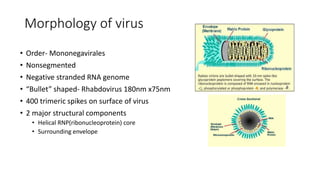
Morphology of virus
• Order- Mononegavirales
• Nonsegmented
• Negative stranded RNA genome
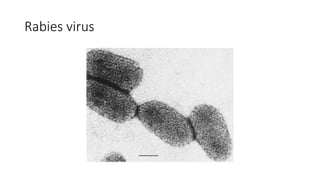
• “Bullet” shaped- Rhabdovirus 180nm x75nm
• 400 trimeric spikes on surface of virus
• 2 major structural components
• Helical RNP(ribonucleoprotein) core
• Surrounding envelope
Rabies virus
Incubation period
• Average incubation period is 1 - 3 months. (Can vary from 10 days to
one year)
• The incubation period depends on the site and the severity of the bite
• If the bite is deep and near the head, the incubation period will be short
• If the bite is mild and on the foot, the incubation period will be long .
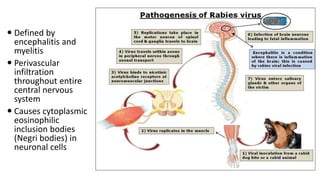
 Defined by
encephalitis and
myelitis
 Perivascular
infiltration
throughout entire
central nervous
system
 Causes cytoplasmic
eosinophilic
inclusion bodies
(Negri bodies) in
neuronal cells
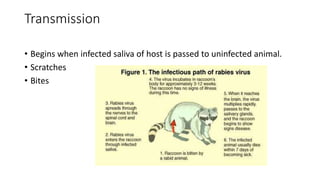
Transmission
• Begins when infected saliva of host is passed to uninfected animal.
• Scratches
• Bites
Signs and symptoms
• Initially the symptoms usually include-
 Anxiety
 Insomnia
 Confusion
 Agitation
 Fever
 Nausea and vomiting
• This shall soon be followed by:-
• Inability to drink water and / or fear for water ( hydrophobia )
• Fear for draught of air ( aerophobia )
• Fear for light ( photophobia )
• Abnormal behaviour
• Hallucinations progressing to delirium
• Slight or partial paralysis
• Ultimately leading to cardio-respiratory failure and death
Treatment and Prevention
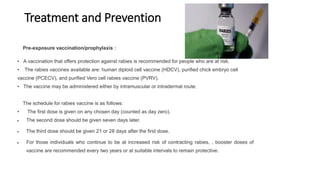
Pre-exposure vaccination/prophylaxis :
• A vaccination that offers protection against rabies is recommended for people who are at risk.
• The rabies vaccines available are: human diploid cell vaccine (HDCV), purified chick embryo cell
vaccine (PCECV), and purified Vero cell rabies vaccine (PVRV).
• The vaccine may be administered either by intramuscular or intradermal route.
The schedule for rabies vaccine is as follows:
• The first dose is given on any chosen day (counted as day zero).
 The second dose should be given seven days later.
 The third dose should be given 21 or 28 days after the first dose.
 For those individuals who continue to be at increased risk of contracting rabies, , booster doses of
vaccine are recommended every two years or at suitable intervals to remain protective.
Post-exposure prophylaxis (PEP) :
• Immunization or sero-vaccine therapy if administered immediately or as early as possible after exposure is highly successful.
• Person bitten by a suspected animal
• To neutralize the inoculated virus before it enters nervous system
• Combined administration of a single dose of antirabies serum with a course of vaccine, together with local treatment of the wound.
• 2 components- local treatment of wounds and immunization.
• It includes:-
 Thorough cleansing of the wound/s with water and soap or detergent and applying an anti-septic like povidone-iodine or others.
 Administering rabies immunoglobulin, following severe exposures to rabies a special preparation of anti-rabies antibodies, into and
around the wounds, as anatomically feasible.
 Administering a course of modern rabies vaccine using the “Essen” regimen consisting of five injections by intramuscular (into the
muscle) route given on days 0 (day of the first injection and may not be the day of exposure/bite), 3,7,14 and 28; or by
intradermal ( into the skin ) route, given on days 0 (day of the first injection and may not be the day of exposure/bite), 3, 7 and
28. Only the rabies vaccines approved by the national health authorities shall be used for use by the intra-dermal route.
National rabies control programme
• In India, dogs are responsible for about 97% of human rabies, followed by cats 2%, and others at 1%.
• The disease is invariably fatal and perhaps the most painful and dreadful.
• Fortunately, the development of rabies can be prevented to a large extent if animal bites are managed
appropriately and in time. In this regard, the post-exposure treatment of animal bite cases is of prime
importance.
• National Centre for Disease Control (formerly National Institute of Communicable Diseases), Delhi, WHO
Collaborating Centre for Rabies Epidemiology, organized an expert consultation in 2002 to formulate national
guidelines for rabies prophylaxis to bring out uniformity in post-exposure prophylaxis practices. Due to new
interventions in this field, it has been further revised over the years.
• Under the 12 five-year plan, National Rabies Control Programme (NRCP) has been approved. The NRCP
has both human and animal health components.
• Human Component - which is being implemented in all the states & UTs. National Centre for the Diseases control is
the nodal agency for the Human Component of the program. The strategies for the human component are:
 Training of health professionals
 Implementing use of intra-dermal route of inoculation of cell culture vaccines
 Strengthening surveillance of human rabies
 Information Education & Communication
 Laboratory strengthening
•
• Animal Component- which is being pilot tested in the Haryana & Chennai. The Animal Welfare Board of India, Ministry
of Environment & Forests is the Nodal agency for the Animal Component of the program. The strategies for the animal
component are:
 Population survey of dogs
 Mass vaccination of dogs
• Dog population management
2021 National indian Program Launch in the context of
Microbiology-
References
• Rabies | National Health Portal Of India (nhp.gov.in)
• Rabies presentation | monyaki sydwelll - Academia.edu
• National Rabies Control Programme | National Health Portal Of India (nhp.gov.in)
• Rabies virus - Wikipedia
Thank you

Rabies - Ancient disease still a modern problem.

  • 1.
    Rabies – Acontinuing public health issue. M.Sc Microbiology Mahatma Jyotiba Phule Rohilkhand University, Bareilly
  • 2.
    Content • What isRabies- introduction • Rabies in history • Pasteurs contribution • Epidemiological factors • Morphology of virus • Incubation period • Pathogenesity • Transmission • Signs and symptoms • Treatment and Prevention • National rabies control program • 2021 National Indian program launch in the context of microbiology • References
  • 3.
    What is Rabies? •The name rabies is derived from the Latin rabies, "madness“. • Rabies virus causes an acute encephalitis (inflammation of the brain) in all warm-blooded hosts. • The impact of rabies on public health includes an estimate of the animal population that is affected and the steps involved in preventing transmission of rabies from animals to humans. • Raccoons, skunks, foxes, coyotes, and several species of insectivorous bats have been identified as reservoirs for the disease. • Rabies is transmitted through the saliva of an infected animal. This usually occurs by a bite wound.
  • 4.
    Rabies in History •Rabies cases have been reported since before 2300 BC. • 1st century AD a Roman scholar named Aulus Cornelius Celsus gave the first accurate description of the disease. • 1st scientist to test rabies infection through inoculation of saliva was a German scientist named Zinke in 1804
  • 5.
    Pasteur’s Contribution • 1885he published a method for protecting dogs against rabies • A dog exposed to rabies was protected by inoculation with an emulsion prepared from the dried spinal cord of a diseased rabbit • Pasteur had the chance to test this same method on humans when Joseph Meister, a nine-year-old boy who was bitten by a rabid dog was brought to him in July of 1885. • Joseph was injected over several days with the emulsions prepared from animal spinal cord material. • After 2 weeks, Joseph was given an injection of virus that had maximal virulence when tested in a rabbit • Joseph survived as did thousands of others treated by the same procedure
  • 6.
    Epidemiological factors • Agent– Rabies virus • Reservoir of infection – Dogs and wild animals • Source of infection – saliva of rabid animals • Host factors – Veterinary doctors, people who go to the forest are at a high risk of getting Rabies
  • 7.
    Morphology of virus •Order- Mononegavirales • Nonsegmented • Negative stranded RNA genome • “Bullet” shaped- Rhabdovirus 180nm x75nm • 400 trimeric spikes on surface of virus • 2 major structural components • Helical RNP(ribonucleoprotein) core • Surrounding envelope
  • 8.
  • 9.
    Incubation period • Averageincubation period is 1 - 3 months. (Can vary from 10 days to one year) • The incubation period depends on the site and the severity of the bite • If the bite is deep and near the head, the incubation period will be short • If the bite is mild and on the foot, the incubation period will be long .
  • 10.
     Defined by encephalitisand myelitis  Perivascular infiltration throughout entire central nervous system  Causes cytoplasmic eosinophilic inclusion bodies (Negri bodies) in neuronal cells
  • 11.
    Transmission • Begins wheninfected saliva of host is passed to uninfected animal. • Scratches • Bites
  • 12.
    Signs and symptoms •Initially the symptoms usually include-  Anxiety  Insomnia  Confusion  Agitation  Fever  Nausea and vomiting • This shall soon be followed by:- • Inability to drink water and / or fear for water ( hydrophobia ) • Fear for draught of air ( aerophobia ) • Fear for light ( photophobia ) • Abnormal behaviour • Hallucinations progressing to delirium • Slight or partial paralysis • Ultimately leading to cardio-respiratory failure and death
  • 13.
    Treatment and Prevention Pre-exposurevaccination/prophylaxis : • A vaccination that offers protection against rabies is recommended for people who are at risk. • The rabies vaccines available are: human diploid cell vaccine (HDCV), purified chick embryo cell vaccine (PCECV), and purified Vero cell rabies vaccine (PVRV). • The vaccine may be administered either by intramuscular or intradermal route. The schedule for rabies vaccine is as follows: • The first dose is given on any chosen day (counted as day zero).  The second dose should be given seven days later.  The third dose should be given 21 or 28 days after the first dose.  For those individuals who continue to be at increased risk of contracting rabies, , booster doses of vaccine are recommended every two years or at suitable intervals to remain protective.
  • 14.
    Post-exposure prophylaxis (PEP): • Immunization or sero-vaccine therapy if administered immediately or as early as possible after exposure is highly successful. • Person bitten by a suspected animal • To neutralize the inoculated virus before it enters nervous system • Combined administration of a single dose of antirabies serum with a course of vaccine, together with local treatment of the wound. • 2 components- local treatment of wounds and immunization. • It includes:-  Thorough cleansing of the wound/s with water and soap or detergent and applying an anti-septic like povidone-iodine or others.  Administering rabies immunoglobulin, following severe exposures to rabies a special preparation of anti-rabies antibodies, into and around the wounds, as anatomically feasible.  Administering a course of modern rabies vaccine using the “Essen” regimen consisting of five injections by intramuscular (into the muscle) route given on days 0 (day of the first injection and may not be the day of exposure/bite), 3,7,14 and 28; or by intradermal ( into the skin ) route, given on days 0 (day of the first injection and may not be the day of exposure/bite), 3, 7 and 28. Only the rabies vaccines approved by the national health authorities shall be used for use by the intra-dermal route.
  • 15.
    National rabies controlprogramme • In India, dogs are responsible for about 97% of human rabies, followed by cats 2%, and others at 1%. • The disease is invariably fatal and perhaps the most painful and dreadful. • Fortunately, the development of rabies can be prevented to a large extent if animal bites are managed appropriately and in time. In this regard, the post-exposure treatment of animal bite cases is of prime importance. • National Centre for Disease Control (formerly National Institute of Communicable Diseases), Delhi, WHO Collaborating Centre for Rabies Epidemiology, organized an expert consultation in 2002 to formulate national guidelines for rabies prophylaxis to bring out uniformity in post-exposure prophylaxis practices. Due to new interventions in this field, it has been further revised over the years. • Under the 12 five-year plan, National Rabies Control Programme (NRCP) has been approved. The NRCP has both human and animal health components.
  • 16.
    • Human Component- which is being implemented in all the states & UTs. National Centre for the Diseases control is the nodal agency for the Human Component of the program. The strategies for the human component are:  Training of health professionals  Implementing use of intra-dermal route of inoculation of cell culture vaccines  Strengthening surveillance of human rabies  Information Education & Communication  Laboratory strengthening • • Animal Component- which is being pilot tested in the Haryana & Chennai. The Animal Welfare Board of India, Ministry of Environment & Forests is the Nodal agency for the Animal Component of the program. The strategies for the animal component are:  Population survey of dogs  Mass vaccination of dogs • Dog population management
  • 17.
    2021 National indianProgram Launch in the context of Microbiology-
  • 18.
    References • Rabies |National Health Portal Of India (nhp.gov.in) • Rabies presentation | monyaki sydwelll - Academia.edu • National Rabies Control Programme | National Health Portal Of India (nhp.gov.in) • Rabies virus - Wikipedia
  • 19.