RABIES
Dr. D. Gracy Paulin
Assistant Professor
Department of Community Medicine
Learning objectives
At the end of this session, you should be able to
1. Summarize the burden of rabies
2. Describe the epidemiological features of rabies
3. Describe the steps in the management of dog bite
4. List the steps for the control of rabies
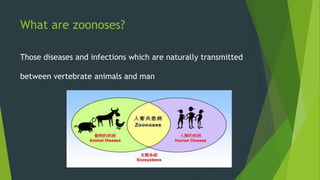
What are zoonoses?
Those diseases and infections which are naturally transmitted
between vertebrate animals and man
CLASSIFICATION OF ZOONOSES
 Etiological agents
 Transmission cycle
 Direct zoonoses
 Cyclozoonoses
 Metazoonoses
 Saprozoonoses
 Reservoir host
 Anthropozoonoses
 Zooanthroponoses
 Amphixenoses
DIRECT ZOONOSES
 Transmitted by direct contact, by fomite or by a
mechanical vector
 No propagative or developmental change during
transmission
 Eg: Rabies, Trichinosis, Brucellosis, anthrax
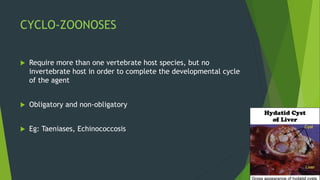
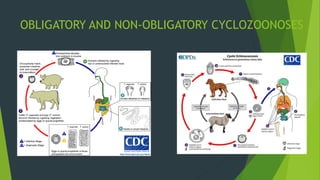
CYCLO-ZOONOSES
 Require more than one vertebrate host species, but no
invertebrate host in order to complete the developmental cycle
of the agent
 Obligatory and non-obligatory
 Eg: Taeniases, Echinococcosis
OBLIGATORY AND NON-OBLIGATORY CYCLOZOONOSES
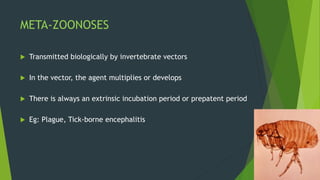
META-ZOONOSES
 Transmitted biologically by invertebrate vectors
 In the vector, the agent multiplies or develops
 There is always an extrinsic incubation period or prepatent period
 Eg: Plague, Tick-borne encephalitis
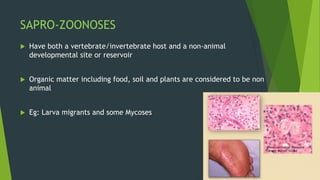
SAPRO-ZOONOSES
 Have both a vertebrate/invertebrate host and a non-animal
developmental site or reservoir
 Organic matter including food, soil and plants are considered to be non
animal
 Eg: Larva migrants and some Mycoses
CLASSIFICATION – Reservoir host
Anthropo-zoonoses – infections transmitted to man from lower
vertebrate animals
Examples??
Zooanthroponoses – infections transmitted from man to lower vertebrate
animals
Examples – Tuberculosis, amoebiasis, Diphtheria
Amphixenoses – infections maintained in both man and lower vertebrate
animals that may be transmitted in either directions. Universal

diseases.

Examples – Streptococcosis, Staphylococcosis.
RABIES
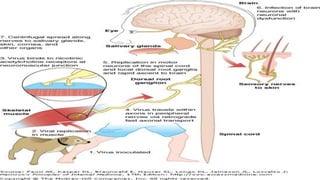
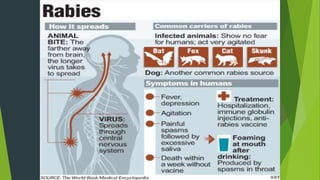
 Acute, highly fatal viral disease of central nervous system
 Zoonotic disease of warm blooded animals caused by Lyssavirus
Type I
 Transmitted by bites or licks of rabid animals
 Also known as hydrophobia
 ONLY COMMUNICABLE DISEASE THAT IS ALWAYS FATAL
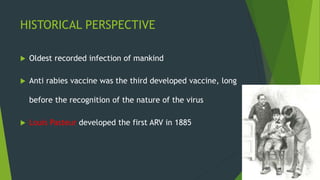
HISTORICAL PERSPECTIVE
 Oldest recorded infection of mankind
 Anti rabies vaccine was the third developed vaccine, long
before the recognition of the nature of the virus
 Louis Pasteur developed the first ARV in 1885
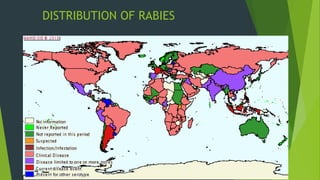
DISTRIBUTION OF RABIES
“RABIES FREE” AREA
 Water is the natural barrier for rabies
 Rabies free areas – Australia, China (Taiwan), Cyprus, Iceland, Ireland,
Japan, Malta, New Zealand, U.K, Islands of Western Pacific
 Rabies free area in India???
 When do you say an area to be “rabies free”?
AGENT FACTORS
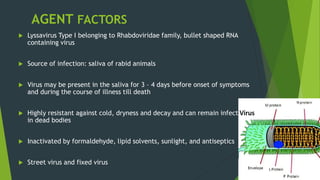
 Lyssavirus Type I belonging to Rhabdoviridae family, bullet shaped RNA
containing virus
 Source of infection: saliva of rabid animals
 Virus may be present in the saliva for 3 – 4 days before onset of symptoms
and during the course of illness till death
 Highly resistant against cold, dryness and decay and can remain infectious
in dead bodies
 Inactivated by formaldehyde, lipid solvents, sunlight, and antiseptics
 Street virus and fixed virus
HOST FACTORS
 All warm blooded animals including man
 Man – dead end infection
 Age group – 1-24 years
 Laboratory staff working with rabies virus,
veterinarians, dog handlers, hunters and field
naturalists have higher risk
INCUBATION PERIOD
 1-3 months but may very from 7 days to several years
 Depends on site and severity of bite, no. of wounds, amount of virus
injected, species of biting animal, protection provided by clothing
and treatment taken
 Incubation period tends to be shorter in bites on face, neck and
upper extremities.
CLINICAL FEATURES
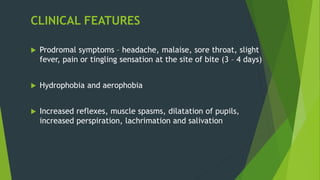
 Prodromal symptoms – headache, malaise, sore throat, slight
fever, pain or tingling sensation at the site of bite (3 – 4 days)
 Hydrophobia and aerophobia
 Increased reflexes, muscle spasms, dilatation of pupils,
increased perspiration, lachrimation and salivation
DIAGNOSIS
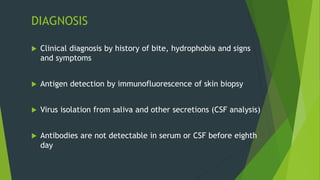
 Clinical diagnosis by history of bite, hydrophobia and signs
and symptoms
 Antigen detection by immunofluorescence of skin biopsy
 Virus isolation from saliva and other secretions (CSF analysis)
 Antibodies are not detectable in serum or CSF before eighth
day
TREATMENT
 No specific treatment
 Isolate and protect the patient from external stimuli
 Relieve anxiety and pain by sedatives
 Hydration and diuresis
 Cardio respiratory support
 To-date, only seven people are on record who have been stricken
with rabies and have survived
POST EXPOSURE PROPHYLAXIS
 To neutralize the inoculated virus before it reaches
central nervous system
 Single dose of rabies immunoglobulin
 A course of vaccine
 Local treatment of wound
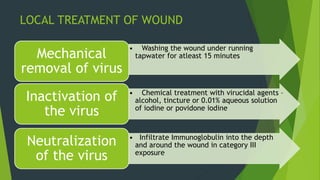
LOCAL TREATMENT OF WOUND
• Washing the wound under running
tapwater for atleast 15 minutesMechanical
removal of virus
• Chemical treatment with virucidal agents –
alcohol, tincture or 0.01% aqueous solution
of iodine or povidone iodine
Inactivation of
the virus
• Infiltrate Immunoglobulin into the depth
and around the wound in category III
exposure
Neutralization
of the virus
“SUTURING THE
WOUND SHOULD BE
AVOIDED AS A RULE”
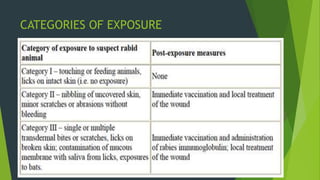
CATEGORIES OF EXPOSURE
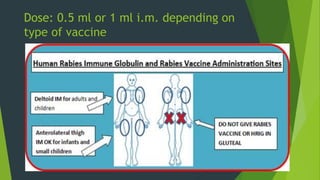
Dose: 0.5 ml or 1 ml i.m. depending on
type of vaccine
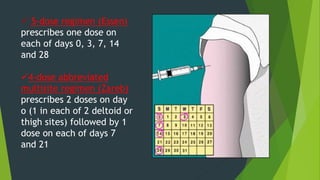
 5-dose regimen (Essen)
prescribes one dose on
each of days 0, 3, 7, 14
and 28
4-dose abbreviated
multisite regimen (Zareb)
prescribes 2 doses on day
o (1 in each of 2 deltoid or
thigh sites) followed by 1
dose on each of days 7
and 21
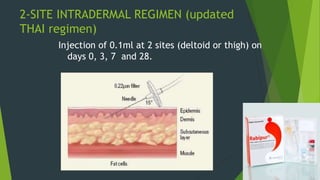
2-SITE INTRADERMAL REGIMEN (updated
THAI regimen)
Injection of 0.1ml at 2 sites (deltoid or thigh) on
days 0, 3, 7 and 28.
PEP FOR PREVIOUSLY VACCINATED
INDIVIDUALS
1 Dose delivered i.m or a CCV delivered i.d on days 0 and 3
(or)
Single visit 4-site i.d regimen: 4 injections of 0.1 ml equally
distributed over left and right deltoids and thighs
PASSIVE IMMUNIZAATION
 Rabies immunoglobulin administered only once
 At or as soon as possible after the first dose
 Beyond 7th day, it is not indicated
 Dose – 20IU/ Kg body weight
 Should be administered as much as possible in or around the bite
site
 Remaining, if any, should be administered distant from vaccination
site
Post-exposure prophylaxis can be
discontinued if the suspected animal is
proved by appropriate laboratory
examination to be free of rabies, or, in
the case of domestic animals, the
animal remains healthy 10 days
observation period starting from the
date of bite
PRE-EXPOSURE PROPHYLAXIS
 I.M doses of 1ml or 0.5 ml depending on type of vaccine
 I.D administration of 0.1 ml volume per site (one site each day)
 On days 0, 7, 21 and 28
 For persons who are at increased risk
 Boosters are not needed but can be given periodically with
antibody titre monitoring
CONTROL MEASURES
 Elimination of stray and ownerless dogs
 Swift mass immunization
 Registration and licensing of all domestic dogs
 Restraint of dogs in public places
 Immediate destruction of dogs and cats bitten by rabid
animals
 Quarantine for about 6 months of imported dogs
 Health education
REVIEW
1. Rabies is
a. Direct zoonoses
b. Cyclo zoonoses
c. Meta zoonoses
d. Sapro zoonoses
2. All are true about Rabies except
a. It is a RNA virus
b.It has fixed incubation period
c. Incubation period depends on site of bite
d.All bites with laceration on fingers are
category III injury
3. For the treatment of category III dog bite,
all of the following are correct except
a. Give immunoglobulins for passive immunity
b.Give ARV
c. Immediately suture wound under antibiotic
coverage
d.Immediately wash wound with soap and
water
4. A rabies free area is one with no
indigenously acquired cases
a. In man for 2 years
b.In man and animal for 2 years
c. In man for 1 year
d.In man and animal for 1 year
5. Rabies free country is
1.China
2.Russia
3.Canada
4.France
SUMMARY
 Classification of zoonoses
 Burden of Rabies
 Rabies free area
 Epidemiological triad
 Clinical features
 Post exposure prophylaxis
 Anti Rabies Vaccine
 Rabies immunoglobulin
 Control of rabies
Rabies

Rabies

  • 1.
    RABIES Dr. D. GracyPaulin Assistant Professor Department of Community Medicine
  • 2.
    Learning objectives At theend of this session, you should be able to 1. Summarize the burden of rabies 2. Describe the epidemiological features of rabies 3. Describe the steps in the management of dog bite 4. List the steps for the control of rabies
  • 3.
    What are zoonoses? Thosediseases and infections which are naturally transmitted between vertebrate animals and man
  • 4.
    CLASSIFICATION OF ZOONOSES Etiological agents  Transmission cycle  Direct zoonoses  Cyclozoonoses  Metazoonoses  Saprozoonoses  Reservoir host  Anthropozoonoses  Zooanthroponoses  Amphixenoses
  • 5.
    DIRECT ZOONOSES  Transmittedby direct contact, by fomite or by a mechanical vector  No propagative or developmental change during transmission  Eg: Rabies, Trichinosis, Brucellosis, anthrax
  • 6.
    CYCLO-ZOONOSES  Require morethan one vertebrate host species, but no invertebrate host in order to complete the developmental cycle of the agent  Obligatory and non-obligatory  Eg: Taeniases, Echinococcosis
  • 7.
  • 8.
    META-ZOONOSES  Transmitted biologicallyby invertebrate vectors  In the vector, the agent multiplies or develops  There is always an extrinsic incubation period or prepatent period  Eg: Plague, Tick-borne encephalitis
  • 9.
    SAPRO-ZOONOSES  Have botha vertebrate/invertebrate host and a non-animal developmental site or reservoir  Organic matter including food, soil and plants are considered to be non animal  Eg: Larva migrants and some Mycoses
  • 10.
    CLASSIFICATION – Reservoirhost Anthropo-zoonoses – infections transmitted to man from lower vertebrate animals Examples?? Zooanthroponoses – infections transmitted from man to lower vertebrate animals Examples – Tuberculosis, amoebiasis, Diphtheria Amphixenoses – infections maintained in both man and lower vertebrate animals that may be transmitted in either directions. Universal diseases. Examples – Streptococcosis, Staphylococcosis.
  • 12.
    RABIES  Acute, highlyfatal viral disease of central nervous system  Zoonotic disease of warm blooded animals caused by Lyssavirus Type I  Transmitted by bites or licks of rabid animals  Also known as hydrophobia  ONLY COMMUNICABLE DISEASE THAT IS ALWAYS FATAL
  • 13.
    HISTORICAL PERSPECTIVE  Oldestrecorded infection of mankind  Anti rabies vaccine was the third developed vaccine, long before the recognition of the nature of the virus  Louis Pasteur developed the first ARV in 1885
  • 15.
  • 16.
    “RABIES FREE” AREA Water is the natural barrier for rabies  Rabies free areas – Australia, China (Taiwan), Cyprus, Iceland, Ireland, Japan, Malta, New Zealand, U.K, Islands of Western Pacific  Rabies free area in India???  When do you say an area to be “rabies free”?
  • 17.
    AGENT FACTORS  LyssavirusType I belonging to Rhabdoviridae family, bullet shaped RNA containing virus  Source of infection: saliva of rabid animals  Virus may be present in the saliva for 3 – 4 days before onset of symptoms and during the course of illness till death  Highly resistant against cold, dryness and decay and can remain infectious in dead bodies  Inactivated by formaldehyde, lipid solvents, sunlight, and antiseptics  Street virus and fixed virus
  • 18.
    HOST FACTORS  Allwarm blooded animals including man  Man – dead end infection  Age group – 1-24 years  Laboratory staff working with rabies virus, veterinarians, dog handlers, hunters and field naturalists have higher risk
  • 19.
    INCUBATION PERIOD  1-3months but may very from 7 days to several years  Depends on site and severity of bite, no. of wounds, amount of virus injected, species of biting animal, protection provided by clothing and treatment taken  Incubation period tends to be shorter in bites on face, neck and upper extremities.
  • 21.
    CLINICAL FEATURES  Prodromalsymptoms – headache, malaise, sore throat, slight fever, pain or tingling sensation at the site of bite (3 – 4 days)  Hydrophobia and aerophobia  Increased reflexes, muscle spasms, dilatation of pupils, increased perspiration, lachrimation and salivation
  • 23.
    DIAGNOSIS  Clinical diagnosisby history of bite, hydrophobia and signs and symptoms  Antigen detection by immunofluorescence of skin biopsy  Virus isolation from saliva and other secretions (CSF analysis)  Antibodies are not detectable in serum or CSF before eighth day
  • 24.
    TREATMENT  No specifictreatment  Isolate and protect the patient from external stimuli  Relieve anxiety and pain by sedatives  Hydration and diuresis  Cardio respiratory support  To-date, only seven people are on record who have been stricken with rabies and have survived
  • 25.
    POST EXPOSURE PROPHYLAXIS To neutralize the inoculated virus before it reaches central nervous system  Single dose of rabies immunoglobulin  A course of vaccine  Local treatment of wound
  • 26.
    LOCAL TREATMENT OFWOUND • Washing the wound under running tapwater for atleast 15 minutesMechanical removal of virus • Chemical treatment with virucidal agents – alcohol, tincture or 0.01% aqueous solution of iodine or povidone iodine Inactivation of the virus • Infiltrate Immunoglobulin into the depth and around the wound in category III exposure Neutralization of the virus
  • 27.
    “SUTURING THE WOUND SHOULDBE AVOIDED AS A RULE”
  • 28.
  • 29.
    Dose: 0.5 mlor 1 ml i.m. depending on type of vaccine
  • 30.
     5-dose regimen(Essen) prescribes one dose on each of days 0, 3, 7, 14 and 28 4-dose abbreviated multisite regimen (Zareb) prescribes 2 doses on day o (1 in each of 2 deltoid or thigh sites) followed by 1 dose on each of days 7 and 21
  • 31.
    2-SITE INTRADERMAL REGIMEN(updated THAI regimen) Injection of 0.1ml at 2 sites (deltoid or thigh) on days 0, 3, 7 and 28.
  • 32.
    PEP FOR PREVIOUSLYVACCINATED INDIVIDUALS 1 Dose delivered i.m or a CCV delivered i.d on days 0 and 3 (or) Single visit 4-site i.d regimen: 4 injections of 0.1 ml equally distributed over left and right deltoids and thighs
  • 33.
    PASSIVE IMMUNIZAATION  Rabiesimmunoglobulin administered only once  At or as soon as possible after the first dose  Beyond 7th day, it is not indicated  Dose – 20IU/ Kg body weight  Should be administered as much as possible in or around the bite site  Remaining, if any, should be administered distant from vaccination site
  • 34.
    Post-exposure prophylaxis canbe discontinued if the suspected animal is proved by appropriate laboratory examination to be free of rabies, or, in the case of domestic animals, the animal remains healthy 10 days observation period starting from the date of bite
  • 35.
    PRE-EXPOSURE PROPHYLAXIS  I.Mdoses of 1ml or 0.5 ml depending on type of vaccine  I.D administration of 0.1 ml volume per site (one site each day)  On days 0, 7, 21 and 28  For persons who are at increased risk  Boosters are not needed but can be given periodically with antibody titre monitoring
  • 36.
    CONTROL MEASURES  Eliminationof stray and ownerless dogs  Swift mass immunization  Registration and licensing of all domestic dogs  Restraint of dogs in public places  Immediate destruction of dogs and cats bitten by rabid animals  Quarantine for about 6 months of imported dogs  Health education
  • 38.
  • 39.
    1. Rabies is a.Direct zoonoses b. Cyclo zoonoses c. Meta zoonoses d. Sapro zoonoses
  • 40.
    2. All aretrue about Rabies except a. It is a RNA virus b.It has fixed incubation period c. Incubation period depends on site of bite d.All bites with laceration on fingers are category III injury
  • 41.
    3. For thetreatment of category III dog bite, all of the following are correct except a. Give immunoglobulins for passive immunity b.Give ARV c. Immediately suture wound under antibiotic coverage d.Immediately wash wound with soap and water
  • 42.
    4. A rabiesfree area is one with no indigenously acquired cases a. In man for 2 years b.In man and animal for 2 years c. In man for 1 year d.In man and animal for 1 year
  • 43.
    5. Rabies freecountry is 1.China 2.Russia 3.Canada 4.France
  • 44.
    SUMMARY  Classification ofzoonoses  Burden of Rabies  Rabies free area  Epidemiological triad  Clinical features  Post exposure prophylaxis  Anti Rabies Vaccine  Rabies immunoglobulin  Control of rabies

Editor's Notes

  • #4 “Crossing or jumping the species gap” Impact of zoonoses – human health (increased case fatality rate), animal health (reduced productivity), health services (additional burden), economic burden (plaque has crossed ban on international travel), bioterrorism (plague and anthrax)
  • #5 Etiological agent: Bacterial – brucellosis, leptospirosis, Viral – Rabies, JE, Ricketssial and chlamydial – q fever, scrub typhus, parasitic – toxoplasmosis, VLM, Hydatidosis
  • #6 Just mechanical transmission. Already exist in nature in a single vertebrate host.
  • #7 Obligatory – Man is a must to complete the life cycle. Eg: Taenia solium and saginate Non-obligatory – man is an accidental host and may act as a dead end. Eg: Echinicoccus
  • #9 Biologically – The infectious agent may multiply, develop or remain dormant.
  • #13 Carnivores animals – dogs, cats, fox
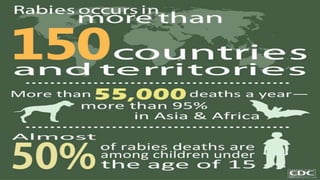
  • #15 56% of mortality in asia and 44% in Africa. Out of the global 55000 deaths, 20000 deaths occur in India.
  • #21 3 to 10 mm/hour
  • #22 Prodromal stage and acute neurologic stage (Stage of acute encephalitis and stage of brainstem dysfunction), Stage of coma and death Hydrophobia – due to painful, violent, involuntary contraction of diaphragm, resp, pharyngeal and laryngeal muscles.
  • #24 Initially there is no viraemia and the virus is not accessible to the body’s natural immune system.
  • #26 Although 100% preventable, once the symptoms develop, it is almost 100% fatal. Hence PEP should be started asap. Observe the dog or cat for 10 days.
  • #28 Suturing may increase the risk of innoculation of virus deep into the wound. Even if unavoidable, it should be loose with minimum sutures after administering RIG. It should be done as late as possible. Bandage should also be avoided as the virus easily grows in anaerobic condition.
  • #35 If the dog or cat has virus in the saliva, it will eventually show symtoms within 3 to 5 days and die in another 3 to 5 days.