Nursing Records
& Reports
Joshi Abhishek
Ashvinbhai
Nursing Tutor
Gov. College of Nursing
Bhavnagar
Quote of The Day
TALENT is God-Given
Be Thankful…..!
FAME is Man-Given
Be Grateful……!
ATTITUDE & EGO is Self-Given
Be Careful….!
Content
• Introduction
• Definitions
• Purposes of Recording & Reporting
• Types of Records & Reports
• General Documentation Guidelines
• Conclusion
Introduction
• All professional persons need to be
Accountable for the performance of their
duties to the public.
• Since nursing has been considered as
profession, nurses need to record their work
on completion.
• Records are a practical and indispensable
aid to the doctor, nurse and paramedical
personnel in giving the best possible service
to the clients.
• Report summarizes the services of the
person or personnel and of the agency.
Nursing Records
Recording
• “A record is a clinical, scientific,
administrative and legal document relating to
the nursing care given to the individual
family or community.’’
OR
• “A record is a permanent written
communication that documents information
relevant to a client’s health care
management.’’
Principles of
Recording
• Specific purpose which should be clearly
understood.
• Items on forms and in registers should be
conveniently grouped so as to make their
completion as easy as possible.
• The wording should be easily understood,
and where doubt is likely to arise,
instructions to facilitate interpretation should
be included.
Cont…
• Adequate supply of stationery to permit
records to be maintained on the proper
forms and in the proper registers at all times.
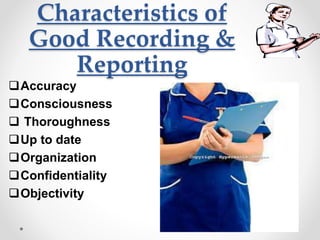
Characteristics of
Good Recording &
Reporting
Accuracy
Consciousness
 Thoroughness
Up to date
Organization
Confidentiality
Objectivity
Purpose Of
Recording
 Provide data that are essential for
programme planning and evaluation.
 Tools of Communication & Dissemination of
Information between Different Teams &
Departments of an Organization.
 Provides Plans for the Future.
 Provides Baseline Data to Estimate the Long
Term Changes related to the Services.
Cont…
 Records Help to Detect Problems.
 Provide an Opportunity for Evaluating
Services.
 Help in the Research for Improvement of
Nursing Care.
 Help to Meet Legal Requirements & Thus
Protect the Workers.
Cont….
 Records Helps in Nursing Audits.
 Helps in Providing High Standard of Service.
 Help in Continuity of Services.
 Enable the Person to justify his/her Actions.
 Legal documents: poisoning, assault, rape,
LAMA, burn etc.
Records Maintained
in Hospital
• The patient’s clinical record
• Records of nurses’ observations – Nurses’
Notes
• Records of orders carried out
• Records of treatment
• Records of admission and discharge
• Records of equipment loss and replacement
( inventory)
• Records of personnel performance.
Types of Records
 1) Wards Records
 2) Nurse’s Records
 3) Students Record
 4) Staff Records
 5) Academic & Administrative Records
Nursing Reports
Reporting
• “It is an Exchange of Information either Verbally
OR Written form Between Nurses or Health
Team.’’
OR
• “Reports are information about a patient either
written or oral.’’
-sr. Nancy
OR
• “A report is a summary of activities or
observations seen, performed or heard.’’
-Potter and Perry
Cont…
• Report Summarizes the Services of the
Person/Personnel of the Agency.
• Reports are usually written Daily , Weekly ,
Monthly , or Yearly.
Types of Reports
• 1) Oral reports : Oral reports are given when the
information is for immediate use and not for
permanency. E.g. it is made by the nurse who is
assigned to patient care, to another nurse who is
planning to relieve her.
• 2) Written reports : Reports are to be written when
the information to be used by several personnel,
which is more or less of permanent value, e.g. day
and night reports, census, interdepartmental reports,
needed according to situation, events and
conditions.
Purpose of
Reporting
• To show the kind and quantity of service
rendered over to a specific period.
• To show the progress in reaching goals.
• As an aid in studying health conditions &
planning.
• To interpret the services to the public and to
other interested agencies.
Cont….
• They save Duplication of Efforts & Eliminate the
Need for Investigation to Learn the Facts in
Situation.
• An Essential Tool of Communication between
the Patient , Nurse , & Member of the Health
Team.
• Reports when Complete , Help in Provides better
Patient Care.
Types Of Reports
 1) Change of shift report
 2) Transfer reports
 3) Incident reports
 4) Legal reports
General
Documentation
Guidelines
 Ensure that You have the Correct Client
Record/Chart & that the client’s Name and
Identifying Information are on Every Page of the
Record.
 Be written as soon as possible after an event
has happened.
 Write Date & Time as well as Sign with your Full
Legal Name in Each Entry.
Cont…
 Do not leave Space between Entries.
 Avoid Erasing , Crossing Out , or using
Correction Fluid.
 If an Error is made while Documenting , Use
a Single Line to Cross out the Error, then
Date , Time & Sign the Correction ( Acc. To
Institutional Policies ).
Cont…
 Never Change Another Person’s Entry , Even
if it is Incorrect.
 Use Quotation Marks to Indicate Direct Client
Response Ex.- “ I feel Lousy ”
 Write Legibly.
 Be based on fact, correct and consistent.
Cont…
 Use a Permanent Ink-pen ( Black is usually
preferable Because of it’s Ability to Photocopy
well ).
 Document in a Complete But Concise manner
by using Phrases & Abbreviations as
Appropriate.
 Document all Telephone calls that You
make/Receive that are related to a Client’s
case.
Conclusion
• Maintaining good quality records and
reports has both immediate and long-term
benefits for staff .. In the long term it protects
individuals and teams from accusations of
poor record-keeping, and the resulting drop in
morale. It also ensures that the professional
and legal standing of nurses are not
undermined by absent or incomplete records,
if they are called to account at a hearing.
Records & Reports.pptx