QUANTITATIVE RESEARCH
APPROACHES:
Types, characteristics,
Advantages, disadvantages
DEFINITION
Quantitative research is a formal, objective and
systematic process for generating information
about the world.
It is conducted to describe new situations, events
or concepts
This is a orderly way of dealing with a research
problem where variables are generally studied
in numerical or quantitative form
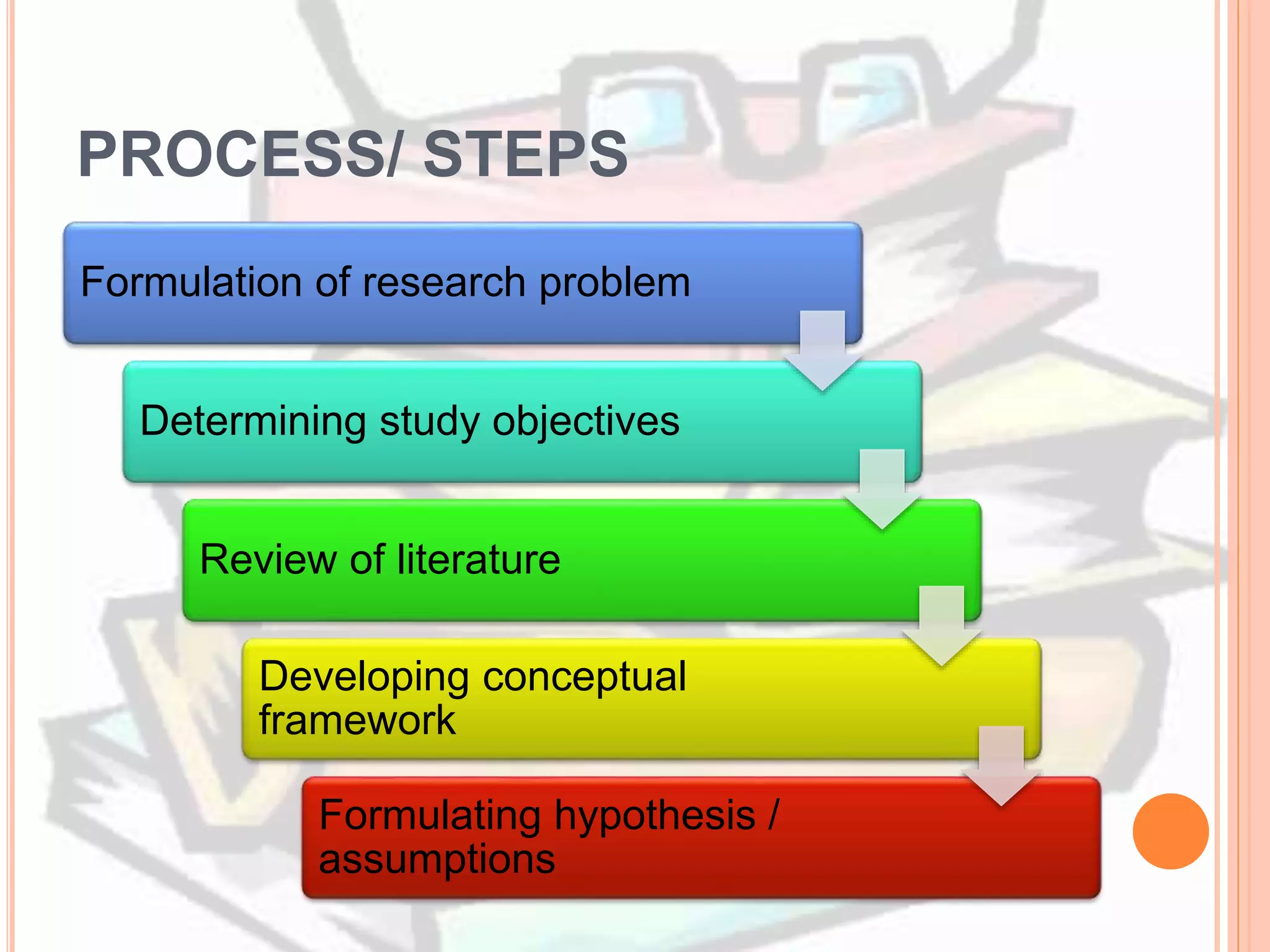
PROCESS/ STEPS
Formulation of research problem
Determining study objectives
Review of literature
Developing conceptual
framework
Formulating hypothesis /
assumptions
PROCESS/ STEPS CONTD…
Selecting research approach/
design
Specifying the population
Developing tools for data
collection
Establishing ethical
considerations
Conducting pilot study
PROCESS/ STEPS CONTD…
Sample selection and data
collection
Preparing data for analysis
Analysis and interpretation
of data
Disseminating the research
findings
CLASSIFICATION
 A. EXPERIMENTAL RESEARCH DESIGN
Experimental research designs are concerned
with examination of the effect of
independent variable on the dependent
variable, where the independent variable is
manipulated through treatment or
interventions and the effect of these
interventions is observed in the dependent
variable
CLASSIFICATION CONTD…
 A. EXPERIMENTAL RESEARCH DESIGN
 A1. True experimental design
 Basic true experimental design
 Post- test only control design
 Pre-test Post-test control group design
 Solomon four group design
 Specific true experimental design
 Parallel group design, Split body design, Factorial design,
Randomized block design, Crossover design, Latin square
design
CLASSIFICATION CONTD…
 A2. Quasi experimental design
 Non-randomized control group design
 Non- equivalent control group post test only
design
 Time series non- equivalent control group design
 Time series design
 One group pre-test post-test design
 A3. Pre experimental design
CLASSIFICATION CONTD…
 B. NON- EXPERIMENTAL RESEARCH DESIGN
Commonly known as observational research design,
which involves study of variables without
manipulating them in natural setting for the purpose
of description, exploration, explanation or
identification of correlation between two or more
variables. Need of non- experimental design arise
when independent variables cannot be manipulated
CLASSIFICATION CONTD…
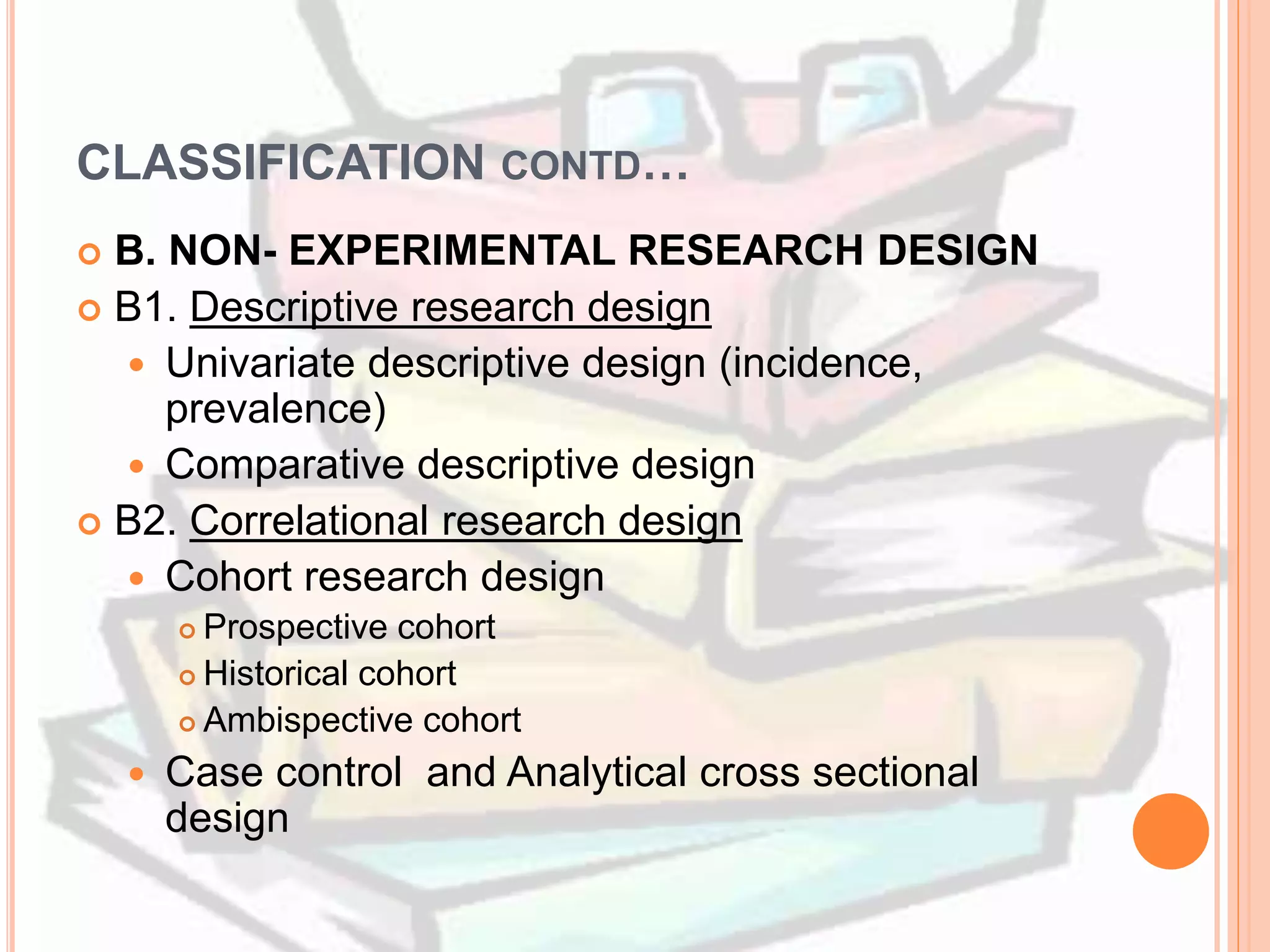
 B. NON- EXPERIMENTAL RESEARCH DESIGN
 B1. Descriptive research design
 Univariate descriptive design (incidence,
prevalence)
 Comparative descriptive design
 B2. Correlational research design
 Cohort research design
 Prospective cohort
 Historical cohort
 Ambispective cohort
 Case control and Analytical cross sectional
design
CLASSIFICATION CONTD…
 B3. Exploratory research design
 Used with a new research and helps to operationally
define the problem and generate hypothesis, may be
used to study qualitative phenomenon also
 B4. Survey research design
 Used to obtain information about prevalence,
distribution and interrelations of phenomenon in a
population such as political opinion polls, customer
survey, health survey
CLASSIFICATION CONTD…
 C. SPECIFIC QUANTITATIVE RESEARCH
DESIGN
 C1. Methodological studies
 C2. Meta analysis
 C3. Secondary data analysis
 C4. Outcome research
 C5. Evaluation studies
 C6. Operational research
SPECIFIC CHARACTERISTICS
 EXPERIMENTAL RESEARCH DESIGN
 True experimental design/ randomized
control trail
 Most scientific design, popularly known as
RCT, where researcher manipulates
independent variables to observe the
effect on dependent variables, in the
presence of randomization and control
group for comparison
SPECIFIC CHARACTERISTICS
 EXPERIMENTAL RESEARCH DESIGN
 Specific true experimental designs
Use of allocation concealment and blinding
may also be used to prevent the
selection, performance and measurement
bias.
SPECIFIC CHARACTERISTICS
 EXPERIMENTAL RESEARCH DESIGN
 Quasi experimental design/ non- randomized
controlled trial
 It is a weak experimental design where the
researcher manipulates independent variables to
observe the effect on dependent variable without
presence of randomization and sometimes even
control group for comparison
 Time series has only one experimental group where
series of observations are made in same subjects
over a period of time and after intervention in same
group for a period of time
SPECIFIC CHARACTERISTICS
 NON-EXPERIMENTAL RESEARCH DESIGN
 Correlational research design
 Involves examination of relationship between two or
more variables in a natural setting without
manipulation or control (cause-effect relationship)
 Cohort: observing a cohort from cause to effect
 Case control: observe cases and controls
retrospectively from cause to effect
 Analytical cross sectional: observing relationship in
two or more naturally occurring variables by
observing at single point of time in cases and
controls
SPECIFIC CHARACTERISTICS
 NON-EXPERIMENTAL RESEARCH DESIGN
 Descriptive research design
 Involves accurate description of characteristics of
individual, situation or group and the frequency with
which a certain phenomenon occurs in natural
settings without imposing any control or manipulation
 When observations are described and compared in
two more different groups
SPECIFIC CHARACTERISTICS
 NON-EXPERIMENTAL RESEARCH DESIGN
 Exploratory research design
 Most primitive research design, which is used to
study phenomenon which is not well understood and
improve a research design
 Survey research design
 Provides superficial information on what people do,
eat, seek, health care so on collected through face-
to-face interview, questionnaire, telephone or social
media interview. It provides extension rather than
intensive results
SPECIFIC CHARACTERISTICS
 SPECIFIC QUANTITATIVE DESIGN
 Methodological studies
 Conducted to develop,test and evaluation of
the research instruments and methods
 Meta analysis
 Quantitatively combining and integrating the
findings of the multiple quantitative research
study on a particular topic
SPECIFIC CHARACTERISTICS
 SPECIFIC QUANTITATIVE DESIGN
 Secondary data analysis
 A design in which the data collected in one
research is re-analysed by another researcher
usually to test new hypotheses
 Outcome research
 Involves the observation and assessment of
carepractices and system in place. Used in nursing
to develop evidence based practice and improve
nsg actions
SPECIFIC CHARACTERISTICS
 SPECIFIC QUANTITATIVE DESIGN
 Evaluation studies
 An interventional study that assess the success of
programmes, practices, procedures or policies
 Operational research
 Involves the study of complex human organization
and service to develop new knowledge about
institutions, programmes, use of facilities and
personnel to improve working efficiency of an
organization
ADVANTAGES OF QUANTITATIVE
APPROACH
TYPES ADVANTAGES
True
experimental
design
*RCT considered most powerful
design to establish the casual
relationship between independent
and dependent variables
*Casual relationship between
variables may be established for
explanation
*Conditions not found in natural
setting can be created in
experimental setting where
independent variable is manipulated
by the researcher
ADVANTAGES OF QUANTITATIVE
APPROACH
TYPES ADVANTAGES
True
experiment
al design
*Greater degree of purity
because of controlled
environment
*Randomized experimental
designs remove any
accusations of conscious or
subconscious bias, practically
guaranteeing external validity
*RCTs completely remove effect
of extraneous variables
ADVANTAGES OF QUANTITATIVE
APPROACH
TYPES ADVANTAGES
Quasi
experimental
design/
non-
randomized
controlled trial
*More practical and feasible
*Suitable for real world natural
setting
*Allows researcher to evaluate the
impact of quasi-independent variable
under naturally occurring conditions
*Helps to establish casual
relationship, wherein some
hypotheses are practically answered
ADVANTAGES OF QUANTITATIVE
APPROACH
TYPES ADVANTAGES
Non-
experimental
research
design
*Tend to be closest to real life situation
*Most suitable for nursing research studies
*Extremely useful to enhance our understanding
about the existing real-world setting
*Numerous human characteristics are inherently not
subject to experimental manipulation (blood type,
personality, health beliefs), therefore effects of these
cannot be studied experimentally
*Fair to carry out in dilemmas of ethical issues
*Cost- effective, time saving
ADVANTAGES OF QUANTITATIVE
APPROACH
TYPES ADVANTAGES
Quantitative
research
approach
(as a whole)
*Permits formulation of statistically
sound hypotheses with no room for
emotional design
*Probabilistic inference and prediction
permits sound implementation and
rigourous evaluation
*Enables evaluation of multiple datasets
and hypotheses faster and accurately
*Time consuming manual
implementations of ideas can be
automated
DISADVANTAGES OF QUANTITATIVE
APPROACH
TYPES DISADVANTAGES
True
experim
ental
design
*Results of lab based RCT cannot be
replicated in studies on human being
due to ethical concerns
*In some cases because of danger to
physical and psychological health on
human subjects, experiments could
not be done
*Lack of valid measurable criteria or
instruments to measure them
*Difficult to control extraneous
variables
DISADVANTAGES OF QUANTITATIVE
APPROACH
TYPES DISADVANTAGES
True
experim
ental
design
*Often impractical when the effect of
independent variable may require a
lengthy period before it can emerge a
response
*Reluctance of participants
to participate in the study
*Small sample size raise question of
generalization of results
DISADVANTAGES OF QUANTITATIVE
APPROACH
TYPES DISADVANTAGES
Quasi
experimental
design/
non-
randomized
controlled trial
*Considered as weak design to
establish casual relationship between
independent and dependent variables
because it controls no threat to internal
validity
*Lack of randomization increase risk
selection bias
*Poor control to confounding variables
influencing dependent variables
*Absence of control group and lack of
control over the research setting makes
results less reliable and weak
DISADVANTAGES OF QUANTITATIVE
APPROACH
TYPES DISADVANTAGES
Non-
experimental
research
design
*Results obtained and the relationship
between the dependent and
independent variables can never be
absolutely clear or error free
*Mainly used for conducting
comparison using non randomly
selected groups which may not be
homogeneous and tend to be dissimilar
in different traits and characteristics that
may affect the authenticity and
generalize ability of the results
DISADVANTAGES OF QUANTITATIVE
APPROACH
TYPES DISADVANTAGES
Quantitative
research
approach
(as a whole)
*Requires constant or periodic monitoring of model
performance to ensure continued compliance with
original hypotheses
*Inadequate quality of training data can lead to
errors or disastrous performance on unseen data
*Requires a deep background in multiple complex
disciplines that are hard to master
*Improper representation of target population
*Lack of resources for data collection
*Inability to control the environment or extragenous
variables
*Time consuming, expensive, limited outcomes
USES OF QUANTITATIVE RESEARCH IN
EVIDENCE BASED PRACTICE
 Assessment and diagnosis of patients
 Interventions based on findings
 Evaluation of outcomes
SUMMARY AND CONCLUSION
 The ultimate goal of research in any discipline is to
develop, refine and expand a body of knowledge.
Quantitative research is a formal, objective and
systemic process to describe new situations, events
or concepts where variables are pre selected and
defined, data collected and analyzed in numerical
form often with the view to establish cause-and-
effect relationship among variables
JOURNAL ABSTRACT
 Harvey K, Kramlich D, Chapman J, Parker J, Blades
E. Exploring and evaluating five paediatric falls
assessment instruments and injury risk indicators: an
ambispective study in a tertiary care setting. J Nurs
Manag. 2010 Jul;18(5):531-41
 Landeiro F, Barrows P, Nuttall Musson E, et al.
Reducing social isolation and loneliness in older
people: a systematic review protocol. BMJ Open: 2017
REFERENCE
Books:
 Sharma SK. Nursing research & statistics. Third edition. New
Delhi: Elsevier publishers; 2018
 Burns N and Grove SK. Understanding nursing research-
building an evidence based practice. Fourth Edition. New
Delhi: Reed Elsevier India; 2007
 Polit D and Beck CT. Nursing Research generating and
assessing evidence for Nursing Practice. Eight Edition. New
Delhi: Wolters Kluwer(India) Pvt Ltd; 2008
 Polit D and Hungler BP. Nursing research Principles and
methods. Fifth Edition. Philadelphia: Lippincott publishers;
1995
 Basvanthappa BT, Nursing research and statistics, 3rd edition.
New Delhi: Jaypee Publications; 2014
 Kaur S & Singh A. Nursing research & Statistics. New Delhi:
CBS Publishers & Distributers; 2015
REFERENCE
JOURNALS
 Landeiro F, Barrows P, Nuttall Musson E, et al.
Reducing social isolation and loneliness in older
people: a systematic review protocol. BMJ
Open: 2017
 Harvey K, Kramlich D, Chapman J, Parker
J, Blades E. Exploring and evaluating five
paediatric falls assessment instruments and injury
risk indicators: an ambispective study in a tertiary
care setting. J Nurs Manag. 2010 Jul;18(5):531-41
REFERENCE
 INTERNET
 https://www.ncbi.nlm.nih.gov/pubmed
 https://bmjopen.bmj.com
 http://scholar.google.com
THANK YOU….

quantitative research approaches

  • 1.
  • 2.
    DEFINITION Quantitative research isa formal, objective and systematic process for generating information about the world. It is conducted to describe new situations, events or concepts This is a orderly way of dealing with a research problem where variables are generally studied in numerical or quantitative form
  • 3.
    PROCESS/ STEPS Formulation ofresearch problem Determining study objectives Review of literature Developing conceptual framework Formulating hypothesis / assumptions
  • 4.
    PROCESS/ STEPS CONTD… Selectingresearch approach/ design Specifying the population Developing tools for data collection Establishing ethical considerations Conducting pilot study
  • 5.
    PROCESS/ STEPS CONTD… Sampleselection and data collection Preparing data for analysis Analysis and interpretation of data Disseminating the research findings
  • 6.
    CLASSIFICATION  A. EXPERIMENTALRESEARCH DESIGN Experimental research designs are concerned with examination of the effect of independent variable on the dependent variable, where the independent variable is manipulated through treatment or interventions and the effect of these interventions is observed in the dependent variable
  • 7.
    CLASSIFICATION CONTD…  A.EXPERIMENTAL RESEARCH DESIGN  A1. True experimental design  Basic true experimental design  Post- test only control design  Pre-test Post-test control group design  Solomon four group design  Specific true experimental design  Parallel group design, Split body design, Factorial design, Randomized block design, Crossover design, Latin square design
  • 8.
    CLASSIFICATION CONTD…  A2.Quasi experimental design  Non-randomized control group design  Non- equivalent control group post test only design  Time series non- equivalent control group design  Time series design  One group pre-test post-test design  A3. Pre experimental design
  • 9.
    CLASSIFICATION CONTD…  B.NON- EXPERIMENTAL RESEARCH DESIGN Commonly known as observational research design, which involves study of variables without manipulating them in natural setting for the purpose of description, exploration, explanation or identification of correlation between two or more variables. Need of non- experimental design arise when independent variables cannot be manipulated
  • 10.
    CLASSIFICATION CONTD…  B.NON- EXPERIMENTAL RESEARCH DESIGN  B1. Descriptive research design  Univariate descriptive design (incidence, prevalence)  Comparative descriptive design  B2. Correlational research design  Cohort research design  Prospective cohort  Historical cohort  Ambispective cohort  Case control and Analytical cross sectional design
  • 11.
    CLASSIFICATION CONTD…  B3.Exploratory research design  Used with a new research and helps to operationally define the problem and generate hypothesis, may be used to study qualitative phenomenon also  B4. Survey research design  Used to obtain information about prevalence, distribution and interrelations of phenomenon in a population such as political opinion polls, customer survey, health survey
  • 12.
    CLASSIFICATION CONTD…  C.SPECIFIC QUANTITATIVE RESEARCH DESIGN  C1. Methodological studies  C2. Meta analysis  C3. Secondary data analysis  C4. Outcome research  C5. Evaluation studies  C6. Operational research
  • 13.
    SPECIFIC CHARACTERISTICS  EXPERIMENTALRESEARCH DESIGN  True experimental design/ randomized control trail  Most scientific design, popularly known as RCT, where researcher manipulates independent variables to observe the effect on dependent variables, in the presence of randomization and control group for comparison
  • 14.
    SPECIFIC CHARACTERISTICS  EXPERIMENTALRESEARCH DESIGN  Specific true experimental designs Use of allocation concealment and blinding may also be used to prevent the selection, performance and measurement bias.
  • 15.
    SPECIFIC CHARACTERISTICS  EXPERIMENTALRESEARCH DESIGN  Quasi experimental design/ non- randomized controlled trial  It is a weak experimental design where the researcher manipulates independent variables to observe the effect on dependent variable without presence of randomization and sometimes even control group for comparison  Time series has only one experimental group where series of observations are made in same subjects over a period of time and after intervention in same group for a period of time
  • 16.
    SPECIFIC CHARACTERISTICS  NON-EXPERIMENTALRESEARCH DESIGN  Correlational research design  Involves examination of relationship between two or more variables in a natural setting without manipulation or control (cause-effect relationship)  Cohort: observing a cohort from cause to effect  Case control: observe cases and controls retrospectively from cause to effect  Analytical cross sectional: observing relationship in two or more naturally occurring variables by observing at single point of time in cases and controls
  • 17.
    SPECIFIC CHARACTERISTICS  NON-EXPERIMENTALRESEARCH DESIGN  Descriptive research design  Involves accurate description of characteristics of individual, situation or group and the frequency with which a certain phenomenon occurs in natural settings without imposing any control or manipulation  When observations are described and compared in two more different groups
  • 18.
    SPECIFIC CHARACTERISTICS  NON-EXPERIMENTALRESEARCH DESIGN  Exploratory research design  Most primitive research design, which is used to study phenomenon which is not well understood and improve a research design  Survey research design  Provides superficial information on what people do, eat, seek, health care so on collected through face- to-face interview, questionnaire, telephone or social media interview. It provides extension rather than intensive results
  • 19.
    SPECIFIC CHARACTERISTICS  SPECIFICQUANTITATIVE DESIGN  Methodological studies  Conducted to develop,test and evaluation of the research instruments and methods  Meta analysis  Quantitatively combining and integrating the findings of the multiple quantitative research study on a particular topic
  • 20.
    SPECIFIC CHARACTERISTICS  SPECIFICQUANTITATIVE DESIGN  Secondary data analysis  A design in which the data collected in one research is re-analysed by another researcher usually to test new hypotheses  Outcome research  Involves the observation and assessment of carepractices and system in place. Used in nursing to develop evidence based practice and improve nsg actions
  • 21.
    SPECIFIC CHARACTERISTICS  SPECIFICQUANTITATIVE DESIGN  Evaluation studies  An interventional study that assess the success of programmes, practices, procedures or policies  Operational research  Involves the study of complex human organization and service to develop new knowledge about institutions, programmes, use of facilities and personnel to improve working efficiency of an organization
  • 22.
    ADVANTAGES OF QUANTITATIVE APPROACH TYPESADVANTAGES True experimental design *RCT considered most powerful design to establish the casual relationship between independent and dependent variables *Casual relationship between variables may be established for explanation *Conditions not found in natural setting can be created in experimental setting where independent variable is manipulated by the researcher
  • 23.
    ADVANTAGES OF QUANTITATIVE APPROACH TYPESADVANTAGES True experiment al design *Greater degree of purity because of controlled environment *Randomized experimental designs remove any accusations of conscious or subconscious bias, practically guaranteeing external validity *RCTs completely remove effect of extraneous variables
  • 24.
    ADVANTAGES OF QUANTITATIVE APPROACH TYPESADVANTAGES Quasi experimental design/ non- randomized controlled trial *More practical and feasible *Suitable for real world natural setting *Allows researcher to evaluate the impact of quasi-independent variable under naturally occurring conditions *Helps to establish casual relationship, wherein some hypotheses are practically answered
  • 25.
    ADVANTAGES OF QUANTITATIVE APPROACH TYPESADVANTAGES Non- experimental research design *Tend to be closest to real life situation *Most suitable for nursing research studies *Extremely useful to enhance our understanding about the existing real-world setting *Numerous human characteristics are inherently not subject to experimental manipulation (blood type, personality, health beliefs), therefore effects of these cannot be studied experimentally *Fair to carry out in dilemmas of ethical issues *Cost- effective, time saving
  • 26.
    ADVANTAGES OF QUANTITATIVE APPROACH TYPESADVANTAGES Quantitative research approach (as a whole) *Permits formulation of statistically sound hypotheses with no room for emotional design *Probabilistic inference and prediction permits sound implementation and rigourous evaluation *Enables evaluation of multiple datasets and hypotheses faster and accurately *Time consuming manual implementations of ideas can be automated
  • 27.
    DISADVANTAGES OF QUANTITATIVE APPROACH TYPESDISADVANTAGES True experim ental design *Results of lab based RCT cannot be replicated in studies on human being due to ethical concerns *In some cases because of danger to physical and psychological health on human subjects, experiments could not be done *Lack of valid measurable criteria or instruments to measure them *Difficult to control extraneous variables
  • 28.
    DISADVANTAGES OF QUANTITATIVE APPROACH TYPESDISADVANTAGES True experim ental design *Often impractical when the effect of independent variable may require a lengthy period before it can emerge a response *Reluctance of participants to participate in the study *Small sample size raise question of generalization of results
  • 29.
    DISADVANTAGES OF QUANTITATIVE APPROACH TYPESDISADVANTAGES Quasi experimental design/ non- randomized controlled trial *Considered as weak design to establish casual relationship between independent and dependent variables because it controls no threat to internal validity *Lack of randomization increase risk selection bias *Poor control to confounding variables influencing dependent variables *Absence of control group and lack of control over the research setting makes results less reliable and weak
  • 30.
    DISADVANTAGES OF QUANTITATIVE APPROACH TYPESDISADVANTAGES Non- experimental research design *Results obtained and the relationship between the dependent and independent variables can never be absolutely clear or error free *Mainly used for conducting comparison using non randomly selected groups which may not be homogeneous and tend to be dissimilar in different traits and characteristics that may affect the authenticity and generalize ability of the results
  • 31.
    DISADVANTAGES OF QUANTITATIVE APPROACH TYPESDISADVANTAGES Quantitative research approach (as a whole) *Requires constant or periodic monitoring of model performance to ensure continued compliance with original hypotheses *Inadequate quality of training data can lead to errors or disastrous performance on unseen data *Requires a deep background in multiple complex disciplines that are hard to master *Improper representation of target population *Lack of resources for data collection *Inability to control the environment or extragenous variables *Time consuming, expensive, limited outcomes
  • 32.
    USES OF QUANTITATIVERESEARCH IN EVIDENCE BASED PRACTICE  Assessment and diagnosis of patients  Interventions based on findings  Evaluation of outcomes
  • 33.
    SUMMARY AND CONCLUSION The ultimate goal of research in any discipline is to develop, refine and expand a body of knowledge. Quantitative research is a formal, objective and systemic process to describe new situations, events or concepts where variables are pre selected and defined, data collected and analyzed in numerical form often with the view to establish cause-and- effect relationship among variables
  • 34.
    JOURNAL ABSTRACT  HarveyK, Kramlich D, Chapman J, Parker J, Blades E. Exploring and evaluating five paediatric falls assessment instruments and injury risk indicators: an ambispective study in a tertiary care setting. J Nurs Manag. 2010 Jul;18(5):531-41  Landeiro F, Barrows P, Nuttall Musson E, et al. Reducing social isolation and loneliness in older people: a systematic review protocol. BMJ Open: 2017
  • 35.
    REFERENCE Books:  Sharma SK.Nursing research & statistics. Third edition. New Delhi: Elsevier publishers; 2018  Burns N and Grove SK. Understanding nursing research- building an evidence based practice. Fourth Edition. New Delhi: Reed Elsevier India; 2007  Polit D and Beck CT. Nursing Research generating and assessing evidence for Nursing Practice. Eight Edition. New Delhi: Wolters Kluwer(India) Pvt Ltd; 2008  Polit D and Hungler BP. Nursing research Principles and methods. Fifth Edition. Philadelphia: Lippincott publishers; 1995  Basvanthappa BT, Nursing research and statistics, 3rd edition. New Delhi: Jaypee Publications; 2014  Kaur S & Singh A. Nursing research & Statistics. New Delhi: CBS Publishers & Distributers; 2015
  • 36.
    REFERENCE JOURNALS  Landeiro F,Barrows P, Nuttall Musson E, et al. Reducing social isolation and loneliness in older people: a systematic review protocol. BMJ Open: 2017  Harvey K, Kramlich D, Chapman J, Parker J, Blades E. Exploring and evaluating five paediatric falls assessment instruments and injury risk indicators: an ambispective study in a tertiary care setting. J Nurs Manag. 2010 Jul;18(5):531-41
  • 37.
    REFERENCE  INTERNET  https://www.ncbi.nlm.nih.gov/pubmed https://bmjopen.bmj.com  http://scholar.google.com
  • 38.