Research Approach and Design
Prof. Asokan R.
I/C of R&D, KINS, KIIT (DU), BBSR
Introductions
Outline of Presentation
Introduction
Understanding different Research Approaches
Foundations of Research Design
Quantitative Research Design
Qualitative Research Design
Mixed-Methods Research Design
What is Research Approach?
Methodological framework that
guides how a research study is planned,
conducted, and executed.
It provides a structured way to
address research questions, gather data,
analyze information, and draw conclusions.
What is Research design?
Overall plan and structure that guides the process of conducting a research
study.
It encompasses the strategies, methods, procedures, and techniques that
researchers use to collect, analyze, and interpret data to address their research
questions or hypotheses.
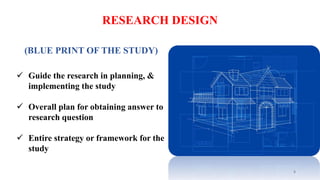
RESEARCH DESIGN
(BLUE PRINT OF THE STUDY)
 Guide the research in planning, &
implementing the study
 Overall plan for obtaining answer to
research question
 Entire strategy or framework for the
study
8
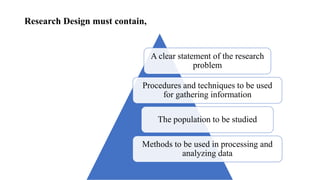
Research Design must contain,
A clear statement of the research
problem
Procedures and techniques to be used
for gathering information
The population to be studied
Methods to be used in processing and
analyzing data
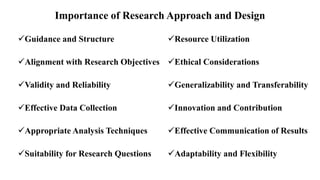
Importance of Research Approach and Design
Guidance and Structure
Alignment with Research Objectives
Validity and Reliability
Effective Data Collection
Appropriate Analysis Techniques
Suitability for Research Questions
Resource Utilization
Ethical Considerations
Generalizability and Transferability
Innovation and Contribution
Effective Communication of Results
Adaptability and Flexibility
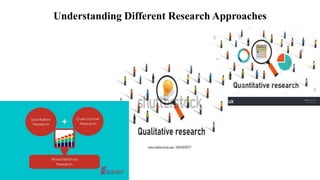
Understanding Different Research Approaches
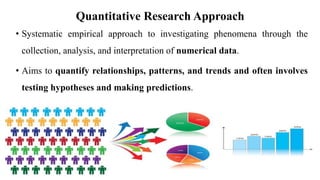
Quantitative Research Approach
• Systematic empirical approach to investigating phenomena through the
collection, analysis, and interpretation of numerical data.
• Aims to quantify relationships, patterns, and trends and often involves
testing hypotheses and making predictions.
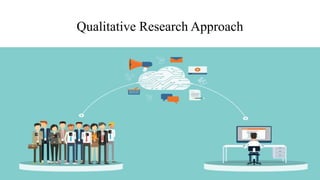
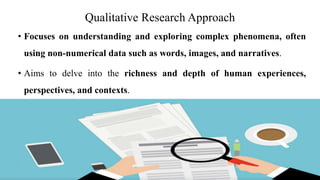
Qualitative Research Approach
• Focuses on understanding and exploring complex phenomena, often
using non-numerical data such as words, images, and narratives.
• Aims to delve into the richness and depth of human experiences,
perspectives, and contexts.
Mixed-Methods Research Approach
• Combines both qualitative and quantitative research methods within a
single study to provide a more comprehensive understanding of a research
question or phenomenon.
• By integrating the strengths of both approaches, researchers can gain deeper
insights and confirm findings, enhancing the overall robustness of their
research.
• Example: How does the implementation of a bedside hand hygiene protocol
(qualitative) impact the reduction of healthcare-associated infections
(quantitative) in a hospital setting?
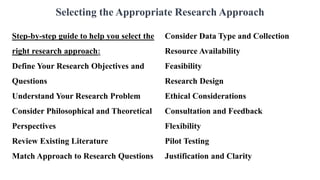
Selecting the Appropriate Research Approach
Step-by-step guide to help you select the
right research approach:
Define Your Research Objectives and
Questions
Understand Your Research Problem
Consider Philosophical and Theoretical
Perspectives
Review Existing Literature
Match Approach to Research Questions
Consider Data Type and Collection
Resource Availability
Feasibility
Research Design
Ethical Considerations
Consultation and Feedback
Flexibility
Pilot Testing
Justification and Clarity
Research Design: Foundations
• Research Questions and Objectives
• Theoretical Framework
• Research Approach
• Data Collection Methods
• Sampling Strategy
• Data Analysis Methods
• Ethical Considerations
• Timeframe and Schedule
• Budget and Resources
• Validity and Reliability
• Pilot Testing
• Scope and Limitations
• Research Design Diagram
• Communication Plan
Quantitative Research Design
• Systematic plan or blueprint that researchers follow to collect, analyze,
and interpret numerical data in order to answer specific research
questions or test hypotheses.
• A well-designed quantitative research study ensures that the data
collected are relevant, reliable, and valid, allowing for meaningful
conclusions and generalizability.
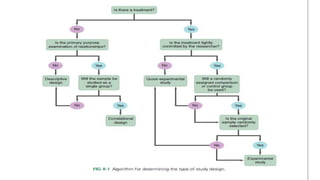
NON-EXPERIMENTAL RESEARCH DESIGN
21
Construct a picture of a phenomenon
Make account of events as they naturally occurs
Investigate current status of something
Describe existing phenomena without manipulating the condition
PURPOSE
22
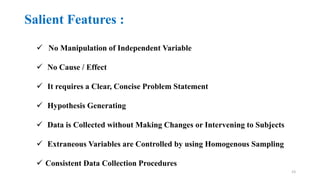
Salient Features :
 No Manipulation of Independent Variable
 No Cause / Effect
 It requires a Clear, Concise Problem Statement
 Hypothesis Generating
 Data is Collected without Making Changes or Intervening to Subjects
 Extraneous Variables are Controlled by using Homogenous Sampling
 Consistent Data Collection Procedures
23
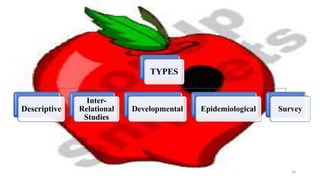
TYPES
Descriptive
Inter-
Relational
Studies
Developmental Epidemiological Survey
24
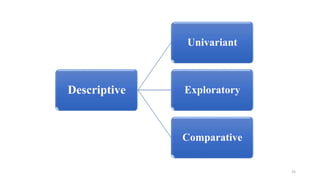
Descriptive
Univariant
Exploratory
Comparative
25
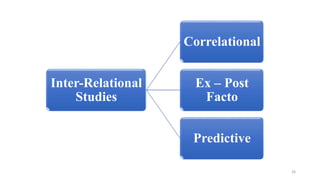
Inter-Relational
Studies
Correlational
Ex – Post
Facto
Predictive
26
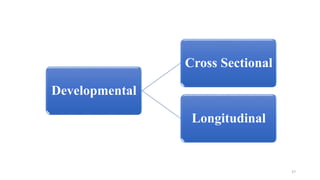
Developmental
Cross Sectional
Longitudinal
27
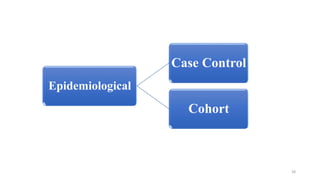
Epidemiological
Case Control
Cohort
28
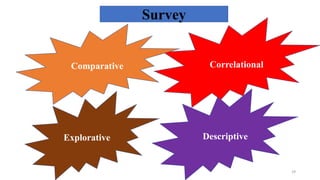
Descriptive
Explorative
Correlational
Comparative
Survey
29
DESCRIPTIVE
Intend to examine and describe an issue.
Descriptive research design is a scientific method which
involves observing and describing the behavior of a subject without
influencing it in any way.
Use to answer questions in ‘wh’ word :
what occur, how occur, when occur, why occur
30
PURPOSE
To observe, describe and document aspects of
situation as it naturally occurs.
To serve as starting point for hypothesis generation
or theory development.
31
CHARACTERISTICS
 Describe a Phenomenon
 Especially effective when the area has been previously
studied. Example- Study of nursing action in diabetic foot
care
 Data is collected through questionnaire, interview, files,
document or observation.
32
For example:
An apparel brand that wants to understand the fashion
purchasing trends among buyers.
33
UNIVARIANT DESCRIPTIVE DESIGN
 It describe frequency of occurrence of a phenomenon rather study
relationship
 It is not necessary that to study a single variable, but may be one or more
variable
 This design mainly try to identify & describe perception, awareness,
behaviour, attitude, knowledge and practice.
 Ex: Student nurses awareness on BLS. 34
EXPLORATIVE
 It identify, explore, & describe the existing phenomenon and related
factors.
Ex: Factors and morbidity pattern among LBW Babies
 It simply describe the phenomena and in-depth relate the cause of
phenomena.
 Aims to explain why particular phenomena work in the way that they do.
35
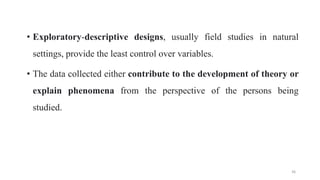
• Exploratory-descriptive designs, usually field studies in natural
settings, provide the least control over variables.
• The data collected either contribute to the development of theory or
explain phenomena from the perspective of the persons being
studied.
36
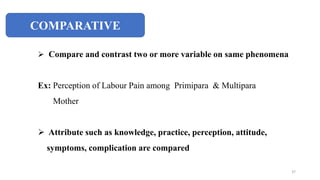
COMPARATIVE
 Compare and contrast two or more variable on same phenomena
Ex: Perception of Labour Pain among Primipara & Multipara
Mother
 Attribute such as knowledge, practice, perception, attitude,
symptoms, complication are compared
37
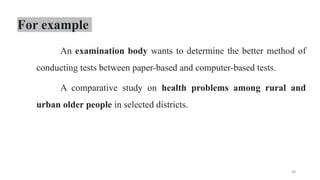
For example
An examination body wants to determine the better method of
conducting tests between paper-based and computer-based tests.
A comparative study on health problems among rural and
urban older people in selected districts.
38
Why Use Descriptive Research Design?
• Define subject characteristics
• Measure Data Trends
• Comparison
• Validate existing conditions
• Conducted Overtime
39
IMPORTANT ISSUES IN DESCRIPTIVE DESIGN
 Cannot make conclusions about relationships studies.
(snapshot of the current thoughts)
 Subjects and instrumentation must be clearly identified.
 Watch for graphic distortion.
 Response & Non-Response Bias.
40
INTER RELATIONAL STUDIES/RELATIONAL STUDIES
 It provides a deeper insight into the phenomenon of
interest than descriptive studies.
 It traces the interrelationships between variables.
 A study that investigates the connection between two or more
variables.
41
Investigate the degree to which differences or variation in
relation to two variables
Ex : Relation between diabetes and development of hypertension
 It determines degree of relationship.
It allows description and prediction of relationships.
Ex : Salary and staff turnover
42
CORRELATIONAL DESIGN / STUDIES
Measures two Variables.
Examine the strength of relationship between variables
Describe a linear relationship
Do not imply a cause and effect relationship
Do not imply that variables share something in common
Ex: Pill users and ovarian cancer
43
Indicates the extent to which one variable (x) related to another (y).
Magnitude and the direction of relationship are indicated by
correlation coefficient.
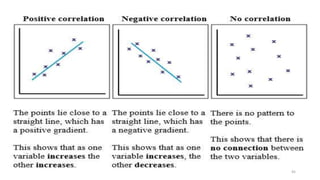
It may be positive or negative ranging from (-1.00) perfect negative
correlation to (1.00) perfect positive correlation and ‘0’ indicate no
relation
44
45
ADVANTAGES
 Analyse relationship among large number of variables
 Demonstrate degree of relationship between variables
 It opens up a great deal of further research to other scholars.
46
EX- POST FACTO STUDIES
CAUSAL COMPARATIVE STUDY / COMPARATIVE STUDY
 The investigation starts after the fact has occurred without interference
from the researcher.
 It is used when causality is a question and experiment is not possible to
do.
 When they cannot manipulate the independent variables
 But according to cause it compare groups
Ex: Smoker and Lung Cancer
Non Smoker and No Lung Cancer
47
• The assignment of subjects to different groups is based on
whichever variable of interest to the researchers.
• Pre-existing characteristic (weight) was used to form the groups.
• Groups with qualities that already exist are compared on some
dependent variable.
48
Cont...
 So the independent variables are identified and the effect on dependent
variable studied.
 Here cause and effect relationships identified by forming groups of
individuals & determine whether groups differ on dependent variables.
 But there is possibility, group will differ by external variables , So need
to cautiously evaluate and draw the conclusion.
 It is classified as retrospective (effect to cause) and prospective (cause
to effect)
49
PREDICTIVE STUDY
Aims to identify pre – existing characteristics (independent variable) that is
predictive of a relationship with dependent variable. (aims to predict future
outcomes)
Ex : Intelligence level with performance, Obesity with hypertension
It uses retrospective data from one group to make prediction about similar
group.
Shows how one variable predict score on another in time
50
 They allow you to make estimates and devise forecasting models.
 Correlation coefficient only show relation.
 Result makes more accurate predictions possible.
 Length of prediction – shorter the time more the prediction (Rain)
 More time =more opportunity for another variable to influence.
 Major advantage – facilitate intelligence decision making as
objective criteria's available to guide the process.
51
ANALYSIS OF PREDECTIVE STUDIES
 Regression (How changes in the independent variables are associated with changes in
the dependent variable & to create a mathematical model that can predict the value of
the dependent variable based on the values of the independent variables.)
 Multiple Regression
 Discriminant Analysis (whether heavy, medium and light users of soft drinks are
different in terms of their consumption of frozen foods
&
price sensitive and non price sensitive buyers of groceries in terms of their
psychological attributes or characteristics.
52
DEVELOPMENTAL STUDIES
 It studies the time perspectives.
 It studies not only present status but also the with related phenomena, also
with changes that result from elapsed time.
 It is generally used to adjunct research design with other designs,
descriptive, cross sections, cross sectional survey, longitudinal co-relational
study.
 Understanding the processes of human growth, change, and development
across the lifespan. Developmental studies aim to provide insights into how
people develop, learn, and adapt to their environments over time.
53
It is a study of status and is widely used in education, nutrition,
epidemiology, and the behavioral sciences.
Problems can be solved and practices improved through observation,
analysis, and description.
EX: To assess the differences in academic and social development in
low-income versus high-income neighborhoods.
54
CROSS SECTIONAL DESIGN
Examine data at one point in time .
Data is collected only on one occasion with same type of subject at one point
or multiple points at one time
Ex: Knowledge of student nurses on neonatal resuscitation
Data are compared in respect to socio- demographic.
This is convenient & easy variables to conduct.
But cohort effect (life experiences) can't be ruled out
55
LONGITUDINAL DESIGN
 It is used when data is required for several times at interval from same
subject .
Ex: Professional adjustment of 1st year nursing student
 The data is collected over an extended time period
 Examine development by making a series of observations or
measurements over time
 Avoid problems with cohort effect or generational effect
56
ADVANTAGES
To study developmental changes /effect.
Disadvantages – time, cost , patience & sample turnover
and other confounding variables
57
EPIDEMIOLOGICAL STUDIES
 Study about distribution & causes of diseases in population.
 Conducted to investigate causes of different diseases either by
retrospective approach /case control studies , prospective approach /
cohort studies
58
The cohort study is concerned with frequency of disease in
exposed and non-exposed individuals,
the case-control study is concerned with the frequency and
amount of exposure in subjects with a specific disease (cases) and
people without the disease (controls).
59
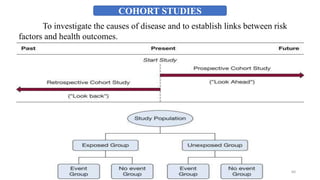
COHORT STUDIES
To investigate the causes of disease and to establish links between risk
factors and health outcomes.
60
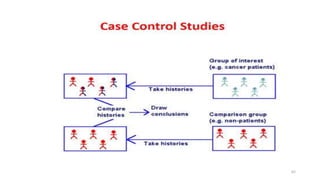
CASE CONTROL STUDIES
 Researcher go back to the causes for a definite occurrence.
 The frequency, incidence, factors effect were studied for prudent
situation.
61
62
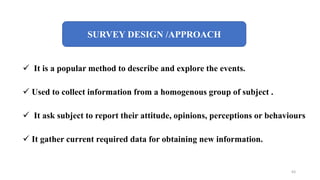
SURVEY DESIGN /APPROACH
 It is a popular method to describe and explore the events.
 Used to collect information from a homogenous group of subject .
 It ask subject to report their attitude, opinions, perceptions or behaviours
 It gather current required data for obtaining new information.
63
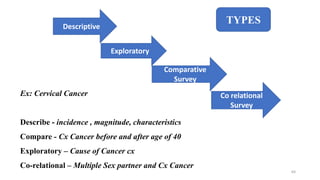
Ex: Cervical Cancer
Describe - incidence , magnitude, characteristics
Compare - Cx Cancer before and after age of 40
Exploratory – Cause of Cancer cx
Co-relational – Multiple Sex partner and Cx Cancer
TYPES
Descriptive
Exploratory
Comparative
Survey
Co relational
Survey
64
Data is collected by phone, mail, interview, questionnaire, etc.
For standardization of questionnaire must be validated.
OTHER TYPES OF SURVEY
CROSS SECTIONAL
Political Survey
Attitude Survey
Programme Evaluation
Performance Evaluation, etc.,
65
LONGITUDINAL
Study of Morbidity, Mortality, Treatment Adherence etc.
In a longitudinal study, researchers repeatedly examine the same
individuals to detect any changes that might occur over a period of time.
Longitudinal studies are a type of correlational research in which
researchers observe and collect data on a number of variables without trying to
influence those variables.
66
ADVANTAGES OF NON-EXPERIMENTAL DESIGN
Require no experiment, real life situation, manipulation.
Easy and convenient to conduct.
Suitable to many field like psychology, sociology, education, nursing, etc.
DISADVANTAGES
Data are less reliable.
Cause & effect relationship absolutely not error free
Improper Interpretation.
67
True Experimental Research
Design
What is True experimental design?
True experimental design is a statistical approach of establishing a
cause and effect relationship between different variables.
This is one of the most accurate forms of research designs which
provides a substantial backing to support the existence of relationships.
A true experimental design is characterized by the following
properties:
True experiments have four elements: manipulation, control , random assignment, and
random selection.
• Manipulation—the experimenter does something to at least some subjects or something
is purposefully changed by the researcher in the environment.
• Control—the experimenter introduces controls over the experimental situation,
including the use of a control group.
• Randomization—the experimenter assigns subjects to a control or experimental group
on a random basis
• A research study using a true experimental design is commonly called a
randomized controlled trial (RCT).
• In hospital and clinic settings, it may be referred to as a “clinical trial” and is
commonly used in drug trials.
• An RCT is considered the “gold standard” for providing information about
cause-and-effect relationships. An individual RCT generates Level II evidence
because of reduced bias provided by randomization, control, and manipulation.
• A well-controlled design using these properties provides more confidence that
the intervention will be effective and produce the same results over time.
Randomization
• Randomization, or random assignment, distribution of subjects to either the
experimental or the control group on a purely random basis.
• Randomization may be done individually or by groups. Several procedures are
used to randomize subjects to groups, such as a table of random numbers or
computer-generated number sequences (Suresh, 2011).
• Whatever method is used, it is important that the process be truly random, that
it be tamperproof, and that the group assignment is concealed (kept secret).
Why randomization?
The basic benefits of randomization include
1. Eliminates selection bias.
2. Balances arms with respect to prognostic variables (known and
unknown).
3. Forms basis for statistical tests, a basis for an assumption-free
statistical test of the equality of treatments.
Methods of randomization
• (1) simple - equivalent to tossing a coin for each subject that enters a trial. The random
number generator is generally used.
• (2) Block - to divide potential patients into m blocks of size 2n, randomize each block
such that n patients are allocated to A and n to B. then choose the blocks randomly.
• (3) Stratified - addresses the need to control and balance the influence of covariates.
This method can be used to achieve balance among groups in terms of subjects’ baseline
characteristics (covariates).
• (4) Adaptive - changing the allocation probability according to the progress and position
of the study. It may be used to minimize the imbalance between treatment groups as well
as to change the allocation probability based on the therapeutic effect.
Blinding
Blinding, in research, mentions to a practice where the study
population or the stakeholders involved in research are not permitted
from knowing certain information or treatment, which may somehow
influence the study findings.
Blinding (also called masking) is typically used in randomized
controlled trials (RCTs).
There are basically three different types of blinding used in researches:
Single blinding or single-masked:
• In single blinding, only a single stakeholder i.e. either the participant or the investigator
is not informed of the nature of treatment the participant is receiving.
• A trial is called single-blind if only one party is blinded. Usually, the participant is
blinded and is unaware of the treatment they receive.
Double-blinding or double-masked:
• Both study population/participant and data collectors/investigators/researchers are
not aware of the kind or nature of the treatment given and who receive the treatment.
• If both ‘the participants’ and ‘the study staffs’ are blinded, it is known as a double-
blind study.
Triple blinding:
A clinical trial in which neither the subject nor the person governing treatment
nor an individual measuring the response to the treatment is aware of the particular
treatment received by the subject is known as triple blind. Triple blinded studies also
lengthen blinding to the data specialists.
• In triple blinding, the study participant, the data investigator or data collector and
the data analyzer- all are blinded.
Unblinded or open-label:
It is the exact opposite of blinding, where all the participant, clinicians, data
collectors, specialists are well known about the treatment/intervention they receive.
Control
• Control refers to the process by which the investigator holds certain conditions
constant to limit bias that could influence the dependent variable(s) / effort by the
researcher to remove the influence of any extraneous, confounding variable.
• Control is acquired by manipulating the independent variable, by randomly
assigning subjects to a group, by using a control group, and by preparing
intervention and data collection protocols to maintain consistency for all study
participants.
• In experimental research, the control group receives the usual treatment or a
placebo (any treatment that has no active properties).
The three main types of controls are positive, negative, and procedural, and
variable controls.
A positive control group is not exposed to the experimental treatment but is
exposed to another treatment that is known to work.
A negative control a process of conducting the experiment in the exact same
way on a control group except that the independent variables are a placebo that is not
expected to produce a result.
procedural controls are designed to reduce error in conducting the experiment.
variable control – the practice of keeping a variable constant to minimize its
influence on results.
Manipulation
• Manipulation is the process of “doing something,” a different dose of
“something,” or comparing different types of treatment by manipulating the
independent variable for at least some of the involved subjects.
• The independent variable might be a treatment, a teaching plan, or a
medication.
• The effect of this manipulation is measured to determine the result of the
experimental treatment on the dependent variable compared with those who
did not receive the treatment.
The classic RCT is conducted as follows
• 1. The researcher recruits a sample from the population.
• 2. Baseline preintervention demographics, personal characteristics, and
measurement of the intended study concepts or dependent variables are collected
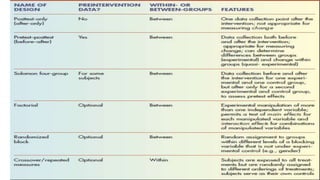
from the entire sample.
• 3. Subjects are then randomized to either the intervention or the control group.
• 4. After each group receives the experimental intervention or comparison/control
intervention (usual care or standard treatment, education, or placebo), both groups
complete postintervention measures to see if any changes have occurred in the
dependent variables.
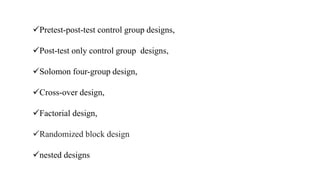
Pretest-post-test control group designs,
Post-test only control group designs,
Solomon four-group design,
Cross-over design,
Factorial design,
Randomized block design
nested designs
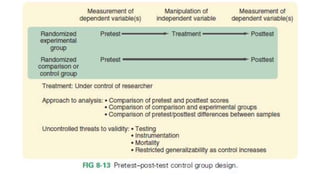
Subjects are randomly assigned to the 2 groups, both are
presented, but only the experimental group is treated.
After close observation, both groups are post-tested to measure
the degree of change in each group.
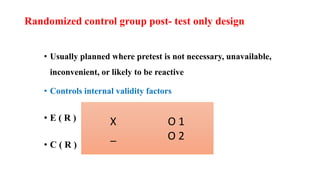
Randomized control group post- test only design
• Usually planned where pretest is not necessary, unavailable,
inconvenient, or likely to be reactive
• Controls internal validity factors
• E ( R )
• C ( R )
X O 1
_ O 2
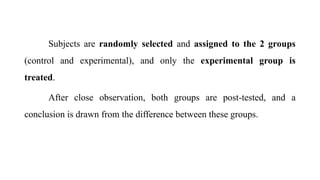
Subjects are randomly selected and assigned to the 2 groups
(control and experimental), and only the experimental group is
treated.
After close observation, both groups are post-tested, and a
conclusion is drawn from the difference between these groups.
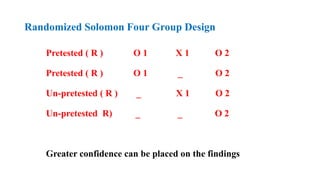
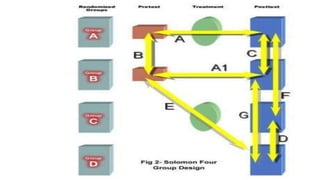
Randomized Solomon Four Group Design
Pretested ( R ) O 1 X 1 O 2
Pretested ( R ) O 1 _ O 2
Un-pretested ( R ) _ X 1 O 2
Un-pretested R) _ _ O 2
Greater confidence can be placed on the findings
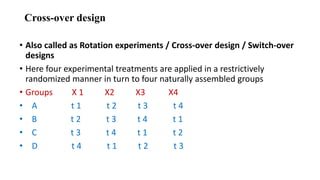
Cross-over design
• Also called as Rotation experiments / Cross-over design / Switch-over
designs
• Here four experimental treatments are applied in a restrictively
randomized manner in turn to four naturally assembled groups
• Groups X 1 X2 X3 X4
• A t 1 t 2 t 3 t 4
• B t 2 t 3 t 4 t 1
• C t 3 t 4 t 1 t 2
• D t 4 t 1 t 2 t 3
A crossover design is a repeated measurements design such that
each experimental unit (patient) receives different treatments during
the different time periods, i.e., the patients cross over from one
treatment to another during the course of the trial.
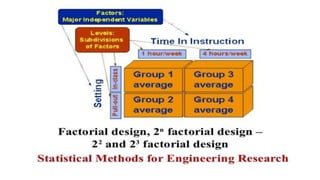
Factorial design
Factorial design involves having more than one independent
variable or factor, in a study.
Factorial designs allow researchers to look at how multiple factors
affect a dependent variable, both independently and together.
Factorial design studies are named for the number of levels of the
factors.
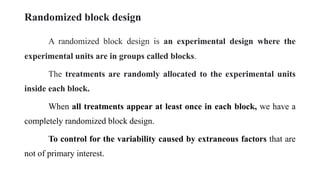
Randomized block design
A randomized block design is an experimental design where the
experimental units are in groups called blocks.
The treatments are randomly allocated to the experimental units
inside each block.
When all treatments appear at least once in each block, we have a
completely randomized block design.
To control for the variability caused by extraneous factors that are
not of primary interest.
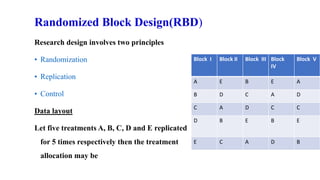
Randomized Block Design(RBD)
Research design involves two principles
• Randomization
• Replication
• Control
Data layout
Let five treatments A, B, C, D and E replicated
for 5 times respectively then the treatment
allocation may be
Block I Block II Block III Block
IV
Block V
A E B E A
B D C A D
C A D C C
D B E B E
E C A D B
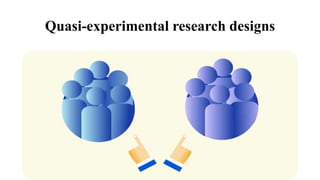
Quasi-experimental research designs
Type of research approach that shares some similarities with
experimental designs but lack the full control over certain variables due to
practical or ethical constraints.
Quasi-experimental designs are commonly used when researchers cannot
manipulate certain factors directly or randomly assign participants to
different groups.
These designs aim to determine causal relationships between variables,
like experimental designs, but they often involve natural settings and existing
groups rather than creating artificial conditions.
Characteristics of quasi experimental research designs
• Lack of Random Assignment
• Pre-existing Groups
• Treatment Manipulation
• Natural Settings
• Selection Bias
• Generalizability
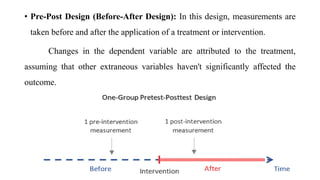
• Pre-Post Design (Before-After Design): In this design, measurements are
taken before and after the application of a treatment or intervention.
Changes in the dependent variable are attributed to the treatment,
assuming that other extraneous variables haven't significantly affected the
outcome.
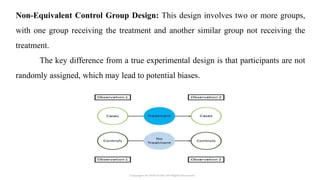
Non-Equivalent Control Group Design: This design involves two or more groups,
with one group receiving the treatment and another similar group not receiving the
treatment.
The key difference from a true experimental design is that participants are not
randomly assigned, which may lead to potential biases.
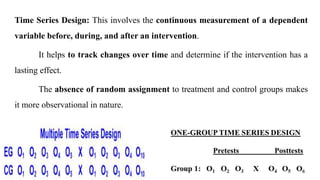
Time Series Design: This involves the continuous measurement of a dependent
variable before, during, and after an intervention.
It helps to track changes over time and determine if the intervention has a
lasting effect.
The absence of random assignment to treatment and control groups makes
it more observational in nature.
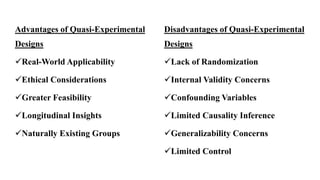
Advantages of Quasi-Experimental
Designs
Real-World Applicability
Ethical Considerations
Greater Feasibility
Longitudinal Insights
Naturally Existing Groups
Disadvantages of Quasi-Experimental
Designs
Lack of Randomization
Internal Validity Concerns
Confounding Variables
Limited Causality Inference
Generalizability Concerns
Limited Control
Qualitative Research Design
What is Qualitative Research?
• A holistic approach to questions.
• The focus is on human experience
• Contact with people in settings where those people normally spend
their time. Contexts of Human Behavior.
Qualitative Research Design
Qualitative research aims to explore, understand, and interpret complex
phenomena, often focusing on the experiences, perspectives, and contexts of
individuals or groups.
A well-designed qualitative research study ensures that the data collected
are rich, meaningful, and insightful, leading to meaningful and contextually
grounded findings.
Characteristics of Qualitative Research
• Exploration and Understanding
• Contextual and Situational
• Subjectivity
• Open-Ended Inquiry
• Rich Data
• Participant Perspective
• Small Sample Sizes
• Nonrandom Sampling
• Naturalistic Setting
Data Collection Methods
1. Interviews (one-on-one interactions between the researcher and the participant. They
can be structured or unstructured.
Focus Groups (Focus groups involve a small group of participants (6-10) who
discuss a topic guided by a moderator.)
2. Observations (systematically watching and recording participants' behaviors,
interactions, and settings in a natural environment.)
Fieldwork (immersing oneself in the participants' natural setting or environment
for an extended period. It often combines observations, interviews, and document
analysis.)
Qualitative Research Traditions
(1) Ethnography
(2) Phenomenology
(3) Grounded Theory
(4) Historical Research
(5) Biography--Life history, oral history
(6) Case Study
Ethnography
• A description and interpretation of a cultural or social group or
system.
• The researcher examines the group’s observable and learned
patterns of behavior, customs, and ways of life.
• Involves prolonged observation of the group, typically through
participant observation.
• Field Work
• Key Informants
• Thick description
• Emic (insider group perspective) and Etic
(researcher’s interpretation of social life).
• need holistic view.
• Need grounding in anthropology.
• Need extensive time to collect data.
• Many ethnographies may be written in a narrative or story
telling approach which may be difficult for the audience
understand to usual social science writing.
• Researcher as instrument - to study a culture it requires a certain
level of intimacy – needs to be developed – become one within the
culture
ETHNOGRAPHY
• Focus: the culture of a group of people
• Assumption: every human group evolves a culture that guides
members view of the world and the way they structure their
experiences.
• “macroethnography: - able to study broadly defined cultures
• “microethnography” – able to study cultures using a very narrow
focus
Three types of information:
(1) Cultural behavior
(2) Cultural artifacts
(3) Cultural speech
Sources of information – in-depth interviews, records, charts,
observations and other types of physical evidence are used.
Products of this research includes:
- rich and holistic descriptions
- describe normative behavior and social patterns
- Information about health beliefs and health practices
- Facilitates an understanding of behaviors affecting health and illness.
“ethnonursing research” –the study and analysis of local or indigenous
people’s viewpoints, beliefs and practices about nursing care behavior and
processes of designated cultures.
Phenomenology
• Phenomenology is both philosophy and a research method.
• Purpose is to describe experiences as they are lived – to capture the
“lived experience”
• an approach to thinking about people’s life experiences.
Describes the meaning of the lived experience about a concept
or a phenomenon for several individuals.
A phenomenological researcher asks the question:
“What is the essence of this phenomena as experienced by these people
and what does it mean?”
Assumption: there is an “essence”
an essential variant structure
 Investigates subjective phenomena
 Belief that truths about reality are grounded in peoples’ lived
experiences
Four aspects of the lived experience:
(1) SPATIALITY (Humans do not merely exist as objects in space; rather, there
is a constant. interactive inhabiting of space, which is at the crux of human
spatiality.)
(2) CORPOREALITY (information that is experienced through the situated and
sensory body as it interacts with material objects, artefacts and other people
that inhabit the same landscape.)
(3) TEMPORALITY ( important role in the establishment of personal identity)
(4) RELATIONALITY (what the client experiences within relationality)
• Phenomenologists believe – human existence is “meaningful” and “interesting”
• “Being in the world” is a concept that acknowledges people’s physical ties to their
world
• People:
THINK
SEE
HEAR
FEEL
CONCIOUS OF THEIR BODIES INTERACTION WITH THE WORLD
Data sources:
• In-depth conversations
• Researcher helps the participant to describe lived experiences without
leading the discussion
• Two or more interviews/conversations are needed
• Usually small number of participants (ie. 10 or less)
• May use participation, observation.
Grounded Theory
• Inductive research technique developed for health-related topics - by
Glaser & Strauss (1967)
• Discipline of sociology
• “Grounded” – means roots in the data from which is was derived.
• An inductive approach in which a theory is developed based on the
data.
Philosophical Orientation:
• Based on symbolic interaction theory
• Explores how people define reality and how their beliefs are related to
their actions
• Meaning is expressed through – symbols – such as words, religious
objects, and clothing
• Symbolic meanings are different for each of us
• Focus: is the evolution of a social experience – the social and
psychological stages that characterize a particular event of process
Methodology:
- does not begin with a focused research question
- the question emerges from the data
Fundamental structure feature –
is the “data collection”
is the “data analysis”
Is the sampling of participants occurs simultaneously
This procedure is referred to as “constant comparison”
Data Sources:
- in-depth interviews are most common
- Observational methods
- Existing documents
- Usually a sample of 25 to 50 informants
Historical Research
• Historiography examines events of the past.
• Historians believe the greatest value of historical knowledge is an increased
self-understanding.
Philosophical Orientation:
• A very old science
• Primary question “Where have we come from, who are we, and where
are we going?”
• Myths are a form of story telling
• History moves beyond the myth
• Chronicling events, victories and stories about people and civilizations
• Comparing histories, identifying patterns
Aim:
• to discovery new knowledge
• Seeking to answer questions concerning causes, effects and trends
relating to past events
Assumptions:
(a) One can learn from the past
Biographical Study
• The study of an individual and her or his experiences as told to
the researcher or found in documents and archival material.
• Life history--The study of an individual’s life and how it reflects
cultural themes of the society.
• Oral history--The researcher gathers personal recollections of
events, their causes, and their effects from and individual or several
individuals.
• The researcher needs to collect extensive information about the subject
of the biography
Case Study
• A case study is an exploration of a “bounded system” or over time
through detailed, in-depth data collection involving multiple
sources of information rich in context.
• The context of the case involves situating the case within its setting.
which may be physical, social, historical and/or economic.
• Data collection strategies include direct observation, interviews,
documents, archival records, participant observation, physical
artifacts and audiovisual materials.
Mixed-Methods Research Design
To gain a deeper and more holistic understanding of a research
question by integrating both qualitative and quantitative data.
Types of Mixed-Methods Research Designs
1.Convergent Design: Qualitative and quantitative data are collected
concurrently or sequentially and then compared for confirmation of findings.
2.Exploratory Design: Qualitative data are collected first to generate insights,
followed by quantitative data to quantify and validate patterns identified
qualitatively.
3.Explanatory Design: Quantitative data are collected first to test hypotheses,
followed by qualitative data to provide deeper explanations and context.
4.Sequential Design: Qualitative and quantitative data are collected in distinct
phases, with one informing the other in a sequential manner.
Benefits of Mixed-Methods Research
• Comprehensive Understanding
• Triangulation
• Exploration and Confirmation
• In-depth Insights
• Contextualization
• Overcoming Limitations
Factors Influencing for selecting Approach and Design
• Research Objectives and Questions
• Nature of the Research Questions
• Data Type and Collection
• Complexity of the Phenomenon
• Context and Environment
• Scope and Resources
• Generalizability
• In-depth Understanding
• Previous Research
• Researcher Expertise
• Stakeholder Needs
Summary
Any Doubts
Research Approach and Design.pptx

Research Approach and Design.pptx

  • 1.
    Research Approach andDesign Prof. Asokan R. I/C of R&D, KINS, KIIT (DU), BBSR
  • 2.
  • 3.
    Outline of Presentation Introduction Understandingdifferent Research Approaches Foundations of Research Design Quantitative Research Design Qualitative Research Design Mixed-Methods Research Design
  • 4.
  • 5.
    Methodological framework that guideshow a research study is planned, conducted, and executed. It provides a structured way to address research questions, gather data, analyze information, and draw conclusions.
  • 6.
  • 7.
    Overall plan andstructure that guides the process of conducting a research study. It encompasses the strategies, methods, procedures, and techniques that researchers use to collect, analyze, and interpret data to address their research questions or hypotheses.
  • 8.
    RESEARCH DESIGN (BLUE PRINTOF THE STUDY)  Guide the research in planning, & implementing the study  Overall plan for obtaining answer to research question  Entire strategy or framework for the study 8
  • 9.
    Research Design mustcontain, A clear statement of the research problem Procedures and techniques to be used for gathering information The population to be studied Methods to be used in processing and analyzing data
  • 10.
    Importance of ResearchApproach and Design Guidance and Structure Alignment with Research Objectives Validity and Reliability Effective Data Collection Appropriate Analysis Techniques Suitability for Research Questions Resource Utilization Ethical Considerations Generalizability and Transferability Innovation and Contribution Effective Communication of Results Adaptability and Flexibility
  • 11.
  • 12.
  • 13.
    Quantitative Research Approach •Systematic empirical approach to investigating phenomena through the collection, analysis, and interpretation of numerical data. • Aims to quantify relationships, patterns, and trends and often involves testing hypotheses and making predictions.
  • 14.
  • 15.
    Qualitative Research Approach •Focuses on understanding and exploring complex phenomena, often using non-numerical data such as words, images, and narratives. • Aims to delve into the richness and depth of human experiences, perspectives, and contexts.
  • 16.
  • 17.
    Mixed-Methods Research Approach •Combines both qualitative and quantitative research methods within a single study to provide a more comprehensive understanding of a research question or phenomenon. • By integrating the strengths of both approaches, researchers can gain deeper insights and confirm findings, enhancing the overall robustness of their research. • Example: How does the implementation of a bedside hand hygiene protocol (qualitative) impact the reduction of healthcare-associated infections (quantitative) in a hospital setting?
  • 18.
    Selecting the AppropriateResearch Approach Step-by-step guide to help you select the right research approach: Define Your Research Objectives and Questions Understand Your Research Problem Consider Philosophical and Theoretical Perspectives Review Existing Literature Match Approach to Research Questions Consider Data Type and Collection Resource Availability Feasibility Research Design Ethical Considerations Consultation and Feedback Flexibility Pilot Testing Justification and Clarity
  • 19.
    Research Design: Foundations •Research Questions and Objectives • Theoretical Framework • Research Approach • Data Collection Methods • Sampling Strategy • Data Analysis Methods • Ethical Considerations • Timeframe and Schedule • Budget and Resources • Validity and Reliability • Pilot Testing • Scope and Limitations • Research Design Diagram • Communication Plan
  • 20.
    Quantitative Research Design •Systematic plan or blueprint that researchers follow to collect, analyze, and interpret numerical data in order to answer specific research questions or test hypotheses. • A well-designed quantitative research study ensures that the data collected are relevant, reliable, and valid, allowing for meaningful conclusions and generalizability.
  • 21.
  • 22.
    Construct a pictureof a phenomenon Make account of events as they naturally occurs Investigate current status of something Describe existing phenomena without manipulating the condition PURPOSE 22
  • 23.
    Salient Features : No Manipulation of Independent Variable  No Cause / Effect  It requires a Clear, Concise Problem Statement  Hypothesis Generating  Data is Collected without Making Changes or Intervening to Subjects  Extraneous Variables are Controlled by using Homogenous Sampling  Consistent Data Collection Procedures 23
  • 24.
  • 25.
  • 26.
  • 27.
  • 28.
  • 29.
  • 30.
    DESCRIPTIVE Intend to examineand describe an issue. Descriptive research design is a scientific method which involves observing and describing the behavior of a subject without influencing it in any way. Use to answer questions in ‘wh’ word : what occur, how occur, when occur, why occur 30
  • 31.
    PURPOSE To observe, describeand document aspects of situation as it naturally occurs. To serve as starting point for hypothesis generation or theory development. 31
  • 32.
    CHARACTERISTICS  Describe aPhenomenon  Especially effective when the area has been previously studied. Example- Study of nursing action in diabetic foot care  Data is collected through questionnaire, interview, files, document or observation. 32
  • 33.
    For example: An apparelbrand that wants to understand the fashion purchasing trends among buyers. 33
  • 34.
    UNIVARIANT DESCRIPTIVE DESIGN It describe frequency of occurrence of a phenomenon rather study relationship  It is not necessary that to study a single variable, but may be one or more variable  This design mainly try to identify & describe perception, awareness, behaviour, attitude, knowledge and practice.  Ex: Student nurses awareness on BLS. 34
  • 35.
    EXPLORATIVE  It identify,explore, & describe the existing phenomenon and related factors. Ex: Factors and morbidity pattern among LBW Babies  It simply describe the phenomena and in-depth relate the cause of phenomena.  Aims to explain why particular phenomena work in the way that they do. 35
  • 36.
    • Exploratory-descriptive designs,usually field studies in natural settings, provide the least control over variables. • The data collected either contribute to the development of theory or explain phenomena from the perspective of the persons being studied. 36
  • 37.
    COMPARATIVE  Compare andcontrast two or more variable on same phenomena Ex: Perception of Labour Pain among Primipara & Multipara Mother  Attribute such as knowledge, practice, perception, attitude, symptoms, complication are compared 37
  • 38.
    For example An examinationbody wants to determine the better method of conducting tests between paper-based and computer-based tests. A comparative study on health problems among rural and urban older people in selected districts. 38
  • 39.
    Why Use DescriptiveResearch Design? • Define subject characteristics • Measure Data Trends • Comparison • Validate existing conditions • Conducted Overtime 39
  • 40.
    IMPORTANT ISSUES INDESCRIPTIVE DESIGN  Cannot make conclusions about relationships studies. (snapshot of the current thoughts)  Subjects and instrumentation must be clearly identified.  Watch for graphic distortion.  Response & Non-Response Bias. 40
  • 41.
    INTER RELATIONAL STUDIES/RELATIONALSTUDIES  It provides a deeper insight into the phenomenon of interest than descriptive studies.  It traces the interrelationships between variables.  A study that investigates the connection between two or more variables. 41
  • 42.
    Investigate the degreeto which differences or variation in relation to two variables Ex : Relation between diabetes and development of hypertension  It determines degree of relationship. It allows description and prediction of relationships. Ex : Salary and staff turnover 42
  • 43.
    CORRELATIONAL DESIGN /STUDIES Measures two Variables. Examine the strength of relationship between variables Describe a linear relationship Do not imply a cause and effect relationship Do not imply that variables share something in common Ex: Pill users and ovarian cancer 43
  • 44.
    Indicates the extentto which one variable (x) related to another (y). Magnitude and the direction of relationship are indicated by correlation coefficient. It may be positive or negative ranging from (-1.00) perfect negative correlation to (1.00) perfect positive correlation and ‘0’ indicate no relation 44
  • 45.
  • 46.
    ADVANTAGES  Analyse relationshipamong large number of variables  Demonstrate degree of relationship between variables  It opens up a great deal of further research to other scholars. 46
  • 47.
    EX- POST FACTOSTUDIES CAUSAL COMPARATIVE STUDY / COMPARATIVE STUDY  The investigation starts after the fact has occurred without interference from the researcher.  It is used when causality is a question and experiment is not possible to do.  When they cannot manipulate the independent variables  But according to cause it compare groups Ex: Smoker and Lung Cancer Non Smoker and No Lung Cancer 47
  • 48.
    • The assignmentof subjects to different groups is based on whichever variable of interest to the researchers. • Pre-existing characteristic (weight) was used to form the groups. • Groups with qualities that already exist are compared on some dependent variable. 48
  • 49.
    Cont...  So theindependent variables are identified and the effect on dependent variable studied.  Here cause and effect relationships identified by forming groups of individuals & determine whether groups differ on dependent variables.  But there is possibility, group will differ by external variables , So need to cautiously evaluate and draw the conclusion.  It is classified as retrospective (effect to cause) and prospective (cause to effect) 49
  • 50.
    PREDICTIVE STUDY Aims toidentify pre – existing characteristics (independent variable) that is predictive of a relationship with dependent variable. (aims to predict future outcomes) Ex : Intelligence level with performance, Obesity with hypertension It uses retrospective data from one group to make prediction about similar group. Shows how one variable predict score on another in time 50
  • 51.
     They allowyou to make estimates and devise forecasting models.  Correlation coefficient only show relation.  Result makes more accurate predictions possible.  Length of prediction – shorter the time more the prediction (Rain)  More time =more opportunity for another variable to influence.  Major advantage – facilitate intelligence decision making as objective criteria's available to guide the process. 51
  • 52.
    ANALYSIS OF PREDECTIVESTUDIES  Regression (How changes in the independent variables are associated with changes in the dependent variable & to create a mathematical model that can predict the value of the dependent variable based on the values of the independent variables.)  Multiple Regression  Discriminant Analysis (whether heavy, medium and light users of soft drinks are different in terms of their consumption of frozen foods & price sensitive and non price sensitive buyers of groceries in terms of their psychological attributes or characteristics. 52
  • 53.
    DEVELOPMENTAL STUDIES  Itstudies the time perspectives.  It studies not only present status but also the with related phenomena, also with changes that result from elapsed time.  It is generally used to adjunct research design with other designs, descriptive, cross sections, cross sectional survey, longitudinal co-relational study.  Understanding the processes of human growth, change, and development across the lifespan. Developmental studies aim to provide insights into how people develop, learn, and adapt to their environments over time. 53
  • 54.
    It is astudy of status and is widely used in education, nutrition, epidemiology, and the behavioral sciences. Problems can be solved and practices improved through observation, analysis, and description. EX: To assess the differences in academic and social development in low-income versus high-income neighborhoods. 54
  • 55.
    CROSS SECTIONAL DESIGN Examinedata at one point in time . Data is collected only on one occasion with same type of subject at one point or multiple points at one time Ex: Knowledge of student nurses on neonatal resuscitation Data are compared in respect to socio- demographic. This is convenient & easy variables to conduct. But cohort effect (life experiences) can't be ruled out 55
  • 56.
    LONGITUDINAL DESIGN  Itis used when data is required for several times at interval from same subject . Ex: Professional adjustment of 1st year nursing student  The data is collected over an extended time period  Examine development by making a series of observations or measurements over time  Avoid problems with cohort effect or generational effect 56
  • 57.
    ADVANTAGES To study developmentalchanges /effect. Disadvantages – time, cost , patience & sample turnover and other confounding variables 57
  • 58.
    EPIDEMIOLOGICAL STUDIES  Studyabout distribution & causes of diseases in population.  Conducted to investigate causes of different diseases either by retrospective approach /case control studies , prospective approach / cohort studies 58
  • 59.
    The cohort studyis concerned with frequency of disease in exposed and non-exposed individuals, the case-control study is concerned with the frequency and amount of exposure in subjects with a specific disease (cases) and people without the disease (controls). 59
  • 60.
    COHORT STUDIES To investigatethe causes of disease and to establish links between risk factors and health outcomes. 60
  • 61.
    CASE CONTROL STUDIES Researcher go back to the causes for a definite occurrence.  The frequency, incidence, factors effect were studied for prudent situation. 61
  • 62.
  • 63.
    SURVEY DESIGN /APPROACH It is a popular method to describe and explore the events.  Used to collect information from a homogenous group of subject .  It ask subject to report their attitude, opinions, perceptions or behaviours  It gather current required data for obtaining new information. 63
  • 64.
    Ex: Cervical Cancer Describe- incidence , magnitude, characteristics Compare - Cx Cancer before and after age of 40 Exploratory – Cause of Cancer cx Co-relational – Multiple Sex partner and Cx Cancer TYPES Descriptive Exploratory Comparative Survey Co relational Survey 64
  • 65.
    Data is collectedby phone, mail, interview, questionnaire, etc. For standardization of questionnaire must be validated. OTHER TYPES OF SURVEY CROSS SECTIONAL Political Survey Attitude Survey Programme Evaluation Performance Evaluation, etc., 65
  • 66.
    LONGITUDINAL Study of Morbidity,Mortality, Treatment Adherence etc. In a longitudinal study, researchers repeatedly examine the same individuals to detect any changes that might occur over a period of time. Longitudinal studies are a type of correlational research in which researchers observe and collect data on a number of variables without trying to influence those variables. 66
  • 67.
    ADVANTAGES OF NON-EXPERIMENTALDESIGN Require no experiment, real life situation, manipulation. Easy and convenient to conduct. Suitable to many field like psychology, sociology, education, nursing, etc. DISADVANTAGES Data are less reliable. Cause & effect relationship absolutely not error free Improper Interpretation. 67
  • 68.
  • 69.
    What is Trueexperimental design?
  • 70.
    True experimental designis a statistical approach of establishing a cause and effect relationship between different variables. This is one of the most accurate forms of research designs which provides a substantial backing to support the existence of relationships.
  • 71.
    A true experimentaldesign is characterized by the following properties: True experiments have four elements: manipulation, control , random assignment, and random selection. • Manipulation—the experimenter does something to at least some subjects or something is purposefully changed by the researcher in the environment. • Control—the experimenter introduces controls over the experimental situation, including the use of a control group. • Randomization—the experimenter assigns subjects to a control or experimental group on a random basis
  • 72.
    • A researchstudy using a true experimental design is commonly called a randomized controlled trial (RCT). • In hospital and clinic settings, it may be referred to as a “clinical trial” and is commonly used in drug trials. • An RCT is considered the “gold standard” for providing information about cause-and-effect relationships. An individual RCT generates Level II evidence because of reduced bias provided by randomization, control, and manipulation. • A well-controlled design using these properties provides more confidence that the intervention will be effective and produce the same results over time.
  • 74.
    Randomization • Randomization, orrandom assignment, distribution of subjects to either the experimental or the control group on a purely random basis. • Randomization may be done individually or by groups. Several procedures are used to randomize subjects to groups, such as a table of random numbers or computer-generated number sequences (Suresh, 2011). • Whatever method is used, it is important that the process be truly random, that it be tamperproof, and that the group assignment is concealed (kept secret).
  • 75.
    Why randomization? The basicbenefits of randomization include 1. Eliminates selection bias. 2. Balances arms with respect to prognostic variables (known and unknown). 3. Forms basis for statistical tests, a basis for an assumption-free statistical test of the equality of treatments.
  • 76.
    Methods of randomization •(1) simple - equivalent to tossing a coin for each subject that enters a trial. The random number generator is generally used. • (2) Block - to divide potential patients into m blocks of size 2n, randomize each block such that n patients are allocated to A and n to B. then choose the blocks randomly. • (3) Stratified - addresses the need to control and balance the influence of covariates. This method can be used to achieve balance among groups in terms of subjects’ baseline characteristics (covariates). • (4) Adaptive - changing the allocation probability according to the progress and position of the study. It may be used to minimize the imbalance between treatment groups as well as to change the allocation probability based on the therapeutic effect.
  • 77.
    Blinding Blinding, in research,mentions to a practice where the study population or the stakeholders involved in research are not permitted from knowing certain information or treatment, which may somehow influence the study findings. Blinding (also called masking) is typically used in randomized controlled trials (RCTs).
  • 79.
    There are basicallythree different types of blinding used in researches: Single blinding or single-masked: • In single blinding, only a single stakeholder i.e. either the participant or the investigator is not informed of the nature of treatment the participant is receiving. • A trial is called single-blind if only one party is blinded. Usually, the participant is blinded and is unaware of the treatment they receive. Double-blinding or double-masked: • Both study population/participant and data collectors/investigators/researchers are not aware of the kind or nature of the treatment given and who receive the treatment. • If both ‘the participants’ and ‘the study staffs’ are blinded, it is known as a double- blind study.
  • 80.
    Triple blinding: A clinicaltrial in which neither the subject nor the person governing treatment nor an individual measuring the response to the treatment is aware of the particular treatment received by the subject is known as triple blind. Triple blinded studies also lengthen blinding to the data specialists. • In triple blinding, the study participant, the data investigator or data collector and the data analyzer- all are blinded. Unblinded or open-label: It is the exact opposite of blinding, where all the participant, clinicians, data collectors, specialists are well known about the treatment/intervention they receive.
  • 81.
    Control • Control refersto the process by which the investigator holds certain conditions constant to limit bias that could influence the dependent variable(s) / effort by the researcher to remove the influence of any extraneous, confounding variable. • Control is acquired by manipulating the independent variable, by randomly assigning subjects to a group, by using a control group, and by preparing intervention and data collection protocols to maintain consistency for all study participants. • In experimental research, the control group receives the usual treatment or a placebo (any treatment that has no active properties).
  • 82.
    The three maintypes of controls are positive, negative, and procedural, and variable controls. A positive control group is not exposed to the experimental treatment but is exposed to another treatment that is known to work. A negative control a process of conducting the experiment in the exact same way on a control group except that the independent variables are a placebo that is not expected to produce a result. procedural controls are designed to reduce error in conducting the experiment. variable control – the practice of keeping a variable constant to minimize its influence on results.
  • 83.
    Manipulation • Manipulation isthe process of “doing something,” a different dose of “something,” or comparing different types of treatment by manipulating the independent variable for at least some of the involved subjects. • The independent variable might be a treatment, a teaching plan, or a medication. • The effect of this manipulation is measured to determine the result of the experimental treatment on the dependent variable compared with those who did not receive the treatment.
  • 84.
    The classic RCTis conducted as follows • 1. The researcher recruits a sample from the population. • 2. Baseline preintervention demographics, personal characteristics, and measurement of the intended study concepts or dependent variables are collected from the entire sample. • 3. Subjects are then randomized to either the intervention or the control group. • 4. After each group receives the experimental intervention or comparison/control intervention (usual care or standard treatment, education, or placebo), both groups complete postintervention measures to see if any changes have occurred in the dependent variables.
  • 86.
    Pretest-post-test control groupdesigns, Post-test only control group designs, Solomon four-group design, Cross-over design, Factorial design, Randomized block design nested designs
  • 88.
    Subjects are randomlyassigned to the 2 groups, both are presented, but only the experimental group is treated. After close observation, both groups are post-tested to measure the degree of change in each group.
  • 89.
    Randomized control grouppost- test only design • Usually planned where pretest is not necessary, unavailable, inconvenient, or likely to be reactive • Controls internal validity factors • E ( R ) • C ( R ) X O 1 _ O 2
  • 90.
    Subjects are randomlyselected and assigned to the 2 groups (control and experimental), and only the experimental group is treated. After close observation, both groups are post-tested, and a conclusion is drawn from the difference between these groups.
  • 91.
    Randomized Solomon FourGroup Design Pretested ( R ) O 1 X 1 O 2 Pretested ( R ) O 1 _ O 2 Un-pretested ( R ) _ X 1 O 2 Un-pretested R) _ _ O 2 Greater confidence can be placed on the findings
  • 93.
    Cross-over design • Alsocalled as Rotation experiments / Cross-over design / Switch-over designs • Here four experimental treatments are applied in a restrictively randomized manner in turn to four naturally assembled groups • Groups X 1 X2 X3 X4 • A t 1 t 2 t 3 t 4 • B t 2 t 3 t 4 t 1 • C t 3 t 4 t 1 t 2 • D t 4 t 1 t 2 t 3
  • 94.
    A crossover designis a repeated measurements design such that each experimental unit (patient) receives different treatments during the different time periods, i.e., the patients cross over from one treatment to another during the course of the trial.
  • 95.
    Factorial design Factorial designinvolves having more than one independent variable or factor, in a study. Factorial designs allow researchers to look at how multiple factors affect a dependent variable, both independently and together. Factorial design studies are named for the number of levels of the factors.
  • 97.
    Randomized block design Arandomized block design is an experimental design where the experimental units are in groups called blocks. The treatments are randomly allocated to the experimental units inside each block. When all treatments appear at least once in each block, we have a completely randomized block design. To control for the variability caused by extraneous factors that are not of primary interest.
  • 98.
    Randomized Block Design(RBD) Researchdesign involves two principles • Randomization • Replication • Control Data layout Let five treatments A, B, C, D and E replicated for 5 times respectively then the treatment allocation may be Block I Block II Block III Block IV Block V A E B E A B D C A D C A D C C D B E B E E C A D B
  • 101.
  • 102.
    Type of researchapproach that shares some similarities with experimental designs but lack the full control over certain variables due to practical or ethical constraints. Quasi-experimental designs are commonly used when researchers cannot manipulate certain factors directly or randomly assign participants to different groups. These designs aim to determine causal relationships between variables, like experimental designs, but they often involve natural settings and existing groups rather than creating artificial conditions.
  • 103.
    Characteristics of quasiexperimental research designs • Lack of Random Assignment • Pre-existing Groups • Treatment Manipulation • Natural Settings • Selection Bias • Generalizability
  • 104.
    • Pre-Post Design(Before-After Design): In this design, measurements are taken before and after the application of a treatment or intervention. Changes in the dependent variable are attributed to the treatment, assuming that other extraneous variables haven't significantly affected the outcome.
  • 105.
    Non-Equivalent Control GroupDesign: This design involves two or more groups, with one group receiving the treatment and another similar group not receiving the treatment. The key difference from a true experimental design is that participants are not randomly assigned, which may lead to potential biases.
  • 106.
    Time Series Design:This involves the continuous measurement of a dependent variable before, during, and after an intervention. It helps to track changes over time and determine if the intervention has a lasting effect. The absence of random assignment to treatment and control groups makes it more observational in nature.
  • 107.
    Advantages of Quasi-Experimental Designs Real-WorldApplicability Ethical Considerations Greater Feasibility Longitudinal Insights Naturally Existing Groups Disadvantages of Quasi-Experimental Designs Lack of Randomization Internal Validity Concerns Confounding Variables Limited Causality Inference Generalizability Concerns Limited Control
  • 108.
  • 109.
    What is QualitativeResearch? • A holistic approach to questions. • The focus is on human experience • Contact with people in settings where those people normally spend their time. Contexts of Human Behavior.
  • 110.
    Qualitative Research Design Qualitativeresearch aims to explore, understand, and interpret complex phenomena, often focusing on the experiences, perspectives, and contexts of individuals or groups. A well-designed qualitative research study ensures that the data collected are rich, meaningful, and insightful, leading to meaningful and contextually grounded findings.
  • 111.
    Characteristics of QualitativeResearch • Exploration and Understanding • Contextual and Situational • Subjectivity • Open-Ended Inquiry • Rich Data • Participant Perspective • Small Sample Sizes • Nonrandom Sampling • Naturalistic Setting
  • 112.
    Data Collection Methods 1.Interviews (one-on-one interactions between the researcher and the participant. They can be structured or unstructured. Focus Groups (Focus groups involve a small group of participants (6-10) who discuss a topic guided by a moderator.) 2. Observations (systematically watching and recording participants' behaviors, interactions, and settings in a natural environment.) Fieldwork (immersing oneself in the participants' natural setting or environment for an extended period. It often combines observations, interviews, and document analysis.)
  • 113.
    Qualitative Research Traditions (1)Ethnography (2) Phenomenology (3) Grounded Theory (4) Historical Research (5) Biography--Life history, oral history (6) Case Study
  • 114.
    Ethnography • A descriptionand interpretation of a cultural or social group or system. • The researcher examines the group’s observable and learned patterns of behavior, customs, and ways of life. • Involves prolonged observation of the group, typically through participant observation.
  • 115.
    • Field Work •Key Informants • Thick description • Emic (insider group perspective) and Etic (researcher’s interpretation of social life). • need holistic view. • Need grounding in anthropology.
  • 116.
    • Need extensivetime to collect data. • Many ethnographies may be written in a narrative or story telling approach which may be difficult for the audience understand to usual social science writing. • Researcher as instrument - to study a culture it requires a certain level of intimacy – needs to be developed – become one within the culture
  • 117.
    ETHNOGRAPHY • Focus: theculture of a group of people • Assumption: every human group evolves a culture that guides members view of the world and the way they structure their experiences. • “macroethnography: - able to study broadly defined cultures • “microethnography” – able to study cultures using a very narrow focus
  • 118.
    Three types ofinformation: (1) Cultural behavior (2) Cultural artifacts (3) Cultural speech Sources of information – in-depth interviews, records, charts, observations and other types of physical evidence are used.
  • 119.
    Products of thisresearch includes: - rich and holistic descriptions - describe normative behavior and social patterns - Information about health beliefs and health practices - Facilitates an understanding of behaviors affecting health and illness. “ethnonursing research” –the study and analysis of local or indigenous people’s viewpoints, beliefs and practices about nursing care behavior and processes of designated cultures.
  • 120.
    Phenomenology • Phenomenology isboth philosophy and a research method. • Purpose is to describe experiences as they are lived – to capture the “lived experience” • an approach to thinking about people’s life experiences.
  • 121.
    Describes the meaningof the lived experience about a concept or a phenomenon for several individuals.
  • 122.
    A phenomenological researcherasks the question: “What is the essence of this phenomena as experienced by these people and what does it mean?” Assumption: there is an “essence” an essential variant structure  Investigates subjective phenomena  Belief that truths about reality are grounded in peoples’ lived experiences
  • 123.
    Four aspects ofthe lived experience: (1) SPATIALITY (Humans do not merely exist as objects in space; rather, there is a constant. interactive inhabiting of space, which is at the crux of human spatiality.) (2) CORPOREALITY (information that is experienced through the situated and sensory body as it interacts with material objects, artefacts and other people that inhabit the same landscape.) (3) TEMPORALITY ( important role in the establishment of personal identity) (4) RELATIONALITY (what the client experiences within relationality)
  • 124.
    • Phenomenologists believe– human existence is “meaningful” and “interesting” • “Being in the world” is a concept that acknowledges people’s physical ties to their world • People: THINK SEE HEAR FEEL CONCIOUS OF THEIR BODIES INTERACTION WITH THE WORLD
  • 125.
    Data sources: • In-depthconversations • Researcher helps the participant to describe lived experiences without leading the discussion • Two or more interviews/conversations are needed • Usually small number of participants (ie. 10 or less) • May use participation, observation.
  • 126.
    Grounded Theory • Inductiveresearch technique developed for health-related topics - by Glaser & Strauss (1967) • Discipline of sociology • “Grounded” – means roots in the data from which is was derived. • An inductive approach in which a theory is developed based on the data.
  • 127.
    Philosophical Orientation: • Basedon symbolic interaction theory • Explores how people define reality and how their beliefs are related to their actions • Meaning is expressed through – symbols – such as words, religious objects, and clothing • Symbolic meanings are different for each of us
  • 128.
    • Focus: isthe evolution of a social experience – the social and psychological stages that characterize a particular event of process
  • 129.
    Methodology: - does notbegin with a focused research question - the question emerges from the data Fundamental structure feature – is the “data collection” is the “data analysis” Is the sampling of participants occurs simultaneously This procedure is referred to as “constant comparison”
  • 130.
    Data Sources: - in-depthinterviews are most common - Observational methods - Existing documents - Usually a sample of 25 to 50 informants
  • 131.
    Historical Research • Historiographyexamines events of the past. • Historians believe the greatest value of historical knowledge is an increased self-understanding. Philosophical Orientation: • A very old science • Primary question “Where have we come from, who are we, and where are we going?” • Myths are a form of story telling
  • 132.
    • History movesbeyond the myth • Chronicling events, victories and stories about people and civilizations • Comparing histories, identifying patterns Aim: • to discovery new knowledge • Seeking to answer questions concerning causes, effects and trends relating to past events
  • 133.
    Assumptions: (a) One canlearn from the past
  • 134.
    Biographical Study • Thestudy of an individual and her or his experiences as told to the researcher or found in documents and archival material. • Life history--The study of an individual’s life and how it reflects cultural themes of the society.
  • 135.
    • Oral history--Theresearcher gathers personal recollections of events, their causes, and their effects from and individual or several individuals. • The researcher needs to collect extensive information about the subject of the biography
  • 136.
    Case Study • Acase study is an exploration of a “bounded system” or over time through detailed, in-depth data collection involving multiple sources of information rich in context. • The context of the case involves situating the case within its setting. which may be physical, social, historical and/or economic.
  • 137.
    • Data collectionstrategies include direct observation, interviews, documents, archival records, participant observation, physical artifacts and audiovisual materials.
  • 138.
  • 139.
    Mixed-Methods Research Design Togain a deeper and more holistic understanding of a research question by integrating both qualitative and quantitative data.
  • 140.
    Types of Mixed-MethodsResearch Designs 1.Convergent Design: Qualitative and quantitative data are collected concurrently or sequentially and then compared for confirmation of findings. 2.Exploratory Design: Qualitative data are collected first to generate insights, followed by quantitative data to quantify and validate patterns identified qualitatively. 3.Explanatory Design: Quantitative data are collected first to test hypotheses, followed by qualitative data to provide deeper explanations and context. 4.Sequential Design: Qualitative and quantitative data are collected in distinct phases, with one informing the other in a sequential manner.
  • 141.
    Benefits of Mixed-MethodsResearch • Comprehensive Understanding • Triangulation • Exploration and Confirmation • In-depth Insights • Contextualization • Overcoming Limitations
  • 142.
    Factors Influencing forselecting Approach and Design • Research Objectives and Questions • Nature of the Research Questions • Data Type and Collection • Complexity of the Phenomenon • Context and Environment • Scope and Resources • Generalizability • In-depth Understanding • Previous Research • Researcher Expertise • Stakeholder Needs
  • 143.
  • 144.