KATORI - SPOON
OR
PALADAI FEEDING
RAKHI DAS I yr MSc N JMMC, Tcr
Introduction
Feeding in a normal newborn is natural when we think
about breastfeeding where the feed is ready at birth.
But in some special cases where the baby is unable to
feed directly on the breast can be fed with expressed
breast milk, or newborns who need long term
neonatal ICU stay due to clinical reasons calls for
meeting the feeding needs with the help of naso /
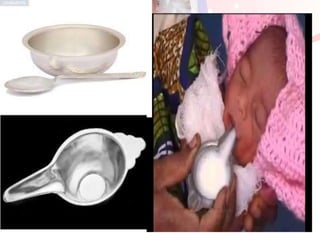
oro - gastric tube or simply with a katori & spoon or
Paladai.
Indications
• Small for gestational age infants
• Premature babies who have good
swallowing reflex but poor sucking
reflex
• Low birth weight baby
Contraindications
• Congenital anomalies - cleft lip or
cleft palate
• Extremely low birth weight below
1000 grams
• Absence of sucking / swallowing
reflex
• Semi conscious unconscious baby
• Incubator or ventilator baby
Guidelines for
method of
providing Fluids
and feeding
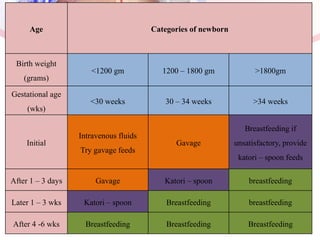
Age Categories of newborn
Birth weight
(grams)
<1200 gm 1200 – 1800 gm >1800gm
Gestational age
(wks)
<30 weeks 30 – 34 weeks >34 weeks
Initial
Intravenous fluids
Try gavage feeds
Gavage
Breastfeeding if
unsatisfactory, provide
katori – spoon feeds
After 1 – 3 days Gavage Katori – spoon breastfeeding
Later 1 – 3 wks Katori – spoon Breastfeeding breastfeeding
After 4 -6 wks Breastfeeding Breastfeeding Breastfeeding
Advantages
• This mode of feeding is a bridge
between gavage feeding and direct
breastfeeding
• Chances for transmission of
infections associated with feeding
is less when compared to bottle
feeding
• Best method for stable premature
and low birth weight babies
Disadvantages
• Cannot replace direct
breastfeeding advantages
• Delay in development of sucking
reflex
• Poor bonding between child and
mother
• Oral trauma
• Respiratory distress syndrome in
few cases
Procedure
Preparation of the articles
• Sterile tray containing
• Sterile steel bowl / katori (medium size)
• steel Teaspoon / paladai
• sterile glass or cup for collecting EBM
• Bib or disposable paper towel
• clean face towel (not needed if using disposable
paper towel)
• measuring cup
Preparation
of the baby
• Explain the mother why we need to feed with spoon
or paladai
• Assist the mother in expression of breastmilk
• If possible let the mother sit near the baby while
expressing the milk
• Check the physician order for feeding amount,
frequency, precautions
Procedure
• Arrange all articles near the baby unit
• Perform hand hygiene
• Put on disposable gloves
• If fed by the nurse:
– Hold baby in a right or sitting position with the
help of the non dominant hand across the back of
neck keeping paper towel folded in front or use a
bib
– Measure required amount of feed into paladai
– Place the spike of the paladai at the corner of the
baby mouth and milk is allowed to flow in slowly
with minimum spillage
• If fed by mother
– Assist mother to hold baby in lap or baby bed as
comfortable for her
– Same steps for paladai to follow
– If katori – spoon, measure amount and pour in
katori, assist to feed with spoon
• Baby should be actively swallowing
• Process repeated untill desired amount fed
• If any vomiting occurs, stop, burp adequately and
report
• Monitor intake - output
Post procedure care
• Remove the articles from the baby surrounding
• Wipe the face and mouth with disposable paper towel or
face towel
• Burp the baby effectively
• Make the way we lie down in prone position for
sometime
• Check the warmer and other attachments in the NICU
unit
• Documents the procedure in the sheet, amount of feed,
any observation- vomiting
Special
Nursing
Considerations
• If infant not swallowing actively, gentle tactile
stimulation can be done to keep baby awake
• If baby continues to be sluggish, do not attempt;
report and consider gavage feeding untill baby is
ready
• Facilitate neuro developmental physiotheraphy to
improve reflex activity

Paladai feeding

  • 1.
    KATORI - SPOON OR PALADAIFEEDING RAKHI DAS I yr MSc N JMMC, Tcr
  • 2.
    Introduction Feeding in anormal newborn is natural when we think about breastfeeding where the feed is ready at birth. But in some special cases where the baby is unable to feed directly on the breast can be fed with expressed breast milk, or newborns who need long term neonatal ICU stay due to clinical reasons calls for meeting the feeding needs with the help of naso / oro - gastric tube or simply with a katori & spoon or Paladai.
  • 4.
    Indications • Small forgestational age infants • Premature babies who have good swallowing reflex but poor sucking reflex • Low birth weight baby
  • 5.
    Contraindications • Congenital anomalies- cleft lip or cleft palate • Extremely low birth weight below 1000 grams • Absence of sucking / swallowing reflex • Semi conscious unconscious baby • Incubator or ventilator baby
  • 6.
  • 7.
    Age Categories ofnewborn Birth weight (grams) <1200 gm 1200 – 1800 gm >1800gm Gestational age (wks) <30 weeks 30 – 34 weeks >34 weeks Initial Intravenous fluids Try gavage feeds Gavage Breastfeeding if unsatisfactory, provide katori – spoon feeds After 1 – 3 days Gavage Katori – spoon breastfeeding Later 1 – 3 wks Katori – spoon Breastfeeding breastfeeding After 4 -6 wks Breastfeeding Breastfeeding Breastfeeding
  • 8.
    Advantages • This modeof feeding is a bridge between gavage feeding and direct breastfeeding • Chances for transmission of infections associated with feeding is less when compared to bottle feeding • Best method for stable premature and low birth weight babies
  • 9.
    Disadvantages • Cannot replacedirect breastfeeding advantages • Delay in development of sucking reflex • Poor bonding between child and mother • Oral trauma • Respiratory distress syndrome in few cases
  • 10.
    Procedure Preparation of thearticles • Sterile tray containing • Sterile steel bowl / katori (medium size) • steel Teaspoon / paladai • sterile glass or cup for collecting EBM • Bib or disposable paper towel • clean face towel (not needed if using disposable paper towel) • measuring cup
  • 11.
    Preparation of the baby •Explain the mother why we need to feed with spoon or paladai • Assist the mother in expression of breastmilk • If possible let the mother sit near the baby while expressing the milk • Check the physician order for feeding amount, frequency, precautions
  • 12.
    Procedure • Arrange allarticles near the baby unit • Perform hand hygiene • Put on disposable gloves • If fed by the nurse: – Hold baby in a right or sitting position with the help of the non dominant hand across the back of neck keeping paper towel folded in front or use a bib – Measure required amount of feed into paladai
  • 13.
    – Place thespike of the paladai at the corner of the baby mouth and milk is allowed to flow in slowly with minimum spillage • If fed by mother – Assist mother to hold baby in lap or baby bed as comfortable for her – Same steps for paladai to follow – If katori – spoon, measure amount and pour in katori, assist to feed with spoon
  • 14.
    • Baby shouldbe actively swallowing • Process repeated untill desired amount fed • If any vomiting occurs, stop, burp adequately and report • Monitor intake - output
  • 15.
    Post procedure care •Remove the articles from the baby surrounding • Wipe the face and mouth with disposable paper towel or face towel • Burp the baby effectively • Make the way we lie down in prone position for sometime • Check the warmer and other attachments in the NICU unit • Documents the procedure in the sheet, amount of feed, any observation- vomiting
  • 16.
    Special Nursing Considerations • If infantnot swallowing actively, gentle tactile stimulation can be done to keep baby awake • If baby continues to be sluggish, do not attempt; report and consider gavage feeding untill baby is ready • Facilitate neuro developmental physiotheraphy to improve reflex activity