CHAPTER 14,
QUANTITATIVE DATA
ANALYSIS
Chapter Outline
 Quantification of Data
 Univariate Analysis
 Subgroup Comparisons
 Bivariate Analysis
 Introduction to Multivariate Analysis
 Sociological Diagnostics
 Ethics and Quantitative Data Analysis
 Quick Quiz
Quantification of Data
 Quantification Analysis – The numerical
representation and manipulation of
observations for the purpose of
describing and explaining the
phenomena that those observations
reflect.
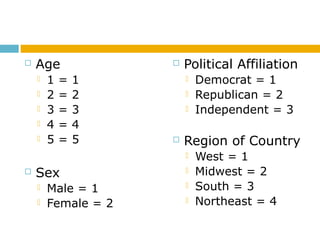
 Age
 1 = 1
 2 = 2
 3 = 3
 4 = 4
 5 = 5
 Sex
 Male = 1
 Female = 2
 Political Affiliation
 Democrat = 1
 Republican = 2
 Independent = 3
 Region of Country
 West = 1
 Midwest = 2
 South = 3
 Northeast = 4
 Develop Code Categories
1. Use well-developed coding scheme.
2. Generate codes from your data.
 Codebook Construction
 Codebook – The document used in data
processing and analysis that tells the
location of different data items in a data
file.
 The codebook also identifies the locations of
data items and the meaning of the codes used.
 Purposes of the Codebook
1. Primary guide in the coking processes
2. Guide for locating variables
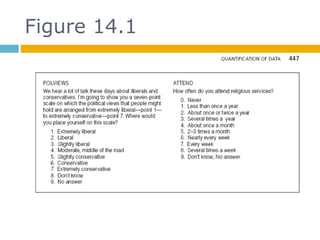
Figure 14.1
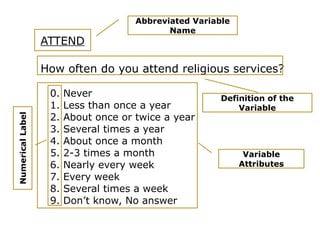
ATTEND
How often do you attend religious services?
0. Never
1. Less than once a year
2. About once or twice a year
3. Several times a year
4. About once a month
5. 2-3 times a month
6. Nearly every week
7. Every week
8. Several times a week
9. Don’t know, No answer
Abbreviated Variable
Name
NumericalLabel
Definition of the
Variable
Variable
Attributes
 Data Entry
 Excel
 SPSS
Univariate Analysis
 Univariate Analysis – The analysis of a
single variable, for purposes of
description (examples: frequency
distribution, averages, and measures of
dispersion).
 Example: Gender
 The number of men in a sample/population and
the number of women in a sample/population.
 Distributions
 Frequency Distributions – A description of
the number of times the various attributes
of a variable are observed in a sample.
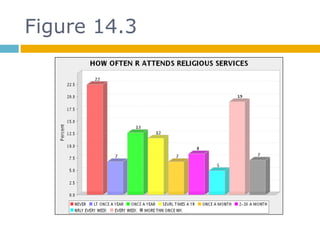
Figure 14.3
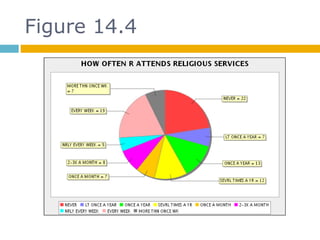
Figure 14.4
 Central Tendency
 Average – An ambiguous term generally
suggesting typical or normal – a central
tendency (examples: mean, median,
mode).
 Mean – an average computed by summing
the values of several observations and
dividing by the number of observations.
 Mode- an average representing the most
frequently observed value or attribute.
 Median – an average representing the value
of the “middle” case in a rank-ordered set
of observations.
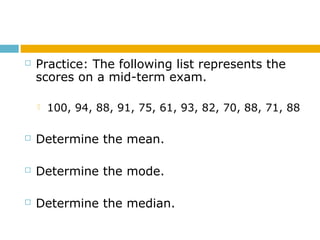
 Practice: The following list represents the
scores on a mid-term exam.
 100, 94, 88, 91, 75, 61, 93, 82, 70, 88, 71, 88
 Determine the mean.
 Determine the mode.
 Determine the median.
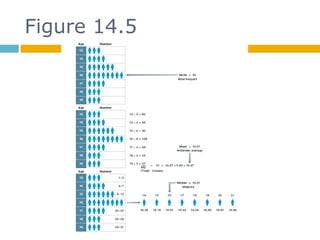
Figure 14.5
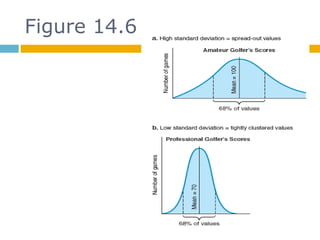
 Dispersion – The distribution of values
around some central value, such as an
average.
 Standard Deviation – A measure of
dispersion around the mean, calculated so
that approximately 68 percent of the cases
will lie within plus or minus one standard
deviation from the mean, 95 percent within
two, and 99.9 percent within three standard
deviations.
Figure 14.6
 Continuous Variable – A variable whose
attributes form a steady progression,
such as age of income.
 Discrete Variable – A variable whose
attributes are separate from one
another, such as gender or political
affiliation.
 Detail versus Manageability
 Provide reader with fullest degree of detail,
balanced with presenting data in a
manageable form.
Subgroup Comparisons
 Description of subsets of cases, subjects
or respondents.
 “Collapsing” Response Categories
 Handling “Don’t Knows”
 Numerical Descriptions in Qualitative
Research
Bivariate Analysis
 Bivariate Analysis – The analysis of two
variables simultaneously, for the
purpose of determine the empirical
relationship between them.
 Constructing a Bivariate Table
1. Determine logical direction of relationship
(independent variable and dependent
variable).
2. Percentage down versus percentage
across.
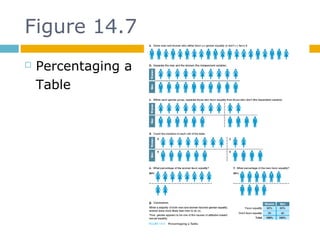
Figure 14.7
 Percentaging a
Table
 Constructing and Reading Bivariate Tables
 Example: Gender and Attitude toward
Sexual Equality
1. The cases are divided into men and women.
2. Each gender subgrouping is described in
terms of approval or disapproval of sexual
equality.
3. Men and women are compared in terms of the
percentages approving of sexual equality.
 Contingency Table – A format for
presenting the relationship among
variables as percentage distributions.
 Guidelines for Presentation of Tables
1. A table should have a heading or title that
describes what is contained in the table.
2. Original content should be clearly
presented.
3. The attributes of each variable should be
clearly indicated.
4. The base on which percentage are
computed should be indicated.
5. Missing data should be indicated in the
table.
Introduction to Multivariate
Analysis
 Multivariate Analysis – The analysis of
the simultaneous relationships among
several variables.
Quick Quiz
1. To conduct a quantitative analysis,
researchers often must engage in a _____
after the data have been collected.
A. coding process
B. case-oriented analysis
C. experimental analysis
D. field research study
Answer: A.
To conduct a quantitative analysis,
researchers often must engage in a
coding process after the data have been
collected.
2. Which of the following describe the
analysis of more than two variables?
A. experimental designs
B. quasi-experimental designs
C. qualitative evaluations
D. multivariate analysis
Answer: D.
Multivariate analyses describe the analysis
of more than two variables.
3. The process of converting data to
numerical format is called _____.
A. feminist research
B. qualification
C. quantification
ANSWER: C.
The process of converting data to
numerical format is called quantification.
4. Which of the following are basic
approaches to the coding process?
A. You can begin with a well developed
coding scheme.
B. You can generate codes from your data.
C. both of the above
D. none of the above
ANSWER: C.
The following are basic approaches to the
coding process: you can begin with a well
developing coding scheme and/or you can
generate codes from your data.
5. A _____ is a document that describes
the locations of variables and lists the
assignments of codes to the attributes
composing those variables.
A. cross-case analysis
B. codebook
C. constant comparative method
D. monitoring study
ANSWER: B.
A codebook is a document that describes
the locations of variables and lists the
assignments of codes to the attributes
composing those variables.
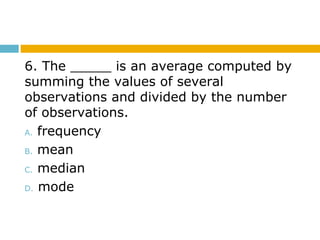
6. The _____ is an average computed by
summing the values of several
observations and divided by the number
of observations.
A. frequency
B. mean
C. median
D. mode
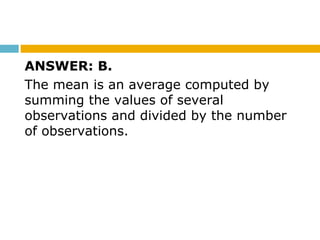
ANSWER: B.
The mean is an average computed by
summing the values of several
observations and divided by the number
of observations.
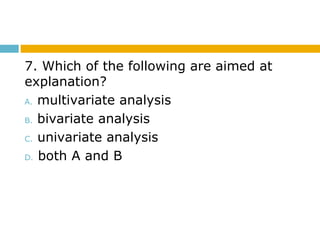
7. Which of the following are aimed at
explanation?
A. multivariate analysis
B. bivariate analysis
C. univariate analysis
D. both A and B
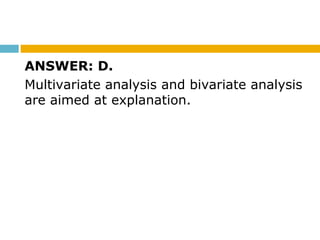
ANSWER: D.
Multivariate analysis and bivariate analysis
are aimed at explanation.
8. The multivariate techniques can serve
as power tools for
A. predicting behavior.
B. diagnosing social problems.
C. reacting to issues.
D. all of the above
ANSWER: B.
The multivariate techniques can serve as
powerful tools for diagnosing social
problems.

Quantitative data 2

  • 1.
  • 2.
    Chapter Outline  Quantificationof Data  Univariate Analysis  Subgroup Comparisons  Bivariate Analysis  Introduction to Multivariate Analysis  Sociological Diagnostics  Ethics and Quantitative Data Analysis  Quick Quiz
  • 3.
    Quantification of Data Quantification Analysis – The numerical representation and manipulation of observations for the purpose of describing and explaining the phenomena that those observations reflect.
  • 4.
     Age  1= 1  2 = 2  3 = 3  4 = 4  5 = 5  Sex  Male = 1  Female = 2  Political Affiliation  Democrat = 1  Republican = 2  Independent = 3  Region of Country  West = 1  Midwest = 2  South = 3  Northeast = 4
  • 5.
     Develop CodeCategories 1. Use well-developed coding scheme. 2. Generate codes from your data.
  • 6.
     Codebook Construction Codebook – The document used in data processing and analysis that tells the location of different data items in a data file.
  • 7.
     The codebookalso identifies the locations of data items and the meaning of the codes used.  Purposes of the Codebook 1. Primary guide in the coking processes 2. Guide for locating variables
  • 8.
  • 9.
    ATTEND How often doyou attend religious services? 0. Never 1. Less than once a year 2. About once or twice a year 3. Several times a year 4. About once a month 5. 2-3 times a month 6. Nearly every week 7. Every week 8. Several times a week 9. Don’t know, No answer Abbreviated Variable Name NumericalLabel Definition of the Variable Variable Attributes
  • 10.
     Data Entry Excel  SPSS
  • 11.
    Univariate Analysis  UnivariateAnalysis – The analysis of a single variable, for purposes of description (examples: frequency distribution, averages, and measures of dispersion).  Example: Gender  The number of men in a sample/population and the number of women in a sample/population.
  • 12.
     Distributions  FrequencyDistributions – A description of the number of times the various attributes of a variable are observed in a sample.
  • 13.
  • 14.
  • 15.
     Central Tendency Average – An ambiguous term generally suggesting typical or normal – a central tendency (examples: mean, median, mode).
  • 16.
     Mean –an average computed by summing the values of several observations and dividing by the number of observations.  Mode- an average representing the most frequently observed value or attribute.  Median – an average representing the value of the “middle” case in a rank-ordered set of observations.
  • 17.
     Practice: Thefollowing list represents the scores on a mid-term exam.  100, 94, 88, 91, 75, 61, 93, 82, 70, 88, 71, 88  Determine the mean.  Determine the mode.  Determine the median.
  • 18.
  • 19.
     Dispersion –The distribution of values around some central value, such as an average.  Standard Deviation – A measure of dispersion around the mean, calculated so that approximately 68 percent of the cases will lie within plus or minus one standard deviation from the mean, 95 percent within two, and 99.9 percent within three standard deviations.
  • 20.
  • 21.
     Continuous Variable– A variable whose attributes form a steady progression, such as age of income.  Discrete Variable – A variable whose attributes are separate from one another, such as gender or political affiliation.
  • 22.
     Detail versusManageability  Provide reader with fullest degree of detail, balanced with presenting data in a manageable form.
  • 23.
    Subgroup Comparisons  Descriptionof subsets of cases, subjects or respondents.  “Collapsing” Response Categories  Handling “Don’t Knows”  Numerical Descriptions in Qualitative Research
  • 24.
    Bivariate Analysis  BivariateAnalysis – The analysis of two variables simultaneously, for the purpose of determine the empirical relationship between them.
  • 25.
     Constructing aBivariate Table 1. Determine logical direction of relationship (independent variable and dependent variable). 2. Percentage down versus percentage across.
  • 26.
  • 27.
     Constructing andReading Bivariate Tables  Example: Gender and Attitude toward Sexual Equality 1. The cases are divided into men and women. 2. Each gender subgrouping is described in terms of approval or disapproval of sexual equality. 3. Men and women are compared in terms of the percentages approving of sexual equality.
  • 28.
     Contingency Table– A format for presenting the relationship among variables as percentage distributions.
  • 29.
     Guidelines forPresentation of Tables 1. A table should have a heading or title that describes what is contained in the table. 2. Original content should be clearly presented. 3. The attributes of each variable should be clearly indicated. 4. The base on which percentage are computed should be indicated. 5. Missing data should be indicated in the table.
  • 30.
    Introduction to Multivariate Analysis Multivariate Analysis – The analysis of the simultaneous relationships among several variables.
  • 31.
  • 32.
    1. To conducta quantitative analysis, researchers often must engage in a _____ after the data have been collected. A. coding process B. case-oriented analysis C. experimental analysis D. field research study
  • 33.
    Answer: A. To conducta quantitative analysis, researchers often must engage in a coding process after the data have been collected.
  • 34.
    2. Which ofthe following describe the analysis of more than two variables? A. experimental designs B. quasi-experimental designs C. qualitative evaluations D. multivariate analysis
  • 35.
    Answer: D. Multivariate analysesdescribe the analysis of more than two variables.
  • 36.
    3. The processof converting data to numerical format is called _____. A. feminist research B. qualification C. quantification
  • 37.
    ANSWER: C. The processof converting data to numerical format is called quantification.
  • 38.
    4. Which ofthe following are basic approaches to the coding process? A. You can begin with a well developed coding scheme. B. You can generate codes from your data. C. both of the above D. none of the above
  • 39.
    ANSWER: C. The followingare basic approaches to the coding process: you can begin with a well developing coding scheme and/or you can generate codes from your data.
  • 40.
    5. A _____is a document that describes the locations of variables and lists the assignments of codes to the attributes composing those variables. A. cross-case analysis B. codebook C. constant comparative method D. monitoring study
  • 41.
    ANSWER: B. A codebookis a document that describes the locations of variables and lists the assignments of codes to the attributes composing those variables.
  • 42.
    6. The _____is an average computed by summing the values of several observations and divided by the number of observations. A. frequency B. mean C. median D. mode
  • 43.
    ANSWER: B. The meanis an average computed by summing the values of several observations and divided by the number of observations.
  • 44.
    7. Which ofthe following are aimed at explanation? A. multivariate analysis B. bivariate analysis C. univariate analysis D. both A and B
  • 45.
    ANSWER: D. Multivariate analysisand bivariate analysis are aimed at explanation.
  • 46.
    8. The multivariatetechniques can serve as power tools for A. predicting behavior. B. diagnosing social problems. C. reacting to issues. D. all of the above
  • 47.
    ANSWER: B. The multivariatetechniques can serve as powerful tools for diagnosing social problems.