International Journal of Instruction July 2011 ● Vol.4, No.2
e-ISSN: 1308-1470 ● www.e-iji.net p-ISSN: 1694-609X
DIFFICULTIES IN TEACHING AND LEARNING GRAMMAR IN
AN EFL CONTEXT1
Abdu Mohammed Al-Mekhlafi
PhD., College of Education, Sultan Qaboos University, Oman
rayan3@gmail.com
Ramani Perur Nagaratnam
PhD., Ministry of Manpower, Oman
The role of grammar instruction in an ESL/EFL context has been for decades a
major issue for students and teachers alike. Researchers have debated whether
grammar should be taught in the classroom and students, for their part, have
generally looked upon grammar instruction as a necessary evil at best, and an
avoidable burden at worst. The paper reports a study undertaken to investigate
the difficulties teachers face in teaching grammar to EFL students as well as those
faced by students in learning it, in the teachers' perception. The study aimed to
find out whether there are significant differences in teachers' perceptions of
difficulties in relation to their gender, qualification, teaching experience, and the
level they teach in school, thus providing insights into their own and their
students' difficulties. Mean scores and t-test were used to interpret the data. The
main findings are reported with implications.
Key Words: English language teaching, instruction, EFL grammar instruction, teaching,
difficulties in grammar instruction
INTRODUCTION
The English teacher is often portrayed as an "unattractive grammar monger
whose only pleasure in life is to point out the faults of others" (Baron, 1982, p.
226). For the most part, within the classroom, any mention of grammar causes
the student moments of discomfort and sometimes even terror. Many teachers
have tried to make grammar teaching a non-threatening, imaginative and useful
activity within the English curriculum.
1
A summary of this paper was presented at the 54th
World Assembly of the International
Council on Education for Teaching (ICET) on ‘Maintaining Strategic Agility: Managing change
and assuring quality in education for teaching’, 14-17 December 2009, Muscat, Oman.
70 Difficulties in Teaching and Learning Grammar…
International Journal of Instruction, July 2011 ● Vol.4, No.2
Previous studies on students' and teachers' attitudes and perceptions of grammar
instruction in the context of language teaching and learning suggest a disparity
between students and teachers. While students favour formal and explicit
grammar instruction and error correction, teachers favour communicative
activities with less conscious focus on grammar (e.g., Brindley 1984;
Kumaravadivelu 1991; Leki 1995; Schultz 1996, 2001; Spratt 1999).
Rationale for the present study
The foregoing review of literature shows that practicing teachers are faced with
a range of options for grammar instruction in their classrooms. There are,
however, many types of difficulties faced by students and teachers with regard
to grammar instruction in an ESL/EFL context. Identifying such difficulties and
being consciously aware of them would help teachers find ways of overcoming
them and provide effective grammar instruction.
There has, however, been little investigation of the difficulties faced by EFL
teachers and Aran learners in the Gulf region with regard to grammar
instruction. The teachers employ theoretically recommended methods without
necessarily taking into account their own and their learners’ potential
difficulties. They may not be conscious of difficulties which are serious and
may thus hinder students’ learning of English grammar, and do not choose the
method of instruction that would pose fewer difficulties and problems to their
learners.
It is in this context that the present study was undertaken to capture valuable
insights into how EFL school teachers in Oman perceive students’ as well as
their own difficulties with grammar instruction. The study reported here aims
to address this need by presenting the difficulties of a cross section of school
EFL teachers in Oman as well as their perceptions of their students' difficulties
in this regard. It also aims to add to the knowledge base in this area.
REVIEW OF LITERATURE
Attitudes towards grammar instruction
In teaching grammar, three areas have to be considered: grammar as rules,
grammar as form, and grammar as resource. For many L2 learners, learning
grammar often means learning the rules of grammar and having an intellectual
knowledge of grammar. Teachers often believe that this will provide the
generative basis on which learners can build their knowledge and will be able to
use the language eventually. For them, prescribed rules give a kind of security.
Al-Mekhlafi & Nagaratnam 71
International Journal of Instruction, July 2011 ● Vol.4, No.2
A better approach is perhaps to see grammar as one of many resources that we
have in language which helps us to communicate. We should see how grammar
relates to what we want to say or write, and how we expect others to interpret
what our language use and its focus.
According to Widdowson (1990: 86), " . . . grammar is not a constraining
imposition but a liberating force: it frees us from a dependency on context and a
purely lexical categorization of reality." Given that many learners – and
teachers – tend to view grammar as a set of restrictions on what is allowed and
disallowed in language use – ‘a linguistic straitjacket’ in Larsen-Freeman’s
words (2002: 103) – the conception of grammar as something that liberates
rather than represses is one that is worth investigating.
According to Morelli (2003), students perceived themselves as having a better
attitude towards grammar instruction in context, while performing slightly
better after having experienced the traditional grammar instruction. Elkilic and
Akca (2008) reported generally positive attitudes of students studying English
grammar at a private primary EFL classroom towards studying grammar. In
particular, however, a little over 50% of their subjects claimed to enjoy
grammar very much and only about 10% reported finding some difficulty in
learning and remembering grammar.
Student expectations
Student expectations of traditional, explicit grammar teaching have been
confirmed by many teachers (cf. Borg, 1999a, b). Burgess and Etherington
(2002:440-441) also conclude that teachers believe that explicit teaching of
grammar is favoured by their students because of expectations and feelings of
insecurity.
Since the 1970s, attention has shifted from ways of teaching grammar to ways
of getting learners to communicate, but grammar has been seen to be a powerful
undermining and demotivating force among L2 learners. In terms of motivation
and learner success with languages, grammar has been seen to be a problem and
to stand in the way of helping learners to communicate fluently. The hard fact
that most teachers face is that learners often find it difficult to make flexible use
of the rules of grammar taught in the classroom. They may know the rules
perfectly, but are incapable of applying them in their own use of the language.
Teachers' recognition of this process (i.e., of transferring declarative knowledge
about grammar into procedural knowledge) as a problem for many of their
students has been reported by Burgess and Etherington (2002:442). Haudeck
72 Difficulties in Teaching and Learning Grammar…
International Journal of Instruction, July 2011 ● Vol.4, No.2
has reported that many learners have difficulty in internalising grammar rules,
although these have been taught intensively (1996, cited in European
Commission, 2006).
The use of grammatical terminology
Metalinguistic discussion (i.e., the use of grammatical terminology to talk about
language) is seen by Stern (1992:327) as one of the characteristics of explicit
grammar teaching. According to Burgess and Etherington (2002: 444), teachers
believe that their students see grammatical terminology as useful and that its use
does not present a particular difficulty for students.
Descriptive grammars acknowledge the fact that language is dynamic and its
use is constantly changing, although not in major ways. The problem for
ESL/EFL learners, however, is that there is a time-lag between the awareness of
such changes and their acceptance as the proper use of the language.
As Morelli (2003:33-34) has observed, “Grammar can be taught traditionally or
contextually, but student perception should be considered by teachers in the
decision-making process. Students need to feel confident that educators have
met their needs . . . and educators should be willing to consider the attitudes and
perceptions of students when making decisions about how to teach grammar.”
METHOD
Purpose
The study reported here aims to investigate the difficulties of a cross section of
school EFL teachers in Oman as well as their perceptions of their students'
difficulties with regard to grammar instruction.
Research questions
The study aimed to answer the following questions:
1. What are EFL teachers’ perceptions of the difficulties of students and
teachers with regard to grammar instruction in an EFL context?
2. Are there any differences in teachers' perceptions between the difficulties
faced by teachers and those faced by students?
3. Do these perceptions of difficulties vary according to the teachers’:
• Gender,
• Level taught,
• Qualifications, and
• Experience?
Al-Mekhlafi & Nagaratnam 73
International Journal of Instruction, July 2011 ● Vol.4, No.2
4. Are there any significant differences in teachers' perceptions due to the type
of difficulty?
Limitation of the study
The present study is limited to:
• EFL teachers teaching English in Omani Basic Education schools, and
• The use of questionnaire as the research instrument.
Nevertheless, the responses are valuable in themselves, indicating the general
difficulties that students and teachers face with regard to grammar instruction in
an EFL context.
Research design
The study was mainly quantitative in design, using a questionnaire and the
subjects responded to each statement on a five-point Likert-type attitude scale
(from 5 for 'strongly agree' to 1 for 'strongly disagree'). The respondents also
provided background information on gender, qualification, teaching experience
and the level they teach, for creating their profile in terms of variables. The data
was analyzed (t-test and ANOVA) using the SPSS.
The research instrument
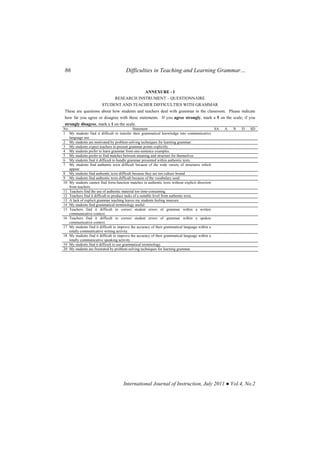
The questionnaire used in the present study, which comprises 20 statements,
was the one employed by Burgess and Etherington in their study (2002: 451-
452) (See ANNEXURE – I for the questionnaire used in the present study).
Subjects
Only one broad geographical context was chosen for the study, namely Oman,
in order to be context-specific and be able to make a close connection between
teachers, their assumptions and their practical experience. It is believed that the
subjects fairly represented the context of EFL teaching at different levels in
Omani schools. Besides, the sample size was 90, more than the minimum
number required for making useful statistical analyses according to Cohen and
Manion (1994:77). The profile of the subjects in terms of the four variables is
given below in Table 1:
74 Difficulties in Teaching and Learning Grammar…
International Journal of Instruction, July 2011 ● Vol.4, No.2
Table 1. Profile of Respondents to the Study Instrument
Variable
Categories within the
variable
No. of respondents
in each category
Total
(N)
Male 39
Gender
Female 51
90
Grades 1-4 17
Grades 5-10 31Level they teach
Grades 11-12 42
90
Master’s Degree 8
Bachelor’s Degree 76Qualification
Diploma 6
90
≤ 5 years 27
> 5 ≤ 10 years 41Experience
> 10 years 22
90
RESULTS AND DISCUSSION
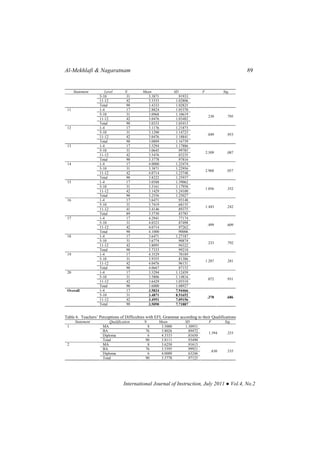
With regard to the first research question whether there are difficulties faced by
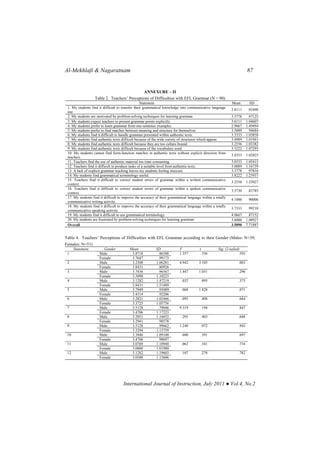
students and teachers with grammar instruction, Table 2 (ANNEXURE – II)
shows an overall mean of 3.51 on a five-point scale, the means for individual
statements ranging from 2.97 to 4.10, thus indicating teachers' general
agreement with most of the statements in the survey questionnaire (See Fig. 1
below). This suggests that, in the perceptions of teachers, there are difficulties
faced by teachers as well as students with regard to grammar instruction in an
EFL context.
Fig. 1. Teachers’ Perceptions of Difficulties with EFL Grammar
Al-Mekhlafi & Nagaratnam 75
International Journal of Instruction, July 2011 ● Vol.4, No.2
With regard to the second research question about the differences between
students and teachers in the difficulties faced, Table 3 shows that there is a
statistically significant difference at the level of
p < 0.001 in the perceptions of teachers and students, with students
experiencing difficulties to a greater extent than teachers, which is
understandable. The overall mean for students' difficulties as perceived by the
teachers was 3.58, while the overall mean for teachers' difficulties was 3.23
(Table 3 below).
Table 3. Teachers’ Perceptions of Teachers’ and Students’ Difficulties with
EFL Grammar (N = 90)
Statement Mean SD t Sig.(2-tailed)
Teachers’ Difficulties 3.2331 .58484
Students’ Difficulties as perceived by
the Teachers
3.5779 .42214
5.225 .000
The third research question is about the differences in perception of difficulties
in terms of the four teacher variables: gender, level taught, qualification, and
teaching experience.
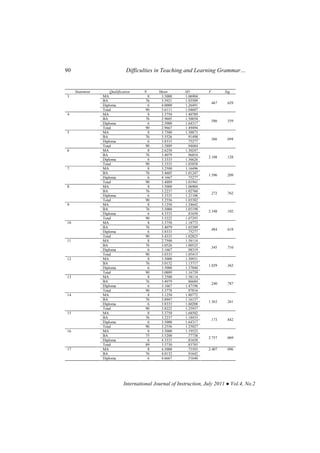
With regard to gender, a comparison of the overall mean response for male
(3.508) and female teachers (3.510) (See Fig. 2 below) shows that they are quite
nearly the same and that there is no statistically significant difference at the
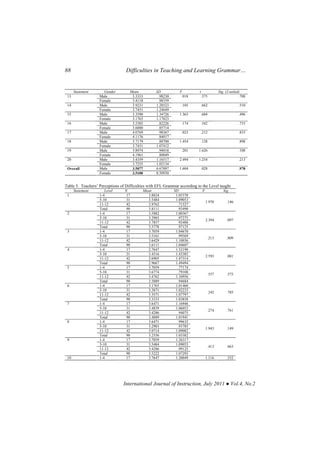
level of 0.05 in their perceptions about the difficulties (Sig.: .978) (Table 4 in
ANNEXURE – II)). This suggests that gender does not play a significant role
in the teachers' perceptions when it comes to articulating their own difficulties
as well as those of their students with English grammar instruction.
Fig. 2. Teachers’ Perceptions of Difficulties with EFL Grammar according to
Gender
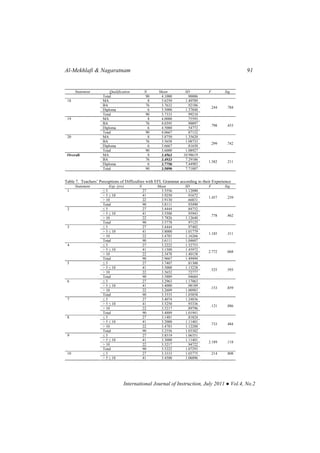
With regard to the level taught, Table 5 (ANNEXURE – II) shows that teachers
teaching at different levels have similar perceptions about their own and their
76 Difficulties in Teaching and Learning Grammar…
International Journal of Instruction, July 2011 ● Vol.4, No.2
students' difficulties with English grammar instruction, with a slightly higher
mean for teachers of Grades 1-4 (3.58) than the means for teachers of the other
two levels, which are nearly the same (3.49 and 3.5) (See Fig. 3 below). Table 5
also shows that there is no statistically significant difference at the level of 0.05
in terms of this variable (Sig.: .686).
Fig. 3. Teachers’ Perceptions of Difficulties with EFL Grammar according to
Level Taught
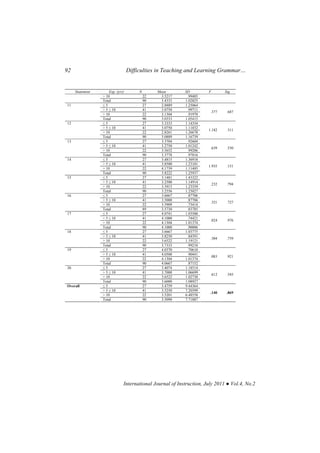
With regard to teachers’ qualifications, Table 6 (ANNEXURE – II) shows a
slightly higher overall mean for teachers with a diploma qualification (3.78)
than the overall means for teachers with higher qualifications, viz. bachelor's
(3.46) or master's degree (3.49) (See Fig. 4 below). The results also show that
there is no statistically significant difference at the level of 0.05 in terms of this
variable (Sig.: .211 – Table 6).
Fig. 4. Teachers’ Perceptions of Difficulties with EFL Grammar according to
Qualifications
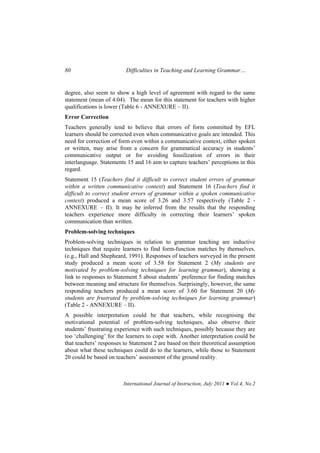
With regard to teachers' experience, it does not seem to be a significant variable
with regard to their perceptions of their own and their students' difficulties with
English grammar instruction, as Table 7 (ANNEXURE – II) shows (See Fig. 5
below). The results also show that there is no statistically significant difference
at the level of 0.05 in terms of this variable (Sig.: .869 – Table 7).
Al-Mekhlafi & Nagaratnam 77
International Journal of Instruction, July 2011 ● Vol.4, No.2
Fig. 5. Teachers’ Perceptions of Difficulties with EFL Grammar according to
Experience
The foregoing discussion is based on the overall mean score obtained for the
difficulties in general and for each of the four teacher variables considered in
the present study. With regard to the fourth research question, a detailed
analysis of the results provides interesting and valuable insights into teachers’
perceptions of different types of difficulties for students and teachers
themselves and their concerns about classroom application of grammar teaching
principles. The results are discussed with respect to difficulties categorized in
terms of the themes listed in Table 8 below:
Table 8. Statements in the Questionnaire Categorised according to Themes
Theme Statement(s)
Explicit grammar teaching 3, 4, 5, 13
The transfer of declarative knowledge into procedural
knowledge
1, 17, 18
The use of grammatical terminology 14, 19
Error correction 15, 16
Problem-solving activities 2, 20
The use of authentic texts for grammar instruction 6, 7, 8, 9, 10, 11, 12
The use of spoken and written communicative activities 17, 18
Explicit grammar teaching
The dichotomies of unconscious/conscious learning and inductive/deductive
teaching methods are both sometimes equated with the dichotomy between
implicit and explicit instruction. Attitudes to inductive and deductive methods
were investigated through statements concerning explicit presentation of
grammar by teachers, students finding form-function matches for themselves,
and the constraints in using either of the two methods.
78 Difficulties in Teaching and Learning Grammar…
International Journal of Instruction, July 2011 ● Vol.4, No.2
Statement 3 (My students expect teachers to present grammar explicitly) and
Statement 13 (A lack of explicit grammar teaching leaves my students feeling
insecure) produced a mean score of 3.61 and 3.38 respectively (Table 2 -
ANNEXURE – II), supporting the view that students, in teachers’ perception,
prefer explicit grammar teaching. This is not surprising, as students are known
to expect traditional, explicit grammar instruction (e.g., Borg, 1999a, b). The
responses in the present study indicate that this expectation of students still
remains, especially at the school level.
Responses to Statement 5 (My students prefer to find matches between meaning
and structure for themselves), however, produced a mean score of 3.59 (Table 2
- ANNEXURE – II), which is very close to the mean score for students’
expectation about explicit teaching of grammar. This perception of students’
preference for an inductive method of learning grammar on the part of the same
responding teachers is surprising. With regard to the same statement, the
difference in mean between males and females seems to be higher than for the
other statements (Table 4 - ANNEXURE – II). A follow-up interview with
teachers might have provided more specific information and thrown light on
their understanding of explicit and implicit methods of teaching grammar.
With regard to Statement 4 (My students prefer to learn grammar from one-
sentence examples), which links to explicit grammar teaching, responding
teachers produced the lowest mean score (2.97) of all statements in the
questionnaire (Table 2 - ANNEXURE – II). In terms of experience, however,
there seems to be some significant difference at the level of 0.05 in favour of
teachers with more than 10 years of experience (Table 7 - ANNEXURE – II).
Declarative vs procedural knowledge
Statement 1 (My students find it difficult to transfer their grammatical
knowledge into communicative language use), designed to identify teachers’
beliefs about the possible transfer of declarative knowledge (i.e., knowledge
about grammar) into procedural knowledge (i.e., ability to use that knowledge
in actual communication), produced a mean score of 3.81 (Table 2 -
ANNEXURE – II). This indicates that responding teachers recognise this
process of transfer of one kind of knowledge into another as a problem for a
large number of their students.
This gap between students’ grammatical knowledge and communicative ability
is not surprising to teachers, who often find that most of their students can recall
grammatical rules accurately and perform very well on discrete-point grammar
Al-Mekhlafi & Nagaratnam 79
International Journal of Instruction, July 2011 ● Vol.4, No.2
exercises, but fail to achieve such grammatical accuracy in actual
communication.
This fact is corroborated by the responses to Statements 17 and 18 (My students
find it difficult to improve the accuracy of their grammatical knowledge within
a totally communicative writing/speaking activity), which produced a mean
score of 4.10 and 3.73 respectively (Table 2 - ANNEXURE – II).
In terms of teacher qualifications, teachers with a diploma agree strongly (mean
of 4.33) that their students find it difficult to transfer their grammatical
knowledge into communicative language use. The mean for this statement for
teachers with higher qualifications is lower (Table 6 - ANNEXURE – II).
The use of grammatical terminology
The use of grammatical terminology in the EFL classroom is seen as a
necessary part of the explicit method of teaching grammar. When students and
teachers talk about grammar (i.e., in meta-linguistic discussion), which is one of
the characteristics of explicit language teaching (Stern 1992: 327), they need to
use grammatical terms.
Two statements (14 & 19) sought to explore teachers’ perceptions of how their
students feel about the use of grammatical terminology. Statement 14 (My
students find grammatical terminology useful) and Statement 19 (My students
find it difficult to use grammatical terminology) produced a mean score of 3.82
and 4.07 respectively (Table 2 - ANNEXURE – II). This indicates that, in the
responding teachers’ perception, their students see grammatical terminology as
useful, but find difficulty in using the terms to be of a greater magnitude.
Interestingly, the usefulness of grammatical terminology seems to be linked to
the students’ preference for explicit grammar instruction.
The difference in mean between teachers of Grades 1-4 and 11-12 on the one
hand (mean of ≥ 4) and those of Grades 5-10 (mean of 3.4), however, seems to
be higher with regard to their perceptions of the usefulness of grammatical
terminology to their students. That is, teachers of the lowest and highest levels
think that their students find grammatical terminology more useful than those of
the middle grades. There is a significant difference at the level of 0.05 in terms
of the level taught with regard to the usefulness of grammatical terminology
(statement 14) (Table 5 - ANNEXURE – II).
In terms of teacher qualifications, teachers with a diploma agree very strongly
(mean of 4.50) that their students find it difficult to use grammatical
terminology and the majority of teachers surveyed, who have a bachelor's
80 Difficulties in Teaching and Learning Grammar…
International Journal of Instruction, July 2011 ● Vol.4, No.2
degree, also seem to show a high level of agreement with regard to the same
statement (mean of 4.04). The mean for this statement for teachers with higher
qualifications is lower (Table 6 - ANNEXURE – II).
Error Correction
Teachers generally tend to believe that errors of form committed by EFL
learners should be corrected even when communicative goals are intended. This
need for correction of form even within a communicative context, either spoken
or written, may arise from a concern for grammatical accuracy in students’
communicative output or for avoiding fossilization of errors in their
interlanguage. Statements 15 and 16 aim to capture teachers’ perceptions in this
regard.
Statement 15 (Teachers find it difficult to correct student errors of grammar
within a written communicative context) and Statement 16 (Teachers find it
difficult to correct student errors of grammar within a spoken communicative
context) produced a mean score of 3.26 and 3.57 respectively (Table 2 -
ANNEXURE – II). It may be inferred from the results that the responding
teachers experience more difficulty in correcting their learners’ spoken
communication than written.
Problem-solving techniques
Problem-solving techniques in relation to grammar teaching are inductive
techniques that require learners to find form-function matches by themselves.
(e.g., Hall and Shepheard, 1991). Responses of teachers surveyed in the present
study produced a mean score of 3.58 for Statement 2 (My students are
motivated by problem-solving techniques for learning grammar), showing a
link to responses to Statement 5 about students’ preference for finding matches
between meaning and structure for themselves. Surprisingly, however, the same
responding teachers produced a mean score of 3.60 for Statement 20 (My
students are frustrated by problem-solving techniques for learning grammar)
(Table 2 - ANNEXURE – II).
A possible interpretation could be that teachers, while recognising the
motivational potential of problem-solving techniques, also observe their
students’ frustrating experience with such techniques, possibly because they are
too ‘challenging’ for the learners to cope with. Another interpretation could be
that teachers’ responses to Statement 2 are based on their theoretical assumption
about what these techniques could do to the learners, while those to Statement
20 could be based on teachers’ assessment of the ground reality.
Al-Mekhlafi & Nagaratnam 81
International Journal of Instruction, July 2011 ● Vol.4, No.2
With regard to the statement about students being motivated by problem-
solving techniques for learning grammar (Statement 2), there is also a
significant difference at the level of 0.05 between males and females in their
perceptions (Table 4 - ANNEXURE – II).
The use of authentic texts for grammar instruction
Authentic texts are texts that are not produced artificially for the purpose of
language teaching, but are used for genuine purposes in the real world, like
newspaper articles and recipes. By implication, these texts are contextualised
and communicatively complete in themselves. They focus is on conveying real
meaning rather than on form. Decontextualised examples of language, on the
other hand, are one-sentence examples usually found in EFL textbooks and
grammar practice books. They illustrate grammatical forms and structures in
context-free sentences and are generally associated with the explicit method of
teaching grammar.
The use of texts illustrating authentic communication for presenting grammar is
generally seen as posing problems to teachers and students alike. Students’
problems with their use arise from difficulties of variety of structures
(Statement 7), culture (Statement 8), vocabulary (Statement 9), and implicit
form-function matches (Statement 10), besides an overall difficulty in handling
grammar presented within authentic texts (Statement 6). Teachers’ difficulties
with authentic texts include those arising from the amount of time needed for
using them (Statement 11) and producing suitable tasks from such texts
(Statement 12).
According to the responding teachers’ perceptions, students experience greater
difficulties from vocabulary (Mean=3.52), variety of structures (Mean=3.49)
and finding form-function matches (Mean=3.43) than from handling from
presented within authentic texts (Mean=3.33) and culture (Mean=3.26).
Statements 11 and 12 relating to teachers’ difficulties in using authentic texts
produced a mean score of 3.03 and 3.09 respectively (Table 2 - ANNEXURE –
II), which indicates a lower perception of teachers of their own difficulties than
those of students.
The use of spoken and written communicative activities
Statements 17 and 18 refer to the possible difficulties students might have in
improving the accuracy of their grammatical language within totally
communicative activities. Responding teachers produced a mean score of 4.10
and 3.73 for the two statements respectively. In fact, the highest mean score of
82 Difficulties in Teaching and Learning Grammar…
International Journal of Instruction, July 2011 ● Vol.4, No.2
all scores for the survey questionnaire (4.10) was obtained for Statement 17 (My
students find it difficult to improve the accuracy of their grammatical
knowledge within a totally communicative writing activity) (Table 2 -
ANNEXURE – II).
The results indicate that, in teachers' perceptions, totally communicative
activities, whether written or spoken, pose great difficulties to students for
learning grammar and improving grammatical accuracy, writing activities
proving more challenging than spoken ones. It might be inferred that the
teachers surveyed might have a serious concern about the lack of sufficient
focus on form in purely communicative activities or tasks for developing
students' grammatical knowledge. Practising language as communication in
real-life tasks might not give sufficient opportunities for students to improve
their grammatical knowledge.
In terms of teacher qualifications, teachers with a diploma agree very strongly
(mean of 4.67) that their students find it difficult to improve the accuracy of
their grammatical language within a totally communicative writing activity and
the majority of teachers surveyed, who have a bachelor's degree, also seem to
show a high level of agreement with regard to the same statement (mean of
4.01). The mean for this statement for teachers with higher qualifications is
lower (Table 6 - ANNEXURE – II).
CONCLUSION
Generally speaking, in teachers’ perceptions, both teachers and students
invariably face serious difficulties with regard to EFL grammar instruction,
students facing them to a greater extent than teachers. It is obvious that EFL
teachers consider these difficulties quite serious, which suggests that serious
attention needs to be paid to them.
There may be generally recommended ways of teaching EFL grammar (for
example, the implicit method), but it would not be proper to adopt them
universally without looking at the possible difficulties that might go with those
methods suggested. While a less favoured method might pose fewer problems
and hence be more effective, a more favoured method might be less effective
owing to greater difficulties or problems in implementing it. The difficulties
may also be influenced by the context in which a particular method is used.
It is, therefore, necessary to make a detailed study of such difficulties faced by
teachers and students in specific contexts, take appropriate steps to overcome
them, and adapt the method to suit the actual teaching and learning
Al-Mekhlafi & Nagaratnam 83
International Journal of Instruction, July 2011 ● Vol.4, No.2
environment. This is not to suggest ‘diluting’ a sound approach or method, but
only to plan mediating or supplementary tasks to help learners tide over the
difficulties.
IMPLICATIONS
The findings of the present study point to the following implications:
1. EFL Curriculum and material developers should show an understanding of
learners’ and teachers’ difficulties, and provide sufficient guidance and
help in the curriculum document and the teachers’ book showing how the
potential difficulties could be addressed in planning their classroom
activities. Teachers may be given examples of mediating tasks, which
would mitigate the difficulties.
2. As Morelli (2003: 33-34) has pointed out, students need to be taught
grammar through various methodologies and approaches to cater to their
individual styles of learning, and educators should consider students’
attitudes and perceptions when making decisions about how to teach
grammar.
3. EFL teachers would do well to understand and address their learners’
concerns in planning their lessons and classroom activities, and use
supplementary materials, if necessary, to help learners cope with the
difficulties.
4. Both in-service and pre-service training programmes should be planned in
such a way that student-teachers and practising teachers articulate the
potential and actual difficulties and discuss ways of overcoming or at least
coping with them.
The database relating to teaching English as a foreign language, including the
difficulties of learners and teachers with regard to grammar instruction, should
be enriched by more detailed research and analysis, which would enable
generalizations across the gulf countries.
84 Difficulties in Teaching and Learning Grammar…
International Journal of Instruction, July 2011 ● Vol.4, No.2
REFERENCES
Baron, D. (1982). Grammar and good taste: Reforming the American language.
New Haven, NJ: Yale University Press.
Borg, S. (1999a). The use of grammatical terminology in the second language
classroom: a qualitative study of teachers’ practices and cognitions. Applied
Linguistics, 20 (1): 95-126. (cited in Burgess and Etherington, 2002)
Borg, S. (1999b). Teachers’ theories in grammar teaching. ELT Journal, 53 (3):
157-167. (cited in Burgess and Etherington, 2002).
Brindley, G. (1984). Needs Analysis and Objective Setting in the Adult Migrant
Education Program. NSW Adult Migrant Education Service, Sydney.
Burgess, J. and Etherington, S. (2002). Focus on grammatical form: explicit or
implicit? System, 30: 433-458.
Cohen, L. and Manion, L. C. (1994). Research Methods in Education. London:
Routledge.
Elkilic, G. and Akca, C. (2008). Attitudes of the Students Studying at Kafkas
University Private Primary EFL Classroom towards Storytelling and
Motivation. Journal of Language and Linguistic Studies, 4(1): 1-22.
European Commission (2006). The Main Pedagogical Principles Underlying the
Teaching of Languages to Very Young Learners. Final Report of the EAC
89/04, Lot 1 Study: Edelenbos, P., Johnstone, R. and Kubanek, A.
Hall, N. and Shepheard, J. (1991). The Anti-Grammar Grammar Book. London:
Longman.
Kumaravadivelu, B. (1991). Language learning tasks: teacher intention and
learner interpretation. ELT Journal, 45 (2): 98-107.
Larsen-Freeman, D. (2002). The Grammar of Choice. In E. Hinkel and S. Fotos
(Eds.). New Perspectives on Grammar Teaching in Second Language
Classrooms. Mahwah, New Jersey: Lawrence Erlbaum Associates.
Leki, I. (1995). Good writing: I know it when I see it. In In D. Belcher and G.
Braine (eds.) Academic Writing in a Second Language. Norwood, NJ: Ablex
Publishing.
Al-Mekhlafi & Nagaratnam 85
International Journal of Instruction, July 2011 ● Vol.4, No.2
Morelli, J. A. (2003). Ninth Graders’ Attitudes toward Different Approaches to
Grammar Instruction. Unpublished Dissertation. The Graduate School of
Education, Fordham University, New York.
Schultz, R. (1996). Focus on form in the foreign language classroom: students’
and teachers’ views on error correction and the role of grammar. Foreign
Language Annals, 29(3): 343-364.
Schultz, R. (2001). Cultural differences in student and teacher perceptions
concerning the role of grammar instruction and corrective feedback. USA-
Colombia. The Modern Language Journal, 85(ii): 244-258.
Spratt, M. (1999). How good are we at knowing what learners like? System,
27:141-155.
Stern, H. H. (1992). Issues and Options in English Language Teaching. Oxford:
Oxford University Press.
Widdowson, H. G. (1990). Grammar and nonsense and learning. In H. G.
Widdowson, Aspects of language teaching, pp. 79-98. Oxford: Oxford
University Press.
86 Difficulties in Teaching and Learning Grammar…
International Journal of Instruction, July 2011 ● Vol.4, No.2
ANNEXURE - I
RESEARCH INSTRUMENT – QUESTIONNAIRE
STUDENT AND TEACHER DIFFICULTIES WITH GRAMMAR
These are questions about how students and teachers deal with grammar in the classroom. Please indicate
how far you agree or disagree with these statements. If you agree strongly, mark a 5 on the scale; if you
strongly disagree, mark a 1 on the scale.
No. Statement SA A N D SD
1 My students find it difficult to transfer their grammatical knowledge into communicative
language use.
2 My students are motivated by problem-solving techniques for learning grammar.
3 My students expect teachers to present grammar points explicitly.
4 My students prefer to learn grammar from one-sentence examples.
5 My students prefer to find matches between meaning and structure for themselves.
6 My students find it difficult to handle grammar presented within authentic texts.
7 My students find authentic texts difficult because of the wide variety of structures which
appear.
8 My students find authentic texts difficult because they are too culture bound.
9 My students find authentic texts difficult because of the vocabulary used.
10 My students cannot find form-function matches in authentic texts without explicit direction
from teachers.
11 Teachers find the use of authentic material too time-consuming.
12 Teachers find it difficult to produce tasks of a suitable level from authentic texts.
13 A lack of explicit grammar teaching leaves my students feeling insecure.
14 My students find grammatical terminology useful.
15 Teachers find it difficult to correct student errors of grammar within a written
communicative context.
16 Teachers find it difficult to correct student errors of grammar within a spoken
communicative context.
17 My students find it difficult to improve the accuracy of their grammatical language within a
totally communicative writing activity.
18 My students find it difficult to improve the accuracy of their grammatical language within a
totally communicative speaking activity.
19 My students find it difficult to use grammatical terminology.
20 My students are frustrated by problem-solving techniques for learning grammar.
Al-Mekhlafi & Nagaratnam 87
International Journal of Instruction, July 2011 ● Vol.4, No.2
ANNEXURE – II
Table 2. Teachers’ Perceptions of Difficulties with EFL Grammar (N = 90)
Statement Mean SD
1. My students find it difficult to transfer their grammatical knowledge into communicative language
use.
3.8111 .93490
2. My students are motivated by problem-solving techniques for learning grammar. 3.5778 .97125
3. My students expect teachers to present grammar points explicitly. 3.6111 1.04607
4. My students prefer to learn grammar from one-sentence examples. 2.9667 1.49494
5. My students prefer to find matches between meaning and structure for themselves. 3.5889 .94684
6. My students find it difficult to handle grammar presented within authentic texts. 3.3333 1.03858
7. My students find authentic texts difficult because of the wide variety of structures which appear. 3.4889 1.01941
8. My students find authentic texts difficult because they are too culture bound. 3.2556 1.03382
9. My students find authentic texts difficult because of the vocabulary used. 3.5222 1.07293
10. My students cannot find form-function matches in authentic texts without explicit direction from
teachers.
3.4333 1.02825
11. Teachers find the use of authentic material too time-consuming. 3.0333 1.05415
12. Teachers find it difficult to produce tasks of a suitable level from authentic texts. 3.0889 1.16739
13. A lack of explicit grammar teaching leaves my students feeling insecure. 3.3778 .97816
14. My students find grammatical terminology useful. 3.8222 1.25937
15. Teachers find it difficult to correct student errors of grammar within a written communicative
context.
3.2556 1.25027
16. Teachers find it difficult to correct student errors of grammar within a spoken communicative
context.
3.5730 .83785
17. My students find it difficult to improve the accuracy of their grammatical language within a totally
communicative writing activity.
4.1000 .90006
18. My students find it difficult to improve the accuracy of their grammatical language within a totally
communicative speaking activity.
3.7333 .99210
19. My students find it difficult to use grammatical terminology. 4.0667 .87152
20. My students are frustrated by problem-solving techniques for learning grammar. 3.6000 1.08927
Overall 3.5090 7.71887
Table 4. Teachers’ Perceptions of Difficulties with EFL Grammar according to their Gender (Males: N=39;
Females: N=51)
Statement Gender Mean SD F t Sig. (2-tailed)
Male 3.8718 .863881
Female 3.7647 .99173
1.357 .536 .593
Male 3.2308 1.062812
Female 3.8431 .80926
4.942 3.105 .003
Male 3.7436 .965673
Female 3.5098 1.10223
1.447 1.051 .296
Male 3.1282 1.472194
Female 2.8431 1.51489
.032 .895 .373
Male 3.7949 .950895
Female 3.4314 .92206
.068 1.828 .071
Male 3.2821 1.024666
Female 3.3725 1.05756
.095 .408 .684
Male 3.5128 .790467
Female 3.4706 1.17223
9.319 .194 .847
Male 3.2051 1.104528
Female 3.2941 .98578
.295 .403 .688
Male 3.5128 .996629
Female 3.5294 1.13759
1.240 .072 .943
Male 3.3846 1.0910010
Female 3.4706 .98697
.600 .391 .697
Male 3.0769 1.1094011
Female 3.0000 1.01980
.062 .341 .734
Male 3.1282 1.1960312
Female 3.0588 1.15606
.107 .278 .782
88 Difficulties in Teaching and Learning Grammar…
International Journal of Instruction, July 2011 ● Vol.4, No.2
Statement Gender Mean SD F t Sig. (2-tailed)
Male 3.3333 .9823013
Female 3.4118 .98339
.018 .375 .708
Male 3.9231 1.2852314
Female 3.7451 1.24649
.105 .662 .510
Male 3.3590 1.3472615
Female 3.1765 1.17823
1.363 .684 .496
Male 3.5385 .8222616
Female 3.6000 .85714
.174 .342 .733
Male 4.0769 .9836717
Female 4.1176 .84017
.023 .212 .833
Male 3.7179 .8870018
Female 3.7451 1.07412
1.454 .128 .898
Male 3.8974 .9401819
Female 4.1961 .80049
.201 1.626 .108
Male 3.4359 1.1651720
Female 3.7255 1.02134
2.494 1.254 .213
Male 3.5077 6.67887Overall
Female 3.5100 8.50930
1.604 .028 .978
Table 5. Teachers’ Perceptions of Difficulties with EFL Grammar according to the Level taught
Statement Level N Mean SD F Sig.
1-4 17 3.8824 1.05370
5-10 31 3.5484 1.09053
11-12 42 3.9762 .71527
1
Total 90 3.8111 .93490
1.970 .146
1-4 17 3.5882 1.00367
5-10 31 3.2903 .97275
11-12 42 3.7857 .92488
2
Total 90 3.5778 .97125
2.394 .097
1-4 17 3.7059 1.04670
5-10 31 3.5161 .99569
11-12 42 3.6429 1.10036
3
Total 90 3.6111 1.04607
.213 .809
1-4 17 2.7647 1.52190
5-10 31 3.4516 1.43385
11-12 42 2.6905 1.47314
4
Total 90 2.9667 1.49494
2.593 .081
1-4 17 3.7059 .77174
5-10 31 3.6774 .79108
11-12 42 3.4762 1.10956
5
Total 90 3.5889 .94684
.557 .575
1-4 17 3.1765 1.01460
5-10 31 3.3871 1.02233
11-12 42 3.3571 1.07797
6
Total 90 3.3333 1.03858
.242 .785
1-4 17 3.6471 1.16946
5-10 31 3.4839 1.06053
11-12 42 3.4286 .94075
7
Total 90 3.4889 1.01941
.274 .761
1-4 17 3.6471 .99632
5-10 31 3.2903 .93785
11-12 42 3.0714 1.09082
8
Total 90 3.2556 1.03382
1.943 .149
1-4 17 3.7059 1.26317
5-10 31 3.5484 1.09053
11-12 42 3.4286 .99125
9
Total 90 3.5222 1.07293
.413 .663
10 1-4 17 3.7647 1.20049 1.116 .332
Al-Mekhlafi & Nagaratnam 89
International Journal of Instruction, July 2011 ● Vol.4, No.2
Statement Level N Mean SD F Sig.
5-10 31 3.3871 .91933
11-12 42 3.3333 1.02806
Total 90 3.4333 1.02825
1-4 17 2.8824 1.05370
5-10 31 3.0968 1.10619
11-12 42 3.0476 1.03482
11
Total 90 3.0333 1.05415
.230 .795
1-4 17 3.1176 1.21873
5-10 31 3.1290 1.14723
11-12 42 3.0476 1.18841
12
Total 90 3.0889 1.16739
.049 .953
1-4 17 3.5294 1.17886
5-10 31 3.0645 .99785
11-12 42 3.5476 .83235
13
Total 90 3.3778 .97816
2.509 .087
1-4 17 4.0000 1.22474
5-10 31 3.3871 1.22956
11-12 42 4.0714 1.23748
14
Total 90 3.8222 1.25937
2.968 .057
1-4 17 3.0588 1.39062
5-10 31 3.5161 1.17958
11-12 42 3.1429 1.24100
15
Total 90 3.2556 1.25027
1.056 .352
1-4 17 3.6471 .93148
5-10 31 3.7419 .68155
11-12 41 3.4146 .89375
16
Total 89 3.5730 .83785
1.443 .242
1-4 17 4.2941 .77174
5-10 31 4.0323 .87498
11-12 42 4.0714 .97262
17
Total 90 4.1000 .90006
.499 .609
1-4 17 3.6471 1.27187
5-10 31 3.6774 .90874
11-12 42 3.8095 .94322
18
Total 90 3.7333 .99210
.233 .792
1-4 17 4.3529 .70189
5-10 31 3.9355 .81386
11-12 42 4.0476 .96151
19
Total 90 4.0667 .87152
1.287 .281
1-4 17 3.5294 1.12459
5-10 31 3.5806 1.14816
11-12 42 3.6429 1.05510
20
Total 90 3.6000 1.08927
.072 .931
1-4 17 3.5824 7.94466
5-10 31 3.4871 8.51652
11-12 42 3.4951 7.09156
Overall
Total 90 3.5090 7.71887
.378 .686
Table 6. Teachers’ Perceptions of Difficulties with EFL Grammar according to their Qualifications
Statement Qualification N Mean SD F Sig.
MA 8 3.5000 1.30931
BA 76 3.8026 .89472
Diploma 6 4.3333 .81650
1
Total 90 3.8111 .93490
1.394 .253
MA 8 3.6250 .91613
BA 76 3.5395 .99921
Diploma 6 4.0000 .63246
2
Total 90 3.5778 .97125
.630 .535
90 Difficulties in Teaching and Learning Grammar…
International Journal of Instruction, July 2011 ● Vol.4, No.2
Statement Qualification N Mean SD F Sig.
MA 8 3.5000 1.06904
BA 76 3.5921 1.03509
Diploma 6 4.0000 1.26491
3
Total 90 3.6111 1.04607
.467 .629
MA 8 3.3750 1.40789
BA 76 2.9605 1.50058
Diploma 6 2.5000 1.64317
4
Total 90 2.9667 1.49494
.586 .559
MA 8 3.7500 1.38873
BA 76 3.5526 .91498
Diploma 6 3.8333 .75277
5
Total 90 3.5889 .94684
.366 .694
MA 8 2.6250 1.30247
BA 76 3.4079 .96854
Diploma 6 3.3333 1.36626
6
Total 90 3.3333 1.03858
2.108 .128
MA 8 3.2500 1.16496
BA 76 3.4605 1.01247
Diploma 6 4.1667 .75277
7
Total 90 3.4889 1.01941
1.596 .209
MA 8 3.5000 1.06904
BA 76 3.2237 1.02760
Diploma 6 3.3333 1.21106
8
Total 90 3.2556 1.03382
.272 .762
MA 8 3.1250 1.24642
BA 76 3.5000 1.05198
Diploma 6 4.3333 .81650
9
Total 90 3.5222 1.07293
2.348 .102
MA 8 3.3750 1.18773
BA 76 3.4079 1.03509
Diploma 6 3.8333 .75277
10
Total 90 3.4333 1.02825
.484 .618
MA 8 2.7500 1.58114
BA 76 3.0526 1.00525
Diploma 6 3.1667 .98319
11
Total 90 3.0333 1.05415
.345 .710
MA 8 3.5000 1.30931
BA 76 3.0132 1.13717
Diploma 6 3.5000 1.37840
12
Total 90 3.0889 1.16739
1.029 .362
MA 8 3.2500 1.58114
BA 76 3.4079 .86684
Diploma 6 3.1667 1.47196
13
Total 90 3.3778 .97816
.240 .787
MA 8 3.1250 1.80772
BA 76 3.8947 1.16137
Diploma 6 3.8333 1.60208
14
Total 90 3.8222 1.25937
1.363 .261
MA 8 3.3750 1.68502
BA 76 3.2237 1.18433
Diploma 6 3.5000 1.64317
15
Total 90 3.2556 1.25027
.173 .842
MA 8 3.5000 1.19523
BA 75 3.5200 .77738
Diploma 6 4.3333 .81650
16
Total 89 3.5730 .83785
2.757 .069
MA 8 4.5000 .75593
BA 76 4.0132 .91642
17
Diploma 6 4.6667 .51640
2.407 .096
Al-Mekhlafi & Nagaratnam 91
International Journal of Instruction, July 2011 ● Vol.4, No.2
Statement Qualification N Mean SD F Sig.
Total 90 4.1000 .90006
MA 8 3.6250 1.40789
BA 76 3.7632 .92186
Diploma 6 3.5000 1.37840
18
Total 90 3.7333 .99210
.244 .784
MA 8 4.0000 .75593
BA 76 4.0395 .90097
Diploma 6 4.5000 .54772
19
Total 90 4.0667 .87152
.798 .453
MA 8 3.8750 1.35620
BA 76 3.5658 1.08733
Diploma 6 3.6667 .81650
20
Total 90 3.6000 1.08927
.299 .742
MA 8 3.4563 10.98619
BA 76 3.4933 7.29186
Diploma 6 3.7750 7.44983
Overall
Total 90 3.5090 7.71887
1.582 .211
Table 7. Teachers’ Perceptions of Difficulties with EFL Grammar according to their Experience
Statement Exp. (yrs) N Mean SD F Sig.
≤ 5 27 3.5556 1.12090
> 5 ≤ 10 41 3.9250 .91672
> 10 22 3.9130 .66831
1
Total 90 3.8111 .93490
1.457 .239
≤ 5 27 3.4444 .84732
> 5 ≤ 10 41 3.5500 .95943
> 10 22 3.7826 1.12640
2
Total 90 3.5778 .97125
.778 .462
≤ 5 27 3.4444 .97402
> 5 ≤ 10 41 3.8000 1.01779
> 10 22 3.4783 1.16266
3
Total 90 3.6111 1.04607
1.185 .311
≤ 5 27 3.2222 1.52753
> 5 ≤ 10 41 3.1500 1.45972
> 10 22 2.3478 1.40158
4
Total 90 2.9667 1.49494
2.772 .068
≤ 5 27 3.7407 .81300
> 5 ≤ 10 41 3.5000 1.13228
> 10 22 3.5652 .72777
5
Total 90 3.5889 .94684
.525 .593
≤ 5 27 3.2963 1.17063
> 5 ≤ 10 41 3.4000 .98189
> 10 22 3.2609 1.00983
6
Total 90 3.3333 1.03858
.153 .859
≤ 5 27 3.4074 1.24836
> 5 ≤ 10 41 3.5250 .93336
> 10 22 3.5217 .89796
7
Total 90 3.4889 1.01941
.121 .886
≤ 5 27 3.1481 .81824
> 5 ≤ 10 41 3.2000 1.11401
> 10 22 3.4783 1.12288
8
Total 90 3.2556 1.03382
.733 .484
≤ 5 27 3.8519 1.06351
> 5 ≤ 10 41 3.3000 1.11401
> 10 22 3.5217 .94722
9
Total 90 3.5222 1.07293
2.189 .118
≤ 5 27 3.3333 1.0377510
> 5 ≤ 10 41 3.4500 1.06096
.214 .808
92 Difficulties in Teaching and Learning Grammar…
International Journal of Instruction, July 2011 ● Vol.4, No.2
Statement Exp. (yrs) N Mean SD F Sig.
> 10 22 3.5217 .99405
Total 90 3.4333 1.02825
≤ 5 27 2.8889 1.25064
> 5 ≤ 10 41 3.0750 .99711
> 10 22 3.1304 .91970
11
Total 90 3.0333 1.05415
.377 .687
≤ 5 27 3.3333 1.14354
> 5 ≤ 10 41 3.0750 1.11832
> 10 22 2.8261 1.26678
12
Total 90 3.0889 1.16739
1.182 .311
≤ 5 27 3.3704 .92604
> 5 ≤ 10 41 3.2750 1.01242
> 10 22 3.5652 .99206
13
Total 90 3.3778 .97816
.639 .530
≤ 5 27 3.4815 1.36918
> 5 ≤ 10 41 3.8500 1.23101
> 10 22 4.1739 1.11405
14
Total 90 3.8222 1.25937
1.935 .151
≤ 5 27 3.1481 1.43322
> 5 ≤ 10 41 3.2500 1.14914
> 10 22 3.3913 1.23359
15
Total 90 3.2556 1.25027
.232 .794
≤ 5 27 3.6667 .87706
> 5 ≤ 10 41 3.5000 .87706
> 10 22 3.5909 .73414
16
Total 89 3.5730 .83785
.321 .727
≤ 5 27 4.0741 1.03500
> 5 ≤ 10 41 4.1000 .74421
> 10 22 4.1304 1.01374
17
Total 90 4.1000 .90006
.024 .976
≤ 5 27 3.6667 1.03775
> 5 ≤ 10 41 3.8250 .84391
> 10 22 3.6522 1.19121
18
Total 90 3.7333 .99210
.304 .739
≤ 5 27 4.0370 .70610
> 5 ≤ 10 41 4.0500 .90441
> 10 22 4.1304 1.01374
19
Total 90 4.0667 .87152
.083 .921
≤ 5 27 3.4074 1.18514
> 5 ≤ 10 41 3.7000 1.06699
> 10 22 3.6522 1.02730
20
Total 90 3.6000 1.08927
.612 .545
≤ 5 27 3.4759 9.44364
> 5 ≤ 10 41 3.5250 7.20399
> 10 22 3.5201 6.48558
Overall
Total 90 3.5090 7.71887
.140 .869

Grammar 3

  • 1.
    International Journal ofInstruction July 2011 ● Vol.4, No.2 e-ISSN: 1308-1470 ● www.e-iji.net p-ISSN: 1694-609X DIFFICULTIES IN TEACHING AND LEARNING GRAMMAR IN AN EFL CONTEXT1 Abdu Mohammed Al-Mekhlafi PhD., College of Education, Sultan Qaboos University, Oman rayan3@gmail.com Ramani Perur Nagaratnam PhD., Ministry of Manpower, Oman The role of grammar instruction in an ESL/EFL context has been for decades a major issue for students and teachers alike. Researchers have debated whether grammar should be taught in the classroom and students, for their part, have generally looked upon grammar instruction as a necessary evil at best, and an avoidable burden at worst. The paper reports a study undertaken to investigate the difficulties teachers face in teaching grammar to EFL students as well as those faced by students in learning it, in the teachers' perception. The study aimed to find out whether there are significant differences in teachers' perceptions of difficulties in relation to their gender, qualification, teaching experience, and the level they teach in school, thus providing insights into their own and their students' difficulties. Mean scores and t-test were used to interpret the data. The main findings are reported with implications. Key Words: English language teaching, instruction, EFL grammar instruction, teaching, difficulties in grammar instruction INTRODUCTION The English teacher is often portrayed as an "unattractive grammar monger whose only pleasure in life is to point out the faults of others" (Baron, 1982, p. 226). For the most part, within the classroom, any mention of grammar causes the student moments of discomfort and sometimes even terror. Many teachers have tried to make grammar teaching a non-threatening, imaginative and useful activity within the English curriculum. 1 A summary of this paper was presented at the 54th World Assembly of the International Council on Education for Teaching (ICET) on ‘Maintaining Strategic Agility: Managing change and assuring quality in education for teaching’, 14-17 December 2009, Muscat, Oman.
  • 2.
    70 Difficulties inTeaching and Learning Grammar… International Journal of Instruction, July 2011 ● Vol.4, No.2 Previous studies on students' and teachers' attitudes and perceptions of grammar instruction in the context of language teaching and learning suggest a disparity between students and teachers. While students favour formal and explicit grammar instruction and error correction, teachers favour communicative activities with less conscious focus on grammar (e.g., Brindley 1984; Kumaravadivelu 1991; Leki 1995; Schultz 1996, 2001; Spratt 1999). Rationale for the present study The foregoing review of literature shows that practicing teachers are faced with a range of options for grammar instruction in their classrooms. There are, however, many types of difficulties faced by students and teachers with regard to grammar instruction in an ESL/EFL context. Identifying such difficulties and being consciously aware of them would help teachers find ways of overcoming them and provide effective grammar instruction. There has, however, been little investigation of the difficulties faced by EFL teachers and Aran learners in the Gulf region with regard to grammar instruction. The teachers employ theoretically recommended methods without necessarily taking into account their own and their learners’ potential difficulties. They may not be conscious of difficulties which are serious and may thus hinder students’ learning of English grammar, and do not choose the method of instruction that would pose fewer difficulties and problems to their learners. It is in this context that the present study was undertaken to capture valuable insights into how EFL school teachers in Oman perceive students’ as well as their own difficulties with grammar instruction. The study reported here aims to address this need by presenting the difficulties of a cross section of school EFL teachers in Oman as well as their perceptions of their students' difficulties in this regard. It also aims to add to the knowledge base in this area. REVIEW OF LITERATURE Attitudes towards grammar instruction In teaching grammar, three areas have to be considered: grammar as rules, grammar as form, and grammar as resource. For many L2 learners, learning grammar often means learning the rules of grammar and having an intellectual knowledge of grammar. Teachers often believe that this will provide the generative basis on which learners can build their knowledge and will be able to use the language eventually. For them, prescribed rules give a kind of security.
  • 3.
    Al-Mekhlafi & Nagaratnam71 International Journal of Instruction, July 2011 ● Vol.4, No.2 A better approach is perhaps to see grammar as one of many resources that we have in language which helps us to communicate. We should see how grammar relates to what we want to say or write, and how we expect others to interpret what our language use and its focus. According to Widdowson (1990: 86), " . . . grammar is not a constraining imposition but a liberating force: it frees us from a dependency on context and a purely lexical categorization of reality." Given that many learners – and teachers – tend to view grammar as a set of restrictions on what is allowed and disallowed in language use – ‘a linguistic straitjacket’ in Larsen-Freeman’s words (2002: 103) – the conception of grammar as something that liberates rather than represses is one that is worth investigating. According to Morelli (2003), students perceived themselves as having a better attitude towards grammar instruction in context, while performing slightly better after having experienced the traditional grammar instruction. Elkilic and Akca (2008) reported generally positive attitudes of students studying English grammar at a private primary EFL classroom towards studying grammar. In particular, however, a little over 50% of their subjects claimed to enjoy grammar very much and only about 10% reported finding some difficulty in learning and remembering grammar. Student expectations Student expectations of traditional, explicit grammar teaching have been confirmed by many teachers (cf. Borg, 1999a, b). Burgess and Etherington (2002:440-441) also conclude that teachers believe that explicit teaching of grammar is favoured by their students because of expectations and feelings of insecurity. Since the 1970s, attention has shifted from ways of teaching grammar to ways of getting learners to communicate, but grammar has been seen to be a powerful undermining and demotivating force among L2 learners. In terms of motivation and learner success with languages, grammar has been seen to be a problem and to stand in the way of helping learners to communicate fluently. The hard fact that most teachers face is that learners often find it difficult to make flexible use of the rules of grammar taught in the classroom. They may know the rules perfectly, but are incapable of applying them in their own use of the language. Teachers' recognition of this process (i.e., of transferring declarative knowledge about grammar into procedural knowledge) as a problem for many of their students has been reported by Burgess and Etherington (2002:442). Haudeck
  • 4.
    72 Difficulties inTeaching and Learning Grammar… International Journal of Instruction, July 2011 ● Vol.4, No.2 has reported that many learners have difficulty in internalising grammar rules, although these have been taught intensively (1996, cited in European Commission, 2006). The use of grammatical terminology Metalinguistic discussion (i.e., the use of grammatical terminology to talk about language) is seen by Stern (1992:327) as one of the characteristics of explicit grammar teaching. According to Burgess and Etherington (2002: 444), teachers believe that their students see grammatical terminology as useful and that its use does not present a particular difficulty for students. Descriptive grammars acknowledge the fact that language is dynamic and its use is constantly changing, although not in major ways. The problem for ESL/EFL learners, however, is that there is a time-lag between the awareness of such changes and their acceptance as the proper use of the language. As Morelli (2003:33-34) has observed, “Grammar can be taught traditionally or contextually, but student perception should be considered by teachers in the decision-making process. Students need to feel confident that educators have met their needs . . . and educators should be willing to consider the attitudes and perceptions of students when making decisions about how to teach grammar.” METHOD Purpose The study reported here aims to investigate the difficulties of a cross section of school EFL teachers in Oman as well as their perceptions of their students' difficulties with regard to grammar instruction. Research questions The study aimed to answer the following questions: 1. What are EFL teachers’ perceptions of the difficulties of students and teachers with regard to grammar instruction in an EFL context? 2. Are there any differences in teachers' perceptions between the difficulties faced by teachers and those faced by students? 3. Do these perceptions of difficulties vary according to the teachers’: • Gender, • Level taught, • Qualifications, and • Experience?
  • 5.
    Al-Mekhlafi & Nagaratnam73 International Journal of Instruction, July 2011 ● Vol.4, No.2 4. Are there any significant differences in teachers' perceptions due to the type of difficulty? Limitation of the study The present study is limited to: • EFL teachers teaching English in Omani Basic Education schools, and • The use of questionnaire as the research instrument. Nevertheless, the responses are valuable in themselves, indicating the general difficulties that students and teachers face with regard to grammar instruction in an EFL context. Research design The study was mainly quantitative in design, using a questionnaire and the subjects responded to each statement on a five-point Likert-type attitude scale (from 5 for 'strongly agree' to 1 for 'strongly disagree'). The respondents also provided background information on gender, qualification, teaching experience and the level they teach, for creating their profile in terms of variables. The data was analyzed (t-test and ANOVA) using the SPSS. The research instrument The questionnaire used in the present study, which comprises 20 statements, was the one employed by Burgess and Etherington in their study (2002: 451- 452) (See ANNEXURE – I for the questionnaire used in the present study). Subjects Only one broad geographical context was chosen for the study, namely Oman, in order to be context-specific and be able to make a close connection between teachers, their assumptions and their practical experience. It is believed that the subjects fairly represented the context of EFL teaching at different levels in Omani schools. Besides, the sample size was 90, more than the minimum number required for making useful statistical analyses according to Cohen and Manion (1994:77). The profile of the subjects in terms of the four variables is given below in Table 1:
  • 6.
    74 Difficulties inTeaching and Learning Grammar… International Journal of Instruction, July 2011 ● Vol.4, No.2 Table 1. Profile of Respondents to the Study Instrument Variable Categories within the variable No. of respondents in each category Total (N) Male 39 Gender Female 51 90 Grades 1-4 17 Grades 5-10 31Level they teach Grades 11-12 42 90 Master’s Degree 8 Bachelor’s Degree 76Qualification Diploma 6 90 ≤ 5 years 27 > 5 ≤ 10 years 41Experience > 10 years 22 90 RESULTS AND DISCUSSION With regard to the first research question whether there are difficulties faced by students and teachers with grammar instruction, Table 2 (ANNEXURE – II) shows an overall mean of 3.51 on a five-point scale, the means for individual statements ranging from 2.97 to 4.10, thus indicating teachers' general agreement with most of the statements in the survey questionnaire (See Fig. 1 below). This suggests that, in the perceptions of teachers, there are difficulties faced by teachers as well as students with regard to grammar instruction in an EFL context. Fig. 1. Teachers’ Perceptions of Difficulties with EFL Grammar
  • 7.
    Al-Mekhlafi & Nagaratnam75 International Journal of Instruction, July 2011 ● Vol.4, No.2 With regard to the second research question about the differences between students and teachers in the difficulties faced, Table 3 shows that there is a statistically significant difference at the level of p < 0.001 in the perceptions of teachers and students, with students experiencing difficulties to a greater extent than teachers, which is understandable. The overall mean for students' difficulties as perceived by the teachers was 3.58, while the overall mean for teachers' difficulties was 3.23 (Table 3 below). Table 3. Teachers’ Perceptions of Teachers’ and Students’ Difficulties with EFL Grammar (N = 90) Statement Mean SD t Sig.(2-tailed) Teachers’ Difficulties 3.2331 .58484 Students’ Difficulties as perceived by the Teachers 3.5779 .42214 5.225 .000 The third research question is about the differences in perception of difficulties in terms of the four teacher variables: gender, level taught, qualification, and teaching experience. With regard to gender, a comparison of the overall mean response for male (3.508) and female teachers (3.510) (See Fig. 2 below) shows that they are quite nearly the same and that there is no statistically significant difference at the level of 0.05 in their perceptions about the difficulties (Sig.: .978) (Table 4 in ANNEXURE – II)). This suggests that gender does not play a significant role in the teachers' perceptions when it comes to articulating their own difficulties as well as those of their students with English grammar instruction. Fig. 2. Teachers’ Perceptions of Difficulties with EFL Grammar according to Gender With regard to the level taught, Table 5 (ANNEXURE – II) shows that teachers teaching at different levels have similar perceptions about their own and their
  • 8.
    76 Difficulties inTeaching and Learning Grammar… International Journal of Instruction, July 2011 ● Vol.4, No.2 students' difficulties with English grammar instruction, with a slightly higher mean for teachers of Grades 1-4 (3.58) than the means for teachers of the other two levels, which are nearly the same (3.49 and 3.5) (See Fig. 3 below). Table 5 also shows that there is no statistically significant difference at the level of 0.05 in terms of this variable (Sig.: .686). Fig. 3. Teachers’ Perceptions of Difficulties with EFL Grammar according to Level Taught With regard to teachers’ qualifications, Table 6 (ANNEXURE – II) shows a slightly higher overall mean for teachers with a diploma qualification (3.78) than the overall means for teachers with higher qualifications, viz. bachelor's (3.46) or master's degree (3.49) (See Fig. 4 below). The results also show that there is no statistically significant difference at the level of 0.05 in terms of this variable (Sig.: .211 – Table 6). Fig. 4. Teachers’ Perceptions of Difficulties with EFL Grammar according to Qualifications With regard to teachers' experience, it does not seem to be a significant variable with regard to their perceptions of their own and their students' difficulties with English grammar instruction, as Table 7 (ANNEXURE – II) shows (See Fig. 5 below). The results also show that there is no statistically significant difference at the level of 0.05 in terms of this variable (Sig.: .869 – Table 7).
  • 9.
    Al-Mekhlafi & Nagaratnam77 International Journal of Instruction, July 2011 ● Vol.4, No.2 Fig. 5. Teachers’ Perceptions of Difficulties with EFL Grammar according to Experience The foregoing discussion is based on the overall mean score obtained for the difficulties in general and for each of the four teacher variables considered in the present study. With regard to the fourth research question, a detailed analysis of the results provides interesting and valuable insights into teachers’ perceptions of different types of difficulties for students and teachers themselves and their concerns about classroom application of grammar teaching principles. The results are discussed with respect to difficulties categorized in terms of the themes listed in Table 8 below: Table 8. Statements in the Questionnaire Categorised according to Themes Theme Statement(s) Explicit grammar teaching 3, 4, 5, 13 The transfer of declarative knowledge into procedural knowledge 1, 17, 18 The use of grammatical terminology 14, 19 Error correction 15, 16 Problem-solving activities 2, 20 The use of authentic texts for grammar instruction 6, 7, 8, 9, 10, 11, 12 The use of spoken and written communicative activities 17, 18 Explicit grammar teaching The dichotomies of unconscious/conscious learning and inductive/deductive teaching methods are both sometimes equated with the dichotomy between implicit and explicit instruction. Attitudes to inductive and deductive methods were investigated through statements concerning explicit presentation of grammar by teachers, students finding form-function matches for themselves, and the constraints in using either of the two methods.
  • 10.
    78 Difficulties inTeaching and Learning Grammar… International Journal of Instruction, July 2011 ● Vol.4, No.2 Statement 3 (My students expect teachers to present grammar explicitly) and Statement 13 (A lack of explicit grammar teaching leaves my students feeling insecure) produced a mean score of 3.61 and 3.38 respectively (Table 2 - ANNEXURE – II), supporting the view that students, in teachers’ perception, prefer explicit grammar teaching. This is not surprising, as students are known to expect traditional, explicit grammar instruction (e.g., Borg, 1999a, b). The responses in the present study indicate that this expectation of students still remains, especially at the school level. Responses to Statement 5 (My students prefer to find matches between meaning and structure for themselves), however, produced a mean score of 3.59 (Table 2 - ANNEXURE – II), which is very close to the mean score for students’ expectation about explicit teaching of grammar. This perception of students’ preference for an inductive method of learning grammar on the part of the same responding teachers is surprising. With regard to the same statement, the difference in mean between males and females seems to be higher than for the other statements (Table 4 - ANNEXURE – II). A follow-up interview with teachers might have provided more specific information and thrown light on their understanding of explicit and implicit methods of teaching grammar. With regard to Statement 4 (My students prefer to learn grammar from one- sentence examples), which links to explicit grammar teaching, responding teachers produced the lowest mean score (2.97) of all statements in the questionnaire (Table 2 - ANNEXURE – II). In terms of experience, however, there seems to be some significant difference at the level of 0.05 in favour of teachers with more than 10 years of experience (Table 7 - ANNEXURE – II). Declarative vs procedural knowledge Statement 1 (My students find it difficult to transfer their grammatical knowledge into communicative language use), designed to identify teachers’ beliefs about the possible transfer of declarative knowledge (i.e., knowledge about grammar) into procedural knowledge (i.e., ability to use that knowledge in actual communication), produced a mean score of 3.81 (Table 2 - ANNEXURE – II). This indicates that responding teachers recognise this process of transfer of one kind of knowledge into another as a problem for a large number of their students. This gap between students’ grammatical knowledge and communicative ability is not surprising to teachers, who often find that most of their students can recall grammatical rules accurately and perform very well on discrete-point grammar
  • 11.
    Al-Mekhlafi & Nagaratnam79 International Journal of Instruction, July 2011 ● Vol.4, No.2 exercises, but fail to achieve such grammatical accuracy in actual communication. This fact is corroborated by the responses to Statements 17 and 18 (My students find it difficult to improve the accuracy of their grammatical knowledge within a totally communicative writing/speaking activity), which produced a mean score of 4.10 and 3.73 respectively (Table 2 - ANNEXURE – II). In terms of teacher qualifications, teachers with a diploma agree strongly (mean of 4.33) that their students find it difficult to transfer their grammatical knowledge into communicative language use. The mean for this statement for teachers with higher qualifications is lower (Table 6 - ANNEXURE – II). The use of grammatical terminology The use of grammatical terminology in the EFL classroom is seen as a necessary part of the explicit method of teaching grammar. When students and teachers talk about grammar (i.e., in meta-linguistic discussion), which is one of the characteristics of explicit language teaching (Stern 1992: 327), they need to use grammatical terms. Two statements (14 & 19) sought to explore teachers’ perceptions of how their students feel about the use of grammatical terminology. Statement 14 (My students find grammatical terminology useful) and Statement 19 (My students find it difficult to use grammatical terminology) produced a mean score of 3.82 and 4.07 respectively (Table 2 - ANNEXURE – II). This indicates that, in the responding teachers’ perception, their students see grammatical terminology as useful, but find difficulty in using the terms to be of a greater magnitude. Interestingly, the usefulness of grammatical terminology seems to be linked to the students’ preference for explicit grammar instruction. The difference in mean between teachers of Grades 1-4 and 11-12 on the one hand (mean of ≥ 4) and those of Grades 5-10 (mean of 3.4), however, seems to be higher with regard to their perceptions of the usefulness of grammatical terminology to their students. That is, teachers of the lowest and highest levels think that their students find grammatical terminology more useful than those of the middle grades. There is a significant difference at the level of 0.05 in terms of the level taught with regard to the usefulness of grammatical terminology (statement 14) (Table 5 - ANNEXURE – II). In terms of teacher qualifications, teachers with a diploma agree very strongly (mean of 4.50) that their students find it difficult to use grammatical terminology and the majority of teachers surveyed, who have a bachelor's
  • 12.
    80 Difficulties inTeaching and Learning Grammar… International Journal of Instruction, July 2011 ● Vol.4, No.2 degree, also seem to show a high level of agreement with regard to the same statement (mean of 4.04). The mean for this statement for teachers with higher qualifications is lower (Table 6 - ANNEXURE – II). Error Correction Teachers generally tend to believe that errors of form committed by EFL learners should be corrected even when communicative goals are intended. This need for correction of form even within a communicative context, either spoken or written, may arise from a concern for grammatical accuracy in students’ communicative output or for avoiding fossilization of errors in their interlanguage. Statements 15 and 16 aim to capture teachers’ perceptions in this regard. Statement 15 (Teachers find it difficult to correct student errors of grammar within a written communicative context) and Statement 16 (Teachers find it difficult to correct student errors of grammar within a spoken communicative context) produced a mean score of 3.26 and 3.57 respectively (Table 2 - ANNEXURE – II). It may be inferred from the results that the responding teachers experience more difficulty in correcting their learners’ spoken communication than written. Problem-solving techniques Problem-solving techniques in relation to grammar teaching are inductive techniques that require learners to find form-function matches by themselves. (e.g., Hall and Shepheard, 1991). Responses of teachers surveyed in the present study produced a mean score of 3.58 for Statement 2 (My students are motivated by problem-solving techniques for learning grammar), showing a link to responses to Statement 5 about students’ preference for finding matches between meaning and structure for themselves. Surprisingly, however, the same responding teachers produced a mean score of 3.60 for Statement 20 (My students are frustrated by problem-solving techniques for learning grammar) (Table 2 - ANNEXURE – II). A possible interpretation could be that teachers, while recognising the motivational potential of problem-solving techniques, also observe their students’ frustrating experience with such techniques, possibly because they are too ‘challenging’ for the learners to cope with. Another interpretation could be that teachers’ responses to Statement 2 are based on their theoretical assumption about what these techniques could do to the learners, while those to Statement 20 could be based on teachers’ assessment of the ground reality.
  • 13.
    Al-Mekhlafi & Nagaratnam81 International Journal of Instruction, July 2011 ● Vol.4, No.2 With regard to the statement about students being motivated by problem- solving techniques for learning grammar (Statement 2), there is also a significant difference at the level of 0.05 between males and females in their perceptions (Table 4 - ANNEXURE – II). The use of authentic texts for grammar instruction Authentic texts are texts that are not produced artificially for the purpose of language teaching, but are used for genuine purposes in the real world, like newspaper articles and recipes. By implication, these texts are contextualised and communicatively complete in themselves. They focus is on conveying real meaning rather than on form. Decontextualised examples of language, on the other hand, are one-sentence examples usually found in EFL textbooks and grammar practice books. They illustrate grammatical forms and structures in context-free sentences and are generally associated with the explicit method of teaching grammar. The use of texts illustrating authentic communication for presenting grammar is generally seen as posing problems to teachers and students alike. Students’ problems with their use arise from difficulties of variety of structures (Statement 7), culture (Statement 8), vocabulary (Statement 9), and implicit form-function matches (Statement 10), besides an overall difficulty in handling grammar presented within authentic texts (Statement 6). Teachers’ difficulties with authentic texts include those arising from the amount of time needed for using them (Statement 11) and producing suitable tasks from such texts (Statement 12). According to the responding teachers’ perceptions, students experience greater difficulties from vocabulary (Mean=3.52), variety of structures (Mean=3.49) and finding form-function matches (Mean=3.43) than from handling from presented within authentic texts (Mean=3.33) and culture (Mean=3.26). Statements 11 and 12 relating to teachers’ difficulties in using authentic texts produced a mean score of 3.03 and 3.09 respectively (Table 2 - ANNEXURE – II), which indicates a lower perception of teachers of their own difficulties than those of students. The use of spoken and written communicative activities Statements 17 and 18 refer to the possible difficulties students might have in improving the accuracy of their grammatical language within totally communicative activities. Responding teachers produced a mean score of 4.10 and 3.73 for the two statements respectively. In fact, the highest mean score of
  • 14.
    82 Difficulties inTeaching and Learning Grammar… International Journal of Instruction, July 2011 ● Vol.4, No.2 all scores for the survey questionnaire (4.10) was obtained for Statement 17 (My students find it difficult to improve the accuracy of their grammatical knowledge within a totally communicative writing activity) (Table 2 - ANNEXURE – II). The results indicate that, in teachers' perceptions, totally communicative activities, whether written or spoken, pose great difficulties to students for learning grammar and improving grammatical accuracy, writing activities proving more challenging than spoken ones. It might be inferred that the teachers surveyed might have a serious concern about the lack of sufficient focus on form in purely communicative activities or tasks for developing students' grammatical knowledge. Practising language as communication in real-life tasks might not give sufficient opportunities for students to improve their grammatical knowledge. In terms of teacher qualifications, teachers with a diploma agree very strongly (mean of 4.67) that their students find it difficult to improve the accuracy of their grammatical language within a totally communicative writing activity and the majority of teachers surveyed, who have a bachelor's degree, also seem to show a high level of agreement with regard to the same statement (mean of 4.01). The mean for this statement for teachers with higher qualifications is lower (Table 6 - ANNEXURE – II). CONCLUSION Generally speaking, in teachers’ perceptions, both teachers and students invariably face serious difficulties with regard to EFL grammar instruction, students facing them to a greater extent than teachers. It is obvious that EFL teachers consider these difficulties quite serious, which suggests that serious attention needs to be paid to them. There may be generally recommended ways of teaching EFL grammar (for example, the implicit method), but it would not be proper to adopt them universally without looking at the possible difficulties that might go with those methods suggested. While a less favoured method might pose fewer problems and hence be more effective, a more favoured method might be less effective owing to greater difficulties or problems in implementing it. The difficulties may also be influenced by the context in which a particular method is used. It is, therefore, necessary to make a detailed study of such difficulties faced by teachers and students in specific contexts, take appropriate steps to overcome them, and adapt the method to suit the actual teaching and learning
  • 15.
    Al-Mekhlafi & Nagaratnam83 International Journal of Instruction, July 2011 ● Vol.4, No.2 environment. This is not to suggest ‘diluting’ a sound approach or method, but only to plan mediating or supplementary tasks to help learners tide over the difficulties. IMPLICATIONS The findings of the present study point to the following implications: 1. EFL Curriculum and material developers should show an understanding of learners’ and teachers’ difficulties, and provide sufficient guidance and help in the curriculum document and the teachers’ book showing how the potential difficulties could be addressed in planning their classroom activities. Teachers may be given examples of mediating tasks, which would mitigate the difficulties. 2. As Morelli (2003: 33-34) has pointed out, students need to be taught grammar through various methodologies and approaches to cater to their individual styles of learning, and educators should consider students’ attitudes and perceptions when making decisions about how to teach grammar. 3. EFL teachers would do well to understand and address their learners’ concerns in planning their lessons and classroom activities, and use supplementary materials, if necessary, to help learners cope with the difficulties. 4. Both in-service and pre-service training programmes should be planned in such a way that student-teachers and practising teachers articulate the potential and actual difficulties and discuss ways of overcoming or at least coping with them. The database relating to teaching English as a foreign language, including the difficulties of learners and teachers with regard to grammar instruction, should be enriched by more detailed research and analysis, which would enable generalizations across the gulf countries.
  • 16.
    84 Difficulties inTeaching and Learning Grammar… International Journal of Instruction, July 2011 ● Vol.4, No.2 REFERENCES Baron, D. (1982). Grammar and good taste: Reforming the American language. New Haven, NJ: Yale University Press. Borg, S. (1999a). The use of grammatical terminology in the second language classroom: a qualitative study of teachers’ practices and cognitions. Applied Linguistics, 20 (1): 95-126. (cited in Burgess and Etherington, 2002) Borg, S. (1999b). Teachers’ theories in grammar teaching. ELT Journal, 53 (3): 157-167. (cited in Burgess and Etherington, 2002). Brindley, G. (1984). Needs Analysis and Objective Setting in the Adult Migrant Education Program. NSW Adult Migrant Education Service, Sydney. Burgess, J. and Etherington, S. (2002). Focus on grammatical form: explicit or implicit? System, 30: 433-458. Cohen, L. and Manion, L. C. (1994). Research Methods in Education. London: Routledge. Elkilic, G. and Akca, C. (2008). Attitudes of the Students Studying at Kafkas University Private Primary EFL Classroom towards Storytelling and Motivation. Journal of Language and Linguistic Studies, 4(1): 1-22. European Commission (2006). The Main Pedagogical Principles Underlying the Teaching of Languages to Very Young Learners. Final Report of the EAC 89/04, Lot 1 Study: Edelenbos, P., Johnstone, R. and Kubanek, A. Hall, N. and Shepheard, J. (1991). The Anti-Grammar Grammar Book. London: Longman. Kumaravadivelu, B. (1991). Language learning tasks: teacher intention and learner interpretation. ELT Journal, 45 (2): 98-107. Larsen-Freeman, D. (2002). The Grammar of Choice. In E. Hinkel and S. Fotos (Eds.). New Perspectives on Grammar Teaching in Second Language Classrooms. Mahwah, New Jersey: Lawrence Erlbaum Associates. Leki, I. (1995). Good writing: I know it when I see it. In In D. Belcher and G. Braine (eds.) Academic Writing in a Second Language. Norwood, NJ: Ablex Publishing.
  • 17.
    Al-Mekhlafi & Nagaratnam85 International Journal of Instruction, July 2011 ● Vol.4, No.2 Morelli, J. A. (2003). Ninth Graders’ Attitudes toward Different Approaches to Grammar Instruction. Unpublished Dissertation. The Graduate School of Education, Fordham University, New York. Schultz, R. (1996). Focus on form in the foreign language classroom: students’ and teachers’ views on error correction and the role of grammar. Foreign Language Annals, 29(3): 343-364. Schultz, R. (2001). Cultural differences in student and teacher perceptions concerning the role of grammar instruction and corrective feedback. USA- Colombia. The Modern Language Journal, 85(ii): 244-258. Spratt, M. (1999). How good are we at knowing what learners like? System, 27:141-155. Stern, H. H. (1992). Issues and Options in English Language Teaching. Oxford: Oxford University Press. Widdowson, H. G. (1990). Grammar and nonsense and learning. In H. G. Widdowson, Aspects of language teaching, pp. 79-98. Oxford: Oxford University Press.
  • 18.
    86 Difficulties inTeaching and Learning Grammar… International Journal of Instruction, July 2011 ● Vol.4, No.2 ANNEXURE - I RESEARCH INSTRUMENT – QUESTIONNAIRE STUDENT AND TEACHER DIFFICULTIES WITH GRAMMAR These are questions about how students and teachers deal with grammar in the classroom. Please indicate how far you agree or disagree with these statements. If you agree strongly, mark a 5 on the scale; if you strongly disagree, mark a 1 on the scale. No. Statement SA A N D SD 1 My students find it difficult to transfer their grammatical knowledge into communicative language use. 2 My students are motivated by problem-solving techniques for learning grammar. 3 My students expect teachers to present grammar points explicitly. 4 My students prefer to learn grammar from one-sentence examples. 5 My students prefer to find matches between meaning and structure for themselves. 6 My students find it difficult to handle grammar presented within authentic texts. 7 My students find authentic texts difficult because of the wide variety of structures which appear. 8 My students find authentic texts difficult because they are too culture bound. 9 My students find authentic texts difficult because of the vocabulary used. 10 My students cannot find form-function matches in authentic texts without explicit direction from teachers. 11 Teachers find the use of authentic material too time-consuming. 12 Teachers find it difficult to produce tasks of a suitable level from authentic texts. 13 A lack of explicit grammar teaching leaves my students feeling insecure. 14 My students find grammatical terminology useful. 15 Teachers find it difficult to correct student errors of grammar within a written communicative context. 16 Teachers find it difficult to correct student errors of grammar within a spoken communicative context. 17 My students find it difficult to improve the accuracy of their grammatical language within a totally communicative writing activity. 18 My students find it difficult to improve the accuracy of their grammatical language within a totally communicative speaking activity. 19 My students find it difficult to use grammatical terminology. 20 My students are frustrated by problem-solving techniques for learning grammar.
  • 19.
    Al-Mekhlafi & Nagaratnam87 International Journal of Instruction, July 2011 ● Vol.4, No.2 ANNEXURE – II Table 2. Teachers’ Perceptions of Difficulties with EFL Grammar (N = 90) Statement Mean SD 1. My students find it difficult to transfer their grammatical knowledge into communicative language use. 3.8111 .93490 2. My students are motivated by problem-solving techniques for learning grammar. 3.5778 .97125 3. My students expect teachers to present grammar points explicitly. 3.6111 1.04607 4. My students prefer to learn grammar from one-sentence examples. 2.9667 1.49494 5. My students prefer to find matches between meaning and structure for themselves. 3.5889 .94684 6. My students find it difficult to handle grammar presented within authentic texts. 3.3333 1.03858 7. My students find authentic texts difficult because of the wide variety of structures which appear. 3.4889 1.01941 8. My students find authentic texts difficult because they are too culture bound. 3.2556 1.03382 9. My students find authentic texts difficult because of the vocabulary used. 3.5222 1.07293 10. My students cannot find form-function matches in authentic texts without explicit direction from teachers. 3.4333 1.02825 11. Teachers find the use of authentic material too time-consuming. 3.0333 1.05415 12. Teachers find it difficult to produce tasks of a suitable level from authentic texts. 3.0889 1.16739 13. A lack of explicit grammar teaching leaves my students feeling insecure. 3.3778 .97816 14. My students find grammatical terminology useful. 3.8222 1.25937 15. Teachers find it difficult to correct student errors of grammar within a written communicative context. 3.2556 1.25027 16. Teachers find it difficult to correct student errors of grammar within a spoken communicative context. 3.5730 .83785 17. My students find it difficult to improve the accuracy of their grammatical language within a totally communicative writing activity. 4.1000 .90006 18. My students find it difficult to improve the accuracy of their grammatical language within a totally communicative speaking activity. 3.7333 .99210 19. My students find it difficult to use grammatical terminology. 4.0667 .87152 20. My students are frustrated by problem-solving techniques for learning grammar. 3.6000 1.08927 Overall 3.5090 7.71887 Table 4. Teachers’ Perceptions of Difficulties with EFL Grammar according to their Gender (Males: N=39; Females: N=51) Statement Gender Mean SD F t Sig. (2-tailed) Male 3.8718 .863881 Female 3.7647 .99173 1.357 .536 .593 Male 3.2308 1.062812 Female 3.8431 .80926 4.942 3.105 .003 Male 3.7436 .965673 Female 3.5098 1.10223 1.447 1.051 .296 Male 3.1282 1.472194 Female 2.8431 1.51489 .032 .895 .373 Male 3.7949 .950895 Female 3.4314 .92206 .068 1.828 .071 Male 3.2821 1.024666 Female 3.3725 1.05756 .095 .408 .684 Male 3.5128 .790467 Female 3.4706 1.17223 9.319 .194 .847 Male 3.2051 1.104528 Female 3.2941 .98578 .295 .403 .688 Male 3.5128 .996629 Female 3.5294 1.13759 1.240 .072 .943 Male 3.3846 1.0910010 Female 3.4706 .98697 .600 .391 .697 Male 3.0769 1.1094011 Female 3.0000 1.01980 .062 .341 .734 Male 3.1282 1.1960312 Female 3.0588 1.15606 .107 .278 .782
  • 20.
    88 Difficulties inTeaching and Learning Grammar… International Journal of Instruction, July 2011 ● Vol.4, No.2 Statement Gender Mean SD F t Sig. (2-tailed) Male 3.3333 .9823013 Female 3.4118 .98339 .018 .375 .708 Male 3.9231 1.2852314 Female 3.7451 1.24649 .105 .662 .510 Male 3.3590 1.3472615 Female 3.1765 1.17823 1.363 .684 .496 Male 3.5385 .8222616 Female 3.6000 .85714 .174 .342 .733 Male 4.0769 .9836717 Female 4.1176 .84017 .023 .212 .833 Male 3.7179 .8870018 Female 3.7451 1.07412 1.454 .128 .898 Male 3.8974 .9401819 Female 4.1961 .80049 .201 1.626 .108 Male 3.4359 1.1651720 Female 3.7255 1.02134 2.494 1.254 .213 Male 3.5077 6.67887Overall Female 3.5100 8.50930 1.604 .028 .978 Table 5. Teachers’ Perceptions of Difficulties with EFL Grammar according to the Level taught Statement Level N Mean SD F Sig. 1-4 17 3.8824 1.05370 5-10 31 3.5484 1.09053 11-12 42 3.9762 .71527 1 Total 90 3.8111 .93490 1.970 .146 1-4 17 3.5882 1.00367 5-10 31 3.2903 .97275 11-12 42 3.7857 .92488 2 Total 90 3.5778 .97125 2.394 .097 1-4 17 3.7059 1.04670 5-10 31 3.5161 .99569 11-12 42 3.6429 1.10036 3 Total 90 3.6111 1.04607 .213 .809 1-4 17 2.7647 1.52190 5-10 31 3.4516 1.43385 11-12 42 2.6905 1.47314 4 Total 90 2.9667 1.49494 2.593 .081 1-4 17 3.7059 .77174 5-10 31 3.6774 .79108 11-12 42 3.4762 1.10956 5 Total 90 3.5889 .94684 .557 .575 1-4 17 3.1765 1.01460 5-10 31 3.3871 1.02233 11-12 42 3.3571 1.07797 6 Total 90 3.3333 1.03858 .242 .785 1-4 17 3.6471 1.16946 5-10 31 3.4839 1.06053 11-12 42 3.4286 .94075 7 Total 90 3.4889 1.01941 .274 .761 1-4 17 3.6471 .99632 5-10 31 3.2903 .93785 11-12 42 3.0714 1.09082 8 Total 90 3.2556 1.03382 1.943 .149 1-4 17 3.7059 1.26317 5-10 31 3.5484 1.09053 11-12 42 3.4286 .99125 9 Total 90 3.5222 1.07293 .413 .663 10 1-4 17 3.7647 1.20049 1.116 .332
  • 21.
    Al-Mekhlafi & Nagaratnam89 International Journal of Instruction, July 2011 ● Vol.4, No.2 Statement Level N Mean SD F Sig. 5-10 31 3.3871 .91933 11-12 42 3.3333 1.02806 Total 90 3.4333 1.02825 1-4 17 2.8824 1.05370 5-10 31 3.0968 1.10619 11-12 42 3.0476 1.03482 11 Total 90 3.0333 1.05415 .230 .795 1-4 17 3.1176 1.21873 5-10 31 3.1290 1.14723 11-12 42 3.0476 1.18841 12 Total 90 3.0889 1.16739 .049 .953 1-4 17 3.5294 1.17886 5-10 31 3.0645 .99785 11-12 42 3.5476 .83235 13 Total 90 3.3778 .97816 2.509 .087 1-4 17 4.0000 1.22474 5-10 31 3.3871 1.22956 11-12 42 4.0714 1.23748 14 Total 90 3.8222 1.25937 2.968 .057 1-4 17 3.0588 1.39062 5-10 31 3.5161 1.17958 11-12 42 3.1429 1.24100 15 Total 90 3.2556 1.25027 1.056 .352 1-4 17 3.6471 .93148 5-10 31 3.7419 .68155 11-12 41 3.4146 .89375 16 Total 89 3.5730 .83785 1.443 .242 1-4 17 4.2941 .77174 5-10 31 4.0323 .87498 11-12 42 4.0714 .97262 17 Total 90 4.1000 .90006 .499 .609 1-4 17 3.6471 1.27187 5-10 31 3.6774 .90874 11-12 42 3.8095 .94322 18 Total 90 3.7333 .99210 .233 .792 1-4 17 4.3529 .70189 5-10 31 3.9355 .81386 11-12 42 4.0476 .96151 19 Total 90 4.0667 .87152 1.287 .281 1-4 17 3.5294 1.12459 5-10 31 3.5806 1.14816 11-12 42 3.6429 1.05510 20 Total 90 3.6000 1.08927 .072 .931 1-4 17 3.5824 7.94466 5-10 31 3.4871 8.51652 11-12 42 3.4951 7.09156 Overall Total 90 3.5090 7.71887 .378 .686 Table 6. Teachers’ Perceptions of Difficulties with EFL Grammar according to their Qualifications Statement Qualification N Mean SD F Sig. MA 8 3.5000 1.30931 BA 76 3.8026 .89472 Diploma 6 4.3333 .81650 1 Total 90 3.8111 .93490 1.394 .253 MA 8 3.6250 .91613 BA 76 3.5395 .99921 Diploma 6 4.0000 .63246 2 Total 90 3.5778 .97125 .630 .535
  • 22.
    90 Difficulties inTeaching and Learning Grammar… International Journal of Instruction, July 2011 ● Vol.4, No.2 Statement Qualification N Mean SD F Sig. MA 8 3.5000 1.06904 BA 76 3.5921 1.03509 Diploma 6 4.0000 1.26491 3 Total 90 3.6111 1.04607 .467 .629 MA 8 3.3750 1.40789 BA 76 2.9605 1.50058 Diploma 6 2.5000 1.64317 4 Total 90 2.9667 1.49494 .586 .559 MA 8 3.7500 1.38873 BA 76 3.5526 .91498 Diploma 6 3.8333 .75277 5 Total 90 3.5889 .94684 .366 .694 MA 8 2.6250 1.30247 BA 76 3.4079 .96854 Diploma 6 3.3333 1.36626 6 Total 90 3.3333 1.03858 2.108 .128 MA 8 3.2500 1.16496 BA 76 3.4605 1.01247 Diploma 6 4.1667 .75277 7 Total 90 3.4889 1.01941 1.596 .209 MA 8 3.5000 1.06904 BA 76 3.2237 1.02760 Diploma 6 3.3333 1.21106 8 Total 90 3.2556 1.03382 .272 .762 MA 8 3.1250 1.24642 BA 76 3.5000 1.05198 Diploma 6 4.3333 .81650 9 Total 90 3.5222 1.07293 2.348 .102 MA 8 3.3750 1.18773 BA 76 3.4079 1.03509 Diploma 6 3.8333 .75277 10 Total 90 3.4333 1.02825 .484 .618 MA 8 2.7500 1.58114 BA 76 3.0526 1.00525 Diploma 6 3.1667 .98319 11 Total 90 3.0333 1.05415 .345 .710 MA 8 3.5000 1.30931 BA 76 3.0132 1.13717 Diploma 6 3.5000 1.37840 12 Total 90 3.0889 1.16739 1.029 .362 MA 8 3.2500 1.58114 BA 76 3.4079 .86684 Diploma 6 3.1667 1.47196 13 Total 90 3.3778 .97816 .240 .787 MA 8 3.1250 1.80772 BA 76 3.8947 1.16137 Diploma 6 3.8333 1.60208 14 Total 90 3.8222 1.25937 1.363 .261 MA 8 3.3750 1.68502 BA 76 3.2237 1.18433 Diploma 6 3.5000 1.64317 15 Total 90 3.2556 1.25027 .173 .842 MA 8 3.5000 1.19523 BA 75 3.5200 .77738 Diploma 6 4.3333 .81650 16 Total 89 3.5730 .83785 2.757 .069 MA 8 4.5000 .75593 BA 76 4.0132 .91642 17 Diploma 6 4.6667 .51640 2.407 .096
  • 23.
    Al-Mekhlafi & Nagaratnam91 International Journal of Instruction, July 2011 ● Vol.4, No.2 Statement Qualification N Mean SD F Sig. Total 90 4.1000 .90006 MA 8 3.6250 1.40789 BA 76 3.7632 .92186 Diploma 6 3.5000 1.37840 18 Total 90 3.7333 .99210 .244 .784 MA 8 4.0000 .75593 BA 76 4.0395 .90097 Diploma 6 4.5000 .54772 19 Total 90 4.0667 .87152 .798 .453 MA 8 3.8750 1.35620 BA 76 3.5658 1.08733 Diploma 6 3.6667 .81650 20 Total 90 3.6000 1.08927 .299 .742 MA 8 3.4563 10.98619 BA 76 3.4933 7.29186 Diploma 6 3.7750 7.44983 Overall Total 90 3.5090 7.71887 1.582 .211 Table 7. Teachers’ Perceptions of Difficulties with EFL Grammar according to their Experience Statement Exp. (yrs) N Mean SD F Sig. ≤ 5 27 3.5556 1.12090 > 5 ≤ 10 41 3.9250 .91672 > 10 22 3.9130 .66831 1 Total 90 3.8111 .93490 1.457 .239 ≤ 5 27 3.4444 .84732 > 5 ≤ 10 41 3.5500 .95943 > 10 22 3.7826 1.12640 2 Total 90 3.5778 .97125 .778 .462 ≤ 5 27 3.4444 .97402 > 5 ≤ 10 41 3.8000 1.01779 > 10 22 3.4783 1.16266 3 Total 90 3.6111 1.04607 1.185 .311 ≤ 5 27 3.2222 1.52753 > 5 ≤ 10 41 3.1500 1.45972 > 10 22 2.3478 1.40158 4 Total 90 2.9667 1.49494 2.772 .068 ≤ 5 27 3.7407 .81300 > 5 ≤ 10 41 3.5000 1.13228 > 10 22 3.5652 .72777 5 Total 90 3.5889 .94684 .525 .593 ≤ 5 27 3.2963 1.17063 > 5 ≤ 10 41 3.4000 .98189 > 10 22 3.2609 1.00983 6 Total 90 3.3333 1.03858 .153 .859 ≤ 5 27 3.4074 1.24836 > 5 ≤ 10 41 3.5250 .93336 > 10 22 3.5217 .89796 7 Total 90 3.4889 1.01941 .121 .886 ≤ 5 27 3.1481 .81824 > 5 ≤ 10 41 3.2000 1.11401 > 10 22 3.4783 1.12288 8 Total 90 3.2556 1.03382 .733 .484 ≤ 5 27 3.8519 1.06351 > 5 ≤ 10 41 3.3000 1.11401 > 10 22 3.5217 .94722 9 Total 90 3.5222 1.07293 2.189 .118 ≤ 5 27 3.3333 1.0377510 > 5 ≤ 10 41 3.4500 1.06096 .214 .808
  • 24.
    92 Difficulties inTeaching and Learning Grammar… International Journal of Instruction, July 2011 ● Vol.4, No.2 Statement Exp. (yrs) N Mean SD F Sig. > 10 22 3.5217 .99405 Total 90 3.4333 1.02825 ≤ 5 27 2.8889 1.25064 > 5 ≤ 10 41 3.0750 .99711 > 10 22 3.1304 .91970 11 Total 90 3.0333 1.05415 .377 .687 ≤ 5 27 3.3333 1.14354 > 5 ≤ 10 41 3.0750 1.11832 > 10 22 2.8261 1.26678 12 Total 90 3.0889 1.16739 1.182 .311 ≤ 5 27 3.3704 .92604 > 5 ≤ 10 41 3.2750 1.01242 > 10 22 3.5652 .99206 13 Total 90 3.3778 .97816 .639 .530 ≤ 5 27 3.4815 1.36918 > 5 ≤ 10 41 3.8500 1.23101 > 10 22 4.1739 1.11405 14 Total 90 3.8222 1.25937 1.935 .151 ≤ 5 27 3.1481 1.43322 > 5 ≤ 10 41 3.2500 1.14914 > 10 22 3.3913 1.23359 15 Total 90 3.2556 1.25027 .232 .794 ≤ 5 27 3.6667 .87706 > 5 ≤ 10 41 3.5000 .87706 > 10 22 3.5909 .73414 16 Total 89 3.5730 .83785 .321 .727 ≤ 5 27 4.0741 1.03500 > 5 ≤ 10 41 4.1000 .74421 > 10 22 4.1304 1.01374 17 Total 90 4.1000 .90006 .024 .976 ≤ 5 27 3.6667 1.03775 > 5 ≤ 10 41 3.8250 .84391 > 10 22 3.6522 1.19121 18 Total 90 3.7333 .99210 .304 .739 ≤ 5 27 4.0370 .70610 > 5 ≤ 10 41 4.0500 .90441 > 10 22 4.1304 1.01374 19 Total 90 4.0667 .87152 .083 .921 ≤ 5 27 3.4074 1.18514 > 5 ≤ 10 41 3.7000 1.06699 > 10 22 3.6522 1.02730 20 Total 90 3.6000 1.08927 .612 .545 ≤ 5 27 3.4759 9.44364 > 5 ≤ 10 41 3.5250 7.20399 > 10 22 3.5201 6.48558 Overall Total 90 3.5090 7.71887 .140 .869