EX POST FACTO RESEARCH
Presented By
Muhammad Shahzad Ashfaq
Ph.D Education Scholar
Introduction
• Ex post facto is a Latin phrase that essentially
means "retroactive," or affecting something
that's already happened.
• Ex post facto design is a quasi-experimental
study examining how an independent variable,
present prior to the study in the participants,
affects a dependent variable. A quasi-
experimental study simply means participants
are not randomly assigned.
PROCEDURES IN AN EX POST
FACTO INVESTIGATION
Stage One: Define the problem and survey the
literature.
Stage Two: State the hypotheses and the
assumptions or premises on which the
hypotheses and research procedures are based.
Stage Three: Select the subjects (sampling)
and identify the methods for collecting the data.
Stage Four: Identify the criteria and categories
for classifying the data to fit the purposes of the
study.
PROCEDURES IN AN EX POST FACTO
INVESTIGATION
Stage Five: Gather data on those factors which are
always present in which the given outcome occurs, and
discard the data in which those factors are not always
present.
Stage Six: Gather data on those factors which are
always present in which the given outcome does not
occur.
Stage Seven: Compare the two sets of data (i.e.
subtract the former (Stage Five) from the latter (Stage Six),
in order to infer the causes that are responsible for the
occurrence or non-occurrence of the outcome.
Stage Eight: Analyze, interpret and report findings.
APPROACHES TO EX POST FACTO
RESEARCH
1. One commences with subjects who differ on an
independent variable, for example their years
of study in mathematics, and then study how
they differ on the dependent variable, e.g. a
mathematics test.
2. One commences with subjects who differ on
the dependent variable (for example their
performance in a mathematics test) and
discover how they differ on a range of
independent variables, e.g. their years of study,
their liking for the subject, the amount of
homework they do in mathematics).
CHARACTERISTICS OF EX
POST FACTO RESEARCH
o In ex post facto research the
researcher takes the effect (or
dependent variable) and examines
the data retrospectively to establish
causes, relationships or
associations, and their meanings.
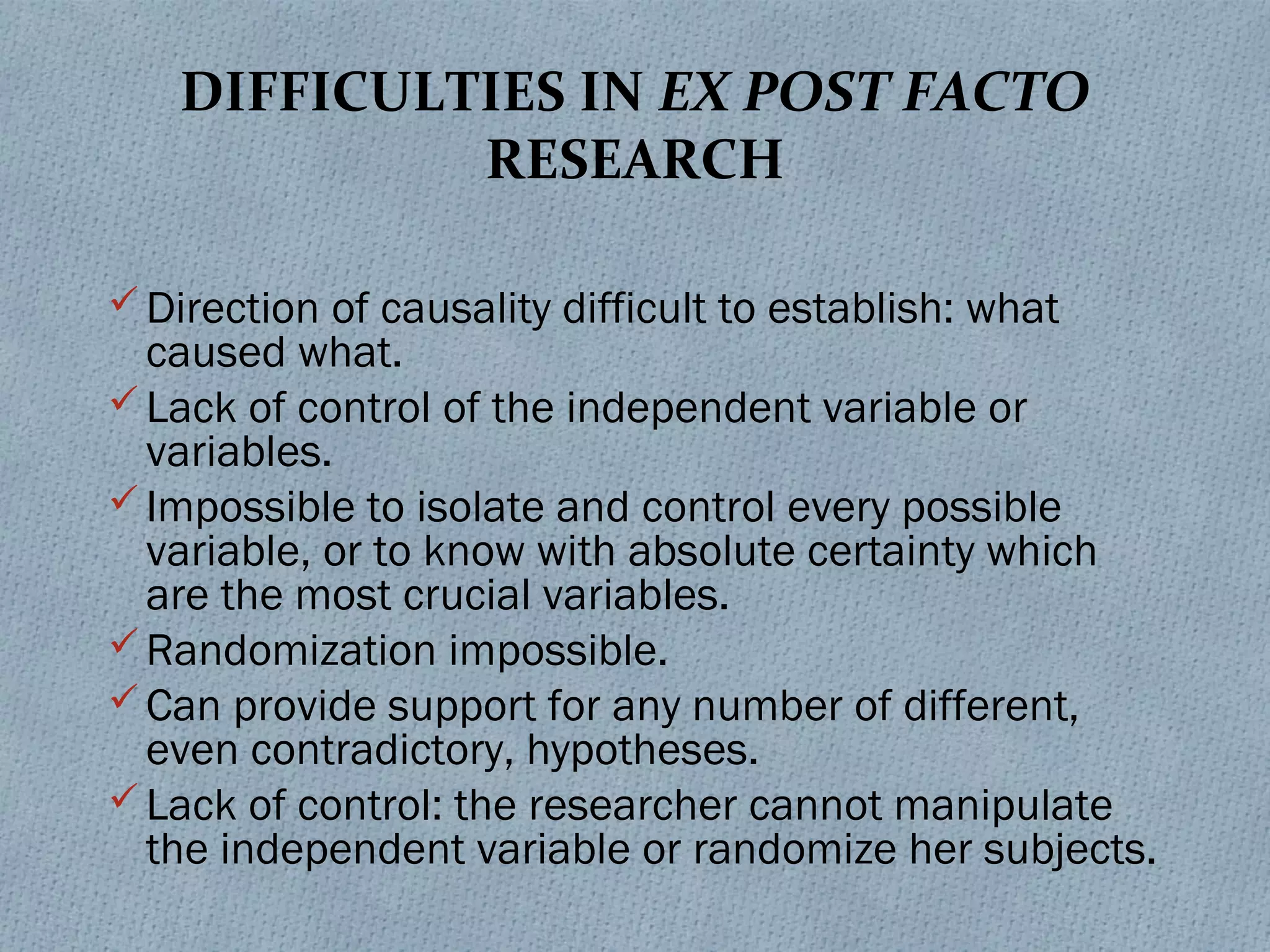
DIFFICULTIES IN EX POST FACTO
RESEARCH
Direction of causality difficult to establish: what
caused what.
Lack of control of the independent variable or
variables.
Impossible to isolate and control every possible
variable, or to know with absolute certainty which
are the most crucial variables.
Randomization impossible.
Can provide support for any number of different,
even contradictory, hypotheses.
Lack of control: the researcher cannot manipulate
the independent variable or randomize her subjects.
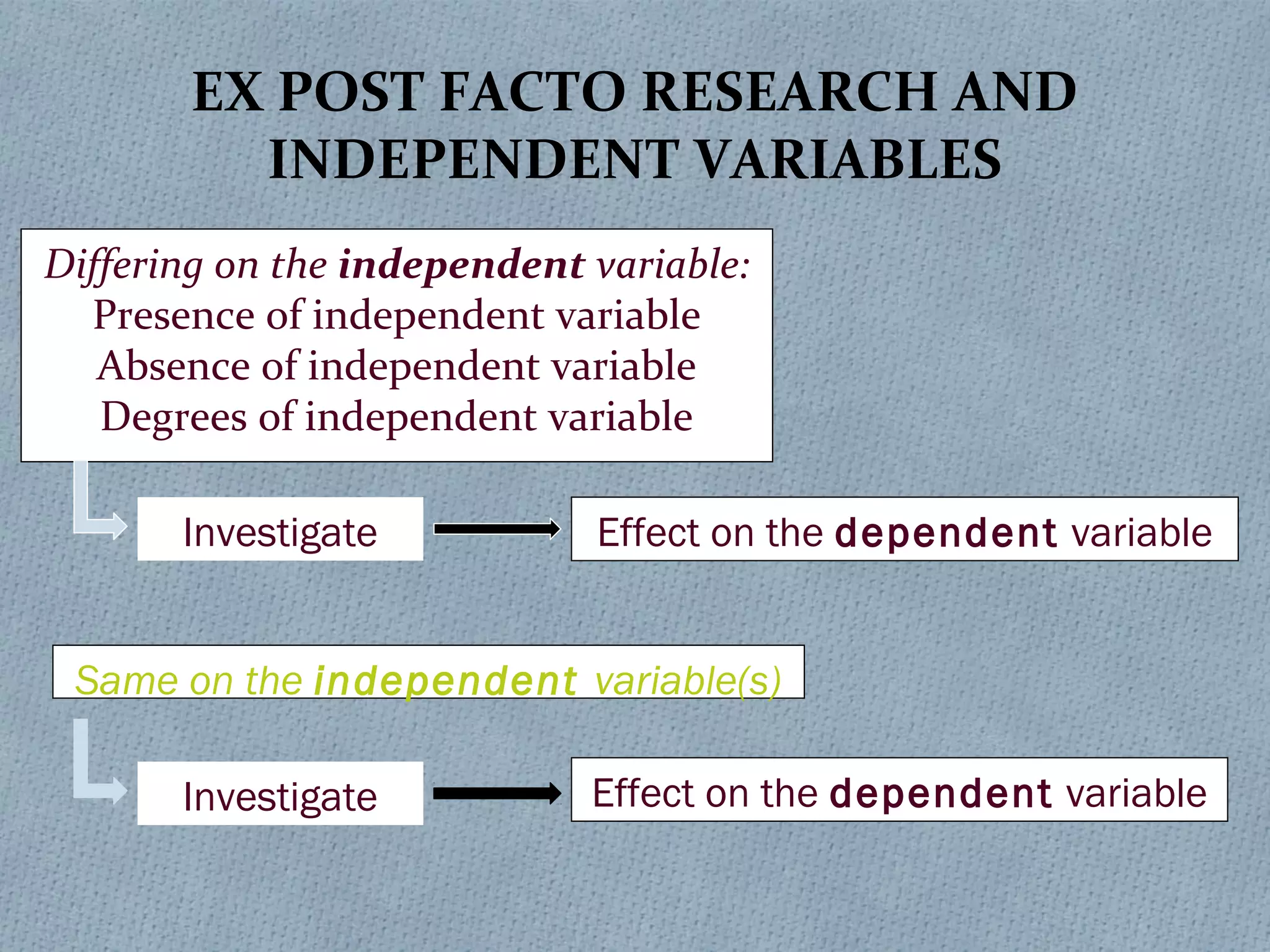
Investigate
Differing on the independent variable:
Presence of independent variable
Absence of independent variable
Degrees of independent variable
Effect on the dependent variable
Same on the independent variable(s)
Effect on the dependent variable
EX POST FACTO RESEARCH AND
INDEPENDENT VARIABLES
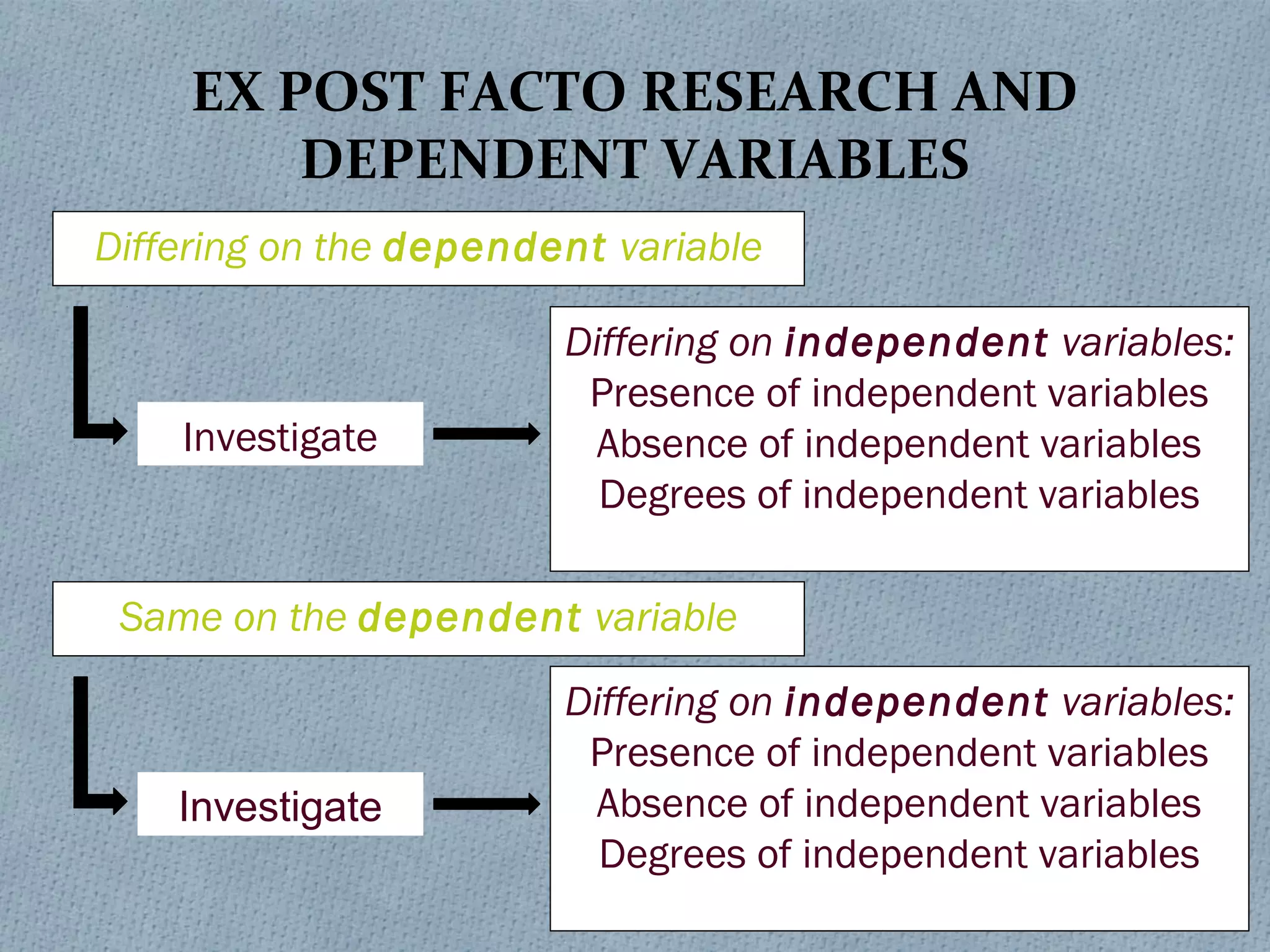
Investigate
Differing on independent variables:
Presence of independent variables
Absence of independent variables
Degrees of independent variables
Same on the dependent variable
EX POST FACTO RESEARCH AND
DEPENDENT VARIABLES
Differing on the dependent variable
Investigate
Differing on independent variables:
Presence of independent variables
Absence of independent variables
Degrees of independent variables
Investigate
EX POST FACTO RESEARCH IS
USEFUL WHEN . . .
It is impossible, impractical, costly or
unethical to conduct an experiment.
It is not possible to select, control and
manipulate the factors necessary to
study cause-and-effect relationships
directly.
When the control of all variables
except a single independent variable
may be unrealistic and artificial.
Where the independent variable lies
outside the researcher’s control.
ADVANTAGES OF EX POST FACTO
RESEARCH
O Useful where the more rigorous experimental
approach is not possible.
O Useful to study what goes with what and under
what conditions.
O Useful where the setting up of the latter would
introduce a note of artificiality into research
proceedings.
O Useful where simple cause-and-effect
relationships are being explored.
O It can give a sense of direction and provide a
source of hypotheses that can subsequently be
tested by the more rigorous experimental
method.
DISADVANTAGES OF EX POST FACTO
RESEARCH
O One cannot know for certain whether the causative
factor has been included or even identified.
O It may be that no single factor is the cause.
O A particular outcome may result from different causes
on different occasions.
O It is not possible to disconfirm a hypothesis.
O Classifying into dichotomous groups can be problematic.
O As the researcher attempts to match groups on key
variables, this leads to shrinkage of sample.
O Conclusions may be based on too limited a sample or
number of occurrences.
O It may fail to single out the really significant factors.
OTHANK
OYOU

EX POST FACTO RESEARCH

  • 1.
    EX POST FACTORESEARCH Presented By Muhammad Shahzad Ashfaq Ph.D Education Scholar
  • 2.
    Introduction • Ex postfacto is a Latin phrase that essentially means "retroactive," or affecting something that's already happened. • Ex post facto design is a quasi-experimental study examining how an independent variable, present prior to the study in the participants, affects a dependent variable. A quasi- experimental study simply means participants are not randomly assigned.
  • 3.
    PROCEDURES IN ANEX POST FACTO INVESTIGATION Stage One: Define the problem and survey the literature. Stage Two: State the hypotheses and the assumptions or premises on which the hypotheses and research procedures are based. Stage Three: Select the subjects (sampling) and identify the methods for collecting the data. Stage Four: Identify the criteria and categories for classifying the data to fit the purposes of the study.
  • 4.
    PROCEDURES IN ANEX POST FACTO INVESTIGATION Stage Five: Gather data on those factors which are always present in which the given outcome occurs, and discard the data in which those factors are not always present. Stage Six: Gather data on those factors which are always present in which the given outcome does not occur. Stage Seven: Compare the two sets of data (i.e. subtract the former (Stage Five) from the latter (Stage Six), in order to infer the causes that are responsible for the occurrence or non-occurrence of the outcome. Stage Eight: Analyze, interpret and report findings.
  • 5.
    APPROACHES TO EXPOST FACTO RESEARCH 1. One commences with subjects who differ on an independent variable, for example their years of study in mathematics, and then study how they differ on the dependent variable, e.g. a mathematics test. 2. One commences with subjects who differ on the dependent variable (for example their performance in a mathematics test) and discover how they differ on a range of independent variables, e.g. their years of study, their liking for the subject, the amount of homework they do in mathematics).
  • 6.
    CHARACTERISTICS OF EX POSTFACTO RESEARCH o In ex post facto research the researcher takes the effect (or dependent variable) and examines the data retrospectively to establish causes, relationships or associations, and their meanings.
  • 7.
    DIFFICULTIES IN EXPOST FACTO RESEARCH Direction of causality difficult to establish: what caused what. Lack of control of the independent variable or variables. Impossible to isolate and control every possible variable, or to know with absolute certainty which are the most crucial variables. Randomization impossible. Can provide support for any number of different, even contradictory, hypotheses. Lack of control: the researcher cannot manipulate the independent variable or randomize her subjects.
  • 8.
    Investigate Differing on theindependent variable: Presence of independent variable Absence of independent variable Degrees of independent variable Effect on the dependent variable Same on the independent variable(s) Effect on the dependent variable EX POST FACTO RESEARCH AND INDEPENDENT VARIABLES Investigate
  • 9.
    Differing on independentvariables: Presence of independent variables Absence of independent variables Degrees of independent variables Same on the dependent variable EX POST FACTO RESEARCH AND DEPENDENT VARIABLES Differing on the dependent variable Investigate Differing on independent variables: Presence of independent variables Absence of independent variables Degrees of independent variables Investigate
  • 10.
    EX POST FACTORESEARCH IS USEFUL WHEN . . . It is impossible, impractical, costly or unethical to conduct an experiment. It is not possible to select, control and manipulate the factors necessary to study cause-and-effect relationships directly. When the control of all variables except a single independent variable may be unrealistic and artificial. Where the independent variable lies outside the researcher’s control.
  • 11.
    ADVANTAGES OF EXPOST FACTO RESEARCH O Useful where the more rigorous experimental approach is not possible. O Useful to study what goes with what and under what conditions. O Useful where the setting up of the latter would introduce a note of artificiality into research proceedings. O Useful where simple cause-and-effect relationships are being explored. O It can give a sense of direction and provide a source of hypotheses that can subsequently be tested by the more rigorous experimental method.
  • 12.
    DISADVANTAGES OF EXPOST FACTO RESEARCH O One cannot know for certain whether the causative factor has been included or even identified. O It may be that no single factor is the cause. O A particular outcome may result from different causes on different occasions. O It is not possible to disconfirm a hypothesis. O Classifying into dichotomous groups can be problematic. O As the researcher attempts to match groups on key variables, this leads to shrinkage of sample. O Conclusions may be based on too limited a sample or number of occurrences. O It may fail to single out the really significant factors.
  • 13.