


INTRODUCTION TO
RESEARCH
THE WHAT, WHY AND HOW
TO DO RESEARCH:
IMPLICATIONS FOR
DEVELOPING COUNTRIES
Presenter: Philmore Alleyne
Department of Management Studies
University of the West Indies
Cave Hill Campus
Barbados
OVERVIEW OF PRESENTATION
 Overview of Quantitative/Qualitative
Methodologies
 Focus on Qualitative Research
 Questions, Characteristics, Methods, Data Analysis,
Credibility
 Research Methodologies / Methods
 Discussion
WHAT IS RESEARCH ?
 Research is a careful and systematic
process of inquiry to find answers to
problem of interest.
 Research include: use of facts, use of
theories, data analysis, sampling, doing
an experiment, going to library to read up
on a topic
 To do ‘research’ is to investigate the
problem systematically and thoroughly
 Goal of research is to solve ‘problem’ of
interest.
AIMS OF RESEARCH
 Describe
 Predict
 Explain
 Interpret
DESCRIBE
 Descriptive studies are designed
primarily to describe what is going on or
what exists
 In polling cases, we want to know what
percent of the population would vote for a
party in next election not why such a
distribution occurs
 Describe about an algorithm, a method,
an object, etc.
PREDICT
 Causal study
 Correlational research is used
to predict trend or pattern
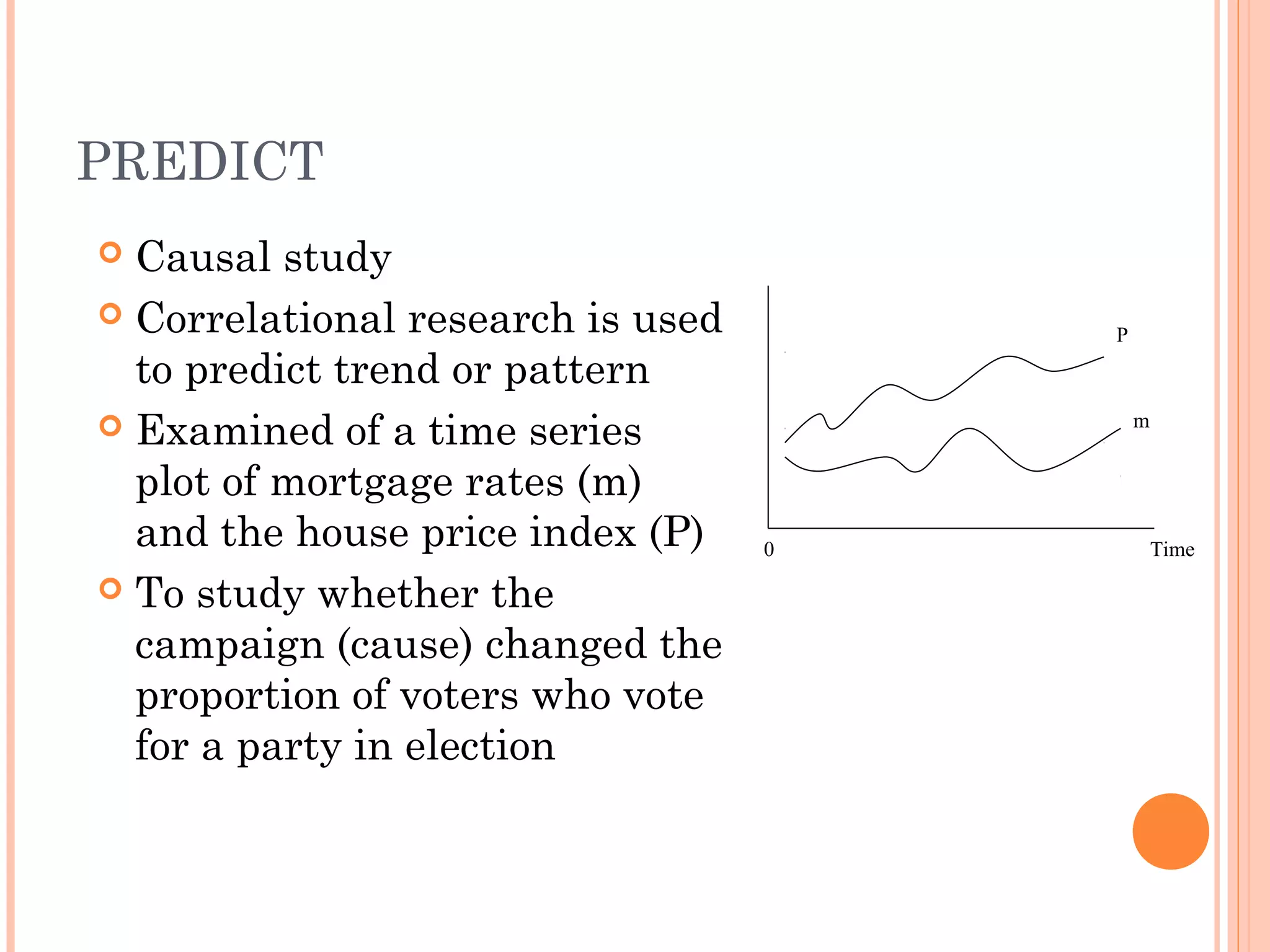
 Examined of a time series
plot of mortgage rates (m)
and the house price index (P)
 To study whether the
campaign (cause) changed the
proportion of voters who vote
for a party in election
P
m
0 Time
EXPLAIN
 Explain phenomena by establishing
correlations and postulating a causal
mechanism (called a ‘theory’ or its testable
part, a ‘hypothesis’) to explain the events.
 It may be hypothesized that since lower
mortgage rates cheapen the user cost of
housing, they tend to encourage people to
buy houses. Conversely, higher mortgage
rates tend to depress housing demand
INTERPRET
 Understanding or interpreting the reasons
and intentions behind individual actions.
 A researcher may want to know how an
individual makes housing choices or the
meaning of a 'home' rather than
aggregates of housing demand
 We may want to know how it feels to be
unemployed rather than aggregates such
as the unemployment rate
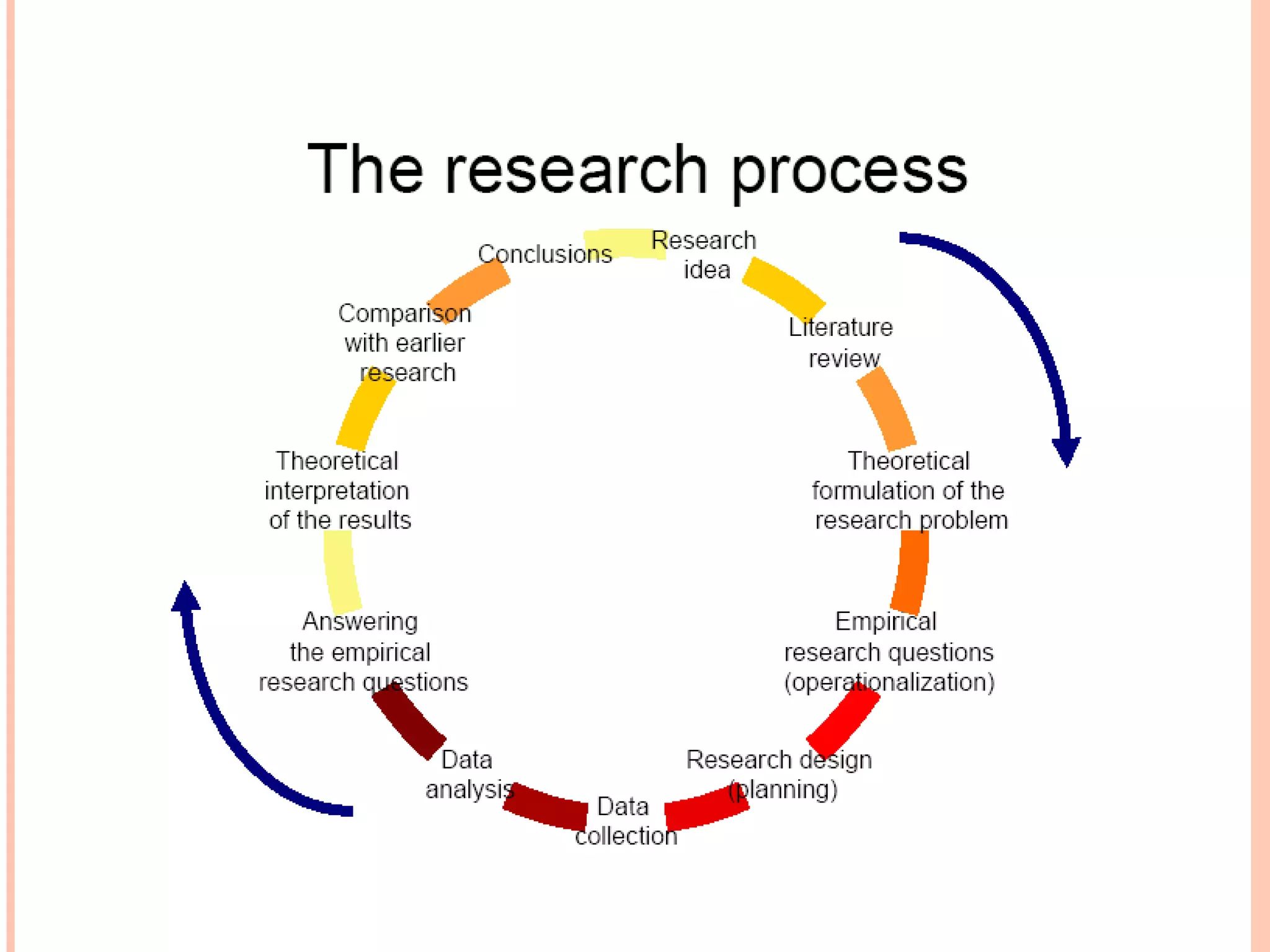
RESEARCH PROCESS
 Formulation of Research Problem
 Determination of research design
 Selection of data collection methods
 Data collection and processing
 Data analysis and conclution
 Research Report
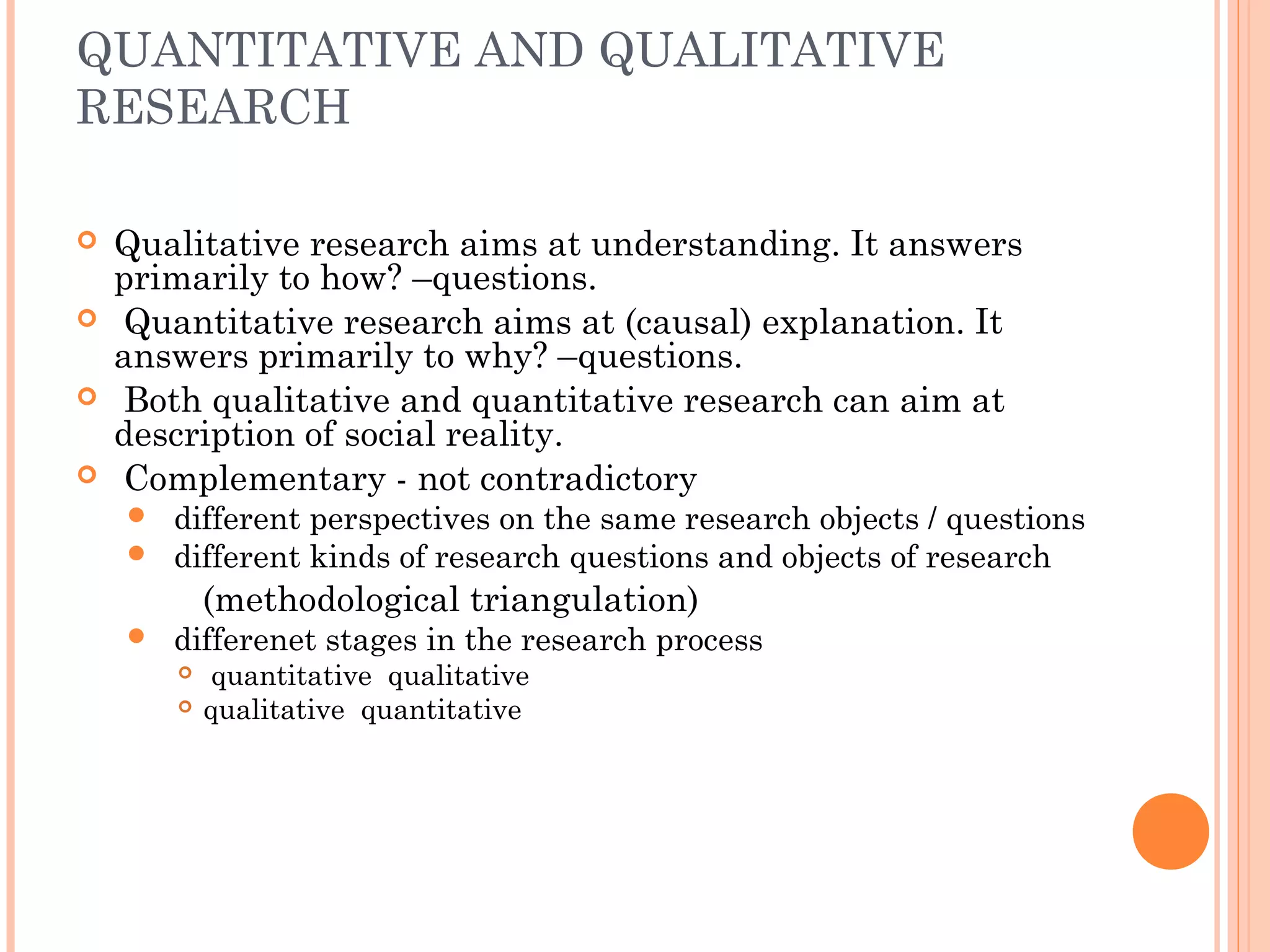
QUANTITATIVE AND QUALITATIVE
RESEARCH
 Qualitative research aims at understanding. It answers
primarily to how? –questions.
 Quantitative research aims at (causal) explanation. It
answers primarily to why? –questions.
 Both qualitative and quantitative research can aim at
description of social reality.
 Complementary - not contradictory
 different perspectives on the same research objects / questions
 different kinds of research questions and objects of research
(methodological triangulation)
 differenet stages in the research process
 quantitative qualitative
 qualitative quantitative
OVERVIEW OF RESEARCH
METHODOLOGIES
 Qualitative Research
 Ethnography, Case Study, Grounded Theory,
Autobiography, Participatory Action Research,
Phenomenology (each grounded in a specific
discipline and philosophical assumptions)
 Quantitative Research
 Survey methods, Experiments
 Mixed Methods
 Draw from qualitative and quantitative methods
QUANTITATIVE
 A quantitative approach is one in which the
investigator primarily uses post-positivist claims
for developing knowledge (i.e. cause and effect
thinking, reduction to specific variables and
hypotheses and questions, use of measurement
and observation, and the test of theories).
(Creswell, 2003, p.19)
THE QUANTITATIVE METHOD
 Based on the idea that social phenomena
can be quantified, measured and
expressed numerically.
 The information about a social
phenomenon is expressed in numeric
terms that can be analysed by statistical
methods.
 The observations can be directly numeric
information or can be classified into
numeric variables.
 .
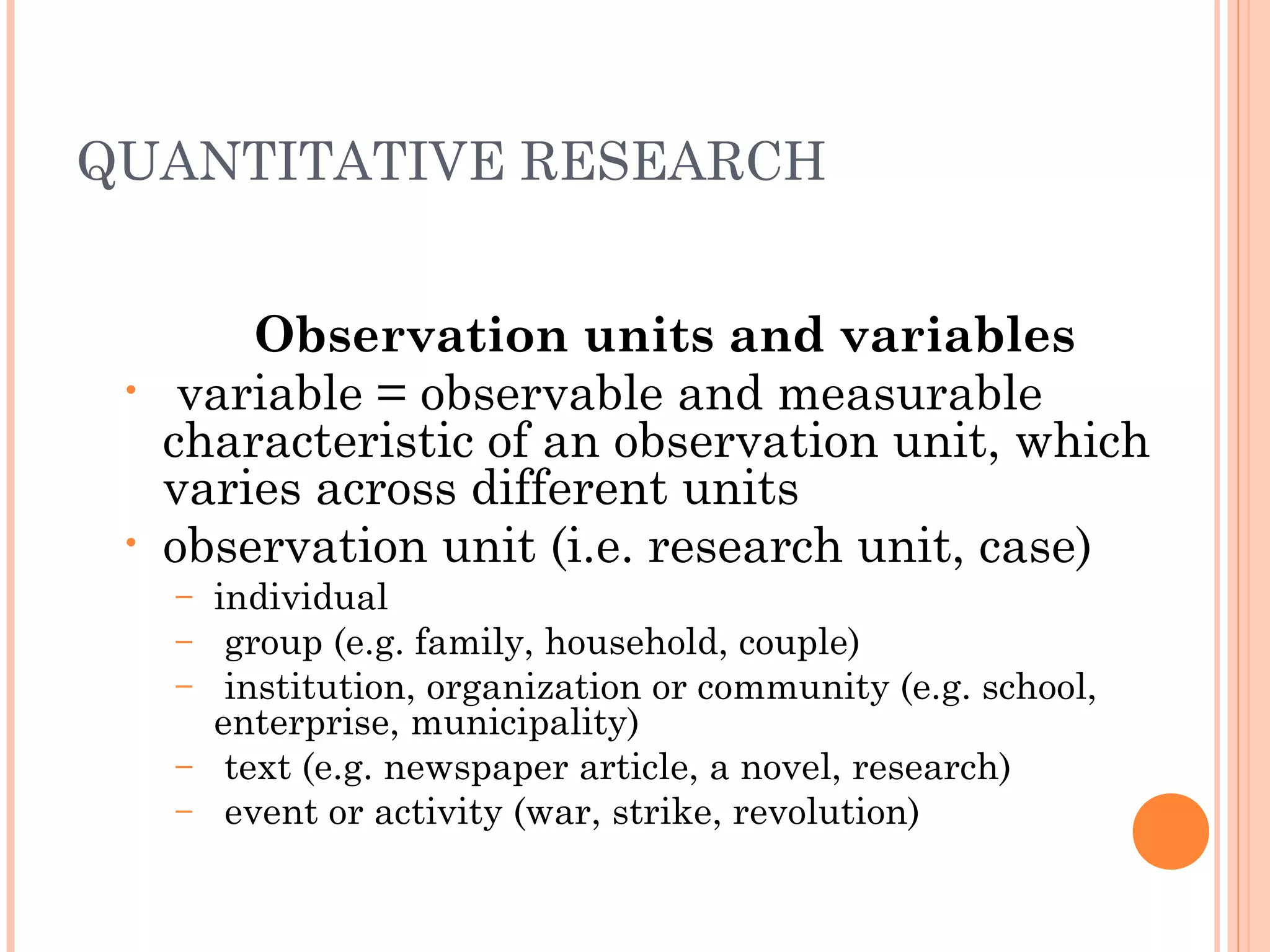
QUANTITATIVE RESEARCH
Observation units and variables
• variable = observable and measurable
characteristic of an observation unit, which
varies across different units
• observation unit (i.e. research unit, case)
– individual
– group (e.g. family, household, couple)
– institution, organization or community (e.g. school,
enterprise, municipality)
– text (e.g. newspaper article, a novel, research)
– event or activity (war, strike, revolution)
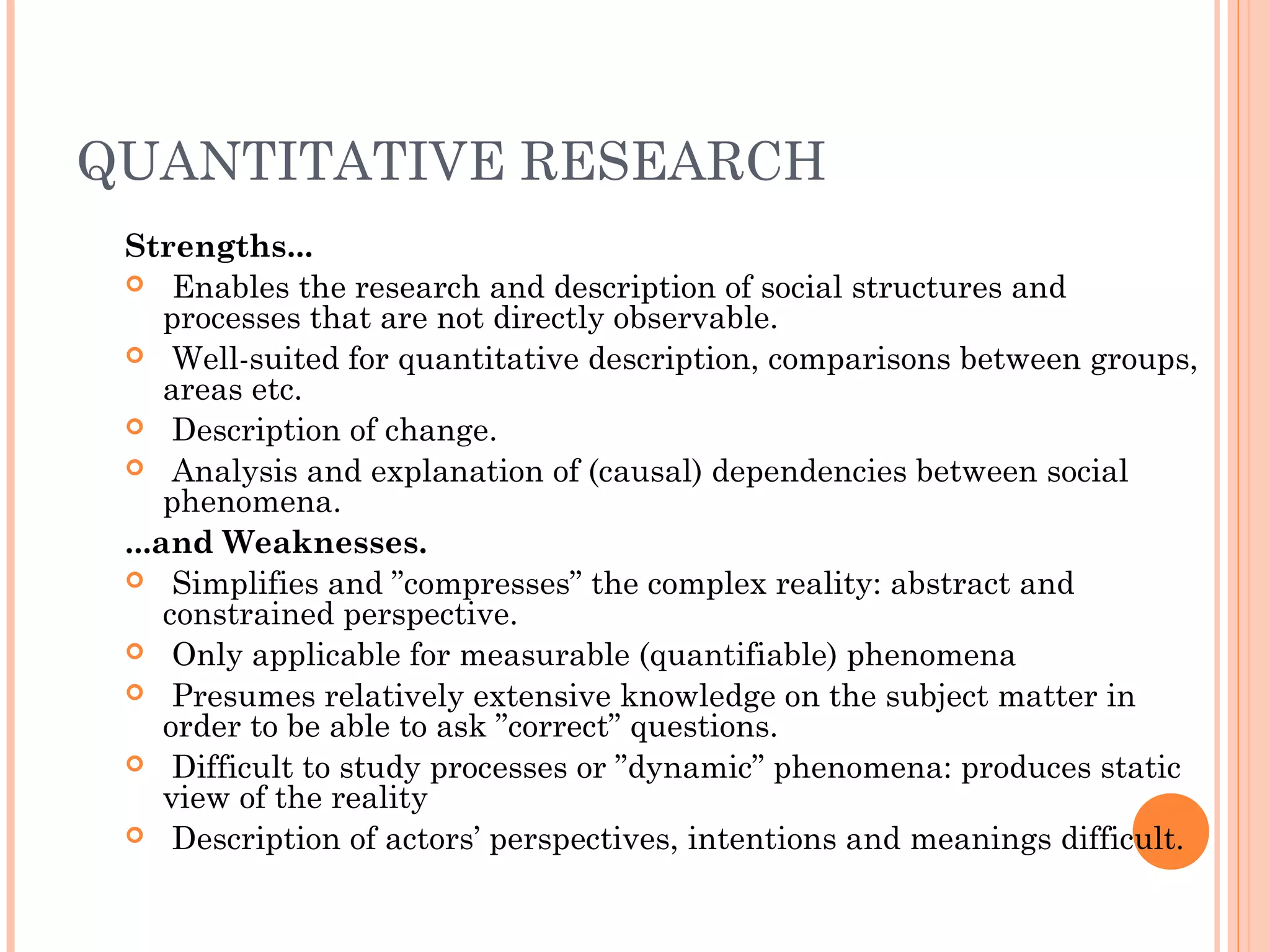
QUANTITATIVE RESEARCH
Strengths...
 Enables the research and description of social structures and
processes that are not directly observable.
 Well-suited for quantitative description, comparisons between groups,
areas etc.
 Description of change.
 Analysis and explanation of (causal) dependencies between social
phenomena.
...and Weaknesses.
 Simplifies and ”compresses” the complex reality: abstract and
constrained perspective.
 Only applicable for measurable (quantifiable) phenomena
 Presumes relatively extensive knowledge on the subject matter in
order to be able to ask ”correct” questions.
 Difficult to study processes or ”dynamic” phenomena: produces static
view of the reality
 Description of actors’ perspectives, intentions and meanings difficult.
QUALITATIVE - DEFINITION
 … qualitative researchers study things in their
natural settings, attempting to make sense of or
interpret phenomenon in terms of the meanings
people bring to them. (Denzin & Lincoln, 2000, p.3).
QUALITATIVE - DEFINITION
 A qualitative approach is one in which the
inquirer often makes knowledge claims
based primarily on constructivist
perspectives (i.e. the multiple meanings of
individual experiences, meanings socially
and historically constructed, with an
intent of developing a theory or pattern)
or advocacy/participatory perspectives (i.e.
political, issue-oriented, collaborative or
change oriented) or both. (Creswell, 2003, p.18)
QUALITATIVE RESEARCH
QUESTIONS
 Qualitative
In qualitative study inquirers state
research questions, not objectives (i.e.
specific goals for the research) or
hypotheses (i.e. predictions that involve
variables and statistical tests). (C.,
2003, p.105)
Example: How do students use program
development tools?
CHARACTERISTICS OF
QUALITATIVE RESEARCH
 Takes place in the natural setting
 Uses multiple methods that are interpretive
 Is emergent rather than tightly prefigured
 Fundamentally interpretive (role of researcher as
interpreter)
 Researcher views social phenomena holistically
 Researcher systematically reflects on who he or
she is in the inquiry and is sensitive to hiw or her
personal biography and how it shapes the study
 Researcher uses complex reasoning that is
multifaceted, iterative, and simultaneous
 Researcher adopts and uses one or more
strategies of inquiry
EXAMPLES OF QUALITATIVE
RESEARCH METHODS
 Interviews
 Focus groups
 Participant observation (field notes)
 Case Study
 Video
 Text and Image analysis (documents
Analysis, media data)
DATA ANALYSIS (C., P.191)
 Organize and prepare the data for
analysis
 Read all data, get a sense of the whole
 Begin detailed analysis with coding
process
 Generate a description of the
setting/people as well as categories or
themes for analysis
 Represent themes (writing, visual, etc.)
 Interpret and make meaning out of data
 *iterative, non-linear process
CHOICE OF
METHODOLOGY & METHODS
 Depends on
Research Questions
Research Goals
Researcher Beliefs and Values
Researcher Skills
Time and Funds
IMPLICATIONS FOR THE
CARIBBEAN
 Help policymakers
 Assist practitioners
 Provide guidance to educators
 Improve life in communities
CHALLENGES
 Limited access to do the research
 Lack of funding
 Lack of knowledge on what constitutes
research and its benefits
 Research priorities
REFERENCES
 Creswell, J.W. (1998). Qualitative inquiry and
research design. Choosing among five traditions.
Thousand Oaks, CA: Sage.
 Creswell, J.W. (2003). Research design.
Qualitative, quantitative and mixed methods
approaches. Thousand Oaks, CA: Sage.
 Denzin, N.K. & Lincoln, Y. (2000). Introduction:
The discipline and practice of qualitative
research. In N.K. Denzin & Y. Lincoln (Eds.),
Handbook of qualitative research (2nd
ed., pp.1-
17). Thousand Oaks, CA: Sage.
 Leedy , P. & Ormrod, J. (2005). Practical
Research: Planning and Design (8th
ed.) New
Jersey, Prentice Hall, Inc.

The what, why and how to do research: Implications for developing countries

  • 1.
    INTRODUCTION TO RESEARCH THE WHAT,WHY AND HOW TO DO RESEARCH: IMPLICATIONS FOR DEVELOPING COUNTRIES Presenter: Philmore Alleyne Department of Management Studies University of the West Indies Cave Hill Campus Barbados
  • 2.
    OVERVIEW OF PRESENTATION Overview of Quantitative/Qualitative Methodologies  Focus on Qualitative Research  Questions, Characteristics, Methods, Data Analysis, Credibility  Research Methodologies / Methods  Discussion
  • 3.
    WHAT IS RESEARCH?  Research is a careful and systematic process of inquiry to find answers to problem of interest.  Research include: use of facts, use of theories, data analysis, sampling, doing an experiment, going to library to read up on a topic  To do ‘research’ is to investigate the problem systematically and thoroughly  Goal of research is to solve ‘problem’ of interest.
  • 4.
    AIMS OF RESEARCH Describe  Predict  Explain  Interpret
  • 5.
    DESCRIBE  Descriptive studiesare designed primarily to describe what is going on or what exists  In polling cases, we want to know what percent of the population would vote for a party in next election not why such a distribution occurs  Describe about an algorithm, a method, an object, etc.
  • 6.
    PREDICT  Causal study Correlational research is used to predict trend or pattern  Examined of a time series plot of mortgage rates (m) and the house price index (P)  To study whether the campaign (cause) changed the proportion of voters who vote for a party in election P m 0 Time
  • 7.
    EXPLAIN  Explain phenomenaby establishing correlations and postulating a causal mechanism (called a ‘theory’ or its testable part, a ‘hypothesis’) to explain the events.  It may be hypothesized that since lower mortgage rates cheapen the user cost of housing, they tend to encourage people to buy houses. Conversely, higher mortgage rates tend to depress housing demand
  • 8.
    INTERPRET  Understanding orinterpreting the reasons and intentions behind individual actions.  A researcher may want to know how an individual makes housing choices or the meaning of a 'home' rather than aggregates of housing demand  We may want to know how it feels to be unemployed rather than aggregates such as the unemployment rate
  • 9.
    RESEARCH PROCESS  Formulationof Research Problem  Determination of research design  Selection of data collection methods  Data collection and processing  Data analysis and conclution  Research Report
  • 11.
    QUANTITATIVE AND QUALITATIVE RESEARCH Qualitative research aims at understanding. It answers primarily to how? –questions.  Quantitative research aims at (causal) explanation. It answers primarily to why? –questions.  Both qualitative and quantitative research can aim at description of social reality.  Complementary - not contradictory  different perspectives on the same research objects / questions  different kinds of research questions and objects of research (methodological triangulation)  differenet stages in the research process  quantitative qualitative  qualitative quantitative
  • 12.
    OVERVIEW OF RESEARCH METHODOLOGIES Qualitative Research  Ethnography, Case Study, Grounded Theory, Autobiography, Participatory Action Research, Phenomenology (each grounded in a specific discipline and philosophical assumptions)  Quantitative Research  Survey methods, Experiments  Mixed Methods  Draw from qualitative and quantitative methods
  • 13.
    QUANTITATIVE  A quantitativeapproach is one in which the investigator primarily uses post-positivist claims for developing knowledge (i.e. cause and effect thinking, reduction to specific variables and hypotheses and questions, use of measurement and observation, and the test of theories). (Creswell, 2003, p.19)
  • 14.
    THE QUANTITATIVE METHOD Based on the idea that social phenomena can be quantified, measured and expressed numerically.  The information about a social phenomenon is expressed in numeric terms that can be analysed by statistical methods.  The observations can be directly numeric information or can be classified into numeric variables.  .
  • 15.
    QUANTITATIVE RESEARCH Observation unitsand variables • variable = observable and measurable characteristic of an observation unit, which varies across different units • observation unit (i.e. research unit, case) – individual – group (e.g. family, household, couple) – institution, organization or community (e.g. school, enterprise, municipality) – text (e.g. newspaper article, a novel, research) – event or activity (war, strike, revolution)
  • 16.
    QUANTITATIVE RESEARCH Strengths...  Enablesthe research and description of social structures and processes that are not directly observable.  Well-suited for quantitative description, comparisons between groups, areas etc.  Description of change.  Analysis and explanation of (causal) dependencies between social phenomena. ...and Weaknesses.  Simplifies and ”compresses” the complex reality: abstract and constrained perspective.  Only applicable for measurable (quantifiable) phenomena  Presumes relatively extensive knowledge on the subject matter in order to be able to ask ”correct” questions.  Difficult to study processes or ”dynamic” phenomena: produces static view of the reality  Description of actors’ perspectives, intentions and meanings difficult.
  • 17.
    QUALITATIVE - DEFINITION … qualitative researchers study things in their natural settings, attempting to make sense of or interpret phenomenon in terms of the meanings people bring to them. (Denzin & Lincoln, 2000, p.3).
  • 18.
    QUALITATIVE - DEFINITION A qualitative approach is one in which the inquirer often makes knowledge claims based primarily on constructivist perspectives (i.e. the multiple meanings of individual experiences, meanings socially and historically constructed, with an intent of developing a theory or pattern) or advocacy/participatory perspectives (i.e. political, issue-oriented, collaborative or change oriented) or both. (Creswell, 2003, p.18)
  • 19.
    QUALITATIVE RESEARCH QUESTIONS  Qualitative Inqualitative study inquirers state research questions, not objectives (i.e. specific goals for the research) or hypotheses (i.e. predictions that involve variables and statistical tests). (C., 2003, p.105) Example: How do students use program development tools?
  • 20.
    CHARACTERISTICS OF QUALITATIVE RESEARCH Takes place in the natural setting  Uses multiple methods that are interpretive  Is emergent rather than tightly prefigured  Fundamentally interpretive (role of researcher as interpreter)  Researcher views social phenomena holistically  Researcher systematically reflects on who he or she is in the inquiry and is sensitive to hiw or her personal biography and how it shapes the study  Researcher uses complex reasoning that is multifaceted, iterative, and simultaneous  Researcher adopts and uses one or more strategies of inquiry
  • 21.
    EXAMPLES OF QUALITATIVE RESEARCHMETHODS  Interviews  Focus groups  Participant observation (field notes)  Case Study  Video  Text and Image analysis (documents Analysis, media data)
  • 22.
    DATA ANALYSIS (C.,P.191)  Organize and prepare the data for analysis  Read all data, get a sense of the whole  Begin detailed analysis with coding process  Generate a description of the setting/people as well as categories or themes for analysis  Represent themes (writing, visual, etc.)  Interpret and make meaning out of data  *iterative, non-linear process
  • 23.
    CHOICE OF METHODOLOGY &METHODS  Depends on Research Questions Research Goals Researcher Beliefs and Values Researcher Skills Time and Funds
  • 24.
    IMPLICATIONS FOR THE CARIBBEAN Help policymakers  Assist practitioners  Provide guidance to educators  Improve life in communities
  • 25.
    CHALLENGES  Limited accessto do the research  Lack of funding  Lack of knowledge on what constitutes research and its benefits  Research priorities
  • 27.
    REFERENCES  Creswell, J.W.(1998). Qualitative inquiry and research design. Choosing among five traditions. Thousand Oaks, CA: Sage.  Creswell, J.W. (2003). Research design. Qualitative, quantitative and mixed methods approaches. Thousand Oaks, CA: Sage.  Denzin, N.K. & Lincoln, Y. (2000). Introduction: The discipline and practice of qualitative research. In N.K. Denzin & Y. Lincoln (Eds.), Handbook of qualitative research (2nd ed., pp.1- 17). Thousand Oaks, CA: Sage.  Leedy , P. & Ormrod, J. (2005). Practical Research: Planning and Design (8th ed.) New Jersey, Prentice Hall, Inc.