CHAPTER 2
QUALITATIVE &
QUANTITATIVE RESEARCH
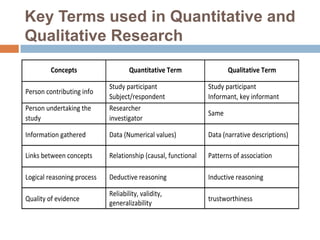
Key Terms used in Quantitative and
Qualitative Research
Concepts

Quantitative Term

Qualitative Term
Study participant
Informant, key informant

Person undertaking the
study

Study participant
Subject/respondent
Researcher
investigator

Information gathered

Data (Numerical values)

Data (narrative descriptions)

Links between concepts

Relationship (causal, functional

Patterns of association

Logical reasoning process

Deductive reasoning

Inductive reasoning

Quality of evidence

Reliability, validity,
generalizability

trustworthiness

Person contributing info

Same
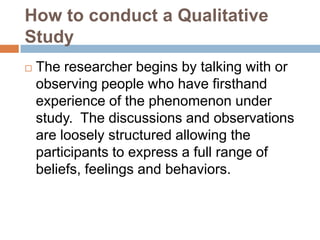
How to conduct a Qualitative
Study


The researcher begins by talking with or
observing people who have firsthand
experience of the phenomenon under
study. The discussions and observations
are loosely structured allowing the
participants to express a full range of
beliefs, feelings and behaviors.


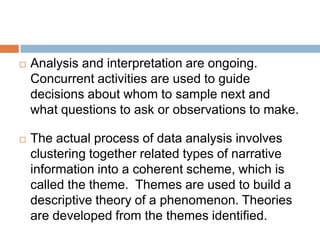
Analysis and interpretation are ongoing.
Concurrent activities are used to guide
decisions about whom to sample next and
what questions to ask or observations to make.



The actual process of data analysis involves
clustering together related types of narrative
information into a coherent scheme, which is
called the theme. Themes are used to build a
descriptive theory of a phenomenon. Theories
are developed from the themes identified.


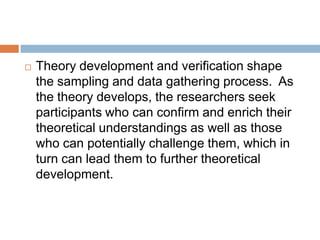
Theory development and verification shape
the sampling and data gathering process. As
the theory develops, the researchers seek
participants who can confirm and enrich their
theoretical understandings as well as those
who can potentially challenge them, which in
turn can lead them to further theoretical
development.


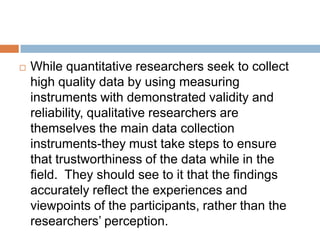
While quantitative researchers seek to collect
high quality data by using measuring
instruments with demonstrated validity and
reliability, qualitative researchers are
themselves the main data collection
instruments-they must take steps to ensure
that trustworthiness of the data while in the
field. They should see to it that the findings
accurately reflect the experiences and
viewpoints of the participants, rather than the
researchers’ perception.
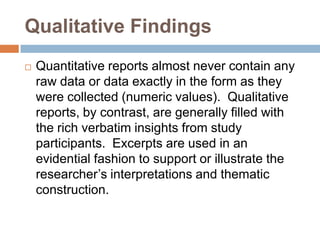
Qualitative Findings


Quantitative reports almost never contain any
raw data or data exactly in the form as they
were collected (numeric values). Qualitative
reports, by contrast, are generally filled with
the rich verbatim insights from study
participants. Excerpts are used in an
evidential fashion to support or illustrate the
researcher’s interpretations and thematic
construction.
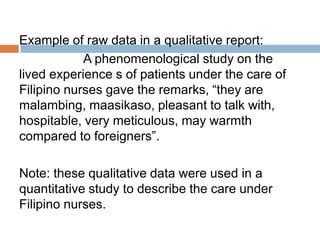
Example of raw data in a qualitative report:
A phenomenological study on the
lived experience s of patients under the care of
Filipino nurses gave the remarks, “they are
malambing, maasikaso, pleasant to talk with,
hospitable, very meticulous, may warmth
compared to foreigners”.
Note: these qualitative data were used in a
quantitative study to describe the care under
Filipino nurses.

Qualitative and Quantitative Research

  • 1.
  • 2.
    Key Terms usedin Quantitative and Qualitative Research Concepts Quantitative Term Qualitative Term Study participant Informant, key informant Person undertaking the study Study participant Subject/respondent Researcher investigator Information gathered Data (Numerical values) Data (narrative descriptions) Links between concepts Relationship (causal, functional Patterns of association Logical reasoning process Deductive reasoning Inductive reasoning Quality of evidence Reliability, validity, generalizability trustworthiness Person contributing info Same
  • 3.
    How to conducta Qualitative Study  The researcher begins by talking with or observing people who have firsthand experience of the phenomenon under study. The discussions and observations are loosely structured allowing the participants to express a full range of beliefs, feelings and behaviors.
  • 4.
     Analysis and interpretationare ongoing. Concurrent activities are used to guide decisions about whom to sample next and what questions to ask or observations to make.  The actual process of data analysis involves clustering together related types of narrative information into a coherent scheme, which is called the theme. Themes are used to build a descriptive theory of a phenomenon. Theories are developed from the themes identified.
  • 5.
     Theory development andverification shape the sampling and data gathering process. As the theory develops, the researchers seek participants who can confirm and enrich their theoretical understandings as well as those who can potentially challenge them, which in turn can lead them to further theoretical development.
  • 6.
     While quantitative researchersseek to collect high quality data by using measuring instruments with demonstrated validity and reliability, qualitative researchers are themselves the main data collection instruments-they must take steps to ensure that trustworthiness of the data while in the field. They should see to it that the findings accurately reflect the experiences and viewpoints of the participants, rather than the researchers’ perception.
  • 7.
    Qualitative Findings  Quantitative reportsalmost never contain any raw data or data exactly in the form as they were collected (numeric values). Qualitative reports, by contrast, are generally filled with the rich verbatim insights from study participants. Excerpts are used in an evidential fashion to support or illustrate the researcher’s interpretations and thematic construction.
  • 8.
    Example of rawdata in a qualitative report: A phenomenological study on the lived experience s of patients under the care of Filipino nurses gave the remarks, “they are malambing, maasikaso, pleasant to talk with, hospitable, very meticulous, may warmth compared to foreigners”. Note: these qualitative data were used in a quantitative study to describe the care under Filipino nurses.