Research methodology 
 Quantitative Research. 
 Qualitative Research. 
 Survey vs. questionnaire. 
 By: MUBARAK AHMED
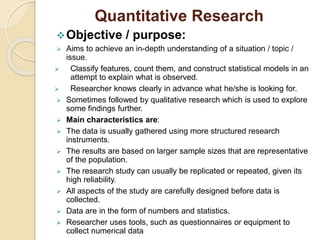
Quantitative Research 
Objective / purpose: 
 Aims to achieve an in-depth understanding of a situation / topic / 
issue. 
 Classify features, count them, and construct statistical models in an 
attempt to explain what is observed. 
 Researcher knows clearly in advance what he/she is looking for. 
 Sometimes followed by qualitative research which is used to explore 
some findings further. 
 Main characteristics are: 
 The data is usually gathered using more structured research 
instruments. 
 The results are based on larger sample sizes that are representative 
of the population. 
 The research study can usually be replicated or repeated, given its 
high reliability. 
 All aspects of the study are carefully designed before data is 
collected. 
 Data are in the form of numbers and statistics. 
 Researcher uses tools, such as questionnaires or equipment to 
collect numerical data
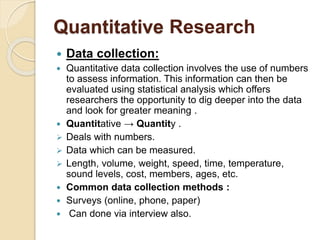
Quantitative Research 
 Data collection: 
 Quantitative data collection involves the use of numbers 
to assess information. This information can then be 
evaluated using statistical analysis which offers 
researchers the opportunity to dig deeper into the data 
and look for greater meaning . 
 Quantitative → Quantity . 
 Deals with numbers. 
 Data which can be measured. 
 Length, volume, weight, speed, time, temperature, 
sound levels, cost, members, ages, etc. 
 Common data collection methods : 
 Surveys (online, phone, paper) 
 Can done via interview also.
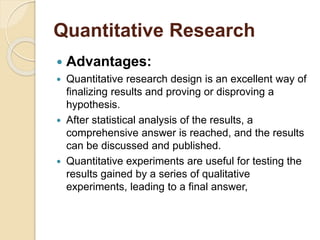
Quantitative Research 
 Advantages: 
 Quantitative research design is an excellent way of 
finalizing results and proving or disproving a 
hypothesis. 
 After statistical analysis of the results, a 
comprehensive answer is reached, and the results 
can be discussed and published. 
 Quantitative experiments are useful for testing the 
results gained by a series of qualitative 
experiments, leading to a final answer,
Quantitative Research 
 Disadvantages 
 Quantitative experiments can be difficult and 
expensive and require a lot of time to perform. 
 Quantitative studies usually require extensive 
statistical analysis, which can be difficult, due to 
fact that most of the researchers know less about 
statistics tools and how to use them. 
 Quantitative research design also tends to 
generate only proved or unproven results.
Qualitative Research 
 Qualitative research refers to studies of subjects that are hard to 
quantify, such as art history. 
 Data is in the form of words, pictures or objects. 
 The results of qualitative research are descriptive rather than 
predictive. 
 The strength of qualitative research is its ability to provide complex 
textual descriptions of how people experience a given research 
issue. 
 It provides information about the “human” side of an issue 
,behaviors, beliefs, opinions, emotions, and relationships of 
individuals.
Qualitative Research 
Data collection : 
 Deals with descriptions. 
 Data can be observed but not measured. 
 Colors, textures, appearance, beauty, etc. 
 Qualitative → Quality 
 Common data collection methods : 
 The three most common qualitative methods 
1- Participant observation: is optimal for collecting data on 
naturally occurring behaviors in their usual contexts. 
2 - In-depth interview: is optimal for collecting data on 
individuals’ personal histories, perspectives, and experiences, 
particularly when sensitive topics are being explored. 
3 -Focus groups : are effective in extracting data on the 
cultural standard of a group and in generating broad overviews 
of issues of concern to the cultural groups or subgroups 
represented.
Qualitative Research 
 Advantages: 
 Qualitative techniques are extremely useful when a 
subject is too complex to be answered by a simple 
yes or no hypothesis. 
 Qualitative research methods are not as dependent 
upon sample sizes as quantitative methods; a case 
study, for example, can generate meaningful 
results with a small sample group.
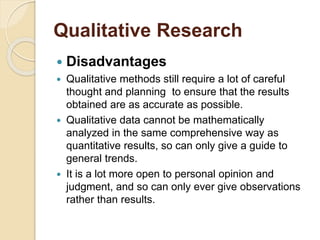
Qualitative Research 
 Disadvantages 
 Qualitative methods still require a lot of careful 
thought and planning to ensure that the results 
obtained are as accurate as possible. 
 Qualitative data cannot be mathematically 
analyzed in the same comprehensive way as 
quantitative results, so can only give a guide to 
general trends. 
 It is a lot more open to personal opinion and 
judgment, and so can only ever give observations 
rather than results.
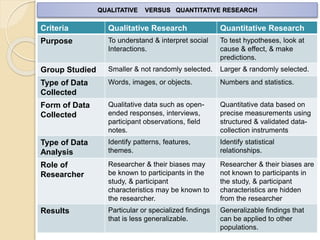
QUALITATIVE VERSUS QUANTITATIVE RESEARCH 
Criteria Qualitative Research Quantitative Research 
Purpose To understand & interpret social 
Interactions. 
To test hypotheses, look at 
cause & effect, & make 
predictions. 
Group Studied Smaller & not randomly selected. Larger & randomly selected. 
Type of Data 
Words, images, or objects. Numbers and statistics. 
Collected 
Form of Data 
Collected 
Qualitative data such as open-ended 
responses, interviews, 
participant observations, field 
notes. 
Quantitative data based on 
precise measurements using 
structured & validated data-collection 
instruments 
Type of Data 
Analysis 
Identify patterns, features, 
themes. 
Identify statistical 
relationships. 
Role of 
Researcher 
Researcher & their biases may 
be known to participants in the 
study, & participant 
characteristics may be known to 
the researcher. 
Researcher & their biases are 
not known to participants in 
the study, & participant 
characteristics are hidden 
from the researcher 
Results Particular or specialized findings 
that is less generalizable. 
Generalizable findings that 
can be applied to other 
populations.
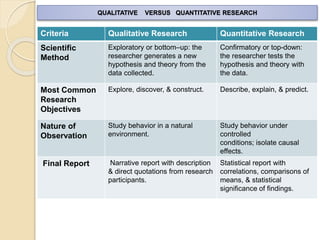
QUALITATIVE VERSUS QUANTITATIVE RESEARCH 
Criteria Qualitative Research Quantitative Research 
Scientific 
Method 
Exploratory or bottom–up: the 
researcher generates a new 
hypothesis and theory from the 
data collected. 
Confirmatory or top-down: 
the researcher tests the 
hypothesis and theory with 
the data. 
Most Common 
Research 
Objectives 
Explore, discover, & construct. Describe, explain, & predict. 
Nature of 
Observation 
Study behavior in a natural 
environment. 
Study behavior under 
controlled 
conditions; isolate causal 
effects. 
Final Report Narrative report with description 
& direct quotations from research 
participants. 
Statistical report with 
correlations, comparisons of 
means, & statistical 
significance of findings.
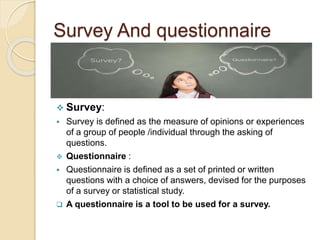
Survey And questionnaire 
 Survey: 
 Survey is defined as the measure of opinions or experiences 
of a group of people /individual through the asking of 
questions. 
 Questionnaire : 
 Questionnaire is defined as a set of printed or written 
questions with a choice of answers, devised for the purposes 
of a survey or statistical study. 
 A questionnaire is a tool to be used for a survey.
Survey And questionnaire 
 When conducting a survey your list of questions is 
called your questionnaire. 
 A survey, on the other hand, encompasses all aspects 
of the research process, including research 
design, survey construction, sampling method, data 
collection, and response analysis. 
 Surveys can be carried out in 2 ways: 
 1- Questionnaires: 
 Researchers give the questionnaires to the candidates 
who fill it out and then he collects and analyze it. 
 2- Interviews: (personal/ phone) 
One on one, searcher asks questionnaires to the 
candidate himself.
Surveys advantages and 
disadvantages 
 Advantages 
 The major noticeable advantages of surveys are time saver as 
surveys allow to collect a large amount of data in short time. 
 Surveys are less expensive than most of the other type of data 
collection methods. 
 Surveys are allowed to collect data on wide range of things. 
 Surveys are flexible ,can easily be combined with other methods 
to produce richer data. for instance, you might want to consider 
also using diaries, focus groups, or in-depth interviews. 
 Disadvantages 
 Accuracy, the response given may not reflect the reality. 
 Surveys are not so good at explaining why people think or act as 
they do . 
For example Surveys can tell us how many people behave in a 
certain way or how many patients were dissatisfied with their 
treatment, but they may be limited in the information they can 
provide as to why this is so .
Methods of doing surveys 
E-mail survey: (Commonly used in all areas) 
Advantages: 
 Fast results 
 Easy to modify 
 Data sets are created in real time 
 Inexpensive in most cases 
 Large sample size 
Disadvantages: 
 Honesty of responses can be an issue 
 Face to face interviews: 
 Advantages: 
 Face to face communication- more honest answers 
 Subject are more likely to give more accurate and detailed answers (qualitative 
data) 
 Disadvantages: 
 Some people do not like to talk about personal information (prefer to write) 
 Time consuming 
 Expensive 
 Smaller sample size
Methods of doing surveys 
Telephone: (mainly businesses) : 
Advantages: 
Higher response rate . 
Higher validity of answer . 
Disadvantages: 
More time consuming. 
Might be expensive (international surveys) . 
Might be annoying to the subjects to be contacted on phone . 
On-line survey: 
Advantages 
Very fast results 
Used in large scale of industries 
Cheap and very efficient 
Easy to target certain interest groups (i.e Facebook) 
Easy to process the data 
Disadvantages: 
Difficult to validate the gathered data 
Subject might not give complete/ honest answers 
Not suitable for people who do not use computers

Quantitative search and_qualitative_research by mubarak

  • 1.
    Research methodology Quantitative Research.  Qualitative Research.  Survey vs. questionnaire.  By: MUBARAK AHMED
  • 2.
    Quantitative Research Objective/ purpose:  Aims to achieve an in-depth understanding of a situation / topic / issue.  Classify features, count them, and construct statistical models in an attempt to explain what is observed.  Researcher knows clearly in advance what he/she is looking for.  Sometimes followed by qualitative research which is used to explore some findings further.  Main characteristics are:  The data is usually gathered using more structured research instruments.  The results are based on larger sample sizes that are representative of the population.  The research study can usually be replicated or repeated, given its high reliability.  All aspects of the study are carefully designed before data is collected.  Data are in the form of numbers and statistics.  Researcher uses tools, such as questionnaires or equipment to collect numerical data
  • 3.
    Quantitative Research Data collection:  Quantitative data collection involves the use of numbers to assess information. This information can then be evaluated using statistical analysis which offers researchers the opportunity to dig deeper into the data and look for greater meaning .  Quantitative → Quantity .  Deals with numbers.  Data which can be measured.  Length, volume, weight, speed, time, temperature, sound levels, cost, members, ages, etc.  Common data collection methods :  Surveys (online, phone, paper)  Can done via interview also.
  • 4.
    Quantitative Research Advantages:  Quantitative research design is an excellent way of finalizing results and proving or disproving a hypothesis.  After statistical analysis of the results, a comprehensive answer is reached, and the results can be discussed and published.  Quantitative experiments are useful for testing the results gained by a series of qualitative experiments, leading to a final answer,
  • 5.
    Quantitative Research Disadvantages  Quantitative experiments can be difficult and expensive and require a lot of time to perform.  Quantitative studies usually require extensive statistical analysis, which can be difficult, due to fact that most of the researchers know less about statistics tools and how to use them.  Quantitative research design also tends to generate only proved or unproven results.
  • 6.
    Qualitative Research Qualitative research refers to studies of subjects that are hard to quantify, such as art history.  Data is in the form of words, pictures or objects.  The results of qualitative research are descriptive rather than predictive.  The strength of qualitative research is its ability to provide complex textual descriptions of how people experience a given research issue.  It provides information about the “human” side of an issue ,behaviors, beliefs, opinions, emotions, and relationships of individuals.
  • 7.
    Qualitative Research Datacollection :  Deals with descriptions.  Data can be observed but not measured.  Colors, textures, appearance, beauty, etc.  Qualitative → Quality  Common data collection methods :  The three most common qualitative methods 1- Participant observation: is optimal for collecting data on naturally occurring behaviors in their usual contexts. 2 - In-depth interview: is optimal for collecting data on individuals’ personal histories, perspectives, and experiences, particularly when sensitive topics are being explored. 3 -Focus groups : are effective in extracting data on the cultural standard of a group and in generating broad overviews of issues of concern to the cultural groups or subgroups represented.
  • 8.
    Qualitative Research Advantages:  Qualitative techniques are extremely useful when a subject is too complex to be answered by a simple yes or no hypothesis.  Qualitative research methods are not as dependent upon sample sizes as quantitative methods; a case study, for example, can generate meaningful results with a small sample group.
  • 9.
    Qualitative Research Disadvantages  Qualitative methods still require a lot of careful thought and planning to ensure that the results obtained are as accurate as possible.  Qualitative data cannot be mathematically analyzed in the same comprehensive way as quantitative results, so can only give a guide to general trends.  It is a lot more open to personal opinion and judgment, and so can only ever give observations rather than results.
  • 10.
    QUALITATIVE VERSUS QUANTITATIVERESEARCH Criteria Qualitative Research Quantitative Research Purpose To understand & interpret social Interactions. To test hypotheses, look at cause & effect, & make predictions. Group Studied Smaller & not randomly selected. Larger & randomly selected. Type of Data Words, images, or objects. Numbers and statistics. Collected Form of Data Collected Qualitative data such as open-ended responses, interviews, participant observations, field notes. Quantitative data based on precise measurements using structured & validated data-collection instruments Type of Data Analysis Identify patterns, features, themes. Identify statistical relationships. Role of Researcher Researcher & their biases may be known to participants in the study, & participant characteristics may be known to the researcher. Researcher & their biases are not known to participants in the study, & participant characteristics are hidden from the researcher Results Particular or specialized findings that is less generalizable. Generalizable findings that can be applied to other populations.
  • 11.
    QUALITATIVE VERSUS QUANTITATIVERESEARCH Criteria Qualitative Research Quantitative Research Scientific Method Exploratory or bottom–up: the researcher generates a new hypothesis and theory from the data collected. Confirmatory or top-down: the researcher tests the hypothesis and theory with the data. Most Common Research Objectives Explore, discover, & construct. Describe, explain, & predict. Nature of Observation Study behavior in a natural environment. Study behavior under controlled conditions; isolate causal effects. Final Report Narrative report with description & direct quotations from research participants. Statistical report with correlations, comparisons of means, & statistical significance of findings.
  • 12.
    Survey And questionnaire  Survey:  Survey is defined as the measure of opinions or experiences of a group of people /individual through the asking of questions.  Questionnaire :  Questionnaire is defined as a set of printed or written questions with a choice of answers, devised for the purposes of a survey or statistical study.  A questionnaire is a tool to be used for a survey.
  • 13.
    Survey And questionnaire  When conducting a survey your list of questions is called your questionnaire.  A survey, on the other hand, encompasses all aspects of the research process, including research design, survey construction, sampling method, data collection, and response analysis.  Surveys can be carried out in 2 ways:  1- Questionnaires:  Researchers give the questionnaires to the candidates who fill it out and then he collects and analyze it.  2- Interviews: (personal/ phone) One on one, searcher asks questionnaires to the candidate himself.
  • 14.
    Surveys advantages and disadvantages  Advantages  The major noticeable advantages of surveys are time saver as surveys allow to collect a large amount of data in short time.  Surveys are less expensive than most of the other type of data collection methods.  Surveys are allowed to collect data on wide range of things.  Surveys are flexible ,can easily be combined with other methods to produce richer data. for instance, you might want to consider also using diaries, focus groups, or in-depth interviews.  Disadvantages  Accuracy, the response given may not reflect the reality.  Surveys are not so good at explaining why people think or act as they do . For example Surveys can tell us how many people behave in a certain way or how many patients were dissatisfied with their treatment, but they may be limited in the information they can provide as to why this is so .
  • 15.
    Methods of doingsurveys E-mail survey: (Commonly used in all areas) Advantages:  Fast results  Easy to modify  Data sets are created in real time  Inexpensive in most cases  Large sample size Disadvantages:  Honesty of responses can be an issue  Face to face interviews:  Advantages:  Face to face communication- more honest answers  Subject are more likely to give more accurate and detailed answers (qualitative data)  Disadvantages:  Some people do not like to talk about personal information (prefer to write)  Time consuming  Expensive  Smaller sample size
  • 16.
    Methods of doingsurveys Telephone: (mainly businesses) : Advantages: Higher response rate . Higher validity of answer . Disadvantages: More time consuming. Might be expensive (international surveys) . Might be annoying to the subjects to be contacted on phone . On-line survey: Advantages Very fast results Used in large scale of industries Cheap and very efficient Easy to target certain interest groups (i.e Facebook) Easy to process the data Disadvantages: Difficult to validate the gathered data Subject might not give complete/ honest answers Not suitable for people who do not use computers