WELCOME TO MY PRESENTATION
Quality by Design (QbD) For Formulation And
Development
Presented by:-
SUHASINI . V
M.Pharm 1st year
(Pharmaceutics)
Ref.: ICH Q8 (R2)
SIGNIFICANCE OF QbD :
 Quality by Design means –designing and
developing formulations and manufacturing
processes to ensure a predefined quality
 Quality by Design requires – understanding how
formulation and manufacturing process variables
influence product quality .
 Quality by Design ensures – Product quality with
effective control strategy
BENEFITS OF QBD:
 QbD is good Business
 Eliminate batch failures
 Minimize deviations and costly investigations
 Avoid regulatory compliance problems
 Organizational learning is an investment in the
future
 QbD is good Science
 Better development decisions
 Empowerment of technical staff
IMPORTABT OF OBD FOR FORMULATION
AND DEVELOPMENT
 Quality target product profile (QTPP)
 Critical quality attribute (CQAs)
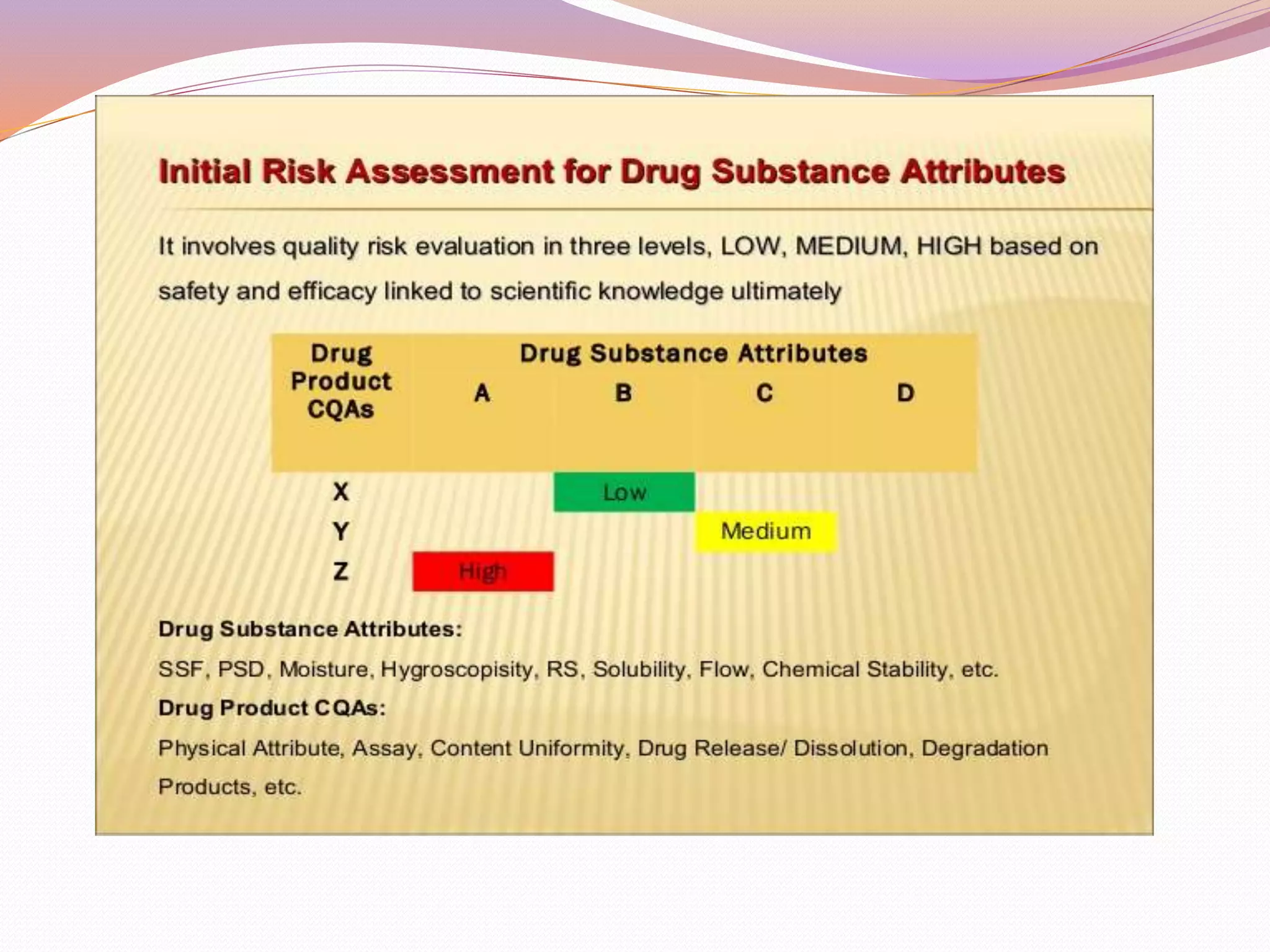
 Initial risk assessment for drug substance attributes
 Initial risk assessment for drug formulation attributes
1. Selection of excipients
2. Excipients compatibility studies
3. Development of Q& Q formula for initial
formulation development
 Design development strategies
 DOE for optimization of formulation
 Initial risk assessment for manufacturing process
 Pilot bioequivalence studies
 Well defined control strategy
 Scale up from lab to pilot scale and then commercial
scale
 Container and closure system
 Development studies to be supported with stability
studies
Initial risk assessment for drug formulation
attributes
 “A planned set of controls, derived from current
product and process understanding that ensures
process performance and product quality…..”
ICH Q8 (R2) & Q10
Control Strategy includes following elements (but not
limited to):
 Input material attributes (e.g. drug substance, excipients,
container closure)
 Equipment operating conditions
 In-process controls
 Finished product specifications
 Controls for each unit operations
 Methods and frequency of monitoring and control.
Control Strategy
Pilot bioequivalence studies
 A pilot study in a small number of subjects can be
carried out before proceeding with a full
bioequivalence study.
 The study can be used to validate analytical
methodology, assess variability, optimize sample
collection time intervals, and provide other
information.
 Example : Pilot bioequivalence studies can help
determine the sampling schedule to assess lag time
and dose dumping.
Scale up from lab to pilot scale and
then commercial scale
 It is the part of the pharmaceutical industry where
a lab scale formula is transformed into a viable
product by development of liable practical
procedure of manufacturing.
 Evaluating the results of laboratory studies and
making product and process corrections and
improvements
Container and closure system
 Suitable container closure system to achieve the
target shelf life and to ensure product integrity
during shipping
 primary packaging components & secondary
packaging components, if the latter are intended to
provide additional protection to the drug product.
 Packaging aspects must be considered during the
development of product. The packaging process
parameters may affect the final product quality.
Development studies to be supported
with stability studies
 "…… to provide evidence on how the quality of a drug
substance or drug product varies with time under the
influence of a variety of environmental factors such as
temperature, humidity & light, & enables
recommended storage conditions, re-test periods &
shelf lives to be established”
1. Long Term
2. Intermediate
3. Accelerated
Advantages of QbD
 Benefits for Industry:
 Better understanding of the process.
 Less batch failure.
 More efficient and effective control
 Return on investment / cost savings.
 Allows for implementation of new technology to improve
manufacturing
 Improves interaction with FDA –deal on a science level instead of on a
process level
 Allows for continuous improvements in products and manufacturing
process.
1. Guidance for Industry: Q8(R2) Pharmaceutical Development
2. Guidance for Industry: Q9 Quality Risk Management
3. Guidance for Industry: Q10 Pharmaceutical Quality System
4. http : // www.drug regulation .org
Quality by design

Quality by design

  • 1.
    WELCOME TO MYPRESENTATION Quality by Design (QbD) For Formulation And Development Presented by:- SUHASINI . V M.Pharm 1st year (Pharmaceutics)
  • 3.
  • 4.
    SIGNIFICANCE OF QbD:  Quality by Design means –designing and developing formulations and manufacturing processes to ensure a predefined quality  Quality by Design requires – understanding how formulation and manufacturing process variables influence product quality .  Quality by Design ensures – Product quality with effective control strategy
  • 6.
    BENEFITS OF QBD: QbD is good Business  Eliminate batch failures  Minimize deviations and costly investigations  Avoid regulatory compliance problems  Organizational learning is an investment in the future  QbD is good Science  Better development decisions  Empowerment of technical staff
  • 7.
    IMPORTABT OF OBDFOR FORMULATION AND DEVELOPMENT  Quality target product profile (QTPP)  Critical quality attribute (CQAs)  Initial risk assessment for drug substance attributes  Initial risk assessment for drug formulation attributes 1. Selection of excipients 2. Excipients compatibility studies 3. Development of Q& Q formula for initial formulation development
  • 8.
     Design developmentstrategies  DOE for optimization of formulation  Initial risk assessment for manufacturing process  Pilot bioequivalence studies  Well defined control strategy  Scale up from lab to pilot scale and then commercial scale  Container and closure system  Development studies to be supported with stability studies
  • 13.
    Initial risk assessmentfor drug formulation attributes
  • 17.
     “A plannedset of controls, derived from current product and process understanding that ensures process performance and product quality…..” ICH Q8 (R2) & Q10 Control Strategy includes following elements (but not limited to):  Input material attributes (e.g. drug substance, excipients, container closure)  Equipment operating conditions  In-process controls  Finished product specifications  Controls for each unit operations  Methods and frequency of monitoring and control. Control Strategy
  • 18.
    Pilot bioequivalence studies A pilot study in a small number of subjects can be carried out before proceeding with a full bioequivalence study.  The study can be used to validate analytical methodology, assess variability, optimize sample collection time intervals, and provide other information.  Example : Pilot bioequivalence studies can help determine the sampling schedule to assess lag time and dose dumping.
  • 19.
    Scale up fromlab to pilot scale and then commercial scale  It is the part of the pharmaceutical industry where a lab scale formula is transformed into a viable product by development of liable practical procedure of manufacturing.  Evaluating the results of laboratory studies and making product and process corrections and improvements
  • 20.
    Container and closuresystem  Suitable container closure system to achieve the target shelf life and to ensure product integrity during shipping  primary packaging components & secondary packaging components, if the latter are intended to provide additional protection to the drug product.  Packaging aspects must be considered during the development of product. The packaging process parameters may affect the final product quality.
  • 21.
    Development studies tobe supported with stability studies  "…… to provide evidence on how the quality of a drug substance or drug product varies with time under the influence of a variety of environmental factors such as temperature, humidity & light, & enables recommended storage conditions, re-test periods & shelf lives to be established” 1. Long Term 2. Intermediate 3. Accelerated
  • 22.
    Advantages of QbD Benefits for Industry:  Better understanding of the process.  Less batch failure.  More efficient and effective control  Return on investment / cost savings.  Allows for implementation of new technology to improve manufacturing  Improves interaction with FDA –deal on a science level instead of on a process level  Allows for continuous improvements in products and manufacturing process.
  • 23.
    1. Guidance forIndustry: Q8(R2) Pharmaceutical Development 2. Guidance for Industry: Q9 Quality Risk Management 3. Guidance for Industry: Q10 Pharmaceutical Quality System 4. http : // www.drug regulation .org