
In-Process Quality
Control Of
Pharmaceutical
Dosage Form
Presented By:
Kay Kay Shain Marma &
Saad Ahmed Sami
Dept. of Pharmacy
University Of Chittagong
Bangladesh.
IPQC
 IPQC stands for “In Process Quality Control”.
 It is a planned system to identify the materials, equipments, processes
and operators.
 IPQC cover the entire chain of operations from the receipt of raw
material in the warehouse to the release of finished products from the
warehouse for distribution and or sale.
 IPQC tests are performed at regular intervals (generally each 1 hr later)
during the manufacturing process. These tests are varied from dosage form to
dosage form.
IPQC
Right
materia
l
Right
Amount
Right
Place
Right
Time
4R of IPQC
Importance of IPQC
• To detect the errors.
• To minimize the human errors.
• Provides accurate, specific, and definite description of the
procedure to be employed.
• Can detect any abnormality immediately and at the
same time indicate the kind of action needed to correct the
problem.
• To enforce the flow of manufacturing and packing
operations according to established rules and practices.
Who do IPQC Test ?
Usually, the tests are carried out by-
•Quality compliance personnel &
•Production personnel.
On the basis of organizational instructions and process descriptions,
quality control personnel may also carry out the necessary tasks.
Where to do IPQC ?
• In-process controls may be carried out within the
production area provided they do not carry any risk for the production.”
FACTORS MAKING IPQC EFFECTIVE
 People
 Training
 Environment
 Process
 Equipment
 Management
 Better communication
In Process Checks Shall Includes
Following Process Controls
• Cleanliness of the area and line clearance
• Checking of the status labels on the area and process containers.
• Equipment/instrument: Calibration, verification and checking of the
status labels.
• Checking and verification of material used as Material Name, Material
Code, Control No.
• Time limits at all stages of process.
• Online review of batch record at every stage of process.
• Product attributes Like Weight, Hardness.
• Verification of yield at various stages of manufacturing process.
• Measured values obtained from the room environment like Temperature,
Humidity.
IPQC FOR SOLID
PRODUCTS
IN-PROCESS QUALITY CONTROL
TESTS FOR
TABLETS
 General appearance test
 Hardness
 Friability
 Disintegration time
 Weight variation
 Content uniformity
 Dissolution test
 Leakage testing for strip and blister packaging
GENERAL APPEARANCE TEST
1.SIZE AND SHAPE : The size and shape of the tablet can be
dimensionally described monitored and controlled. it is determined by the
tooling during the compression process.
2.COLOR AND ODOUR : Colors used for rapid identification and
consumer acceptance. but it must be uniform within a single tablet, from
tablet to tablet and from lot to lot. the presence of an odor in a batch of
tablets could indicate stability e.g. the characteristic odor of acetic acid in
degrading aspirin tablets .Taste is important in consumer acceptance of
product.
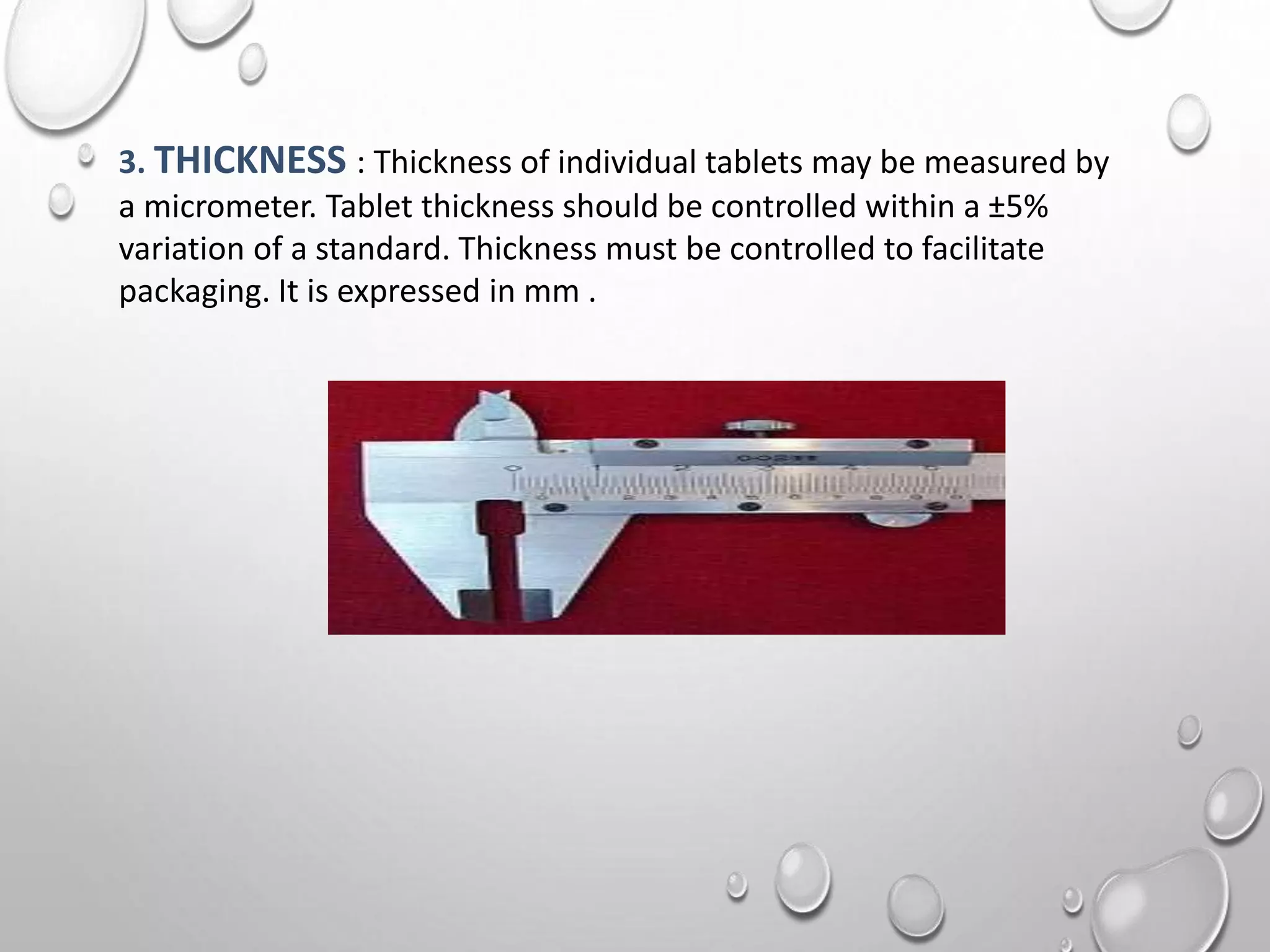
3. THICKNESS : Thickness of individual tablets may be measured by
a micrometer. Tablet thickness should be controlled within a ±5%
variation of a standard. Thickness must be controlled to facilitate
packaging. It is expressed in mm .
• If the tablet is too hard, it may not disintegrate in the required period of
time.
• If the tablet is too soft, it will not withstand the handling during
subsequent processing such as coating or packaging.
Hardness
Hardness generally measures the tablet crushing strength.
It is the load required to crush the tablet when placed on its edge.
LIMITS : ( Take 5 tablets and avg. out)
Oral tablets 4-10 kg
Chewable tablets 3 kg
Sustained release tablets 10-20 kg
Schleuniger
Erweka
Monsanto
Strong-cobb
DIFFERENT HARDNESS TESTER
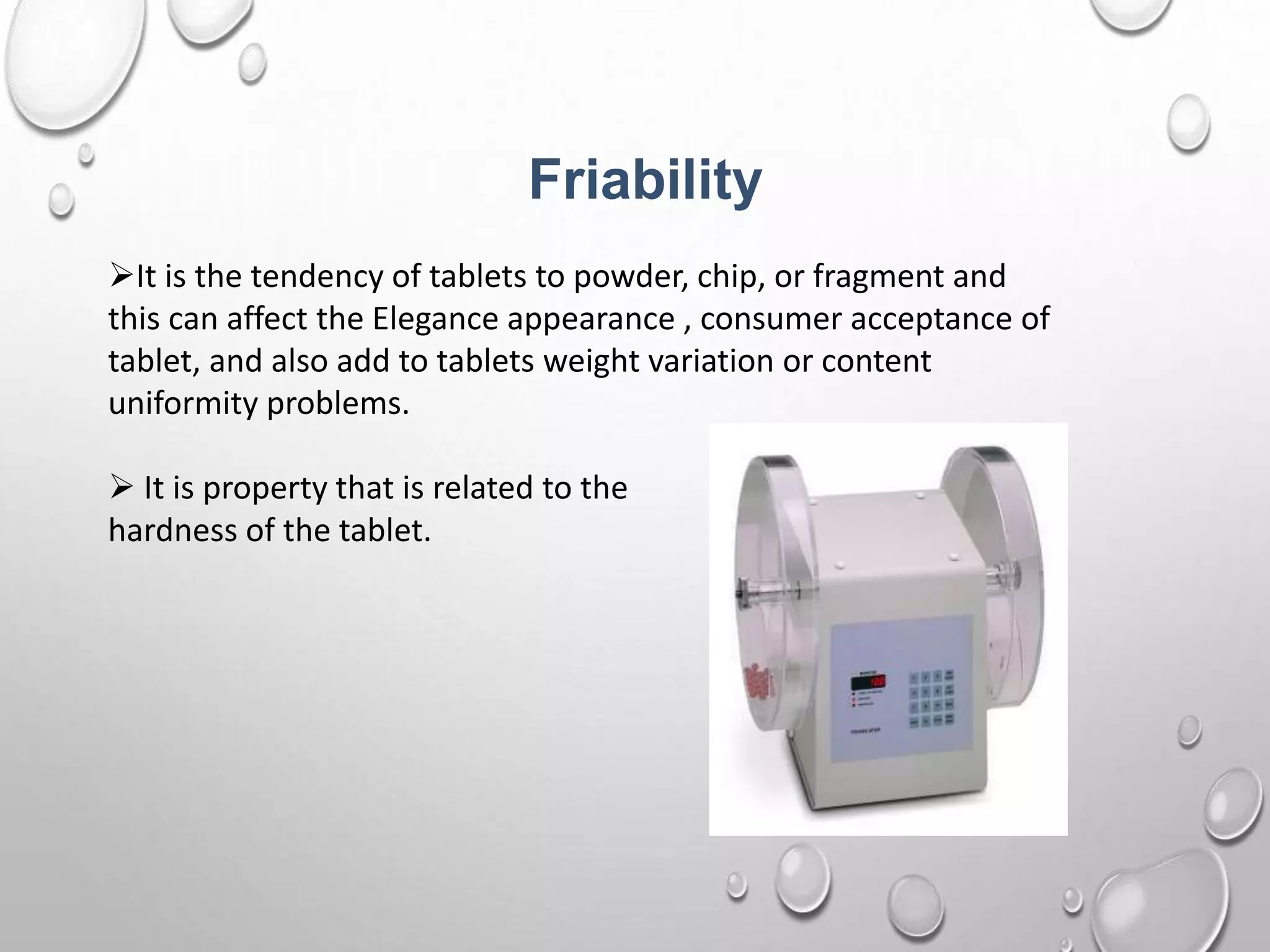
Friability
It is the tendency of tablets to powder, chip, or fragment and
this can affect the Elegance appearance , consumer acceptance of
tablet, and also add to tablets weight variation or content
uniformity problems.
 It is property that is related to the
hardness of the tablet.
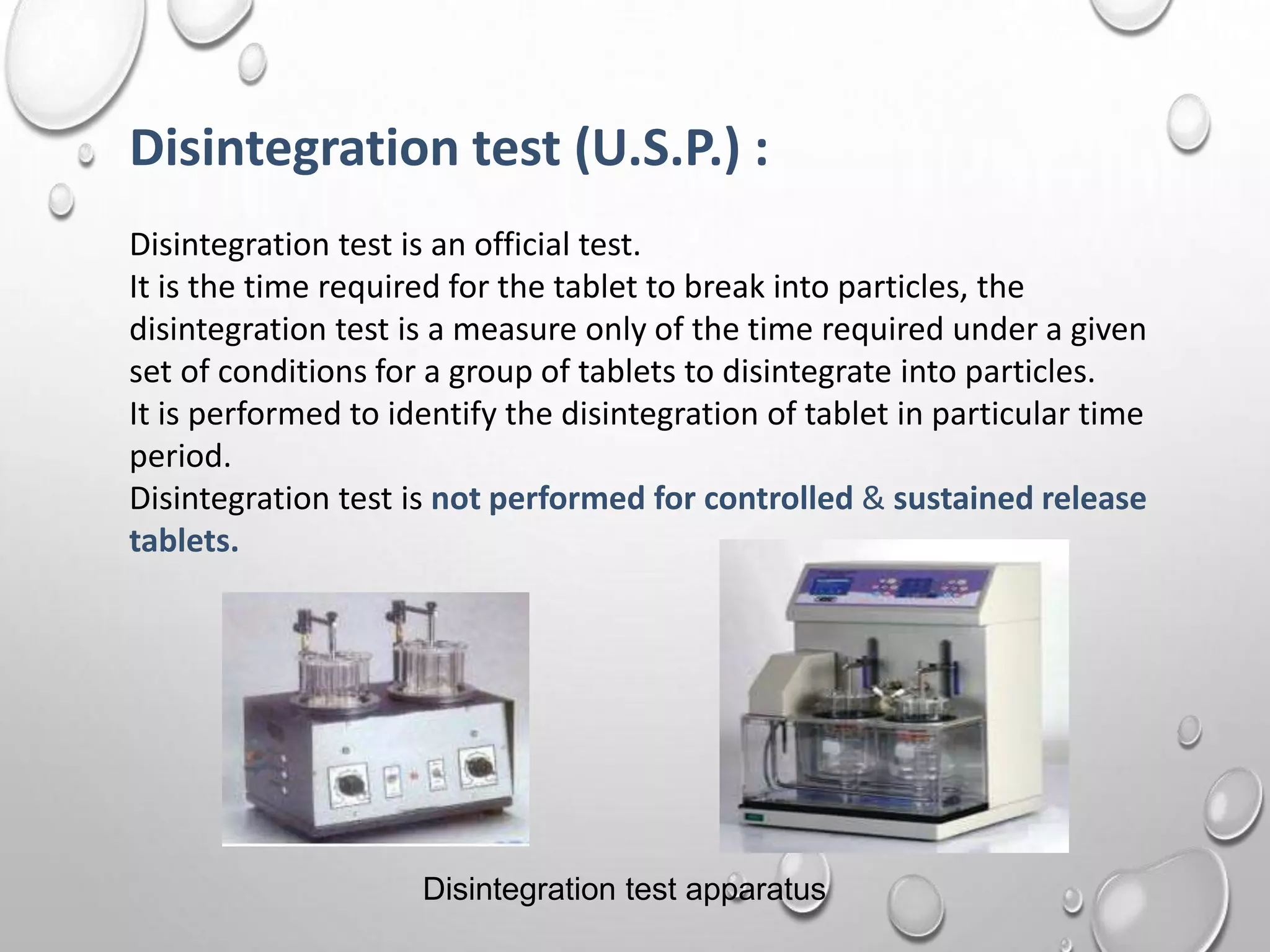
Disintegration test (U.S.P.) :
Disintegration test is an official test.
It is the time required for the tablet to break into particles, the
disintegration test is a measure only of the time required under a given
set of conditions for a group of tablets to disintegrate into particles.
It is performed to identify the disintegration of tablet in particular time
period.
Disintegration test is not performed for controlled & sustained release
tablets.
Disintegration test apparatus
• Weighing 20 tablets individually calculating the average weights and
comparing the individual tablet weights to the average. The value of
weight variation test is expressed in percentage.
• The tablet complies with the test if not more than 2 of the individual
masses deviate from the average mass by more than the percentage .
Weight Variation Test
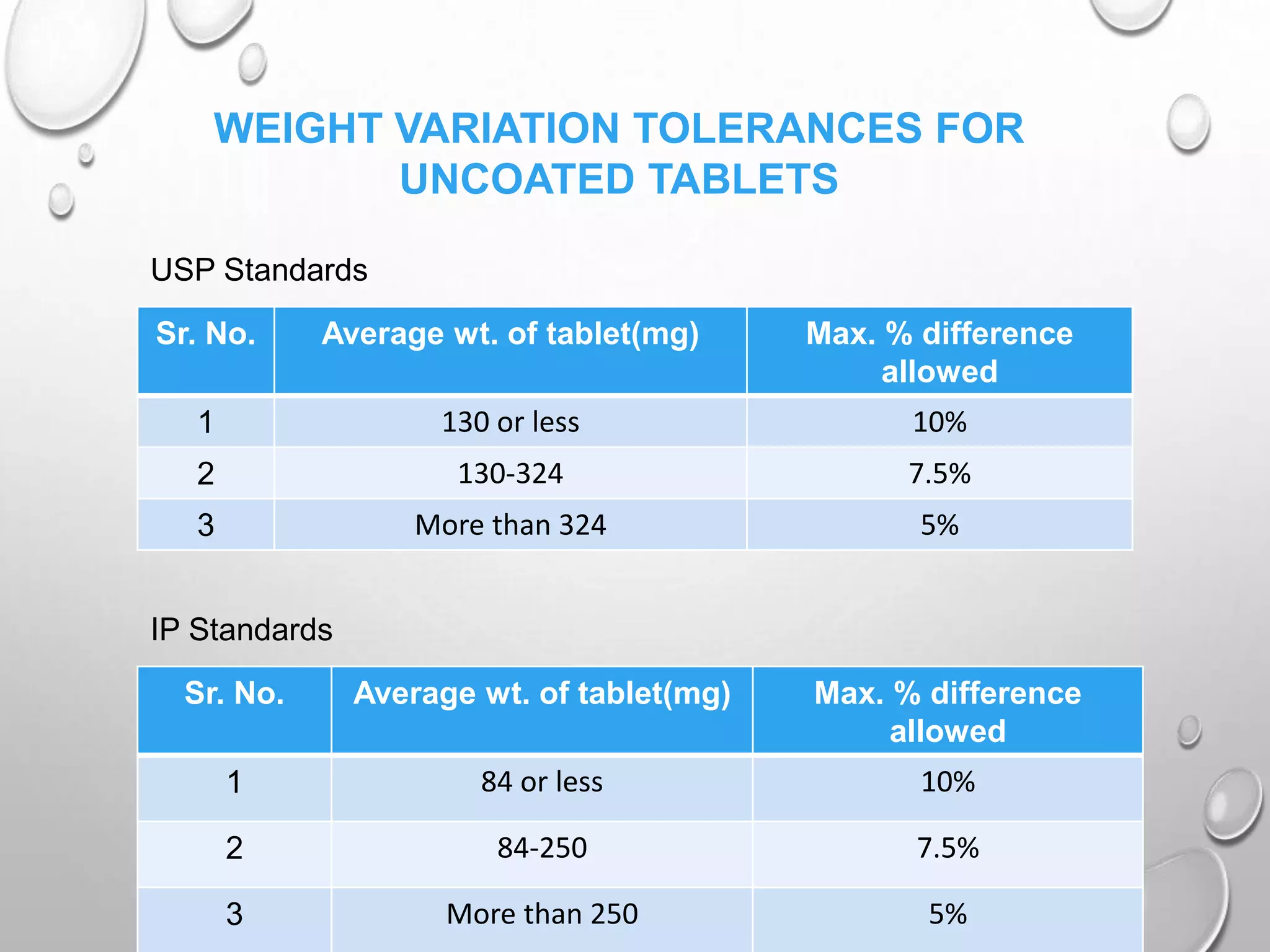
WEIGHT VARIATION TOLERANCES FOR
UNCOATED TABLETS
Sr. No. Average wt. of tablet(mg) Max. % difference
allowed
1 130 or less 10%
2 130-324 7.5%
3 More than 324 5%
Sr. No. Average wt. of tablet(mg) Max. % difference
allowed
1 84 or less 10%
2 84-250 7.5%
3 More than 250 5%
IP Standards
USP Standards
Leakage test for blister or strip
packaging
Vacuum Leak Method is used. It uses methylene Blue dye or another
colored liquid to determine whether or not there is a leak. If there is a
leak, the liquid will seep into the package, thereby giving visual proof.
Vacuum leakage tester
IPQC OF LIQUID
PRODUCTS
IPQC TESTS FOR LIQUID
Visual inspection
Uniformity of content
pH test
Particle size
Determination of phase
Filled volume
Check sealing
• VISUAL INSPECTION
Appearance should be good and patient compliant. Any bad color bad smell
must be handled with care. Physical appearance of products for patient
compliance is critical. So it should be good looking, elegant in appearance.
• DRUG CONTENT DETERMINATION
Determination of drug content in suspension and syrups are important
because their concentration has to be sufficient itself that it produce the
pharmacological action.
• pH OF THE PRODUCT
pH affects the stability of the product so before filling and after filling of
syrups pH has to be checked out. It can be measured by pH meter.
• DETERMINATION OF PHASE
Phase separation may be observed visually or by measuring the
volume of separate phases or by subjecting it to various stress
conditions.
• PARTICLE SIZE
Particle size becomes the important factor for the suitability of the
product and all the particles has to be of same size and shape for
proper dispersion in the solvent.
• FILLED VOLUME
The volume should be checked with the measuring cylinder when
sealing is done. Then it should be adjusted.
• CHECK SEALING
Sealing should be checked by the operator to see if there are any
defects.
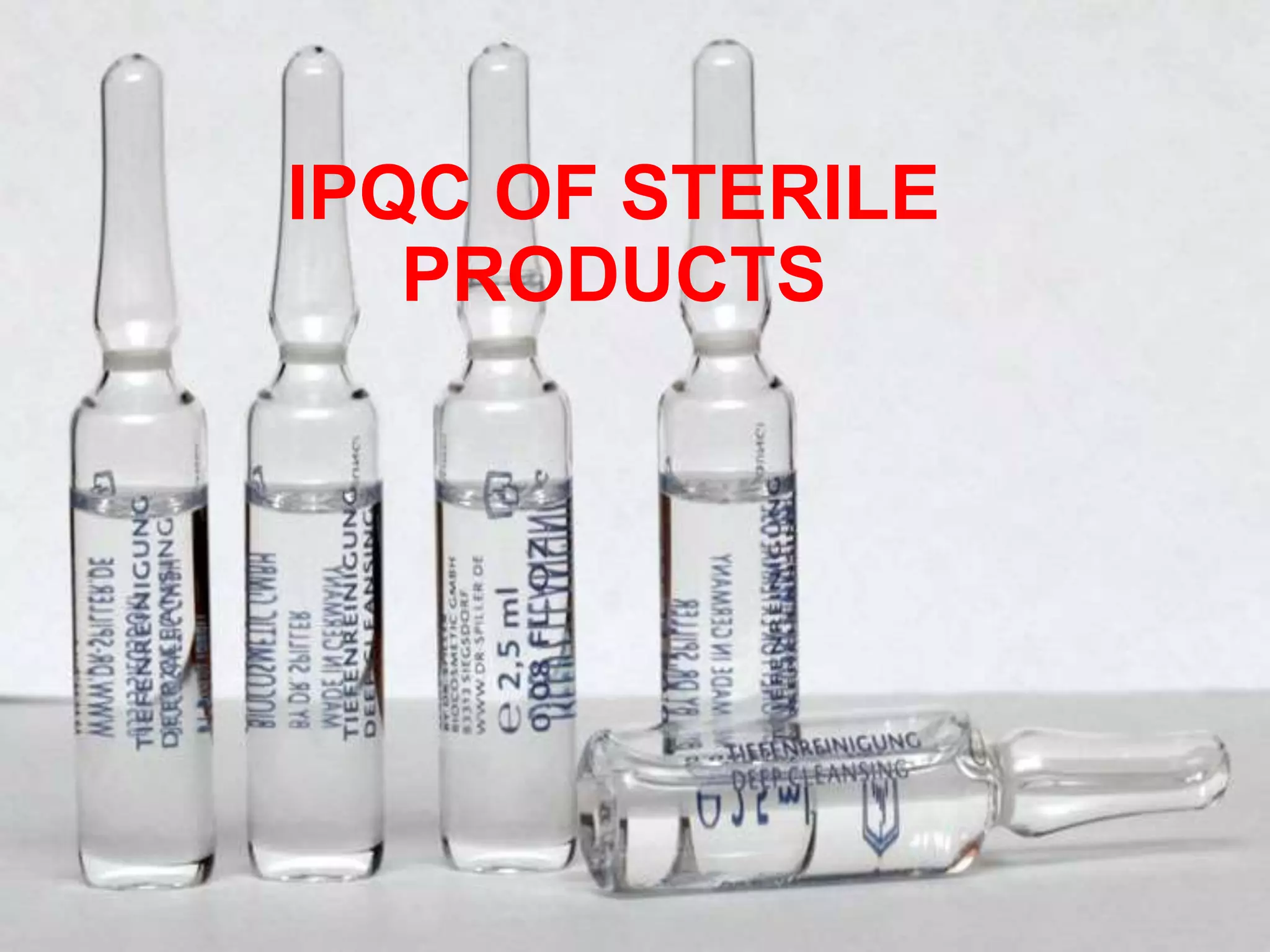
IPQC OF STERILE
PRODUCTS
IPQC TESTS FOR STERILE
PRODUCTS
Some basic IPQC tests are done for sterile products such as:
• pH test
• Conductivity test
• Leakage test
• Volume test
• Clarity test etc.
Other test like potency and sterility test is done by QC.
pH Test
• As sterile products are directly given to body cavity, so its pH must be
compatible with the body fluid.
• The pH range for sterile products is 5.5 – 7.0
• Before starting the manufacturing of the products the pH of WFI is
checked.
• After finishing the manufacturing the pH of the product is also checked.
CONDUCTIVITY TEST
• As like pH the conductivity of the product must be compatible with
body.
• The conductivity range of WFI is 0.3- 1.3 microsiemens/cm
• This is checked for two times.
• First only WFI is checked before manufacturing and then the finished
product is checked.
• This is checked by placing the electrode into the sample as shown in
figure.
VOLUME TEST
• The volume of finished products is checked visually
• This test ensure the right dose
CLARITY TEST
• The preparations clarity is tested visually
• The ampules/vials/bottles are placed under
black and white background under LED light
• Presence of glass particle, dart or fiber is
checked by this test
LEAKAGE TEST
• The test container is immersed in a dye bath.
• Vacuum and negative pressure is applied for some time.
• The container is removed from the dye bath and washed.
• The container is then inspected for the presence of dye visually
• The dye used may be of pink, blue, green, yellowish-green color.
CONCLUSION
• In-process control not only provides a means of controlling production.
it also performs a quality assurance function.
• The objective of the IPQC is to ensure the product quality by checking
the processes.
• If any anomalies shown it is easy to correct it when a few product of a
batch is manufactured.
• By this we can minimize material, time, cost, processes repetition.
• So that can it is easy to develop the quality of products.
• So maintaining IPQC is important and beneficial.
IPQC of dosage form in pharmaceutical industry

IPQC of dosage form in pharmaceutical industry

  • 1.
    In-Process Quality Control Of Pharmaceutical DosageForm Presented By: Kay Kay Shain Marma & Saad Ahmed Sami Dept. of Pharmacy University Of Chittagong Bangladesh.
  • 2.
    IPQC  IPQC standsfor “In Process Quality Control”.  It is a planned system to identify the materials, equipments, processes and operators.  IPQC cover the entire chain of operations from the receipt of raw material in the warehouse to the release of finished products from the warehouse for distribution and or sale.  IPQC tests are performed at regular intervals (generally each 1 hr later) during the manufacturing process. These tests are varied from dosage form to dosage form.
  • 4.
  • 5.
    Importance of IPQC •To detect the errors. • To minimize the human errors. • Provides accurate, specific, and definite description of the procedure to be employed. • Can detect any abnormality immediately and at the same time indicate the kind of action needed to correct the problem. • To enforce the flow of manufacturing and packing operations according to established rules and practices.
  • 6.
    Who do IPQCTest ? Usually, the tests are carried out by- •Quality compliance personnel & •Production personnel. On the basis of organizational instructions and process descriptions, quality control personnel may also carry out the necessary tasks. Where to do IPQC ? • In-process controls may be carried out within the production area provided they do not carry any risk for the production.”
  • 7.
    FACTORS MAKING IPQCEFFECTIVE  People  Training  Environment  Process  Equipment  Management  Better communication
  • 8.
    In Process ChecksShall Includes Following Process Controls • Cleanliness of the area and line clearance • Checking of the status labels on the area and process containers. • Equipment/instrument: Calibration, verification and checking of the status labels. • Checking and verification of material used as Material Name, Material Code, Control No. • Time limits at all stages of process. • Online review of batch record at every stage of process. • Product attributes Like Weight, Hardness. • Verification of yield at various stages of manufacturing process. • Measured values obtained from the room environment like Temperature, Humidity.
  • 9.
  • 10.
    IN-PROCESS QUALITY CONTROL TESTSFOR TABLETS  General appearance test  Hardness  Friability  Disintegration time  Weight variation  Content uniformity  Dissolution test  Leakage testing for strip and blister packaging
  • 11.
    GENERAL APPEARANCE TEST 1.SIZEAND SHAPE : The size and shape of the tablet can be dimensionally described monitored and controlled. it is determined by the tooling during the compression process. 2.COLOR AND ODOUR : Colors used for rapid identification and consumer acceptance. but it must be uniform within a single tablet, from tablet to tablet and from lot to lot. the presence of an odor in a batch of tablets could indicate stability e.g. the characteristic odor of acetic acid in degrading aspirin tablets .Taste is important in consumer acceptance of product.
  • 12.
    3. THICKNESS :Thickness of individual tablets may be measured by a micrometer. Tablet thickness should be controlled within a ±5% variation of a standard. Thickness must be controlled to facilitate packaging. It is expressed in mm .
  • 13.
    • If thetablet is too hard, it may not disintegrate in the required period of time. • If the tablet is too soft, it will not withstand the handling during subsequent processing such as coating or packaging. Hardness Hardness generally measures the tablet crushing strength. It is the load required to crush the tablet when placed on its edge. LIMITS : ( Take 5 tablets and avg. out) Oral tablets 4-10 kg Chewable tablets 3 kg Sustained release tablets 10-20 kg
  • 14.
  • 15.
    Friability It is thetendency of tablets to powder, chip, or fragment and this can affect the Elegance appearance , consumer acceptance of tablet, and also add to tablets weight variation or content uniformity problems.  It is property that is related to the hardness of the tablet.
  • 16.
    Disintegration test (U.S.P.): Disintegration test is an official test. It is the time required for the tablet to break into particles, the disintegration test is a measure only of the time required under a given set of conditions for a group of tablets to disintegrate into particles. It is performed to identify the disintegration of tablet in particular time period. Disintegration test is not performed for controlled & sustained release tablets. Disintegration test apparatus
  • 17.
    • Weighing 20tablets individually calculating the average weights and comparing the individual tablet weights to the average. The value of weight variation test is expressed in percentage. • The tablet complies with the test if not more than 2 of the individual masses deviate from the average mass by more than the percentage . Weight Variation Test
  • 18.
    WEIGHT VARIATION TOLERANCESFOR UNCOATED TABLETS Sr. No. Average wt. of tablet(mg) Max. % difference allowed 1 130 or less 10% 2 130-324 7.5% 3 More than 324 5% Sr. No. Average wt. of tablet(mg) Max. % difference allowed 1 84 or less 10% 2 84-250 7.5% 3 More than 250 5% IP Standards USP Standards
  • 19.
    Leakage test forblister or strip packaging Vacuum Leak Method is used. It uses methylene Blue dye or another colored liquid to determine whether or not there is a leak. If there is a leak, the liquid will seep into the package, thereby giving visual proof. Vacuum leakage tester
  • 20.
  • 21.
    IPQC TESTS FORLIQUID Visual inspection Uniformity of content pH test Particle size Determination of phase Filled volume Check sealing
  • 22.
    • VISUAL INSPECTION Appearanceshould be good and patient compliant. Any bad color bad smell must be handled with care. Physical appearance of products for patient compliance is critical. So it should be good looking, elegant in appearance. • DRUG CONTENT DETERMINATION Determination of drug content in suspension and syrups are important because their concentration has to be sufficient itself that it produce the pharmacological action. • pH OF THE PRODUCT pH affects the stability of the product so before filling and after filling of syrups pH has to be checked out. It can be measured by pH meter.
  • 23.
    • DETERMINATION OFPHASE Phase separation may be observed visually or by measuring the volume of separate phases or by subjecting it to various stress conditions. • PARTICLE SIZE Particle size becomes the important factor for the suitability of the product and all the particles has to be of same size and shape for proper dispersion in the solvent. • FILLED VOLUME The volume should be checked with the measuring cylinder when sealing is done. Then it should be adjusted. • CHECK SEALING Sealing should be checked by the operator to see if there are any defects.
  • 24.
  • 25.
    IPQC TESTS FORSTERILE PRODUCTS Some basic IPQC tests are done for sterile products such as: • pH test • Conductivity test • Leakage test • Volume test • Clarity test etc. Other test like potency and sterility test is done by QC.
  • 26.
    pH Test • Assterile products are directly given to body cavity, so its pH must be compatible with the body fluid. • The pH range for sterile products is 5.5 – 7.0 • Before starting the manufacturing of the products the pH of WFI is checked. • After finishing the manufacturing the pH of the product is also checked.
  • 27.
    CONDUCTIVITY TEST • Aslike pH the conductivity of the product must be compatible with body. • The conductivity range of WFI is 0.3- 1.3 microsiemens/cm • This is checked for two times. • First only WFI is checked before manufacturing and then the finished product is checked. • This is checked by placing the electrode into the sample as shown in figure.
  • 28.
    VOLUME TEST • Thevolume of finished products is checked visually • This test ensure the right dose CLARITY TEST • The preparations clarity is tested visually • The ampules/vials/bottles are placed under black and white background under LED light • Presence of glass particle, dart or fiber is checked by this test
  • 29.
    LEAKAGE TEST • Thetest container is immersed in a dye bath. • Vacuum and negative pressure is applied for some time. • The container is removed from the dye bath and washed. • The container is then inspected for the presence of dye visually • The dye used may be of pink, blue, green, yellowish-green color.
  • 30.
    CONCLUSION • In-process controlnot only provides a means of controlling production. it also performs a quality assurance function. • The objective of the IPQC is to ensure the product quality by checking the processes. • If any anomalies shown it is easy to correct it when a few product of a batch is manufactured. • By this we can minimize material, time, cost, processes repetition. • So that can it is easy to develop the quality of products. • So maintaining IPQC is important and beneficial.