Microencapsulation: Techniques and Characteristics
Dept. Textile and Apparel Designing
College of Rural Home Science
UAS, Dharwad
Mrs. Shameembanu A. Byadgi
Ph.D. Scholar
History
 The microencapsulation procedure was introduced by Bungen burg
de Jon and Kan in the year 1931
 The origin of microencapsulation lie in the pharmaceutical and
paper industries of 1940s
 Textile industry started introducing encapsulated products in
between 1980 and 1990
 Pharmaceutical industry has long used microencapsulation for the
preparation of capsules containing active ingredients
 During the past 10 years this approach has been explored widely by
the agricultural, food, cosmetic and textile industries
Introduction…….
What is MICROENCAPSULATION……???
 Micro-encapsulation is a process in which tiny particles or droplets are surrounded by a
coating to give small capsules with useful properties
 Micro-encapsulation may also be defined as the process of surrounding or enveloping
one substance within another substance on a very small scale, yielding capsules ranging
from less than one micron to several hundred microns in size
 The potential size range of the microcapsules produced is enormous, with typical
diameters being between 2 and 2000 µm
 Capsule walls are typically 0.5-150 µm thick
 The proportion of core material in the capsule is usually between 20 and 95% by mass
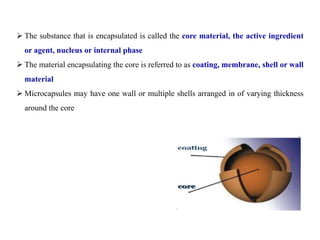
 The substance that is encapsulated is called the core material, the active ingredient
or agent, nucleus or internal phase
 The material encapsulating the core is referred to as coating, membrane, shell or wall
material
 Microcapsules may have one wall or multiple shells arranged in of varying thickness
around the core
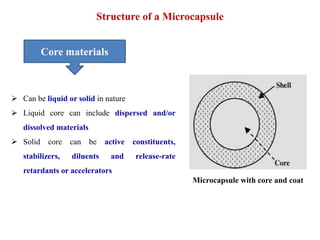
Microcapsule with core and coat
 Can be liquid or solid in nature
 Liquid core can include dispersed and/or
dissolved materials
 Solid core can be active constituents,
stabilizers, diluents and release-rate
retardants or accelerators
Core materials
Structure of a Microcapsule
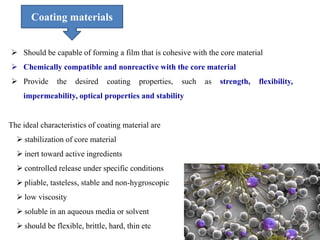
 Should be capable of forming a film that is cohesive with the core material
 Chemically compatible and nonreactive with the core material
 Provide the desired coating properties, such as strength, flexibility,
impermeability, optical properties and stability
The ideal characteristics of coating material are
 stabilization of core material
 inert toward active ingredients
 controlled release under specific conditions
 pliable, tasteless, stable and non-hygroscopic
 low viscosity
 soluble in an aqueous media or solvent
 should be flexible, brittle, hard, thin etc
Coating materials
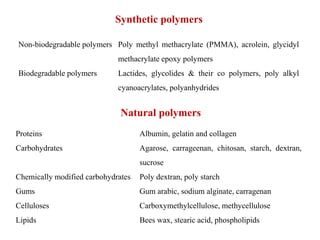
Non-biodegradable polymers Poly methyl methacrylate (PMMA), acrolein, glycidyl
methacrylate epoxy polymers
Biodegradable polymers Lactides, glycolides & their co polymers, poly alkyl
cyanoacrylates, polyanhydrides
Proteins Albumin, gelatin and collagen
Carbohydrates Agarose, carrageenan, chitosan, starch, dextran,
sucrose
Chemically modified carbohydrates Poly dextran, poly starch
Gums Gum arabic, sodium alginate, carragenan
Celluloses Carboxymethylcellulose, methycellulose
Lipids Bees wax, stearic acid, phospholipids
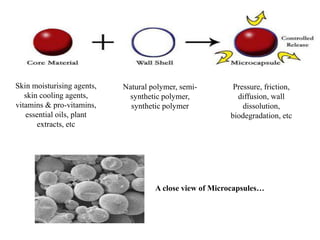
Synthetic polymers
Natural polymers
Skin moisturising agents,
skin cooling agents,
vitamins & pro-vitamins,
essential oils, plant
extracts, etc
Natural polymer, semi-
synthetic polymer,
synthetic polymer
Pressure, friction,
diffusion, wall
dissolution,
biodegradation, etc
A close view of Microcapsules…
MECHANISM ….
How it Works…..???
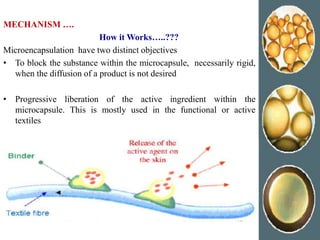
Microencapsulation have two distinct objectives
• To block the substance within the microcapsule, necessarily rigid,
when the diffusion of a product is not desired
• Progressive liberation of the active ingredient within the
microcapsule. This is mostly used in the functional or active
textiles
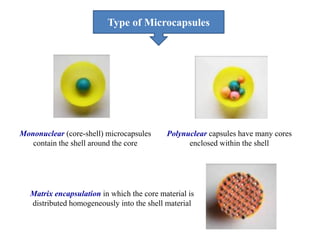
Type of Microcapsules
Mononuclear (core-shell) microcapsules
contain the shell around the core
Polynuclear capsules have many cores
enclosed within the shell
Matrix encapsulation in which the core material is
distributed homogeneously into the shell material
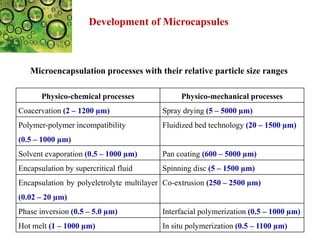
Physico-chemical processes Physico-mechanical processes
Coacervation (2 – 1200 µm) Spray drying (5 – 5000 µm)
Polymer-polymer incompatibility
(0.5 – 1000 µm)
Fluidized bed technology (20 – 1500 µm)
Solvent evaporation (0.5 – 1000 µm) Pan coating (600 – 5000 µm)
Encapsulation by supercritical fluid Spinning disc (5 – 1500 µm)
Encapsulation by polyeletrolyte multilayer
(0.02 – 20 µm)
Co-extrusion (250 – 2500 µm)
Phase inversion (0.5 – 5.0 µm) Interfacial polymerization (0.5 – 1000 µm)
Hot melt (1 – 1000 µm) In situ polymerization (0.5 – 1100 µm)
Microencapsulation processes with their relative particle size ranges
Development of Microcapsules
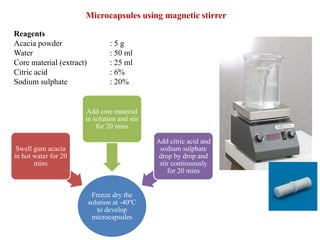
Reagents
Acacia powder : 5 g
Water : 50 ml
Core material (extract) : 25 ml
Citric acid : 6%
Sodium sulphate : 20%
Freeze dry the
solution at -40ºC
to develop
microcapsules
Swell gum acacia
in hot water for 20
mins
Add core material
in solution and stir
for 20 mins
Add citric acid and
sodium sulphate
drop by drop and
stir continuously
for 20 mins
Microcapsules using magnetic stirrer
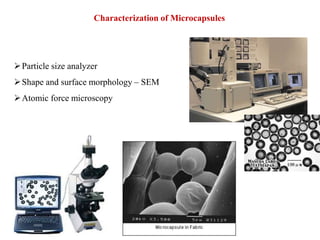
Characterization of Microcapsules
Particle size analyzer
Shape and surface morphology – SEM
Atomic force microscopy
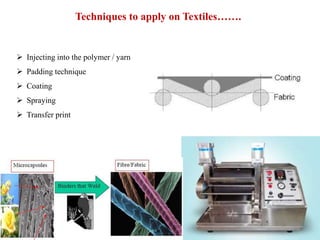
Techniques to apply on Textiles…….
 Injecting into the polymer / yarn
 Padding technique
 Coating
 Spraying
 Transfer print
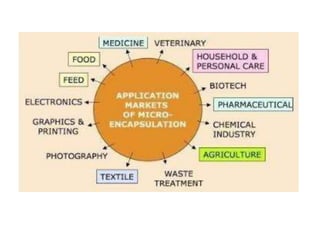
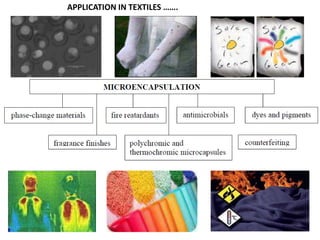
APPLICATION IN TEXTILES …….
INTERESTING ASPECTS !!!!
 Claim to resist up to 25 wash cycles
 Shelf life between 3 – 5 years
 Colourless
 No visible effects when applied over coloured or printed fabrics
 Versatile technology for its controlled release properties
Microencapsulation

Microencapsulation

  • 1.
    Microencapsulation: Techniques andCharacteristics Dept. Textile and Apparel Designing College of Rural Home Science UAS, Dharwad Mrs. Shameembanu A. Byadgi Ph.D. Scholar
  • 2.
    History  The microencapsulationprocedure was introduced by Bungen burg de Jon and Kan in the year 1931  The origin of microencapsulation lie in the pharmaceutical and paper industries of 1940s  Textile industry started introducing encapsulated products in between 1980 and 1990  Pharmaceutical industry has long used microencapsulation for the preparation of capsules containing active ingredients  During the past 10 years this approach has been explored widely by the agricultural, food, cosmetic and textile industries Introduction…….
  • 3.
    What is MICROENCAPSULATION……??? Micro-encapsulation is a process in which tiny particles or droplets are surrounded by a coating to give small capsules with useful properties  Micro-encapsulation may also be defined as the process of surrounding or enveloping one substance within another substance on a very small scale, yielding capsules ranging from less than one micron to several hundred microns in size  The potential size range of the microcapsules produced is enormous, with typical diameters being between 2 and 2000 µm  Capsule walls are typically 0.5-150 µm thick  The proportion of core material in the capsule is usually between 20 and 95% by mass
  • 4.
     The substancethat is encapsulated is called the core material, the active ingredient or agent, nucleus or internal phase  The material encapsulating the core is referred to as coating, membrane, shell or wall material  Microcapsules may have one wall or multiple shells arranged in of varying thickness around the core
  • 5.
    Microcapsule with coreand coat  Can be liquid or solid in nature  Liquid core can include dispersed and/or dissolved materials  Solid core can be active constituents, stabilizers, diluents and release-rate retardants or accelerators Core materials Structure of a Microcapsule
  • 6.
     Should becapable of forming a film that is cohesive with the core material  Chemically compatible and nonreactive with the core material  Provide the desired coating properties, such as strength, flexibility, impermeability, optical properties and stability The ideal characteristics of coating material are  stabilization of core material  inert toward active ingredients  controlled release under specific conditions  pliable, tasteless, stable and non-hygroscopic  low viscosity  soluble in an aqueous media or solvent  should be flexible, brittle, hard, thin etc Coating materials
  • 7.
    Non-biodegradable polymers Polymethyl methacrylate (PMMA), acrolein, glycidyl methacrylate epoxy polymers Biodegradable polymers Lactides, glycolides & their co polymers, poly alkyl cyanoacrylates, polyanhydrides Proteins Albumin, gelatin and collagen Carbohydrates Agarose, carrageenan, chitosan, starch, dextran, sucrose Chemically modified carbohydrates Poly dextran, poly starch Gums Gum arabic, sodium alginate, carragenan Celluloses Carboxymethylcellulose, methycellulose Lipids Bees wax, stearic acid, phospholipids Synthetic polymers Natural polymers
  • 8.
    Skin moisturising agents, skincooling agents, vitamins & pro-vitamins, essential oils, plant extracts, etc Natural polymer, semi- synthetic polymer, synthetic polymer Pressure, friction, diffusion, wall dissolution, biodegradation, etc A close view of Microcapsules…
  • 9.
    MECHANISM …. How itWorks…..??? Microencapsulation have two distinct objectives • To block the substance within the microcapsule, necessarily rigid, when the diffusion of a product is not desired • Progressive liberation of the active ingredient within the microcapsule. This is mostly used in the functional or active textiles
  • 10.
    Type of Microcapsules Mononuclear(core-shell) microcapsules contain the shell around the core Polynuclear capsules have many cores enclosed within the shell Matrix encapsulation in which the core material is distributed homogeneously into the shell material
  • 11.
    Physico-chemical processes Physico-mechanicalprocesses Coacervation (2 – 1200 µm) Spray drying (5 – 5000 µm) Polymer-polymer incompatibility (0.5 – 1000 µm) Fluidized bed technology (20 – 1500 µm) Solvent evaporation (0.5 – 1000 µm) Pan coating (600 – 5000 µm) Encapsulation by supercritical fluid Spinning disc (5 – 1500 µm) Encapsulation by polyeletrolyte multilayer (0.02 – 20 µm) Co-extrusion (250 – 2500 µm) Phase inversion (0.5 – 5.0 µm) Interfacial polymerization (0.5 – 1000 µm) Hot melt (1 – 1000 µm) In situ polymerization (0.5 – 1100 µm) Microencapsulation processes with their relative particle size ranges Development of Microcapsules
  • 12.
    Reagents Acacia powder :5 g Water : 50 ml Core material (extract) : 25 ml Citric acid : 6% Sodium sulphate : 20% Freeze dry the solution at -40ºC to develop microcapsules Swell gum acacia in hot water for 20 mins Add core material in solution and stir for 20 mins Add citric acid and sodium sulphate drop by drop and stir continuously for 20 mins Microcapsules using magnetic stirrer
  • 13.
    Characterization of Microcapsules Particlesize analyzer Shape and surface morphology – SEM Atomic force microscopy
  • 16.
    Techniques to applyon Textiles…….  Injecting into the polymer / yarn  Padding technique  Coating  Spraying  Transfer print
  • 17.
  • 18.
    INTERESTING ASPECTS !!!! Claim to resist up to 25 wash cycles  Shelf life between 3 – 5 years  Colourless  No visible effects when applied over coloured or printed fabrics  Versatile technology for its controlled release properties