Production Control
 The term production means conversion of raw
products into cooked meal or product.
 The production control consists of Production
planning and Production control.
 Production Planning involves establishing of
criteria so that the standard products may be
produced and served. It consists of following
stages.
 VOLUME FORECASTING
 STANDARD YIELD
 STANDARD RECIPE
 STANDARD PORTION SIZE
Volume Forecasting –
Objectives
 To predict the choice of menu item by customer.
 To facilitate the purchasing of raw material.
 To reduce the problem of left over & over production.
 To ensure the availability of all the ingredients.
 To control the food cost in relation to sales
 To enable the food controller to compare between
actual and potential sale and for corrective action to
be taken if necessary.
Process of Forecasting
 INITIAL FORECASTING
 FINAL FORECASTING
Initial forecasting
PAST RECORDS
ADVANCE BOOKING
CURRENT EVENT
CURRENT TRENDS
FESTIVALS
NO OF DOMESTIC & INTERNATION
TOURIST
Final Forecasting
Previous Day Sales
Weather Forecasting
Standard Yield
Yield may be defined by the number of
portions you get or as a yield percentage.
OBJECTIVES OF STANDARD YIELD
 To establish a standard for the quantity and number
of proportions obtainable from a specific item of
food.
 To establish a standard for comparison with operating
results
 To establish an objective method of further
evaluating standard purchase specification.
 To establish the standard cost factor for the items of
food.
 To assist converting forecast requirement into raw
material requirements.
 Acts as double check for the purchasing department.
 Aid to menu pricing and food cost control.
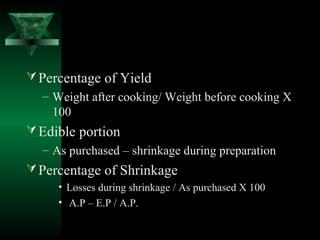
Percentage of Yield
– Weight after cooking/ Weight before cooking X
100
Edible portion
– As purchased – shrinkage during preparation
Percentage of Shrinkage
• Losses during shrinkage / As purchased X 100
• A.P – E.P / A.P.
Yield Test
TRIM TEST
AGING YIELD
BONNING YIELD
COOKING TEST
Standard Recipe
 Exact amount of ingredients.
 Procedure
 Method of preparation
 Cooking time and temperature.
 Yield and Portion size
 Garnish
 Cost per portion
 Nutritional value.
OBJECTIVES OF STANDARD RECIPE
 To determine the quantity and quality of ingredient to be used.
 To obtain the yield obtainable from a recipe.
 To determine the cost per portion.
 To determine the nutritional value.
 To facilitate balance menu planning.
 To facilitate portion control.
 It helps in costing of dishes, pricing menus for banquet.
 It helps in uniform quality and taste.
 Require less supervision.
 Less training is required for a newly appointed employee.
 Establishes food cost control.
Standard Recipe CardIngredient Quantity Unit Cost Total Cost Procedure
Total
Food cost data Output Data Nutritional
Data
Total Per
portion
Total cost No. of portion produced/ Size
of Portion
Fat
Cost per portion Calories
Cooking time Vitamin
Protein
Total preparation time
Garnish
Method of Service
Portion Control
Potion controls means controlling the size
of food to be served to each clientele.
The amount of food allowed depends upon
three factors.
The types of customer or establishment
The quality of food
The buying price of food.
Fair price for fair Portion
Advantage
 Customer satisfaction as he/she is receiving the
same amount every time.
 Food cost is controlled.
 Avoid pilferage by staff.
 Over portioning is avoided.
 Reduces the amount of leftover.
 Helps in indenting.
 Helps in reducing wastage.
 Less of training is required for newly appointed
staff.
Equipment
Standard sized pans,
Serving spoons,
Scoops.
Cups, glasses and moulds,
Cutting markers,
Portions scale
Ladles.

Production control

  • 1.
    Production Control  Theterm production means conversion of raw products into cooked meal or product.  The production control consists of Production planning and Production control.  Production Planning involves establishing of criteria so that the standard products may be produced and served. It consists of following stages.
  • 2.
     VOLUME FORECASTING STANDARD YIELD  STANDARD RECIPE  STANDARD PORTION SIZE
  • 3.
    Volume Forecasting – Objectives To predict the choice of menu item by customer.  To facilitate the purchasing of raw material.  To reduce the problem of left over & over production.  To ensure the availability of all the ingredients.  To control the food cost in relation to sales  To enable the food controller to compare between actual and potential sale and for corrective action to be taken if necessary.
  • 4.
    Process of Forecasting INITIAL FORECASTING  FINAL FORECASTING
  • 5.
    Initial forecasting PAST RECORDS ADVANCEBOOKING CURRENT EVENT CURRENT TRENDS FESTIVALS NO OF DOMESTIC & INTERNATION TOURIST
  • 6.
    Final Forecasting Previous DaySales Weather Forecasting
  • 7.
    Standard Yield Yield maybe defined by the number of portions you get or as a yield percentage.
  • 8.
    OBJECTIVES OF STANDARDYIELD  To establish a standard for the quantity and number of proportions obtainable from a specific item of food.  To establish a standard for comparison with operating results  To establish an objective method of further evaluating standard purchase specification.  To establish the standard cost factor for the items of food.  To assist converting forecast requirement into raw material requirements.  Acts as double check for the purchasing department.  Aid to menu pricing and food cost control.
  • 9.
    Percentage of Yield –Weight after cooking/ Weight before cooking X 100 Edible portion – As purchased – shrinkage during preparation Percentage of Shrinkage • Losses during shrinkage / As purchased X 100 • A.P – E.P / A.P.
  • 10.
    Yield Test TRIM TEST AGINGYIELD BONNING YIELD COOKING TEST
  • 11.
    Standard Recipe  Exactamount of ingredients.  Procedure  Method of preparation  Cooking time and temperature.  Yield and Portion size  Garnish  Cost per portion  Nutritional value.
  • 12.
    OBJECTIVES OF STANDARDRECIPE  To determine the quantity and quality of ingredient to be used.  To obtain the yield obtainable from a recipe.  To determine the cost per portion.  To determine the nutritional value.  To facilitate balance menu planning.  To facilitate portion control.  It helps in costing of dishes, pricing menus for banquet.  It helps in uniform quality and taste.  Require less supervision.  Less training is required for a newly appointed employee.  Establishes food cost control.
  • 13.
    Standard Recipe CardIngredientQuantity Unit Cost Total Cost Procedure Total Food cost data Output Data Nutritional Data Total Per portion Total cost No. of portion produced/ Size of Portion Fat Cost per portion Calories Cooking time Vitamin Protein Total preparation time Garnish Method of Service
  • 14.
    Portion Control Potion controlsmeans controlling the size of food to be served to each clientele. The amount of food allowed depends upon three factors.
  • 15.
    The types ofcustomer or establishment The quality of food The buying price of food. Fair price for fair Portion
  • 16.
    Advantage  Customer satisfactionas he/she is receiving the same amount every time.  Food cost is controlled.  Avoid pilferage by staff.  Over portioning is avoided.  Reduces the amount of leftover.  Helps in indenting.  Helps in reducing wastage.  Less of training is required for newly appointed staff.
  • 17.
    Equipment Standard sized pans, Servingspoons, Scoops. Cups, glasses and moulds, Cutting markers, Portions scale Ladles.