Presented By-
Sathish kumar.P
M. Pharmacy Sem – II
Department of Pharmaceutics
1
⦁ Introduction
⦁ Concepts and Background of QBD
⦁ Advantages of QBD
⦁ Objectives of QBD
⦁ Key Aspects of QBD
⦁ Significance of QBD
⦁ Conclusion
⦁ Reference
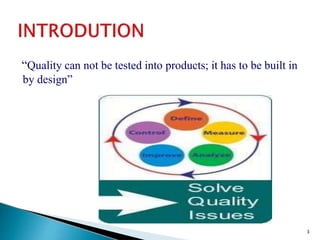
“Quality can not be tested into products; it has to be built in
by design”
3
DEFINATION OF QBD –
• ‘systematic approach to development that begins with predefined
objectives and emphasizes product and process understanding and
process control, based on sound science and quality risk
management’
4
⦁ Quality by Design is a concept first outlined by Joseph M. Juran in
various publications.
⦁ He supposed that quality could be planned. The concept of QBD
was mention in ICH Q8 guidelines, which states that, “To identify
quality can not be tested in products, i.e. Quality should be built
in to product by design.”
 Benefits for Industry:
 Better understanding of the process.
 Less batch failure.
 More efficient and effective control of change.
 Return on investment / cost savings.
5
 Reduction of post-approval submissions.
 More efficient technology transfer to manufacturing.
 Risk-based approach and identification.
 Innovative process validation approaches
 The main objectives of QBD is to ensure the quality
products, for that product & process characteristics
important to desired performance must be resulting from a
combination of prior knowledge & new estimation during
development.
measurement
 From this knowledge
& desired
& data
attributes
process
may be
constructed.
 Ensures combination of product & process
knowledge gained during development.
6
⦁ Q8- Pharmaceutical Development
⦁ Q9- Quality Risk Management
⦁ Q10- Pharmaceutical Quality System
⦁ Q11- Development and Manufacture of Drug Substances
8
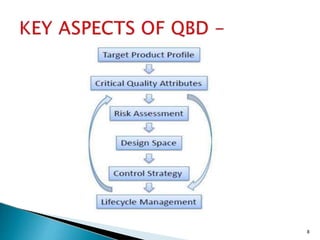
1] The Target Product Quality Profile (TPQP) -
9
TPQP has been defined as a “prospective and dynamic
summary of the quality characteristics of a drug product that
ideally will be achieved to ensure that the desired quality, and thus
the safety and efficacy, of a drug product is realized”.
⦁ TPP forms the basis for product design in the following way
 Dosage form, Route of administration, Strength, Release
 Pharmacological characteristic
 Drug product quality criteria
 Pharmaceutical elegance
2] Critical Quality Attribute (CQA) -
⦁ Once TPQP has been identified, the next step is to identify the
relevant CQAs.
⦁ A CQA has been defined as “a physical, chemical, biological, or
microbiological property or characteristic that should be within an
appropriate limit, range, or distributed to ensure the desired
product quality”
⦁ Prior product knowledge, such as the accumulated laboratory,
nonclinical and clinical experience with a specific product-
quality attribute, is the key in making these risk assessments.
10
3] Critical Process Parameter (CPPs) -
⦁ Critical process parameters (CPPs) are defined as “parameters
whose variability have an impact on a CQA and therefore should
be monitored or controlled to ensure the process produces the
desired quality”
⦁ Process robustness is defined as the ability of a process to
demonstrate acceptable quality and performance and tolerate
variability in inputs at the same time.
11
4] Risk Assessment
⦁ Quality risk management is a systematic process for the
assessment, control, communication and review of risks to the
quality of the drug (medicinal) product across the product
lifecycle.
⦁ The initial list of potential parameters which can affect CQAs
can be quite extensive but can be reduced by quality risk
assessment (QRA).
12
5] Design Space –
⦁ The ICH Q8(R2) States that the design space is multi
dimensional combination and interaction of input variables (e.g.,
material attributes) and process parameters that have been
demonstrated to provide assurance of quality.
⦁ Working within the design space is not considered as a change.
Movement out of the design space is considered to be a change
and would normally initiate a regulatory post approval change
process .
13
6] Control Strategy-
 Control strategy is defined as “a planned set of controls,
derived from current product and process understanding that
assures process performance and product quality”.
 The ability to evaluate and ensure the quality of in- process
and/or final product based on process data which typically
include a valid combination of measured material attributes and
process controls. ICH Q8(R2).

el
The control strategy can include the following
elements: procedural controls, in process controls, lot release
testing, process monitoring, characterization testing, comparability
testing and stability testing .
14
7] Life Cycle Management
⦁ In the QBD paradigm, process changes within the design space
will not require review or approval.
⦁ Therefore, process improvements during the product life cycle
with regard to process consistency and throughput could take
place with fewer post approval submissions.
15
16
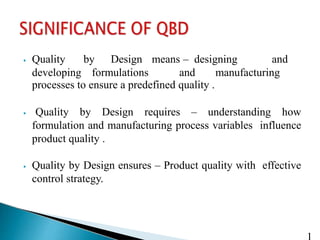
⦁ Quality by Design
developing formulations
means – designing and
and manufacturing
processes to ensure a predefined quality .
⦁ Quality by Design requires – understanding how
formulation and manufacturing process variables influence
product quality .
⦁ Quality by Design ensures – Product quality with effective
control strategy.
 QbD is the effective tool, should be implement from
the initial stage of the product development
independent of target market .
 Discuss QbD scheme with other groups and stake holder to
achieve aim of QbD and keep future projection to avoid
regulatory queries and post approval changes/Variation .
 DoE is not mandatory for QbD based submission.
18
⦁ Research And Reviews: Journal Of Pharmaceutical Quality
Assurance
Quality By Design Sushila D. Chavan*, Nayana V. Pimpodkar,
Amruta
S. Kadam, Puja S.Gaikwad .
⦁ WHO Prequalification Programme : Priority Essential
Medicines Quality By Design (Qbd) And Pharmaceutical
Active Ingredient Maufacture.
19
 ICH Guideline Q8 – Pharmaceutical Development,
http://www.ich.org (10 Nov 2005).
20

sathish cadd 2.pptx

  • 1.
    Presented By- Sathish kumar.P M.Pharmacy Sem – II Department of Pharmaceutics 1
  • 2.
    ⦁ Introduction ⦁ Conceptsand Background of QBD ⦁ Advantages of QBD ⦁ Objectives of QBD ⦁ Key Aspects of QBD ⦁ Significance of QBD ⦁ Conclusion ⦁ Reference
  • 3.
    “Quality can notbe tested into products; it has to be built in by design” 3
  • 4.
    DEFINATION OF QBD– • ‘systematic approach to development that begins with predefined objectives and emphasizes product and process understanding and process control, based on sound science and quality risk management’ 4 ⦁ Quality by Design is a concept first outlined by Joseph M. Juran in various publications. ⦁ He supposed that quality could be planned. The concept of QBD was mention in ICH Q8 guidelines, which states that, “To identify quality can not be tested in products, i.e. Quality should be built in to product by design.”
  • 5.
     Benefits forIndustry:  Better understanding of the process.  Less batch failure.  More efficient and effective control of change.  Return on investment / cost savings. 5  Reduction of post-approval submissions.  More efficient technology transfer to manufacturing.  Risk-based approach and identification.  Innovative process validation approaches
  • 6.
     The mainobjectives of QBD is to ensure the quality products, for that product & process characteristics important to desired performance must be resulting from a combination of prior knowledge & new estimation during development. measurement  From this knowledge & desired & data attributes process may be constructed.  Ensures combination of product & process knowledge gained during development. 6
  • 7.
    ⦁ Q8- PharmaceuticalDevelopment ⦁ Q9- Quality Risk Management ⦁ Q10- Pharmaceutical Quality System ⦁ Q11- Development and Manufacture of Drug Substances
  • 8.
  • 9.
    1] The TargetProduct Quality Profile (TPQP) - 9 TPQP has been defined as a “prospective and dynamic summary of the quality characteristics of a drug product that ideally will be achieved to ensure that the desired quality, and thus the safety and efficacy, of a drug product is realized”. ⦁ TPP forms the basis for product design in the following way  Dosage form, Route of administration, Strength, Release  Pharmacological characteristic  Drug product quality criteria  Pharmaceutical elegance
  • 10.
    2] Critical QualityAttribute (CQA) - ⦁ Once TPQP has been identified, the next step is to identify the relevant CQAs. ⦁ A CQA has been defined as “a physical, chemical, biological, or microbiological property or characteristic that should be within an appropriate limit, range, or distributed to ensure the desired product quality” ⦁ Prior product knowledge, such as the accumulated laboratory, nonclinical and clinical experience with a specific product- quality attribute, is the key in making these risk assessments. 10
  • 11.
    3] Critical ProcessParameter (CPPs) - ⦁ Critical process parameters (CPPs) are defined as “parameters whose variability have an impact on a CQA and therefore should be monitored or controlled to ensure the process produces the desired quality” ⦁ Process robustness is defined as the ability of a process to demonstrate acceptable quality and performance and tolerate variability in inputs at the same time. 11
  • 12.
    4] Risk Assessment ⦁Quality risk management is a systematic process for the assessment, control, communication and review of risks to the quality of the drug (medicinal) product across the product lifecycle. ⦁ The initial list of potential parameters which can affect CQAs can be quite extensive but can be reduced by quality risk assessment (QRA). 12
  • 13.
    5] Design Space– ⦁ The ICH Q8(R2) States that the design space is multi dimensional combination and interaction of input variables (e.g., material attributes) and process parameters that have been demonstrated to provide assurance of quality. ⦁ Working within the design space is not considered as a change. Movement out of the design space is considered to be a change and would normally initiate a regulatory post approval change process . 13
  • 14.
    6] Control Strategy- Control strategy is defined as “a planned set of controls, derived from current product and process understanding that assures process performance and product quality”.  The ability to evaluate and ensure the quality of in- process and/or final product based on process data which typically include a valid combination of measured material attributes and process controls. ICH Q8(R2).  el The control strategy can include the following elements: procedural controls, in process controls, lot release testing, process monitoring, characterization testing, comparability testing and stability testing . 14
  • 15.
    7] Life CycleManagement ⦁ In the QBD paradigm, process changes within the design space will not require review or approval. ⦁ Therefore, process improvements during the product life cycle with regard to process consistency and throughput could take place with fewer post approval submissions. 15
  • 16.
  • 17.
    ⦁ Quality byDesign developing formulations means – designing and and manufacturing processes to ensure a predefined quality . ⦁ Quality by Design requires – understanding how formulation and manufacturing process variables influence product quality . ⦁ Quality by Design ensures – Product quality with effective control strategy.
  • 18.
     QbD isthe effective tool, should be implement from the initial stage of the product development independent of target market .  Discuss QbD scheme with other groups and stake holder to achieve aim of QbD and keep future projection to avoid regulatory queries and post approval changes/Variation .  DoE is not mandatory for QbD based submission. 18
  • 19.
    ⦁ Research AndReviews: Journal Of Pharmaceutical Quality Assurance Quality By Design Sushila D. Chavan*, Nayana V. Pimpodkar, Amruta S. Kadam, Puja S.Gaikwad . ⦁ WHO Prequalification Programme : Priority Essential Medicines Quality By Design (Qbd) And Pharmaceutical Active Ingredient Maufacture. 19  ICH Guideline Q8 – Pharmaceutical Development, http://www.ich.org (10 Nov 2005).
  • 20.