Principles of Antibacterial Agent
Selection
Dr Utkarsh Shah
Department of Pharmacology,
Medical College Baroda
1
General principles of antibacterial
therapy
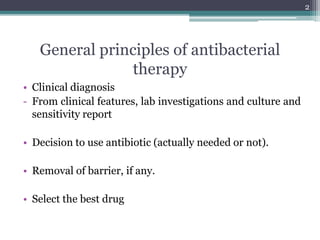
• Clinical diagnosis
- From clinical features, lab investigations and culture and
sensitivity report
• Decision to use antibiotic (actually needed or not).
• Removal of barrier, if any.
• Select the best drug
2
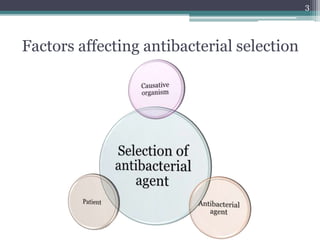
Factors affecting antibacterial selection
3
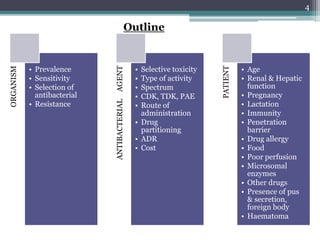
ORGANISM
• Prevalence
• Sensitivity
• Selection of
antibacterial
• Resistance
ANTIBACTERIALAGENT
• Selective toxicity
• Type of activity
• Spectrum
• CDK, TDK, PAE
• Route of
administration
• Drug
partitioning
• ADR
• Cost
PATIENT
• Age
• Renal & Hepatic
function
• Pregnancy
• Lactation
• Immunity
• Penetration
barrier
• Drug allergy
• Food
• Poor perfusion
• Microsomal
enzymes
• Other drugs
• Presence of pus
& secretion,
foreign body
• Haematoma
Outline
4
Factors related to Organism
• Prevalence of organism
- varies from place to place
• Sensitivity pattern
- varies from place to place
- may be different in vivo and in vitro
- culture and sensitivity guide to choose an antibacterial agent.
- Because of in vitro activity that may not be same as in vivo in
some cases - in certain situation if it is not serious, it is better
to rely on clinical response.
5
 Minimum Inhibitory Concentration (MIC)
- lowest concentration of antibacterial which prevents
growth of microorganism.
 Minimum Bactericidal Concentration (MBC)
- concentration of antibacterial which kills 99.9% of the
bacteria.
6
Dilution Tests
• Antibiotics in serially diluted concentrations on solid agar or
in broth medium that contains a culture of test organism
• MIC can be calculated.
• Result: lowest concentration of antibacterial that prevents
visible growth after 18-24 hours of incubation-MIC
• Automated systems measure optical density of broth culture
of clinical isolate in presence of drug is determined.
• If OD exceeds threshold-growth occurred.
• If OD below threshold-MIC
7
Disk diffusion method
• Qualitative assessment
• Performed by applying filter paper disks impregnated
with specific amount of antibacterial onto an agar
surface, over which culture of microorganism has been
streaked.
• Result: after 18-24 hours of incubation, size of clear zone
of inhibition is measured.
• Standardized values for zone sizes for each bacterial
species and antibiotic permit classification as resistant or
susceptible.
8
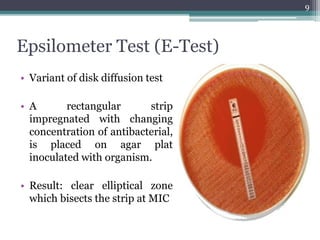
Epsilometer Test (E-Test)
• Variant of disk diffusion test
• A rectangular strip
impregnated with changing
concentration of antibacterial,
is placed on agar plat
inoculated with organism.
• Result: clear elliptical zone
which bisects the strip at MIC
9
•Selection of Antibacterial agent
Cases where diagnosis decides choice of drug
- causative organism is single and its sensitivity pattern is well
known.
- e.g. typhoid, syphilis, diphtheria, tetanus, plague, cholera etc.
Cases where causative organism can be guessed
- Based on c/f and local experience of organism and its
sensitivity
- e.g. otitis media, tonsillitis, boils, urethritis etc.
Cases where causative organism can not be guessed
- culture and sensitivity is preferred.
- e.g. meningitis, pneumonia, empyema, UTI, wound infection
etc.
10
Bacteriological examination not available
- empirical therapy with broad spectrum antibacterial to
cover all possible organisms.
- further treatment is modified according to response.
Bacteriological examination available but treatment can
not be delayed
- in serious infections like meningitis, septicemias
- sample for bacteriological examination is collected and
empirical therapy started which is changed according to
sample result.
11
Bacteriological examination available and treatment can
be delayed
- as in chronic UTI
- wait for culture and sensitivity and start definitive
therapy
12
•Resistance
• Natural resistance
- organism lacks the metabolic process or target site which
is affected by particular antibacterial.
- e.g. gram negative bacilli- penicillin G
anaerobic bacteria- aminoglycoside
• Acquired resistance
- development of resistance by an organism which was
sensitive earlier.
13
Mechanism of Resistance
Mutation
- Genetic alteration.
- replicate and transmit properties to daughter cells.
- vertical transfer of resistance.
- Occur by insertion, deletion or substitution of one or
more nucleotide within the genome.
.
14
DNA transfer (infectious resistance)
- resistance acquired due to DNA transfer from one
organism to other.
- resistance properties are encoded in extrachromosomal
genetic elements (plasmid).
- plasmids enter cell by conjugation, transduction and
transformation.
15
Altered expression of proteins in drug resistant
organism
Modification of target site
- loss of affinity to target site
- altered PBP- penicillin resistance
- plasmid mediated synthesis of dihydrofolate reductase-
low affinity to trimethoprim.
16
Decreased drug accumulation
- ↓permeability of antibacterial into organism
- seen with tetracycline and aminoglycoside.
- active efflux pump which pump out the antibacterial.
- seen with tetracycline, floroquinolones.
Enzymatic inactivation
- resistant microbes secrete an enzyme which inactivates
the drug
- β- lactamase, chloramphenicol acetyl transferase and
adenylate / acetylase / phosphorylase against
aminoglycoside.
17
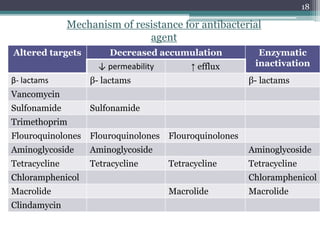
Altered targets Decreased accumulation Enzymatic
inactivation↓ permeability ↑ efflux
β- lactams β- lactams β- lactams
Vancomycin
Sulfonamide Sulfonamide
Trimethoprim
Flouroquinolones Flouroquinolones Flouroquinolones
Aminoglycoside Aminoglycoside Aminoglycoside
Tetracycline Tetracycline Tetracycline Tetracycline
Chloramphenicol Chloramphenicol
Macrolide Macrolide Macrolide
Clindamycin
Mechanism of resistance for antibacterial
agent
18
Factors related to antibacterial agent
• Selective toxicity to organism
- maximized by finding and exploiting differences between
normal human cells and pathogenic cells.
- human cells do not possess a structure analogue to
bacterial cell wall; thus β- lactams are effective against
streptococci but little toxicity to humans.
19
• Type of activity
- With normal host defense – response equally well to
bacteriostatic and bactericidal.
- Bacteriostatic drug arrest the growth and replication
of bacteria → limit spread of infection.
- Body’s immune mechanism attacks, immobilizes and
eliminates the pathogen.
- If the drug is removed before the immune system has
scavenged the organism, enough viable organisms
remain to begin a second cycle of infection.
20
- By contrast, addition of bactericidal agent, kills
bacteria.
• Spectrum
- narrow spectrum- acting on a single or limited
group of microorganisms
e.g. Cloxacillin
- Extended spectrum- effective against both
gram +ve and gram –ve
e.g. ampicillin
- Broad spectrum- covers wide variety of
microorganism
e.g. tetracycline
21
•Selection of dose and dosing schedule
MIC
- response of organism to fixed dose of antibacterials
differs according to susceptibility.
- vancomycin resistance is said when MIC ˃ 2 mg/L.
- In one study, when patients with MRSA infection were
treated with vancomycin
→61% success rate with MIC of 0.5 mg/L
→28% success rate with MIC of 1.0 mg/L
→11% success rate with MIC of 2.0 mg/L
- Thus, outcome were poorer with increasing MIC.
- so, it is important to index drug exposure to MIC.
22
Optimal dose
- Dose itself is a poor measure of drug exposure, given
between-patient and within-patient pharmacokinetic
variability. Rather, actual drug concentration achieved at
site of infection is important.
- non-protein-bound antimicrobial exposures associated
with 80-90% of Emax are termed “optimal“
concentrations.
- The optimal dose of the antibiotic for a patient is the dose
that achieves IC80 to IC90 exposures at the site of
infection.
23
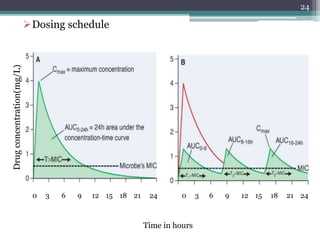
Dosing schedule
Drugconcentration(mg/L)
0 3 6 9 12 15 18 21 24 0 3 6 9 12 15 18 21 24
Time in hours
24
• As same cumulative dose has been given for dosing
interval of 24 hours and 8 hours, so
- AUC0-24=AUC0-8+AUC8-16+AUC16-24
- MIC is 0.5mg/L (same for both).
- So, AUC/MIC will be same for both.
- Cmax is decreased by a third in thrice daily dosing
compared to once daily dosing.
25
- So, Cmax / MIC ratio decrease when drug administered
more frequently.
- T˃MIC- fraction of dosing interval for which the drug
concentration remains above the MIC
- Which is increased with more frequent dosing.
26
• Concentration dependant killing ( CDK )
- Inhibitory effect depends on the ratio of peak
concentration to the MIC (Cmax/MIC).
- More effective at higher concentration.
- Seen with aminoglycoside, flouroquinolones and
metronidazole.
- Giving combined doses on more intermittent
basis (once a day) will maximize the drug action.
- Aminoglycosides are more effective and have less toxicity
in single daily dose in comparison to thrice daily dose.
27
• Time dependant killing ( TDK )
- Kill best when concentration persists above MIC for
longer duration (T˃MIC).
- Increasing drug concentration 4-6 times the MIC does
not increase microbial kill.
- Seen with β- lactams and vancomycin.
- Drug optimized for T˃MIC should be dosed more
frequently or their t1/2 should be prolonged by
other drug.
28
• Cumulative dose
- does not show CDK or TDK.
- So more the total concentration to MIC ratio
(AUC/MIC), more drug effect is seen.
- Seen with daptomycin.
• Post antibiotic effect
- Persistent suppression of bacterial growth after brief
exposure of an antibacterial.
- Inhibition of bacterial growth when its concentration is
below MIC.
29
- reflects time required for bacteria to return to normal
growth.
- due to disruption in bacterial ribosomal or DNA gyrase
function whose resumption requires time.
- seen with aminoglycosides, flouroquinolones,
tetracycline, chloramphenicol and rifampicin.
30
• Route of administration
- Aminoglycosides, penicillin G, carbenicillin, many
cephalosporins have to be given by parental route only.
- For less severe infection-oral route
- For serious infection- parental route is preferable.
• Drug partitioning into cell
- Some bacteria such as chlamydia and mycoplasma are
intracellular pathogens which will be killed by those
antibacterial which can enter into cell. e.g. macrolide and
flouroquinolones.
31
• Side effects and toxicity
- More likely in tissues that interact with drug.
- e.g. aminoglycoside effect on kidney and ear.
- Some adverse reactions are unrelated to either allergy or
overdose known as idiosyncratic.
- e.g. chloramphenicol induced aplastic anaemia
• Cost
- Least expensive drug should be preferred.
32
Factors related to Patient
• Age
- affects kinetics of antibacterials and produces age related
effects.
- renal & hepatic elimination processes are poorly
developed in newborn
- sulfonamide→ kernicterus in neonate
- chloramphenicol → grey baby syndrome in newborn
- aminoglycoside → 8th nerve toxicity in elderly
- tetracycline → yellowish discoloration of teeth
33
• Renal function
- cautious use and modification of the dose of an
antibacterial which is excreted by kidney becomes
necessary when renal function is defective.
- serum creatinine level used as index of renal function.
- monitoring of serum level of antibacterial should be
done.
- elderly patients have decreased number of functioning
nephron→ vulnerable to drug accumulation.
- e.g. penicillin, sulfonamide, aminoglycoside
34
• Hepatic function
- drug which is eliminated by liver should be avoided in
patient with poor hepatic function.
- e.g. erythromycin estolate, pyrazinamide, tetracyclines.
• Pregnancy
- all antibacterials should be avoided.
- penicillins, many cephalosporins and erythromycin are
safe.
35
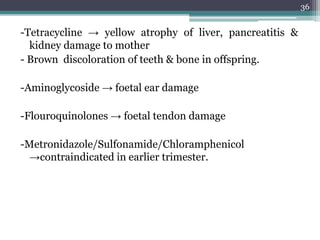
-Tetracycline → yellow atrophy of liver, pancreatitis &
kidney damage to mother
- Brown discoloration of teeth & bone in offspring.
-Aminoglycoside → foetal ear damage
-Flouroquinolones → foetal tendon damage
-Metronidazole/Sulfonamide/Chloramphenicol
→contraindicated in earlier trimester.
36
• Lactation
- Drug administered to a lactating mother may enter the
nursing infant via breast milk.
- even though the concentration of antibacterial in milk is
usually low, the total dose to the infant may be enough to
cause problems.
• Immunity
- normal immunity→ bacteriostatic antibacterial
- impaired immunity → bactericidal antibacterial (higher
doses and longer treatment)
37
- neutropenic patients → pyogenic infection
- HIV, leukemia, severe debilitated immobile patient,
burn, generalized metastasis → opportunistic infection
with intracellular pathogen
• Penetration barrier
- to be effective, each antibacterial has to get to where
pathogen is, to penetrate into the infected compartment
38
- for levofloxacin skin/plasma peak concentration ratio is
1.4, epithelial lining fluid to plasma ratio is 2.8 and urine
to plasma ratio is 67.
- failure rate of therapy was 0% with UTI, 16% for skin &
soft tissue infection.
- poorer the penetration into anatomical compartment
→more chances of failure.
39
- hydrophobic molecule → concentrated in bi-lipid cell
membrane bi-layer.
- hydrophilic molecule → concentrated in blood, cytosol
and other aqueous compartment.
- membrane transporter such as P-glycoprotein → actively
export drug from cellular or tissue compartment back
into blood.
40
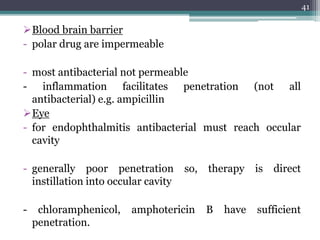
Blood brain barrier
- polar drug are impermeable
- most antibacterial not permeable
- inflammation facilitates penetration (not all
antibacterial) e.g. ampicillin
Eye
- for endophthalmitis antibacterial must reach occular
cavity
- generally poor penetration so, therapy is direct
instillation into occular cavity
- chloramphenicol, amphotericin B have sufficient
penetration.
41
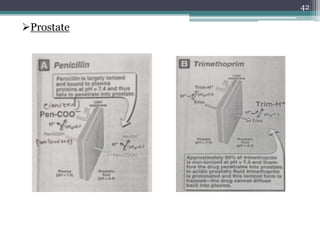
Prostate
42
• Drug allergy
- H/o previous exposure to an antibacterial which caused
allergic reaction should be obtained.
- Same should be avoided, alternative antibacterial.
- Seen with β- lactams, sulfonamide, flouroquinolones and
nitrofurantoin.
• Food
- ↓absorption of ampicillin, azithromycin
- Drug should be taken 1-2 hours before or after food.
- Ca+2, Mg+2, Al+3, milk- ↓absorption of tetracycline &
flouroquinolones.
43
• Poor perfusion
- ↓circulation to an anatomic area, as in lower limbs of the
diabetic → reduces amount of antibacterial that reaches
the extremities.
• Cytochrome P450
- heterogeneity in human population for hepatic
microsomal cytochrome P450.
- possession of an unfavorable phenotype → risk for drug
toxicity.
- slow acetylators of isoniazid → peripheral neuropathy at
standard dose of isoniazid.
44
• Other drugs
- if patient already on other drugs, precautions should be
taken to prevent drug interaction.
- e.g. enzyme inducer/inhibitor, theophylline with
erythromycin etc.
• Presence of pus & secretion
- ↓entry of aminoglycosides
- ↓efficacy of sulfonamide & aminoglycosides
- in abscess, vascularity is low as pus causes tension in
cavity leading to collapse of blood vessel → antibacterial
can not reach.
- drainage of abscess → ↓infective material & organism
↓anaerobic environment
↑diffusion of antibacterial
45
• Presence of necrotic material or foreign body
- bacteria adhering foreign body such as catheters,
implants and prosthesis, are difficult to eradicate.
- bacteria secrete polysaccharide which act as a bridge
which kept them adhered to foreign body known as
biofilm.
- such bacteria are difficult to reach and less vulnerable to
antibacterial.
• pH
- lowering of pH→↑activity of tetracycline, nitrofurantoin
- increasing pH →↑activity of aminoglycoside & macrolide
46
• Haematoma
- foster bacterial growth.
- tetracycline, penicillin, cephalosporin→ get bound to
degraded Hb of haematoma.
47
Combined use of antibacterials
• To prevent emergence of resistance
- Valid for chronic infections needing prolonged therapy
- e.g. TB, leprosy, HIV , H.pylori, malaria.
• To reduce severity of incidence of adverse effects
- Possible only if combination is synergistic so that the dose can
be reduced.
- In c/o drug with low safety margin
- For strep. faecalis in SABE → Streptomycin + penicillin G
48
• To broaden the spectrum of action
Treatment of mixed infection
- e.g. colorectal surgery, brain abcess, diabetic foot ,
gynaecological infection are often mixed infection.
- For colorectal surgery → likely pathogen are E.coli,
streptococci, clostridia & bacteriods. So ampicillin+
gentamicin + metronidazole or cefotaxime+ metronidazole.
- Gynaecological surgery → likely pathogen are coliforms,
streptococci & bacteriods. So, cefotaxime + metronidazole is
suitable.
49
Initial treatment of severe infection
- for empirical therapy, drugs covering both gram +ve and
gram –ve both and for anaerobes in certain cases.
- e.g. penicillin + streptomycin
cephalosporin + aminoglycoside with or
without metronidazole.
Topically
- Antibacterials which are not used systemically, are
poorly absorbed from local site also.
- Such antibacterials which cover gram +ve and gram –ve
are combined for topical use.
- e.g. bacitracin + neomycin + polymyxin B
50
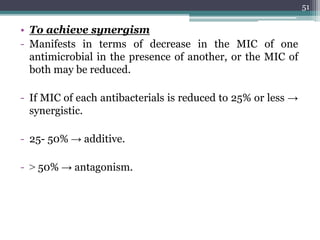
• To achieve synergism
- Manifests in terms of decrease in the MIC of one
antimicrobial in the presence of another, or the MIC of
both may be reduced.
- If MIC of each antibacterials is reduced to 25% or less →
synergistic.
- 25- 50% → additive.
- ˃ 50% → antagonism.
51
Two bacteriostatic drug
- Often additive, rarely synergistic
- e.g. combination of tetracycline, chloramphenicol,
erythromycin etc.
- Sulfonamide + trimethoprim → supraadditive.
52
Two bactericidal drugs
- Frequently additive & sometime synergistic if the
organism is sensitive to both.
- e.g. penicillin + aminoglycoside or vancomycin +
aminoglycoside for enterococcal SABE.
- Carbenicillin/ ticarcillin + gentamicin for pseudomonas
infection.
- Here , combination causes faster cure and reduces the
chances of relapse.
53
Combination of bactericidal with bacteriostatic
- Synergistic or antagonistic
- If organism is highly sensitive to cidal drug →
response to combination is equal to the static drug given
alone (antagonism).
- For pneumococcal meningitis → penicillin +
tetracycline.
- For group A streptococci → penicillin + erythromycin.
54
- If organism has low sensitivity to cidal drug
- Synergism seen
- For actinomycosis → penicillin + sulfonamide
- For brucellosis → streptomycin + tetracycline
55
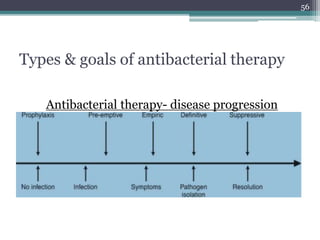
Types & goals of antibacterial therapy
Antibacterial therapy- disease progression
timeline
56
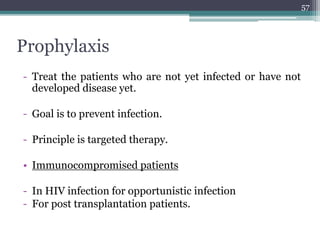
Prophylaxis
- Treat the patients who are not yet infected or have not
developed disease yet.
- Goal is to prevent infection.
- Principle is targeted therapy.
• Immunocompromised patients
- In HIV infection for opportunistic infection
- For post transplantation patients.
57
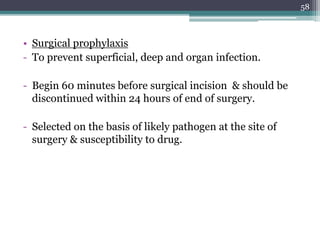
• Surgical prophylaxis
- To prevent superficial, deep and organ infection.
- Begin 60 minutes before surgical incision & should be
discontinued within 24 hours of end of surgery.
- Selected on the basis of likely pathogen at the site of
surgery & susceptibility to drug.
58
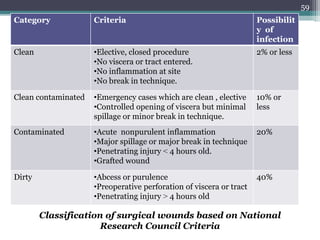
Category Criteria Possibilit
y of
infection
Clean •Elective, closed procedure
•No viscera or tract entered.
•No inflammation at site
•No break in technique.
2% or less
Clean contaminated •Emergency cases which are clean , elective
•Controlled opening of viscera but minimal
spillage or minor break in technique.
10% or
less
Contaminated •Acute nonpurulent inflammation
•Major spillage or major break in technique
•Penetrating injury ˂ 4 hours old.
•Grafted wound
20%
Dirty •Abcess or purulence
•Preoperative perforation of viscera or tract
•Penetrating injury ˃ 4 hours old
40%
Classification of surgical wounds based on National
Research Council Criteria
59
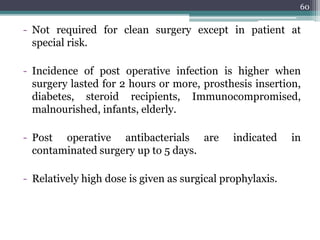
- Not required for clean surgery except in patient at
special risk.
- Incidence of post operative infection is higher when
surgery lasted for 2 hours or more, prosthesis insertion,
diabetes, steroid recipients, Immunocompromised,
malnourished, infants, elderly.
- Post operative antibacterials are indicated in
contaminated surgery up to 5 days.
- Relatively high dose is given as surgical prophylaxis.
60
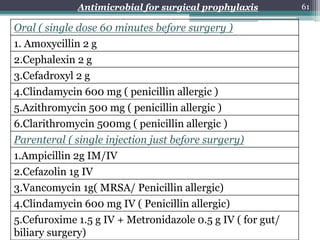
Oral ( single dose 60 minutes before surgery )
1. Amoxycillin 2 g
2.Cephalexin 2 g
3.Cefadroxyl 2 g
4.Clindamycin 600 mg ( penicillin allergic )
5.Azithromycin 500 mg ( penicillin allergic )
6.Clarithromycin 500mg ( penicillin allergic )
Parenteral ( single injection just before surgery)
1.Ampicillin 2g IM/IV
2.Cefazolin 1g IV
3.Vancomycin 1g( MRSA/ Penicillin allergic)
4.Clindamycin 600 mg IV ( Penicillin allergic)
5.Cefuroxime 1.5 g IV + Metronidazole 0.5 g IV ( for gut/
biliary surgery)
Antimicrobial for surgical prophylaxis 61
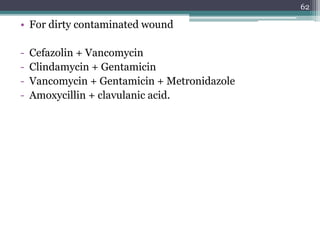
• For dirty contaminated wound
- Cefazolin + Vancomycin
- Clindamycin + Gentamicin
- Vancomycin + Gentamicin + Metronidazole
- Amoxycillin + clavulanic acid.
62
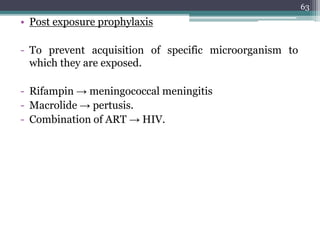
• Post exposure prophylaxis
- To prevent acquisition of specific microorganism to
which they are exposed.
- Rifampin → meningococcal meningitis
- Macrolide → pertusis.
- Combination of ART → HIV.
63
Pre- emptive therapy
- Early targeted therapy in high risk patients who are
already been infected but have not developed symptoms.
- For short & defined duration.
- Ganicyclovir for Cytomegalovirus after hematopoietic or
stem cell transplants & after solid organ transplantation.
64
Empirical therapy
- Diagnosis may be masked if therapy is started and
appropriate cultures are not obtained.
- If cost of waiting for few days is low → wait for
microbiology data & no empirical therapy.
- If the risks for waiting is high (immuno-compromised,
neutropenic) → empirical therapy is started.
- Mostly broad spectrum antibacterials are selected.
65
Definitive therapy
• When pathogen has been isolated and susceptibility
results are available → therapy is streamlined to narrow
targeted antibacterial.
- Monotherapy is preferred.
- Duration of therapy should be as short as possible.
66
Post treatment suppressive therapy
• After initial control of disease with definitive therapy,
therapy is continued at a lower dose.
- Because infection is not completely eradicated &
immunological or anatomical defect that lead to original
infection is still present.
- Goal is secondary prophylaxis.
- In c/o HIV, malaria, post transplant patients.
67
References
• Goodman & Gilman’s The Pharmacological Basis of
THERAPUTICS ,12th edition, page 1365-1381.
• Essentials of MEDICAL PHARMACOLOGY, KD
Tripathi, 7th edition, page 688-703.
• Principles of Pharmacology, HL Sharma & KK Sharma,
2nd edition, page 697-698.
• Lippincott’s Illustrated Reviews: Pharmacology, 2nd
edition, page 279-287.
68
• Modern Pharmacology with Clinical Application, Charles
R. Craig & Robert E. Stitzel, page 543-549.
• Clinical Pharmacology, D R Laurence, P N Bennell, 7th
edition ,page 151-156.
• A complete Textbook of Medical Pharmacology, S K
Srivastava, 1st edition, page 781-789
• Quintessence of Medical Pharmacology, Sujit Chaudhuri,
1st edition, page 435-438.
69
70

Principles of antibacterial agent selection

  • 1.
    Principles of AntibacterialAgent Selection Dr Utkarsh Shah Department of Pharmacology, Medical College Baroda 1
  • 2.
    General principles ofantibacterial therapy • Clinical diagnosis - From clinical features, lab investigations and culture and sensitivity report • Decision to use antibiotic (actually needed or not). • Removal of barrier, if any. • Select the best drug 2
  • 3.
  • 4.
    ORGANISM • Prevalence • Sensitivity •Selection of antibacterial • Resistance ANTIBACTERIALAGENT • Selective toxicity • Type of activity • Spectrum • CDK, TDK, PAE • Route of administration • Drug partitioning • ADR • Cost PATIENT • Age • Renal & Hepatic function • Pregnancy • Lactation • Immunity • Penetration barrier • Drug allergy • Food • Poor perfusion • Microsomal enzymes • Other drugs • Presence of pus & secretion, foreign body • Haematoma Outline 4
  • 5.
    Factors related toOrganism • Prevalence of organism - varies from place to place • Sensitivity pattern - varies from place to place - may be different in vivo and in vitro - culture and sensitivity guide to choose an antibacterial agent. - Because of in vitro activity that may not be same as in vivo in some cases - in certain situation if it is not serious, it is better to rely on clinical response. 5
  • 6.
     Minimum InhibitoryConcentration (MIC) - lowest concentration of antibacterial which prevents growth of microorganism.  Minimum Bactericidal Concentration (MBC) - concentration of antibacterial which kills 99.9% of the bacteria. 6
  • 7.
    Dilution Tests • Antibioticsin serially diluted concentrations on solid agar or in broth medium that contains a culture of test organism • MIC can be calculated. • Result: lowest concentration of antibacterial that prevents visible growth after 18-24 hours of incubation-MIC • Automated systems measure optical density of broth culture of clinical isolate in presence of drug is determined. • If OD exceeds threshold-growth occurred. • If OD below threshold-MIC 7
  • 8.
    Disk diffusion method •Qualitative assessment • Performed by applying filter paper disks impregnated with specific amount of antibacterial onto an agar surface, over which culture of microorganism has been streaked. • Result: after 18-24 hours of incubation, size of clear zone of inhibition is measured. • Standardized values for zone sizes for each bacterial species and antibiotic permit classification as resistant or susceptible. 8
  • 9.
    Epsilometer Test (E-Test) •Variant of disk diffusion test • A rectangular strip impregnated with changing concentration of antibacterial, is placed on agar plat inoculated with organism. • Result: clear elliptical zone which bisects the strip at MIC 9
  • 10.
    •Selection of Antibacterialagent Cases where diagnosis decides choice of drug - causative organism is single and its sensitivity pattern is well known. - e.g. typhoid, syphilis, diphtheria, tetanus, plague, cholera etc. Cases where causative organism can be guessed - Based on c/f and local experience of organism and its sensitivity - e.g. otitis media, tonsillitis, boils, urethritis etc. Cases where causative organism can not be guessed - culture and sensitivity is preferred. - e.g. meningitis, pneumonia, empyema, UTI, wound infection etc. 10
  • 11.
    Bacteriological examination notavailable - empirical therapy with broad spectrum antibacterial to cover all possible organisms. - further treatment is modified according to response. Bacteriological examination available but treatment can not be delayed - in serious infections like meningitis, septicemias - sample for bacteriological examination is collected and empirical therapy started which is changed according to sample result. 11
  • 12.
    Bacteriological examination availableand treatment can be delayed - as in chronic UTI - wait for culture and sensitivity and start definitive therapy 12
  • 13.
    •Resistance • Natural resistance -organism lacks the metabolic process or target site which is affected by particular antibacterial. - e.g. gram negative bacilli- penicillin G anaerobic bacteria- aminoglycoside • Acquired resistance - development of resistance by an organism which was sensitive earlier. 13
  • 14.
    Mechanism of Resistance Mutation -Genetic alteration. - replicate and transmit properties to daughter cells. - vertical transfer of resistance. - Occur by insertion, deletion or substitution of one or more nucleotide within the genome. . 14
  • 15.
    DNA transfer (infectiousresistance) - resistance acquired due to DNA transfer from one organism to other. - resistance properties are encoded in extrachromosomal genetic elements (plasmid). - plasmids enter cell by conjugation, transduction and transformation. 15
  • 16.
    Altered expression ofproteins in drug resistant organism Modification of target site - loss of affinity to target site - altered PBP- penicillin resistance - plasmid mediated synthesis of dihydrofolate reductase- low affinity to trimethoprim. 16
  • 17.
    Decreased drug accumulation -↓permeability of antibacterial into organism - seen with tetracycline and aminoglycoside. - active efflux pump which pump out the antibacterial. - seen with tetracycline, floroquinolones. Enzymatic inactivation - resistant microbes secrete an enzyme which inactivates the drug - β- lactamase, chloramphenicol acetyl transferase and adenylate / acetylase / phosphorylase against aminoglycoside. 17
  • 18.
    Altered targets Decreasedaccumulation Enzymatic inactivation↓ permeability ↑ efflux β- lactams β- lactams β- lactams Vancomycin Sulfonamide Sulfonamide Trimethoprim Flouroquinolones Flouroquinolones Flouroquinolones Aminoglycoside Aminoglycoside Aminoglycoside Tetracycline Tetracycline Tetracycline Tetracycline Chloramphenicol Chloramphenicol Macrolide Macrolide Macrolide Clindamycin Mechanism of resistance for antibacterial agent 18
  • 19.
    Factors related toantibacterial agent • Selective toxicity to organism - maximized by finding and exploiting differences between normal human cells and pathogenic cells. - human cells do not possess a structure analogue to bacterial cell wall; thus β- lactams are effective against streptococci but little toxicity to humans. 19
  • 20.
    • Type ofactivity - With normal host defense – response equally well to bacteriostatic and bactericidal. - Bacteriostatic drug arrest the growth and replication of bacteria → limit spread of infection. - Body’s immune mechanism attacks, immobilizes and eliminates the pathogen. - If the drug is removed before the immune system has scavenged the organism, enough viable organisms remain to begin a second cycle of infection. 20
  • 21.
    - By contrast,addition of bactericidal agent, kills bacteria. • Spectrum - narrow spectrum- acting on a single or limited group of microorganisms e.g. Cloxacillin - Extended spectrum- effective against both gram +ve and gram –ve e.g. ampicillin - Broad spectrum- covers wide variety of microorganism e.g. tetracycline 21
  • 22.
    •Selection of doseand dosing schedule MIC - response of organism to fixed dose of antibacterials differs according to susceptibility. - vancomycin resistance is said when MIC ˃ 2 mg/L. - In one study, when patients with MRSA infection were treated with vancomycin →61% success rate with MIC of 0.5 mg/L →28% success rate with MIC of 1.0 mg/L →11% success rate with MIC of 2.0 mg/L - Thus, outcome were poorer with increasing MIC. - so, it is important to index drug exposure to MIC. 22
  • 23.
    Optimal dose - Doseitself is a poor measure of drug exposure, given between-patient and within-patient pharmacokinetic variability. Rather, actual drug concentration achieved at site of infection is important. - non-protein-bound antimicrobial exposures associated with 80-90% of Emax are termed “optimal“ concentrations. - The optimal dose of the antibiotic for a patient is the dose that achieves IC80 to IC90 exposures at the site of infection. 23
  • 24.
    Dosing schedule Drugconcentration(mg/L) 0 36 9 12 15 18 21 24 0 3 6 9 12 15 18 21 24 Time in hours 24
  • 25.
    • As samecumulative dose has been given for dosing interval of 24 hours and 8 hours, so - AUC0-24=AUC0-8+AUC8-16+AUC16-24 - MIC is 0.5mg/L (same for both). - So, AUC/MIC will be same for both. - Cmax is decreased by a third in thrice daily dosing compared to once daily dosing. 25
  • 26.
    - So, Cmax/ MIC ratio decrease when drug administered more frequently. - T˃MIC- fraction of dosing interval for which the drug concentration remains above the MIC - Which is increased with more frequent dosing. 26
  • 27.
    • Concentration dependantkilling ( CDK ) - Inhibitory effect depends on the ratio of peak concentration to the MIC (Cmax/MIC). - More effective at higher concentration. - Seen with aminoglycoside, flouroquinolones and metronidazole. - Giving combined doses on more intermittent basis (once a day) will maximize the drug action. - Aminoglycosides are more effective and have less toxicity in single daily dose in comparison to thrice daily dose. 27
  • 28.
    • Time dependantkilling ( TDK ) - Kill best when concentration persists above MIC for longer duration (T˃MIC). - Increasing drug concentration 4-6 times the MIC does not increase microbial kill. - Seen with β- lactams and vancomycin. - Drug optimized for T˃MIC should be dosed more frequently or their t1/2 should be prolonged by other drug. 28
  • 29.
    • Cumulative dose -does not show CDK or TDK. - So more the total concentration to MIC ratio (AUC/MIC), more drug effect is seen. - Seen with daptomycin. • Post antibiotic effect - Persistent suppression of bacterial growth after brief exposure of an antibacterial. - Inhibition of bacterial growth when its concentration is below MIC. 29
  • 30.
    - reflects timerequired for bacteria to return to normal growth. - due to disruption in bacterial ribosomal or DNA gyrase function whose resumption requires time. - seen with aminoglycosides, flouroquinolones, tetracycline, chloramphenicol and rifampicin. 30
  • 31.
    • Route ofadministration - Aminoglycosides, penicillin G, carbenicillin, many cephalosporins have to be given by parental route only. - For less severe infection-oral route - For serious infection- parental route is preferable. • Drug partitioning into cell - Some bacteria such as chlamydia and mycoplasma are intracellular pathogens which will be killed by those antibacterial which can enter into cell. e.g. macrolide and flouroquinolones. 31
  • 32.
    • Side effectsand toxicity - More likely in tissues that interact with drug. - e.g. aminoglycoside effect on kidney and ear. - Some adverse reactions are unrelated to either allergy or overdose known as idiosyncratic. - e.g. chloramphenicol induced aplastic anaemia • Cost - Least expensive drug should be preferred. 32
  • 33.
    Factors related toPatient • Age - affects kinetics of antibacterials and produces age related effects. - renal & hepatic elimination processes are poorly developed in newborn - sulfonamide→ kernicterus in neonate - chloramphenicol → grey baby syndrome in newborn - aminoglycoside → 8th nerve toxicity in elderly - tetracycline → yellowish discoloration of teeth 33
  • 34.
    • Renal function -cautious use and modification of the dose of an antibacterial which is excreted by kidney becomes necessary when renal function is defective. - serum creatinine level used as index of renal function. - monitoring of serum level of antibacterial should be done. - elderly patients have decreased number of functioning nephron→ vulnerable to drug accumulation. - e.g. penicillin, sulfonamide, aminoglycoside 34
  • 35.
    • Hepatic function -drug which is eliminated by liver should be avoided in patient with poor hepatic function. - e.g. erythromycin estolate, pyrazinamide, tetracyclines. • Pregnancy - all antibacterials should be avoided. - penicillins, many cephalosporins and erythromycin are safe. 35
  • 36.
    -Tetracycline → yellowatrophy of liver, pancreatitis & kidney damage to mother - Brown discoloration of teeth & bone in offspring. -Aminoglycoside → foetal ear damage -Flouroquinolones → foetal tendon damage -Metronidazole/Sulfonamide/Chloramphenicol →contraindicated in earlier trimester. 36
  • 37.
    • Lactation - Drugadministered to a lactating mother may enter the nursing infant via breast milk. - even though the concentration of antibacterial in milk is usually low, the total dose to the infant may be enough to cause problems. • Immunity - normal immunity→ bacteriostatic antibacterial - impaired immunity → bactericidal antibacterial (higher doses and longer treatment) 37
  • 38.
    - neutropenic patients→ pyogenic infection - HIV, leukemia, severe debilitated immobile patient, burn, generalized metastasis → opportunistic infection with intracellular pathogen • Penetration barrier - to be effective, each antibacterial has to get to where pathogen is, to penetrate into the infected compartment 38
  • 39.
    - for levofloxacinskin/plasma peak concentration ratio is 1.4, epithelial lining fluid to plasma ratio is 2.8 and urine to plasma ratio is 67. - failure rate of therapy was 0% with UTI, 16% for skin & soft tissue infection. - poorer the penetration into anatomical compartment →more chances of failure. 39
  • 40.
    - hydrophobic molecule→ concentrated in bi-lipid cell membrane bi-layer. - hydrophilic molecule → concentrated in blood, cytosol and other aqueous compartment. - membrane transporter such as P-glycoprotein → actively export drug from cellular or tissue compartment back into blood. 40
  • 41.
    Blood brain barrier -polar drug are impermeable - most antibacterial not permeable - inflammation facilitates penetration (not all antibacterial) e.g. ampicillin Eye - for endophthalmitis antibacterial must reach occular cavity - generally poor penetration so, therapy is direct instillation into occular cavity - chloramphenicol, amphotericin B have sufficient penetration. 41
  • 42.
  • 43.
    • Drug allergy -H/o previous exposure to an antibacterial which caused allergic reaction should be obtained. - Same should be avoided, alternative antibacterial. - Seen with β- lactams, sulfonamide, flouroquinolones and nitrofurantoin. • Food - ↓absorption of ampicillin, azithromycin - Drug should be taken 1-2 hours before or after food. - Ca+2, Mg+2, Al+3, milk- ↓absorption of tetracycline & flouroquinolones. 43
  • 44.
    • Poor perfusion -↓circulation to an anatomic area, as in lower limbs of the diabetic → reduces amount of antibacterial that reaches the extremities. • Cytochrome P450 - heterogeneity in human population for hepatic microsomal cytochrome P450. - possession of an unfavorable phenotype → risk for drug toxicity. - slow acetylators of isoniazid → peripheral neuropathy at standard dose of isoniazid. 44
  • 45.
    • Other drugs -if patient already on other drugs, precautions should be taken to prevent drug interaction. - e.g. enzyme inducer/inhibitor, theophylline with erythromycin etc. • Presence of pus & secretion - ↓entry of aminoglycosides - ↓efficacy of sulfonamide & aminoglycosides - in abscess, vascularity is low as pus causes tension in cavity leading to collapse of blood vessel → antibacterial can not reach. - drainage of abscess → ↓infective material & organism ↓anaerobic environment ↑diffusion of antibacterial 45
  • 46.
    • Presence ofnecrotic material or foreign body - bacteria adhering foreign body such as catheters, implants and prosthesis, are difficult to eradicate. - bacteria secrete polysaccharide which act as a bridge which kept them adhered to foreign body known as biofilm. - such bacteria are difficult to reach and less vulnerable to antibacterial. • pH - lowering of pH→↑activity of tetracycline, nitrofurantoin - increasing pH →↑activity of aminoglycoside & macrolide 46
  • 47.
    • Haematoma - fosterbacterial growth. - tetracycline, penicillin, cephalosporin→ get bound to degraded Hb of haematoma. 47
  • 48.
    Combined use ofantibacterials • To prevent emergence of resistance - Valid for chronic infections needing prolonged therapy - e.g. TB, leprosy, HIV , H.pylori, malaria. • To reduce severity of incidence of adverse effects - Possible only if combination is synergistic so that the dose can be reduced. - In c/o drug with low safety margin - For strep. faecalis in SABE → Streptomycin + penicillin G 48
  • 49.
    • To broadenthe spectrum of action Treatment of mixed infection - e.g. colorectal surgery, brain abcess, diabetic foot , gynaecological infection are often mixed infection. - For colorectal surgery → likely pathogen are E.coli, streptococci, clostridia & bacteriods. So ampicillin+ gentamicin + metronidazole or cefotaxime+ metronidazole. - Gynaecological surgery → likely pathogen are coliforms, streptococci & bacteriods. So, cefotaxime + metronidazole is suitable. 49
  • 50.
    Initial treatment ofsevere infection - for empirical therapy, drugs covering both gram +ve and gram –ve both and for anaerobes in certain cases. - e.g. penicillin + streptomycin cephalosporin + aminoglycoside with or without metronidazole. Topically - Antibacterials which are not used systemically, are poorly absorbed from local site also. - Such antibacterials which cover gram +ve and gram –ve are combined for topical use. - e.g. bacitracin + neomycin + polymyxin B 50
  • 51.
    • To achievesynergism - Manifests in terms of decrease in the MIC of one antimicrobial in the presence of another, or the MIC of both may be reduced. - If MIC of each antibacterials is reduced to 25% or less → synergistic. - 25- 50% → additive. - ˃ 50% → antagonism. 51
  • 52.
    Two bacteriostatic drug -Often additive, rarely synergistic - e.g. combination of tetracycline, chloramphenicol, erythromycin etc. - Sulfonamide + trimethoprim → supraadditive. 52
  • 53.
    Two bactericidal drugs -Frequently additive & sometime synergistic if the organism is sensitive to both. - e.g. penicillin + aminoglycoside or vancomycin + aminoglycoside for enterococcal SABE. - Carbenicillin/ ticarcillin + gentamicin for pseudomonas infection. - Here , combination causes faster cure and reduces the chances of relapse. 53
  • 54.
    Combination of bactericidalwith bacteriostatic - Synergistic or antagonistic - If organism is highly sensitive to cidal drug → response to combination is equal to the static drug given alone (antagonism). - For pneumococcal meningitis → penicillin + tetracycline. - For group A streptococci → penicillin + erythromycin. 54
  • 55.
    - If organismhas low sensitivity to cidal drug - Synergism seen - For actinomycosis → penicillin + sulfonamide - For brucellosis → streptomycin + tetracycline 55
  • 56.
    Types & goalsof antibacterial therapy Antibacterial therapy- disease progression timeline 56
  • 57.
    Prophylaxis - Treat thepatients who are not yet infected or have not developed disease yet. - Goal is to prevent infection. - Principle is targeted therapy. • Immunocompromised patients - In HIV infection for opportunistic infection - For post transplantation patients. 57
  • 58.
    • Surgical prophylaxis -To prevent superficial, deep and organ infection. - Begin 60 minutes before surgical incision & should be discontinued within 24 hours of end of surgery. - Selected on the basis of likely pathogen at the site of surgery & susceptibility to drug. 58
  • 59.
    Category Criteria Possibilit yof infection Clean •Elective, closed procedure •No viscera or tract entered. •No inflammation at site •No break in technique. 2% or less Clean contaminated •Emergency cases which are clean , elective •Controlled opening of viscera but minimal spillage or minor break in technique. 10% or less Contaminated •Acute nonpurulent inflammation •Major spillage or major break in technique •Penetrating injury ˂ 4 hours old. •Grafted wound 20% Dirty •Abcess or purulence •Preoperative perforation of viscera or tract •Penetrating injury ˃ 4 hours old 40% Classification of surgical wounds based on National Research Council Criteria 59
  • 60.
    - Not requiredfor clean surgery except in patient at special risk. - Incidence of post operative infection is higher when surgery lasted for 2 hours or more, prosthesis insertion, diabetes, steroid recipients, Immunocompromised, malnourished, infants, elderly. - Post operative antibacterials are indicated in contaminated surgery up to 5 days. - Relatively high dose is given as surgical prophylaxis. 60
  • 61.
    Oral ( singledose 60 minutes before surgery ) 1. Amoxycillin 2 g 2.Cephalexin 2 g 3.Cefadroxyl 2 g 4.Clindamycin 600 mg ( penicillin allergic ) 5.Azithromycin 500 mg ( penicillin allergic ) 6.Clarithromycin 500mg ( penicillin allergic ) Parenteral ( single injection just before surgery) 1.Ampicillin 2g IM/IV 2.Cefazolin 1g IV 3.Vancomycin 1g( MRSA/ Penicillin allergic) 4.Clindamycin 600 mg IV ( Penicillin allergic) 5.Cefuroxime 1.5 g IV + Metronidazole 0.5 g IV ( for gut/ biliary surgery) Antimicrobial for surgical prophylaxis 61
  • 62.
    • For dirtycontaminated wound - Cefazolin + Vancomycin - Clindamycin + Gentamicin - Vancomycin + Gentamicin + Metronidazole - Amoxycillin + clavulanic acid. 62
  • 63.
    • Post exposureprophylaxis - To prevent acquisition of specific microorganism to which they are exposed. - Rifampin → meningococcal meningitis - Macrolide → pertusis. - Combination of ART → HIV. 63
  • 64.
    Pre- emptive therapy -Early targeted therapy in high risk patients who are already been infected but have not developed symptoms. - For short & defined duration. - Ganicyclovir for Cytomegalovirus after hematopoietic or stem cell transplants & after solid organ transplantation. 64
  • 65.
    Empirical therapy - Diagnosismay be masked if therapy is started and appropriate cultures are not obtained. - If cost of waiting for few days is low → wait for microbiology data & no empirical therapy. - If the risks for waiting is high (immuno-compromised, neutropenic) → empirical therapy is started. - Mostly broad spectrum antibacterials are selected. 65
  • 66.
    Definitive therapy • Whenpathogen has been isolated and susceptibility results are available → therapy is streamlined to narrow targeted antibacterial. - Monotherapy is preferred. - Duration of therapy should be as short as possible. 66
  • 67.
    Post treatment suppressivetherapy • After initial control of disease with definitive therapy, therapy is continued at a lower dose. - Because infection is not completely eradicated & immunological or anatomical defect that lead to original infection is still present. - Goal is secondary prophylaxis. - In c/o HIV, malaria, post transplant patients. 67
  • 68.
    References • Goodman &Gilman’s The Pharmacological Basis of THERAPUTICS ,12th edition, page 1365-1381. • Essentials of MEDICAL PHARMACOLOGY, KD Tripathi, 7th edition, page 688-703. • Principles of Pharmacology, HL Sharma & KK Sharma, 2nd edition, page 697-698. • Lippincott’s Illustrated Reviews: Pharmacology, 2nd edition, page 279-287. 68
  • 69.
    • Modern Pharmacologywith Clinical Application, Charles R. Craig & Robert E. Stitzel, page 543-549. • Clinical Pharmacology, D R Laurence, P N Bennell, 7th edition ,page 151-156. • A complete Textbook of Medical Pharmacology, S K Srivastava, 1st edition, page 781-789 • Quintessence of Medical Pharmacology, Sujit Chaudhuri, 1st edition, page 435-438. 69
  • 70.