QUALITY BY DESIGN IN
PHARAMCEUTICAL
DEVELOPMENT
Presented by,
SILAMBARASAN I
DEPT OF PHARMCEUTICS
MTPG & RIHS
INTRODUCTION
▪ Quality is the prime factor in pharmaceutical products.
▪ The principle of Quality is described by ICH guidelines,
Q8- Pharmaceutical development
Q9-Pharamceutical quality risk management
Q10-Pharamceutical quality system
▪ Quality cannot be tested into product i.e. quality should be built in
by design.
▪ Quality-by-design is a recent concept which has been added as an
annex to ICH Q8.
2
Cont,
 Aim of pharmaceutical development
-Design of Quality product
-Manufacturing process to consistently deliver intended performance
 Strategies for product development vary from company to company
and from product to product.
 An applicant might choose either an empirical approach or a more
systemic approach to product development or a combination of both .
 Systemic approach can enhance desired quality of product and help
the regulators to understand company strategy better.
3
Cont,
 Quality by Design,
A systemic approach to development that
- begins with predefined objectives
- emphasizes product and process understanding
- process control ,based on sound science and quality
risk management.
4
HISTORY OF QbD
▪ Term “Quality by design”-Joseph M. Juran in 1985
▪ Published in “Juran on Quality by Design”
▪ Proposed Juran’s Triology –Planning,control,Improvement
▪ Report on “Pharmaceutical cGmp for the 21st century ,A risk based
approach” by USFDA in 2002.
▪ Introduction of term QbD in pharmaceutical industry is with ICH through
Q8(R2) guideline in 2009.
▪ First drug using QbD is “JANUVIA” -Sitagliptin
5
SIGNIFICANCE OF QbD
 Quality by Design means:
Designing and developing formulations and manufacturing.
 Quality by Design requires:
Understanding how formulation and manufacturing process
variables influence product quality.
 Quality by Design ensures:
Product quality with effective control strategy.
6
BENEFITS OF QbD for industry
▪ Eliminate batch failures.
▪ Minimize deviations and costly investigations.
▪ Empowerment of technical staff.
▪ Increase manufacturing efficiency.
▪ Better understanding of the process.
 Continuous improvement.
 Ensure better design of product with less cost.
7
BENEFITS OF QbD for REGULATORs
 Improves quality of review.
 Ensure scientific base of analysis.
 More flexibility in decision making.
 Provide better consistency.
 Ensures decision made on science not on
empirical information.
8
DRAWBACKS OF QbD
▪ New concept – hard to adapt.
▪ Just starting to be recognised by authorities.
▪ Require time to understand process and product.
9
QbD approach
QUALITYTARGETPRODUCTPROFILE (QTPP)
▪ According to the ICH Q8 guideline, QTPP is a prospective
summary of the quality characteristics of a drug product
to ensure the desired quality, taking into account safety
and efficacy of that drug product.
 At the start of development.
10
Components of QTPP
Critical and non-critical components
▪ Critical: Assay, content uniformity
▪ Non-critical: Appearance
Fixed and variable components
▪ Fixed elements must be present
e.g. Dosage form, strength
▪ Variable elements may have a range of acceptable values
e.g. Tablet weight, assay
11
QTPP components for IR tablet –Example
▪ Dosage Form
▪ Route of administration
▪ Strength
▪ Weight
▪ Pharmacokinetics
▪ Appearance
▪ Identity
▪ Assay
▪ Impurities
▪ Content uniformity
▪ Friability
▪ Dissolution
▪ Residual solvents
12
Critical QualityAttributes (CQA)
It is used to guide product development such as
▪ Physical
▪ Chemical
▪ Microbiological property that should be within an
appropriate limit.
▪ Assay, Content uniformity – CQAs
▪ CQAs ensure that DP remains within safe and effective
levels.
▪ CQAs are monitored throughout the DP development.
13
Critical ProcessParameter (CPP)
▪ Parameters whose variability have an impact on a CQA
▪ It should be monitored to ensure the process produces
the desired quality.
▪ It is input.
14
Design Space
▪ Design space is multidimensional combination and interaction
of input variables (e.g., material attributes) and process
parameters that have been demonstrated to provide assurance
of quality.
15
ICH Q8 GUIDELINE
 It describes good practices for pharmaceutical product
development.
 It is used to improve productivity & quality assurance in
pharmaceutical industry.
 It provide opportunities for pharmaceutical
manufacturers to seek ,
- Regulatory flexibility,
- Mitigation of some activities required for product
registration,
- Reduce Stringent in Post approval change process.
16
Cont,
• Pharmaceutical manufacturers are encouraged to describe
the design space in their submission by using a variety of
terms in the entire manufacturing process.
• In order to ensure the product of required quality is
produced, various control strategies are designed.
• These strategies are based on product, formulation ,process
understanding .
17
18
1. Introduction
Objective
2. Pharmaceutical Development
Components of Drug Product
a) Drug Substance
b) Excipients
 Drug Product
a) Formulation Development
b) Overages
c) Physiochemical and Biological
Properties
Manufacturing Process
Development
Container Closure System
Microbial Attributes
Compatibility
TABLE OF CONTENTS
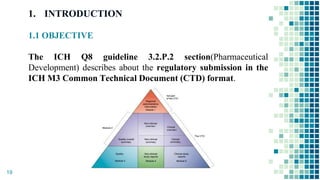
1. INTRODUCTION
1.1 OBJECTIVE
The ICH Q8 guideline 3.2.P.2 section(Pharmaceutical
Development) describes about the regulatory submission in the
ICH M3 Common Technical Document (CTD) format.
19
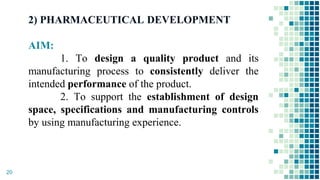
2) PHARMACEUTICAL DEVELOPMENT
AIM:
1. To design a quality product and its
manufacturing process to consistently deliver the
intended performance of the product.
2. To support the establishment of design
space, specifications and manufacturing controls
by using manufacturing experience.
20
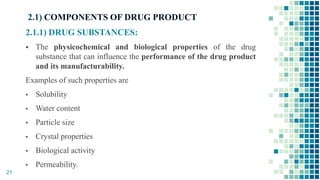
2.1) COMPONENTS OF DRUG PRODUCT
2.1.1) DRUG SUBSTANCES:
 The physicochemical and biological properties of the drug
substance that can influence the performance of the drug product
and its manufacturability.
Examples of such properties are
▪ Solubility
▪ Water content
▪ Particle size
▪ Crystal properties
▪ Biological activity
▪ Permeability.
21
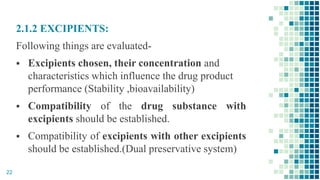
2.1.2 EXCIPIENTS:
Following things are evaluated-
 Excipients chosen, their concentration and
characteristics which influence the drug product
performance (Stability ,bioavailability)
 Compatibility of the drug substance with
excipients should be established.
 Compatibility of excipients with other excipients
should be established.(Dual preservative system)
22
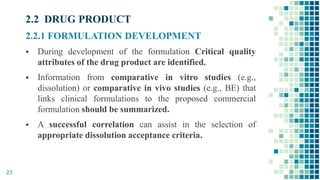
2.2 DRUG PRODUCT
2.2.1 FORMULATION DEVELOPMENT
 During development of the formulation Critical quality
attributes of the drug product are identified.
 Information from comparative in vitro studies (e.g.,
dissolution) or comparative in vivo studies (e.g., BE) that
links clinical formulations to the proposed commercial
formulation should be summarized.
 A successful correlation can assist in the selection of
appropriate dissolution acceptance criteria.
23
2.2.2 OVERAGES
 Overages in the manufacture of the drug product, whether
they appear in the final formulated product or not, should be
justified considering the safety and efficacy of the product.
 Information should be provided about the
1) Amount of overage.
2) Reason for the overage
3) Justification for the amount of overage.
24
2.2.3 PHYSIOCHEMICAL & BIOLOGICAL PROPERTIES
 Safety,
 Performance
 Manufacturability of the drug product should be identified and
discussed.
25
2.3 MANUFACTURING PROCESS DEVELOPMENT
 Any improvement in manufacturing process should be
explained.
 Address the selection of the manufacturing process and
confirm the appropriateness of the components and the
equipment used.
 Identifies the critical process parameters that should be
monitored or controlled to ensure the desired product quality.
26
2.4 CONTAINER CLOSURE SYSTEM
The following should be discussed.
 Choice for selection of the container closure system
 Choice of materials for primary and secondary packaging
 Possible interaction between product and container
27
2.5 MICROBIOLOGICAL ATTRIBUTES
 For sterile products, the integrity of the container closure
system relates to preventing microbial contamination.
 The lowest specified concentration of antimicrobial
preservative should be demonstrated to be effective in
controlling microorganism by using antimicrobial
preservative effectiveness test.
 The concentration used should be justified in terms of
efficacy and safety.
28
REGULATORY AND INDUSTRIAL VIEWS ON QbD
FDA :
▪ It states that QbD concept can lead to cost savings and
efficiency improvements for both industry and regulators.
▪ QbD can make innovation ,increase manufacturing
efficiency, Reduce cost ,opportunities for continual
improvement.
29
Cont,
ICH quality implementation working group
(Q-IWG):
▪ It prepared various templates,
▪ Workshop training materials,
▪ Questions and answers ,
▪ Points- to-consider document ,
- that covers ICH Q8(R2), ICH Q9, and ICH Q10
guidelines.
30
Cont,
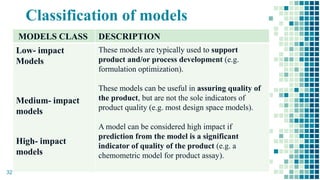
▪ Models are expected to enhance scientific
understanding and predict the behavior of a
system under a set of conditions.
▪ For the purposes of regulatory submissions,
the ICH Q-IWG document classifies the
models according to their relative contribution.
31
Classification of models
32
MODELS CLASS DESCRIPTION
Low- impact
Models
Medium- impact
models
High- impact
models
These models are typically used to support
product and/or process development (e.g.
formulation optimization).
These models can be useful in assuring quality of
the product, but are not the sole indicators of
product quality (e.g. most design space models).
A model can be considered high impact if
prediction from the model is a significant
indicator of quality of the product (e.g. a
chemometric model for product assay).
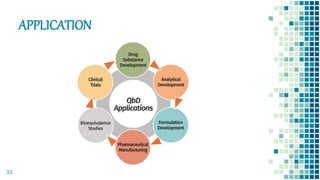
APPLICATION
33
1) Insulin
▪ QbD principles used to investigate the spray
drying process of insulin intended for
pulmonary administration.
2) Multi particulate system
▪ QbD principles used to multi particulate system
designed for colon-specific delivery of celecoxib
for both systemic and local therapy.
34
Cont,
3) Nano suspension
▪ A QbD approach used to study the process of a
Nano suspension preparation.
4 ) Liposomes
▪ QbD was applied in development of liposomes
containing a hydrophilic drug .
35
5) Used in formulation of dispersible tablet.
6) Used in industrial fluidized bed granulation
process.
36
REFERENCES
▪ Jelena Djuris, “Computer Aided Application in
Pharmaceutical Technology ”, First Edition,
Woodhead Publishing.
▪ ICH Q8_R2_Guideline.
37
THANK YOU
38