QUALITY AUDIT
BY;- SANCHIT
DHANKHAR
CONTENTS
 Definition
 Objectives
 Difference between Quality audit and Periodic
evaluation
 Self inspection
 Types of Quality Audit
 Role OF GMP Audit in QA and QC programmes
 Elements of a Systemic Audit program
Quality Audit
 Quality audit is defined as a systematic and
independent examination to determine whether
activities and related results comply with
planned arrangements and whether these
arrangements are implemented effectively and
are suitable to achieve objectives
1.Quality Audit
 Quality audit means a systematic examination of
a quality system.
 Quality audits are typically performed at defined
intervals
 Any failure in their proper implementation may
be published publicly and may lead to a
revocation of quality certification
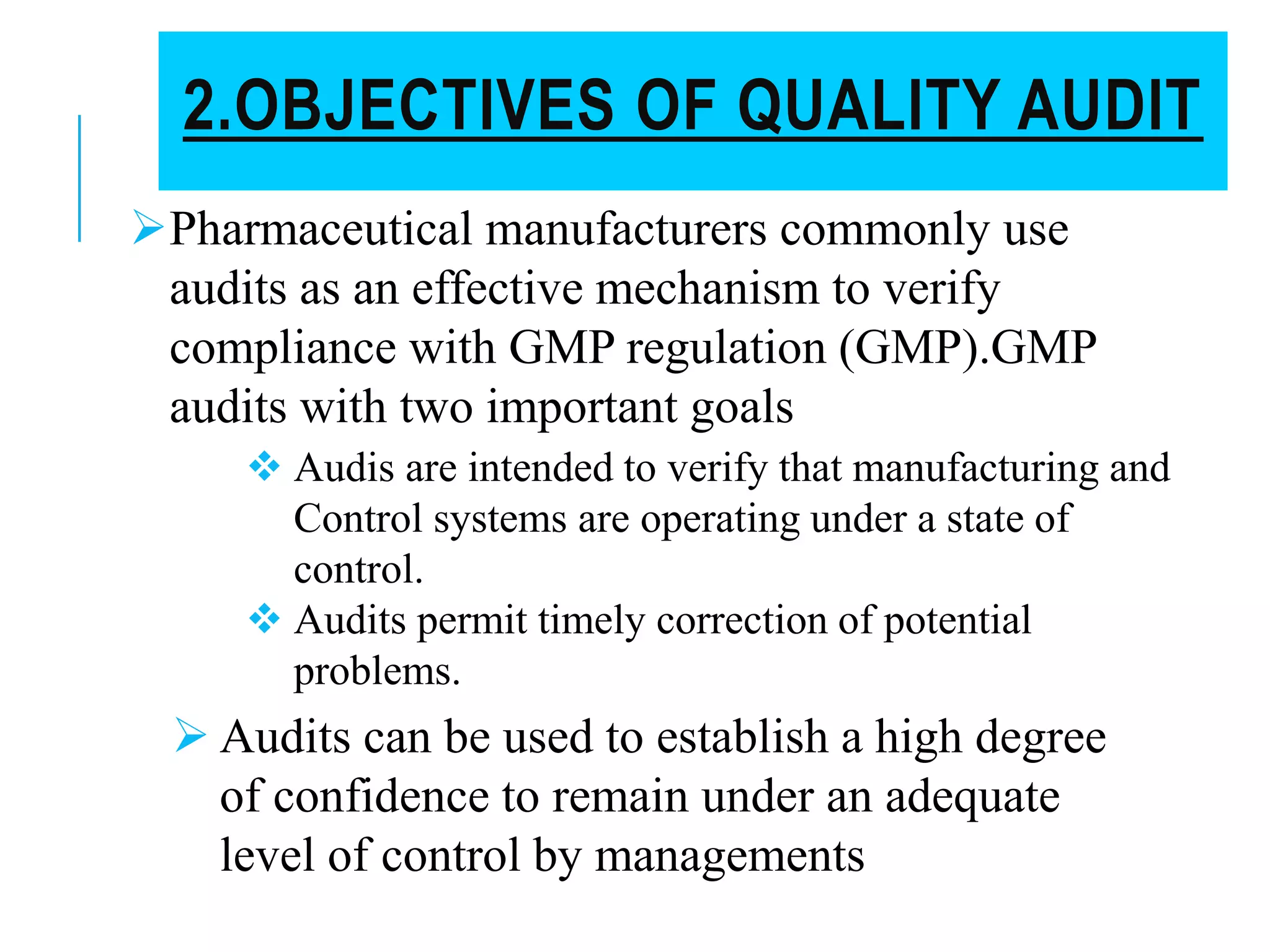
2.OBJECTIVES OF QUALITY AUDIT
Pharmaceutical manufacturers commonly use
audits as an effective mechanism to verify
compliance with GMP regulation (GMP).GMP
audits with two important goals
 Audis are intended to verify that manufacturing and
Control systems are operating under a state of
control.
 Audits permit timely correction of potential
problems.
 Audits can be used to establish a high degree
of confidence to remain under an adequate
level of control by managements
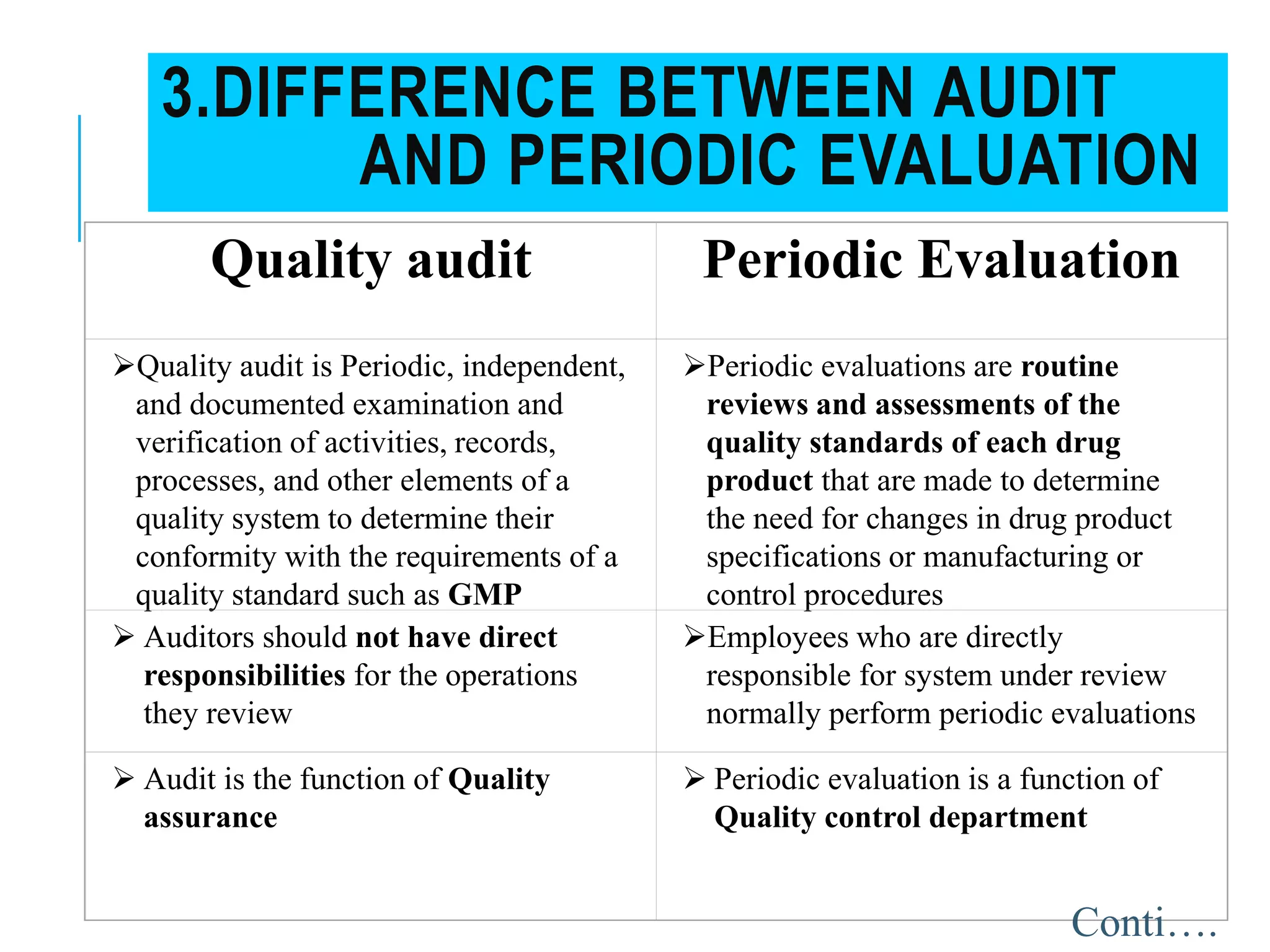
3.DIFFERENCE BETWEEN AUDIT
AND PERIODIC EVALUATION
Quality audit Periodic Evaluation
Quality audit is Periodic, independent,
and documented examination and
verification of activities, records,
processes, and other elements of a
quality system to determine their
conformity with the requirements of a
quality standard such as GMP
Periodic evaluations are routine
reviews and assessments of the
quality standards of each drug
product that are made to determine
the need for changes in drug product
specifications or manufacturing or
control procedures
 Auditors should not have direct
responsibilities for the operations
they review
Employees who are directly
responsible for system under review
normally perform periodic evaluations
 Audit is the function of Quality
assurance
 Periodic evaluation is a function of
Quality control department
Conti….
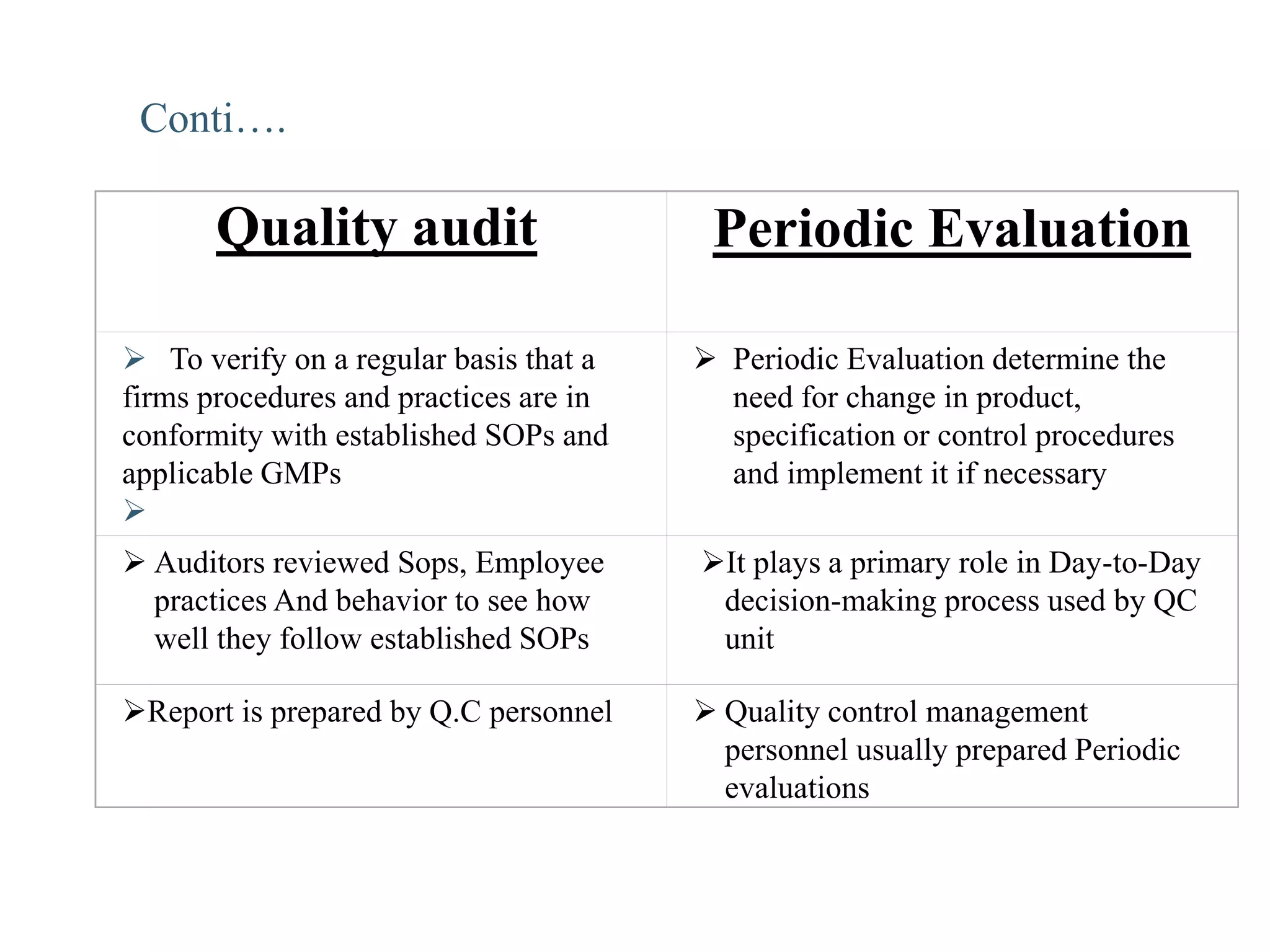
Quality audit Periodic Evaluation
 To verify on a regular basis that a
firms procedures and practices are in
conformity with established SOPs and
applicable GMPs

 Periodic Evaluation determine the
need for change in product,
specification or control procedures
and implement it if necessary
 Auditors reviewed Sops, Employee
practices And behavior to see how
well they follow established SOPs
It plays a primary role in Day-to-Day
decision-making process used by QC
unit
Report is prepared by Q.C personnel  Quality control management
personnel usually prepared Periodic
evaluations
Conti….
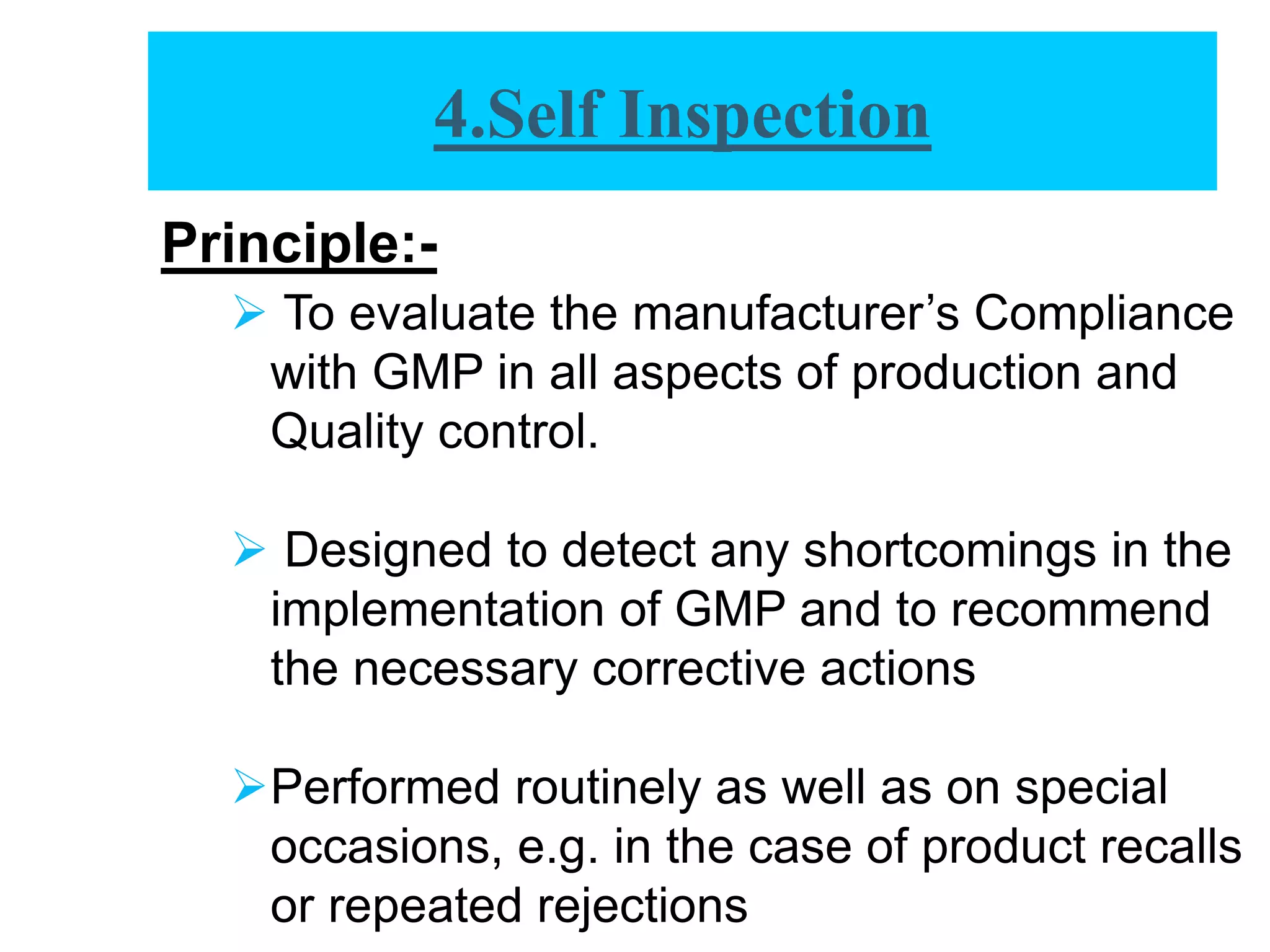
Principle:-
 To evaluate the manufacturer’s Compliance
with GMP in all aspects of production and
Quality control.
 Designed to detect any shortcomings in the
implementation of GMP and to recommend
the necessary corrective actions
Performed routinely as well as on special
occasions, e.g. in the case of product recalls
or repeated rejections
4.Self Inspection
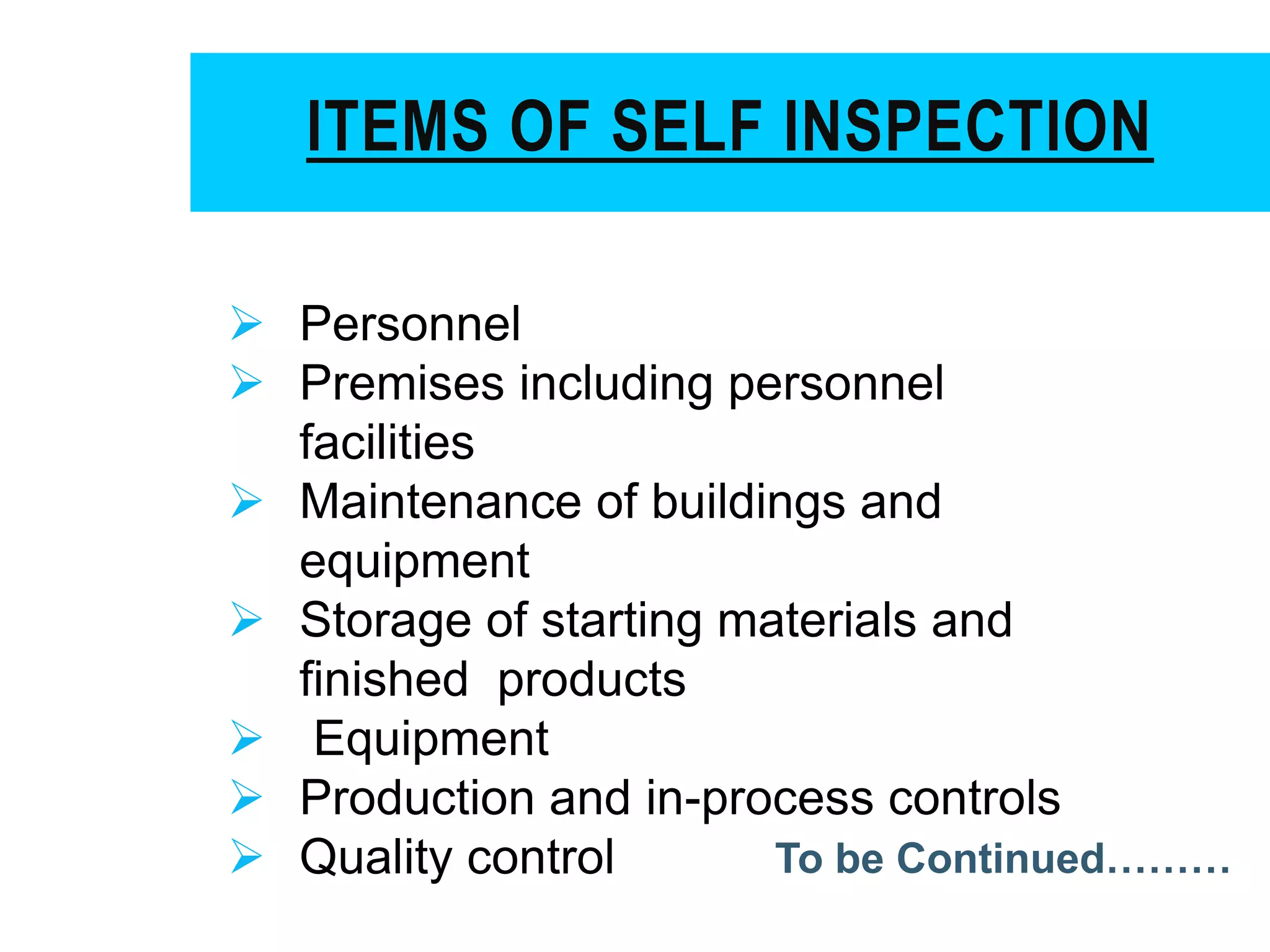
ITEMS OF SELF INSPECTION
 Personnel
 Premises including personnel
facilities
 Maintenance of buildings and
equipment
 Storage of starting materials and
finished products
 Equipment
 Production and in-process controls
 Quality control To be Continued………
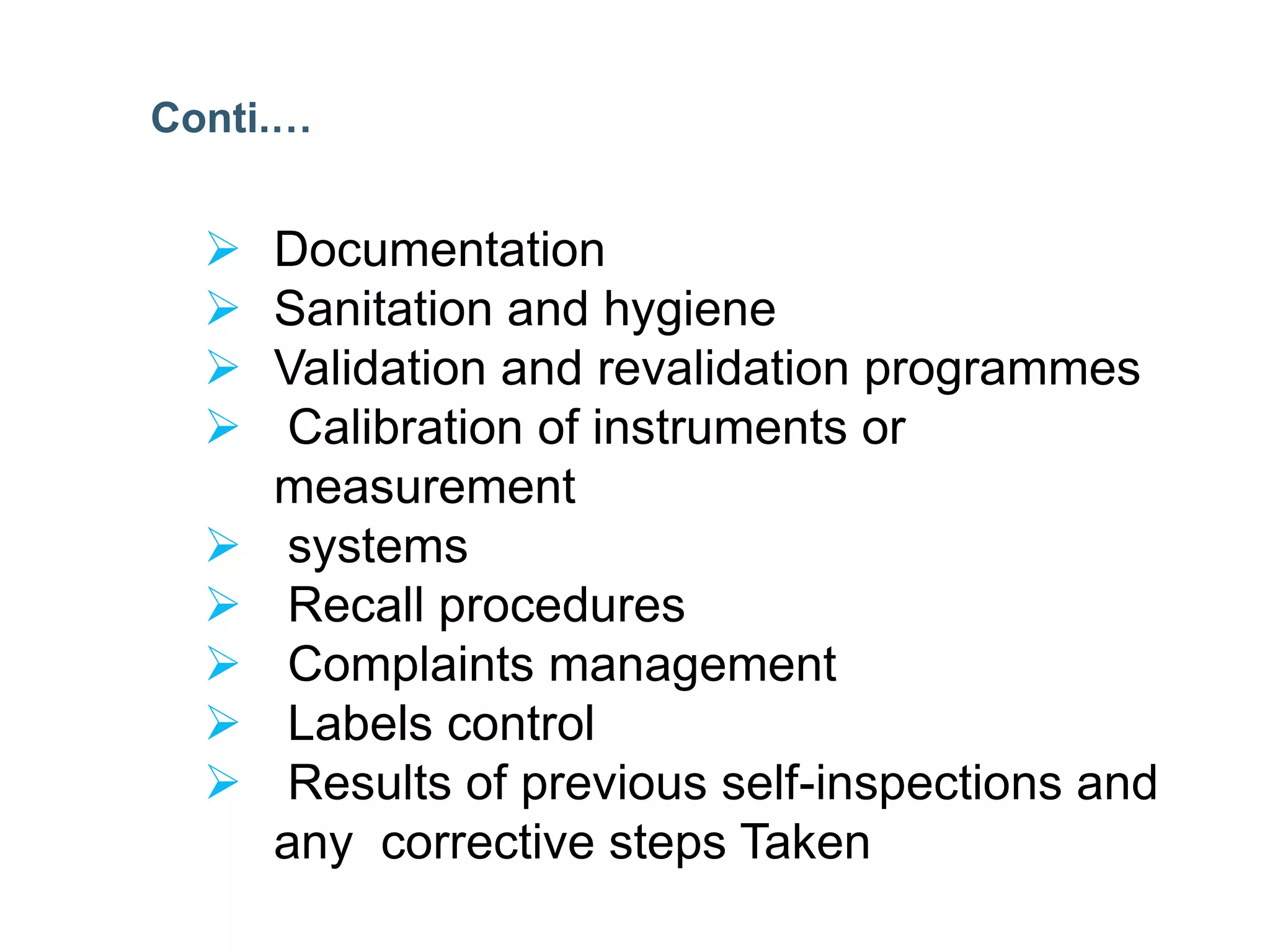
 Documentation
 Sanitation and hygiene
 Validation and revalidation programmes
 Calibration of instruments or
measurement
 systems
 Recall procedures
 Complaints management
 Labels control
 Results of previous self-inspections and
any corrective steps Taken
Conti.…
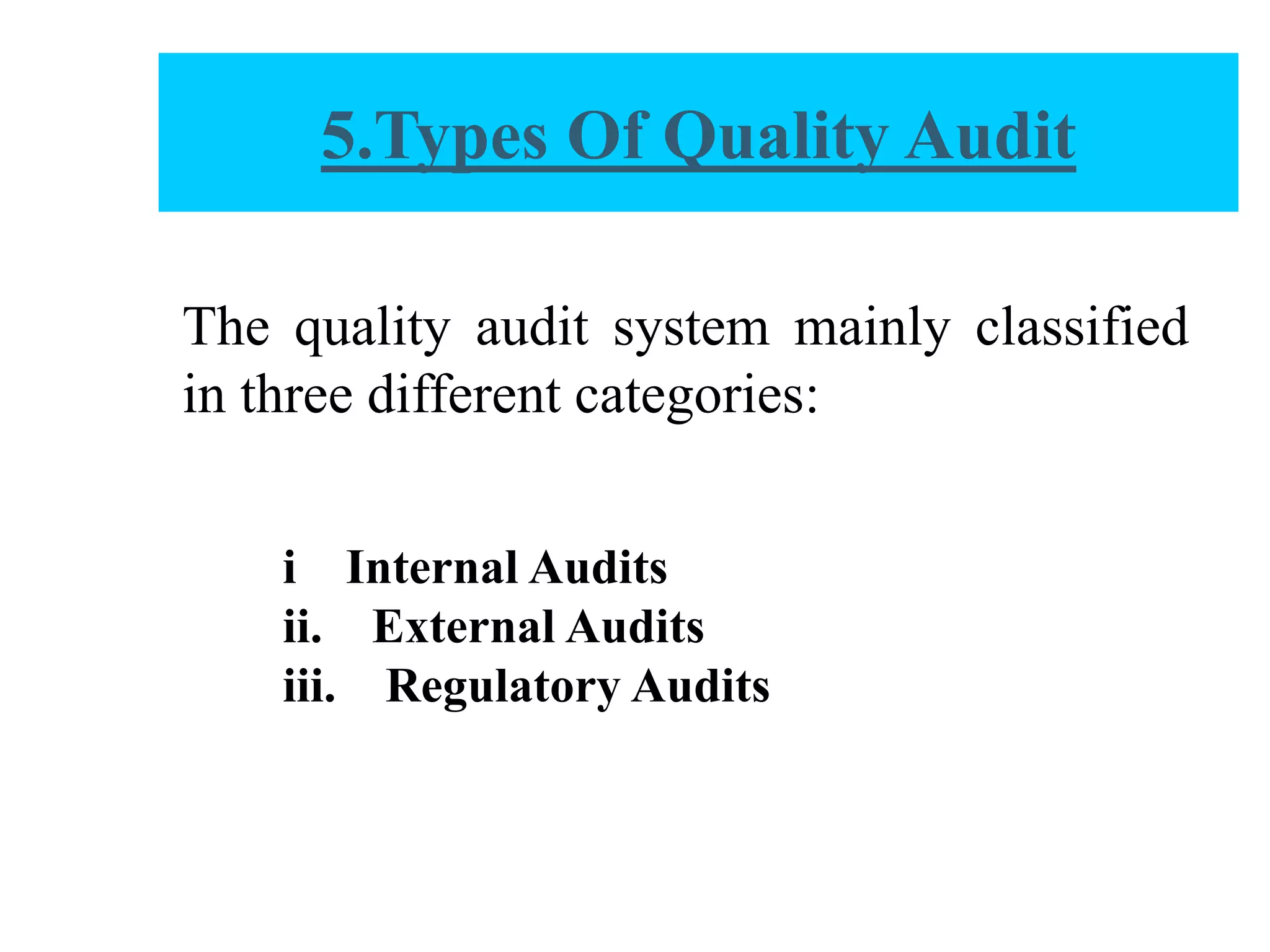
The quality audit system mainly classified
in three different categories:
i Internal Audits
ii. External Audits
iii. Regulatory Audits
5.Types Of Quality Audit
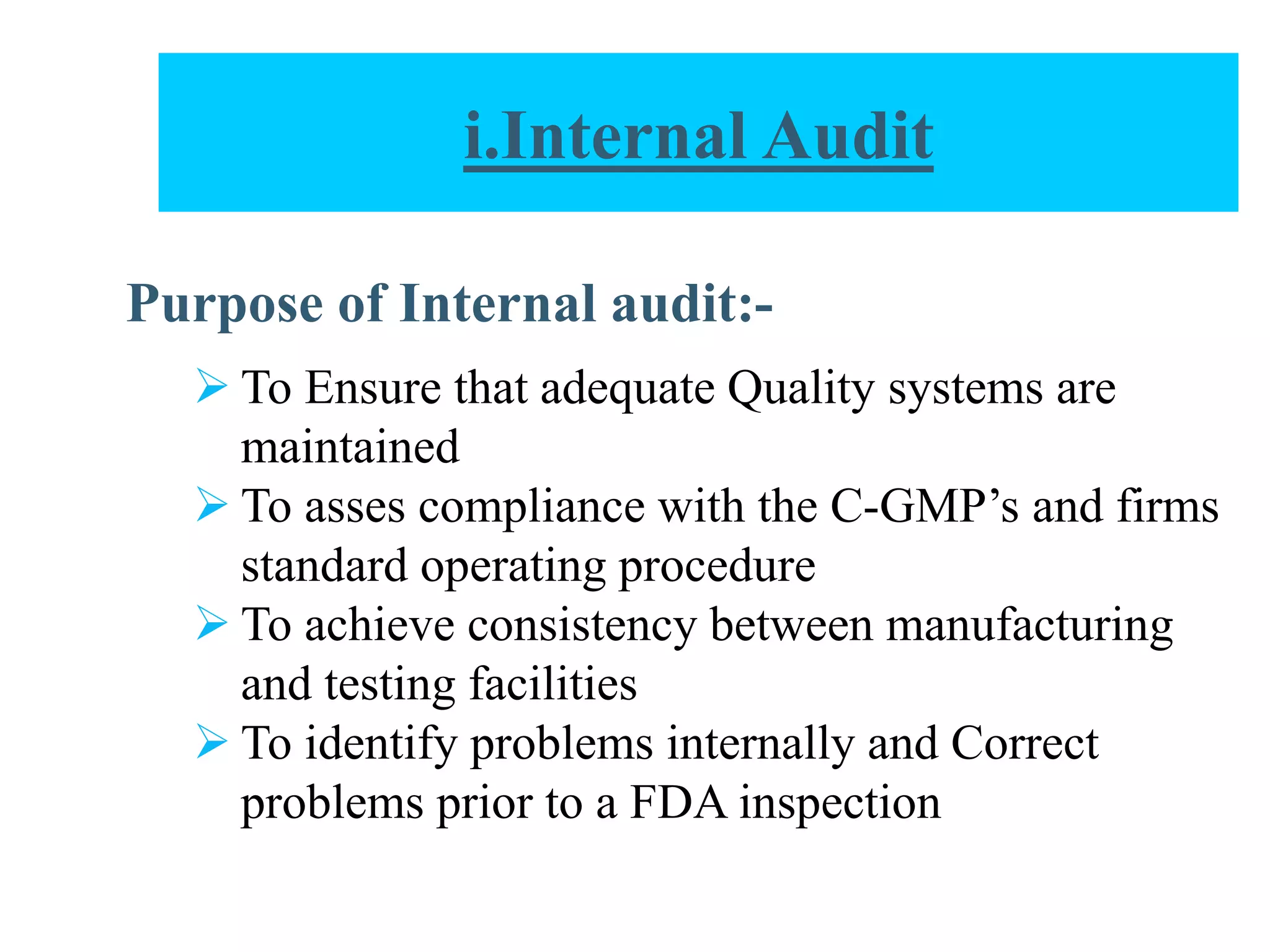
Purpose of Internal audit:-
 To Ensure that adequate Quality systems are
maintained
 To asses compliance with the C-GMP’s and firms
standard operating procedure
 To achieve consistency between manufacturing
and testing facilities
 To identify problems internally and Correct
problems prior to a FDA inspection
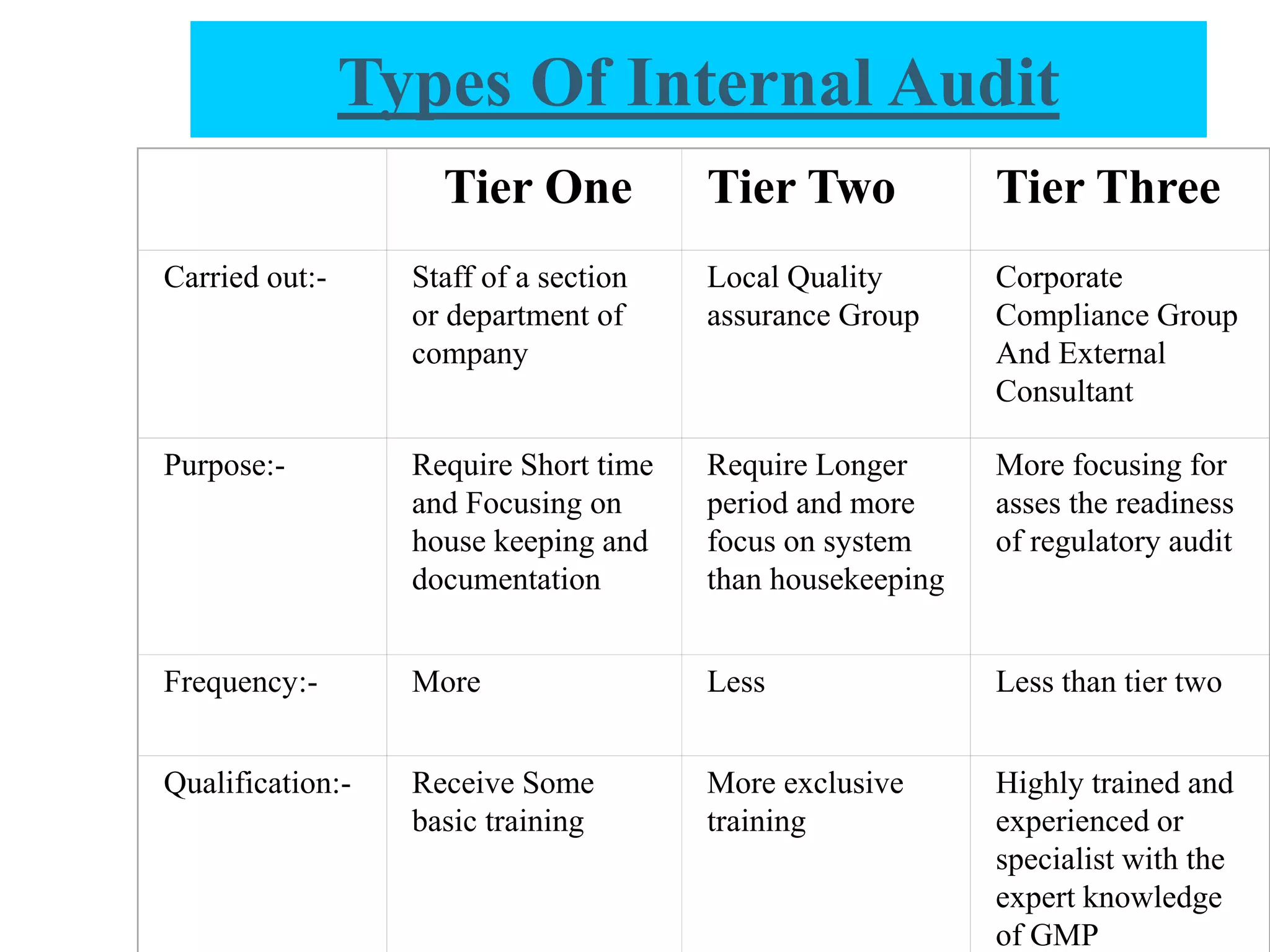
i.Internal Audit
Tier One Tier Two Tier Three
Carried out:- Staff of a section
or department of
company
Local Quality
assurance Group
Corporate
Compliance Group
And External
Consultant
Purpose:- Require Short time
and Focusing on
house keeping and
documentation
Require Longer
period and more
focus on system
than housekeeping
More focusing for
asses the readiness
of regulatory audit
Frequency:- More Less Less than tier two
Qualification:- Receive Some
basic training
More exclusive
training
Highly trained and
experienced or
specialist with the
expert knowledge
of GMP
Types Of Internal Audit
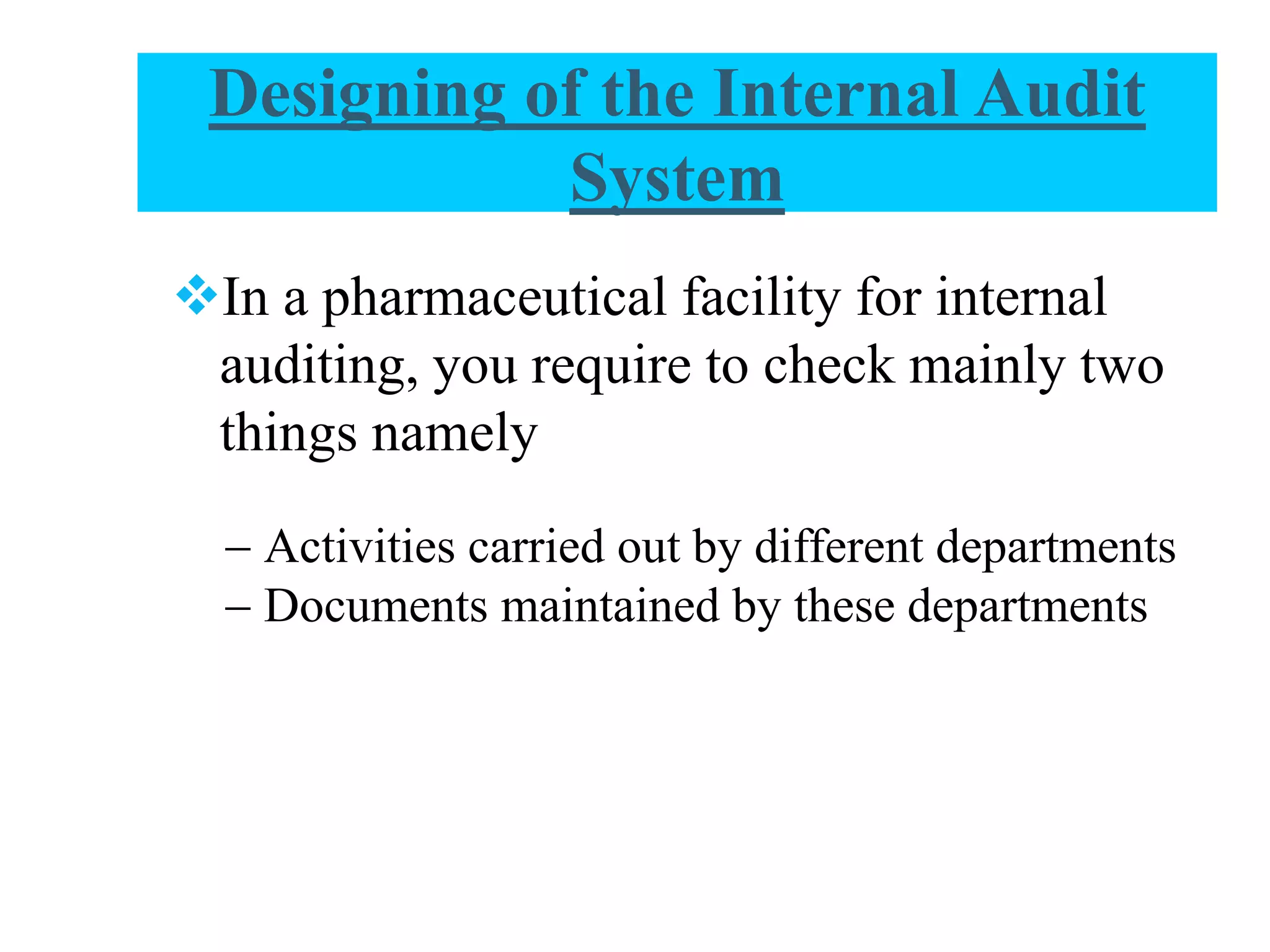
In a pharmaceutical facility for internal
auditing, you require to check mainly two
things namely
- Activities carried out by different departments
- Documents maintained by these departments
Designing of the Internal Audit
System
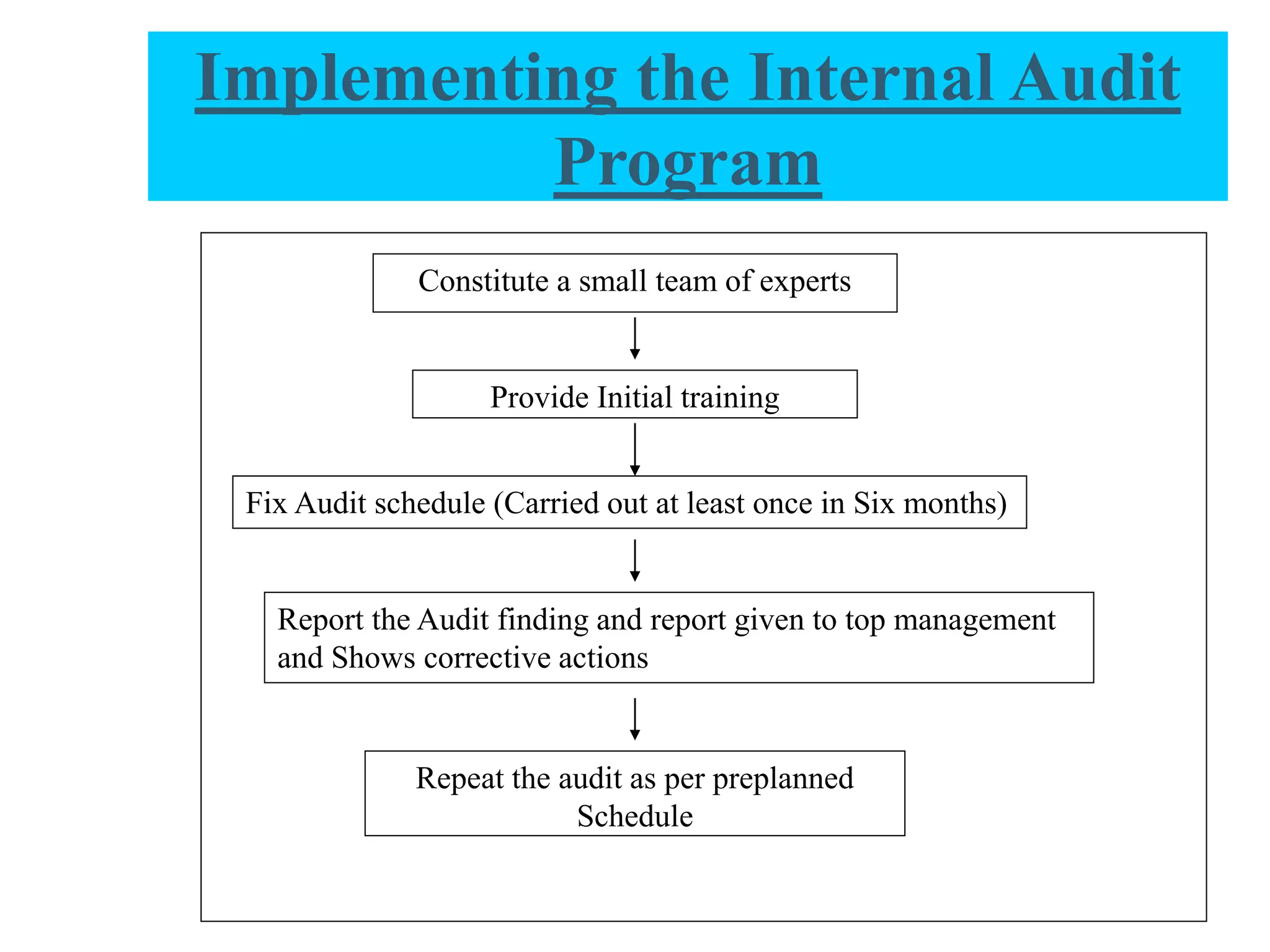
Constitute a small team of experts
Provide Initial training
Fix Audit schedule (Carried out at least once in Six months)
Report the Audit finding and report given to top management
and Shows corrective actions
Repeat the audit as per preplanned
Schedule
Implementing the Internal Audit
Program
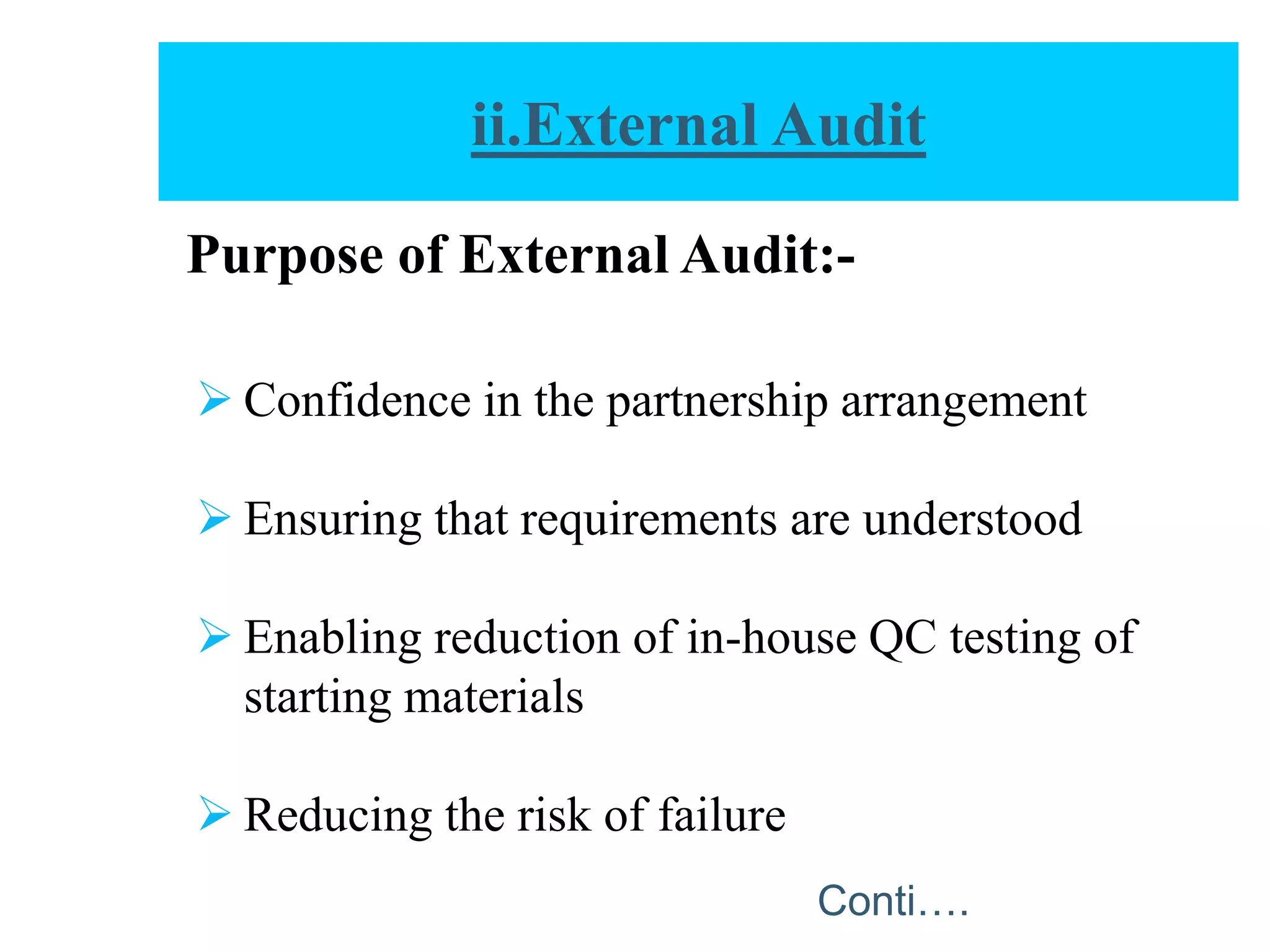
EXTERNAL AUDIT
Purpose of External Audit:-
 Confidence in the partnership arrangement
 Ensuring that requirements are understood
 Enabling reduction of in-house QC testing of
starting materials
 Reducing the risk of failure
ii.External Audit
Conti….
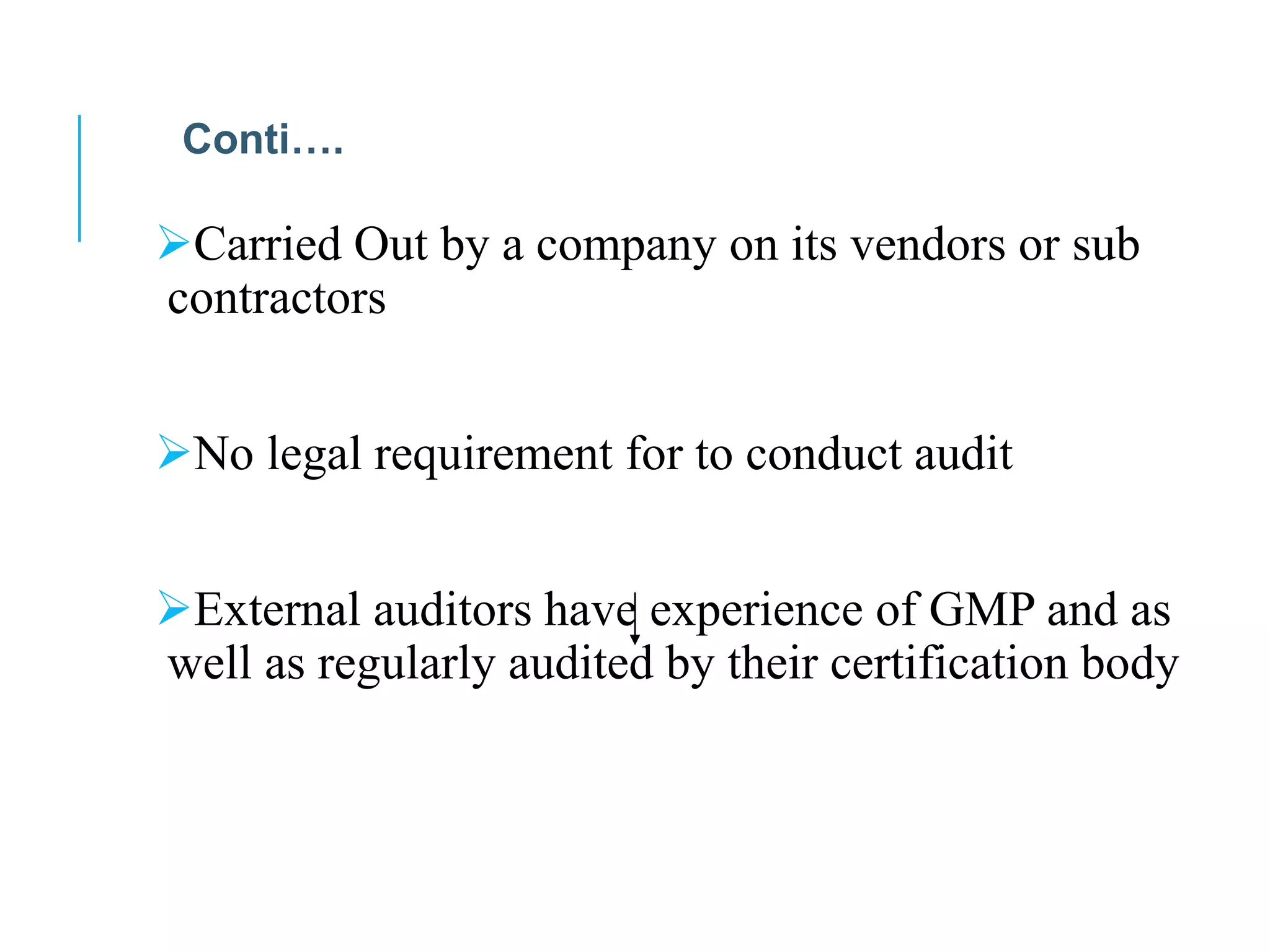
Carried Out by a company on its vendors or sub
contractors
No legal requirement for to conduct audit
External auditors have experience of GMP and as
well as regularly audited by their certification body
Conti….
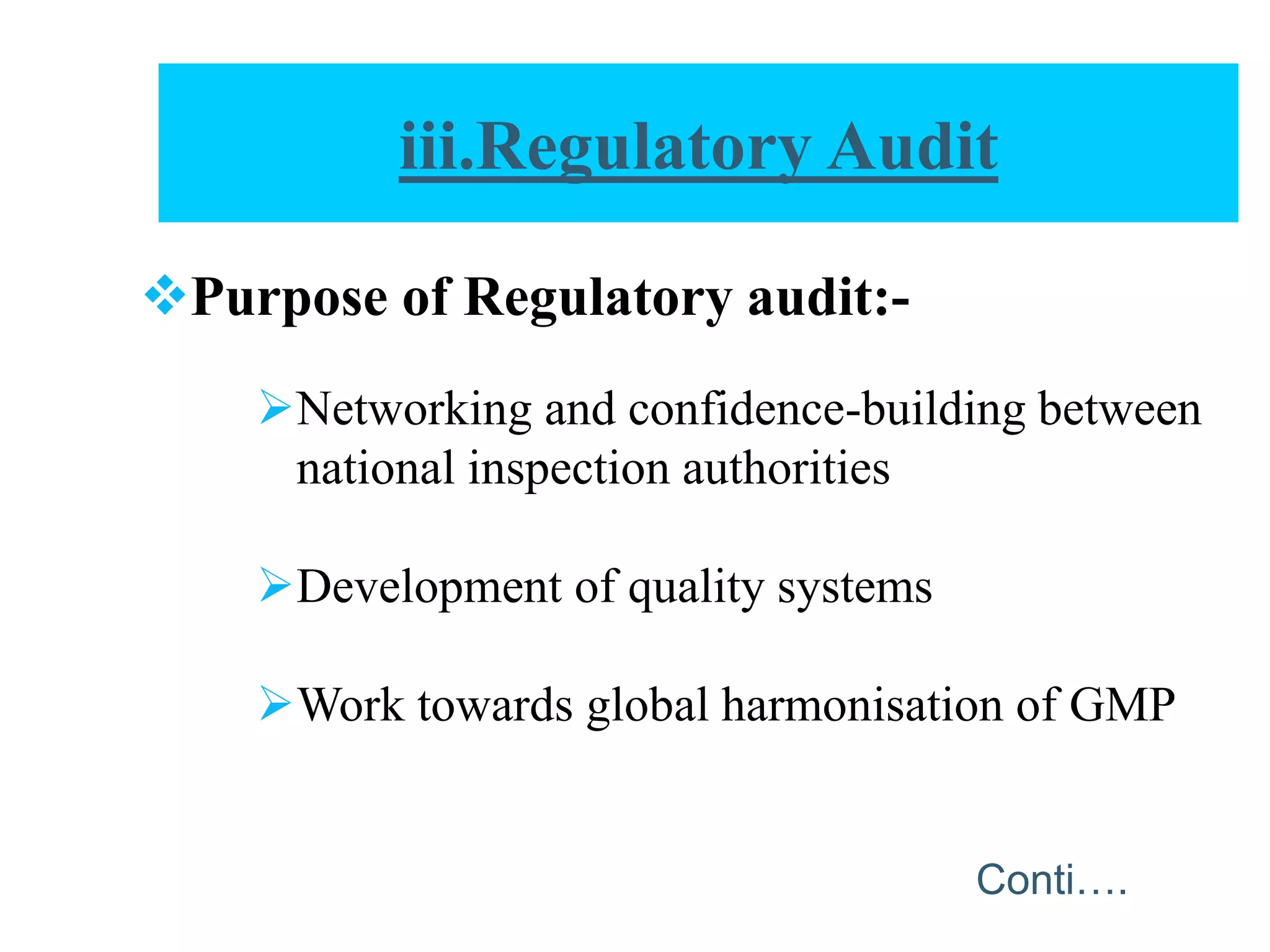
Purpose of Regulatory audit:-
Networking and confidence-building between
national inspection authorities
Development of quality systems
Work towards global harmonisation of GMP
iii.Regulatory Audit
Conti….
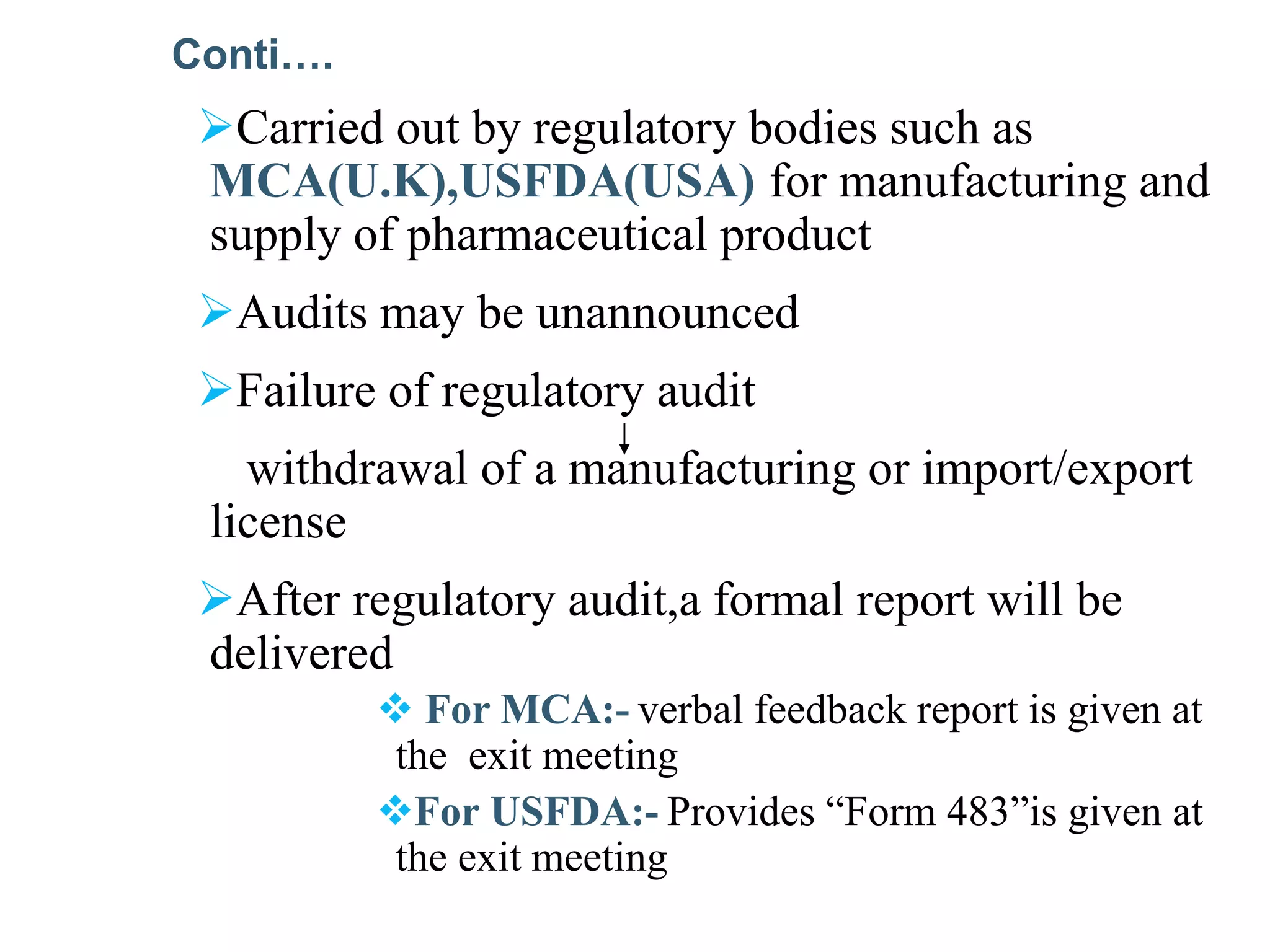
Carried out by regulatory bodies such as
MCA(U.K),USFDA(USA) for manufacturing and
supply of pharmaceutical product
Audits may be unannounced
Failure of regulatory audit
withdrawal of a manufacturing or import/export
license
After regulatory audit,a formal report will be
delivered
 For MCA:- verbal feedback report is given at
the exit meeting
For USFDA:- Provides “Form 483”is given at
the exit meeting
Conti….
6.Role of GMPAudits in Q.AAnd
Q.C programmes
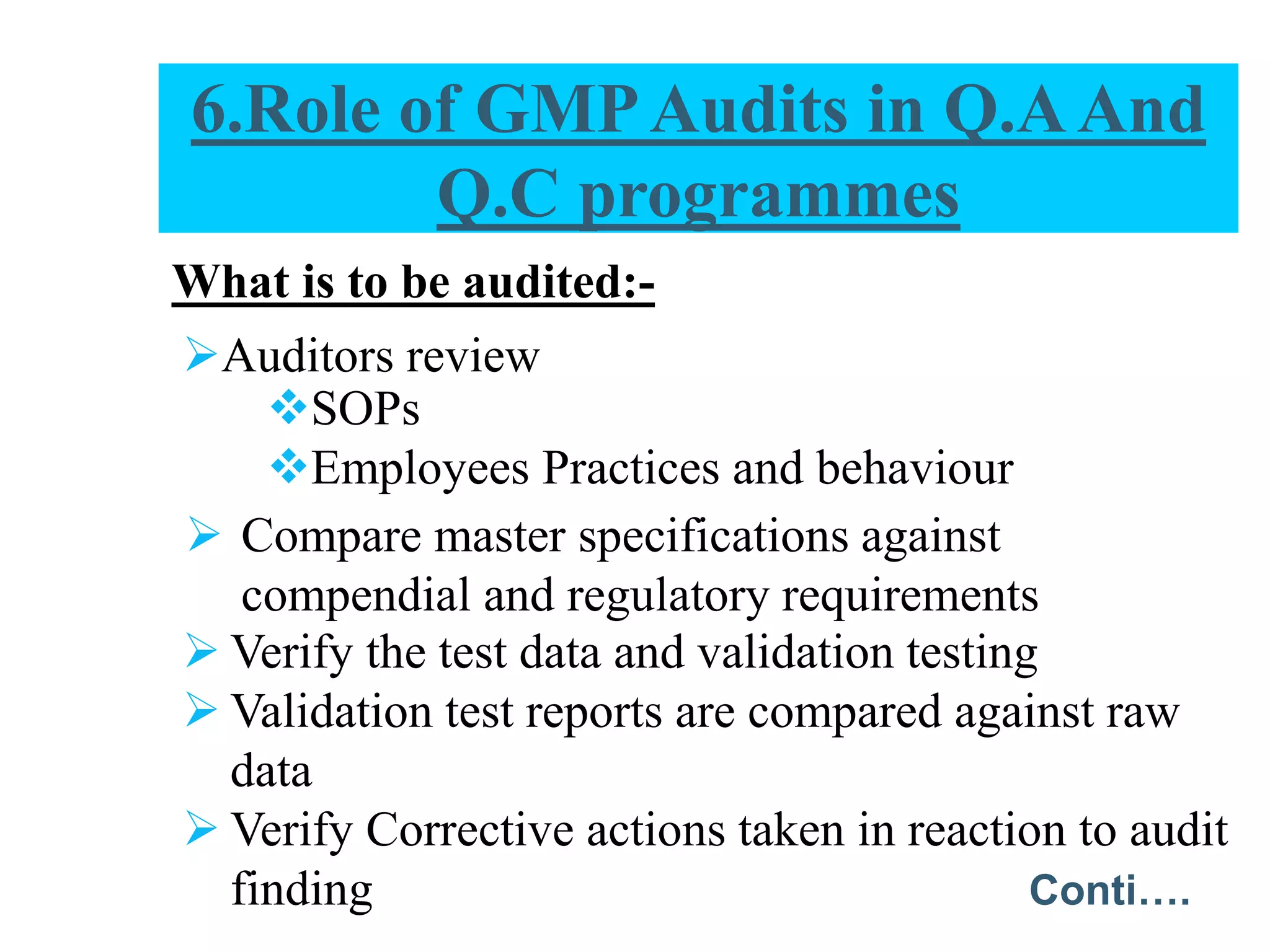
What is to be audited:-
Auditors review
 Compare master specifications against
compendial and regulatory requirements
 Verify the test data and validation testing
 Validation test reports are compared against raw
data
 Verify Corrective actions taken in reaction to audit
finding
SOPs
Employees Practices and behaviour
Conti….
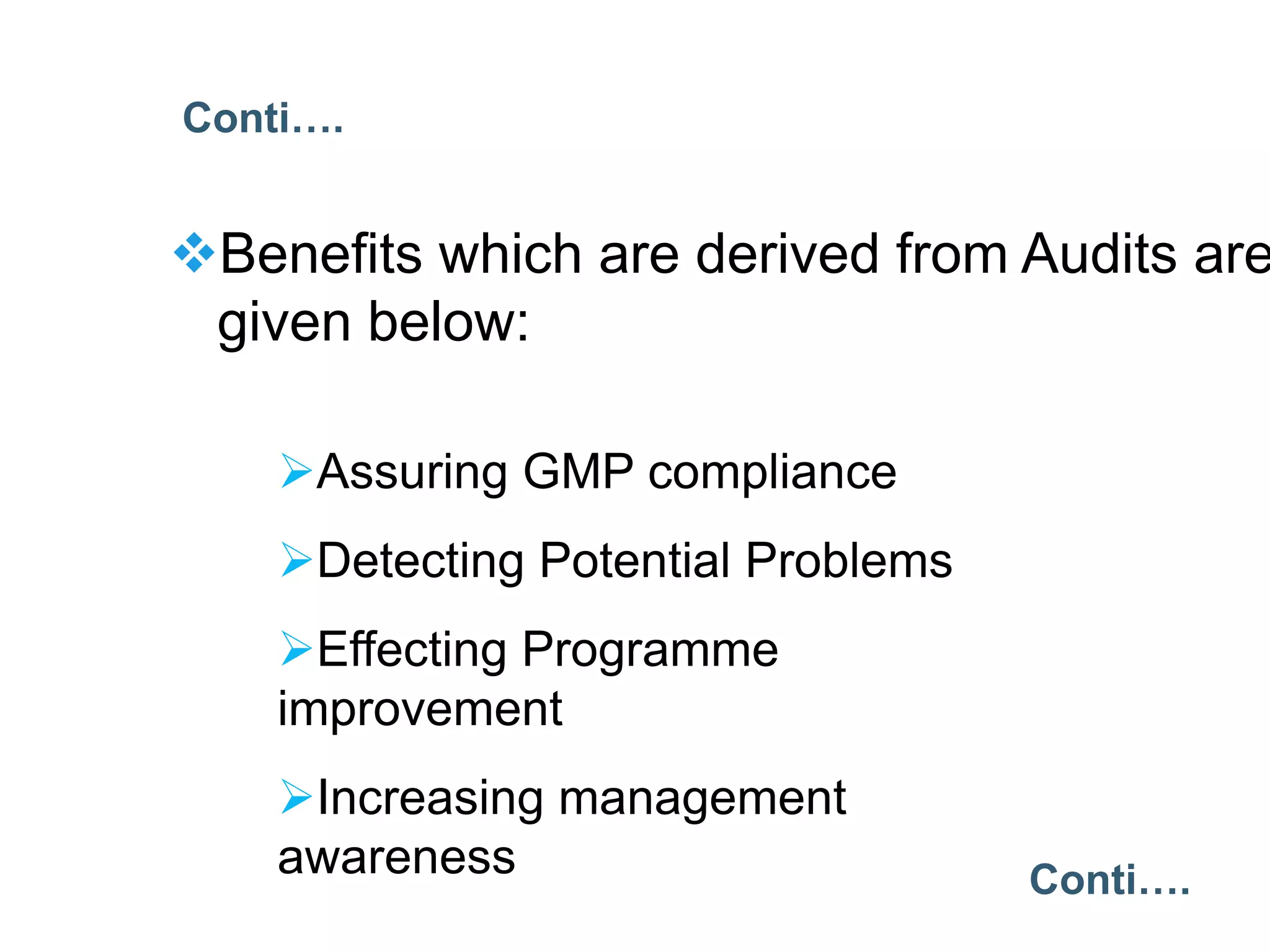
Assuring GMP compliance
Detecting Potential Problems
Effecting Programme
improvement
Increasing management
awareness
Benefits which are derived from Audits are
given below:
Conti….
Conti….
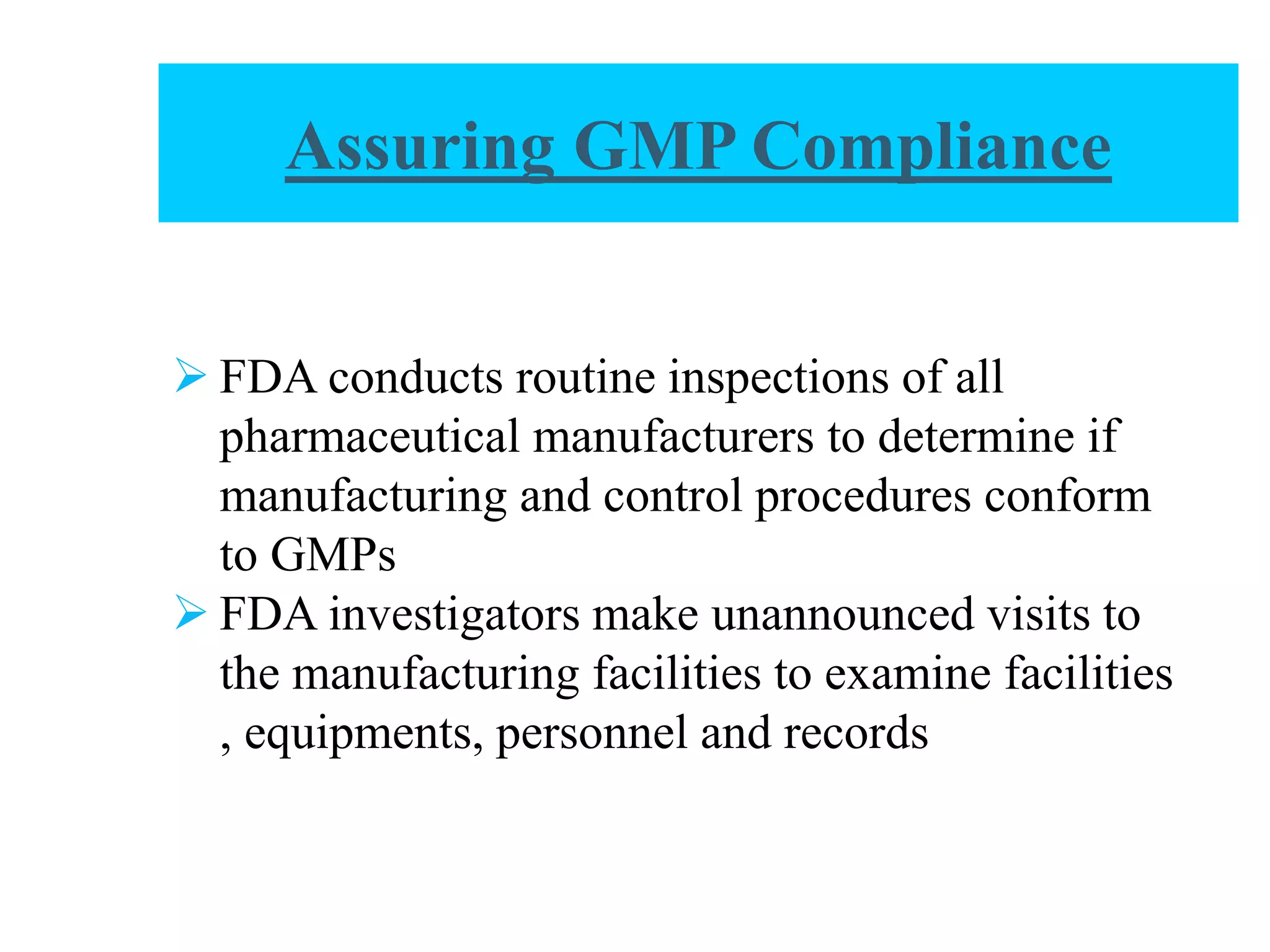
Assuring GMP Compliance
 FDA conducts routine inspections of all
pharmaceutical manufacturers to determine if
manufacturing and control procedures conform
to GMPs
 FDA investigators make unannounced visits to
the manufacturing facilities to examine facilities
, equipments, personnel and records
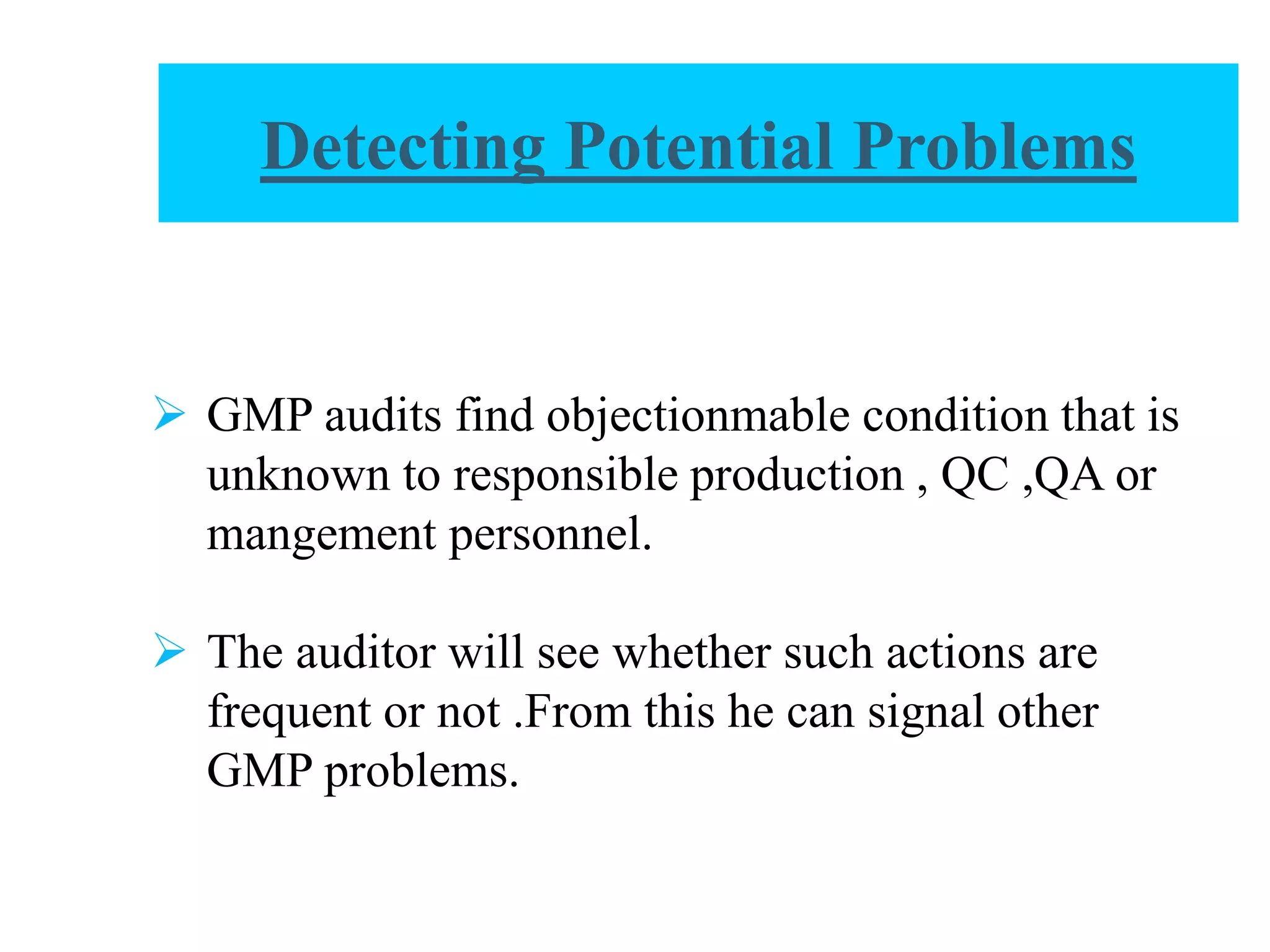
Detecting Potential Problems
 GMP audits find objectionmable condition that is
unknown to responsible production , QC ,QA or
mangement personnel.
 The auditor will see whether such actions are
frequent or not .From this he can signal other
GMP problems.
Effecting Programme
Improvements
 Changing SOPs
 Modifying maufacturing equipment or
procedure
 Upgrading equipment or procedure
 Improving employee training programme
 Developing new or revised documentary system
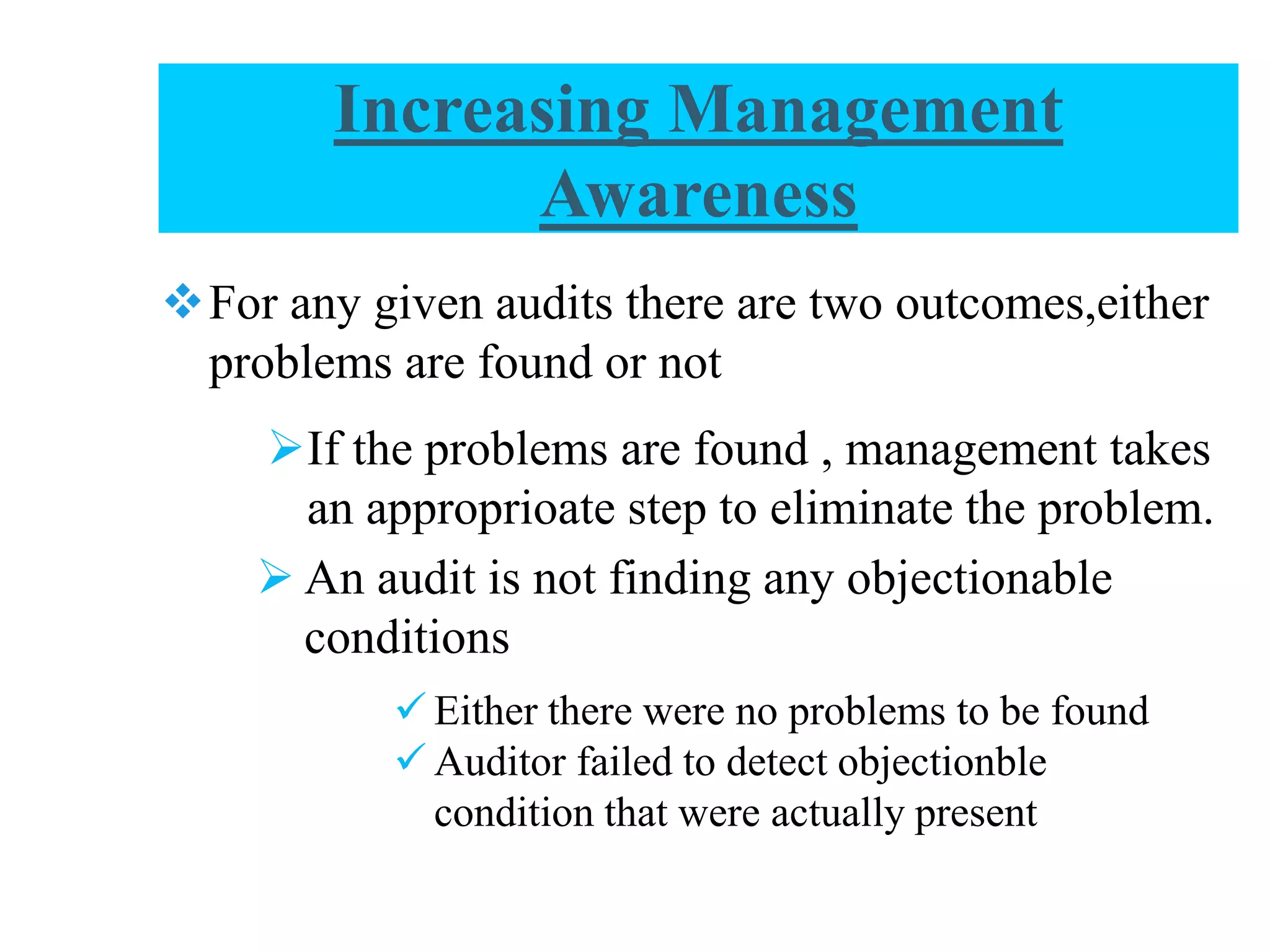
Increasing Management
Awareness
For any given audits there are two outcomes,either
problems are found or not
If the problems are found , management takes
an approprioate step to eliminate the problem.
 An audit is not finding any objectionable
conditions
 Either there were no problems to be found
 Auditor failed to detect objectionble
condition that were actually present
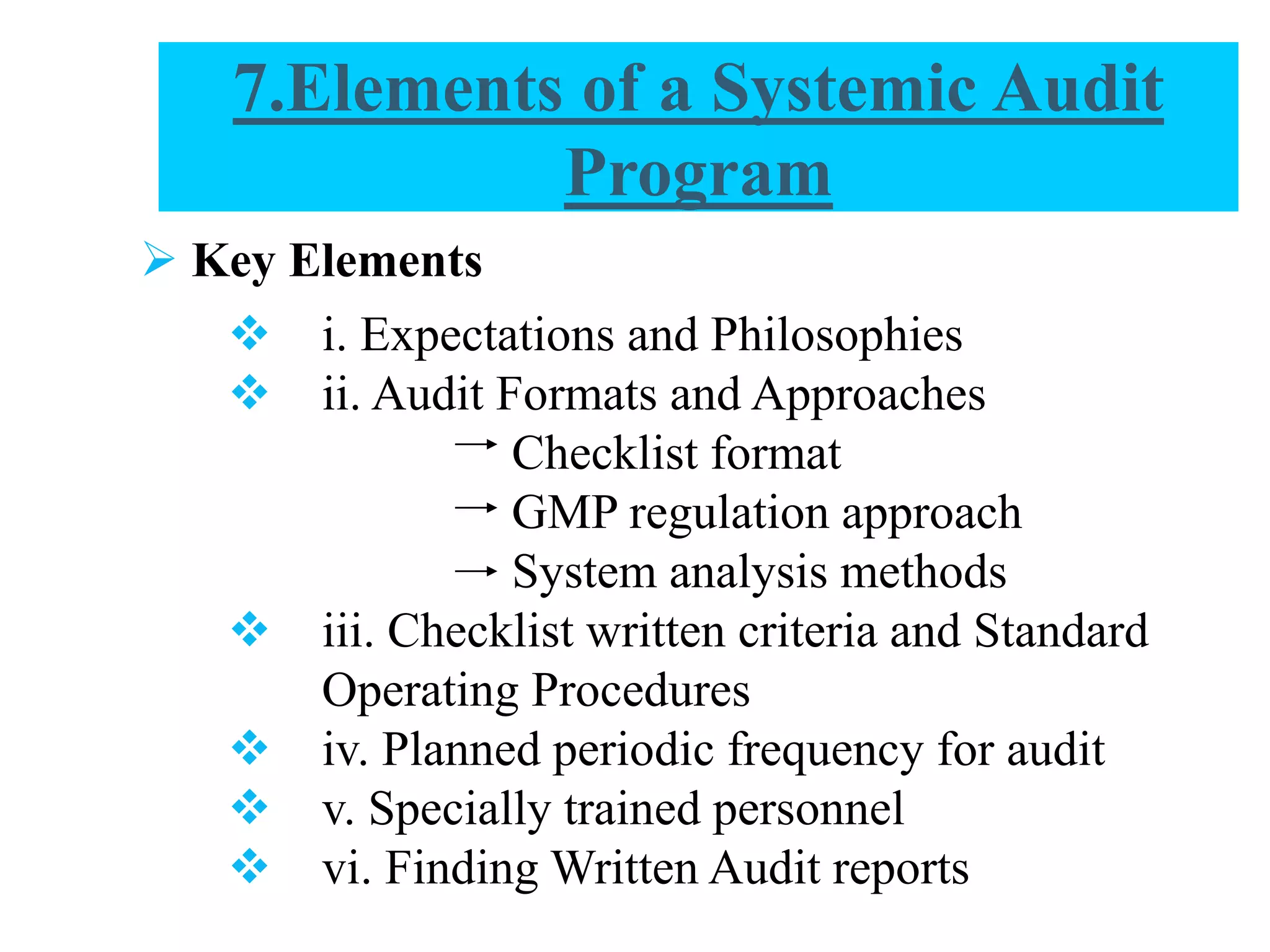
 Key Elements
 i. Expectations and Philosophies
 ii. Audit Formats and Approaches
Checklist format
GMP regulation approach
System analysis methods
 iii. Checklist written criteria and Standard
Operating Procedures
 iv. Planned periodic frequency for audit
 v. Specially trained personnel
 vi. Finding Written Audit reports
7.Elements of a Systemic Audit
Program
Senior management establishes the fundamental
expectations of audit
 Upper level management must establish the
realistic goals and objectives
 Use of “ Formal Written Master Plan” approved
by management
i.Expectations and Philosophies
Checklist format
GMP regulation approach
 Systems analysis method
Manual GMP audit methods can be divided in
to categories
II.AUDIT FORMAT AND
APPROACHES
 Use checklist as GMP audit guides and reporting
finding.
 Series of questions or instructions are grouped in to
logical order.
 Blocks may be used to record answer and space
may be provided to make comments.
CHECKLIST FORMAT
Conti….
Advantages:-
 Simple, convenient and easy to use for any
desired subjected area
 Knowledgeable personnel may develop
questions and guideline
 Questions are in logical order that help
auditor to detect problems
 Report can be prepared in a minimum
amount of time.
Conti….
Conti….
 Question may be interpreted in more than one
way because of bias or hidden meaning
 Solve the devising questions is not easy task
 Limited content
The amount and type of questions that are
provided limited .
Not every issue will be covered
Each auditor must apply sound judgment when
evaluating system.
DISADVANTAGES:-
Conti….
 Subpart B: Organization and personnel
 Subpart C: Building and facilities
 Subpart D: Equipments
 Subpart E: Production and Processing Controls
 Subpart F: Production and Packaging control
 Subpart H: Holding and Distribution
 Subpart I: Lab controls
 Subpart J: Records and Reports
 Subpart K: Returned and Salvaged drug
 The basic elements are derived from the
following subpart of regulations
GMP Regulation Format
 Likely to Affect the Quality Of the Product
 These FDA investigators describe the
organized method for determining of
potential problem
Systemic Potential Problem
Analysis
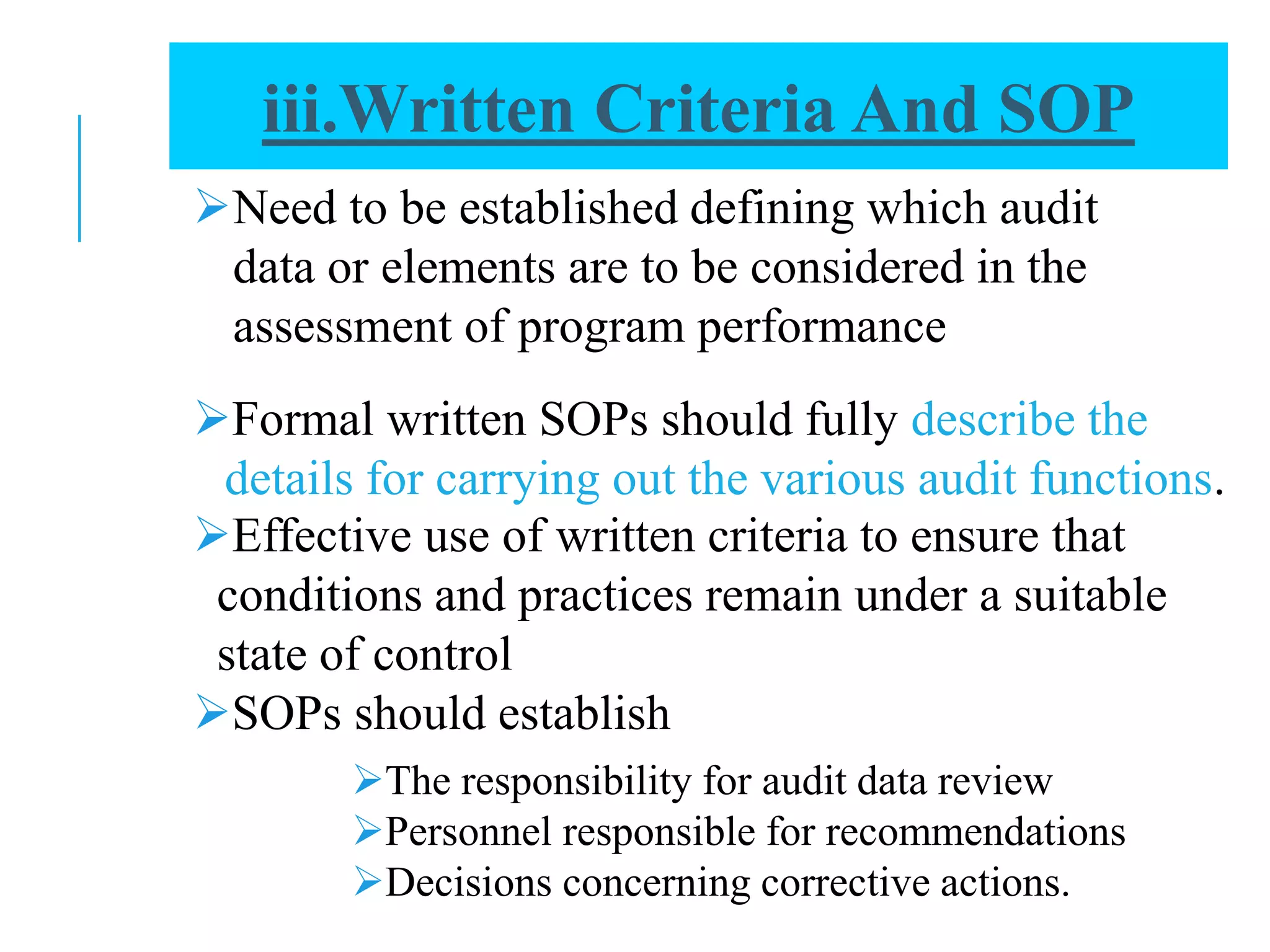
Need to be established defining which audit
data or elements are to be considered in the
assessment of program performance
Effective use of written criteria to ensure that
conditions and practices remain under a suitable
state of control
SOPs should establish
Formal written SOPs should fully describe the
details for carrying out the various audit functions.
The responsibility for audit data review
Personnel responsible for recommendations
Decisions concerning corrective actions.
iii.Written Criteria And SOP
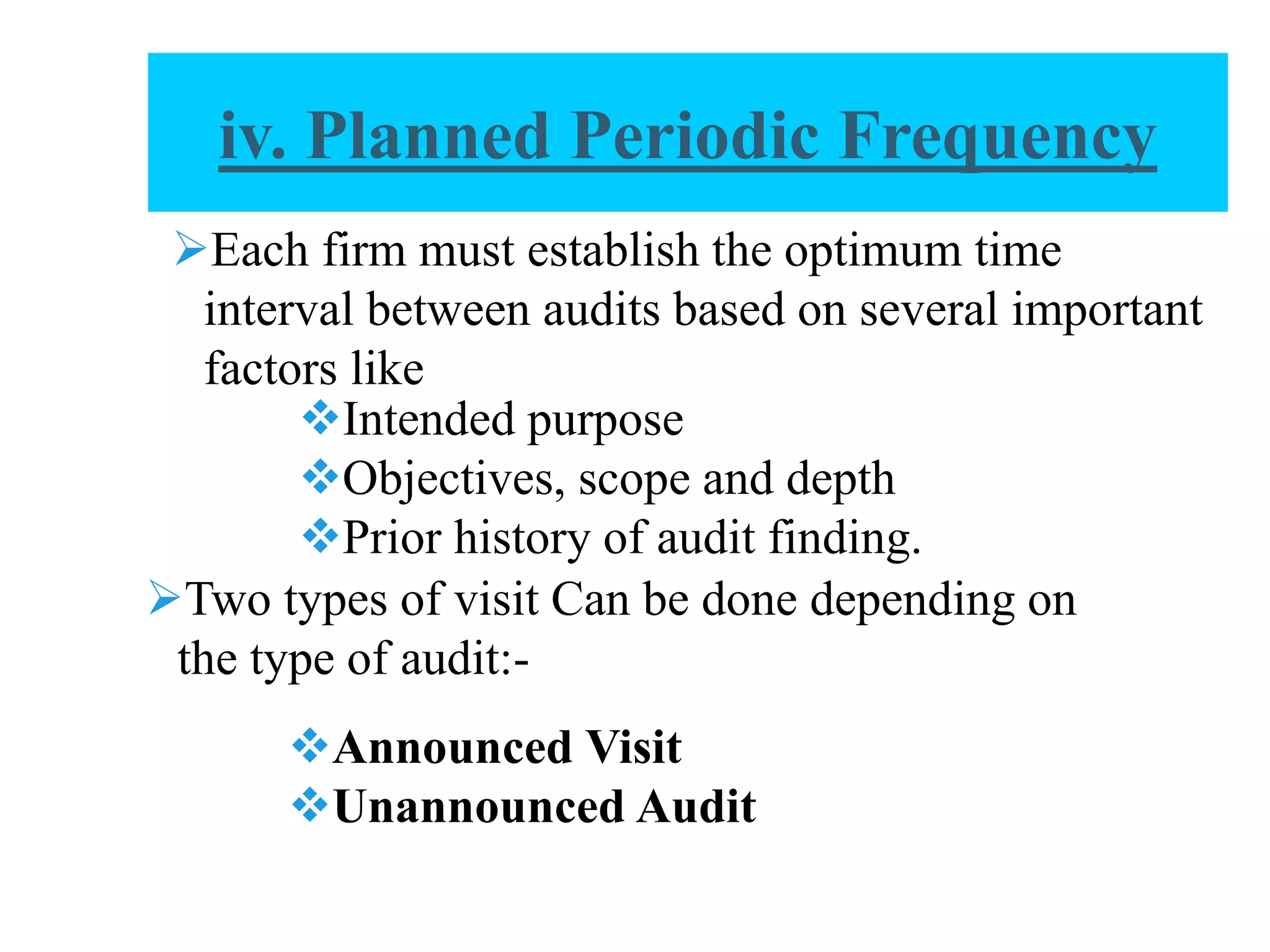
Each firm must establish the optimum time
interval between audits based on several important
factors like
Intended purpose
Objectives, scope and depth
Prior history of audit finding.
Two types of visit Can be done depending on
the type of audit:-
Announced Visit
Unannounced Audit
iv. Planned Periodic Frequency
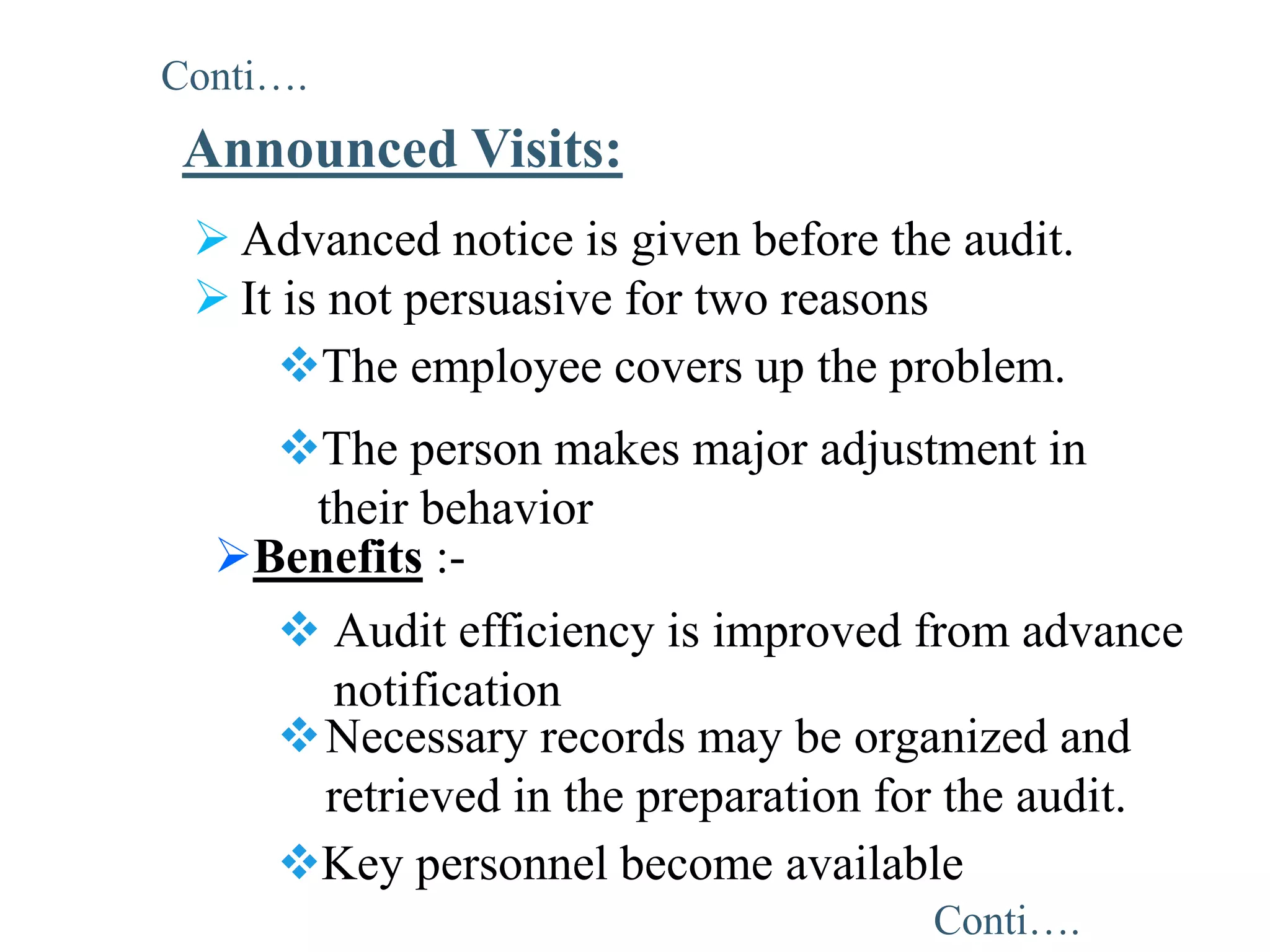
 Advanced notice is given before the audit.
 It is not persuasive for two reasons
Announced Visits:
The employee covers up the problem.
The person makes major adjustment in
their behavior
Benefits :-
 Audit efficiency is improved from advance
notification
Necessary records may be organized and
retrieved in the preparation for the audit.
Key personnel become available
Conti….
Conti….
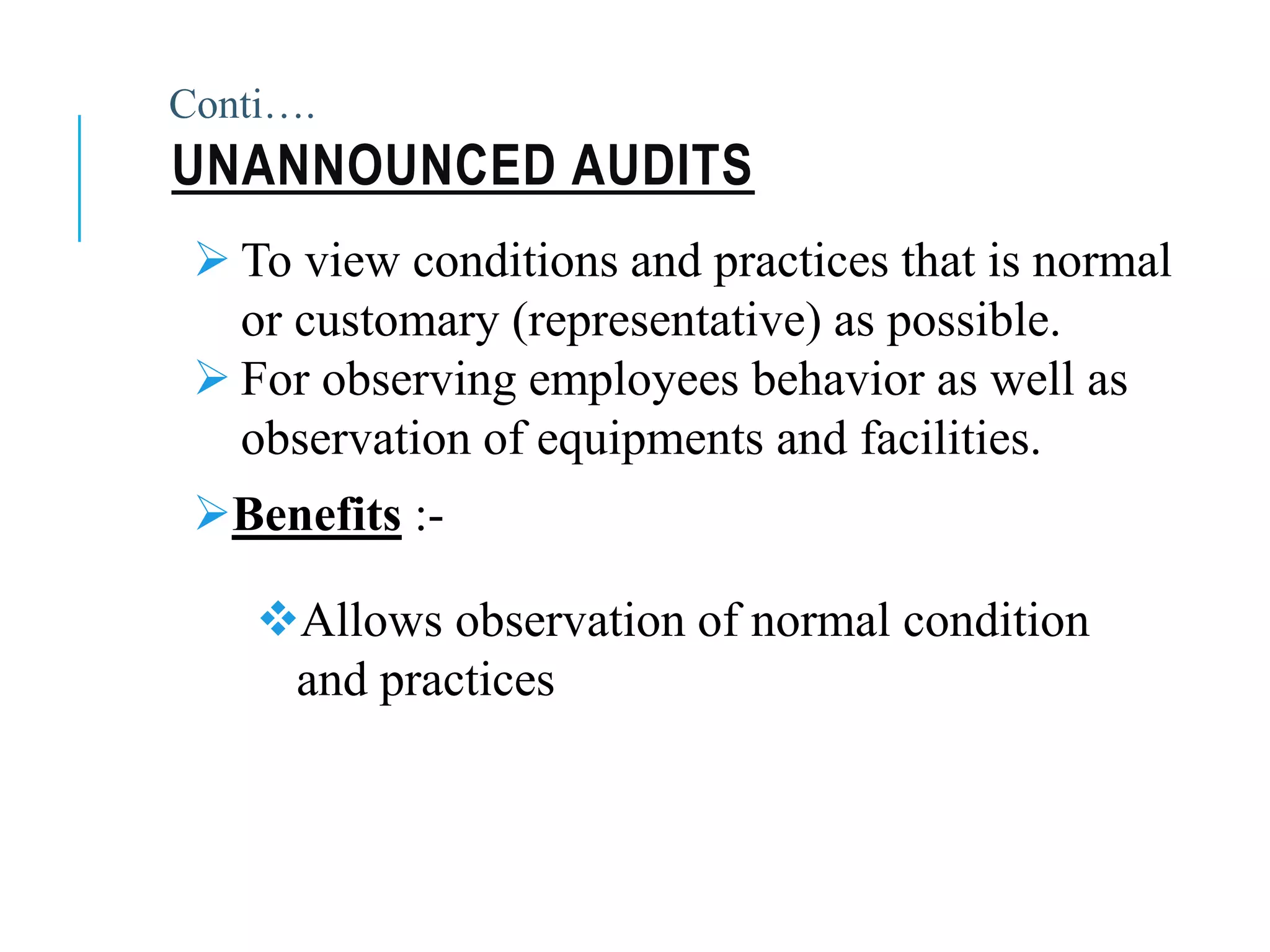
 To view conditions and practices that is normal
or customary (representative) as possible.
 For observing employees behavior as well as
observation of equipments and facilities.
UNANNOUNCED AUDITS
Benefits :-
Allows observation of normal condition
and practices
Conti….
 The following personnel factors deserve systemic
attention
 Defining auditor Qualification
 Documentation training skills and Experience.
 Selecting audit teams
 Maintaining auditor awareness levels
v. Specially Trained Personnel
Selected based
On their knowledge
Experience in manufacturing and QC
principles as well as years of first hand
experience dealing with GMP matters.
Essential auditor skill is aware of
Firm’s SOPs and Knowledge
Integrated by various departments.
Defining Auditor Qualification
Two formats
Scientific Principles
Training under chemistry, engineering,
statistical and pharmaceutics
GMP
GMP training may include the cumulative
knowledge from years of experience
This knowledge comes from
Daily activities
Formal training sessions
Documentation Training Skills
And Experience
 Limitations of Personnel audit
Experience and knowledge, which is
individual.
Emphasize on familiar issues as well as
particular area
 Team is required for cover many different
systems and large amount of data.
 Composition of team will vary depending upon
the nature and scope of the audit
Selecting Audit teams
Conti….
Leader is usually a senior auditor who has
extensive knowledge of the firm’s operations and
exhibit strong leadership qualities.
Team size depends upon
 Firm size
 Total no of products manufacturing
and control system
 Breath and depth of the audit.
 The Audit objective
Conti….
Audit reports should contain complete details
of the program detected.
Corrective action is taken to eliminate
problems and to measure the overall adequacy
of the audit program uses reports.
There are two important reporting phases:-
1) Preliminary reports during the audit
2) Final report to the management
vi. Reporting Audit Finding
Conti….
Preliminary reports during the audit:
1) Benefits can be gained from having dialogues
with employees
2) Finding is communicated with affected
personnel.
3) Discussion may help the employees to learn
why problems happened.
Conti….
Conti….
Management must review the final reports and
determine what steps need to be taken to eliminate
deficiencies.
Management should sincerely encourage detection of
problems and express appreciation for being able to
improve quality operations.
The audit reports may be shared with manger
supervisor who may discuss finding with
employees.
The workers and supervisory personnel should be
given the opportunity to explain their views and
ideas about the audit findings.
Final report to the management
Conti….
Quality audit- Quality audit is the process of systematic examination of a quality system carried out by an internal or external quality auditor or an audit team

Quality audit- Quality audit is the process of systematic examination of a quality system carried out by an internal or external quality auditor or an audit team

  • 1.
  • 2.
    CONTENTS  Definition  Objectives Difference between Quality audit and Periodic evaluation  Self inspection  Types of Quality Audit  Role OF GMP Audit in QA and QC programmes  Elements of a Systemic Audit program
  • 3.
    Quality Audit  Qualityaudit is defined as a systematic and independent examination to determine whether activities and related results comply with planned arrangements and whether these arrangements are implemented effectively and are suitable to achieve objectives 1.Quality Audit
  • 4.
     Quality auditmeans a systematic examination of a quality system.  Quality audits are typically performed at defined intervals  Any failure in their proper implementation may be published publicly and may lead to a revocation of quality certification
  • 5.
    2.OBJECTIVES OF QUALITYAUDIT Pharmaceutical manufacturers commonly use audits as an effective mechanism to verify compliance with GMP regulation (GMP).GMP audits with two important goals  Audis are intended to verify that manufacturing and Control systems are operating under a state of control.  Audits permit timely correction of potential problems.  Audits can be used to establish a high degree of confidence to remain under an adequate level of control by managements
  • 6.
    3.DIFFERENCE BETWEEN AUDIT ANDPERIODIC EVALUATION Quality audit Periodic Evaluation Quality audit is Periodic, independent, and documented examination and verification of activities, records, processes, and other elements of a quality system to determine their conformity with the requirements of a quality standard such as GMP Periodic evaluations are routine reviews and assessments of the quality standards of each drug product that are made to determine the need for changes in drug product specifications or manufacturing or control procedures  Auditors should not have direct responsibilities for the operations they review Employees who are directly responsible for system under review normally perform periodic evaluations  Audit is the function of Quality assurance  Periodic evaluation is a function of Quality control department Conti….
  • 7.
    Quality audit PeriodicEvaluation  To verify on a regular basis that a firms procedures and practices are in conformity with established SOPs and applicable GMPs   Periodic Evaluation determine the need for change in product, specification or control procedures and implement it if necessary  Auditors reviewed Sops, Employee practices And behavior to see how well they follow established SOPs It plays a primary role in Day-to-Day decision-making process used by QC unit Report is prepared by Q.C personnel  Quality control management personnel usually prepared Periodic evaluations Conti….
  • 8.
    Principle:-  To evaluatethe manufacturer’s Compliance with GMP in all aspects of production and Quality control.  Designed to detect any shortcomings in the implementation of GMP and to recommend the necessary corrective actions Performed routinely as well as on special occasions, e.g. in the case of product recalls or repeated rejections 4.Self Inspection
  • 9.
    ITEMS OF SELFINSPECTION  Personnel  Premises including personnel facilities  Maintenance of buildings and equipment  Storage of starting materials and finished products  Equipment  Production and in-process controls  Quality control To be Continued………
  • 10.
     Documentation  Sanitationand hygiene  Validation and revalidation programmes  Calibration of instruments or measurement  systems  Recall procedures  Complaints management  Labels control  Results of previous self-inspections and any corrective steps Taken Conti.…
  • 11.
    The quality auditsystem mainly classified in three different categories: i Internal Audits ii. External Audits iii. Regulatory Audits 5.Types Of Quality Audit
  • 12.
    Purpose of Internalaudit:-  To Ensure that adequate Quality systems are maintained  To asses compliance with the C-GMP’s and firms standard operating procedure  To achieve consistency between manufacturing and testing facilities  To identify problems internally and Correct problems prior to a FDA inspection i.Internal Audit
  • 13.
    Tier One TierTwo Tier Three Carried out:- Staff of a section or department of company Local Quality assurance Group Corporate Compliance Group And External Consultant Purpose:- Require Short time and Focusing on house keeping and documentation Require Longer period and more focus on system than housekeeping More focusing for asses the readiness of regulatory audit Frequency:- More Less Less than tier two Qualification:- Receive Some basic training More exclusive training Highly trained and experienced or specialist with the expert knowledge of GMP Types Of Internal Audit
  • 14.
    In a pharmaceuticalfacility for internal auditing, you require to check mainly two things namely - Activities carried out by different departments - Documents maintained by these departments Designing of the Internal Audit System
  • 15.
    Constitute a smallteam of experts Provide Initial training Fix Audit schedule (Carried out at least once in Six months) Report the Audit finding and report given to top management and Shows corrective actions Repeat the audit as per preplanned Schedule Implementing the Internal Audit Program
  • 16.
    EXTERNAL AUDIT Purpose ofExternal Audit:-  Confidence in the partnership arrangement  Ensuring that requirements are understood  Enabling reduction of in-house QC testing of starting materials  Reducing the risk of failure ii.External Audit Conti….
  • 17.
    Carried Out bya company on its vendors or sub contractors No legal requirement for to conduct audit External auditors have experience of GMP and as well as regularly audited by their certification body Conti….
  • 18.
    Purpose of Regulatoryaudit:- Networking and confidence-building between national inspection authorities Development of quality systems Work towards global harmonisation of GMP iii.Regulatory Audit Conti….
  • 19.
    Carried out byregulatory bodies such as MCA(U.K),USFDA(USA) for manufacturing and supply of pharmaceutical product Audits may be unannounced Failure of regulatory audit withdrawal of a manufacturing or import/export license After regulatory audit,a formal report will be delivered  For MCA:- verbal feedback report is given at the exit meeting For USFDA:- Provides “Form 483”is given at the exit meeting Conti….
  • 20.
    6.Role of GMPAuditsin Q.AAnd Q.C programmes What is to be audited:- Auditors review  Compare master specifications against compendial and regulatory requirements  Verify the test data and validation testing  Validation test reports are compared against raw data  Verify Corrective actions taken in reaction to audit finding SOPs Employees Practices and behaviour Conti….
  • 21.
    Assuring GMP compliance DetectingPotential Problems Effecting Programme improvement Increasing management awareness Benefits which are derived from Audits are given below: Conti…. Conti….
  • 22.
    Assuring GMP Compliance FDA conducts routine inspections of all pharmaceutical manufacturers to determine if manufacturing and control procedures conform to GMPs  FDA investigators make unannounced visits to the manufacturing facilities to examine facilities , equipments, personnel and records
  • 23.
    Detecting Potential Problems GMP audits find objectionmable condition that is unknown to responsible production , QC ,QA or mangement personnel.  The auditor will see whether such actions are frequent or not .From this he can signal other GMP problems.
  • 24.
    Effecting Programme Improvements  ChangingSOPs  Modifying maufacturing equipment or procedure  Upgrading equipment or procedure  Improving employee training programme  Developing new or revised documentary system
  • 25.
    Increasing Management Awareness For anygiven audits there are two outcomes,either problems are found or not If the problems are found , management takes an approprioate step to eliminate the problem.  An audit is not finding any objectionable conditions  Either there were no problems to be found  Auditor failed to detect objectionble condition that were actually present
  • 26.
     Key Elements i. Expectations and Philosophies  ii. Audit Formats and Approaches Checklist format GMP regulation approach System analysis methods  iii. Checklist written criteria and Standard Operating Procedures  iv. Planned periodic frequency for audit  v. Specially trained personnel  vi. Finding Written Audit reports 7.Elements of a Systemic Audit Program
  • 27.
    Senior management establishesthe fundamental expectations of audit  Upper level management must establish the realistic goals and objectives  Use of “ Formal Written Master Plan” approved by management i.Expectations and Philosophies
  • 28.
    Checklist format GMP regulationapproach  Systems analysis method Manual GMP audit methods can be divided in to categories II.AUDIT FORMAT AND APPROACHES
  • 29.
     Use checklistas GMP audit guides and reporting finding.  Series of questions or instructions are grouped in to logical order.  Blocks may be used to record answer and space may be provided to make comments. CHECKLIST FORMAT Conti….
  • 30.
    Advantages:-  Simple, convenientand easy to use for any desired subjected area  Knowledgeable personnel may develop questions and guideline  Questions are in logical order that help auditor to detect problems  Report can be prepared in a minimum amount of time. Conti…. Conti….
  • 31.
     Question maybe interpreted in more than one way because of bias or hidden meaning  Solve the devising questions is not easy task  Limited content The amount and type of questions that are provided limited . Not every issue will be covered Each auditor must apply sound judgment when evaluating system. DISADVANTAGES:- Conti….
  • 32.
     Subpart B:Organization and personnel  Subpart C: Building and facilities  Subpart D: Equipments  Subpart E: Production and Processing Controls  Subpart F: Production and Packaging control  Subpart H: Holding and Distribution  Subpart I: Lab controls  Subpart J: Records and Reports  Subpart K: Returned and Salvaged drug  The basic elements are derived from the following subpart of regulations GMP Regulation Format
  • 33.
     Likely toAffect the Quality Of the Product  These FDA investigators describe the organized method for determining of potential problem Systemic Potential Problem Analysis
  • 34.
    Need to beestablished defining which audit data or elements are to be considered in the assessment of program performance Effective use of written criteria to ensure that conditions and practices remain under a suitable state of control SOPs should establish Formal written SOPs should fully describe the details for carrying out the various audit functions. The responsibility for audit data review Personnel responsible for recommendations Decisions concerning corrective actions. iii.Written Criteria And SOP
  • 35.
    Each firm mustestablish the optimum time interval between audits based on several important factors like Intended purpose Objectives, scope and depth Prior history of audit finding. Two types of visit Can be done depending on the type of audit:- Announced Visit Unannounced Audit iv. Planned Periodic Frequency
  • 36.
     Advanced noticeis given before the audit.  It is not persuasive for two reasons Announced Visits: The employee covers up the problem. The person makes major adjustment in their behavior Benefits :-  Audit efficiency is improved from advance notification Necessary records may be organized and retrieved in the preparation for the audit. Key personnel become available Conti…. Conti….
  • 37.
     To viewconditions and practices that is normal or customary (representative) as possible.  For observing employees behavior as well as observation of equipments and facilities. UNANNOUNCED AUDITS Benefits :- Allows observation of normal condition and practices Conti….
  • 38.
     The followingpersonnel factors deserve systemic attention  Defining auditor Qualification  Documentation training skills and Experience.  Selecting audit teams  Maintaining auditor awareness levels v. Specially Trained Personnel
  • 39.
    Selected based On theirknowledge Experience in manufacturing and QC principles as well as years of first hand experience dealing with GMP matters. Essential auditor skill is aware of Firm’s SOPs and Knowledge Integrated by various departments. Defining Auditor Qualification
  • 40.
    Two formats Scientific Principles Trainingunder chemistry, engineering, statistical and pharmaceutics GMP GMP training may include the cumulative knowledge from years of experience This knowledge comes from Daily activities Formal training sessions Documentation Training Skills And Experience
  • 41.
     Limitations ofPersonnel audit Experience and knowledge, which is individual. Emphasize on familiar issues as well as particular area  Team is required for cover many different systems and large amount of data.  Composition of team will vary depending upon the nature and scope of the audit Selecting Audit teams Conti….
  • 42.
    Leader is usuallya senior auditor who has extensive knowledge of the firm’s operations and exhibit strong leadership qualities. Team size depends upon  Firm size  Total no of products manufacturing and control system  Breath and depth of the audit.  The Audit objective Conti….
  • 43.
    Audit reports shouldcontain complete details of the program detected. Corrective action is taken to eliminate problems and to measure the overall adequacy of the audit program uses reports. There are two important reporting phases:- 1) Preliminary reports during the audit 2) Final report to the management vi. Reporting Audit Finding Conti….
  • 44.
    Preliminary reports duringthe audit: 1) Benefits can be gained from having dialogues with employees 2) Finding is communicated with affected personnel. 3) Discussion may help the employees to learn why problems happened. Conti…. Conti….
  • 45.
    Management must reviewthe final reports and determine what steps need to be taken to eliminate deficiencies. Management should sincerely encourage detection of problems and express appreciation for being able to improve quality operations. The audit reports may be shared with manger supervisor who may discuss finding with employees. The workers and supervisory personnel should be given the opportunity to explain their views and ideas about the audit findings. Final report to the management Conti….