1
IMPORTANCE OF AUDITS IN PHARMA INDUSTRY
PRESENTED BY:
SWATHI.P
1ST M.PHARM
DEPT. OF PHARM QUALITY ASSURANCE
GUIDED BY:
Mr. J.S.K.NAGARAJAN
DEPT. OF PHARM. ANALYSIS
JSS COLLEGE OF PHARMACY , OOTY
2
3
CONTENTS
 WHAT IS AN AUDIT
 OBJECTIVES OF AUDIT
 PURPOSE OF AUDIT
 TYPES OF AUDIT
 COMPONENTS OF AUDIT
 IMPORTANCE OF AUDITS
 AUDIT TRAINING
 SOP FOR AUDITING
 AUDITING PRINCIPLES
 COMPLIANCE CLASSIFICATION
 REFERENCES
 AUDITING PROCEDURE
 CONCLUSION
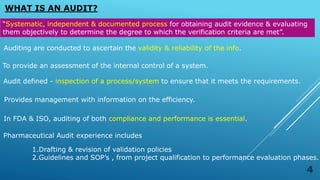
WHAT IS AN AUDIT?
Auditing are conducted to ascertain the validity & reliability of the info.
To provide an assessment of the internal control of a system.
Audit defined - inspection of a process/system to ensure that it meets the requirements.
“Systematic, independent & documented process for obtaining audit evidence & evaluating
them objectively to determine the degree to which the verification criteria are met”.
Provides management with information on the efficiency.
In FDA & ISO, auditing of both compliance and performance is essential.
Pharmaceutical Audit experience includes
1.Drafting & revision of validation policies
2.Guidelines and SOP’s , from project qualification to performance evaluation phases.
4
OBJECTIVES OF AUDIT
Evaluating conformity of requirements to ISO 9001.
Evaluating conformity of documentation to ISO 9001.
 Judging conformity of implementation to documentation.
Providing an opportunity to improve the quality management system.
Providing Registration and inclusion in a list of registered companies.
To determine the conformity & non-conformity of the quality system in meeting the
specified requirements
To determine the effectiveness of the implemented quality in meeting the specified
Quality objectives.
5
WHY AUDIT?
1. To initially evaluate the supplier where there is a desire to establish a contractual
relationship.
2. To verify that an organization own quality system continues to meet specified
requirements and is being implemented.
3. To evaluate an organization’s own quality system against quality system standard.
4. Within a framework a contractual relationship to verify that the suppliers quality
system continues to meet specified requirements and is being implemented.
6
TYPES OF AUDITS
7
•First party Audit or self-audit
•Auditor & those being Audited belongs to same organization.
• Eg.QA Department
•Second party Audit
•Customer conducting an Audit on a supplier or contractor.
•Ex. QSR, ISO 9001 or ISO 13485 standards
•Third-party Audit
•A Regulatory agency or an independent body performs this
Audit.
•For Compliance or Certification or Registration
•Eg. FDA Investigator
To assist the internal control
system.
Builds confidence in Quality system
Safeguarding the assets
Detection and prevention of errors
and faults.
Verify the accuracy and authenticity
of errors and frauds
Improves performance
Effective assessment of GMP
compliance
Helps in smooth functioning
of the internal check system
Reduce the Risk of failure
Allow the reduction of some
activities (e. g. in-house
quality control (QC) testing of
starting materials
Ensures that requirements
are understood and met
BENEFITS OF INTERNAL AUDIT BENEFITS OF EXTERNAL AUDIT
8
 General
 Name of the company
 Names & designations of persons constituting self inspection team
 Organization chart of the company
 Date of commencement of self inspection
 Date of completion of self inspection
 Personnel
 Premises
 Storage of starting materials
 Weighing area
 Equipments
 Sanitation & hygiene
 Production & in process control
 Printed labeling & packaging material control
 Quality control
 Storage of finished products
 Documentation
 Calibration of instrument & measurement systems
 Validation & revalidation
 Complaints
 Product recalls
 Returned & salvaged drug products
 Results of previous self inspection & corrective measures taken
 Results of the current self inspection
 Recommendations
 Signature of persons comprising self inspection team
Items for self inspection [Internal audit]
9
1. Risk Assessment - relevant risk factors
2. Scope Statement - activities during the audit project justification, the project
description, the deliverables, & the success criteria.
COMPONENTS OF AUDIT
3. Audit Program - audit procedures & objectives.
4. Audit Procedures - tasks that the auditor follows to gather, analyze, and document
during the audit.
5. Work papers - detailed documentation
10
 Regulatory agencies play a very important role assuring the good quality so that
safe & effective product should be delivered to the public.
 Auditing has become one of the important key for the success of a pharma company.
 Quality is determined the firm complies with GMP requirements & makes
scientifically justified decisions.
1. Medicinal products high quality as people lives depend on it, although end product
testing of samples from each batch is important, it is not enough to ensure quality which
must be built in to the manufacturing processes.
2. To ensure the quality, establish & implement as effective pharmaceutical QA
system.
 Quality can only be achieved when everyone works together to meet the challenge.
IMPORTANCE OF AUDITS IN PHARMACEUTICAL INDUSTRY
11
5. Audits are intended to verify that manufacturing control systems are operating under the
state of control.
6. Audit can detect potential problems to permit timely correction
7. Audits can be used to establish with a high range of confidence to remain adequate level
of control by management.
CONTI
4. Pharmaceutical manufacturers commonly use audits as effective mechanism to verify
compliance with GMPs.
3. To assess the effectiveness of these QA systems & to ensure it follow GMP, self inspection
and other regulatory audits must be performed.
12
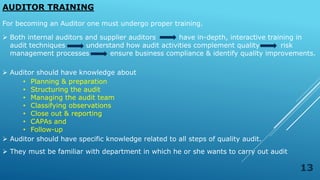
AUDITOR TRAINING
For becoming an Auditor one must undergo proper training.
 Both internal auditors and supplier auditors have in-depth, interactive training in
audit techniques understand how audit activities complement quality risk
management processes ensure business compliance & identify quality improvements.
 Auditor should have knowledge about
• Planning & preparation
• Structuring the audit
• Managing the audit team
• Classifying observations
• Close out & reporting
• CAPAs and
• Follow-up
 Auditor should have specific knowledge related to all steps of quality audit.
 They must be familiar with department in which he or she wants to carry out audit
13
AUDIT TRAINING PROGRAM
 Auditing Basics
 Auditing Types & Models
 Audit methods, Tools & Techniques
 The Audit process
 Developing an Audit Plan & Aide Memoire
 Internal Auditing & Improving the Audit System
 How to Audit CAPA, OOS, OOT & QRM
 Auditing Products Manufacturers
 Classification of Observations
 Auditing for Approval of Suppliers/Contractors
 Auditing API Suppliers
 Data integrity
14
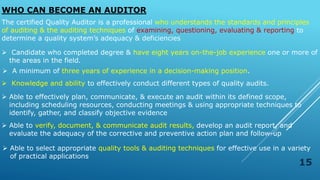
 Candidate who completed degree & have eight years on-the-job experience one or more of
the areas in the field.
WHO CAN BECOME AN AUDITOR
The certified Quality Auditor is a professional who understands the standards and principles
of auditing & the auditing techniques of examining, questioning, evaluating & reporting to
determine a quality system’s adequacy & deficiencies
 A minimum of three years of experience in a decision-making position.
 Knowledge and ability to effectively conduct different types of quality audits.
 Able to effectively plan, communicate, & execute an audit within its defined scope,
including scheduling resources, conducting meetings & using appropriate techniques to
identify, gather, and classify objective evidence
 Able to verify, document, & communicate audit results, develop an audit report, and
evaluate the adequacy of the corrective and preventive action plan and follow-up
 Able to select appropriate quality tools & auditing techniques for effective use in a variety
of practical applications
15
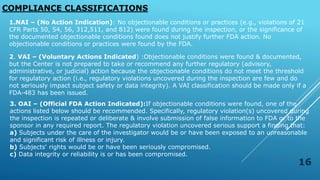
1.NAI – (No Action Indication): No objectionable conditions or practices (e.g., violations of 21
CFR Parts 50, 54, 56, 312,511, and 812) were found during the inspection, or the significance of
the documented objectionable conditions found does not justify further FDA action. No
objectionable conditions or practices were found by the FDA.
COMPLIANCE CLASSIFICATIONS
2. VAI – (Voluntary Actions Indicated) :Objectionable conditions were found & documented,
but the Center is not prepared to take or recommend any further regulatory (advisory,
administrative, or judicial) action because the objectionable conditions do not meet the threshold
for regulatory action (i.e., regulatory violations uncovered during the inspection are few and do
not seriously impact subject safety or data integrity). A VAI classification should be made only if a
FDA-483 has been issued.
3. OAI – (Official FDA Action Indicated):If objectionable conditions were found, one of the
actions listed below should be recommended. Specifically, regulatory violation(s) uncovered during
the inspection is repeated or deliberate & involve submission of false information to FDA or to the
sponsor in any required report. The regulatory violation uncovered serious support a finding that:
a) Subjects under the care of the investigator would be or have been exposed to an unreasonable
and significant risk of illness or injury.
b) Subjects' rights would be or have been seriously compromised.
c) Data integrity or reliability is or has been compromised.
16
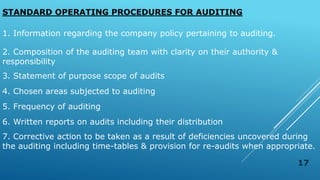
7. Corrective action to be taken as a result of deficiencies uncovered during
the auditing including time-tables & provision for re-audits when appropriate.
6. Written reports on audits including their distribution
5. Frequency of auditing
4. Chosen areas subjected to auditing
3. Statement of purpose scope of audits
2. Composition of the auditing team with clarity on their authority &
responsibility
1. Information regarding the company policy pertaining to auditing.
STANDARD OPERATING PROCEDURES FOR AUDITING
17
AUDITING
PRINCIPLES
Integrity
Fair
Presentation
Due
professional
care
Confidentiali
ty
Independenc
e
Evidence
Based
Approach
18
MANAGING AN AUDIT PROGRAM
19
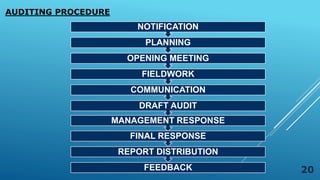
AUDITING PROCEDURE
PLANNING
NOTIFICATION
OPENING MEETING
FIELDWORK
COMMUNICATION
DRAFT AUDIT
MANAGEMENT RESPONSE
FINAL RESPONSE
FEEDBACK
REPORT DISTRIBUTION
20
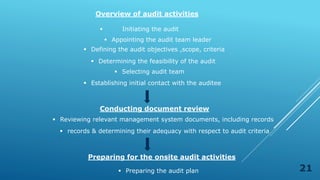
Overview of audit activities
 Initiating the audit
 Appointing the audit team leader
 Defining the audit objectives ,scope, criteria
 Determining the feasibility of the audit
 Selecting audit team
 Establishing initial contact with the auditee
Conducting document review
 Reviewing relevant management system documents, including records
 records & determining their adequacy with respect to audit criteria
Preparing for the onsite audit activities
 Preparing the audit plan 21
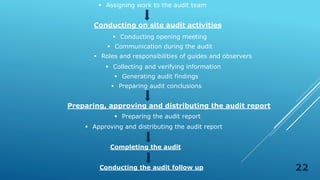
 Assigning work to the audit team
Conducting on site audit activities
 Conducting opening meeting
 Communication during the audit
 Roles and responsibilities of guides and observers
 Collecting and verifying information
 Generating audit findings
 Preparing audit conclusions
Preparing, approving and distributing the audit report
 Preparing the audit report
 Approving and distributing the audit report
Completing the audit
Conducting the audit follow up 22
23
CHECKLIST
24
CONCLUSION
 A Quality system approaches calls for audits to be conducted at
planned intervals to evaluate effective implementation &
maintenance of the Quality system.
 Integral part of an industry & cannot be neglected as it helps in
product realization, process perfection, quality monitoring.
 Serves as Regulatory compliance and business needs.
 Tool for continuous improvement of quality system of an industry.
25
REFERENCES
 https://www.omicsonline.org/conferences-list/importance-of-audit-in-pharmaceutical-industry
 https://ispe.org/training/online-learning/gmp-auditing-pharmaceutical-industry
 https://www.pharmaguideline.com/p/audit.html
 https://www.researchgate.net/publication/229600793_Role_of_Quality_Systems_and_Audits_in_Pharmaceutical_M
anufacturing_Environment
 https://pharmapathway.com/quality-audit-introduction-types-and-procedure/
 https://www.aicpa.org/interestareas/notforprofit/resources/governancemanagement/ten-steps-to-a-smooth-
audit.html
 https://quantivate.com/blog/10-steps-successful-audit-program/
 https://medium.com/libt/10-steps-to-perform-an-internal-audit-in-your-organization-c0bb3cebdde9
 https://www.pharmalex.com/10-top-tips-for-an-effective-internal-audit-system/
26

Audits

  • 1.
  • 2.
    IMPORTANCE OF AUDITSIN PHARMA INDUSTRY PRESENTED BY: SWATHI.P 1ST M.PHARM DEPT. OF PHARM QUALITY ASSURANCE GUIDED BY: Mr. J.S.K.NAGARAJAN DEPT. OF PHARM. ANALYSIS JSS COLLEGE OF PHARMACY , OOTY 2
  • 3.
    3 CONTENTS  WHAT ISAN AUDIT  OBJECTIVES OF AUDIT  PURPOSE OF AUDIT  TYPES OF AUDIT  COMPONENTS OF AUDIT  IMPORTANCE OF AUDITS  AUDIT TRAINING  SOP FOR AUDITING  AUDITING PRINCIPLES  COMPLIANCE CLASSIFICATION  REFERENCES  AUDITING PROCEDURE  CONCLUSION
  • 4.
    WHAT IS ANAUDIT? Auditing are conducted to ascertain the validity & reliability of the info. To provide an assessment of the internal control of a system. Audit defined - inspection of a process/system to ensure that it meets the requirements. “Systematic, independent & documented process for obtaining audit evidence & evaluating them objectively to determine the degree to which the verification criteria are met”. Provides management with information on the efficiency. In FDA & ISO, auditing of both compliance and performance is essential. Pharmaceutical Audit experience includes 1.Drafting & revision of validation policies 2.Guidelines and SOP’s , from project qualification to performance evaluation phases. 4
  • 5.
    OBJECTIVES OF AUDIT Evaluatingconformity of requirements to ISO 9001. Evaluating conformity of documentation to ISO 9001.  Judging conformity of implementation to documentation. Providing an opportunity to improve the quality management system. Providing Registration and inclusion in a list of registered companies. To determine the conformity & non-conformity of the quality system in meeting the specified requirements To determine the effectiveness of the implemented quality in meeting the specified Quality objectives. 5
  • 6.
    WHY AUDIT? 1. Toinitially evaluate the supplier where there is a desire to establish a contractual relationship. 2. To verify that an organization own quality system continues to meet specified requirements and is being implemented. 3. To evaluate an organization’s own quality system against quality system standard. 4. Within a framework a contractual relationship to verify that the suppliers quality system continues to meet specified requirements and is being implemented. 6
  • 7.
    TYPES OF AUDITS 7 •Firstparty Audit or self-audit •Auditor & those being Audited belongs to same organization. • Eg.QA Department •Second party Audit •Customer conducting an Audit on a supplier or contractor. •Ex. QSR, ISO 9001 or ISO 13485 standards •Third-party Audit •A Regulatory agency or an independent body performs this Audit. •For Compliance or Certification or Registration •Eg. FDA Investigator
  • 8.
    To assist theinternal control system. Builds confidence in Quality system Safeguarding the assets Detection and prevention of errors and faults. Verify the accuracy and authenticity of errors and frauds Improves performance Effective assessment of GMP compliance Helps in smooth functioning of the internal check system Reduce the Risk of failure Allow the reduction of some activities (e. g. in-house quality control (QC) testing of starting materials Ensures that requirements are understood and met BENEFITS OF INTERNAL AUDIT BENEFITS OF EXTERNAL AUDIT 8
  • 9.
     General  Nameof the company  Names & designations of persons constituting self inspection team  Organization chart of the company  Date of commencement of self inspection  Date of completion of self inspection  Personnel  Premises  Storage of starting materials  Weighing area  Equipments  Sanitation & hygiene  Production & in process control  Printed labeling & packaging material control  Quality control  Storage of finished products  Documentation  Calibration of instrument & measurement systems  Validation & revalidation  Complaints  Product recalls  Returned & salvaged drug products  Results of previous self inspection & corrective measures taken  Results of the current self inspection  Recommendations  Signature of persons comprising self inspection team Items for self inspection [Internal audit] 9
  • 10.
    1. Risk Assessment- relevant risk factors 2. Scope Statement - activities during the audit project justification, the project description, the deliverables, & the success criteria. COMPONENTS OF AUDIT 3. Audit Program - audit procedures & objectives. 4. Audit Procedures - tasks that the auditor follows to gather, analyze, and document during the audit. 5. Work papers - detailed documentation 10
  • 11.
     Regulatory agenciesplay a very important role assuring the good quality so that safe & effective product should be delivered to the public.  Auditing has become one of the important key for the success of a pharma company.  Quality is determined the firm complies with GMP requirements & makes scientifically justified decisions. 1. Medicinal products high quality as people lives depend on it, although end product testing of samples from each batch is important, it is not enough to ensure quality which must be built in to the manufacturing processes. 2. To ensure the quality, establish & implement as effective pharmaceutical QA system.  Quality can only be achieved when everyone works together to meet the challenge. IMPORTANCE OF AUDITS IN PHARMACEUTICAL INDUSTRY 11
  • 12.
    5. Audits areintended to verify that manufacturing control systems are operating under the state of control. 6. Audit can detect potential problems to permit timely correction 7. Audits can be used to establish with a high range of confidence to remain adequate level of control by management. CONTI 4. Pharmaceutical manufacturers commonly use audits as effective mechanism to verify compliance with GMPs. 3. To assess the effectiveness of these QA systems & to ensure it follow GMP, self inspection and other regulatory audits must be performed. 12
  • 13.
    AUDITOR TRAINING For becomingan Auditor one must undergo proper training.  Both internal auditors and supplier auditors have in-depth, interactive training in audit techniques understand how audit activities complement quality risk management processes ensure business compliance & identify quality improvements.  Auditor should have knowledge about • Planning & preparation • Structuring the audit • Managing the audit team • Classifying observations • Close out & reporting • CAPAs and • Follow-up  Auditor should have specific knowledge related to all steps of quality audit.  They must be familiar with department in which he or she wants to carry out audit 13
  • 14.
    AUDIT TRAINING PROGRAM Auditing Basics  Auditing Types & Models  Audit methods, Tools & Techniques  The Audit process  Developing an Audit Plan & Aide Memoire  Internal Auditing & Improving the Audit System  How to Audit CAPA, OOS, OOT & QRM  Auditing Products Manufacturers  Classification of Observations  Auditing for Approval of Suppliers/Contractors  Auditing API Suppliers  Data integrity 14
  • 15.
     Candidate whocompleted degree & have eight years on-the-job experience one or more of the areas in the field. WHO CAN BECOME AN AUDITOR The certified Quality Auditor is a professional who understands the standards and principles of auditing & the auditing techniques of examining, questioning, evaluating & reporting to determine a quality system’s adequacy & deficiencies  A minimum of three years of experience in a decision-making position.  Knowledge and ability to effectively conduct different types of quality audits.  Able to effectively plan, communicate, & execute an audit within its defined scope, including scheduling resources, conducting meetings & using appropriate techniques to identify, gather, and classify objective evidence  Able to verify, document, & communicate audit results, develop an audit report, and evaluate the adequacy of the corrective and preventive action plan and follow-up  Able to select appropriate quality tools & auditing techniques for effective use in a variety of practical applications 15
  • 16.
    1.NAI – (NoAction Indication): No objectionable conditions or practices (e.g., violations of 21 CFR Parts 50, 54, 56, 312,511, and 812) were found during the inspection, or the significance of the documented objectionable conditions found does not justify further FDA action. No objectionable conditions or practices were found by the FDA. COMPLIANCE CLASSIFICATIONS 2. VAI – (Voluntary Actions Indicated) :Objectionable conditions were found & documented, but the Center is not prepared to take or recommend any further regulatory (advisory, administrative, or judicial) action because the objectionable conditions do not meet the threshold for regulatory action (i.e., regulatory violations uncovered during the inspection are few and do not seriously impact subject safety or data integrity). A VAI classification should be made only if a FDA-483 has been issued. 3. OAI – (Official FDA Action Indicated):If objectionable conditions were found, one of the actions listed below should be recommended. Specifically, regulatory violation(s) uncovered during the inspection is repeated or deliberate & involve submission of false information to FDA or to the sponsor in any required report. The regulatory violation uncovered serious support a finding that: a) Subjects under the care of the investigator would be or have been exposed to an unreasonable and significant risk of illness or injury. b) Subjects' rights would be or have been seriously compromised. c) Data integrity or reliability is or has been compromised. 16
  • 17.
    7. Corrective actionto be taken as a result of deficiencies uncovered during the auditing including time-tables & provision for re-audits when appropriate. 6. Written reports on audits including their distribution 5. Frequency of auditing 4. Chosen areas subjected to auditing 3. Statement of purpose scope of audits 2. Composition of the auditing team with clarity on their authority & responsibility 1. Information regarding the company policy pertaining to auditing. STANDARD OPERATING PROCEDURES FOR AUDITING 17
  • 18.
  • 19.
  • 20.
    AUDITING PROCEDURE PLANNING NOTIFICATION OPENING MEETING FIELDWORK COMMUNICATION DRAFTAUDIT MANAGEMENT RESPONSE FINAL RESPONSE FEEDBACK REPORT DISTRIBUTION 20
  • 21.
    Overview of auditactivities  Initiating the audit  Appointing the audit team leader  Defining the audit objectives ,scope, criteria  Determining the feasibility of the audit  Selecting audit team  Establishing initial contact with the auditee Conducting document review  Reviewing relevant management system documents, including records  records & determining their adequacy with respect to audit criteria Preparing for the onsite audit activities  Preparing the audit plan 21
  • 22.
     Assigning workto the audit team Conducting on site audit activities  Conducting opening meeting  Communication during the audit  Roles and responsibilities of guides and observers  Collecting and verifying information  Generating audit findings  Preparing audit conclusions Preparing, approving and distributing the audit report  Preparing the audit report  Approving and distributing the audit report Completing the audit Conducting the audit follow up 22
  • 23.
  • 24.
    24 CONCLUSION  A Qualitysystem approaches calls for audits to be conducted at planned intervals to evaluate effective implementation & maintenance of the Quality system.  Integral part of an industry & cannot be neglected as it helps in product realization, process perfection, quality monitoring.  Serves as Regulatory compliance and business needs.  Tool for continuous improvement of quality system of an industry.
  • 25.
    25 REFERENCES  https://www.omicsonline.org/conferences-list/importance-of-audit-in-pharmaceutical-industry  https://ispe.org/training/online-learning/gmp-auditing-pharmaceutical-industry https://www.pharmaguideline.com/p/audit.html  https://www.researchgate.net/publication/229600793_Role_of_Quality_Systems_and_Audits_in_Pharmaceutical_M anufacturing_Environment  https://pharmapathway.com/quality-audit-introduction-types-and-procedure/  https://www.aicpa.org/interestareas/notforprofit/resources/governancemanagement/ten-steps-to-a-smooth- audit.html  https://quantivate.com/blog/10-steps-successful-audit-program/  https://medium.com/libt/10-steps-to-perform-an-internal-audit-in-your-organization-c0bb3cebdde9  https://www.pharmalex.com/10-top-tips-for-an-effective-internal-audit-system/
  • 26.