AUDITS IN PHARMACEUTICAL
INDUSTRY
PRESENTED BY
Mr.Madane Vikram A
Department-pharmaceutical Quality Assurance
Bharati Vidyapeeth College Of pharmacy,
kolhapur
Roll No-8
GUIDED BY
Mr.D.V.Mahuli
Department-pharmacology
Bharati Vidyapeeth College Of Pharmacy,kolhapur.
INDEX
 Definitions
 Objective
 Self Inspection
 Types Of Quality Audits
• Internal Audit
• External Audit
• Regulatory Audit
 Role Of Audits In QA&QC Program
 Benefits Of Audits
 Reference
AUDITS
A systematic, independent and documented process for obtaining
evidence and evaluating it objectively to determine the extent to which
criteria are fulfilled.
QUALITY AUDIT
Quality audit is defined as a systematic and independent examination to
determine whether activities and related results comply with planned
arrangements and whether these arrangements are implemented
effectively and are suitable to achieve objectives
GMP Compliance Audit-
 It is the audit related to Good Manufacturing Practice in
Pharmaceutical Industry.
 Applying to national or international GMP Regulations.
 It can be define as an audit conducted by someone external to your
organization with the purpose of discovering GMP deficiencies.
Objective of the Quality Audits-
Pharmaceutical manufacturers commonly use audits as an
effective mechanism to verify compliance with GMP regulation
(GMP).GMP audits with two important goals -
• Audis are intended to verify that manufacturing and Control
systems are operating under a state of control.
• Audits permit timely correction of potential problems.
Audits can be used to establish a High degree of confidence to
remain under an adequate level of control by managements.
Self Inspection
Principle –
 To evaluate the manufacturer’s Compliance with GMP in all aspects of production
and Quality control.
 Designed to detect any shortcomings in the implementation of GMP and to
recommend the necessary corrective actions.
 Performed routinely as well as on special occasions, e.g. in the case of product
recalls or repeated rejections
Items of Self Inspection
 Personnel
 Premises including personnel facilities
 Maintenance of buildings and equipment
 Storage of starting materials and finished
products
 Equipment
 Production and in-process controls
 Quality control
 Documentation
 Sanitation and hygiene
 Validation and revalidation
programmes
 Calibration of instruments or
measurement systems Recall
procedures
 Complaints management
 Labels control
 Results of previous self-inspections and
any corrective steps Taken
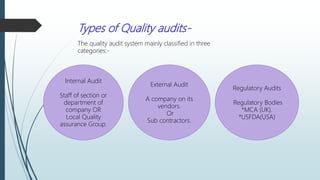
Types of Quality audits-
The quality audit system mainly classified in three
categories:-
Internal Audit
Staff of section or
department of
company OR
Local Quality
assurance Group.
External Audit
A company on its
vendors.
Or
Sub contractors.
Regulatory Audits
Regulatory Bodies
*MCA (UK).
*USFDA(USA)
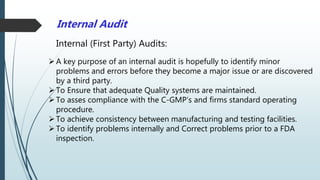
Internal Audit
Internal (First Party) Audits:
A key purpose of an internal audit is hopefully to identify minor
problems and errors before they become a major issue or are discovered
by a third party.
To Ensure that adequate Quality systems are maintained.
To asses compliance with the C-GMP’s and firms standard operating
procedure.
To achieve consistency between manufacturing and testing facilities.
To identify problems internally and Correct problems prior to a FDA
inspection.
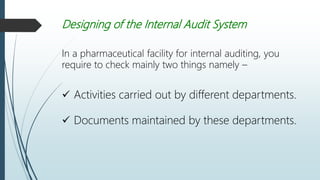
Designing of the Internal Audit System
In a pharmaceutical facility for internal auditing, you
require to check mainly two things namely –
 Activities carried out by different departments.
 Documents maintained by these departments.
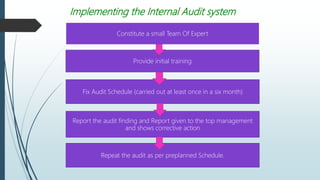
Implementing the Internal Audit system
Constitute a small Team Of Expert
Provide initial training
Fix Audit Schedule (carried out at least once in a six month)
Report the audit finding and Report given to the top management
and shows corrective action
Repeat the audit as per preplanned Schedule.
External Audit-
External Audit ( 2ndParty):
(A second party audit is one that is carried out by a non-
regulatory auditor).
For example, in some industries, especially pharmaceuticals and
chemicals, customers and potential customers will often ask to visit a company :--
-to ensure they are operating according to a quality system and hence will
provide good quality goods.
Purpose:
 Confidence in the partnership arrangement .
 Ensuring that requirements are understood .
 Enabling reduction of in-house QC testing of starting materials .
 Reducing the risk of failure.
 Carried Out by a company on its vendors or sub contractors .
 No legal requirement for to conduct audit.
Purpose cont…..
 Regular audits will be carried out to assesses
compliance with agreed standards .
 Confidence in vendor auditing.
 Reduce level of external auditing.
 External auditors have experience of GMP and as well
as regularly audited by their certification body.
External (Third party Audit) Or
Regulatory Audit-
A third party audit is one that is carried out by a
Regulatory auditor or Inspector.
(These are a legal requirement in highly regulated
industries such as pharmaceuticals and food
production)
Purpose of Regulatory Audits.
Networking and confidence-building between national
inspection authorities . Development of quality systems.
Work towards global harmonization of GMP.
Carried out by regulatory bodies such as MCA(U.K), USFDA
(USA)for manufacturing and supply of pharmaceutical
product .
Audits may be unannounced .
Failure of regulatory audit withdrawal of a manufacturing or
import/export license.
Cont…
After regulatory audit, a formal report will
be delivered-
For MCA :-verbal feedback report is
given at the exit meeting.
For USFDA :-Provides “Form 483”is
given at the exit meeting.
This sort of audit is also a requirement for any company accredited to a
formal quality system such as ISO 9000 or ISO 14000.
ROLE OF GMP AUDITS IN Q.A AND Q.C
PROGRAMMES
What is to be audited-
Auditors review-
SOPs
Employees Practices and behavior.
Compare master specifications against compendia and
regulatory requirements. Verify the test data and validation
testing.
Validation test reports are compared against raw data.
Verify Corrective actions taken in reaction to audit finding .
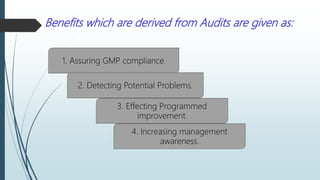
Benefits which are derived from Audits are given as:
1. Assuring GMP compliance.
2. Detecting Potential Problems.
3. Effecting Programmed
improvement.
4. Increasing management
awareness.
References-
• https://www.pharmout.net/industry-solutions/gmpcompliance-audits-
pharmaceuticals/
https://bizfluent.com/list-6833307-quality-audit-types.html
https://www.slideshare.net/Dolita-Shah/qualityaudit?from_action=save
https://www.slideshare.net/prashanthbabu/qualityassurance-audit-and-inspection
Audits in pharmaceutical industry

Audits in pharmaceutical industry

  • 1.
    AUDITS IN PHARMACEUTICAL INDUSTRY PRESENTEDBY Mr.Madane Vikram A Department-pharmaceutical Quality Assurance Bharati Vidyapeeth College Of pharmacy, kolhapur Roll No-8 GUIDED BY Mr.D.V.Mahuli Department-pharmacology Bharati Vidyapeeth College Of Pharmacy,kolhapur.
  • 2.
    INDEX  Definitions  Objective Self Inspection  Types Of Quality Audits • Internal Audit • External Audit • Regulatory Audit  Role Of Audits In QA&QC Program  Benefits Of Audits  Reference
  • 3.
    AUDITS A systematic, independentand documented process for obtaining evidence and evaluating it objectively to determine the extent to which criteria are fulfilled. QUALITY AUDIT Quality audit is defined as a systematic and independent examination to determine whether activities and related results comply with planned arrangements and whether these arrangements are implemented effectively and are suitable to achieve objectives
  • 4.
    GMP Compliance Audit- It is the audit related to Good Manufacturing Practice in Pharmaceutical Industry.  Applying to national or international GMP Regulations.  It can be define as an audit conducted by someone external to your organization with the purpose of discovering GMP deficiencies.
  • 5.
    Objective of theQuality Audits- Pharmaceutical manufacturers commonly use audits as an effective mechanism to verify compliance with GMP regulation (GMP).GMP audits with two important goals - • Audis are intended to verify that manufacturing and Control systems are operating under a state of control. • Audits permit timely correction of potential problems. Audits can be used to establish a High degree of confidence to remain under an adequate level of control by managements.
  • 6.
    Self Inspection Principle – To evaluate the manufacturer’s Compliance with GMP in all aspects of production and Quality control.  Designed to detect any shortcomings in the implementation of GMP and to recommend the necessary corrective actions.  Performed routinely as well as on special occasions, e.g. in the case of product recalls or repeated rejections
  • 7.
    Items of SelfInspection  Personnel  Premises including personnel facilities  Maintenance of buildings and equipment  Storage of starting materials and finished products  Equipment  Production and in-process controls  Quality control  Documentation
  • 8.
     Sanitation andhygiene  Validation and revalidation programmes  Calibration of instruments or measurement systems Recall procedures  Complaints management  Labels control  Results of previous self-inspections and any corrective steps Taken
  • 9.
    Types of Qualityaudits- The quality audit system mainly classified in three categories:- Internal Audit Staff of section or department of company OR Local Quality assurance Group. External Audit A company on its vendors. Or Sub contractors. Regulatory Audits Regulatory Bodies *MCA (UK). *USFDA(USA)
  • 10.
    Internal Audit Internal (FirstParty) Audits: A key purpose of an internal audit is hopefully to identify minor problems and errors before they become a major issue or are discovered by a third party. To Ensure that adequate Quality systems are maintained. To asses compliance with the C-GMP’s and firms standard operating procedure. To achieve consistency between manufacturing and testing facilities. To identify problems internally and Correct problems prior to a FDA inspection.
  • 11.
    Designing of theInternal Audit System In a pharmaceutical facility for internal auditing, you require to check mainly two things namely –  Activities carried out by different departments.  Documents maintained by these departments.
  • 12.
    Implementing the InternalAudit system Constitute a small Team Of Expert Provide initial training Fix Audit Schedule (carried out at least once in a six month) Report the audit finding and Report given to the top management and shows corrective action Repeat the audit as per preplanned Schedule.
  • 13.
    External Audit- External Audit( 2ndParty): (A second party audit is one that is carried out by a non- regulatory auditor). For example, in some industries, especially pharmaceuticals and chemicals, customers and potential customers will often ask to visit a company :-- -to ensure they are operating according to a quality system and hence will provide good quality goods. Purpose:  Confidence in the partnership arrangement .  Ensuring that requirements are understood .  Enabling reduction of in-house QC testing of starting materials .  Reducing the risk of failure.  Carried Out by a company on its vendors or sub contractors .  No legal requirement for to conduct audit.
  • 14.
    Purpose cont…..  Regularaudits will be carried out to assesses compliance with agreed standards .  Confidence in vendor auditing.  Reduce level of external auditing.  External auditors have experience of GMP and as well as regularly audited by their certification body.
  • 15.
    External (Third partyAudit) Or Regulatory Audit- A third party audit is one that is carried out by a Regulatory auditor or Inspector. (These are a legal requirement in highly regulated industries such as pharmaceuticals and food production)
  • 16.
    Purpose of RegulatoryAudits. Networking and confidence-building between national inspection authorities . Development of quality systems. Work towards global harmonization of GMP. Carried out by regulatory bodies such as MCA(U.K), USFDA (USA)for manufacturing and supply of pharmaceutical product . Audits may be unannounced . Failure of regulatory audit withdrawal of a manufacturing or import/export license.
  • 17.
    Cont… After regulatory audit,a formal report will be delivered- For MCA :-verbal feedback report is given at the exit meeting. For USFDA :-Provides “Form 483”is given at the exit meeting. This sort of audit is also a requirement for any company accredited to a formal quality system such as ISO 9000 or ISO 14000.
  • 18.
    ROLE OF GMPAUDITS IN Q.A AND Q.C PROGRAMMES What is to be audited- Auditors review- SOPs Employees Practices and behavior. Compare master specifications against compendia and regulatory requirements. Verify the test data and validation testing. Validation test reports are compared against raw data. Verify Corrective actions taken in reaction to audit finding .
  • 20.
    Benefits which arederived from Audits are given as: 1. Assuring GMP compliance. 2. Detecting Potential Problems. 3. Effecting Programmed improvement. 4. Increasing management awareness.
  • 21.