
USFDA GUIDELINESS ON PROCESS
VALIDATION-A LIFE CYCLE
APPROACH
BY
Ayush Sharma
M . Pharm (QA)
1
Introduction
What is USFDA ?
 The food and drug administration is a federal agency of the
united states department of health and human service, one of
the united states federal executive departments. The FDA is
responsible for protecting and promoting public health through
the control and supervision of food, safety, tobacco products,
dietary supplements.
2
Introduction
• This guidance outlines the general principles and approaches
that FDA considers appropriate elements of process validation
for the manufacture of human and animal drug and biological
products, including active pharmaceutical ingredients (APIs or
drug substances), collectively referred to in this guidance as
drugs or products. This guidance incorporates principles and
approaches that all manufacturers can use to validate
manufacturing processes.
3
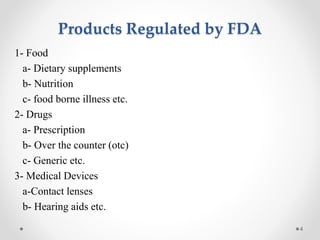
Products Regulated by FDA
1- Food
a- Dietary supplements
b- Nutrition
c- food borne illness etc.
2- Drugs
a- Prescription
b- Over the counter (otc)
c- Generic etc.
3- Medical Devices
a-Contact lenses
b- Hearing aids etc.
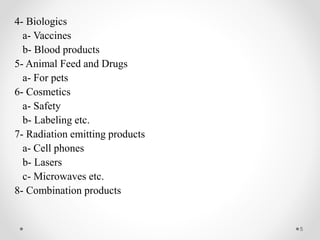
4
4- Biologics
a- Vaccines
b- Blood products
5- Animal Feed and Drugs
a- For pets
6- Cosmetics
a- Safety
b- Labeling etc.
7- Radiation emitting products
a- Cell phones
b- Lasers
c- Microwaves etc.
8- Combination products
5
Process Validation
The US Food and Drug Administration issued Process Validation:
General Principles and Practices (1) in January 2011. This
guidance has given widespread visibility to the lifecycle approach
concept. Validation managers are now responding to questions
and comments about the guidance from their colleagues. The
following discusses these and other areas of concern raised by
attendees at validation meetings in Montreal (2010), Philadelphia
(2010), and Amsterdam (2011).
6
• These are relevant “hands-on” questions from people
that face validation problems every day. Topics
addressed in this discussion include the following:
• What is different about the lifecycle approach? What
is its emphasis compared to the 1987 FDA process
validation guidance (2)?
• Why the lifecycle approach? Is it really a new
approach?
7
• Should the lifecycle approach be applied to other
areas of validation and qualification? What about
using the lifecycle approach to other processes and to
equipment, HVAC, computer systems, and other
qualifications?
• How does the guidance affect our current validation
programs? What areas need to be modified to be
compliant with the new guidance?
8
THE LIFECYCLE APPROACH
• The January 2011 process validation guidance (1) has
integrated information, strategy, and approaches
discussed in various US and international documents
to provide a comprehensive approach to validation
(i.e., the lifecycle approach)
• The guidance provides specific and detailed
recommendations for each stage of the lifecycle
approach.
9
• The definition of process validation stated in the 2011
guidance is as follows:
• “Process validation is defined as the collection and
evaluation of data, from the process design stage
throughout production, which establishes scientific
evidence that a process is capable of consistently
delivering quality product. Process validation
involves a series of activities taking place over the
lifecycle of the product and process.”
10
Approach to Process Validation–Stages 1, 2,
and 3
• This guidance supports process improvement and
innovation through sound science.”
• Successful validation depends on knowledge and
understanding from product and process
development. Specific key areas mentioned in the
guidance include the following:
• “Understanding the sources of variation
11
• Detect the presence and degree of variation
• Understanding the impact of variation on the process
and ultimately on product attributes
• Control the variation in a manner commensurate with
the risk it represents to the process and product.”
12
FDA Recommendations
• The 2011 guidance discusses several areas and
provides specific details. These include
recommendations for the general lifecycle and stages
1, 2, and 3.
• General considerations
• These considerations are applicable to all stages in
the lifecycle.
13
14
Process Validation and Drug Quality
• Effective process validation contributes significantly
to assuring drug quality. The basic principle of quality
assurance is that a drug should be produced that is fit
for its intended use. This principle incorporates the
understanding that the following conditions exist:
• Quality, safety, and efficacy are designed or built into
the product.
15
• Quality cannot be adequately assured merely by in-
process and finished-product inspection or testing.
• Each step of a manufacturing process is controlled to
assure that the finished product meets all quality
attributes including specifications.
16
Approach to Process Validation
• For purposes of this guidance, process validation is
defined as the collection and evaluation of data, from
the process design stage through commercial
production, which establishes scientific evidence that
a process is capable of consistently delivering quality
product. Process validation involves a series of
activities taking place over the lifecycle of the
product and process.
17
• This guidance describes process validation activities
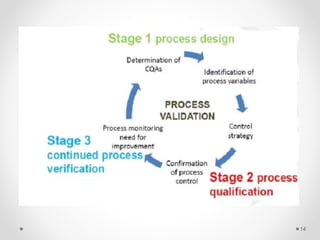
in three stages.
Stage 1 – Process Design: The commercial
manufacturing process is defined during this stage
based on knowledge gained through development and
scale-up activities.
• The functionality and limits of commercial
manufacturing equipment should be considered in the
process design.
18
• Design of experiments (DOE) studies can help to
develop process knowledge by revealing
relationships, including multivariate interactions,
between the variable inputs and the resulting outputs.
• Risk analysis tools can be used to display possible
variables for DOE studies .
19
Stage 2 – Process Qualification:
• During this stage, the process design is evaluated to
determine if the process is capable of reproducible
commercial manufacturing.
• Element (1): Design of a facility and qualification of
utilities and equipment.
• Ensure qualification of facility, utilities and
equipment is completed & documented prior to
initiate process qualification.
20
• Element (2): Process Performance Qualification
(PPQ)
• The PPQ combines the actual facility, utilities,
equipment’s and the trained personnel with the
commercial manufacturing controls.
• A company must successfully complete PPQ before
commencing commercial distribution of the drug
product.
21
Stage 3 – Continued Process Verification: On going
assurance is gained during routine production that the
process remains in a state of control.
• This guidance describes activities typical of each
stage, but in practice, some activities might occur in
multiple stages.
• A successful validation program depends upon
information and knowledge from product and process
development.
22
• This knowledge and understanding is the basis for
establishing an approach to control of the
manufacturing process that results in products with
the desired quality attributes. Manufacturers should:
• Understand the sources of variation
• Detect the presence and degree of variation
• Understand the impact of variation on the process and
ultimately on product attributes
23
• Control the variation in a manner commensurate with
the risk it represents to the process and product
• Manufacturers should use ongoing programs to
collect and analyze product and process data to
evaluate the state of control of the process.
24
WHY THE LIFECYCLE APPROACH?
• Process validation must not be considered a one-time
event or a focused one-time task performed just prior
to commercial launch that emphasizes only the
manufacture of three conformance lots.
• True process validation must be a process that is
never completed and is always ongoing.
• For manufacturing processes to be truly validated,
each of the stages must be addressed and integrated.
25
Is This Really a New Approach?
• The three-stage lifecycle description of process
validation as discussed in the FDA process validation
guidance integrates various strategies, approaches,
and expectations that had been mentioned in several
published documents, guidelines, and presentations.
• The process validation guidance is consistent with
FDA QbD principles.
26
• The process validation guidance is consistent with
FDA QbD principles. The various QbD presentations
and publications strongly encourage demonstrations
of process understanding for both API and drug
product.
• In the 2006 FDA Perspective on the Implementation
of Quality by Design (QbD), a QbD system is defined
as follows:
27
• The API or drug product is designed to meet patient
needs and performance requirements.
• The process is designed to consistently meet critical
quality attributes.
• The impact of starting raw materials and process
parameters on quality is well understood.
• The process is evaluated and updated to allow for
consistent quality over time.
28
APPLYING THE LIFECYCLE APPROACH
• The concepts identified in the respective stages of the
FDA process validation guidance—process design
(understanding), process qualification (performance),
and continued process verification (maintaining
validation)—serve as a model for all areas of
validation and qualification.
29
CONCLUSIONS
• FDA has provided recommendations for the general
lifecycle and stages 1, 2, and 3 including specific
details for each of the stages. Stage 1—Process
Design may be generally described as “process
understanding.”
• Stage 1 work will ultimately be reflected in the
master production record and control records.
30
• Stage 2—Process Qualification may be described as
“validation performance.”
• The lifecycle approach is not a new concept.
• This approach as described in the guidance integrates
various strategies, approaches, and expectations that
had been mentioned in several previously published
documents, guidelines, and presentations.
31
REFERENCES
• 1. FDA, Guidance for Industry, Process Validation:
General Principles and Practices, January 2011.
• 2. FDA, Guideline on General Principles of Process
Validation, May 1987
• Nasr, Moheb, “FDA Perspective on the
Implementation of Quality by Design (QbD),” 9th
APIC/CEFIC, Prague, Czech Republic, October 10,
2006.
32
..Question???
33
THANK YOU

USFDA guidelines on process validation a life cycle approach

  • 1.
    USFDA GUIDELINESS ONPROCESS VALIDATION-A LIFE CYCLE APPROACH BY Ayush Sharma M . Pharm (QA) 1
  • 2.
    Introduction What is USFDA?  The food and drug administration is a federal agency of the united states department of health and human service, one of the united states federal executive departments. The FDA is responsible for protecting and promoting public health through the control and supervision of food, safety, tobacco products, dietary supplements. 2
  • 3.
    Introduction • This guidanceoutlines the general principles and approaches that FDA considers appropriate elements of process validation for the manufacture of human and animal drug and biological products, including active pharmaceutical ingredients (APIs or drug substances), collectively referred to in this guidance as drugs or products. This guidance incorporates principles and approaches that all manufacturers can use to validate manufacturing processes. 3
  • 4.
    Products Regulated byFDA 1- Food a- Dietary supplements b- Nutrition c- food borne illness etc. 2- Drugs a- Prescription b- Over the counter (otc) c- Generic etc. 3- Medical Devices a-Contact lenses b- Hearing aids etc. 4
  • 5.
    4- Biologics a- Vaccines b-Blood products 5- Animal Feed and Drugs a- For pets 6- Cosmetics a- Safety b- Labeling etc. 7- Radiation emitting products a- Cell phones b- Lasers c- Microwaves etc. 8- Combination products 5
  • 6.
    Process Validation The USFood and Drug Administration issued Process Validation: General Principles and Practices (1) in January 2011. This guidance has given widespread visibility to the lifecycle approach concept. Validation managers are now responding to questions and comments about the guidance from their colleagues. The following discusses these and other areas of concern raised by attendees at validation meetings in Montreal (2010), Philadelphia (2010), and Amsterdam (2011). 6
  • 7.
    • These arerelevant “hands-on” questions from people that face validation problems every day. Topics addressed in this discussion include the following: • What is different about the lifecycle approach? What is its emphasis compared to the 1987 FDA process validation guidance (2)? • Why the lifecycle approach? Is it really a new approach? 7
  • 8.
    • Should thelifecycle approach be applied to other areas of validation and qualification? What about using the lifecycle approach to other processes and to equipment, HVAC, computer systems, and other qualifications? • How does the guidance affect our current validation programs? What areas need to be modified to be compliant with the new guidance? 8
  • 9.
    THE LIFECYCLE APPROACH •The January 2011 process validation guidance (1) has integrated information, strategy, and approaches discussed in various US and international documents to provide a comprehensive approach to validation (i.e., the lifecycle approach) • The guidance provides specific and detailed recommendations for each stage of the lifecycle approach. 9
  • 10.
    • The definitionof process validation stated in the 2011 guidance is as follows: • “Process validation is defined as the collection and evaluation of data, from the process design stage throughout production, which establishes scientific evidence that a process is capable of consistently delivering quality product. Process validation involves a series of activities taking place over the lifecycle of the product and process.” 10
  • 11.
    Approach to ProcessValidation–Stages 1, 2, and 3 • This guidance supports process improvement and innovation through sound science.” • Successful validation depends on knowledge and understanding from product and process development. Specific key areas mentioned in the guidance include the following: • “Understanding the sources of variation 11
  • 12.
    • Detect thepresence and degree of variation • Understanding the impact of variation on the process and ultimately on product attributes • Control the variation in a manner commensurate with the risk it represents to the process and product.” 12
  • 13.
    FDA Recommendations • The2011 guidance discusses several areas and provides specific details. These include recommendations for the general lifecycle and stages 1, 2, and 3. • General considerations • These considerations are applicable to all stages in the lifecycle. 13
  • 14.
  • 15.
    Process Validation andDrug Quality • Effective process validation contributes significantly to assuring drug quality. The basic principle of quality assurance is that a drug should be produced that is fit for its intended use. This principle incorporates the understanding that the following conditions exist: • Quality, safety, and efficacy are designed or built into the product. 15
  • 16.
    • Quality cannotbe adequately assured merely by in- process and finished-product inspection or testing. • Each step of a manufacturing process is controlled to assure that the finished product meets all quality attributes including specifications. 16
  • 17.
    Approach to ProcessValidation • For purposes of this guidance, process validation is defined as the collection and evaluation of data, from the process design stage through commercial production, which establishes scientific evidence that a process is capable of consistently delivering quality product. Process validation involves a series of activities taking place over the lifecycle of the product and process. 17
  • 18.
    • This guidancedescribes process validation activities in three stages. Stage 1 – Process Design: The commercial manufacturing process is defined during this stage based on knowledge gained through development and scale-up activities. • The functionality and limits of commercial manufacturing equipment should be considered in the process design. 18
  • 19.
    • Design ofexperiments (DOE) studies can help to develop process knowledge by revealing relationships, including multivariate interactions, between the variable inputs and the resulting outputs. • Risk analysis tools can be used to display possible variables for DOE studies . 19
  • 20.
    Stage 2 –Process Qualification: • During this stage, the process design is evaluated to determine if the process is capable of reproducible commercial manufacturing. • Element (1): Design of a facility and qualification of utilities and equipment. • Ensure qualification of facility, utilities and equipment is completed & documented prior to initiate process qualification. 20
  • 21.
    • Element (2):Process Performance Qualification (PPQ) • The PPQ combines the actual facility, utilities, equipment’s and the trained personnel with the commercial manufacturing controls. • A company must successfully complete PPQ before commencing commercial distribution of the drug product. 21
  • 22.
    Stage 3 –Continued Process Verification: On going assurance is gained during routine production that the process remains in a state of control. • This guidance describes activities typical of each stage, but in practice, some activities might occur in multiple stages. • A successful validation program depends upon information and knowledge from product and process development. 22
  • 23.
    • This knowledgeand understanding is the basis for establishing an approach to control of the manufacturing process that results in products with the desired quality attributes. Manufacturers should: • Understand the sources of variation • Detect the presence and degree of variation • Understand the impact of variation on the process and ultimately on product attributes 23
  • 24.
    • Control thevariation in a manner commensurate with the risk it represents to the process and product • Manufacturers should use ongoing programs to collect and analyze product and process data to evaluate the state of control of the process. 24
  • 25.
    WHY THE LIFECYCLEAPPROACH? • Process validation must not be considered a one-time event or a focused one-time task performed just prior to commercial launch that emphasizes only the manufacture of three conformance lots. • True process validation must be a process that is never completed and is always ongoing. • For manufacturing processes to be truly validated, each of the stages must be addressed and integrated. 25
  • 26.
    Is This Reallya New Approach? • The three-stage lifecycle description of process validation as discussed in the FDA process validation guidance integrates various strategies, approaches, and expectations that had been mentioned in several published documents, guidelines, and presentations. • The process validation guidance is consistent with FDA QbD principles. 26
  • 27.
    • The processvalidation guidance is consistent with FDA QbD principles. The various QbD presentations and publications strongly encourage demonstrations of process understanding for both API and drug product. • In the 2006 FDA Perspective on the Implementation of Quality by Design (QbD), a QbD system is defined as follows: 27
  • 28.
    • The APIor drug product is designed to meet patient needs and performance requirements. • The process is designed to consistently meet critical quality attributes. • The impact of starting raw materials and process parameters on quality is well understood. • The process is evaluated and updated to allow for consistent quality over time. 28
  • 29.
    APPLYING THE LIFECYCLEAPPROACH • The concepts identified in the respective stages of the FDA process validation guidance—process design (understanding), process qualification (performance), and continued process verification (maintaining validation)—serve as a model for all areas of validation and qualification. 29
  • 30.
    CONCLUSIONS • FDA hasprovided recommendations for the general lifecycle and stages 1, 2, and 3 including specific details for each of the stages. Stage 1—Process Design may be generally described as “process understanding.” • Stage 1 work will ultimately be reflected in the master production record and control records. 30
  • 31.
    • Stage 2—ProcessQualification may be described as “validation performance.” • The lifecycle approach is not a new concept. • This approach as described in the guidance integrates various strategies, approaches, and expectations that had been mentioned in several previously published documents, guidelines, and presentations. 31
  • 32.
    REFERENCES • 1. FDA,Guidance for Industry, Process Validation: General Principles and Practices, January 2011. • 2. FDA, Guideline on General Principles of Process Validation, May 1987 • Nasr, Moheb, “FDA Perspective on the Implementation of Quality by Design (QbD),” 9th APIC/CEFIC, Prague, Czech Republic, October 10, 2006. 32
  • 33.