Jadhao Pravin H (M.Pharm 1st Year)
Department of Quality Assurance
School of Pharmacy, SRTMU Nanded
Cell No. 9604542553
Email. pjadhao54@gmail.com
INDEX
 Introduction
 Reasons of Quality Auditing
 Scope and Objectives
 Types of Audit
 Audit Planning
 Audit Report
 Protocol and reports
INTRODUCTION
 Defination:-
Quality audit is defined as a systematic and independent
examination to determine whether activities and related results
comply with planned arrangements and whether these
arrangements are implemented effectively and are suitable to
achieve objectives.
 Quality audit means a systematic examination of a quality system.
 Quality audits are typically performed at defined intervals
 Any failure in their proper implementation may be published
publicly and may lead to a revocation of quality certification
1
Reasons for quality auditing:
In order to internal:
 Determine the level of compliance
 Build confidence (hopefully) in GMP and the QA system
 Build interdepartmental trust, understanding, and communication
(if the audit is done properly and tactfully)
 Determine measures necessary to improve, e.g.,:
 Premises, equipment, environment
 Operations, actions, procedures
 Personnel/training
 Provide a stimulus for improvement
 Recommend corrective action
 Monitor improvement
2
 In order to external :
 Establish and monitor capability of supplier or contractor to
deliver
goods and services that are fit for purpose (and on time, and in
the quantity required)
 Build mutual confidence
 Promote understanding and communication between the parties
involved (both sides can learn!)
 And in general, as listed for “internal”
3
Scope and Objectives:
 To ensure quality of the Product.
 To assess effectiveness of QA system.
 It permits timely correction of problems.
 It established high degree of confidence.
4
Types of quality audit :
1. Internal audit
2. External audit
3. Regulatory audit
4. Product audit
5. Process audit
6. System audit
5
1. Internal audit (First party) :
Purpose of internal audit:
 Increase the potential for early identification of regulatory concerns based
on FDA interpretations and current compliance focus
 Identify compliance deficiency and deviations from industry standards and
company requirements
 Provide a benchmark of compliance with other companies and regulatory
expectations.
 Inform management about regulatory risk
 Foster continuous improvement and forward quality
 Provide a tool by which the company can stay ahead of rapidly increasing
regulatory demands
6
Benefits of internal audit :
 Tells you the health of a quality system
 Identify the root of a problem and plan for corrective and
preventive actions with timeline
 Achieve better allocation of resources
 Able to avoid potentially big problem
 Continuous improvement
7
ning of internal audit system :
 In pharmaceutical industry mainly two things required to check,
1. Activites carried out by different departments
2. Documents mainted by these departments
Implementing the internal audit system :
 Constitution of team
 Provide initial training
 Fix and audit schedule
 Carry out the audit
 Report the audit results
 Follow up
8
2. External audit (second party or third party ):
 External audits are audits carried out by a company on its vendors or
subcontractors.
 Furthermore, if work is contracted out, they must ensure that contractors are
competent to complete it, in accordance with GMP.
 There are also strong business benefits to be derived from performing these
audits:
- building knowledge and confidence in the partnership arrangement
- ensuring that requirements are understood and met
- enabling reduction of certain activities (eg. in-house QC testing of
starting materials)
- reducing the risk of failure
9
Customer employee audit your company
 Your employee audit a company which supplies your company
with a product or service.
Third Party :
 A customer wants an audit of your company but wants your
company to pay for it.
10
3. Regulatory Audit :
 These audits are carried out by regulatory bodies against
relevant regulations for the manufacture and supply of
pharmaceutical products.
 National regulatory bodies, such as the Medicines Control
Agency (MCA) in the UK and Food and Drug Administration
(FDA) in the USA, are statutorily responsible for carrying out
such audits.
 These audits may be unannounced (MCA currently performs
about ten per cent of its UK inspections like this) as
manufacturers are expected to be complying with GMP at all
times.
 Regulatory bodies from other countries in which products are
sold may also audit companies (ie FDA audits European
manufacturers).
 Regulatory inspectors are extensively trained and are 11
 All MCA medicines inspectors are relevantly qualified and
have a minimum of five years' appropriate experience in a
manufacturing operation;
 Failure to pass a regulatory audit can lead practical experience
of GMP and receive to restrictions on (or the withdrawal of) a
manufacturing or import/export licence ;
 Regulatory audits vary considerably in scope, frequency and
duration. Audits by the national regulatory body are likely to be
regular and to cover systematically all areas of a facility, over a
period of time.
12
its :  An in-depth examination of a particular product to evalute whether it
conforms to product specificatiion, performance, standards, and customer
requirements.
5.Process Audit :
 An analysis of elements of a process and appraisal of completeness,
correctness of condition and probable effectiveness.
6.System Audit :
 A documented activity perform to verify, by examination and evalution of
objective evidence, that applicable elements of the quality system are
suitable and have been developed, documented and effectively implemented
in accordance with GMP.
13
AUDIT PLANNING
 BEFORE AUDIT
 DURING AUDIT
 AFTER AUDIT
14
RE AUDIT
 Plan well in advance.
 Decide if there are any products or activites that you want
to exclude from the audit.
 Get to know about your assessor.even witness him auditing
another site, if possible.
 Know your procedures and where they are located.
 Remove all obsolute documentation.
 Ensure all uncontrolled documentation that you are
working with are properly stamped “uncontrolled”
15
 Do not leaves piles of dacuments around waiting to
be processed or filed.
 Label all your filing cabinets and files.
 Do not leave on view neglected libraeies of
catalogues,standards softwares, etc.
 Ensures all productive material, is identified by
number and status.
 Ensure all materials are stored in authorized areas.
 Eliminate all unused ,scrap/suspect material from
around machine and workstations.
 Scrap /non-confirming material must be segregated
and clearly identified.
16
 The external auditors company name and their
objectives.
 Do not over communicate and make people nervous, the
system is being tested not them.
 Be prepared for the audit team to spelt up and audit
separately.
 Have an audit communication center set up.
 Do not forget cover all shift patterns.
 Remember, it is not good enough to say that youdo a
certain thing in the performance your job you must be
able to prove it with dacumentation.
 Dacument the rationale of the things you do not do
dacument in procedures and instrucrion or exclude it
from the scope.
17
AUDIT
 Be punctual and courteous.
 Make everyone aware that the auditors are likely to ask up to
six questions:
 What is your quality policy.
 Tell me how do you do your job.
 Show me wherenn your system it tells you to do this.
 Can I see some evidences.
 What action do you take if yu have problems.
 What training have you received to help you to do this job.
 Be honest in your answers.
18
 DO NOT BRAG: They are not customers.you do not have to
impress them with the past or future, just what happens
now,
 Do not volunteer additional information. Just answer the
question asked and stop. Do not “ramble on”
 Do not use terms like “usually”or “generally. They invite
further questions.
 Do not fill in space between questions. If there is a gap, let
the auditor fill it.
 Do not be afraid to say, “I don’t know, but I shall get back to
you”
19
 Do not rush or divert the auditors. They are responsible for
their own schedule.
 Note any non-compliances observed in as much detail as
possible.
 Do not “point fingers”at someone else in front of the
auditors.
 Do not challenge or argue to excess. Make your point then
stop.
 Do not be panic.
20
T
 Do not argue at the exist meeting.it is too late.
 Do not rush into hasty corrective action.do it properly.
 Remain polite, even if you did not do well.it is not the
auditor fault; it is your organization that failed. Shooting
the messenger will not change a single thing!`
21
AUDIT REPORTS
 1)Title. The title used is “auditors report to the
shareholders”
 2)Address. The report is addressed to the company,it
stakeholder or board of director.
 3)Introductory . Indicating the date and the period covered
in examining the financial statements by the auditor.
 4)Scope paragraph. What the auditor did in the entire audit
process.
22
 5) Opinion paragraph.States the auditor’s
conclusion/opinion on the results of audit examination.
 6)Auditor’s name
 7)Auditor’s address
 8)Date of the report
23
OL:-
 Defination:-A system of rules that explain the
correct conduct and procedures to be followed in
formal situations.
 The data collection protocol is the procedure for
executing the above steps of the Plan to collect and
record the data. It deals with management and
adminstrative issues such as who does what and
when. It also includes a plan for monitoring the
data as they are collected to ensure quality.
24
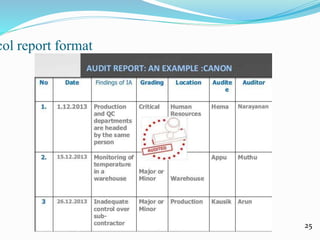
col report format
25
Refference
 Pharmaceutical Dosage forms:Parenteral medication,Revised and
Expanded.Edited by Kenneth E.Avis,Herbert A.libermann and
Leon Lachmann,Volume –3, Second edition ,
Page no:-363-420
 Pharmaceutical Quality group mpnograph no:-5 (revised):
Pharmaceutical Auditing , IQA2001,ISBN 0906810 68X
 Audit Followed up. Retrieved on April 2010. By Electronic
Version. http://www.auditnet.org/process.htm#ixzz0kHSIWg9
(2004) Internal Audit Polices and Procedures Chapter 14.
Electronic Version.
26

Quality audit plan

  • 1.
    Jadhao Pravin H(M.Pharm 1st Year) Department of Quality Assurance School of Pharmacy, SRTMU Nanded Cell No. 9604542553 Email. pjadhao54@gmail.com
  • 2.
    INDEX  Introduction  Reasonsof Quality Auditing  Scope and Objectives  Types of Audit  Audit Planning  Audit Report  Protocol and reports
  • 3.
    INTRODUCTION  Defination:- Quality auditis defined as a systematic and independent examination to determine whether activities and related results comply with planned arrangements and whether these arrangements are implemented effectively and are suitable to achieve objectives.  Quality audit means a systematic examination of a quality system.  Quality audits are typically performed at defined intervals  Any failure in their proper implementation may be published publicly and may lead to a revocation of quality certification 1
  • 4.
    Reasons for qualityauditing: In order to internal:  Determine the level of compliance  Build confidence (hopefully) in GMP and the QA system  Build interdepartmental trust, understanding, and communication (if the audit is done properly and tactfully)  Determine measures necessary to improve, e.g.,:  Premises, equipment, environment  Operations, actions, procedures  Personnel/training  Provide a stimulus for improvement  Recommend corrective action  Monitor improvement 2
  • 5.
     In orderto external :  Establish and monitor capability of supplier or contractor to deliver goods and services that are fit for purpose (and on time, and in the quantity required)  Build mutual confidence  Promote understanding and communication between the parties involved (both sides can learn!)  And in general, as listed for “internal” 3
  • 6.
    Scope and Objectives: To ensure quality of the Product.  To assess effectiveness of QA system.  It permits timely correction of problems.  It established high degree of confidence. 4
  • 7.
    Types of qualityaudit : 1. Internal audit 2. External audit 3. Regulatory audit 4. Product audit 5. Process audit 6. System audit 5
  • 8.
    1. Internal audit(First party) : Purpose of internal audit:  Increase the potential for early identification of regulatory concerns based on FDA interpretations and current compliance focus  Identify compliance deficiency and deviations from industry standards and company requirements  Provide a benchmark of compliance with other companies and regulatory expectations.  Inform management about regulatory risk  Foster continuous improvement and forward quality  Provide a tool by which the company can stay ahead of rapidly increasing regulatory demands 6
  • 9.
    Benefits of internalaudit :  Tells you the health of a quality system  Identify the root of a problem and plan for corrective and preventive actions with timeline  Achieve better allocation of resources  Able to avoid potentially big problem  Continuous improvement 7
  • 10.
    ning of internalaudit system :  In pharmaceutical industry mainly two things required to check, 1. Activites carried out by different departments 2. Documents mainted by these departments Implementing the internal audit system :  Constitution of team  Provide initial training  Fix and audit schedule  Carry out the audit  Report the audit results  Follow up 8
  • 11.
    2. External audit(second party or third party ):  External audits are audits carried out by a company on its vendors or subcontractors.  Furthermore, if work is contracted out, they must ensure that contractors are competent to complete it, in accordance with GMP.  There are also strong business benefits to be derived from performing these audits: - building knowledge and confidence in the partnership arrangement - ensuring that requirements are understood and met - enabling reduction of certain activities (eg. in-house QC testing of starting materials) - reducing the risk of failure 9
  • 12.
    Customer employee audityour company  Your employee audit a company which supplies your company with a product or service. Third Party :  A customer wants an audit of your company but wants your company to pay for it. 10
  • 13.
    3. Regulatory Audit:  These audits are carried out by regulatory bodies against relevant regulations for the manufacture and supply of pharmaceutical products.  National regulatory bodies, such as the Medicines Control Agency (MCA) in the UK and Food and Drug Administration (FDA) in the USA, are statutorily responsible for carrying out such audits.  These audits may be unannounced (MCA currently performs about ten per cent of its UK inspections like this) as manufacturers are expected to be complying with GMP at all times.  Regulatory bodies from other countries in which products are sold may also audit companies (ie FDA audits European manufacturers).  Regulatory inspectors are extensively trained and are 11
  • 14.
     All MCAmedicines inspectors are relevantly qualified and have a minimum of five years' appropriate experience in a manufacturing operation;  Failure to pass a regulatory audit can lead practical experience of GMP and receive to restrictions on (or the withdrawal of) a manufacturing or import/export licence ;  Regulatory audits vary considerably in scope, frequency and duration. Audits by the national regulatory body are likely to be regular and to cover systematically all areas of a facility, over a period of time. 12
  • 15.
    its : An in-depth examination of a particular product to evalute whether it conforms to product specificatiion, performance, standards, and customer requirements. 5.Process Audit :  An analysis of elements of a process and appraisal of completeness, correctness of condition and probable effectiveness. 6.System Audit :  A documented activity perform to verify, by examination and evalution of objective evidence, that applicable elements of the quality system are suitable and have been developed, documented and effectively implemented in accordance with GMP. 13
  • 16.
    AUDIT PLANNING  BEFOREAUDIT  DURING AUDIT  AFTER AUDIT 14
  • 17.
    RE AUDIT  Planwell in advance.  Decide if there are any products or activites that you want to exclude from the audit.  Get to know about your assessor.even witness him auditing another site, if possible.  Know your procedures and where they are located.  Remove all obsolute documentation.  Ensure all uncontrolled documentation that you are working with are properly stamped “uncontrolled” 15
  • 18.
     Do notleaves piles of dacuments around waiting to be processed or filed.  Label all your filing cabinets and files.  Do not leave on view neglected libraeies of catalogues,standards softwares, etc.  Ensures all productive material, is identified by number and status.  Ensure all materials are stored in authorized areas.  Eliminate all unused ,scrap/suspect material from around machine and workstations.  Scrap /non-confirming material must be segregated and clearly identified. 16
  • 19.
     The externalauditors company name and their objectives.  Do not over communicate and make people nervous, the system is being tested not them.  Be prepared for the audit team to spelt up and audit separately.  Have an audit communication center set up.  Do not forget cover all shift patterns.  Remember, it is not good enough to say that youdo a certain thing in the performance your job you must be able to prove it with dacumentation.  Dacument the rationale of the things you do not do dacument in procedures and instrucrion or exclude it from the scope. 17
  • 20.
    AUDIT  Be punctualand courteous.  Make everyone aware that the auditors are likely to ask up to six questions:  What is your quality policy.  Tell me how do you do your job.  Show me wherenn your system it tells you to do this.  Can I see some evidences.  What action do you take if yu have problems.  What training have you received to help you to do this job.  Be honest in your answers. 18
  • 21.
     DO NOTBRAG: They are not customers.you do not have to impress them with the past or future, just what happens now,  Do not volunteer additional information. Just answer the question asked and stop. Do not “ramble on”  Do not use terms like “usually”or “generally. They invite further questions.  Do not fill in space between questions. If there is a gap, let the auditor fill it.  Do not be afraid to say, “I don’t know, but I shall get back to you” 19
  • 22.
     Do notrush or divert the auditors. They are responsible for their own schedule.  Note any non-compliances observed in as much detail as possible.  Do not “point fingers”at someone else in front of the auditors.  Do not challenge or argue to excess. Make your point then stop.  Do not be panic. 20
  • 23.
    T  Do notargue at the exist meeting.it is too late.  Do not rush into hasty corrective action.do it properly.  Remain polite, even if you did not do well.it is not the auditor fault; it is your organization that failed. Shooting the messenger will not change a single thing!` 21
  • 24.
    AUDIT REPORTS  1)Title.The title used is “auditors report to the shareholders”  2)Address. The report is addressed to the company,it stakeholder or board of director.  3)Introductory . Indicating the date and the period covered in examining the financial statements by the auditor.  4)Scope paragraph. What the auditor did in the entire audit process. 22
  • 25.
     5) Opinionparagraph.States the auditor’s conclusion/opinion on the results of audit examination.  6)Auditor’s name  7)Auditor’s address  8)Date of the report 23
  • 26.
    OL:-  Defination:-A systemof rules that explain the correct conduct and procedures to be followed in formal situations.  The data collection protocol is the procedure for executing the above steps of the Plan to collect and record the data. It deals with management and adminstrative issues such as who does what and when. It also includes a plan for monitoring the data as they are collected to ensure quality. 24
  • 27.
  • 28.
    Refference  Pharmaceutical Dosageforms:Parenteral medication,Revised and Expanded.Edited by Kenneth E.Avis,Herbert A.libermann and Leon Lachmann,Volume –3, Second edition , Page no:-363-420  Pharmaceutical Quality group mpnograph no:-5 (revised): Pharmaceutical Auditing , IQA2001,ISBN 0906810 68X  Audit Followed up. Retrieved on April 2010. By Electronic Version. http://www.auditnet.org/process.htm#ixzz0kHSIWg9 (2004) Internal Audit Polices and Procedures Chapter 14. Electronic Version. 26