Internal Auditor
Training
By: Muhammad Zubair
What is Audit..??
• Systematic, independent & documented examin
ation to determine whether activities and related
results comply with planned arrangements and
whether these arrangements are implemented ef
fectively and are suitable to achieve objectives.
Objective of audits..??
• Audits are basic requirement of cGMP and
QMS.
• Pharmaceutical manufacturers commonly use a
udits as an effective mechanism to verify comp
liance with GMP regulation (GMP).
• To evaluate the manufacturer’s Compliance wi
th GMP in all aspects of production and Qualit
y control.
Benefits of Auditing…
• Assure cGMP Compliance
• Detect Potential Problems
• Increased management awareness.
• Reduce Risk of failure
• Identifies improvement opportunities.
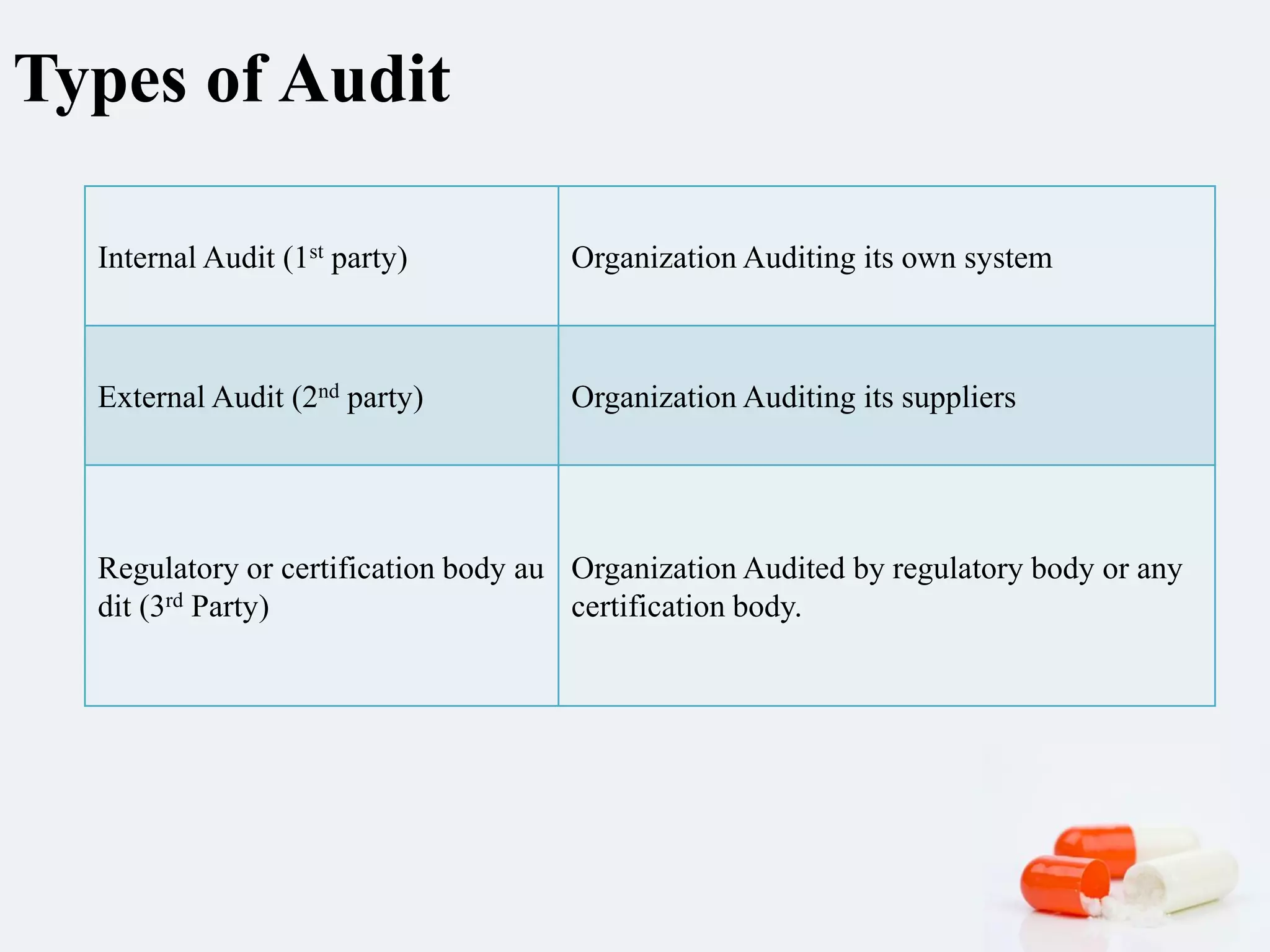
Types of Audit
Internal Audit (1st party) Organization Auditing its own system
External Audit (2nd party) Organization Auditing its suppliers
Regulatory or certification body au
dit (3rd Party)
Organization Audited by regulatory body or any
certification body.
Items of Audit…
• Personnel
• Premises
• Mentainance of buildings and equipment's
• Storage of starting material and finish products
• Equipment
• Production and in-process control
Items of Audit…
• Documentation
• Sanitation & Hygiene
• Validation
• QMS
Principles of Auditing
Ethical Conduct • Trust, Integrity, confidentiality & discretion.
Fair Presentation • Audit finding and conclusion are
Independence
• Auditors are independent of activities being a
udited and are free from bias or conflict of int
erest.
• Conclusion of audit should be objective and e
vidence based only.
Evidence Based Approach
• Audit evidence is based on samples of Inform
ation
• Conclusion are verifiable
Audit Planning
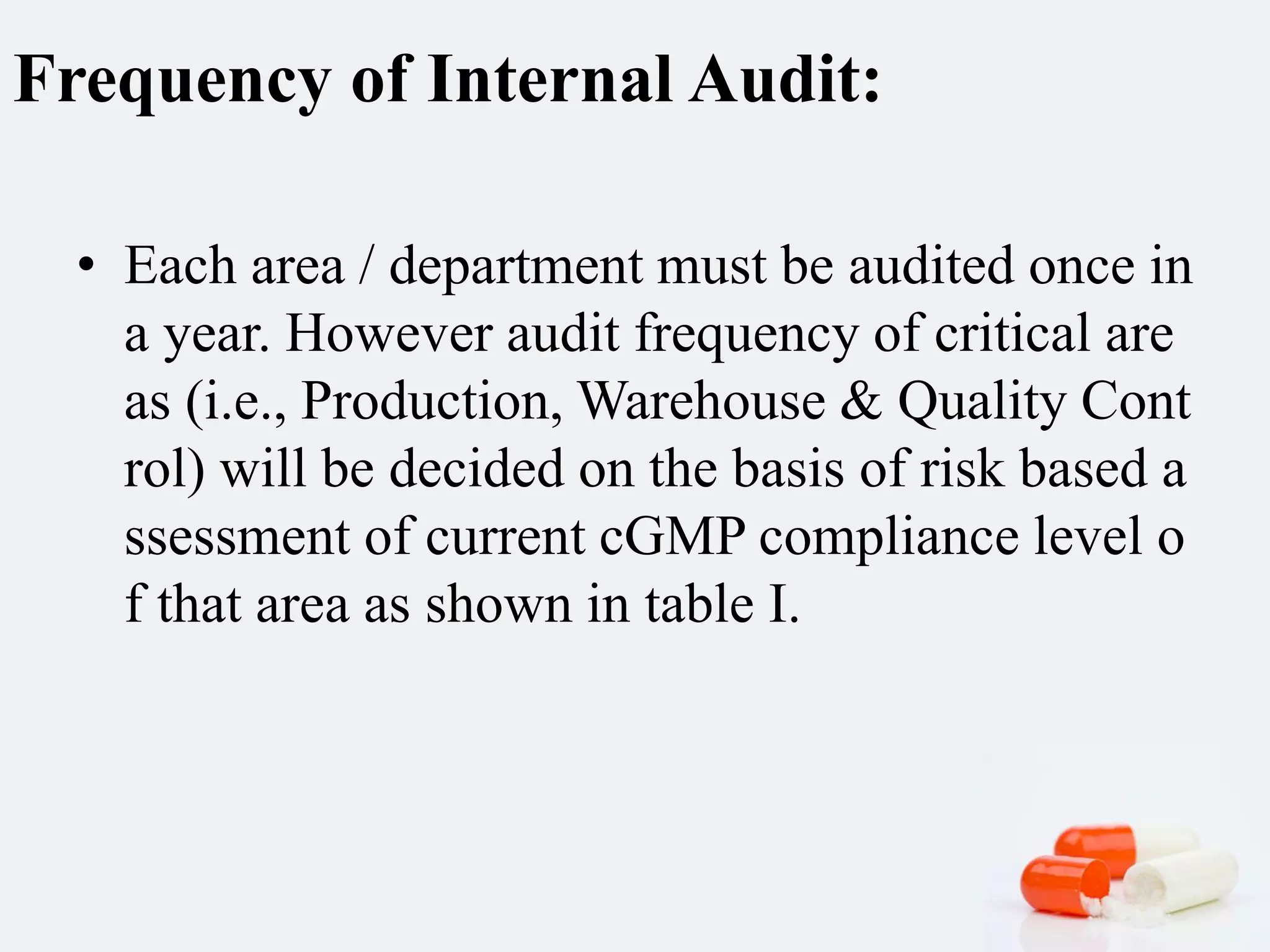
Frequency of Internal Audit:
• Each area / department must be audited once in
a year. However audit frequency of critical are
as (i.e., Production, Warehouse & Quality Cont
rol) will be decided on the basis of risk based a
ssessment of current cGMP compliance level o
f that area as shown in table I.
Frequency of Internal Audit:
Compliance issues Compliance Score
Compliance
Risk
Frequency
≥ 1 critical observations Poor High Quarterly
≥ 5 major observations Poor High Quarterly
2-4 Major Observations Average Medium Biannual
>10 < 25 minor observations Average Medium Biannual
≥ 10minor observations Satisfactory Low Annual
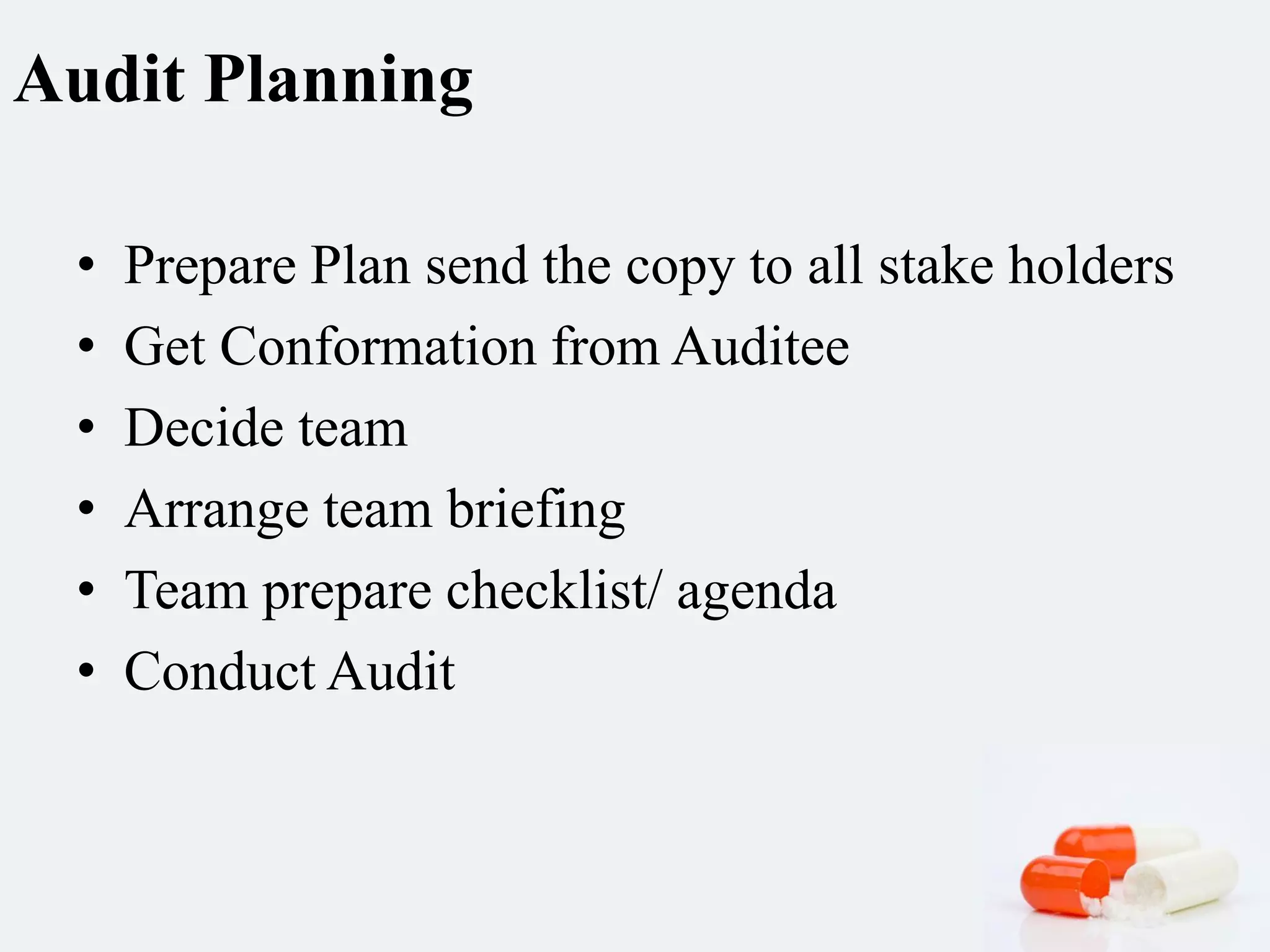
Audit Planning
• Prepare Plan send the copy to all stake holders
• Get Conformation from Auditee
• Decide team
• Arrange team briefing
• Team prepare checklist/ agenda
• Conduct Audit
Selecting Audit Team for Internal Audit
Who Is Internal Auditor…??
A person who has qualification to perform intern
al Audit.
Person Selected as an internal Audit should be.
Free From Bias
Independent of
activity being au
dited
Free from influe
nce
Internal Audit Team..
• Cross functional team is selected to conduct au
dit.
• Individuals in team are selected on basis of
❖Experience and knowledge
❖Familiarization with current guidance and
company's procedures.
• Size of audit team depends upon complexity of
area to be audited
Conducting Audit
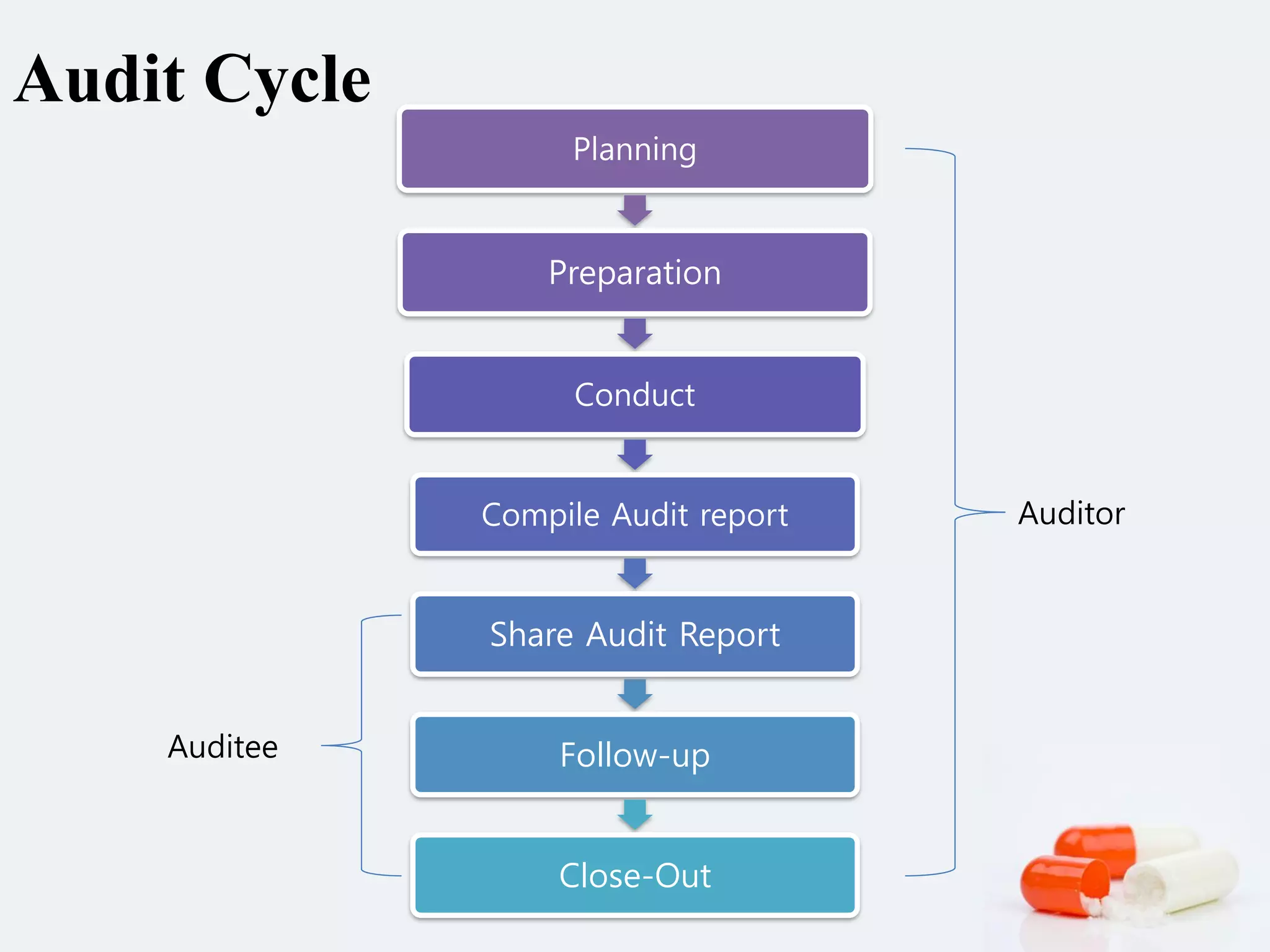
Planning
Preparation
Conduct
Compile Audit report
Share Audit Report
Follow-up
Close-Out
Audit Cycle
Auditor
Auditee
Personal Conduct During Audit….
• Auditor Should have Positive, professional & c
onstructive approach.
• Auditor should be Co-operative, open &honest
.
Audit Do’s…..
• Be prepared for audit
• Be punctual
• Insist on Auditee answering question
• As little talking as possible
• Avoid misunderstanding
• Keep question clear & concise
• Polite & calm
Audit Don’ts…
Do not
• Be side tracked
• Be led or misled
• Get bogged down
• Let Auditee dictate the place
• Make assumption or presumptions
Auditor’s Should…
• Stay within audit scope
• Communicate audit requirement
• Collate objective evidence
• Report audit findings
• Verify effectiveness of corrective actions
• Retain and safeguard documents
During Audit Beware of…
• Aggressive Auditee's
• Timid Auditee's
• Missing People
• Missing Documents
• Pre-pared sample (Choose your own)
• Auditee pretend to be busy
• Emotional Blackmail
Closing Meeting
• Present all findings and evidences carefully &
precisely
• Be prepared to support and justify findings
• Do not be drawn into arguments
• If an error transpires, apologize
• Alter or withdraw if necessary
Post Audit Activities..
• Prepare Audit report
• Write audit observations and categorize these a
s minor, major & critical.
• Write areas of improvement.
• Share compiled audit report to Auditee within
week.
Audit Report…
Should Include
• Agreed Audit agenda
• Audit criteria
• Date and location of audit
• Duration
• Summary of audit findings
Audit Follow Up & Close Out
Follow Up of the Corrective Actions
• To ensure corrective action has prevented any
recurrences
• To determine whether corrective action has be
en effective.
Why follow up
Close Out of Findings…
• Each finding of audit is to be close out individ
ually.
• Ensure that corrective action has addressed the
root cause of findings.
• Not treated symptoms only but prevented recur
rence of nonconformity.
• When auditor is satisfied there is no further ex
ample of nonconformance.
References:
• EU GMP EudraLex Volume 4 (Part I), Chapter 9
• WHO TRS 986, Annex 2
• PICS guideline PE009-13 (Part I), Chapter 9.
• ISO 9001:2015 Quality Management System
• ISO 19011:2011 Auditing Management System
Internal audit training

Internal audit training

  • 1.
  • 2.
    What is Audit..?? •Systematic, independent & documented examin ation to determine whether activities and related results comply with planned arrangements and whether these arrangements are implemented ef fectively and are suitable to achieve objectives.
  • 3.
    Objective of audits..?? •Audits are basic requirement of cGMP and QMS. • Pharmaceutical manufacturers commonly use a udits as an effective mechanism to verify comp liance with GMP regulation (GMP). • To evaluate the manufacturer’s Compliance wi th GMP in all aspects of production and Qualit y control.
  • 4.
    Benefits of Auditing… •Assure cGMP Compliance • Detect Potential Problems • Increased management awareness. • Reduce Risk of failure • Identifies improvement opportunities.
  • 5.
    Types of Audit InternalAudit (1st party) Organization Auditing its own system External Audit (2nd party) Organization Auditing its suppliers Regulatory or certification body au dit (3rd Party) Organization Audited by regulatory body or any certification body.
  • 6.
    Items of Audit… •Personnel • Premises • Mentainance of buildings and equipment's • Storage of starting material and finish products • Equipment • Production and in-process control
  • 7.
    Items of Audit… •Documentation • Sanitation & Hygiene • Validation • QMS
  • 8.
    Principles of Auditing EthicalConduct • Trust, Integrity, confidentiality & discretion. Fair Presentation • Audit finding and conclusion are Independence • Auditors are independent of activities being a udited and are free from bias or conflict of int erest. • Conclusion of audit should be objective and e vidence based only. Evidence Based Approach • Audit evidence is based on samples of Inform ation • Conclusion are verifiable
  • 9.
  • 10.
    Frequency of InternalAudit: • Each area / department must be audited once in a year. However audit frequency of critical are as (i.e., Production, Warehouse & Quality Cont rol) will be decided on the basis of risk based a ssessment of current cGMP compliance level o f that area as shown in table I.
  • 11.
    Frequency of InternalAudit: Compliance issues Compliance Score Compliance Risk Frequency ≥ 1 critical observations Poor High Quarterly ≥ 5 major observations Poor High Quarterly 2-4 Major Observations Average Medium Biannual >10 < 25 minor observations Average Medium Biannual ≥ 10minor observations Satisfactory Low Annual
  • 12.
    Audit Planning • PreparePlan send the copy to all stake holders • Get Conformation from Auditee • Decide team • Arrange team briefing • Team prepare checklist/ agenda • Conduct Audit
  • 13.
    Selecting Audit Teamfor Internal Audit
  • 14.
    Who Is InternalAuditor…?? A person who has qualification to perform intern al Audit. Person Selected as an internal Audit should be. Free From Bias Independent of activity being au dited Free from influe nce
  • 15.
    Internal Audit Team.. •Cross functional team is selected to conduct au dit. • Individuals in team are selected on basis of ❖Experience and knowledge ❖Familiarization with current guidance and company's procedures. • Size of audit team depends upon complexity of area to be audited
  • 16.
  • 17.
    Planning Preparation Conduct Compile Audit report ShareAudit Report Follow-up Close-Out Audit Cycle Auditor Auditee
  • 18.
    Personal Conduct DuringAudit…. • Auditor Should have Positive, professional & c onstructive approach. • Auditor should be Co-operative, open &honest .
  • 19.
    Audit Do’s….. • Beprepared for audit • Be punctual • Insist on Auditee answering question • As little talking as possible • Avoid misunderstanding • Keep question clear & concise • Polite & calm
  • 20.
    Audit Don’ts… Do not •Be side tracked • Be led or misled • Get bogged down • Let Auditee dictate the place • Make assumption or presumptions
  • 21.
    Auditor’s Should… • Staywithin audit scope • Communicate audit requirement • Collate objective evidence • Report audit findings • Verify effectiveness of corrective actions • Retain and safeguard documents
  • 22.
    During Audit Bewareof… • Aggressive Auditee's • Timid Auditee's • Missing People • Missing Documents • Pre-pared sample (Choose your own) • Auditee pretend to be busy • Emotional Blackmail
  • 23.
    Closing Meeting • Presentall findings and evidences carefully & precisely • Be prepared to support and justify findings • Do not be drawn into arguments • If an error transpires, apologize • Alter or withdraw if necessary
  • 24.
    Post Audit Activities.. •Prepare Audit report • Write audit observations and categorize these a s minor, major & critical. • Write areas of improvement. • Share compiled audit report to Auditee within week.
  • 25.
    Audit Report… Should Include •Agreed Audit agenda • Audit criteria • Date and location of audit • Duration • Summary of audit findings
  • 26.
    Audit Follow Up& Close Out
  • 27.
    Follow Up ofthe Corrective Actions • To ensure corrective action has prevented any recurrences • To determine whether corrective action has be en effective. Why follow up
  • 28.
    Close Out ofFindings… • Each finding of audit is to be close out individ ually. • Ensure that corrective action has addressed the root cause of findings. • Not treated symptoms only but prevented recur rence of nonconformity. • When auditor is satisfied there is no further ex ample of nonconformance.
  • 29.
    References: • EU GMPEudraLex Volume 4 (Part I), Chapter 9 • WHO TRS 986, Annex 2 • PICS guideline PE009-13 (Part I), Chapter 9. • ISO 9001:2015 Quality Management System • ISO 19011:2011 Auditing Management System